A
Seminar
For
Education for the physically and the
Cognitively Challenged
On Topic
Nature, Objective and Evaluation of
Inclusive and Exclusive Education
BY:-Aastha Bhatia
Educationalist
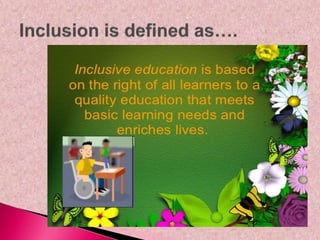
 Inclusive education implies all young learners, young
people-with or without disabilities being able to learn
together through access to common pre-schools and
schools with an appropriate network of support
services.
 Inclusive education refers to the placement and
education of children with disabilities in regular
education classroom with children of the same age who
do not have disabilities.
 Process of bringing exceptional children into the
general classroom for their education.
 Understanding inclusion as a continuing process.
 Encouraging the participation of all students,
teachers and parents.
 Gives a message :
“Everyone belongs to school.
Everyone is welcome to the school”.
 Making the curriculum flexible according to the needs
of the disabled ,while keeping the objectives of
education the same for all children.
 Providing support for the teachers as well the students.
 10% of what we read
 20% of what we hear
 30% of what we see
 50% of what we both see and hear
 70% of what is discussed
 95% of what we teach someone else.
William Glaser
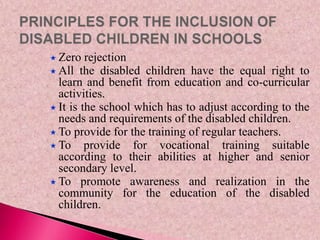
 Zero rejection
 All the disabled children have the equal right to
learn and benefit from education and co-curricular
activities.
 It is the school which has to adjust according to the
needs and requirements of the disabled children.
 To provide for the training of regular teachers.
 To provide for vocational training suitable
according to their abilities at higher and senior
secondary level.
 To promote awareness and realization in the
community for the education of the disabled
children.
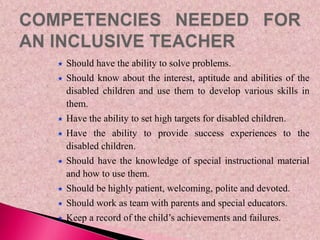
 Should have the ability to solve problems.
 Should know about the interest, aptitude and abilities of the
disabled children and use them to develop various skills in
them.
 Have the ability to set high targets for disabled children.
 Have the ability to provide success experiences to the
disabled children.
 Should have the knowledge of special instructional material
and how to use them.
 Should be highly patient, welcoming, polite and devoted.
 Should work as team with parents and special educators.
 Keep a record of the child’s achievements and failures.
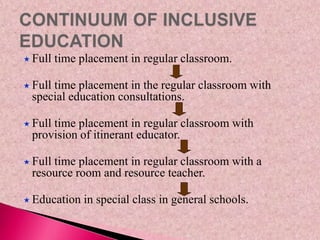
 Full time placement in regular classroom.
 Full time placement in the regular classroom with
special education consultations.
 Full time placement in regular classroom with
provision of itinerant educator.
 Full time placement in regular classroom with a
resource room and resource teacher.
 Education in special class in general schools.
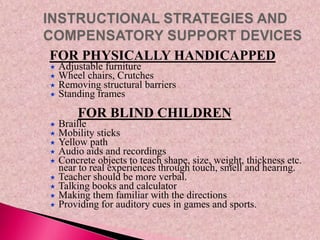
FOR PHYSICALLY HANDICAPPED
 Adjustable furniture
 Wheel chairs, Crutches
 Removing structural barriers
 Standing frames
FOR BLIND CHILDREN
 Braille
 Mobility sticks
 Yellow path
 Audio aids and recordings
 Concrete objects to teach shape, size, weight, thickness etc.
near to real experiences through touch, smell and hearing.
 Teacher should be more verbal.
 Talking books and calculator
 Making them familiar with the directions
 Providing for auditory cues in games and sports.
FOR HEARING IMPAIRED:
 Hearing aid
 Action oriented situations like dramatization for
teaching emotional concepts.
 Use of visual aids like transparencies, chalk board, flash
cards, handouts of classroom instructions
 Lip reading.
 Placing the child in the front row.
 Providing for speech trainer
FOR MENTALLY RETARDED (slow learners):
 Concrete objects for teaching different concepts real life
like situations
 Making repetitions.
 Activity based learning rather than seat based learning.
 Limit the distractions as much as possible
 Providing the content in easy language with a lot
pictures
FOR GIFTED CHILDREN
 Skipping the classes at Primary Level.
 Receiving some instructions at a Higher Level with
another group of students.
 At secondary level special courses can be organized
like-foreign languages, college level course.
 Modification of the content by increasing its
complexity and by bringing novelty.
 Personal &emotional adjustment
 Placement
 Social integration
 Intellectual growth
 Vocational adjustment
 Mass mobilization
 Fulfillment of educational needs
 inclusive and exclusive education

inclusive and exclusive education

  • 1.
    A Seminar For Education for thephysically and the Cognitively Challenged On Topic Nature, Objective and Evaluation of Inclusive and Exclusive Education BY:-Aastha Bhatia Educationalist
  • 2.
     Inclusive educationimplies all young learners, young people-with or without disabilities being able to learn together through access to common pre-schools and schools with an appropriate network of support services.  Inclusive education refers to the placement and education of children with disabilities in regular education classroom with children of the same age who do not have disabilities.
  • 4.
     Process ofbringing exceptional children into the general classroom for their education.  Understanding inclusion as a continuing process.  Encouraging the participation of all students, teachers and parents.  Gives a message : “Everyone belongs to school. Everyone is welcome to the school”.
  • 5.
     Making thecurriculum flexible according to the needs of the disabled ,while keeping the objectives of education the same for all children.  Providing support for the teachers as well the students.
  • 7.
     10% ofwhat we read  20% of what we hear  30% of what we see  50% of what we both see and hear  70% of what is discussed  95% of what we teach someone else. William Glaser
  • 8.
     Zero rejection All the disabled children have the equal right to learn and benefit from education and co-curricular activities.  It is the school which has to adjust according to the needs and requirements of the disabled children.  To provide for the training of regular teachers.  To provide for vocational training suitable according to their abilities at higher and senior secondary level.  To promote awareness and realization in the community for the education of the disabled children.
  • 9.
     Should havethe ability to solve problems.  Should know about the interest, aptitude and abilities of the disabled children and use them to develop various skills in them.  Have the ability to set high targets for disabled children.  Have the ability to provide success experiences to the disabled children.  Should have the knowledge of special instructional material and how to use them.  Should be highly patient, welcoming, polite and devoted.  Should work as team with parents and special educators.  Keep a record of the child’s achievements and failures.
  • 10.
     Full timeplacement in regular classroom.  Full time placement in the regular classroom with special education consultations.  Full time placement in regular classroom with provision of itinerant educator.  Full time placement in regular classroom with a resource room and resource teacher.  Education in special class in general schools.
  • 11.
    FOR PHYSICALLY HANDICAPPED Adjustable furniture  Wheel chairs, Crutches  Removing structural barriers  Standing frames FOR BLIND CHILDREN  Braille  Mobility sticks  Yellow path  Audio aids and recordings  Concrete objects to teach shape, size, weight, thickness etc. near to real experiences through touch, smell and hearing.  Teacher should be more verbal.  Talking books and calculator  Making them familiar with the directions  Providing for auditory cues in games and sports.
  • 12.
    FOR HEARING IMPAIRED: Hearing aid  Action oriented situations like dramatization for teaching emotional concepts.  Use of visual aids like transparencies, chalk board, flash cards, handouts of classroom instructions  Lip reading.  Placing the child in the front row.  Providing for speech trainer FOR MENTALLY RETARDED (slow learners):  Concrete objects for teaching different concepts real life like situations  Making repetitions.  Activity based learning rather than seat based learning.  Limit the distractions as much as possible  Providing the content in easy language with a lot pictures
  • 13.
    FOR GIFTED CHILDREN Skipping the classes at Primary Level.  Receiving some instructions at a Higher Level with another group of students.  At secondary level special courses can be organized like-foreign languages, college level course.  Modification of the content by increasing its complexity and by bringing novelty.
  • 14.
     Personal &emotionaladjustment  Placement  Social integration  Intellectual growth  Vocational adjustment  Mass mobilization  Fulfillment of educational needs