ENTERPRENEURSHIP
AND
EDUCATION
By:
Mrs. Aastha Bhatia
Definition of Entrepreneurship
.
Entrepreneurship refers to an individual’s ability to turn
ideas into action
It includes
 creativity,
 innovation and
 risk taking,
 as well as the ability to plan and manage projects
in order to achieve objectives.
objectives.
 supports everyone in day-to-day life at home and in society,
 makes employees more aware of the context of their work
and better able to seize opportunities,
 and provides a foundation for entrepreneurs establishing a
social or commercial activity
Education
The education system has therefore an important role to
play in stimulating attitudes and behaviour which
promote creativity, self confidence and an understanding
of risk.
It is also important to portray the running of one’s own
business as a possible career option
This must take place through long term work in both
primary and secondary levels.
It is therefore necessary to continue to develop the
capability and the tools to meet these goals .
What is entrepreneurship
education?
Entrepreneurship education seeks to
provide students with the knowledge,
skills and motivation to encourage
entrepreneurial success in a variety of
settings.
Entrepreneurship education should vary
according to the level of schooling, from
primary or secondary schools through
graduate university programmes.
The Ministry of Finance, the Economy and Investment is
launching a scheme whereby it will be making available
funds which can be availed of by education institutions to
finance the development or procurement of projects /
programmes as well as their implementation with the aim of
promoting entrepreneurial qualities and delivering
entrepreneurial experiences at the primary and secondary
level.
Development of Teachers’ competence:
Teachers are important role models. A positive
attitude among young people in schools toward
entrepreneurship, innovation and reorientation
requires that teachers have knowledge and ideally
also experience of this.
It is therefore important to focus on including
the entrepreneurship aspect in teacher training,
and also provide courses in competence
development to working teachers.
What type of Projects?
Raising students’ awareness of self-
employment and entrepreneurship as possible
career options
Work on practical enterprise projects and
activities (e.g. students running mini-
companies)
Providing specific business skills and
knowledge of how to start and successfully
run a company.
High Level Reflection Panels on
Entrepreneurship Education
Two key needs:
1) Increase co-operation between government
administrations – especially those responsible
for education and enterprise - and with
stakeholders on entrepreneurship education;
2) Develop more systematic strategies for
entrepreneurship education.
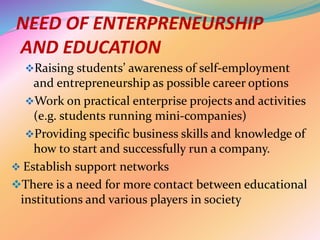
NEED OF ENTERPRENEURSHIP
AND EDUCATION
Raising students’ awareness of self-employment
and entrepreneurship as possible career options
Work on practical enterprise projects and activities
(e.g. students running mini-companies)
Providing specific business skills and knowledge of
how to start and successfully run a company.
 Establish support networks
There is a need for more contact between educational
institutions and various players in society
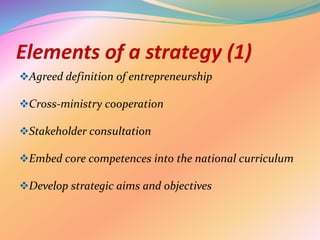
Elements of a strategy (1)
Agreed definition of entrepreneurship
Cross-ministry cooperation
Stakeholder consultation
Embed core competences into the national curriculum
Develop strategic aims and objectives
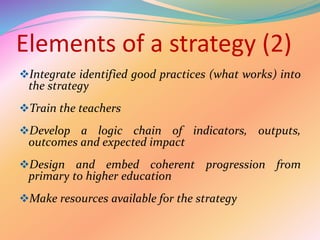
Elements of a strategy (2)
Integrate identified good practices (what works) into
the strategy
Train the teachers
Develop a logic chain of indicators, outputs,
outcomes and expected impact
Design and embed coherent progression from
primary to higher education
Make resources available for the strategy
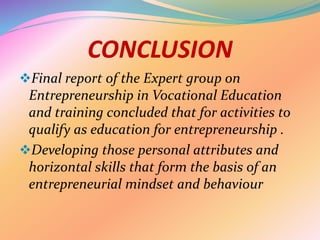
CONCLUSION
Final report of the Expert group on
Entrepreneurship in Vocational Education
and training concluded that for activities to
qualify as education for entrepreneurship .
Developing those personal attributes and
horizontal skills that form the basis of an
entrepreneurial mindset and behaviour
THANK YOU
Is there any question?
Mention it in the comment
section……..

Enterprenure and education

  • 1.
  • 2.
    Definition of Entrepreneurship . Entrepreneurshiprefers to an individual’s ability to turn ideas into action It includes  creativity,  innovation and  risk taking,  as well as the ability to plan and manage projects in order to achieve objectives. objectives.  supports everyone in day-to-day life at home and in society,  makes employees more aware of the context of their work and better able to seize opportunities,  and provides a foundation for entrepreneurs establishing a social or commercial activity
  • 3.
    Education The education systemhas therefore an important role to play in stimulating attitudes and behaviour which promote creativity, self confidence and an understanding of risk. It is also important to portray the running of one’s own business as a possible career option This must take place through long term work in both primary and secondary levels. It is therefore necessary to continue to develop the capability and the tools to meet these goals .
  • 4.
    What is entrepreneurship education? Entrepreneurshipeducation seeks to provide students with the knowledge, skills and motivation to encourage entrepreneurial success in a variety of settings. Entrepreneurship education should vary according to the level of schooling, from primary or secondary schools through graduate university programmes.
  • 5.
    The Ministry ofFinance, the Economy and Investment is launching a scheme whereby it will be making available funds which can be availed of by education institutions to finance the development or procurement of projects / programmes as well as their implementation with the aim of promoting entrepreneurial qualities and delivering entrepreneurial experiences at the primary and secondary level.
  • 6.
    Development of Teachers’competence: Teachers are important role models. A positive attitude among young people in schools toward entrepreneurship, innovation and reorientation requires that teachers have knowledge and ideally also experience of this. It is therefore important to focus on including the entrepreneurship aspect in teacher training, and also provide courses in competence development to working teachers. What type of Projects?
  • 7.
    Raising students’ awarenessof self- employment and entrepreneurship as possible career options Work on practical enterprise projects and activities (e.g. students running mini- companies) Providing specific business skills and knowledge of how to start and successfully run a company.
  • 8.
    High Level ReflectionPanels on Entrepreneurship Education Two key needs: 1) Increase co-operation between government administrations – especially those responsible for education and enterprise - and with stakeholders on entrepreneurship education; 2) Develop more systematic strategies for entrepreneurship education.
  • 9.
    NEED OF ENTERPRENEURSHIP ANDEDUCATION Raising students’ awareness of self-employment and entrepreneurship as possible career options Work on practical enterprise projects and activities (e.g. students running mini-companies) Providing specific business skills and knowledge of how to start and successfully run a company.  Establish support networks There is a need for more contact between educational institutions and various players in society
  • 10.
    Elements of astrategy (1) Agreed definition of entrepreneurship Cross-ministry cooperation Stakeholder consultation Embed core competences into the national curriculum Develop strategic aims and objectives
  • 11.
    Elements of astrategy (2) Integrate identified good practices (what works) into the strategy Train the teachers Develop a logic chain of indicators, outputs, outcomes and expected impact Design and embed coherent progression from primary to higher education Make resources available for the strategy
  • 12.
    CONCLUSION Final report ofthe Expert group on Entrepreneurship in Vocational Education and training concluded that for activities to qualify as education for entrepreneurship . Developing those personal attributes and horizontal skills that form the basis of an entrepreneurial mindset and behaviour
  • 13.
    THANK YOU Is thereany question? Mention it in the comment section……..