4.2SAMPLING
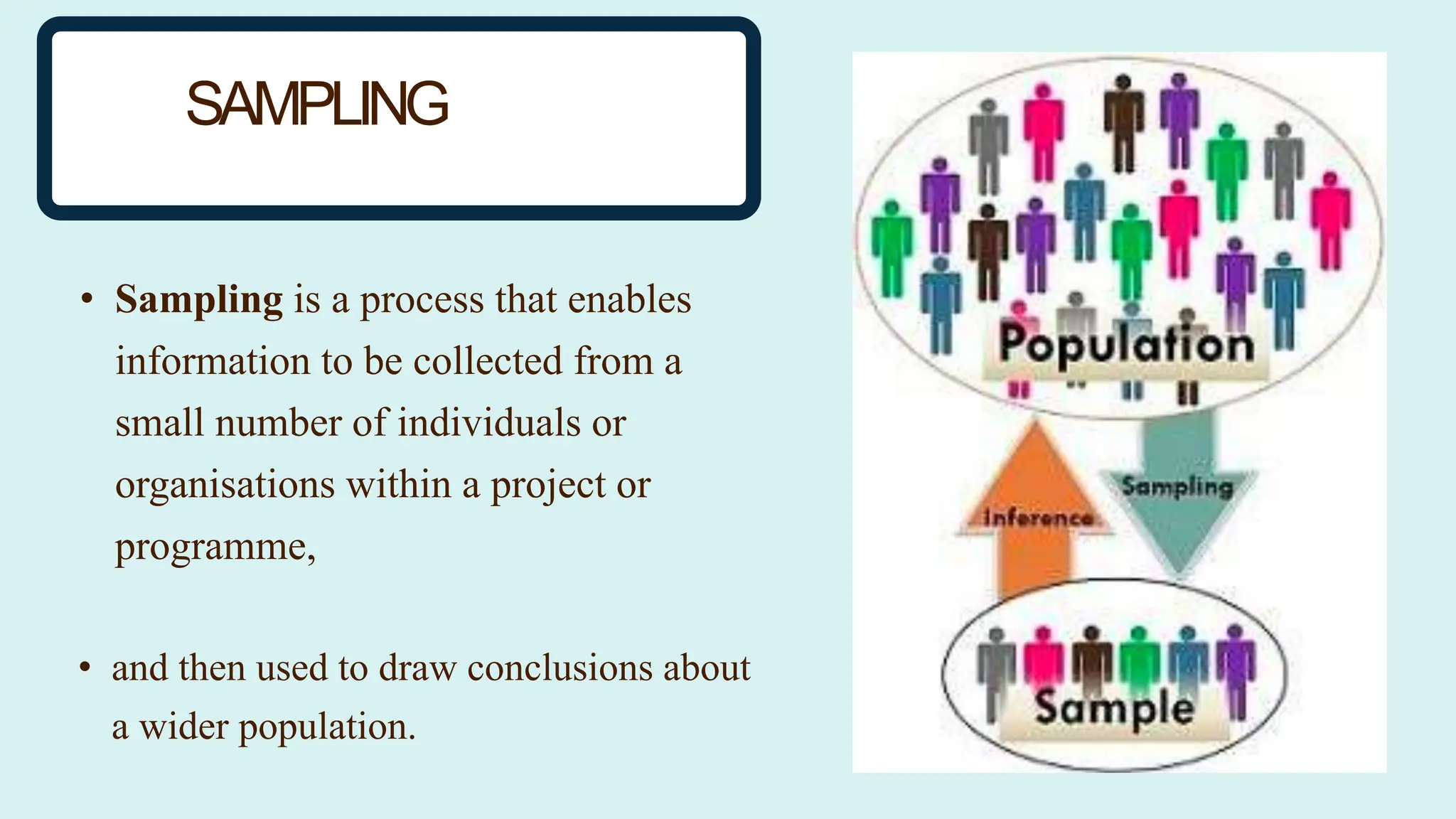
• Sampling is a process that enables
information to be collected from a
small number of individuals or
organisations within a project or
programme,
• and then used to draw conclusions about
a wider population.
SAMPLING
Probability sampling refers to
the selection of a sample from a
population, when this selection
is based on the principle of
randomization, that is, random
selection or chance.
Non-probability sampling is a
method in which not all population
members have an equal chance of
participating in the study, unlike
probability sampling.
typesofsampling
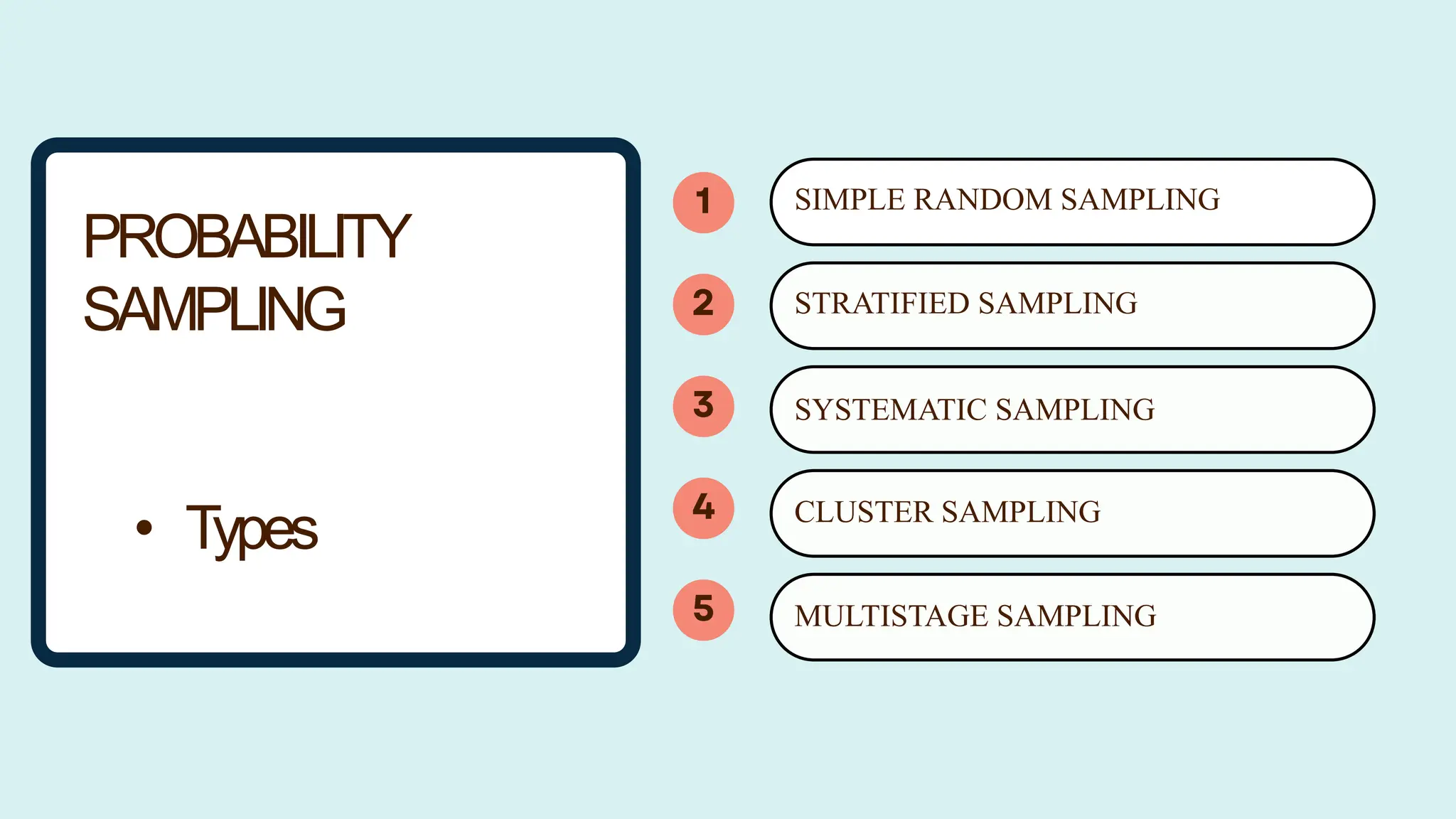
SIMPLE RANDOM SAMPLING
STRATIFIED SAMPLING
CLUSTER SAMPLING
SYSTEMATIC SAMPLING
MULTISTAGE SAMPLING
PROBABILITY
SAMPLING
• Types
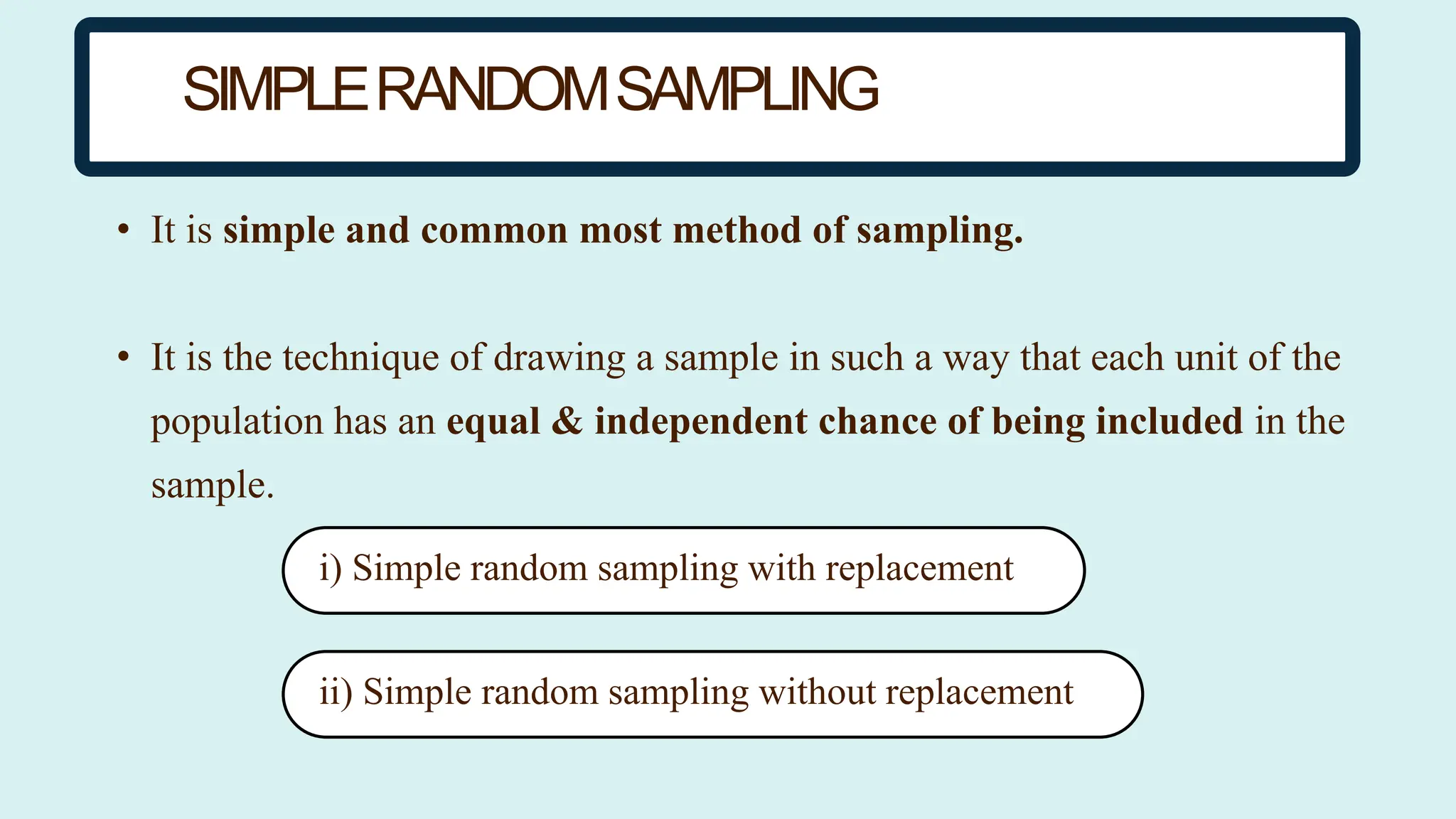
• It is simple and common most method of sampling.
• It is the technique of drawing a sample in such a way that each unit of the
population has an equal & independent chance of being included in the
sample.
i
ii)
Simple
rando
m
sampli
ng
without
ii)
Simple
rando
without
replace
ment
i)
Simple
rando
m
sampli
ng
without
replace
ment
ii) Simple random sampling without replacement
i) Simple random sampling with replacement
SIMPLERANDOMSAMPLING
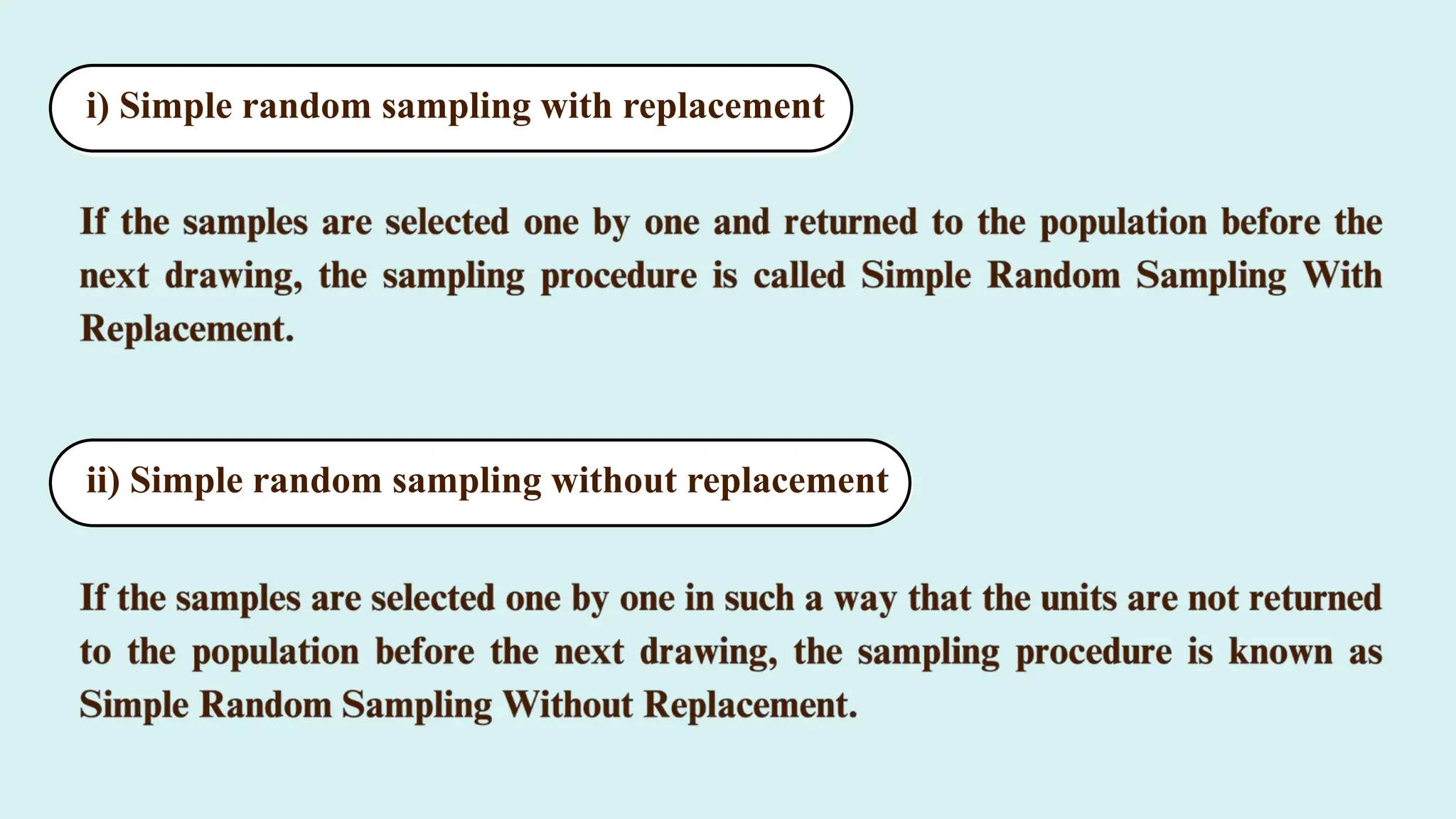
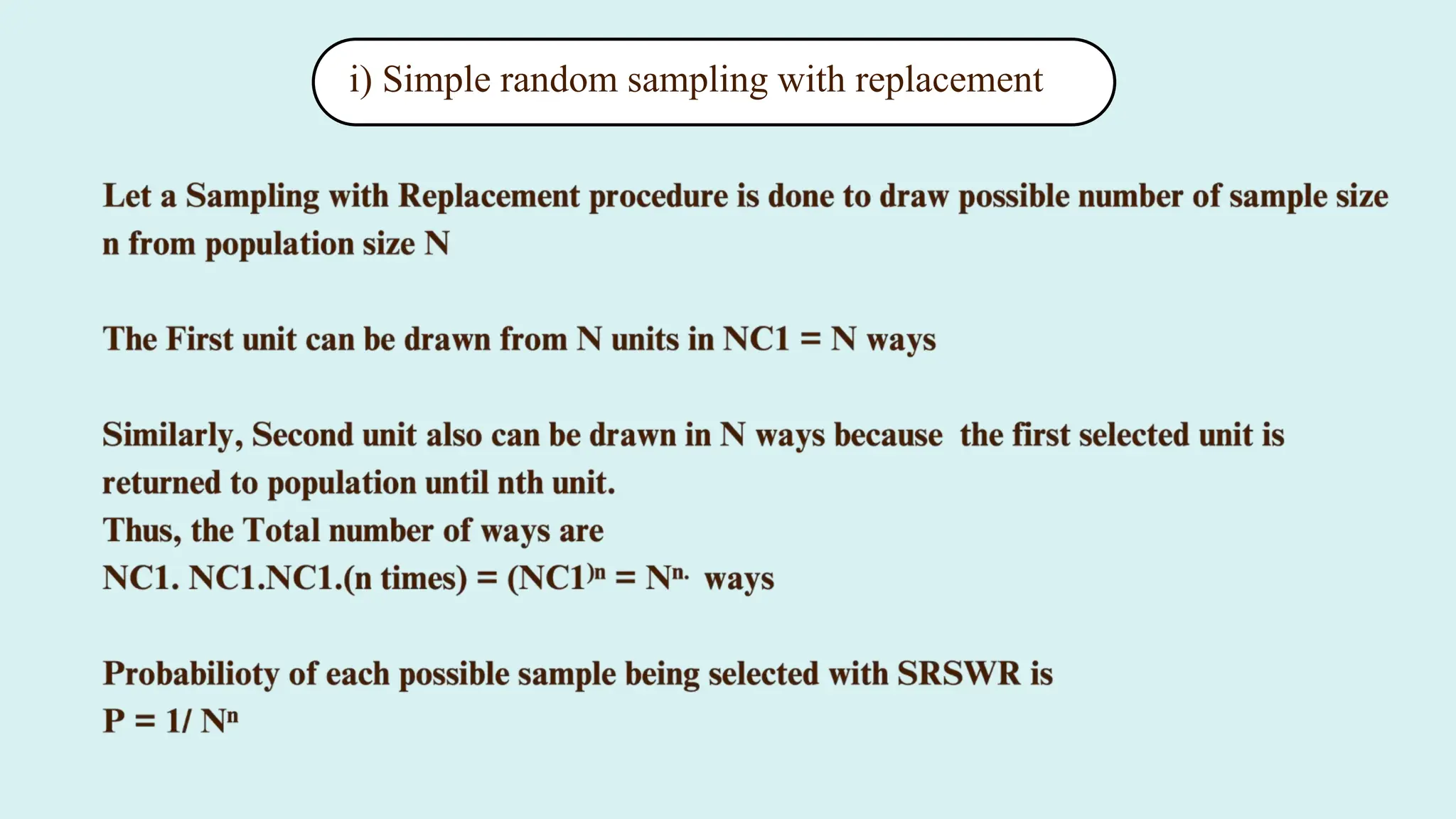
i) Simple random sampling with replacement
i
ii)
Simple
rando
m
sampli
ng
without
ii)
Simple
rando
without
replace
ment
i)
Simple
rando
m
sampli
ng
without
replace
ment
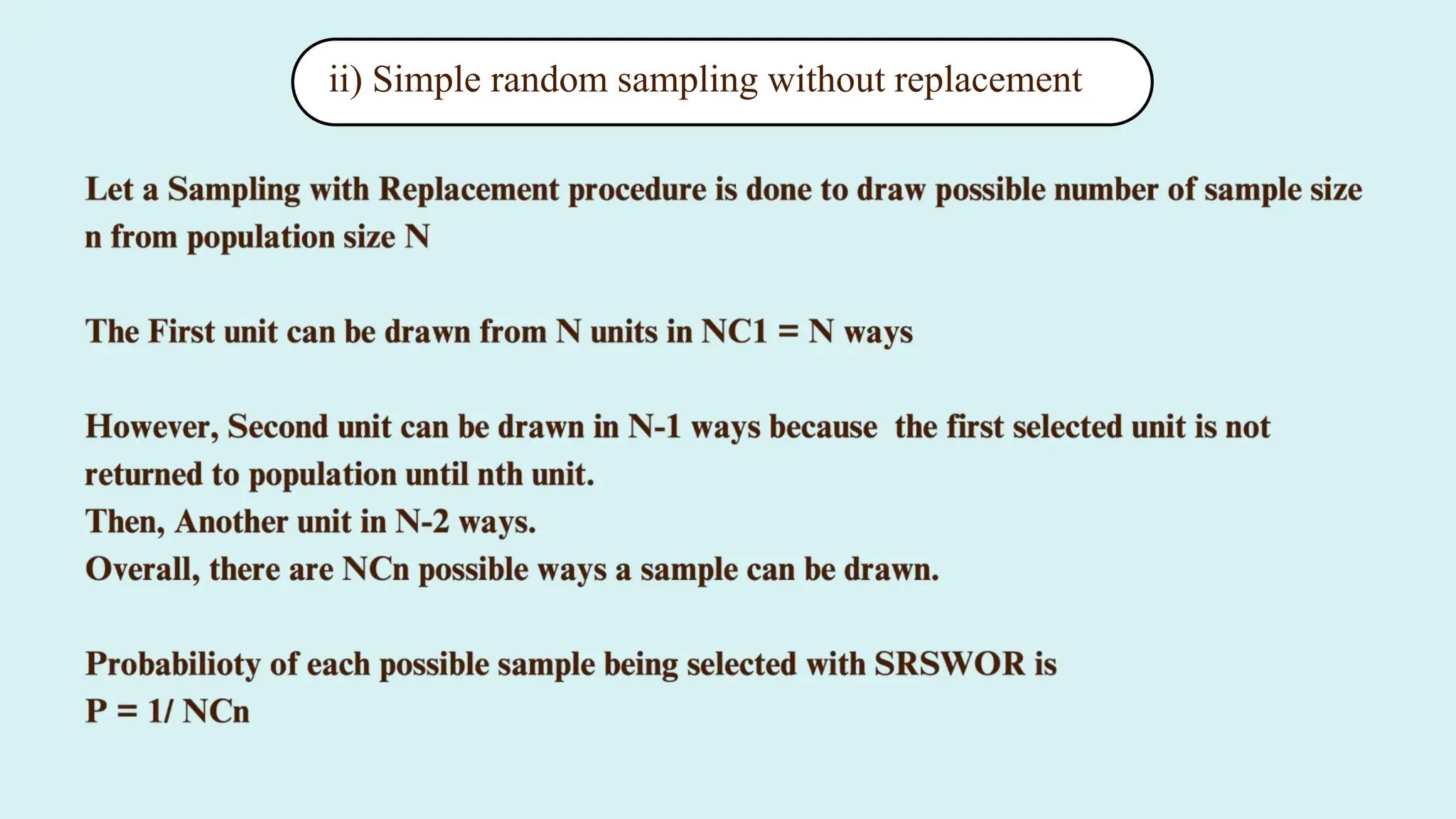
ii) Simple random sampling without replacement
i) Simple random sampling with replacement
i
ii)
Simple
rando
m
sampli
ng
without
ii)
Simple
rando
without
replace
ment
i)
Simple
rando
m
sampli
ng
without
replace
ment
ii) Simple random sampling without replacement
i
ii)
Simple
random
sampling
without
ii)
Simple
rando
without
replaceme
nt
i)
Simple
random
sampling
without
replaceme
nt
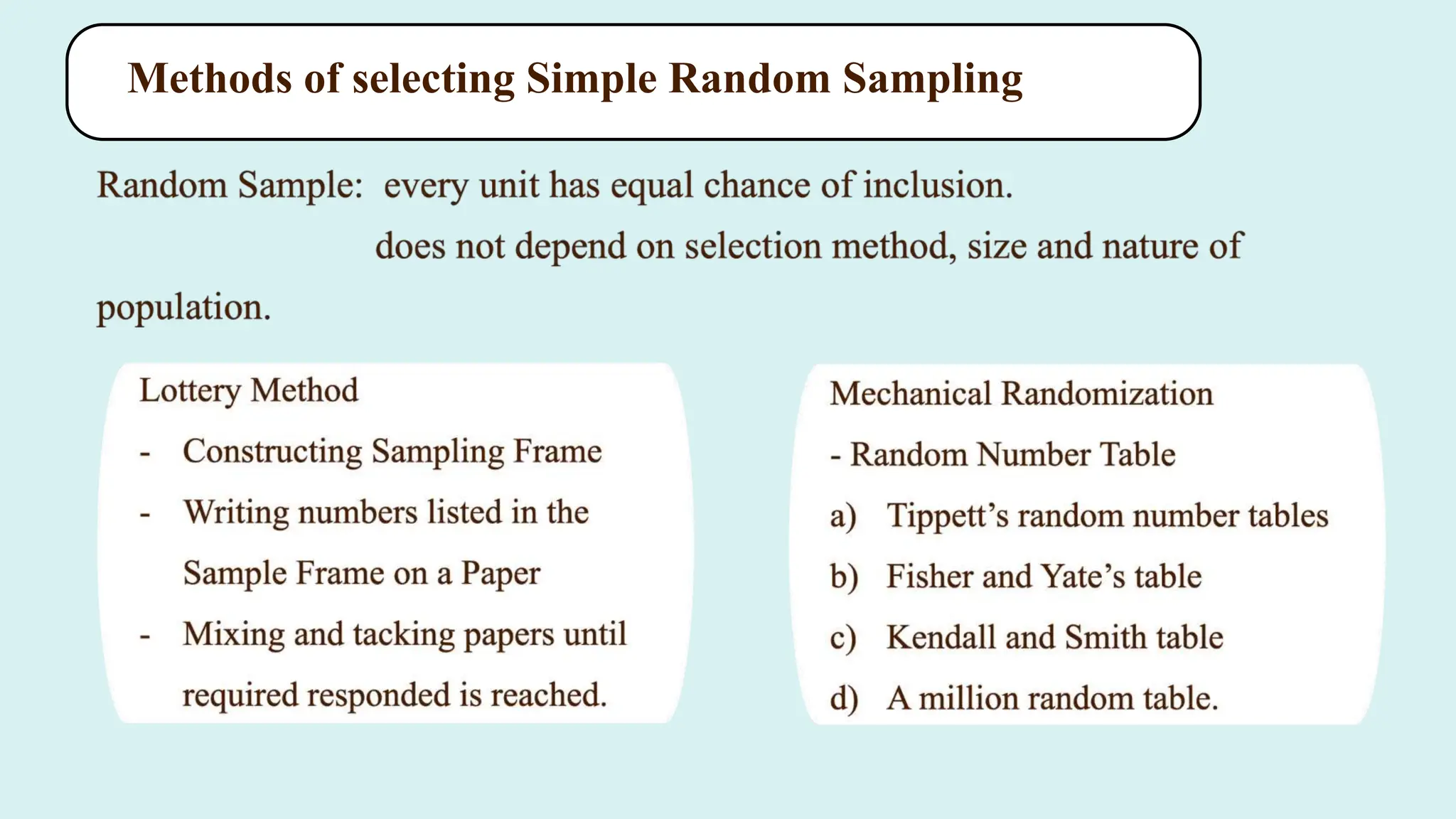
Methods of selecting Simple Random Sampling
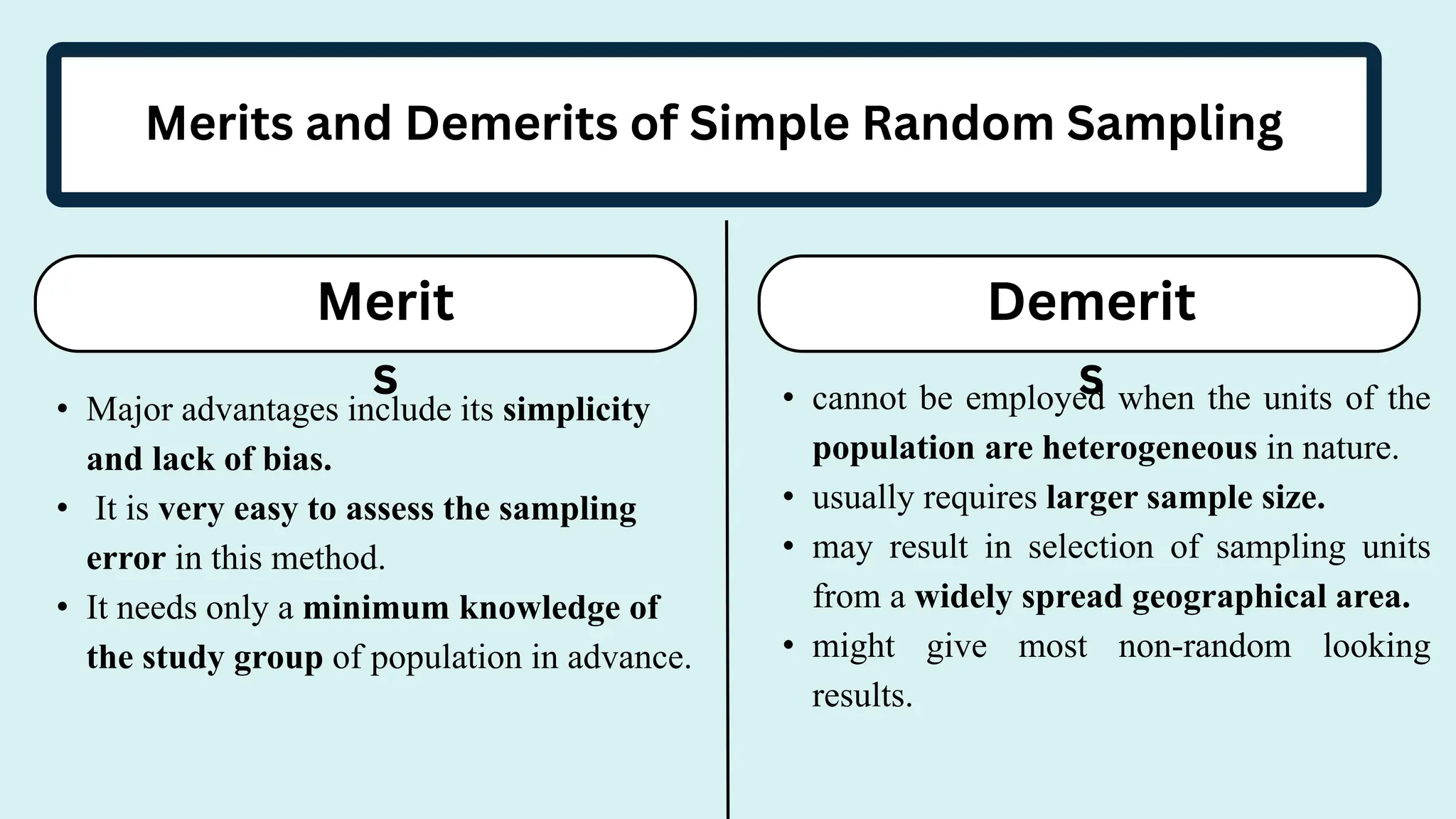
Merits and Demerits of Simple Random Sampling
Merit
s
Demerit
s
• Major advantages include its simplicity
and lack of bias.
• It is very easy to assess the sampling
error in this method.
• It needs only a minimum knowledge of
the study group of population in advance.
• cannot be employed when the units of the
population are heterogeneous in nature.
• usually requires larger sample size.
• may result in selection of sampling units
from a widely spread geographical area.
• might give most non-random looking
results.
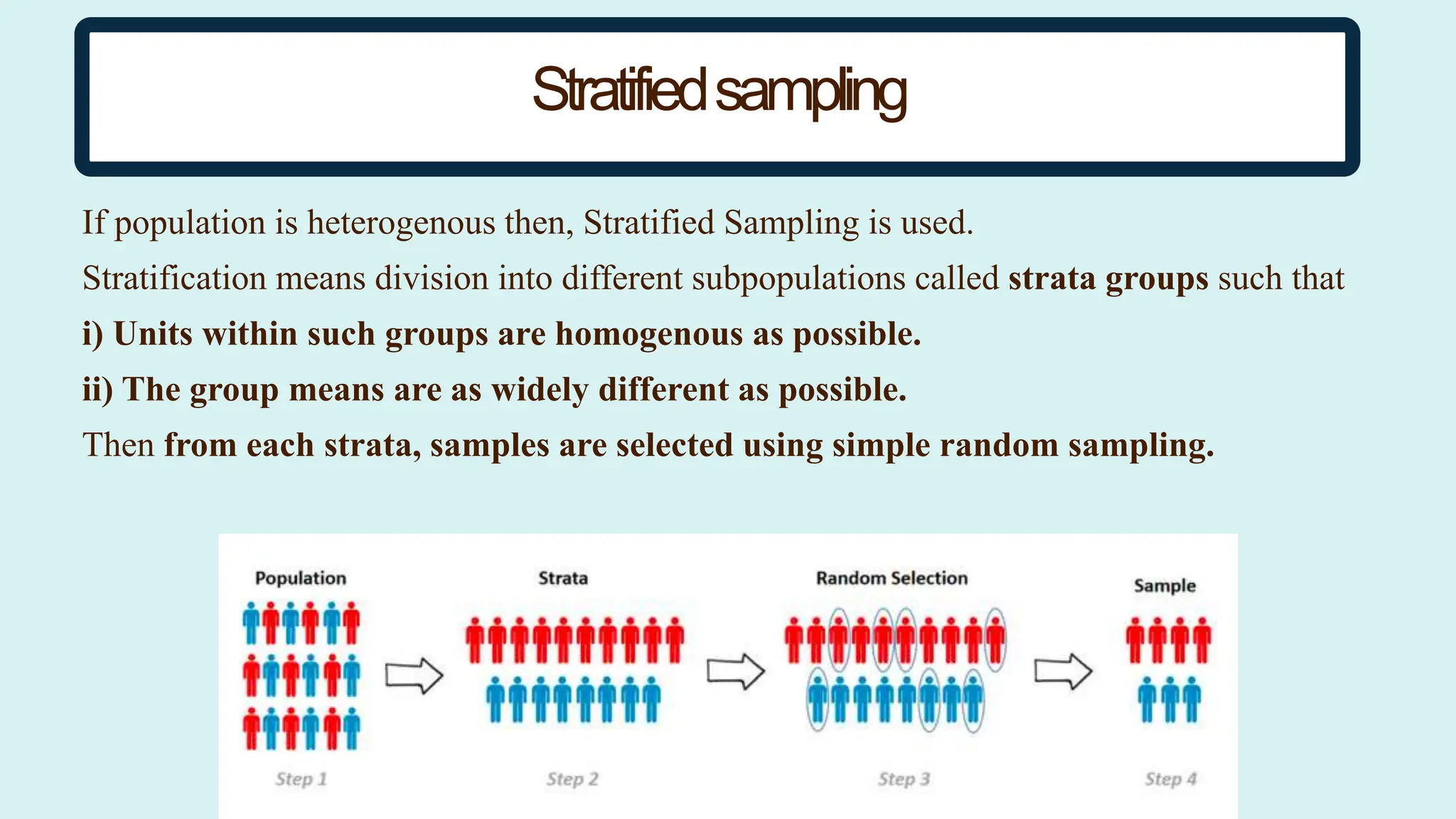
If population is heterogenous then, Stratified Sampling is used.
Stratification means division into different subpopulations called strata groups such that
i) Units within such groups are homogenous as possible.
ii) The group means are as widely different as possible.
Then from each strata, samples are selected using simple random sampling.
Stratifiedsampling
Purpose of Stratification
i) To make more representative:
Stratification ensures desired representation in the sample of the various groups of
population.
Possibility of essential groups being included and provide more efficient system of
sampling
ii) Greater Accuracy:
increased accuracy at a given cost.
enable obtaining the results of known precision of each groups.
iii) Administrative convenience:
concentrate geographically.
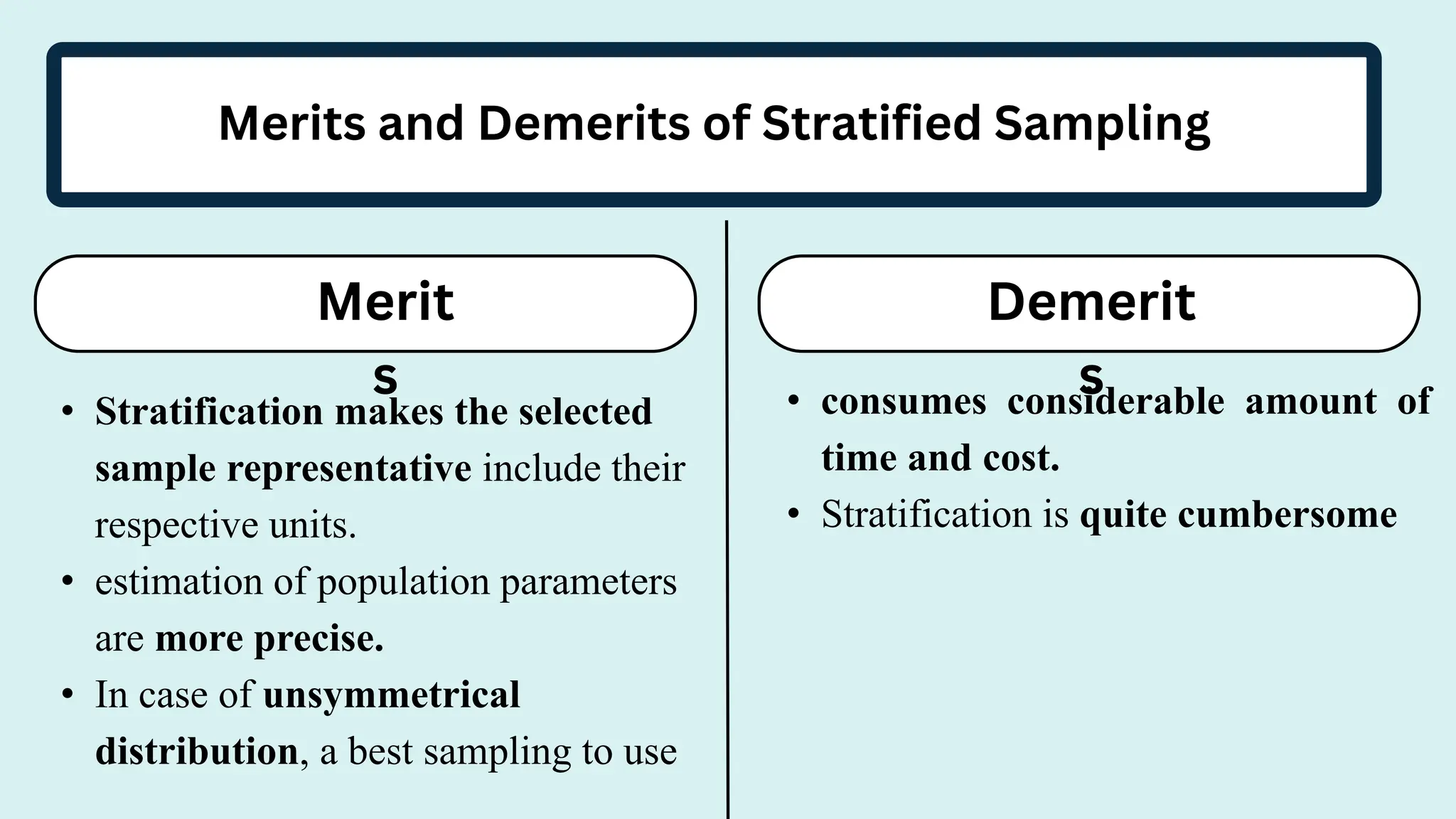
Merits and Demerits of Stratified Sampling
Merit
s
Demerit
s
• Stratification makes the selected
sample representative include their
respective units.
• estimation of population parameters
are more precise.
• In case of unsymmetrical
distribution, a best sampling to use
• consumes considerable amount of
time and cost.
• Stratification is quite cumbersome
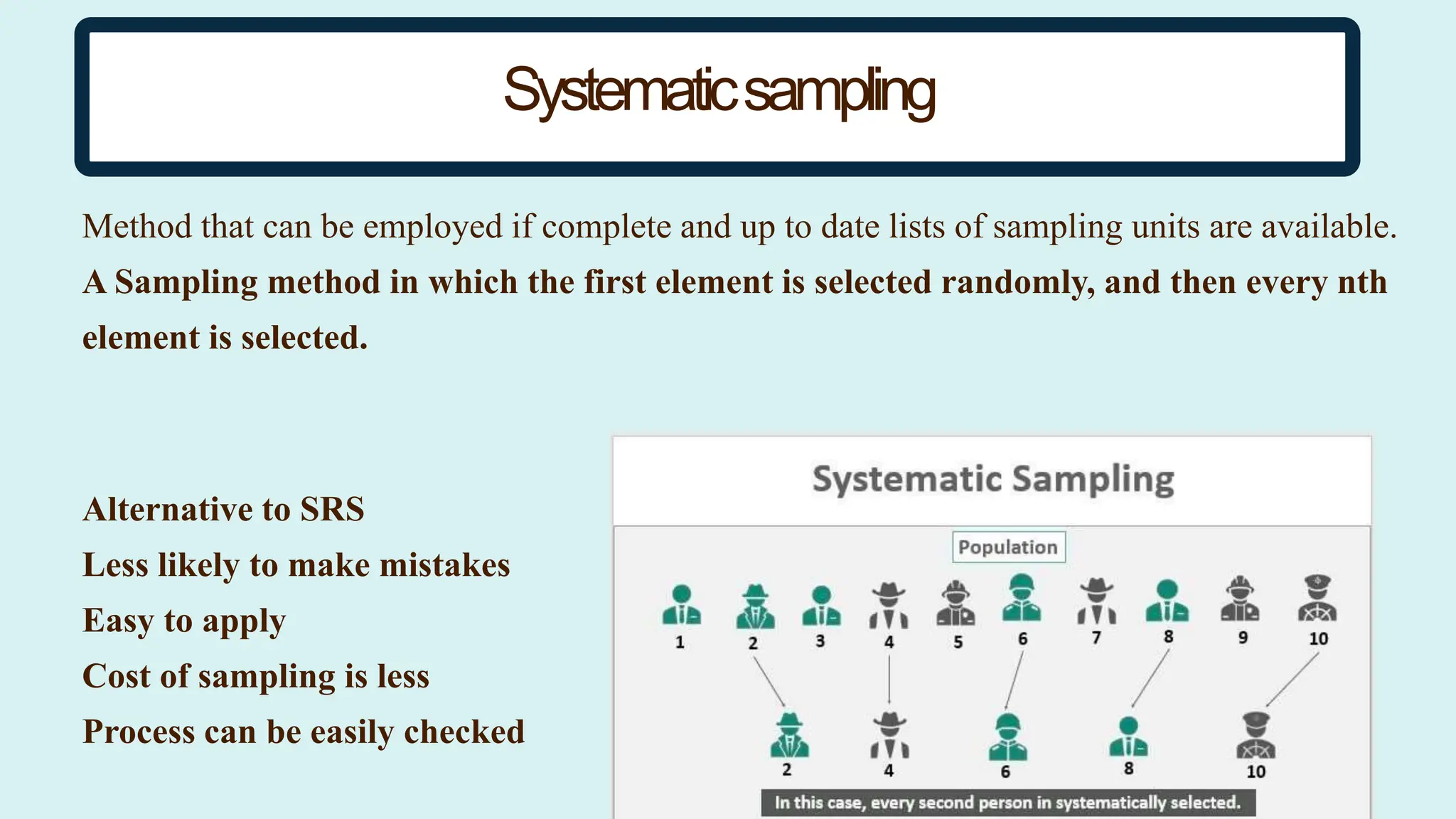
Systematicsampling
Method that can be employed if complete and up to date lists of sampling units are available.
A Sampling method in which the first element is selected randomly, and then every nth
element is selected.
Alternative to SRS
Less likely to make mistakes
Easy to apply
Cost of sampling is less
Process can be easily checked
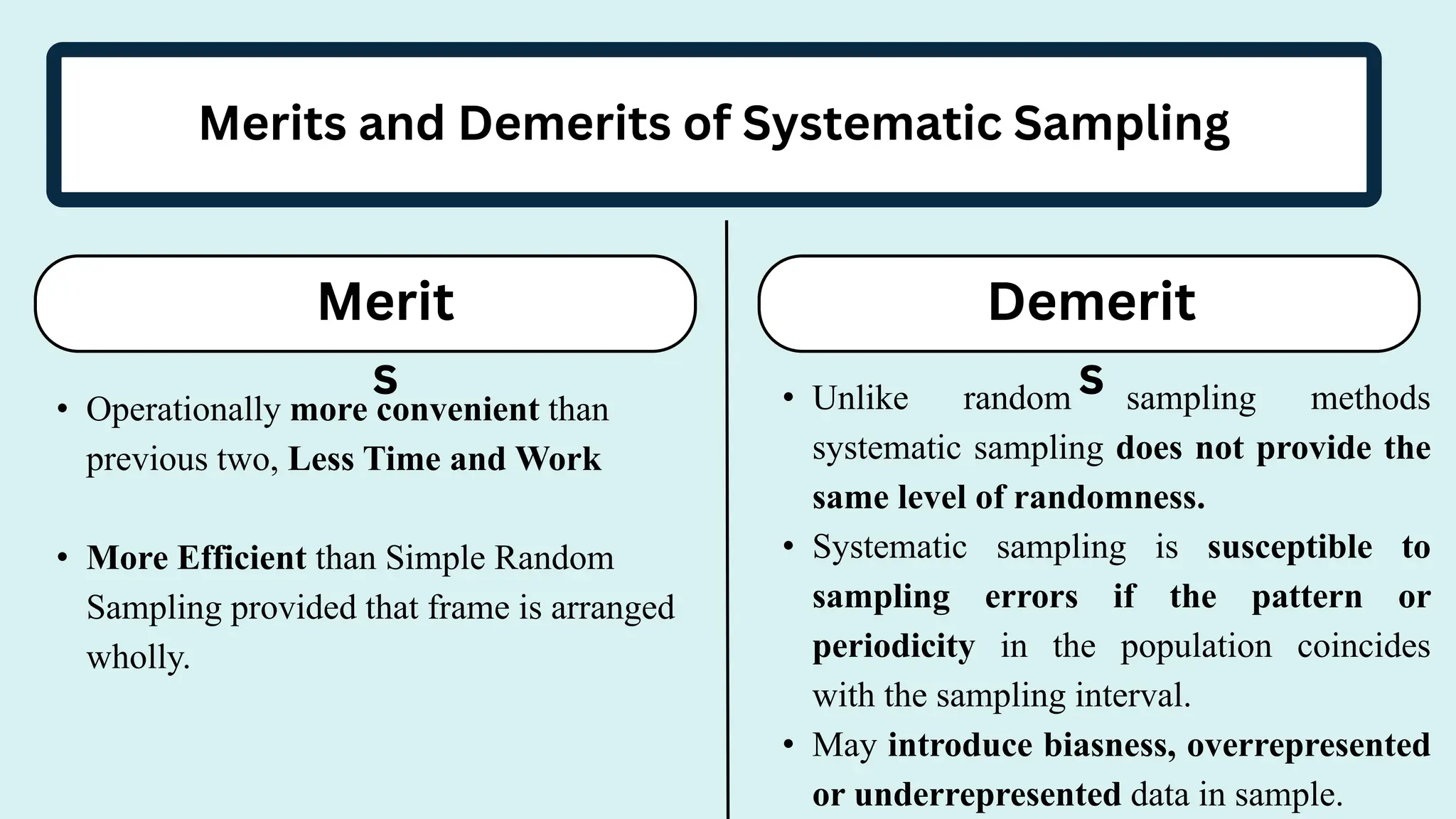
Merits and Demerits of Systematic Sampling
Merit
s
Demerit
s
• Operationally more convenient than
previous two, Less Time and Work
• More Efficient than Simple Random
Sampling provided that frame is arranged
wholly.
• Unlike random sampling methods
systematic sampling does not provide the
same level of randomness.
• Systematic sampling is susceptible to
sampling errors if the pattern or
periodicity in the population coincides
with the sampling interval.
• May introduce biasness, overrepresented
or underrepresented data in sample.
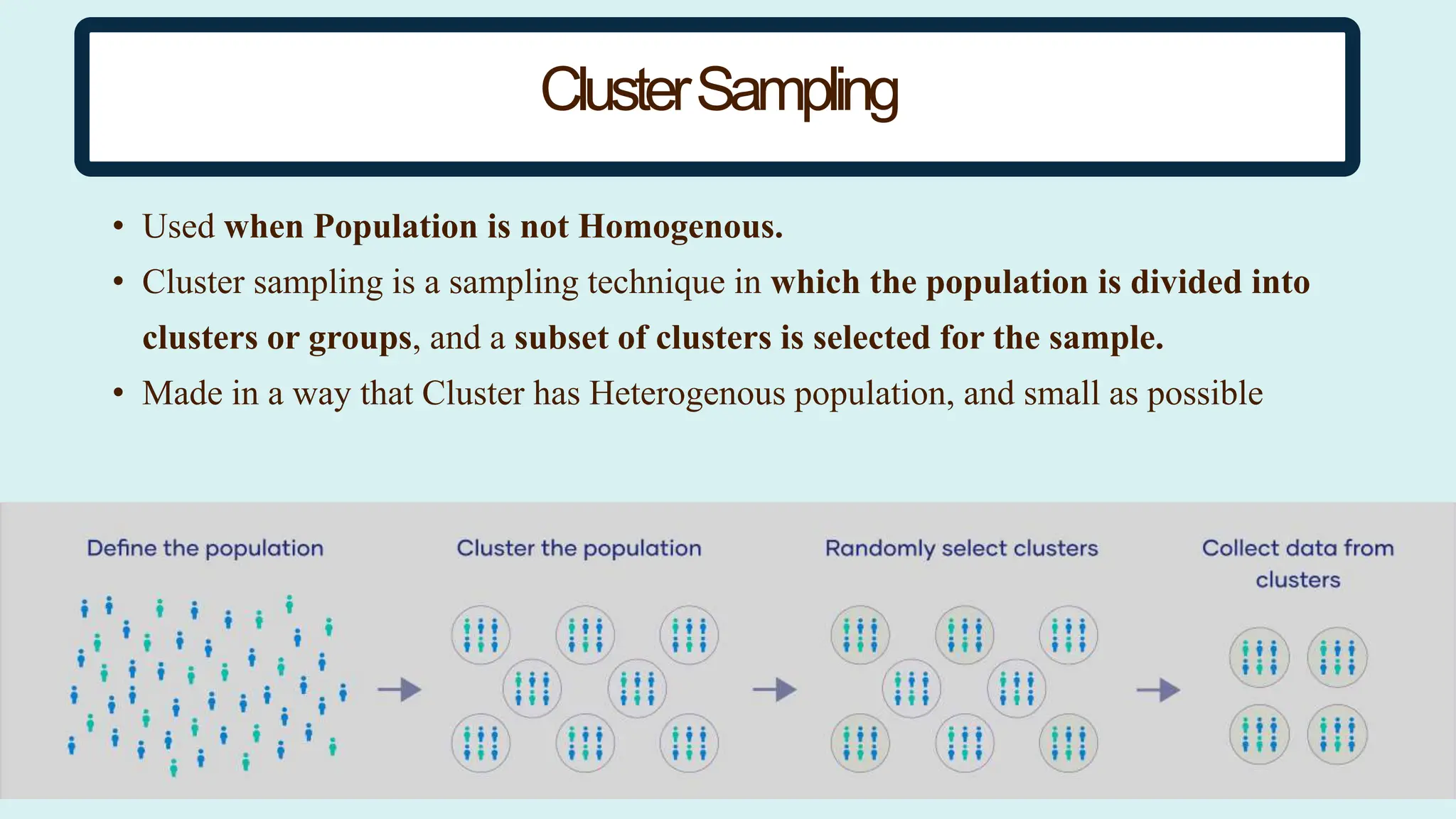
ClusterSampling
• Used when Population is not Homogenous.
• Cluster sampling is a sampling technique in which the population is divided into
clusters or groups, and a subset of clusters is selected for the sample.
• Made in a way that Cluster has Heterogenous population, and small as possible
Merits and Demerits of Cluster Sampling
Merit
s
Demerit
s
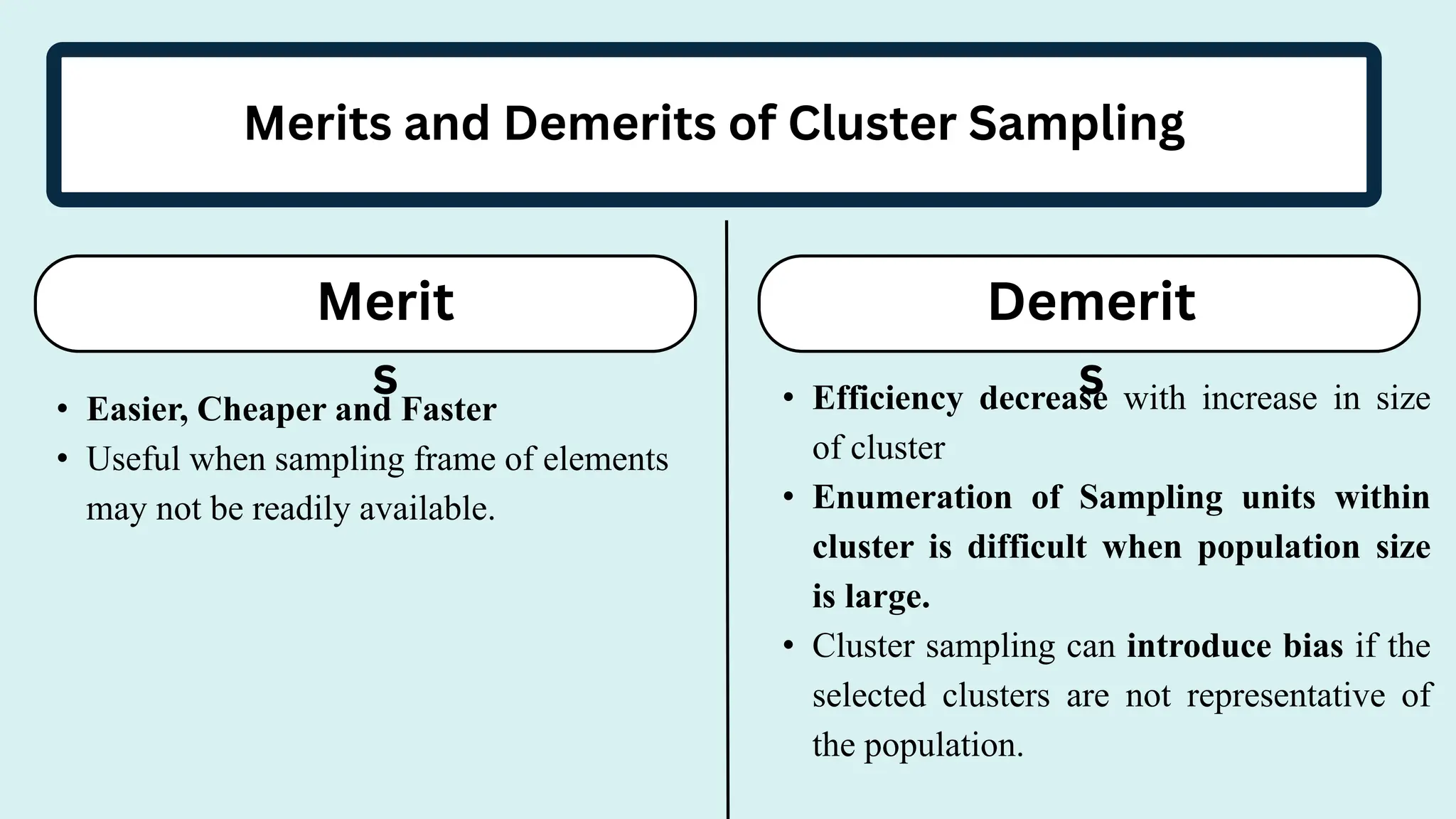
• Easier, Cheaper and Faster
• Useful when sampling frame of elements
may not be readily available.
• Efficiency decrease with increase in size
of cluster
• Enumeration of Sampling units within
cluster is difficult when population size
is large.
• Cluster sampling can introduce bias if the
selected clusters are not representative of
the population.
multistagesampling
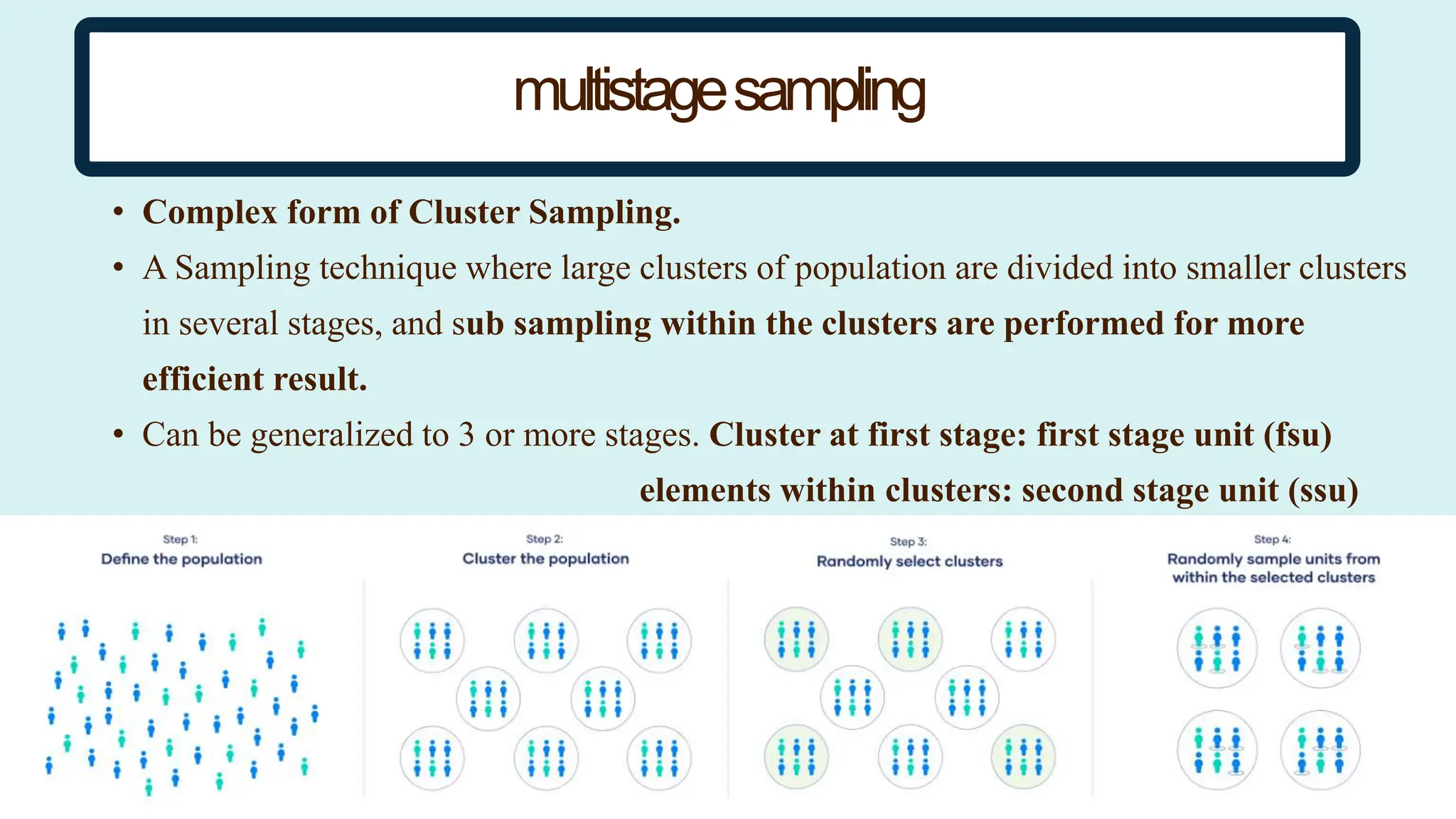
• Complex form of Cluster Sampling.
• A Sampling technique where large clusters of population are divided into smaller clusters
in several stages, and sub sampling within the clusters are performed for more
efficient result.
• Can be generalized to 3 or more stages. Cluster at first stage: first stage unit (fsu)
elements within clusters: second stage unit (ssu)
Merits and Demerits of Multistage Sampling
Merit
s
Demerit
s
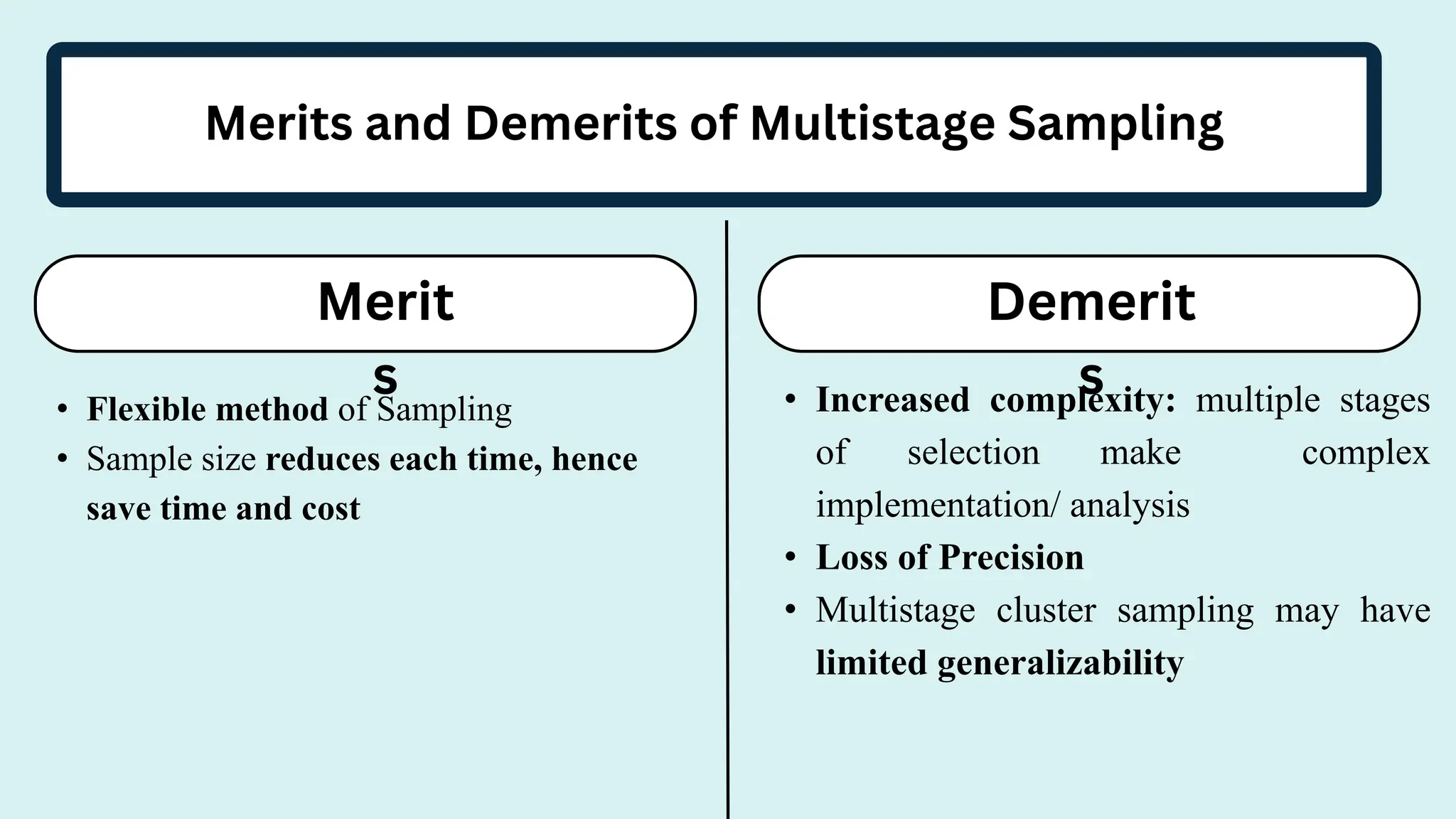
• Flexible method of Sampling
• Sample size reduces each time, hence
save time and cost
• Increased complexity: multiple stages
of selection make complex
implementation/ analysis
• Loss of Precision
• Multistage cluster sampling may have
limited generalizability
Non Probability Sampling
• Sampling technique; samples selection process does not
give all the individuals in population equal chances of being
selected.
• Selection of sample depends upon judgement of
investigator.
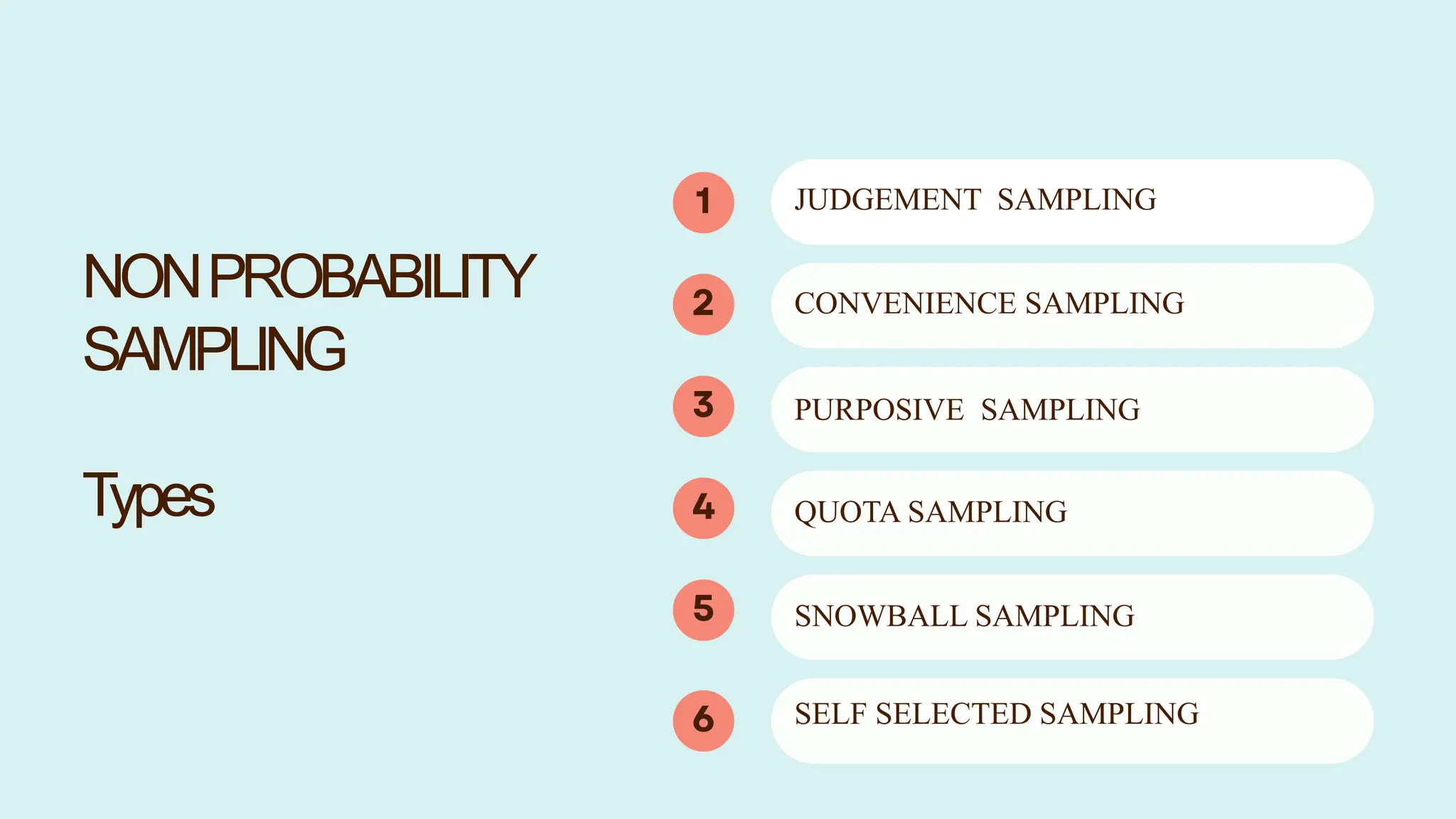
NONPROBABILITY
SAMPLING
Types
JUDGEMENT SAMPLING
CONVENIENCE SAMPLING
QUOTA SAMPLING
PURPOSIVE SAMPLING
SNOWBALL SAMPLING
SELF SELECTED SAMPLING
• Sample units selected according to personal judgement of
researcher.
• May include only those units in sample from population
which are most appropriate for the study.
• Sound judgement during sampling implicates representative
sample.
• Helps to save time and money
Judgement
Sampling
MERITS
• Simple method
• Applicable for quick decision
for urgent need
• Better for small sampling size
Judgement
Sampling
DEMERITS
• May not be representative of
the population for particular
study.
• Biased
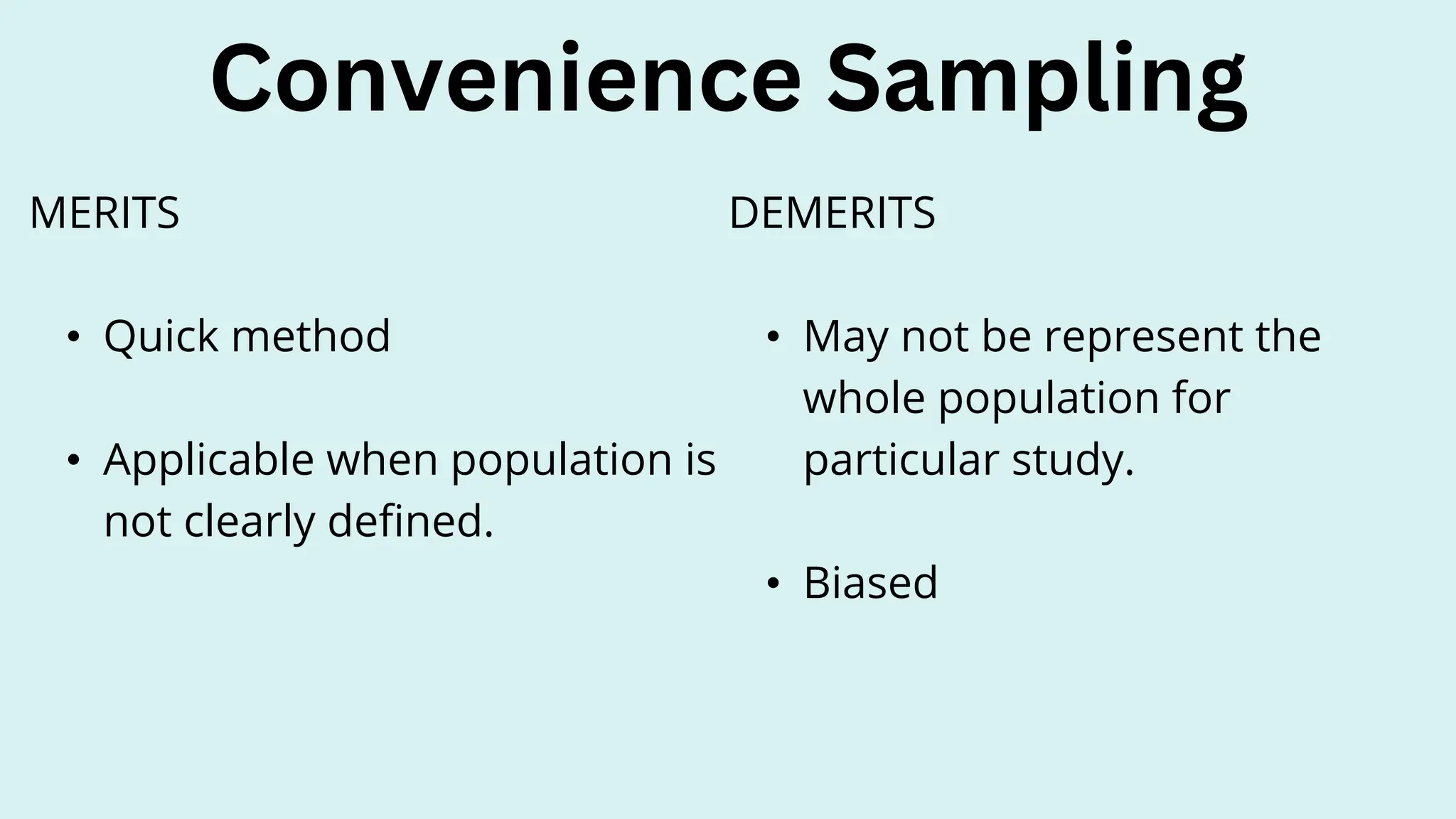
• Sample units selected that are convenient to obtain.
• Availability and easy access of samples lead to
representative units.
• Result obtained cannot be generalized due to lack of
representativeness of the whole population.
Concenience Sampling
Convenience Sampling
DEMERITS
• May not be represent the
whole population for
particular study.
• Biased
MERITS
• Quick method
• Applicable when population is
not clearly defined.
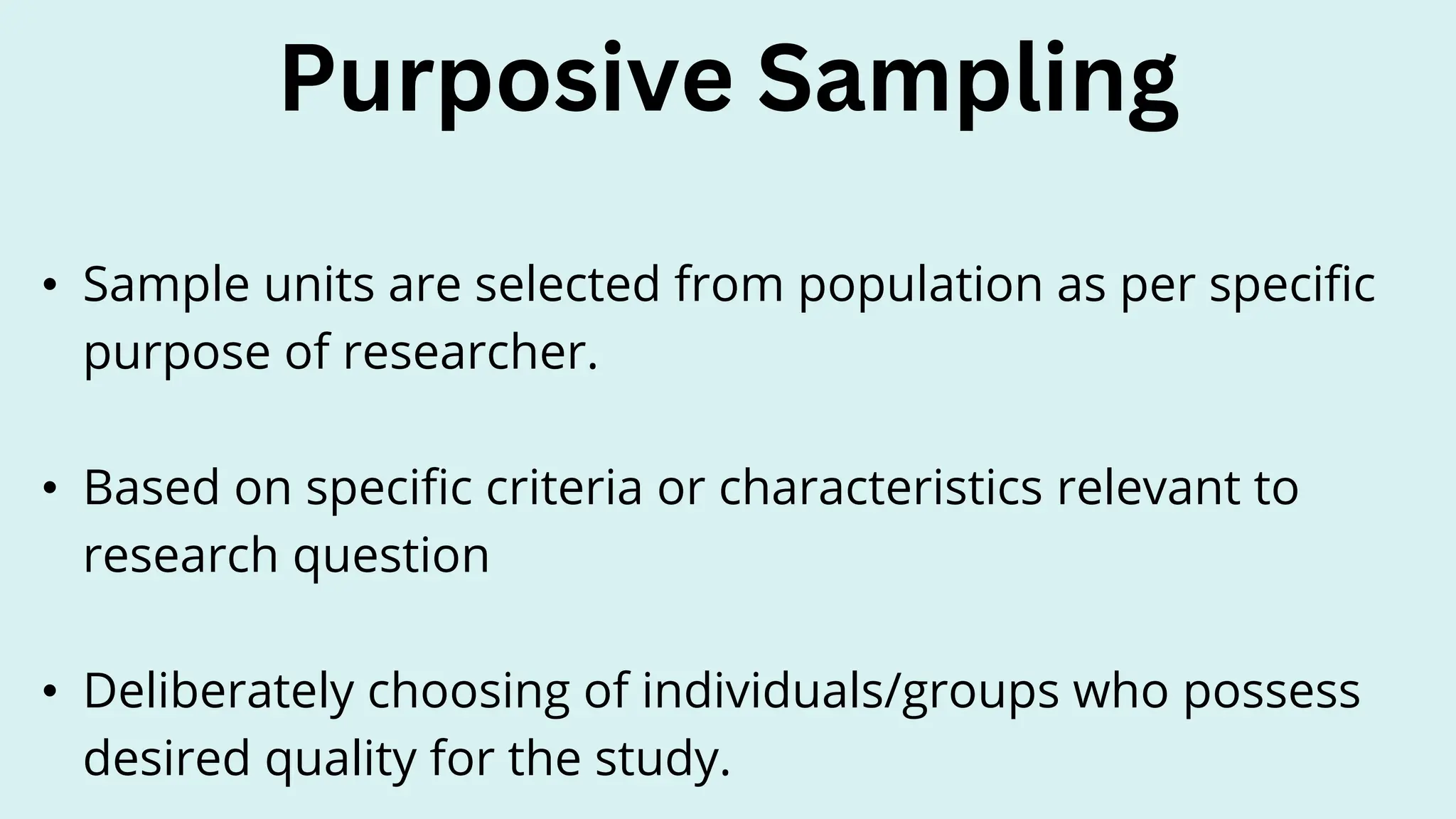
• Sample units are selected from population as per specific
purpose of researcher.
• Based on specific criteria or characteristics relevant to
research question
• Deliberately choosing of individuals/groups who possess
desired quality for the study.
Purposive Sampling
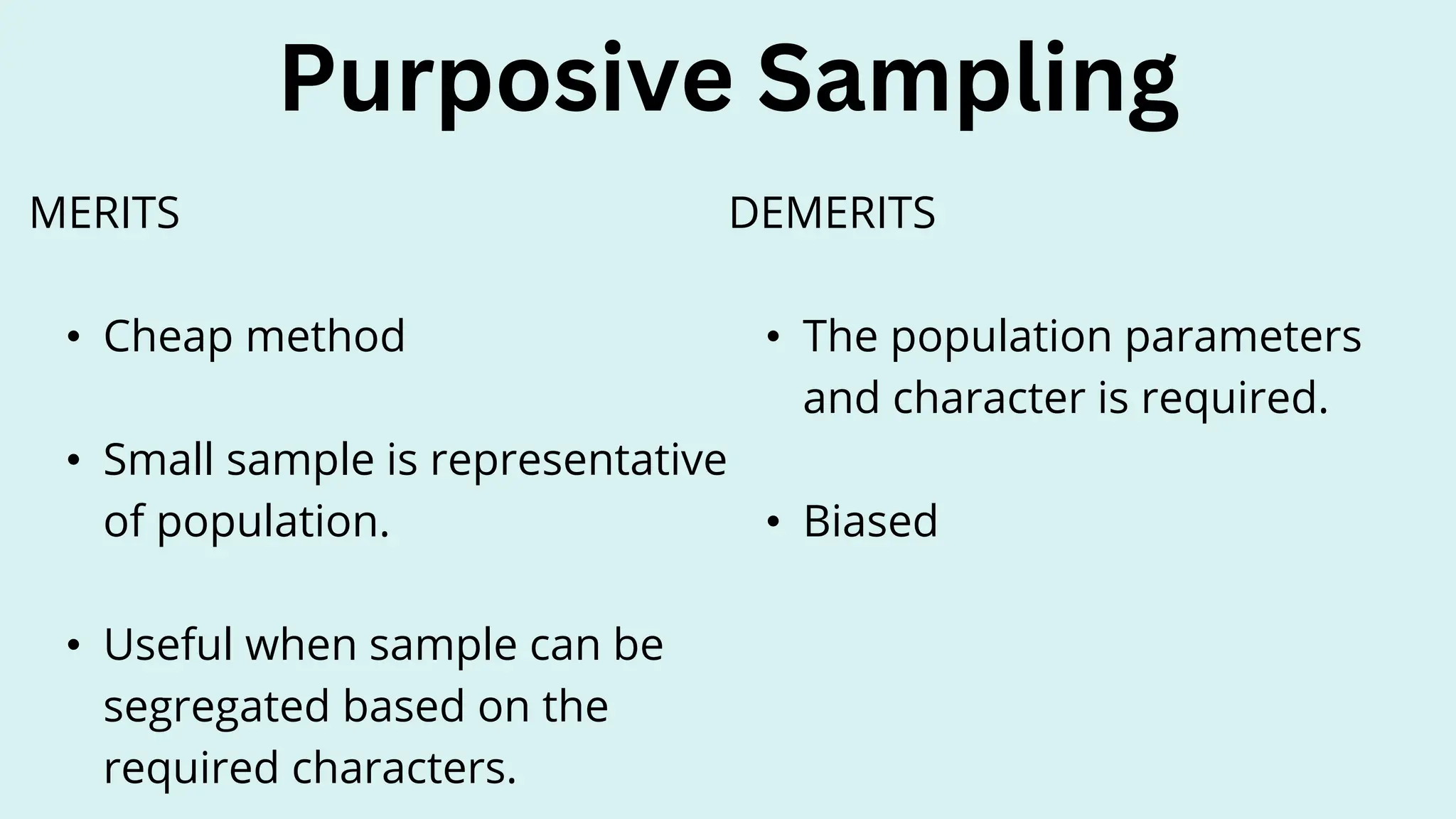
Purposive Sampling
DEMERITS
• The population parameters
and character is required.
• Biased
MERITS
• Cheap method
• Small sample is representative
of population.
• Useful when sample can be
segregated based on the
required characters.
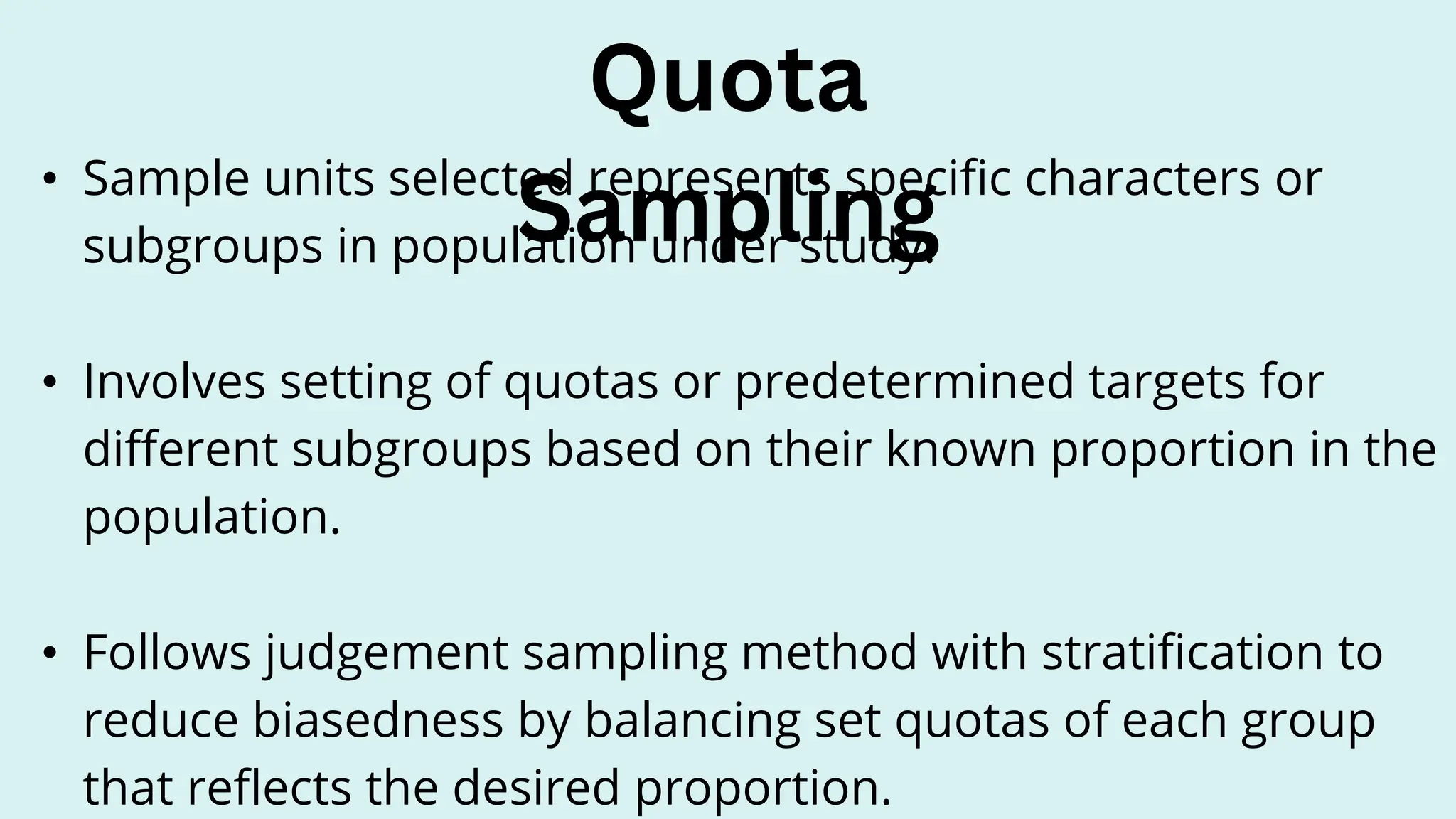
• Sample units selected represents specific characters or
subgroups in population under study.
• Involves setting of quotas or predetermined targets for
different subgroups based on their known proportion in the
population.
• Follows judgement sampling method with stratification to
reduce biasedness by balancing set quotas of each group
that reflects the desired proportion.
Quota
Sampling
Quota
Sampling
DEMERITS
• May not representative of
population.
• Biased
MERITS
• Cheap method
• Effectively balances the
sample distribution to ensure
representation from different
subgroups.
• Sample units selected on referral from other survey
respondents.
• Used to identify potential subjects in studies where the
subjects are hard to locate, according to research objective
and referral from respondent.
• Used in hidden population which are difficult for researchers
to access or are difficult to reach.
Snowball
Sampling
Snowball
Sampling
DEMERITS
• May not representative of
population.
• Time consuming.
MERITS
• Cheap method.
• Effective for collecting sample
from hidden population.
• Sample units are not selected, but are included themselves
to participate in the study.
• Aka. voluntary sampling as participants have the freedom to
decide whether to participate or not.
• Inclusion and exclusion of sample, relies on participants
willingness to be a part of the study.
Self-selected
Sampling
Self-selected
Sampling
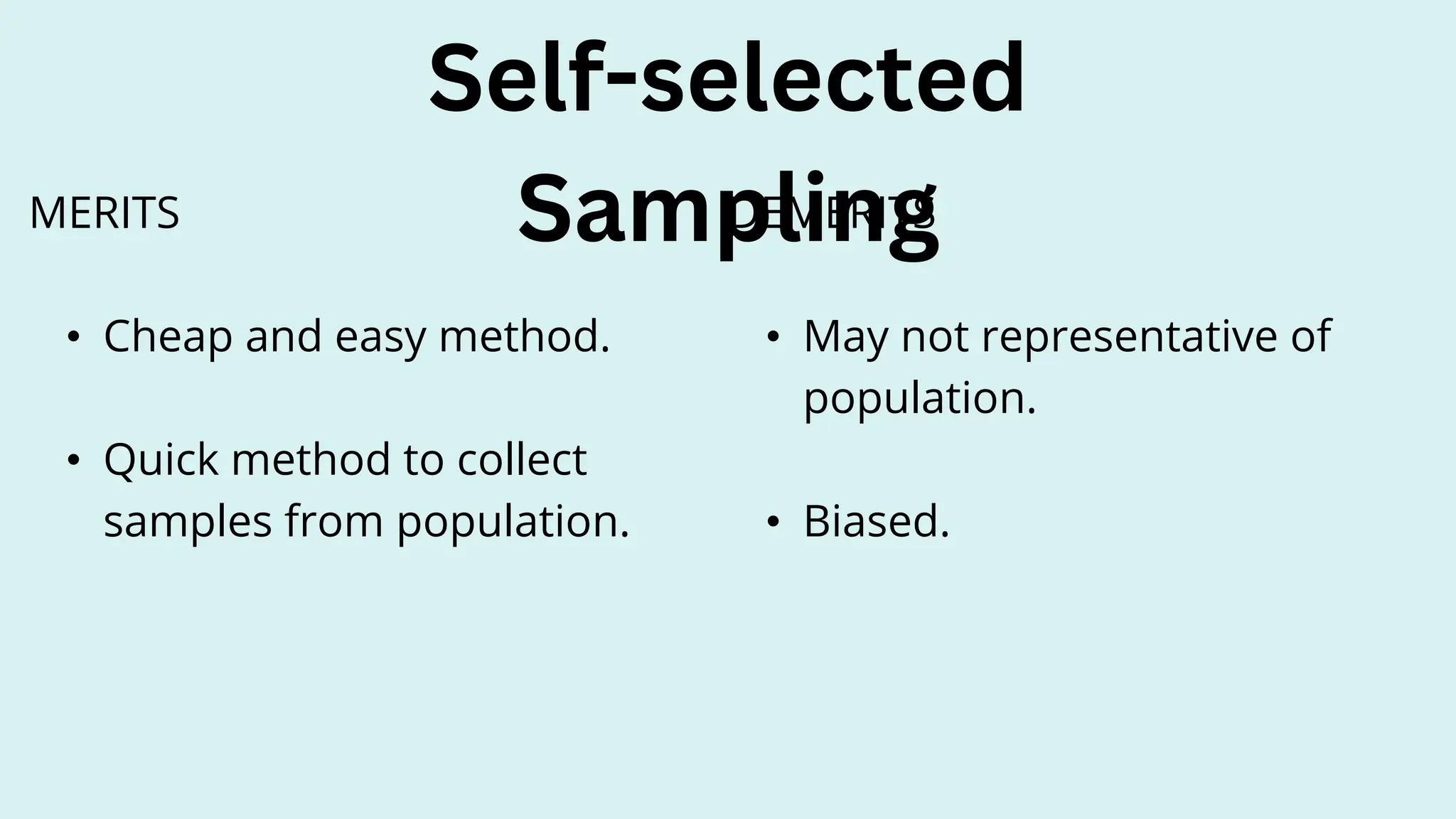
DEMERITS
• May not representative of
population.
• Biased.
MERITS
• Cheap and easy method.
• Quick method to collect
samples from population.

Notes on SAMPLING and its types with examples.pptx

  • 1.
  • 2.
    • Sampling isa process that enables information to be collected from a small number of individuals or organisations within a project or programme, • and then used to draw conclusions about a wider population. SAMPLING
  • 3.
    Probability sampling refersto the selection of a sample from a population, when this selection is based on the principle of randomization, that is, random selection or chance. Non-probability sampling is a method in which not all population members have an equal chance of participating in the study, unlike probability sampling. typesofsampling
  • 4.
    SIMPLE RANDOM SAMPLING STRATIFIEDSAMPLING CLUSTER SAMPLING SYSTEMATIC SAMPLING MULTISTAGE SAMPLING PROBABILITY SAMPLING • Types
  • 5.
    • It issimple and common most method of sampling. • It is the technique of drawing a sample in such a way that each unit of the population has an equal & independent chance of being included in the sample. i ii) Simple rando m sampli ng without ii) Simple rando without replace ment i) Simple rando m sampli ng without replace ment ii) Simple random sampling without replacement i) Simple random sampling with replacement SIMPLERANDOMSAMPLING
  • 6.
    i) Simple randomsampling with replacement i ii) Simple rando m sampli ng without ii) Simple rando without replace ment i) Simple rando m sampli ng without replace ment ii) Simple random sampling without replacement
  • 7.
    i) Simple randomsampling with replacement
  • 8.
  • 9.
  • 10.
    Merits and Demeritsof Simple Random Sampling Merit s Demerit s • Major advantages include its simplicity and lack of bias. • It is very easy to assess the sampling error in this method. • It needs only a minimum knowledge of the study group of population in advance. • cannot be employed when the units of the population are heterogeneous in nature. • usually requires larger sample size. • may result in selection of sampling units from a widely spread geographical area. • might give most non-random looking results.
  • 11.
    If population isheterogenous then, Stratified Sampling is used. Stratification means division into different subpopulations called strata groups such that i) Units within such groups are homogenous as possible. ii) The group means are as widely different as possible. Then from each strata, samples are selected using simple random sampling. Stratifiedsampling
  • 12.
    Purpose of Stratification i)To make more representative: Stratification ensures desired representation in the sample of the various groups of population. Possibility of essential groups being included and provide more efficient system of sampling ii) Greater Accuracy: increased accuracy at a given cost. enable obtaining the results of known precision of each groups. iii) Administrative convenience: concentrate geographically.
  • 13.
    Merits and Demeritsof Stratified Sampling Merit s Demerit s • Stratification makes the selected sample representative include their respective units. • estimation of population parameters are more precise. • In case of unsymmetrical distribution, a best sampling to use • consumes considerable amount of time and cost. • Stratification is quite cumbersome
  • 14.
    Systematicsampling Method that canbe employed if complete and up to date lists of sampling units are available. A Sampling method in which the first element is selected randomly, and then every nth element is selected. Alternative to SRS Less likely to make mistakes Easy to apply Cost of sampling is less Process can be easily checked
  • 15.
    Merits and Demeritsof Systematic Sampling Merit s Demerit s • Operationally more convenient than previous two, Less Time and Work • More Efficient than Simple Random Sampling provided that frame is arranged wholly. • Unlike random sampling methods systematic sampling does not provide the same level of randomness. • Systematic sampling is susceptible to sampling errors if the pattern or periodicity in the population coincides with the sampling interval. • May introduce biasness, overrepresented or underrepresented data in sample.
  • 16.
    ClusterSampling • Used whenPopulation is not Homogenous. • Cluster sampling is a sampling technique in which the population is divided into clusters or groups, and a subset of clusters is selected for the sample. • Made in a way that Cluster has Heterogenous population, and small as possible
  • 17.
    Merits and Demeritsof Cluster Sampling Merit s Demerit s • Easier, Cheaper and Faster • Useful when sampling frame of elements may not be readily available. • Efficiency decrease with increase in size of cluster • Enumeration of Sampling units within cluster is difficult when population size is large. • Cluster sampling can introduce bias if the selected clusters are not representative of the population.
  • 18.
    multistagesampling • Complex formof Cluster Sampling. • A Sampling technique where large clusters of population are divided into smaller clusters in several stages, and sub sampling within the clusters are performed for more efficient result. • Can be generalized to 3 or more stages. Cluster at first stage: first stage unit (fsu) elements within clusters: second stage unit (ssu)
  • 19.
    Merits and Demeritsof Multistage Sampling Merit s Demerit s • Flexible method of Sampling • Sample size reduces each time, hence save time and cost • Increased complexity: multiple stages of selection make complex implementation/ analysis • Loss of Precision • Multistage cluster sampling may have limited generalizability
  • 21.
    Non Probability Sampling •Sampling technique; samples selection process does not give all the individuals in population equal chances of being selected. • Selection of sample depends upon judgement of investigator.
  • 22.
    NONPROBABILITY SAMPLING Types JUDGEMENT SAMPLING CONVENIENCE SAMPLING QUOTASAMPLING PURPOSIVE SAMPLING SNOWBALL SAMPLING SELF SELECTED SAMPLING
  • 23.
    • Sample unitsselected according to personal judgement of researcher. • May include only those units in sample from population which are most appropriate for the study. • Sound judgement during sampling implicates representative sample. • Helps to save time and money Judgement Sampling
  • 24.
    MERITS • Simple method •Applicable for quick decision for urgent need • Better for small sampling size Judgement Sampling DEMERITS • May not be representative of the population for particular study. • Biased
  • 25.
    • Sample unitsselected that are convenient to obtain. • Availability and easy access of samples lead to representative units. • Result obtained cannot be generalized due to lack of representativeness of the whole population. Concenience Sampling
  • 26.
    Convenience Sampling DEMERITS • Maynot be represent the whole population for particular study. • Biased MERITS • Quick method • Applicable when population is not clearly defined.
  • 27.
    • Sample unitsare selected from population as per specific purpose of researcher. • Based on specific criteria or characteristics relevant to research question • Deliberately choosing of individuals/groups who possess desired quality for the study. Purposive Sampling
  • 28.
    Purposive Sampling DEMERITS • Thepopulation parameters and character is required. • Biased MERITS • Cheap method • Small sample is representative of population. • Useful when sample can be segregated based on the required characters.
  • 29.
    • Sample unitsselected represents specific characters or subgroups in population under study. • Involves setting of quotas or predetermined targets for different subgroups based on their known proportion in the population. • Follows judgement sampling method with stratification to reduce biasedness by balancing set quotas of each group that reflects the desired proportion. Quota Sampling
  • 30.
    Quota Sampling DEMERITS • May notrepresentative of population. • Biased MERITS • Cheap method • Effectively balances the sample distribution to ensure representation from different subgroups.
  • 31.
    • Sample unitsselected on referral from other survey respondents. • Used to identify potential subjects in studies where the subjects are hard to locate, according to research objective and referral from respondent. • Used in hidden population which are difficult for researchers to access or are difficult to reach. Snowball Sampling
  • 32.
    Snowball Sampling DEMERITS • May notrepresentative of population. • Time consuming. MERITS • Cheap method. • Effective for collecting sample from hidden population.
  • 33.
    • Sample unitsare not selected, but are included themselves to participate in the study. • Aka. voluntary sampling as participants have the freedom to decide whether to participate or not. • Inclusion and exclusion of sample, relies on participants willingness to be a part of the study. Self-selected Sampling
  • 34.
    Self-selected Sampling DEMERITS • May notrepresentative of population. • Biased. MERITS • Cheap and easy method. • Quick method to collect samples from population.