PEDIATRIC CARDIAC
SERVICES IN INDIA:
WHERE DO WE
ACTUALLY STAND?
D R . M U R T A Z A K A M A L
M D ( P E D S ) , D N B ( P E D S ) , D N B S S ( P E D C A R D I O L O G Y )
P E D I A T R I C C A R D I L O G I S T
1 9 / M A Y / 2 0 2 1
1
DISCLAIMER
• Burden of pediatric heart disease (CHD), including lacunae in
current state, as well as challenges and opportunities for
providing optimal care to the large population of children
• To spread awareness of CHD and its available treatment
modalities in our country
• Not only to sensitise Cardiologists/Paediatricians/Physicians
but for parents of children with CHD, NGO workers,
government officials involved in health care system
2
INTRODUCTION
• India: 2nd most populous country- 1.3 Billions
• Fastest growing major economies
• Globally 1.35 Million (13.5 lacks) kids born/ year with CHD
• All congenital birth defects: MC- CHD (28%)
• Birth prevalence of CHD: 8-10/1000 live births
• 2,42,390 kids born with CHD/ year
• Epidemiology quiet different from western countries
3
PREVALENCE
• Birth prevalence increased over time after 1995: 9.1/
1000 live births
• Asia: High birth prevalence: High consanguinity
• Severe CHD: 1.5- 1.7/ 1000 live births
• Rise in birth prevalence of CHD till 2000: Better
diagnostic modalities; after 2000 most studies Decline
4
RISK FACTORS
• CHD aetiology: Unknown- 85%
• Strong heritable basis: But genetic aetiology< 20%
• 10%: Chromosomal+ NC syndromes
• Maternal rubella (other viral infections)
• Maternal diabetes
• Family history of CHD
• Exposure to teratogenic drugs in 1st trimester
• Invitro fertilisation pregnancy
5
RISK FACTORS CONT…
• Antibiotic abuse: Freely available over the counter drugs
• Increased parental age
• Increased maternal BMI
• Parental consanguinity (AR)
6
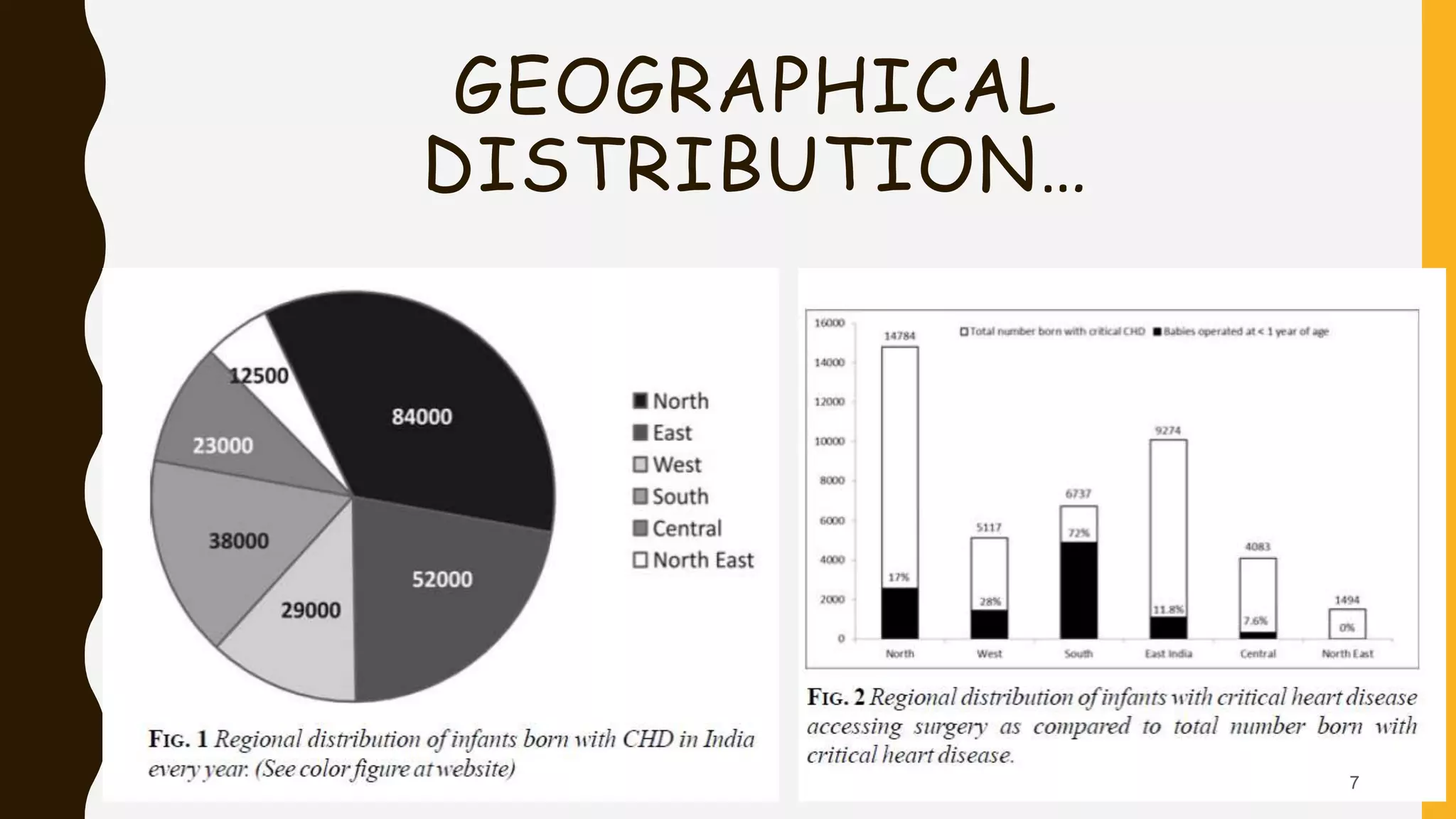
GEOGRAPHICAL
DISTRIBUTION…
7
CURRENT STATUS OF CHD CARE IN
INDIA
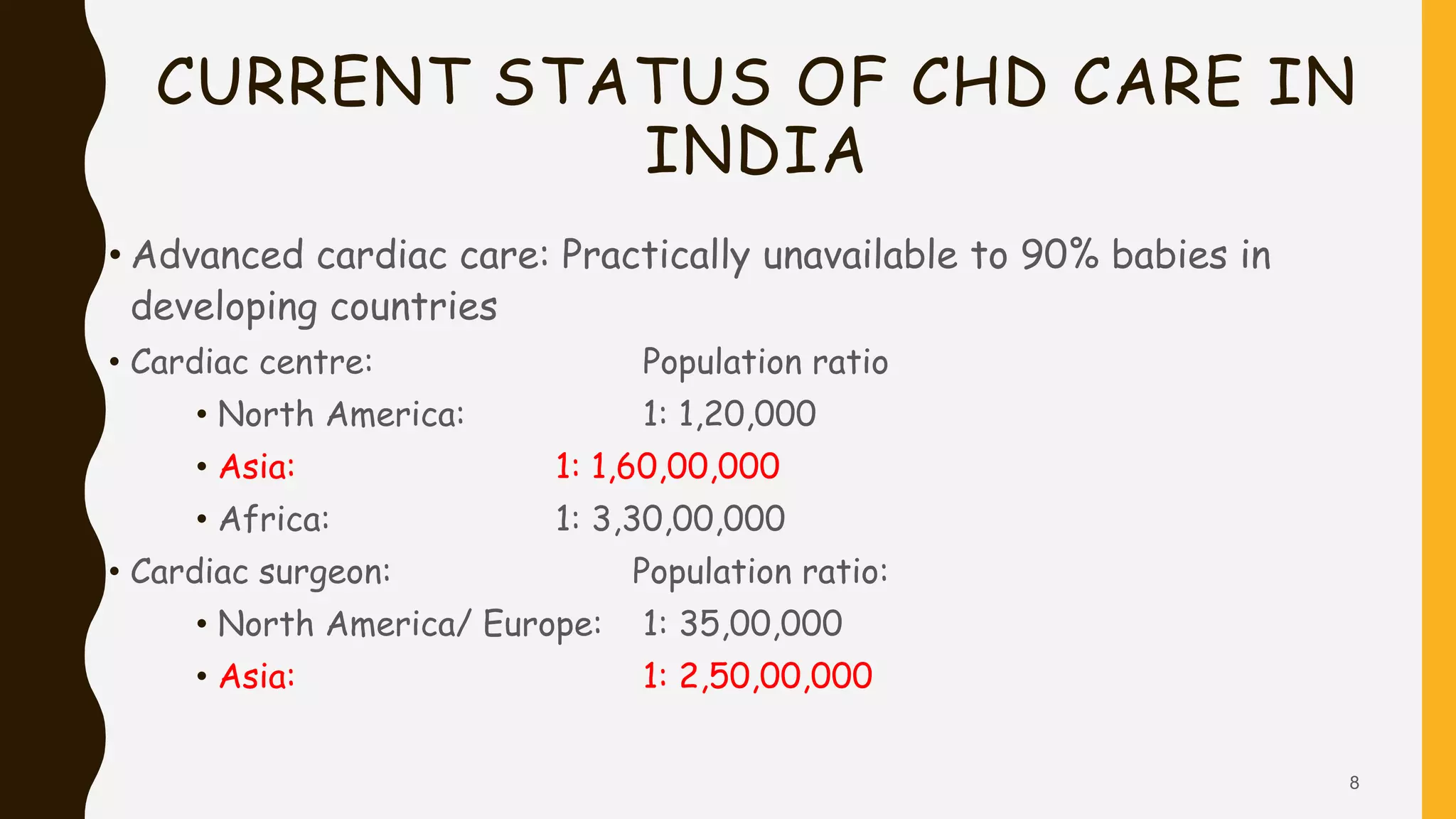
• Advanced cardiac care: Practically unavailable to 90% babies in
developing countries
• Cardiac centre: Population ratio
• North America: 1: 1,20,000
• Asia: 1: 1,60,00,000
• Africa: 1: 3,30,00,000
• Cardiac surgeon: Population ratio:
• North America/ Europe: 1: 35,00,000
• Asia: 1: 2,50,00,000
8
CURRENT STATUS OF CHD CARE IN
INDIA CONT…
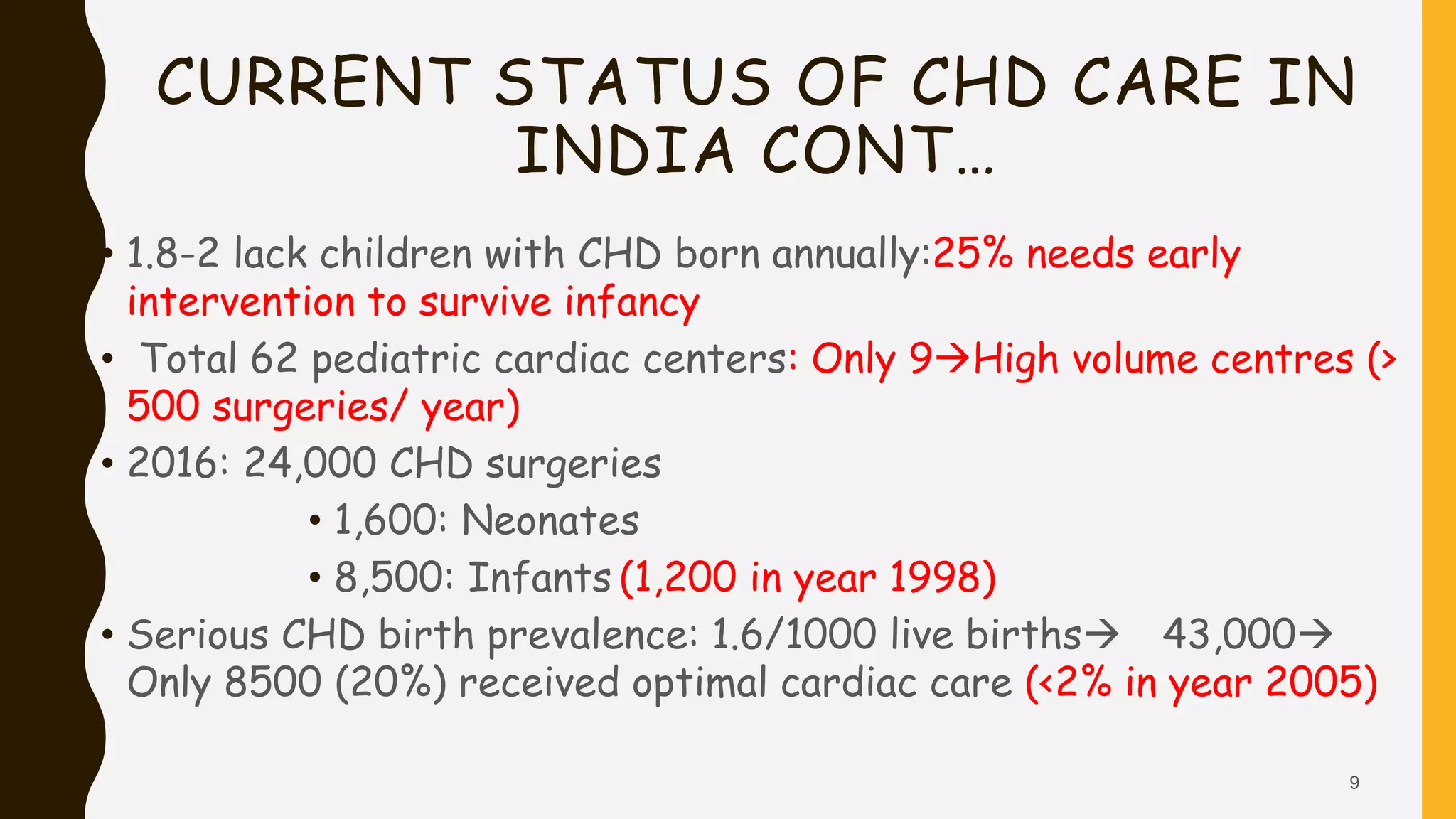
• 1.8-2 lack children with CHD born annually:25% needs early
intervention to survive infancy
• Total 62 pediatric cardiac centers: Only 9High volume centres (>
500 surgeries/ year)
• 2016: 24,000 CHD surgeries
• 1,600: Neonates
• 8,500: Infants (1,200 in year 1998)
• Serious CHD birth prevalence: 1.6/1000 live births 43,000
Only 8500 (20%) received optimal cardiac care (<2% in year 2005)
9
CURRENT STATUS OF CHD CARE IN
INDIA CONT…
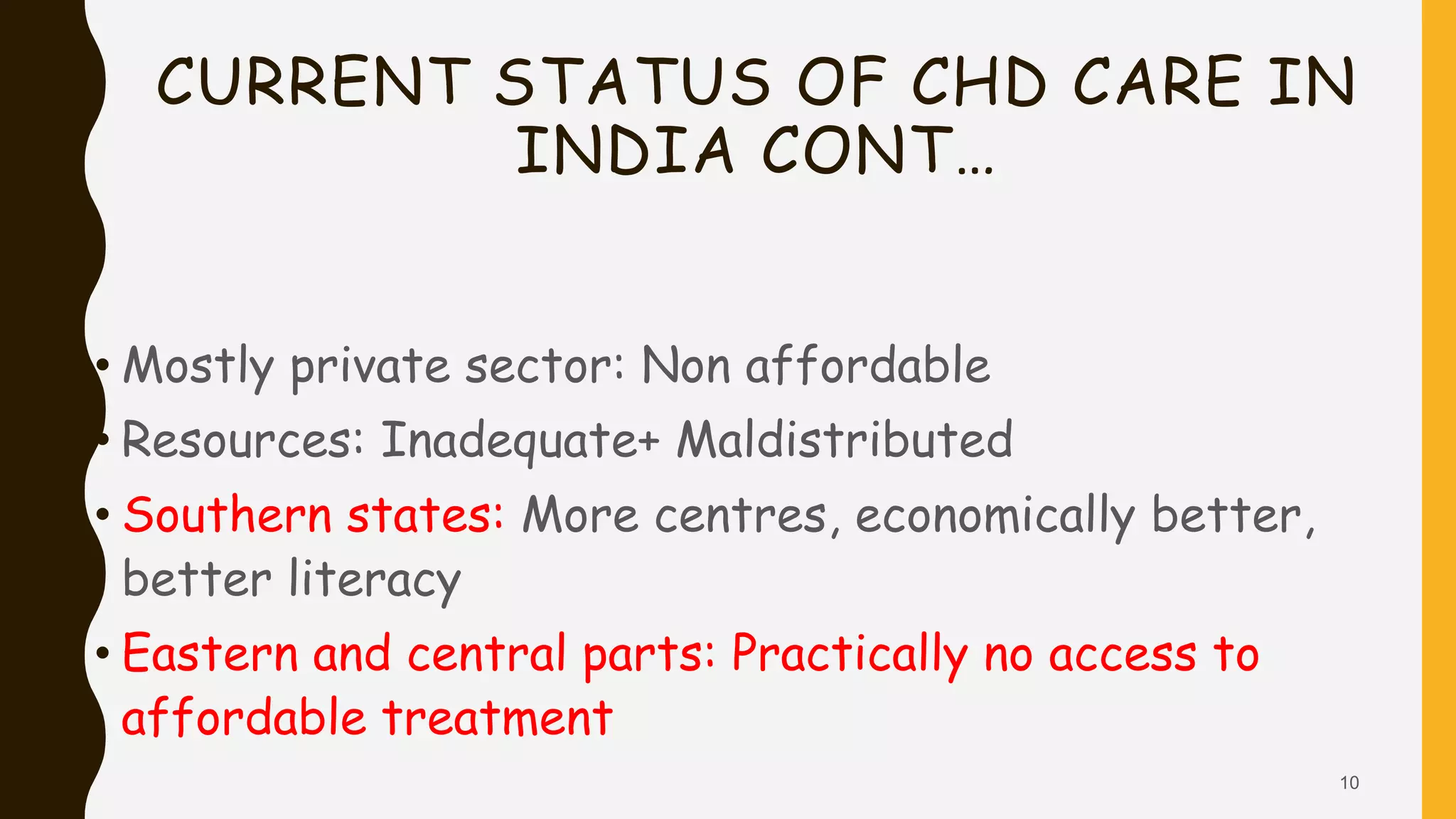
• Mostly private sector: Non affordable
• Resources: Inadequate+ Maldistributed
• Southern states: More centres, economically better,
better literacy
• Eastern and central parts: Practically no access to
affordable treatment
10
OUR PROBLEMS ARE ENDLESS…
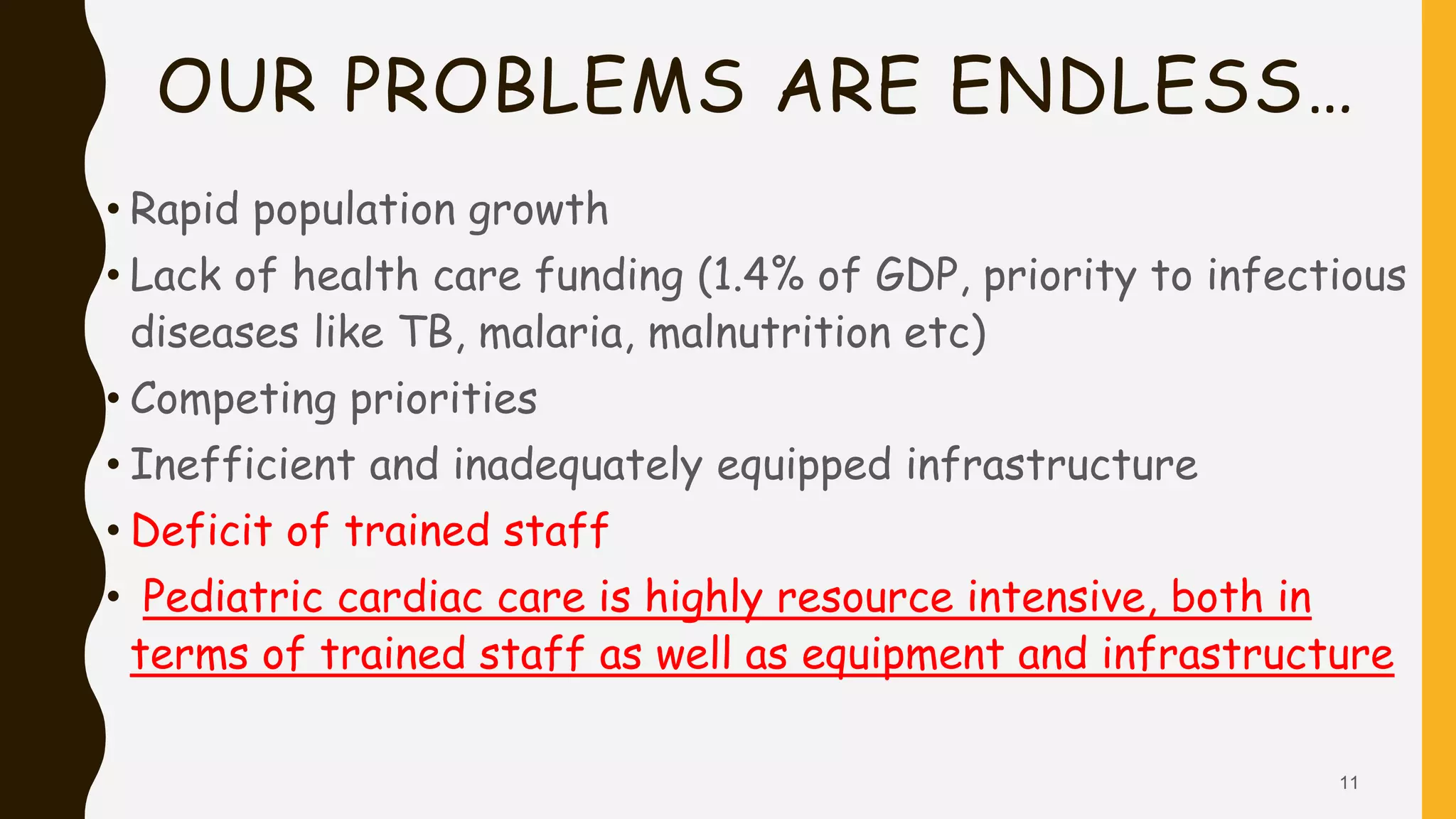
• Rapid population growth
• Lack of health care funding (1.4% of GDP, priority to infectious
diseases like TB, malaria, malnutrition etc)
• Competing priorities
• Inefficient and inadequately equipped infrastructure
• Deficit of trained staff
• Pediatric cardiac care is highly resource intensive, both in
terms of trained staff as well as equipment and infrastructure
11
CURRENT STATUS OF CHD CARE IN
INDIA CONT…
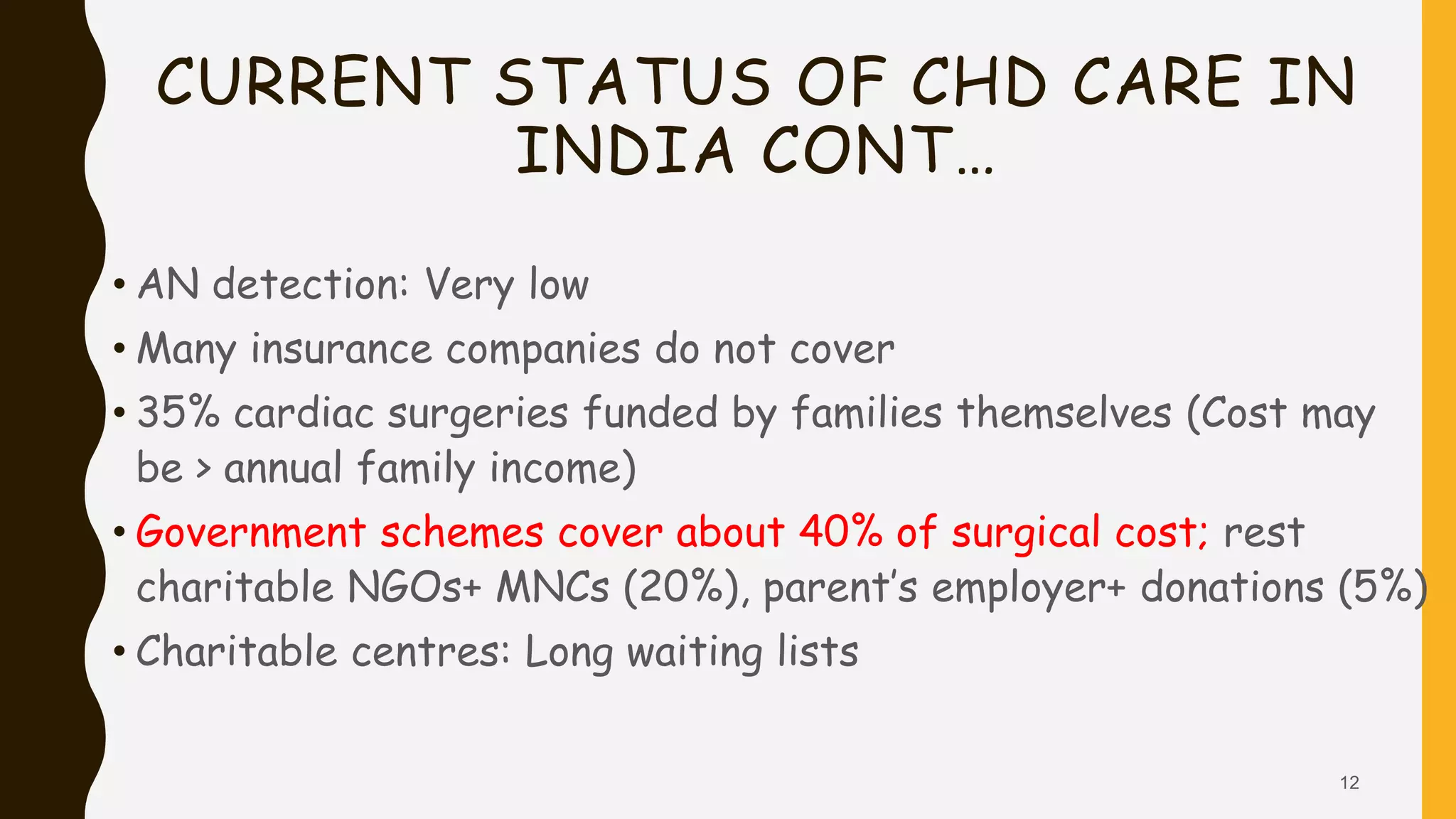
• AN detection: Very low
• Many insurance companies do not cover
• 35% cardiac surgeries funded by families themselves (Cost may
be > annual family income)
• Government schemes cover about 40% of surgical cost; rest
charitable NGOs+ MNCs (20%), parent’s employer+ donations (5%)
• Charitable centres: Long waiting lists
12
CURRENT STATUS OF CHD CARE IN
INDIA CONT…
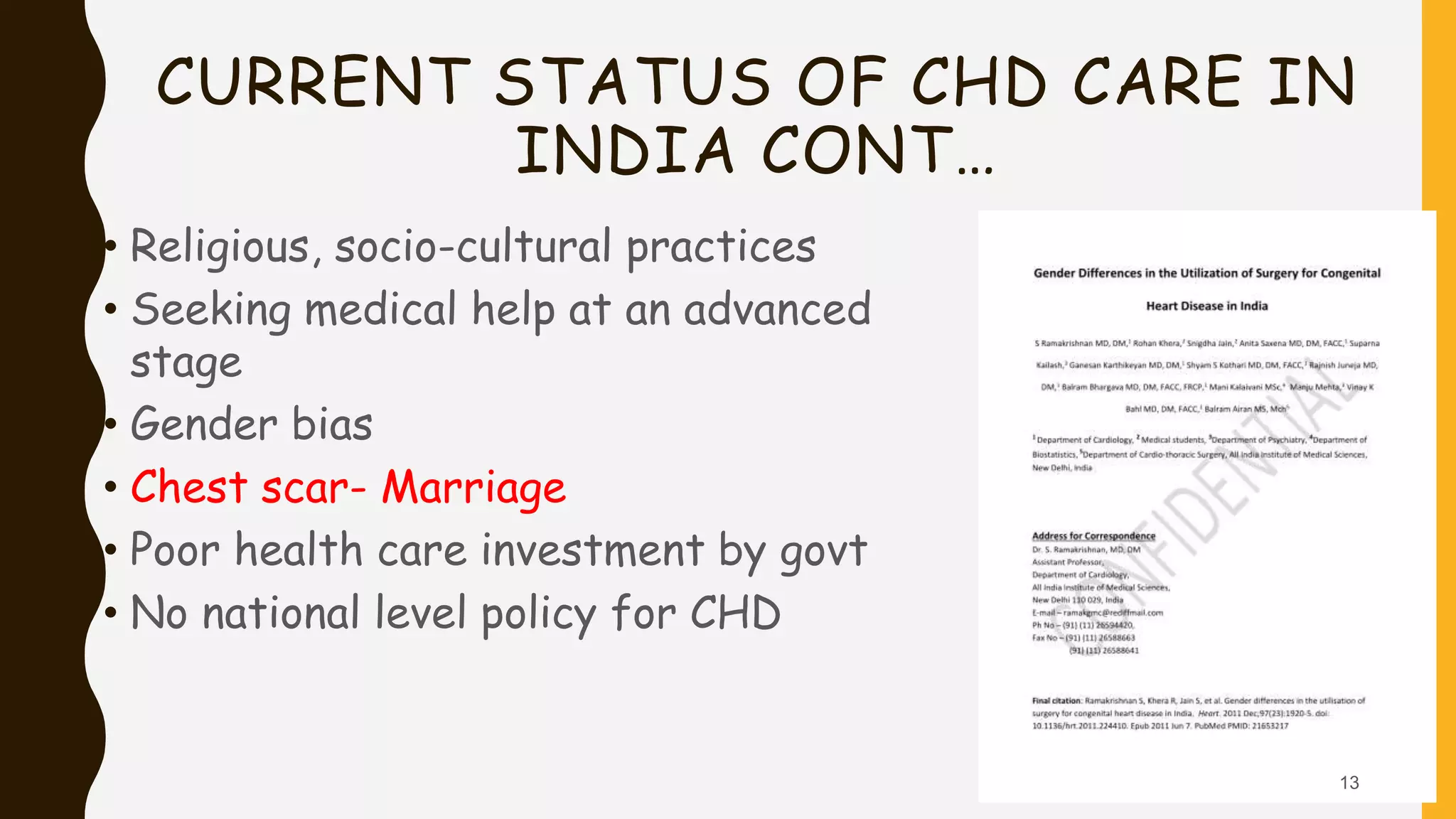
• Religious, socio-cultural practices
• Seeking medical help at an advanced
stage
• Gender bias
• Chest scar- Marriage
• Poor health care investment by govt
• No national level policy for CHD
13
THE SAD STORY IS…
• Many health professionals are unaware of the advances
made in the treatment of newborns with CHD and
parents are counselled against interventions for
apprehension of poor long-term outcome
14
PREVENTION
• Difficult: Cause unknown in majority
• Reduction of fertility rate
• If FR reduced from 2.2 1.1/ women: CHD incidence
reduces to 50% of current birth prevalence
• Women empowerment/ education: Improved efforts for
family planning
• Parental counselling to avoid known risk factors
15
1. IMMUNISATION AGAINST
RUBELLA
• WHO: Single rubella vaccine: >95% long lasting immunity
• 1st trimester infected: 90% chance of transmission
• World: 1,10,000 kids born with CRS/ year
• India: 40,000
• Vaccine now included in schedule
16
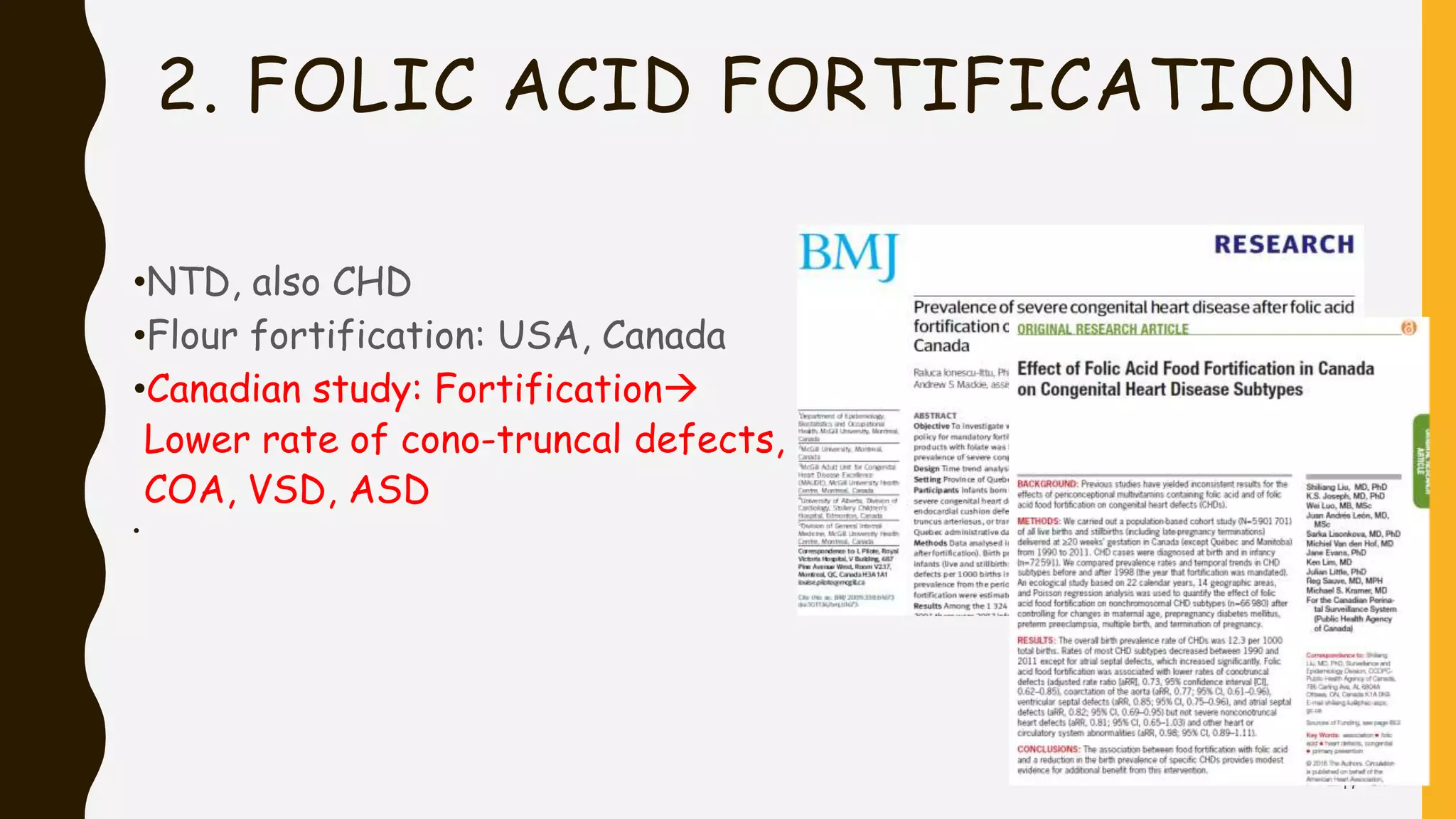
2. FOLIC ACID FORTIFICATION
•NTD, also CHD
•Flour fortification: USA, Canada
•Canadian study: Fortification
Lower rate of cono-truncal defects,
COA, VSD, ASD
•
17
3. CONTROL OF CHRONIC
CONDITIONS+ ADDICTIONS
• Diabetes
• HT
• Cessation of smoking/ alcohol intake
• Avoid passive smoking
18
4. AVOIDANCE OF HARMFUL
MEDICATIONS
• Over the counter medicines
• Teratogenic
• Vit/ Fe/ Ca supplements in appropriate dosage
19
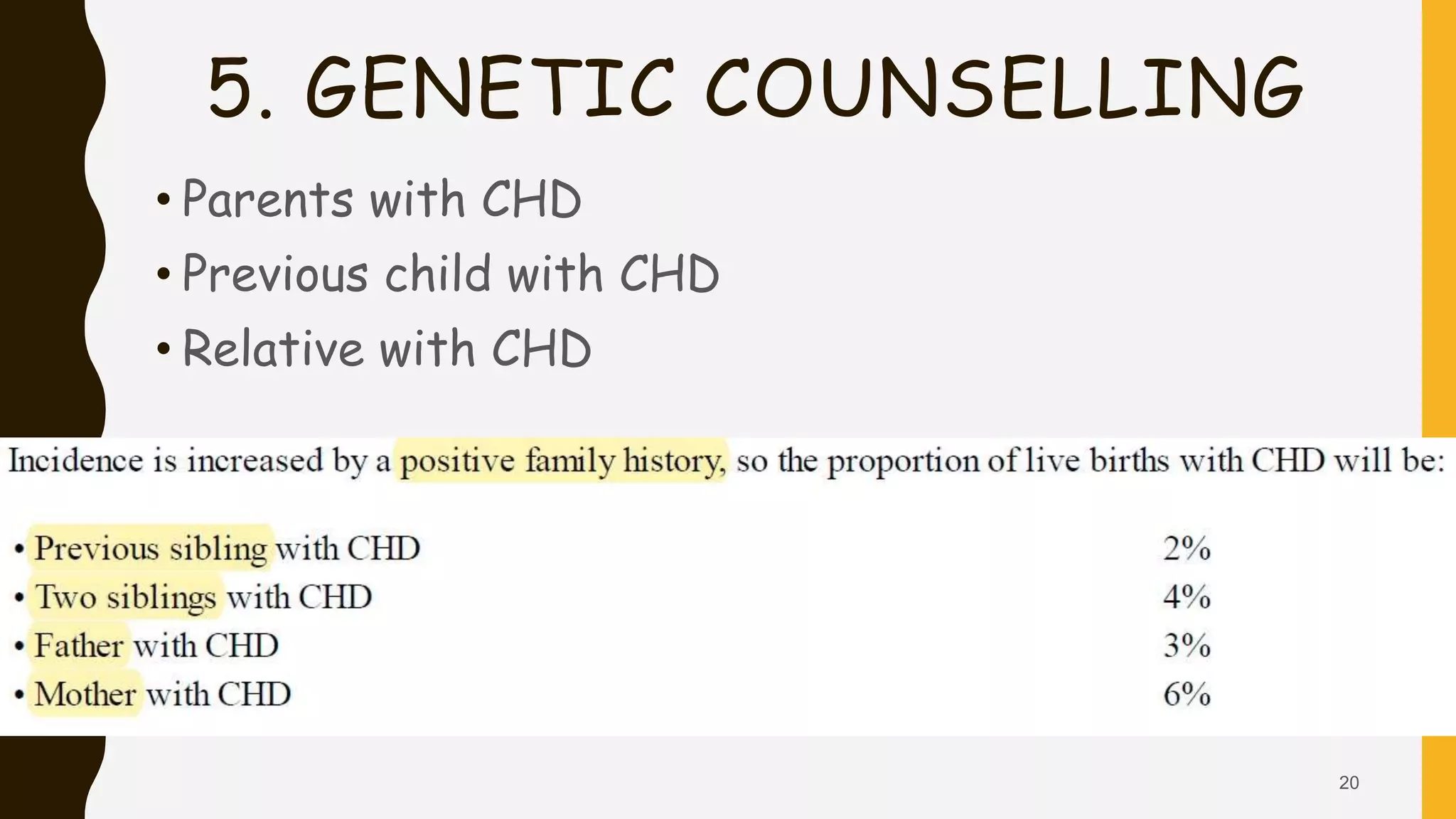
5. GENETIC COUNSELLING
• Parents with CHD
• Previous child with CHD
• Relative with CHD
20
6. FETAL ECHO
• Should not be considered as a tool to prevent CHD
• Termination of pregnancy may be considered for complex CHD
with adverse long term outcomes despite cardiac surgery
• 18-20 weeks
• > 20 weeks MTP illegal
21
7. OTHER MEASURES
• Harmful effects of organic solvents used in dry cleaning,
paint thinners, nail polish remover
• Avoidance of contact with persons with symptoms of
viral infections
22
STRATEGIES FOR IMPROVEMENT
• Limited resources: Needs to be optimally utilised
• Health: State subject; Differ vastly in economy, literacy levels,
population, language, cultural beliefs and human development
indices—> One size fits all approach: Not tenable
• Mass immunisation against rubella and FA fortification
• Comprehensive programme which caters to the well being of
children
23
STRATEGIES FOR IMPROVEMENT
CONT…
• Periodic education to sensitise practising
physicians and paediatricians
• People to be made aware of the availability
of advanced CHD care in India
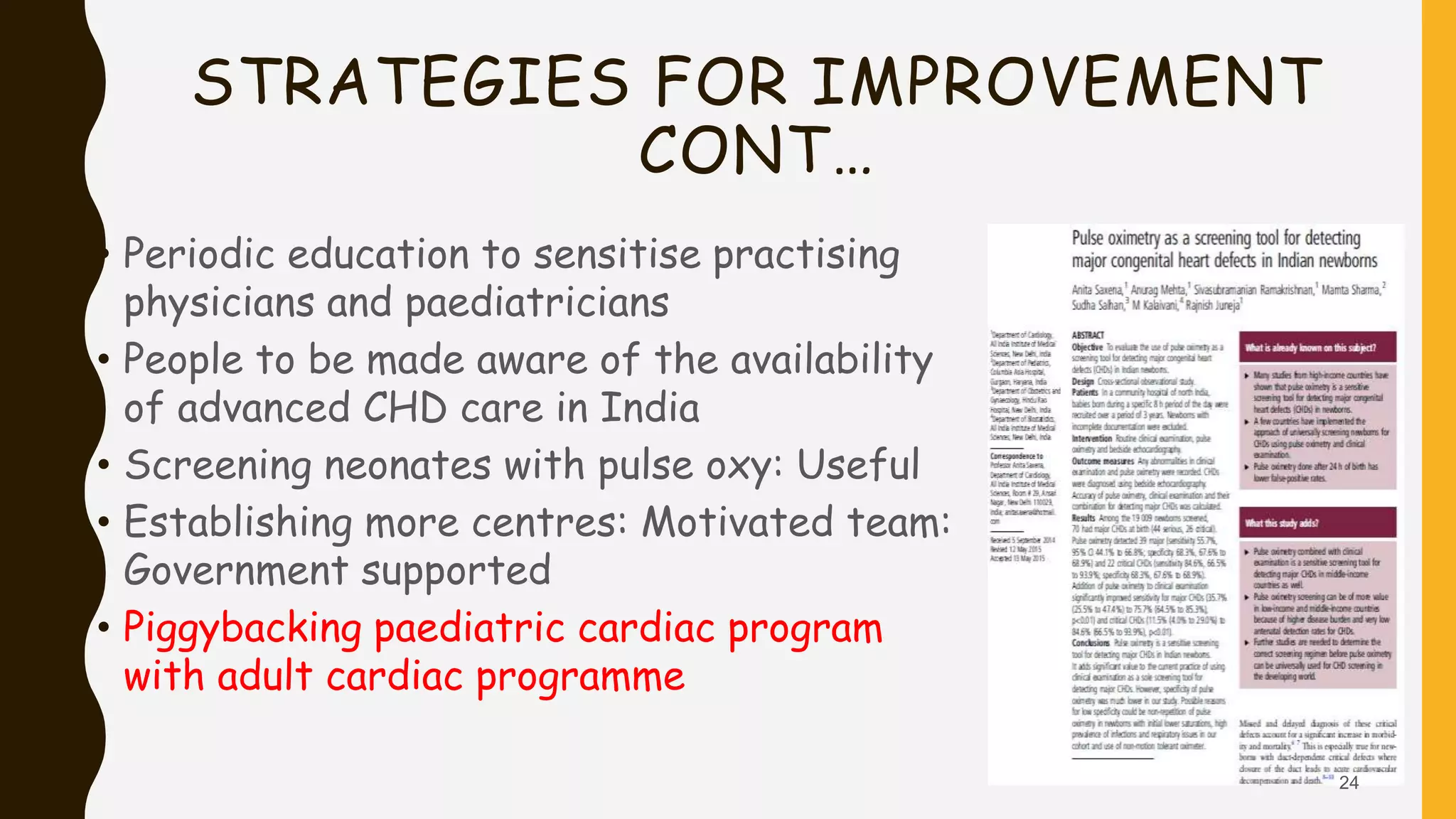
• Screening neonates with pulse oxy: Useful
• Establishing more centres: Motivated team:
Government supported
• Piggybacking paediatric cardiac program
with adult cardiac programme
24
STRATEGIES FOR IMPROVEMENT CONT…
• Cost containment (Home grown technology/ Middle man exclusion)
• Peds care more demanding: Structured training programmes
needed (130 Peds cardiologists/ 110 Peds cardiac surgeons (Non
dedicated)):Telemedicine, Internet
• Incorporating research into a program is very important and helps
in its sustainability
• Creation of a network so that patients can be referred to a
treatment facility which is available locally
25
TAKE HOME MESSAGE
• Pediatric cardiac care is highly resource intensive,
both in terms of trained staff as well as equipment and
infrastructure
• A challenge: Huge number+ limited resources
• Need to tie our knots: Be optimistic for the future
growth and progress
26
MURTAZA.VMMC@GMAIL.COM
27

PEDIATRIC CARDIAC SERVICES IN INDIA: WHERE DO WE ACTUALLY STAND?

  • 1.
    PEDIATRIC CARDIAC SERVICES ININDIA: WHERE DO WE ACTUALLY STAND? D R . M U R T A Z A K A M A L M D ( P E D S ) , D N B ( P E D S ) , D N B S S ( P E D C A R D I O L O G Y ) P E D I A T R I C C A R D I L O G I S T 1 9 / M A Y / 2 0 2 1 1
  • 2.
    DISCLAIMER • Burden ofpediatric heart disease (CHD), including lacunae in current state, as well as challenges and opportunities for providing optimal care to the large population of children • To spread awareness of CHD and its available treatment modalities in our country • Not only to sensitise Cardiologists/Paediatricians/Physicians but for parents of children with CHD, NGO workers, government officials involved in health care system 2
  • 3.
    INTRODUCTION • India: 2ndmost populous country- 1.3 Billions • Fastest growing major economies • Globally 1.35 Million (13.5 lacks) kids born/ year with CHD • All congenital birth defects: MC- CHD (28%) • Birth prevalence of CHD: 8-10/1000 live births • 2,42,390 kids born with CHD/ year • Epidemiology quiet different from western countries 3
  • 4.
    PREVALENCE • Birth prevalenceincreased over time after 1995: 9.1/ 1000 live births • Asia: High birth prevalence: High consanguinity • Severe CHD: 1.5- 1.7/ 1000 live births • Rise in birth prevalence of CHD till 2000: Better diagnostic modalities; after 2000 most studies Decline 4
  • 5.
    RISK FACTORS • CHDaetiology: Unknown- 85% • Strong heritable basis: But genetic aetiology< 20% • 10%: Chromosomal+ NC syndromes • Maternal rubella (other viral infections) • Maternal diabetes • Family history of CHD • Exposure to teratogenic drugs in 1st trimester • Invitro fertilisation pregnancy 5
  • 6.
    RISK FACTORS CONT… •Antibiotic abuse: Freely available over the counter drugs • Increased parental age • Increased maternal BMI • Parental consanguinity (AR) 6
  • 7.
  • 8.
    CURRENT STATUS OFCHD CARE IN INDIA • Advanced cardiac care: Practically unavailable to 90% babies in developing countries • Cardiac centre: Population ratio • North America: 1: 1,20,000 • Asia: 1: 1,60,00,000 • Africa: 1: 3,30,00,000 • Cardiac surgeon: Population ratio: • North America/ Europe: 1: 35,00,000 • Asia: 1: 2,50,00,000 8
  • 9.
    CURRENT STATUS OFCHD CARE IN INDIA CONT… • 1.8-2 lack children with CHD born annually:25% needs early intervention to survive infancy • Total 62 pediatric cardiac centers: Only 9High volume centres (> 500 surgeries/ year) • 2016: 24,000 CHD surgeries • 1,600: Neonates • 8,500: Infants (1,200 in year 1998) • Serious CHD birth prevalence: 1.6/1000 live births 43,000 Only 8500 (20%) received optimal cardiac care (<2% in year 2005) 9
  • 10.
    CURRENT STATUS OFCHD CARE IN INDIA CONT… • Mostly private sector: Non affordable • Resources: Inadequate+ Maldistributed • Southern states: More centres, economically better, better literacy • Eastern and central parts: Practically no access to affordable treatment 10
  • 11.
    OUR PROBLEMS AREENDLESS… • Rapid population growth • Lack of health care funding (1.4% of GDP, priority to infectious diseases like TB, malaria, malnutrition etc) • Competing priorities • Inefficient and inadequately equipped infrastructure • Deficit of trained staff • Pediatric cardiac care is highly resource intensive, both in terms of trained staff as well as equipment and infrastructure 11
  • 12.
    CURRENT STATUS OFCHD CARE IN INDIA CONT… • AN detection: Very low • Many insurance companies do not cover • 35% cardiac surgeries funded by families themselves (Cost may be > annual family income) • Government schemes cover about 40% of surgical cost; rest charitable NGOs+ MNCs (20%), parent’s employer+ donations (5%) • Charitable centres: Long waiting lists 12
  • 13.
    CURRENT STATUS OFCHD CARE IN INDIA CONT… • Religious, socio-cultural practices • Seeking medical help at an advanced stage • Gender bias • Chest scar- Marriage • Poor health care investment by govt • No national level policy for CHD 13
  • 14.
    THE SAD STORYIS… • Many health professionals are unaware of the advances made in the treatment of newborns with CHD and parents are counselled against interventions for apprehension of poor long-term outcome 14
  • 15.
    PREVENTION • Difficult: Causeunknown in majority • Reduction of fertility rate • If FR reduced from 2.2 1.1/ women: CHD incidence reduces to 50% of current birth prevalence • Women empowerment/ education: Improved efforts for family planning • Parental counselling to avoid known risk factors 15
  • 16.
    1. IMMUNISATION AGAINST RUBELLA •WHO: Single rubella vaccine: >95% long lasting immunity • 1st trimester infected: 90% chance of transmission • World: 1,10,000 kids born with CRS/ year • India: 40,000 • Vaccine now included in schedule 16
  • 17.
    2. FOLIC ACIDFORTIFICATION •NTD, also CHD •Flour fortification: USA, Canada •Canadian study: Fortification Lower rate of cono-truncal defects, COA, VSD, ASD • 17
  • 18.
    3. CONTROL OFCHRONIC CONDITIONS+ ADDICTIONS • Diabetes • HT • Cessation of smoking/ alcohol intake • Avoid passive smoking 18
  • 19.
    4. AVOIDANCE OFHARMFUL MEDICATIONS • Over the counter medicines • Teratogenic • Vit/ Fe/ Ca supplements in appropriate dosage 19
  • 20.
    5. GENETIC COUNSELLING •Parents with CHD • Previous child with CHD • Relative with CHD 20
  • 21.
    6. FETAL ECHO •Should not be considered as a tool to prevent CHD • Termination of pregnancy may be considered for complex CHD with adverse long term outcomes despite cardiac surgery • 18-20 weeks • > 20 weeks MTP illegal 21
  • 22.
    7. OTHER MEASURES •Harmful effects of organic solvents used in dry cleaning, paint thinners, nail polish remover • Avoidance of contact with persons with symptoms of viral infections 22
  • 23.
    STRATEGIES FOR IMPROVEMENT •Limited resources: Needs to be optimally utilised • Health: State subject; Differ vastly in economy, literacy levels, population, language, cultural beliefs and human development indices—> One size fits all approach: Not tenable • Mass immunisation against rubella and FA fortification • Comprehensive programme which caters to the well being of children 23
  • 24.
    STRATEGIES FOR IMPROVEMENT CONT… •Periodic education to sensitise practising physicians and paediatricians • People to be made aware of the availability of advanced CHD care in India • Screening neonates with pulse oxy: Useful • Establishing more centres: Motivated team: Government supported • Piggybacking paediatric cardiac program with adult cardiac programme 24
  • 25.
    STRATEGIES FOR IMPROVEMENTCONT… • Cost containment (Home grown technology/ Middle man exclusion) • Peds care more demanding: Structured training programmes needed (130 Peds cardiologists/ 110 Peds cardiac surgeons (Non dedicated)):Telemedicine, Internet • Incorporating research into a program is very important and helps in its sustainability • Creation of a network so that patients can be referred to a treatment facility which is available locally 25
  • 26.
    TAKE HOME MESSAGE •Pediatric cardiac care is highly resource intensive, both in terms of trained staff as well as equipment and infrastructure • A challenge: Huge number+ limited resources • Need to tie our knots: Be optimistic for the future growth and progress 26
  • 27.