WEEDS & PLANKTONS AND ITS
CONTROL
Balwant Singh
Ambreen Wahidy
Babasaheb Bhimrao Ambedkar University
Lucknow-226025 INDIA
balwantsingh1642@gmail.com
Aquatic weeds are the undesirable plants that grow in
water and are more harmful than beneficial for fish culture.
Excessive growth of aquatic vegetation prevent effective
utilisation of water and reduces productivity. Depending on their
habitats, weeds have been classified into the following groups.
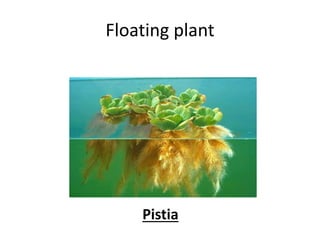
1. Floating plants:
these weeds have there their leaves freely
floating on the surface of water, and roots hanging underneath.
They are profusely found in wind protected ponds and are
harmful as they shade the pond, e.g., Eichhornia, Pisita, Lemna,
Azolla, Wolffia etc.
AQUATIC WEEDS AND
THEIR CONTROL
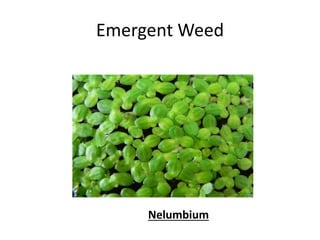
2. Emergent weeds:
these are surface plants which are rooted in the bottom
of the ponds, but their levels on the water surface or rise above the water
level. They prefer shallow parts and shores of the ponds, e.g., nymphea
(Lotus), nelumbium, nymphoides.
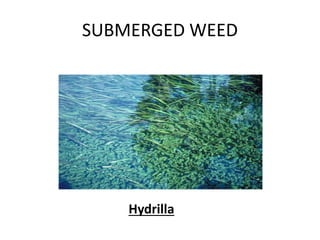
3. Submerged weeds:
these plants grow under the water surface and may
or may not be rooted submerged weeds are Hydrilla, Najas, Vallisneria,
Potamogeton etc. Rootless plants are Ceratophyllum, utricularia etc.
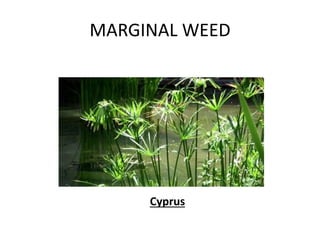
4. Marginal weeds:
these plants grow along the shore line of the pond e.g.,
Typha, Cyperus, Colocasia, Ipomoea, sagittaria etc.
5. Mats or scums:
these formed by filamentous algae and chlamydomonas
e.g., spirogyra, pithophora etc.
SUBMERGED WEED
Hydrilla
Floating plant
Pistia
Emergent Weed
Nelumbium
MARGINAL WEED
Cyprus
Aquatic weeds are harmful as they
consume nutrients of the pond and obstruct
netting operations. They check free movement
of the fish and cause oxygen depletion and
accumulation of carbon-dioxide. Gases like
hydrogen sulphide and methane are formed
which are harmful to the fish. Algal blooms
choke the gills and spoil the water on rotting.
DISADVANTAGES OF WEEDS
aquatic plants, when in limited
quantity are useful and necessary for the
ecology of the pond. They form natural
food of many species of fish, and fertilize
the pond when decayed. They reduce
turbidity and provide spawning beds for
fishes.
Advantage of aquatic weeds
The aquatic weeds can be kept in check by
three methods:
1. Mechanical
2. Chemical
3. Biological
WEED CONTROL
Mechanical removal of weeds by employing human labor or by
machines is the most satisfactory method. In India, where labour is cheap,
manual labour is often employed. Periodical removal of aquatic plants by
hand picking, uprooting or cutting, keeps them in check. During the recent
year, power lifts or diesel operated machines have been used for eradicating
dense rooted vegetation.
several weeds like water hyacinth, Pistia, Salvinia, Azola, and lemna
are the most common floating weeds in ponds and lakes. Complete removal
of these weeds by manual labour, drying and burning it up,is considered the
most effective method of eradication it. Good manure can be obtain by
composting the weed in pits. However, these plant have to be removable
before they emerge again.
WEED CONTROL BY MANUAL AND
MECHANICAL METHODS
Several chemical weedicides are now available for the
control of aquatic weeds, but they have to be used carefully to
prevent adverse effect on the fishes in water . The chemical is to
be selected and used in such a way that:
1. It should be cheap and easily available.
2. Non-toxic to fish and man.
3. Should not pullute the water and
4. Should not involve the use of special and costly equipment.
CHEMICAL CONTROL
Of all the floating weeds, the water hyacinth,
Eichhornia crassipes, is the most common and of
greatest nuisance value. It can be successfully
controlled by the chemical 2,4-dichlorophenoxy acetic
acid (2,4-D). This chemical is applied at the rate of 4.5-
6.5 kg/ha, and has little harmful effect on fish.
3.5 kg of chloroxone in 500-1000 liter of water
can be sprayed on an acre of water. This chemical kills
the plants in 2-3 weeks but is harmless to fish and
operator.
FLOATING WEEDS
Plants like typha, colocasia, sagittaria and grasses
grow alow along the pond margin and harbour
predatory insects. Although the most effective method
is to cut them by manual labour. They can be controlled
by chemical weedicides. Young cyperus and colocasia
are totally killed with 1-1.5% aqueous solution of
traficides-80 a solution of 2,4-D sodium salt (3-4%) with
0.25% surf.
MARGINAL WEEDS
Water lilies and lotus are the common rooted
plants with leaves emerging on the surface. Pulling
them out with manual labour or surface treatment with
chemicals is of little use in eradicating them. Use of
traficde-80 is reported to be effective in controlling
Nelumbo.
EMERGENT WEEDS
Submerged plants like Hydrilla, Vallisneria,
Potamogeton, naja and ceratophyllum are most
trouble-some, and there removal by manual labour is
tedicus and costly. The submerged weeds are kilied if
the water is made is made turbid for a long tirne.
Copper sulphate in combination with ammonium salt is
also found to be effective.
SUBMERGE WEEDS
The filamentous algae rarely become a nuisance,
but sumtimes Spirogyra and pythopthora form
extensive mats. Sodium arsenite is effective in killing
them especially in warm weather. They can be
eradicated by treatment with copper sulphate.
Simazine at a small dose of 0.5-1.0 ppm is also effective
in controlling Microcystis.
ALGAL BLOOMS AND
FILAMENTOUS ALGAE
Several type of weeds can be kept under control
with the help of a few species of herbivorous fishes
such as the Ctenopharyngodon idella and cyprinum
carpio. It has been found that advanced fry and
fingerlings consume wolffia. Advanced fingerlings,
juverniles, lemna, azolla and salvinia. The fish is also
reported to feed on vallisneria and potomogeton.
Inorganic fertilizer mixed with 10%, sodium
nitrate are used for controling submerged weeds like
Najas.
BIOLOGICAL CONTROLE
Plankton include the free floating minute plants and
animal organisms, that have very feeble locomotory organs
and simpaly drift with the water currents. On the bassis of
size. Plankton are divided in to three kind: macro-, micro-,
and nanno- planktons. The macro-plankton include
organisms that are large than 3 mm in size, and visible with
the naked eye, such as larvae, mysids, salpa etc. The largest
forms are also called megaloplanktons. The microplankton
are form below 3 mm in size, while the forms less then then
60 micra in diameter are called nannoplanktons. These
latter can be collected by the finest mesh cloth and
comprises of diatoms, protozoans and bacteria.
PLANKTON & ITS ROLE IN FISHERIES
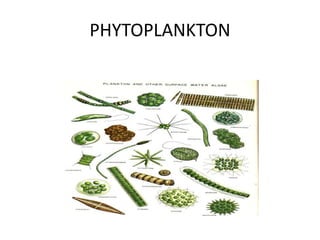
PHYTOPLANKTON
Plankton are also classified as phytoplankton. Of
these the phytoplankton includes organisms with
chlorophyll such as microcystis, volvox etc. as well as
non-photosynthetic plants like bacteria and fungi. It
include all the passivelly floating microscopic plants,
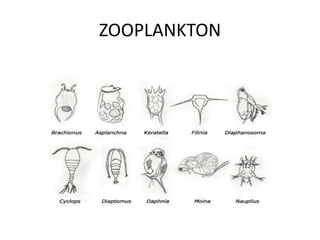
diatoms and dinoflagellates. The zooplankton are minut
animals like the protozoans (radiolaria, forminifer)
rotifer, crustaceans like the copepods, ostracoda,
amphipods, worm, eggs and larvae. The plankton may
be of temporary nature. These consist of planktonic
eggs and are abundant during certain season only,
planktons found throughout the year are called
permanent or holoplankton.
Cont….
Plnkton show a number of adaptation to keep them
floating in the surface water, and prevent sinking. For
example, the cell is relatively large and become bladder-like
filled with alight fluid.
Sesonal qualitative and quantitative fluctuatoin occurs
in the plankton of pond. In fresh water ponds of utter
pradesh peaks of plankton are reported to occur during
spring and monsoonwhile slake period is observed during
summer months.a bimodial pattern of plankton production
has been reported in various ponds,the monsoon peak
consisting mostly of pytoplancton while the winter peak
consists mainly of zooplankton.
Cont…
ZOOPLANKTON
Plankton are used as food by a large number of animal species
including fishthey can also be used as food by man.
The phytoplankton are the producers in the aquatic food
chainand are found in aii waters upto the depth where light
can penetrate.
Certain species of fish feed on phytoplankton such as
multicellular and unicelluar algae,and directly depend on them
for for their existance.
Zooplanktons feed on phytoplanktons and are primary
consumers in the food chain.The planktons form the basic food
for all fish species,directly or indirectly.
PLANKTON AS FOOD
THANK YOU

WEEDS & PLANKTONS AND ITS CONTROL

  • 1.
    WEEDS & PLANKTONSAND ITS CONTROL Balwant Singh Ambreen Wahidy Babasaheb Bhimrao Ambedkar University Lucknow-226025 INDIA balwantsingh1642@gmail.com
  • 2.
    Aquatic weeds arethe undesirable plants that grow in water and are more harmful than beneficial for fish culture. Excessive growth of aquatic vegetation prevent effective utilisation of water and reduces productivity. Depending on their habitats, weeds have been classified into the following groups. 1. Floating plants: these weeds have there their leaves freely floating on the surface of water, and roots hanging underneath. They are profusely found in wind protected ponds and are harmful as they shade the pond, e.g., Eichhornia, Pisita, Lemna, Azolla, Wolffia etc. AQUATIC WEEDS AND THEIR CONTROL
  • 3.
    2. Emergent weeds: theseare surface plants which are rooted in the bottom of the ponds, but their levels on the water surface or rise above the water level. They prefer shallow parts and shores of the ponds, e.g., nymphea (Lotus), nelumbium, nymphoides. 3. Submerged weeds: these plants grow under the water surface and may or may not be rooted submerged weeds are Hydrilla, Najas, Vallisneria, Potamogeton etc. Rootless plants are Ceratophyllum, utricularia etc. 4. Marginal weeds: these plants grow along the shore line of the pond e.g., Typha, Cyperus, Colocasia, Ipomoea, sagittaria etc. 5. Mats or scums: these formed by filamentous algae and chlamydomonas e.g., spirogyra, pithophora etc.
  • 4.
  • 5.
  • 6.
  • 7.
  • 8.
    Aquatic weeds areharmful as they consume nutrients of the pond and obstruct netting operations. They check free movement of the fish and cause oxygen depletion and accumulation of carbon-dioxide. Gases like hydrogen sulphide and methane are formed which are harmful to the fish. Algal blooms choke the gills and spoil the water on rotting. DISADVANTAGES OF WEEDS
  • 9.
    aquatic plants, whenin limited quantity are useful and necessary for the ecology of the pond. They form natural food of many species of fish, and fertilize the pond when decayed. They reduce turbidity and provide spawning beds for fishes. Advantage of aquatic weeds
  • 10.
    The aquatic weedscan be kept in check by three methods: 1. Mechanical 2. Chemical 3. Biological WEED CONTROL
  • 11.
    Mechanical removal ofweeds by employing human labor or by machines is the most satisfactory method. In India, where labour is cheap, manual labour is often employed. Periodical removal of aquatic plants by hand picking, uprooting or cutting, keeps them in check. During the recent year, power lifts or diesel operated machines have been used for eradicating dense rooted vegetation. several weeds like water hyacinth, Pistia, Salvinia, Azola, and lemna are the most common floating weeds in ponds and lakes. Complete removal of these weeds by manual labour, drying and burning it up,is considered the most effective method of eradication it. Good manure can be obtain by composting the weed in pits. However, these plant have to be removable before they emerge again. WEED CONTROL BY MANUAL AND MECHANICAL METHODS
  • 12.
    Several chemical weedicidesare now available for the control of aquatic weeds, but they have to be used carefully to prevent adverse effect on the fishes in water . The chemical is to be selected and used in such a way that: 1. It should be cheap and easily available. 2. Non-toxic to fish and man. 3. Should not pullute the water and 4. Should not involve the use of special and costly equipment. CHEMICAL CONTROL
  • 13.
    Of all thefloating weeds, the water hyacinth, Eichhornia crassipes, is the most common and of greatest nuisance value. It can be successfully controlled by the chemical 2,4-dichlorophenoxy acetic acid (2,4-D). This chemical is applied at the rate of 4.5- 6.5 kg/ha, and has little harmful effect on fish. 3.5 kg of chloroxone in 500-1000 liter of water can be sprayed on an acre of water. This chemical kills the plants in 2-3 weeks but is harmless to fish and operator. FLOATING WEEDS
  • 14.
    Plants like typha,colocasia, sagittaria and grasses grow alow along the pond margin and harbour predatory insects. Although the most effective method is to cut them by manual labour. They can be controlled by chemical weedicides. Young cyperus and colocasia are totally killed with 1-1.5% aqueous solution of traficides-80 a solution of 2,4-D sodium salt (3-4%) with 0.25% surf. MARGINAL WEEDS
  • 15.
    Water lilies andlotus are the common rooted plants with leaves emerging on the surface. Pulling them out with manual labour or surface treatment with chemicals is of little use in eradicating them. Use of traficde-80 is reported to be effective in controlling Nelumbo. EMERGENT WEEDS
  • 16.
    Submerged plants likeHydrilla, Vallisneria, Potamogeton, naja and ceratophyllum are most trouble-some, and there removal by manual labour is tedicus and costly. The submerged weeds are kilied if the water is made is made turbid for a long tirne. Copper sulphate in combination with ammonium salt is also found to be effective. SUBMERGE WEEDS
  • 17.
    The filamentous algaerarely become a nuisance, but sumtimes Spirogyra and pythopthora form extensive mats. Sodium arsenite is effective in killing them especially in warm weather. They can be eradicated by treatment with copper sulphate. Simazine at a small dose of 0.5-1.0 ppm is also effective in controlling Microcystis. ALGAL BLOOMS AND FILAMENTOUS ALGAE
  • 18.
    Several type ofweeds can be kept under control with the help of a few species of herbivorous fishes such as the Ctenopharyngodon idella and cyprinum carpio. It has been found that advanced fry and fingerlings consume wolffia. Advanced fingerlings, juverniles, lemna, azolla and salvinia. The fish is also reported to feed on vallisneria and potomogeton. Inorganic fertilizer mixed with 10%, sodium nitrate are used for controling submerged weeds like Najas. BIOLOGICAL CONTROLE
  • 19.
    Plankton include thefree floating minute plants and animal organisms, that have very feeble locomotory organs and simpaly drift with the water currents. On the bassis of size. Plankton are divided in to three kind: macro-, micro-, and nanno- planktons. The macro-plankton include organisms that are large than 3 mm in size, and visible with the naked eye, such as larvae, mysids, salpa etc. The largest forms are also called megaloplanktons. The microplankton are form below 3 mm in size, while the forms less then then 60 micra in diameter are called nannoplanktons. These latter can be collected by the finest mesh cloth and comprises of diatoms, protozoans and bacteria. PLANKTON & ITS ROLE IN FISHERIES
  • 20.
  • 21.
    Plankton are alsoclassified as phytoplankton. Of these the phytoplankton includes organisms with chlorophyll such as microcystis, volvox etc. as well as non-photosynthetic plants like bacteria and fungi. It include all the passivelly floating microscopic plants, diatoms and dinoflagellates. The zooplankton are minut animals like the protozoans (radiolaria, forminifer) rotifer, crustaceans like the copepods, ostracoda, amphipods, worm, eggs and larvae. The plankton may be of temporary nature. These consist of planktonic eggs and are abundant during certain season only, planktons found throughout the year are called permanent or holoplankton. Cont….
  • 22.
    Plnkton show anumber of adaptation to keep them floating in the surface water, and prevent sinking. For example, the cell is relatively large and become bladder-like filled with alight fluid. Sesonal qualitative and quantitative fluctuatoin occurs in the plankton of pond. In fresh water ponds of utter pradesh peaks of plankton are reported to occur during spring and monsoonwhile slake period is observed during summer months.a bimodial pattern of plankton production has been reported in various ponds,the monsoon peak consisting mostly of pytoplancton while the winter peak consists mainly of zooplankton. Cont…
  • 23.
  • 24.
    Plankton are usedas food by a large number of animal species including fishthey can also be used as food by man. The phytoplankton are the producers in the aquatic food chainand are found in aii waters upto the depth where light can penetrate. Certain species of fish feed on phytoplankton such as multicellular and unicelluar algae,and directly depend on them for for their existance. Zooplanktons feed on phytoplanktons and are primary consumers in the food chain.The planktons form the basic food for all fish species,directly or indirectly. PLANKTON AS FOOD THANK YOU