VIVEKANANDHA
ARTS AND SCIENCE COLLEGE FOR WOMEN
Veerachipalayam - 637 303, Sankagiri, Salem Dt., Tamil Nadu India. Affiliated to
Periyar University, Salem ; Recognised Under Section 2(f) & 12(B) of the UGC Act,
1956 )
SUBJECT INCHARGE:
Dr.R.Mythili,
Assitant professer
Head of the Department,
Department of Microbiology .
DEPARTMENT OF MICROBIOLOGY
TITLE: KINGDOM PLANTAE
SUBMITTED BY:
V.G.Monika lakshmi,
III B.Sc..Microbiology,
Department of Microbiology.
FIVE KINGDOM SYSTEM OF
CLASSIFICATION
INTRODUCTION:
 Its classified from the five kingdom system of classification,
that was proposed by R.H.WHITTAKER (1969), advocated the
a five kingdom system of classification in which the whole
living world has been classified into following five kingdoms.
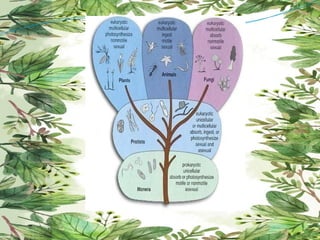
Kingdom monera , (prokaryotic bacteria and blue green algae)
kingdom protista, (unicellular eukaryotic organisms)
kingdom fungi, (multicellular fungi)
kingdom plantae, (all multicellular green plants and alagae)
kingdom animalia. (all multicellular animals)
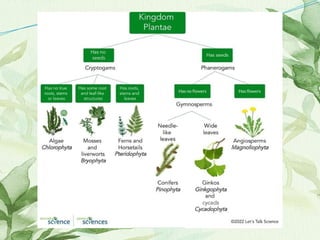
KINGDOM PLANTAE
DEFINITION:
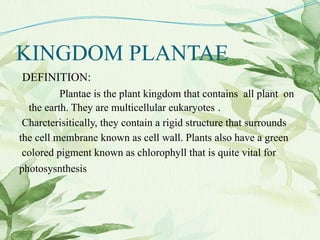
Plantae is the plant kingdom that contains all plant on
the earth. They are multicellular eukaryotes .
Charcterisitically, they contain a rigid structure that surrounds
the cell membrane known as cell wall. Plants also have a green
colored pigment known as chlorophyll that is quite vital for
photosysnthesis
SALIENT FEATURES OF KINGDOM
PLANTAE
 These organisms are autotrophs, that is they manufacture their
own food in the presence of sunlight, water,carbon di oxide, with
the help of chlorophyll by photosynthesis
 cells have a large central vacule and a rigid cell wall composed of
cellulose.
 Mode of nutrition is autotropic. The reserve food material is
starch and fat.
 The plants are mostly non-motile, being anchored to the
substratum. A few froms are free floating in fresh or sea water.
 Growth of plants is indefinite and new organs are continuously
added throughout life.
 Plants are producers of food in the biosphere
CLASSIFICATION OF KINGDOM
PLANTAE:
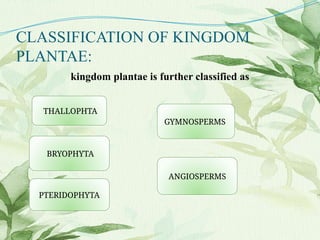
kingdom plantae is further classified as
THALLOPHTA
GYMNOSPERMS
ANGIOSPERMS
BRYOPHYTA
PTERIDOPHYTA
THALLOPHYTA
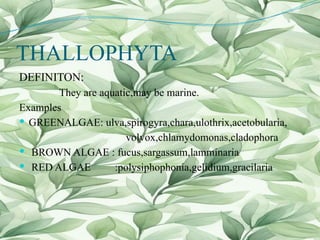
DEFINITON:
They are aquatic,may be marine.
Examples
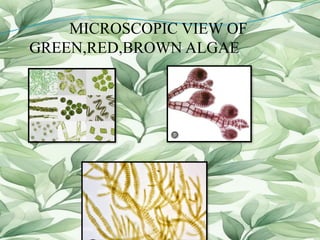
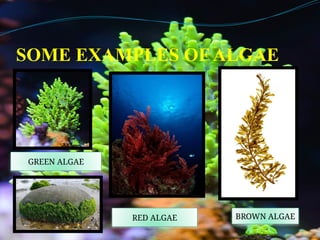
 GREENALGAE: ulva,spirogyra,chara,ulothrix,acetobularia,
volvox,chlamydomonas,cladophora
 BROWN ALGAE : fucus,sargassum,lamminaria
 RED ALGAE :polysiphophonia,gelidium,gracilaria
MICROSCOPIC VIEW OF
GREEN,RED,BROWN ALGAE
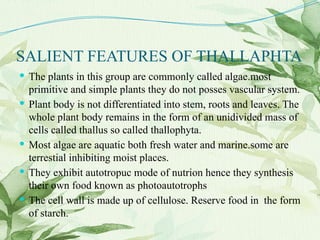
SALIENT FEATURES OF THALLAPHTA
 The plants in this group are commonly called algae.most
primitive and simple plants they do not posses vascular system.
 Plant body is not differentiated into stem, roots and leaves. The
whole plant body remains in the form of an unidivided mass of
cells called thallus so called thallophyta.
 Most algae are aquatic both fresh water and marine.some are
terrestial inhibiting moist places.
 They exhibit autotropuc mode of nutrion hence they synthesis
their own food known as photoautotrophs
 The cell wall is made up of cellulose. Reserve food in the form
of starch.
. some algae algae they grouped in red,green,brown and then
clasified as green algae,red algae,brown algae,..
 Some of algae like chalmydomonas are unicellular,while some
are colonial (volvox),filamentous unbranched
(spirigyra,ulothrix,oedogonium),filamentous branched chara,
cladophora) or with large thallus.
 The mode of reproduction is usually asexual but sexual
reprodution also occur in some forms. The content of
reproductive sytem are completley converted into spore or
gametes.these are simple single celled. Fertilization are not
followed by embryo formation
 Algae the source of about 50% of the total organic matter on
earth
USEFUL ACTIVITES OF ALGAE
 ALGAE AS FOOD: algae is important source of food for aquatic
animal and other mammals including man. Eg chlorella is protein rich
content. Spirulina is richest source of protien.
 ALGAER AS FODDER: many sea weed is used as fodder
sheep,cattle,poutry.
 ALGAE IN INDUSTRY : agar-agar its used in culture media prepared
from red algae like gelidium and gracilaria and other minerals and
elements are also included.
 ALGAE IN AGRICULTURE: its used for nitrogen fixation,soil
relcaimation,fertilization,manures.
 ALGAE IN SEWAGE DISPOSAL: the photosynthetic activity of algae
produce oxygen which is used by bateria for sewage decompostion.
SOME EXAMPLES OF ALGAE
GREEN ALGAE
RED ALGAE BROWN ALGAE
HARMFUL ACTIVITES OF ALGAE
 TOXICITY: some algae produce toxins which cause death to
aquatic animals
 DAMAGE: some algae grow on walls of historical builidings
and monuments and spoil them.
 OTHER EFFECTS: algal growth on ponds,pools and lakes
cause the loss of asthetic and fishing values .many algae
change the taste and colour of water and produce foul odour.
BRYOPHYTA
DEFINITION:
A division of small flowerless green plants which comprises the
mosses and liverworts. They lack true roots and reproduce by spores
released from stalked capsule.
SALIENT FEATURES OF BRYOPHYTA:
 Bryophytes are perhaps the first terrestrial plants having autotropic
mode of nutrition
 They are small,multicellular green plants which inhabit shady damp
places.
 Some bryophytes have a flat green thalloid body (liverworts and
hornworts) while other likemossess have a body which is differentiated
into stem, leaves and rhizoids. Rhizoids are root like structures
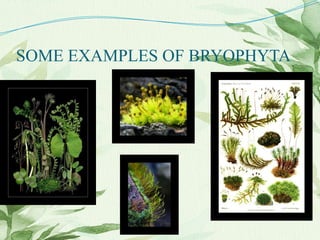
SOME EXAMPLES OF BRYOPHYTA
 Proper roots and flowers are absent. Nthey are non-vascular
plants ie.,xylem and phloem are absent.
 Sex organs are multiceluar. Male sexx organs are antheridia
and female sex organs are archegonia
 Water is requires for fertilization,so bryophytes are called
amphibians of plant kingdom.
EXAMPLE:
Mosses – Funaria,sphagum
Liverworts – Riccia,marchantia
Hornworts – Anthoceros,Notothylas
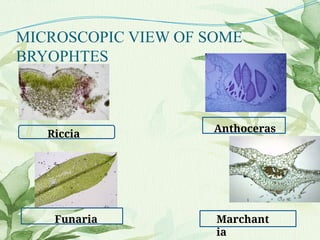
MICROSCOPIC VIEW OF SOME
BRYOPHTES
Marchant
ia
Funaria
Riccia Anthoceras
PTERIDOPHYTA
DEFINITION:
A division of flowerless green plants that comprises the ferns and their
relatives.
SALIENT FEATURES OF PTERIDOPHYTA:
 Pteridophytes are the first territial,vascular plants.
 The plants are sporophytes (diploid) and made up of true roots,true stem, and
true leaves. All the plant possess vascular tissues (xylem and phloem)
organized in definite steles.
 Reproduction occurs by spores produced inside the sporangia.sporangia may
be produced in groups to form sori.sori are born on leaves called sporophyllus.
 Sporangia may be homosporous (one type of spores) or may be heterosporous
(produce two types) smaller microspores and larger megaspores in
sepertaesporangia.
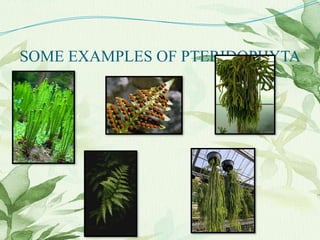
SOME EXAMPLES OF PTERIDOPHYTA
.
 Sex organs are multicellular and jacketed. The male sex organs
are antheridia and female sex organs are archegonia. Flowers
and seeds are not produced. A thin film of water is required for
swimming of male gamates to reach to archegonia. The
fertilized egg develops into embryo.
EXAMPLES:
Horstails – Equisteum
Ferns - Marsilea, Azolla,Pteris
Club mosses – Lycopodium, Selaginella
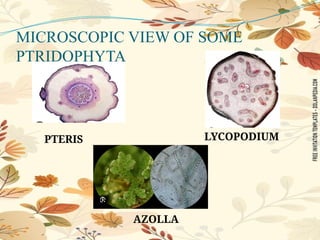
MICROSCOPIC VIEW OF SOME
PTRIDOPHYTA
AZOLLA
LYCOPODIUM
PTERIS
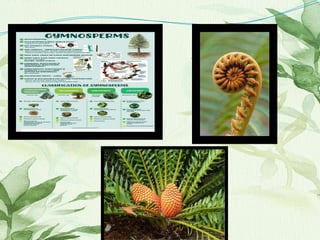
GYMNOSPERMS
DEFINITION :
Gymnosperm, any vascular plant that reproduces by means of an
exposed seed or ovule- unlike angiosperms or flowering plants,
whose seeds are enclosed by mature ovaries or fruits. The seed
of many gynosperms are naked seeds are borne in cones and
are not visible until maturity.
SALIENT FEATURES OF GYMNOSPERMS:
 Gymnosperms consist of evergreen, woody shrubs and trees.
Its mostly large sized sporophytic plants differentiatedinto
roots and stem and leaves.
.
 The roots are generally tap roots, but coralloid roots (roots with
algae) and mycorrhizic roots
(roots with fungi)are known some genera (cycas ,pinus)
 The stem are erect,aerial,branched (pinus) or unbranched
(cycas).
 The leaves are two types (dimorphic).They are microphyllous
and megaphyllus.
 the male spores are called microspores. They produce inside
the microsporangia
 Pollination is anemophilus i.e., wind pollination
 Female gamotophyte is called as endosperm. The dnosperm is
haploid and is pre fertilization tissue
.
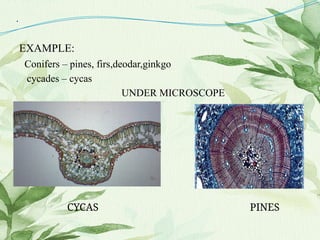
EXAMPLE:
Conifers – pines, firs,deodar,ginkgo
cycades – cycas
UNDER MICROSCOPE
CYCAS PINES
ANGIOSPERM
DEFINITION:
Angiosperms ( in greek, angioon-vessel; sperma-seed) include
flowering plants in which the sees are enclosed in fruits.
SALIENT FEATURES OF ANGIOSPERMS:
 These are usually terrestrial and sporophytic. It includes those
vascular plants which produce flower. The flowers bear
stamens and carpels.
 on the basis conists of monocotyledons (with single
cotyledon) eg; wheat,rice.,
 Dicotyledons (with double cotyledon) eg;pea,gram.,
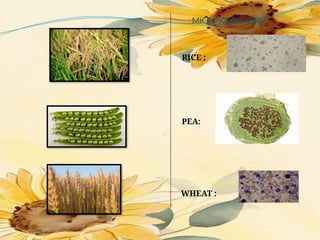
MICROSCOPIC VIEW
RICE :
PEA:
WHEAT :
THANK YOU !

KINGDOM PLANTAE FIVE KINGDOM CLASSIFICATION

  • 1.
    VIVEKANANDHA ARTS AND SCIENCECOLLEGE FOR WOMEN Veerachipalayam - 637 303, Sankagiri, Salem Dt., Tamil Nadu India. Affiliated to Periyar University, Salem ; Recognised Under Section 2(f) & 12(B) of the UGC Act, 1956 ) SUBJECT INCHARGE: Dr.R.Mythili, Assitant professer Head of the Department, Department of Microbiology . DEPARTMENT OF MICROBIOLOGY TITLE: KINGDOM PLANTAE SUBMITTED BY: V.G.Monika lakshmi, III B.Sc..Microbiology, Department of Microbiology.
  • 2.
    FIVE KINGDOM SYSTEMOF CLASSIFICATION INTRODUCTION:  Its classified from the five kingdom system of classification, that was proposed by R.H.WHITTAKER (1969), advocated the a five kingdom system of classification in which the whole living world has been classified into following five kingdoms. Kingdom monera , (prokaryotic bacteria and blue green algae) kingdom protista, (unicellular eukaryotic organisms) kingdom fungi, (multicellular fungi) kingdom plantae, (all multicellular green plants and alagae) kingdom animalia. (all multicellular animals)
  • 4.
    KINGDOM PLANTAE DEFINITION: Plantae isthe plant kingdom that contains all plant on the earth. They are multicellular eukaryotes . Charcterisitically, they contain a rigid structure that surrounds the cell membrane known as cell wall. Plants also have a green colored pigment known as chlorophyll that is quite vital for photosysnthesis
  • 6.
    SALIENT FEATURES OFKINGDOM PLANTAE  These organisms are autotrophs, that is they manufacture their own food in the presence of sunlight, water,carbon di oxide, with the help of chlorophyll by photosynthesis  cells have a large central vacule and a rigid cell wall composed of cellulose.  Mode of nutrition is autotropic. The reserve food material is starch and fat.  The plants are mostly non-motile, being anchored to the substratum. A few froms are free floating in fresh or sea water.  Growth of plants is indefinite and new organs are continuously added throughout life.  Plants are producers of food in the biosphere
  • 7.
    CLASSIFICATION OF KINGDOM PLANTAE: kingdomplantae is further classified as THALLOPHTA GYMNOSPERMS ANGIOSPERMS BRYOPHYTA PTERIDOPHYTA
  • 8.
    THALLOPHYTA DEFINITON: They are aquatic,maybe marine. Examples  GREENALGAE: ulva,spirogyra,chara,ulothrix,acetobularia, volvox,chlamydomonas,cladophora  BROWN ALGAE : fucus,sargassum,lamminaria  RED ALGAE :polysiphophonia,gelidium,gracilaria
  • 9.
  • 10.
    SALIENT FEATURES OFTHALLAPHTA  The plants in this group are commonly called algae.most primitive and simple plants they do not posses vascular system.  Plant body is not differentiated into stem, roots and leaves. The whole plant body remains in the form of an unidivided mass of cells called thallus so called thallophyta.  Most algae are aquatic both fresh water and marine.some are terrestial inhibiting moist places.  They exhibit autotropuc mode of nutrion hence they synthesis their own food known as photoautotrophs  The cell wall is made up of cellulose. Reserve food in the form of starch.
  • 11.
    . some algaealgae they grouped in red,green,brown and then clasified as green algae,red algae,brown algae,..  Some of algae like chalmydomonas are unicellular,while some are colonial (volvox),filamentous unbranched (spirigyra,ulothrix,oedogonium),filamentous branched chara, cladophora) or with large thallus.  The mode of reproduction is usually asexual but sexual reprodution also occur in some forms. The content of reproductive sytem are completley converted into spore or gametes.these are simple single celled. Fertilization are not followed by embryo formation  Algae the source of about 50% of the total organic matter on earth
  • 12.
    USEFUL ACTIVITES OFALGAE  ALGAE AS FOOD: algae is important source of food for aquatic animal and other mammals including man. Eg chlorella is protein rich content. Spirulina is richest source of protien.  ALGAER AS FODDER: many sea weed is used as fodder sheep,cattle,poutry.  ALGAE IN INDUSTRY : agar-agar its used in culture media prepared from red algae like gelidium and gracilaria and other minerals and elements are also included.  ALGAE IN AGRICULTURE: its used for nitrogen fixation,soil relcaimation,fertilization,manures.  ALGAE IN SEWAGE DISPOSAL: the photosynthetic activity of algae produce oxygen which is used by bateria for sewage decompostion.
  • 13.
    SOME EXAMPLES OFALGAE GREEN ALGAE RED ALGAE BROWN ALGAE
  • 14.
    HARMFUL ACTIVITES OFALGAE  TOXICITY: some algae produce toxins which cause death to aquatic animals  DAMAGE: some algae grow on walls of historical builidings and monuments and spoil them.  OTHER EFFECTS: algal growth on ponds,pools and lakes cause the loss of asthetic and fishing values .many algae change the taste and colour of water and produce foul odour.
  • 15.
    BRYOPHYTA DEFINITION: A division ofsmall flowerless green plants which comprises the mosses and liverworts. They lack true roots and reproduce by spores released from stalked capsule. SALIENT FEATURES OF BRYOPHYTA:  Bryophytes are perhaps the first terrestrial plants having autotropic mode of nutrition  They are small,multicellular green plants which inhabit shady damp places.  Some bryophytes have a flat green thalloid body (liverworts and hornworts) while other likemossess have a body which is differentiated into stem, leaves and rhizoids. Rhizoids are root like structures
  • 16.
  • 17.
     Proper rootsand flowers are absent. Nthey are non-vascular plants ie.,xylem and phloem are absent.  Sex organs are multiceluar. Male sexx organs are antheridia and female sex organs are archegonia  Water is requires for fertilization,so bryophytes are called amphibians of plant kingdom. EXAMPLE: Mosses – Funaria,sphagum Liverworts – Riccia,marchantia Hornworts – Anthoceros,Notothylas
  • 18.
    MICROSCOPIC VIEW OFSOME BRYOPHTES Marchant ia Funaria Riccia Anthoceras
  • 19.
    PTERIDOPHYTA DEFINITION: A division offlowerless green plants that comprises the ferns and their relatives. SALIENT FEATURES OF PTERIDOPHYTA:  Pteridophytes are the first territial,vascular plants.  The plants are sporophytes (diploid) and made up of true roots,true stem, and true leaves. All the plant possess vascular tissues (xylem and phloem) organized in definite steles.  Reproduction occurs by spores produced inside the sporangia.sporangia may be produced in groups to form sori.sori are born on leaves called sporophyllus.  Sporangia may be homosporous (one type of spores) or may be heterosporous (produce two types) smaller microspores and larger megaspores in sepertaesporangia.
  • 20.
    SOME EXAMPLES OFPTERIDOPHYTA
  • 21.
    .  Sex organsare multicellular and jacketed. The male sex organs are antheridia and female sex organs are archegonia. Flowers and seeds are not produced. A thin film of water is required for swimming of male gamates to reach to archegonia. The fertilized egg develops into embryo. EXAMPLES: Horstails – Equisteum Ferns - Marsilea, Azolla,Pteris Club mosses – Lycopodium, Selaginella
  • 22.
    MICROSCOPIC VIEW OFSOME PTRIDOPHYTA AZOLLA LYCOPODIUM PTERIS
  • 23.
    GYMNOSPERMS DEFINITION : Gymnosperm, anyvascular plant that reproduces by means of an exposed seed or ovule- unlike angiosperms or flowering plants, whose seeds are enclosed by mature ovaries or fruits. The seed of many gynosperms are naked seeds are borne in cones and are not visible until maturity. SALIENT FEATURES OF GYMNOSPERMS:  Gymnosperms consist of evergreen, woody shrubs and trees. Its mostly large sized sporophytic plants differentiatedinto roots and stem and leaves.
  • 24.
    .  The rootsare generally tap roots, but coralloid roots (roots with algae) and mycorrhizic roots (roots with fungi)are known some genera (cycas ,pinus)  The stem are erect,aerial,branched (pinus) or unbranched (cycas).  The leaves are two types (dimorphic).They are microphyllous and megaphyllus.  the male spores are called microspores. They produce inside the microsporangia  Pollination is anemophilus i.e., wind pollination  Female gamotophyte is called as endosperm. The dnosperm is haploid and is pre fertilization tissue
  • 26.
    . EXAMPLE: Conifers – pines,firs,deodar,ginkgo cycades – cycas UNDER MICROSCOPE CYCAS PINES
  • 27.
    ANGIOSPERM DEFINITION: Angiosperms ( ingreek, angioon-vessel; sperma-seed) include flowering plants in which the sees are enclosed in fruits. SALIENT FEATURES OF ANGIOSPERMS:  These are usually terrestrial and sporophytic. It includes those vascular plants which produce flower. The flowers bear stamens and carpels.  on the basis conists of monocotyledons (with single cotyledon) eg; wheat,rice.,  Dicotyledons (with double cotyledon) eg;pea,gram.,
  • 28.
  • 29.