

Improving the Phenotypic Expression of
Rice Genotypes: Reasons to Rethink
Selection Practices and ‘Intensification’
for Rice Production Systems
Norman Uphoff, Cornell University, USA; Vasilia Fasoula, University of
Georgia, USA; Anas Iswandi, Institut Pertanian Bogor (IPB), Indonesia;
Amir Kassam, University of Reading, UK (presenter); and A.K. Thakur,
Directorate of Water Management, ICAR, India
2014 International Rice Congress, Bangkok
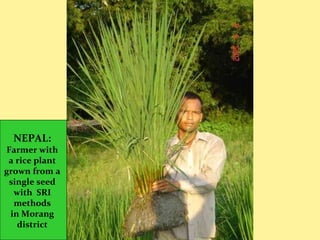
Section C02, Panel E: Improved varieties for
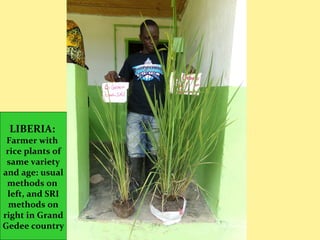
intensive production systems
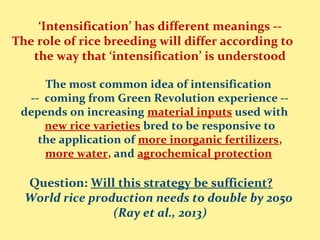
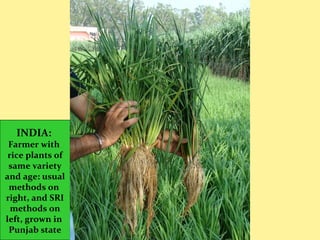
‘Intensification’ has different meanings --
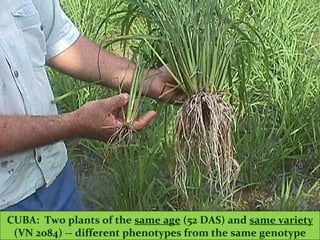
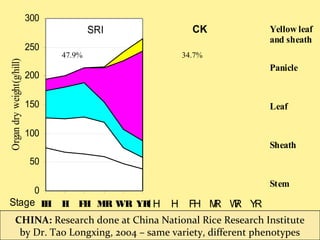
The role of rice breeding will differ according to
the way that ‘intensification’ is understood
The most common idea of intensification
-- coming from Green Revolution experience --
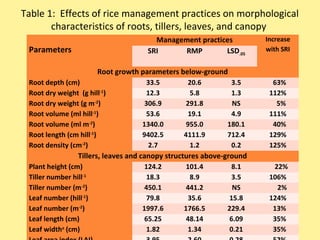
depends on increasing material inputs used with
new rice varieties bred to be responsive to
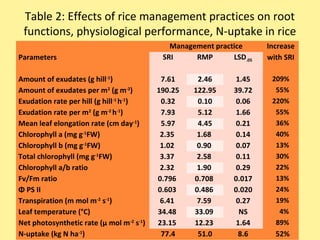
the application of more inorganic fertilizers,
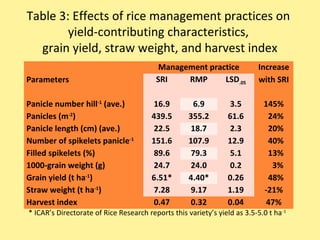
more water, and agrochemical protection
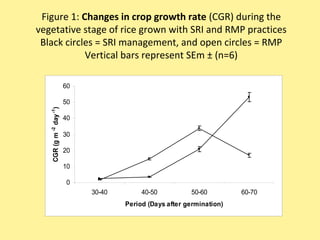
Question: Will this strategy be sufficient?
World rice production needs to double by 2050
(Ray et al., 2013)
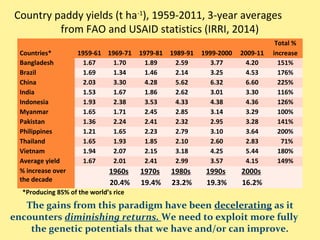
Country paddy yields (t ha-1
), 1959-2011, 3-year averages
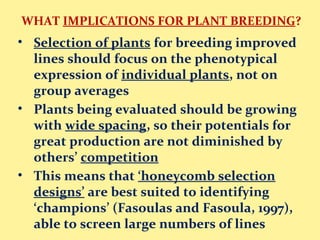
from FAO and USAID statistics (IRRI, 2014)
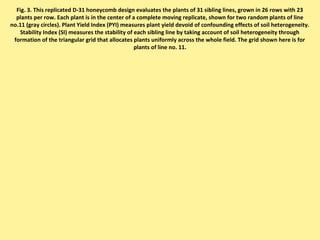
The gains from this paradigm have been decelerating as it
encounters diminishing returns. We need to exploit more fully
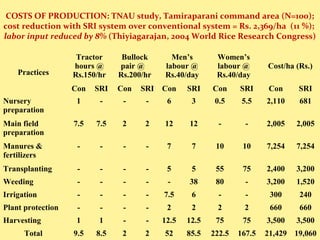
the genetic potentials that we have and/or can improve.
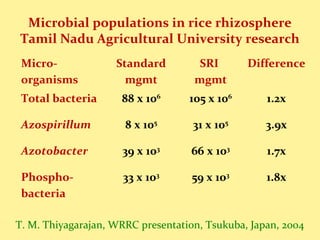
Countries*
 
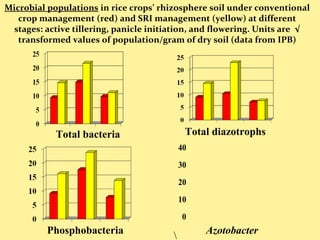
1959-61
 
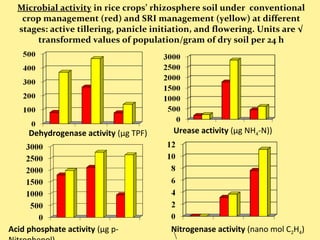
1969-71
 
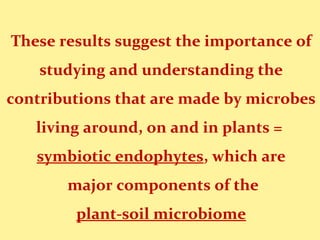
1979-81
 
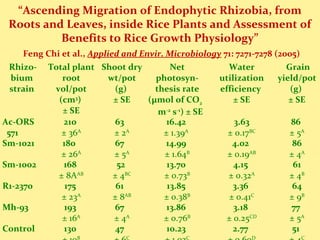
1989-91 1999-2000
 
2009-11
Total % 
increase
Bangladesh 1.67 1.70 1.89 2.59 3.77 4.20 151%
Brazil 1.69 1.34 1.46 2.14 3.25 4.53 176%
China 2.03 3.30 4.28 5.62 6.32 6.60 225%
India 1.53 1.67 1.86 2.62 3.01 3.30 116%
Indonesia 1.93 2.38 3.53 4.33 4.38 4.36 126%
Myanmar 1.65 1.71 2.45 2.85 3.14 3.29 100%
Pakistan 1.36 2.24 2.41 2.32 2.95 3.28 141%
Philippines 1.21 1.65 2.23 2.79 3.10 3.64 200%
Thailand 1.65 1.93 1.85 2.10 2.60 2.83   71%
Vietnam 1.94 2.07 2.15 3.18 4.25 5.44 180%
Average yield 1.67 2.01 2.41 2.99 3.57 4.15 149%
% increase over 
the decade 
  1960s 
20.4%
1970s 
19.4%
1980s 
23.2%
1990s 
19.3%
2000s 
16.2%
 
*Producing 85% of the world’s rice
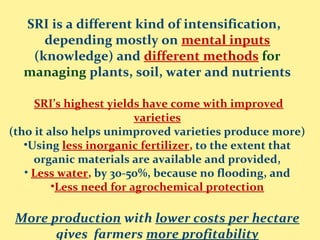
SRI is a different kind of intensification,
depending mostly on mental inputs
(knowledge) and different methods for
managing plants, soil, water and nutrients
SRI’s highest yields have come with improved
varieties
(tho it also helps unimproved varieties produce more)
•Using less inorganic fertilizer, to the extent that
organic materials are available and provided,
• Less water, by 30-50%, because no flooding, and
•Less need for agrochemical protection
More production with lower costs per hectare
gives farmers more profitability
Additional benefits from this kind of
agroecologically-grounded intensification:
More resistance to biotic and abiotic stresses:
•Drought-resistance – tolerate water stress
•Less lodging from wind and rain of storms
•Tolerance of more extreme temperatures
•Resistance to damage from pests and diseases
All are important for dealing with climate change;
also SRI makes net reductions in GHG emissions
Plus shortening of the crop cycle, by 5-15 days, and
higher milling outturn (>10%) because of
fewer unfilled grains and less breakage
So: more rice per unit time and per bag of paddy
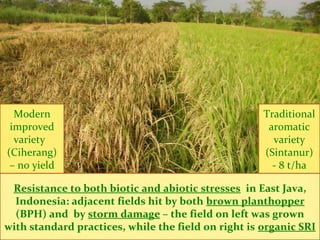
Resistance to both biotic and abiotic stresses in East Java,
Indonesia: adjacent fields hit by both brown planthopper
(BPH) and by storm damage – the field on left was grown
with standard practices, while the field on right is organic SRI
Modern
improved
variety
(Ciherang)
– no yield
Traditional
aromatic
variety
(Sintanur)
- 8 t/ha
How are such effects possible? By eliciting
different, more productive, more resilient
phenotypes from given genotypes
Modification of management practices for
rice plants, soil, water and nutrients leads to
changes in plant morphology and physiology and
at same time to changes in the soil environment:
Pay more attention to E in equation: P = ƒ G + E + GxE
•Get larger, deeper, healthier root systems, and
•More abundant, diverse and active soil biota --
living around, on, and even inside the plants
Both contribute to better plant phenotypes
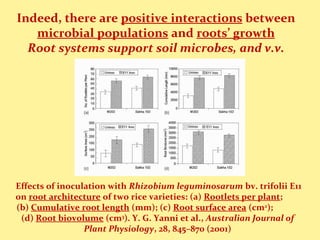
Effects of inoculation with Rhizobium leguminosarum bv. trifolii E11
on root architecture of two rice varieties: (a) Rootlets per plant;
(b) Cumulative root length (mm); (c) Root surface area (cm2
);
(d) Root biovolume (cm3
). Y. G. Yanni et al., Australian Journal of
Plant Physiology, 28, 845–870 (2001)
Indeed, there are positive interactions between
microbial populations and roots’ growth
Root systems support soil microbes, and v.v.
NEPAL:
Farmer with
a rice plant
grown from a
single seed
with SRI
methods
in Morang
district
LIBERIA:
Farmer with
rice plants of
same variety
and age: usual
methods on
left, and SRI
methods on
right in Grand
Gedee country
INDIA:
Farmer with
rice plants of
same variety
and age: usual
methods on
right, and SRI
methods on
left, grown in
Punjab state
CUBA: Two plants of the same age (52 DAS) and same variety
(VN 2084) -- different phenotypes from the same genotype
SRI
0
50
100
150
200
250
300
IH H FH MR WR YRStage
Organdryweight(g/hill)
I H H FH MR WR YR
CK Yellow leaf
and sheath
Panicle
Leaf
Sheath
Stem
47.9% 34.7%
CHINA: Research done at China National Rice Research Institute
by Dr. Tao Longxing, 2004 – same variety, different phenotypes
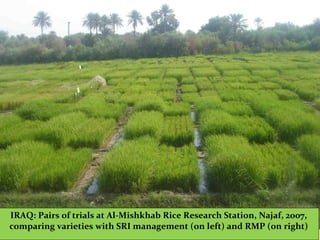
IRAQ: Pairs of trials at Al-Mishkhab Rice Research Station, Najaf, 2007,
comparing varieties with SRI management (on left) and RMP (on right)
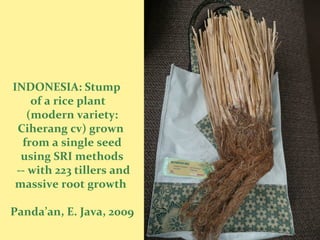
INDONESIA: Stump
of a rice plant
(modern variety:
Ciherang cv) grown
from a single seed
using SRI methods
-- with 223 tillers and
massive root growth
Panda’an, E. Java, 2009
Data from comparative evaluations of SRI effects
on the physiology and morphology of rice plants,
conducted 2005-10 at ICAR’s Directorate of Water
Management in Bhubaneswar, India
The variety planted was Surendra (IET-12815),
130-135 days, usual yield 3.5-5.0 t ha-1
(DRD, 2006)
Published by Thakur et al. in Exper. Agric. (2010),
Paddy & Water Envir. (2011), Plant & Soil (2013)
SRI practices and RMP were taken from the
respective websites of SRI-Rice (Cornell) and
the Central Rice Research Institute (Cuttack)
Table 1: Effects of rice management practices on morphological
characteristics of roots, tillers, leaves, and canopy
 
Parameters
Management practices Increase 
with SRISRI RMP LSD.05
Root growth parameters below-ground
Root depth (cm) 33.5 20.6 3.5   63%
Root dry weight  (g hill-1
) 12.3 5.8 1.3 112%
Root dry weight (g m-2
) 306.9 291.8 NS     5%
Root volume (ml hill-1
) 53.6 19.1 4.9 111%
Root volume (ml m-2
) 1340.0 955.0 180.1   40%
Root length (cm hill-1
) 9402.5 4111.9 712.4 129%
Root density (cm-2
) 2.7 1.2 0.2 125%
Tillers, leaves and canopy structures above-ground
Plant height (cm) 124.2 101.4 8.1     22%
Tiller number hill-1
18.3 8.9 3.5 106%
Tiller number (m-2
) 450.1 441.2 NS      2%
Leaf number (hill-1
) 79.8 35.6 15.8 124%
Leaf number (m-2
) 1997.6 1766.5 229.4   13%
Leaf length (cm) 65.25 48.14 6.09   35%
Leaf widtha
 (cm) 1.82 1.34 0.21   35%
Table 2: Effects of rice management practices on root
functions, physiological performance, N-uptake in rice
Parameters
Management practice Increase 
with SRISRI RMP LSD.05
Amount of exudates (g hill-1
) 7.61 2.46 1.45 209%
Amount of exudates per m2
 (g m-2
) 190.25 122.95 39.72   55%
Exudation rate per hill (g hill-1 
h-1
) 0.32 0.10 0.06 220%
Exudation rate per m2
 (g m-2 
h-1
) 7.93 5.12 1.66   55%
Mean leaf elongation rate (cm day-1
) 5.97 4.45 0.21   36%
Chlorophyll a (mg g-1
FW) 2.35  1.68  0.14   40%
Chlorophyll b (mg g-1
FW) 1.02  0.90  0.07   13%
Total chlorophyll (mg g-1
FW) 3.37  2.58  0.11   30%
Chlorophyll a/b ratio 2.32  1.90  0.29   22%
Fv/Fm ratio 0.796  0.708  0.017   13%
Φ PS II 0.603  0.486  0.020   24%
Transpiration (m mol m-2
 s-1
) 6.41  7.59  0.27   19%
Leaf temperature (°C) 34.48  33.09  NS     4%
Net photosynthetic rate (μ mol m-2
 s-1
) 23.15  12.23  1.64   89%
N-uptake (kg N ha-1
) 77.4 51.0 8.6   52%
Table 3: Effects of rice management practices on
yield-contributing characteristics,
grain yield, straw weight, and harvest index
 
Parameters
Management practice Increase 
with SRISRI RMP LSD.05
Panicle number hill-1
 (ave.) 16.9 6.9 3.5 145%
Panicles (m-2
) 439.5 355.2 61.6   24%
Panicle length (cm) (ave.) 22.5 18.7 2.3   20%
Number of spikelets panicle-1
151.6 107.9 12.9   40%
Filled spikelets (%) 89.6 79.3 5.1   13%
1000-grain weight (g) 24.7 24.0 0.2     3%
Grain yield (t ha-1
) 6.51* 4.40* 0.26   48%
Straw weight (t ha-1
) 7.28 9.17 1.19 -21%
Harvest index 0.47 0.32 0.04 47%
* ICAR’s Directorate of Rice Research reports this variety’s yield as 3.5-5.0 t ha-1
Figure 1: Changes in crop growth rate (CGR) during the
vegetative stage of rice grown with SRI and RMP practices
Black circles = SRI management, and open circles = RMP
Vertical bars represent SEm ± (n=6)
0
10
20
30
40
50
60
30-40 40-50 50-60 60-70
Period (Days after germination)
CGR(gm-2
day-1
)
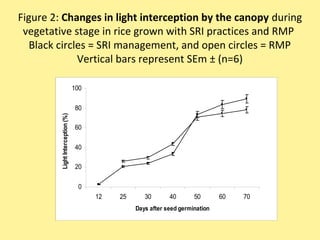
Figure 2: Changes in light interception by the canopy during
vegetative stage in rice grown with SRI practices and RMP
Black circles = SRI management, and open circles = RMP
Vertical bars represent SEm ± (n=6)
0
20
40
60
80
100
12 25 30 40 50 60 70
Days after seed germination
LightInterception(%)
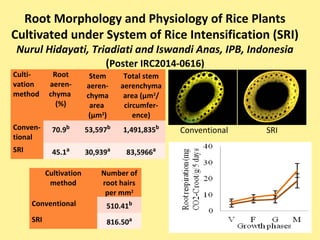
Root Morphology and Physiology of Rice Plants
Cultivated under System of Rice Intensification (SRI)
Nurul Hidayati, Triadiati and Iswandi Anas, IPB, Indonesia
(Poster IRC2014-0616)
Culti-
vation
method
Root
aeren-
chyma
(%)
Stem
aeren-
chyma
area
(µm2
)
Total stem
aerenchyma
area (µm2
/
circumfer-
ence)
Conven-
tional
70.9b
53,597b
1,491,835b
SRI 45.1a
30,939a
83,5966a
Cultivation
method
Number of
root hairs
per mm2
Conventional 510.41b
SRI 816.50a
Conventional SRI
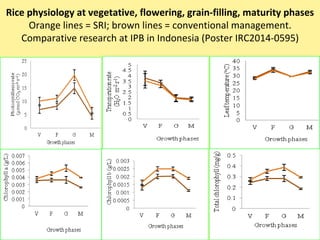
Rice physiology at vegetative, flowering, grain-filling, maturity phases
Orange lines = SRI; brown lines = conventional management.
Comparative research at IPB in Indonesia (Poster IRC2014-0595)
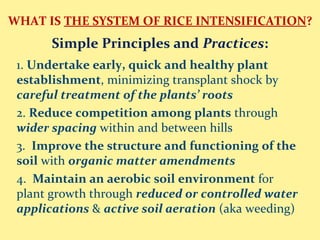
WHAT IS THE SYSTEM OF RICE INTENSIFICATION?
Simple Principles and Practices:
1. Undertake early, quick and healthy plant
establishment, minimizing transplant shock by
careful treatment of the plants’ roots
2. Reduce competition among plants through
wider spacing within and between hills
3. Improve the structure and functioning of the
soil with organic matter amendments
4. Maintain an aerobic soil environment for
plant growth through reduced or controlled water
applications & active soil aeration (aka weeding)
WHAT IMPLICATIONS FOR PLANT BREEDING?
• Selection of plants for breeding improved
lines should focus on the phenotypical
expression of individual plants, not on
group averages
• Plants being evaluated should be growing
with wide spacing, so their potentials for
great production are not diminished by
others’ competition
• This means that ‘honeycomb selection
designs’ are best suited to identifying
‘champions’ (Fasoulas and Fasoula, 1997),
able to screen large numbers of lines
Fig. 3. This replicated D-31 honeycomb design evaluates the plants of 31 sibling lines, grown in 26 rows with 23
plants per row. Each plant is in the center of a complete moving replicate, shown for two random plants of line
no.11 (gray circles). Plant Yield Index (PYI) measures plant yield devoid of confounding effects of soil heterogeneity.
Stability Index (SI) measures the stability of each sibling line by taking account of soil heterogeneity through
formation of the triangular grid that allocates plants uniformly across the whole field. The grid shown here is for
plants of line no. 11.
This strategy deals with a genetic relationship that
confounds conventional plant breeding strategies
• Genes for productivity are inversely related to
genes for competition (Fasoula, Euphytica,
1990; Fasoula & Fasoula, Plant Breeding
Review, 1997; Field Crops Research, 2002)
• Selection of ‘champions’ growing within
dense populations -- where genes for
competition are expressed -- will favor strong
competitors/ weak yielders over their
opposites
• The aim of breeding should be to select
density-neutral best producers, with all
plants in a population producing at their
COSTS OF PRODUCTION: TNAU study, Tamiraparani command area (N=100);
cost reduction with SRI system over conventional system = Rs. 2,369/ha (11 %);
labor input reduced by 8% (Thiyiagarajan, 2004 World Rice Research Congress)
Practices
Tractor
hours @
Rs.150/hr
Bullock
pair @
Rs.200/hr
Men’s
labour @
Rs.40/day
Women’s
labour @
Rs.40/day
Cost/ha (Rs.)
Con SRI Con SRI Con SRI Con SRI Con SRI
Nursery
preparation
1 - - - 6 3 0.5 5.5 2,110 681
Main field
preparation
7.5 7.5 2 2 12 12 - - 2,005 2,005
Manures &
fertilizers
- - - - 7 7 10 10 7,254 7,254
Transplanting - - - - 5 5 55 75 2,400 3,200
Weeding - - - - - 38 80 - 3,200 1,520
Irrigation - - - - 7.5 6 - - 300 240
Plant protection - - - - 2 2 2 2 660 660
Harvesting 1 1 - - 12.5 12.5 75 75 3,500 3,500
Total 9.5 8.5 2 2 52 85.5 222.5 167.5 21,429 19,060
Microbial populations in rice rhizosphere
Tamil Nadu Agricultural University research
Micro-
organisms
Standard
mgmt
SRI
mgmt
Difference
Total bacteria 88 x 106
105 x 106
1.2x
Azospirillum 8 x 10⁵
31 x 105
3.9x
Azotobacter 39 x 103
66 x 103
1.7x
Phospho-
bacteria
33 x 103
59 x 103
1.8x
T. M. Thiyagarajan, WRRC presentation, Tsukuba, Japan, 2004
Total bacteria Total diazotrophs
Microbial populations in rice crops’ rhizosphere soil under conventional
crop management (red) and SRI management (yellow) at different
stages: active tillering, panicle initiation, and flowering. Units are √
transformed values of population/gram of dry soil (data from IPB)
Phosphobacteria

Azotobacter
0
10
20
30
40
Dehydrogenase activity (μg TPF) Urease activity (μg NH4-N))
Microbial activity in rice crops’ rhizosphere soil under conventional
crop management (red) and SRI management (yellow) at different
stages: active tillering, panicle initiation, and flowering. Units are √
transformed values of population/gram of dry soil per 24 h
Acid phosphate activity (μg p-

Nitrogenase activity (nano mol C2H4)
These results suggest the importance of
studying and understanding the
contributions that are made by microbes
living around, on and in plants =
symbiotic endophytes, which are
major components of the
plant-soil microbiome
“Ascending Migration of Endophytic Rhizobia, from
Roots and Leaves, inside Rice Plants and Assessment of
Benefits to Rice Growth Physiology”
Feng Chi et al., Applied and Envir. Microbiology 71: 7271-7278 (2005)
Rhizo-
bium
strain
Total plant
root
vol/pot
(cm3
)
± SE
Shoot dry
wt/pot
(g)
± SE
Net
photosyn-
thesis rate
(µmol of CO2
m-2
s-1
) ± SE
Water
utilization
efficiency
± SE
Grain
yield/pot
(g)
± SE
Ac-ORS
571
210
± 36A
63
± 2A
16.42
± 1.39A
3.63
± 0.17BC
86
± 5A
Sm-1021 180
± 26A
67
± 5A
14.99
± 1.64B
4.02
± 0.19AB
86
± 4A
Sm-1002 168
± 8AAB
52
± 4BC
13.70
± 0.73B
4.15
± 0.32A
61
± 4B
R1-2370 175
± 23A
61
± 8AB
13.85
± 0.38B
3.36
± 0.41C
64
± 9B
Mh-93 193
± 16A
67
± 4A
13.86
± 0.76B
3.18
± 0.25CD
77
± 5A
Control 130
B
47
C
10.23
C
2.77
D
51
C
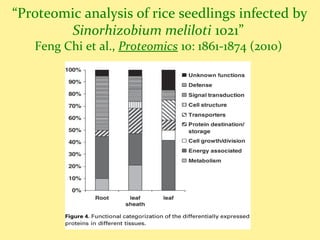
“Proteomic analysis of rice seedlings infected by
Sinorhizobium meliloti 1021”
Feng Chi et al., Proteomics 10: 1861-1874 (2010)
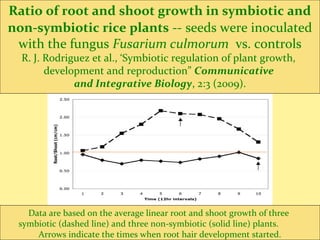
Data are based on the average linear root and shoot growth of three
symbiotic (dashed line) and three non-symbiotic (solid line) plants.
Arrows indicate the times when root hair development started.
Ratio of root and shoot growth in symbiotic and
non-symbiotic rice plants -- seeds were inoculated
with the fungus Fusarium culmorum vs. controls
R. J. Rodriguez et al., ‘Symbiotic regulation of plant growth,
development and reproduction” Communicative
and Integrative Biology, 2:3 (2009).
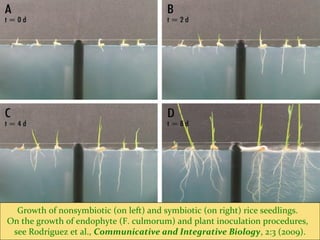
Growth of nonsymbiotic (on left) and symbiotic (on right) rice seedlings.
On the growth of endophyte (F. culmorum) and plant inoculation procedures,
see Rodriguez et al., Communicative and Integrative Biology, 2:3 (2009).
More productive phenotypes also can give
higher water-use efficiency as measured by
the ratio of photosynthesis to transpiration
For each 1 millimol of water lost by transpiration:
3.6 micromols of CO2 are fixed in SRI plants,
1.6 micromols of CO2 are fixed in RMP plants
This becomes more important with climate change
and as water becomes a scarcer factor of production
“An assessment of physiological effects of the System of Rice
Intensification (SRI) compared with recommended rice cultivation
practices in India,” A.K. Thakur, N. Uphoff and E. Antony
Experimental Agriculture, 46(1), 77-98 (2010)
Economics, environmental vulnerabilities,
and climate change effects will require a
different kind of agriculture in 21st
century.
We need to REBIOLOGIZE AGRICULTURE
Fortunately, opportunities for a paradigm shift
are available; but they will require significant
changes in our crop and soil sciences
Work in microbiology, crop physiology, soil ecology,
and esp. epigenetics needs to become more central
to agricultural research and development
THANK YOU
Web page: http://sri.ciifad.cornell.edu/
Email: ntu1@cornell.edu [NTU-one]

1445 - Improving the Phenotypic Expression of Rice Genotypes: Reasons to Rethink Selection Practices and ‘Intensification’ for Rice Production Systems

  • 1.
    Improving the PhenotypicExpression of Rice Genotypes: Reasons to Rethink Selection Practices and ‘Intensification’ for Rice Production Systems Norman Uphoff, Cornell University, USA; Vasilia Fasoula, University of Georgia, USA; Anas Iswandi, Institut Pertanian Bogor (IPB), Indonesia; Amir Kassam, University of Reading, UK (presenter); and A.K. Thakur, Directorate of Water Management, ICAR, India 2014 International Rice Congress, Bangkok Section C02, Panel E: Improved varieties for intensive production systems
  • 2.
    ‘Intensification’ has differentmeanings -- The role of rice breeding will differ according to the way that ‘intensification’ is understood The most common idea of intensification -- coming from Green Revolution experience -- depends on increasing material inputs used with new rice varieties bred to be responsive to the application of more inorganic fertilizers, more water, and agrochemical protection Question: Will this strategy be sufficient? World rice production needs to double by 2050 (Ray et al., 2013)
  • 3.
    Country paddy yields(t ha-1 ), 1959-2011, 3-year averages from FAO and USAID statistics (IRRI, 2014) The gains from this paradigm have been decelerating as it encounters diminishing returns. We need to exploit more fully the genetic potentials that we have and/or can improve. Countries*   1959-61   1969-71   1979-81   1989-91 1999-2000   2009-11 Total %  increase Bangladesh 1.67 1.70 1.89 2.59 3.77 4.20 151% Brazil 1.69 1.34 1.46 2.14 3.25 4.53 176% China 2.03 3.30 4.28 5.62 6.32 6.60 225% India 1.53 1.67 1.86 2.62 3.01 3.30 116% Indonesia 1.93 2.38 3.53 4.33 4.38 4.36 126% Myanmar 1.65 1.71 2.45 2.85 3.14 3.29 100% Pakistan 1.36 2.24 2.41 2.32 2.95 3.28 141% Philippines 1.21 1.65 2.23 2.79 3.10 3.64 200% Thailand 1.65 1.93 1.85 2.10 2.60 2.83   71% Vietnam 1.94 2.07 2.15 3.18 4.25 5.44 180% Average yield 1.67 2.01 2.41 2.99 3.57 4.15 149% % increase over  the decade    1960s  20.4% 1970s  19.4% 1980s  23.2% 1990s  19.3% 2000s  16.2%   *Producing 85% of the world’s rice
  • 4.
    SRI is adifferent kind of intensification, depending mostly on mental inputs (knowledge) and different methods for managing plants, soil, water and nutrients SRI’s highest yields have come with improved varieties (tho it also helps unimproved varieties produce more) •Using less inorganic fertilizer, to the extent that organic materials are available and provided, • Less water, by 30-50%, because no flooding, and •Less need for agrochemical protection More production with lower costs per hectare gives farmers more profitability
  • 5.
    Additional benefits fromthis kind of agroecologically-grounded intensification: More resistance to biotic and abiotic stresses: •Drought-resistance – tolerate water stress •Less lodging from wind and rain of storms •Tolerance of more extreme temperatures •Resistance to damage from pests and diseases All are important for dealing with climate change; also SRI makes net reductions in GHG emissions Plus shortening of the crop cycle, by 5-15 days, and higher milling outturn (>10%) because of fewer unfilled grains and less breakage So: more rice per unit time and per bag of paddy
  • 6.
    Resistance to bothbiotic and abiotic stresses in East Java, Indonesia: adjacent fields hit by both brown planthopper (BPH) and by storm damage – the field on left was grown with standard practices, while the field on right is organic SRI Modern improved variety (Ciherang) – no yield Traditional aromatic variety (Sintanur) - 8 t/ha
  • 7.
    How are sucheffects possible? By eliciting different, more productive, more resilient phenotypes from given genotypes Modification of management practices for rice plants, soil, water and nutrients leads to changes in plant morphology and physiology and at same time to changes in the soil environment: Pay more attention to E in equation: P = ƒ G + E + GxE •Get larger, deeper, healthier root systems, and •More abundant, diverse and active soil biota -- living around, on, and even inside the plants Both contribute to better plant phenotypes
  • 8.
    Effects of inoculationwith Rhizobium leguminosarum bv. trifolii E11 on root architecture of two rice varieties: (a) Rootlets per plant; (b) Cumulative root length (mm); (c) Root surface area (cm2 ); (d) Root biovolume (cm3 ). Y. G. Yanni et al., Australian Journal of Plant Physiology, 28, 845–870 (2001) Indeed, there are positive interactions between microbial populations and roots’ growth Root systems support soil microbes, and v.v.
  • 9.
    NEPAL: Farmer with a riceplant grown from a single seed with SRI methods in Morang district
  • 10.
    LIBERIA: Farmer with rice plantsof same variety and age: usual methods on left, and SRI methods on right in Grand Gedee country
  • 11.
    INDIA: Farmer with rice plantsof same variety and age: usual methods on right, and SRI methods on left, grown in Punjab state
  • 12.
    CUBA: Two plantsof the same age (52 DAS) and same variety (VN 2084) -- different phenotypes from the same genotype
  • 13.
    SRI 0 50 100 150 200 250 300 IH H FHMR WR YRStage Organdryweight(g/hill) I H H FH MR WR YR CK Yellow leaf and sheath Panicle Leaf Sheath Stem 47.9% 34.7% CHINA: Research done at China National Rice Research Institute by Dr. Tao Longxing, 2004 – same variety, different phenotypes
  • 14.
    IRAQ: Pairs oftrials at Al-Mishkhab Rice Research Station, Najaf, 2007, comparing varieties with SRI management (on left) and RMP (on right)
  • 15.
    INDONESIA: Stump of arice plant (modern variety: Ciherang cv) grown from a single seed using SRI methods -- with 223 tillers and massive root growth Panda’an, E. Java, 2009
  • 16.
    Data from comparativeevaluations of SRI effects on the physiology and morphology of rice plants, conducted 2005-10 at ICAR’s Directorate of Water Management in Bhubaneswar, India The variety planted was Surendra (IET-12815), 130-135 days, usual yield 3.5-5.0 t ha-1 (DRD, 2006) Published by Thakur et al. in Exper. Agric. (2010), Paddy & Water Envir. (2011), Plant & Soil (2013) SRI practices and RMP were taken from the respective websites of SRI-Rice (Cornell) and the Central Rice Research Institute (Cuttack)
  • 17.
    Table 1: Effectsof rice management practices on morphological characteristics of roots, tillers, leaves, and canopy   Parameters Management practices Increase  with SRISRI RMP LSD.05 Root growth parameters below-ground Root depth (cm) 33.5 20.6 3.5   63% Root dry weight  (g hill-1 ) 12.3 5.8 1.3 112% Root dry weight (g m-2 ) 306.9 291.8 NS     5% Root volume (ml hill-1 ) 53.6 19.1 4.9 111% Root volume (ml m-2 ) 1340.0 955.0 180.1   40% Root length (cm hill-1 ) 9402.5 4111.9 712.4 129% Root density (cm-2 ) 2.7 1.2 0.2 125% Tillers, leaves and canopy structures above-ground Plant height (cm) 124.2 101.4 8.1     22% Tiller number hill-1 18.3 8.9 3.5 106% Tiller number (m-2 ) 450.1 441.2 NS      2% Leaf number (hill-1 ) 79.8 35.6 15.8 124% Leaf number (m-2 ) 1997.6 1766.5 229.4   13% Leaf length (cm) 65.25 48.14 6.09   35% Leaf widtha  (cm) 1.82 1.34 0.21   35%
  • 18.
    Table 2: Effectsof rice management practices on root functions, physiological performance, N-uptake in rice Parameters Management practice Increase  with SRISRI RMP LSD.05 Amount of exudates (g hill-1 ) 7.61 2.46 1.45 209% Amount of exudates per m2  (g m-2 ) 190.25 122.95 39.72   55% Exudation rate per hill (g hill-1  h-1 ) 0.32 0.10 0.06 220% Exudation rate per m2  (g m-2  h-1 ) 7.93 5.12 1.66   55% Mean leaf elongation rate (cm day-1 ) 5.97 4.45 0.21   36% Chlorophyll a (mg g-1 FW) 2.35  1.68  0.14   40% Chlorophyll b (mg g-1 FW) 1.02  0.90  0.07   13% Total chlorophyll (mg g-1 FW) 3.37  2.58  0.11   30% Chlorophyll a/b ratio 2.32  1.90  0.29   22% Fv/Fm ratio 0.796  0.708  0.017   13% Φ PS II 0.603  0.486  0.020   24% Transpiration (m mol m-2  s-1 ) 6.41  7.59  0.27   19% Leaf temperature (°C) 34.48  33.09  NS     4% Net photosynthetic rate (μ mol m-2  s-1 ) 23.15  12.23  1.64   89% N-uptake (kg N ha-1 ) 77.4 51.0 8.6   52%
  • 19.
    Table 3: Effectsof rice management practices on yield-contributing characteristics, grain yield, straw weight, and harvest index   Parameters Management practice Increase  with SRISRI RMP LSD.05 Panicle number hill-1  (ave.) 16.9 6.9 3.5 145% Panicles (m-2 ) 439.5 355.2 61.6   24% Panicle length (cm) (ave.) 22.5 18.7 2.3   20% Number of spikelets panicle-1 151.6 107.9 12.9   40% Filled spikelets (%) 89.6 79.3 5.1   13% 1000-grain weight (g) 24.7 24.0 0.2     3% Grain yield (t ha-1 ) 6.51* 4.40* 0.26   48% Straw weight (t ha-1 ) 7.28 9.17 1.19 -21% Harvest index 0.47 0.32 0.04 47% * ICAR’s Directorate of Rice Research reports this variety’s yield as 3.5-5.0 t ha-1
  • 20.
    Figure 1: Changes in crop growth rate(CGR) during the vegetative stage of rice grown with SRI and RMP practices Black circles = SRI management, and open circles = RMP Vertical bars represent SEm ± (n=6) 0 10 20 30 40 50 60 30-40 40-50 50-60 60-70 Period (Days after germination) CGR(gm-2 day-1 )
  • 21.
    Figure 2: Changesin light interception by the canopy during vegetative stage in rice grown with SRI practices and RMP Black circles = SRI management, and open circles = RMP Vertical bars represent SEm ± (n=6) 0 20 40 60 80 100 12 25 30 40 50 60 70 Days after seed germination LightInterception(%)
  • 22.
    Root Morphology andPhysiology of Rice Plants Cultivated under System of Rice Intensification (SRI) Nurul Hidayati, Triadiati and Iswandi Anas, IPB, Indonesia (Poster IRC2014-0616) Culti- vation method Root aeren- chyma (%) Stem aeren- chyma area (µm2 ) Total stem aerenchyma area (µm2 / circumfer- ence) Conven- tional 70.9b 53,597b 1,491,835b SRI 45.1a 30,939a 83,5966a Cultivation method Number of root hairs per mm2 Conventional 510.41b SRI 816.50a Conventional SRI
  • 23.
    Rice physiology atvegetative, flowering, grain-filling, maturity phases Orange lines = SRI; brown lines = conventional management. Comparative research at IPB in Indonesia (Poster IRC2014-0595)
  • 24.
    WHAT IS THESYSTEM OF RICE INTENSIFICATION? Simple Principles and Practices: 1. Undertake early, quick and healthy plant establishment, minimizing transplant shock by careful treatment of the plants’ roots 2. Reduce competition among plants through wider spacing within and between hills 3. Improve the structure and functioning of the soil with organic matter amendments 4. Maintain an aerobic soil environment for plant growth through reduced or controlled water applications & active soil aeration (aka weeding)
  • 25.
    WHAT IMPLICATIONS FORPLANT BREEDING? • Selection of plants for breeding improved lines should focus on the phenotypical expression of individual plants, not on group averages • Plants being evaluated should be growing with wide spacing, so their potentials for great production are not diminished by others’ competition • This means that ‘honeycomb selection designs’ are best suited to identifying ‘champions’ (Fasoulas and Fasoula, 1997), able to screen large numbers of lines
  • 26.
    Fig. 3. Thisreplicated D-31 honeycomb design evaluates the plants of 31 sibling lines, grown in 26 rows with 23 plants per row. Each plant is in the center of a complete moving replicate, shown for two random plants of line no.11 (gray circles). Plant Yield Index (PYI) measures plant yield devoid of confounding effects of soil heterogeneity. Stability Index (SI) measures the stability of each sibling line by taking account of soil heterogeneity through formation of the triangular grid that allocates plants uniformly across the whole field. The grid shown here is for plants of line no. 11.
  • 27.
    This strategy dealswith a genetic relationship that confounds conventional plant breeding strategies • Genes for productivity are inversely related to genes for competition (Fasoula, Euphytica, 1990; Fasoula & Fasoula, Plant Breeding Review, 1997; Field Crops Research, 2002) • Selection of ‘champions’ growing within dense populations -- where genes for competition are expressed -- will favor strong competitors/ weak yielders over their opposites • The aim of breeding should be to select density-neutral best producers, with all plants in a population producing at their
  • 28.
    COSTS OF PRODUCTION:TNAU study, Tamiraparani command area (N=100); cost reduction with SRI system over conventional system = Rs. 2,369/ha (11 %); labor input reduced by 8% (Thiyiagarajan, 2004 World Rice Research Congress) Practices Tractor hours @ Rs.150/hr Bullock pair @ Rs.200/hr Men’s labour @ Rs.40/day Women’s labour @ Rs.40/day Cost/ha (Rs.) Con SRI Con SRI Con SRI Con SRI Con SRI Nursery preparation 1 - - - 6 3 0.5 5.5 2,110 681 Main field preparation 7.5 7.5 2 2 12 12 - - 2,005 2,005 Manures & fertilizers - - - - 7 7 10 10 7,254 7,254 Transplanting - - - - 5 5 55 75 2,400 3,200 Weeding - - - - - 38 80 - 3,200 1,520 Irrigation - - - - 7.5 6 - - 300 240 Plant protection - - - - 2 2 2 2 660 660 Harvesting 1 1 - - 12.5 12.5 75 75 3,500 3,500 Total 9.5 8.5 2 2 52 85.5 222.5 167.5 21,429 19,060
  • 29.
    Microbial populations inrice rhizosphere Tamil Nadu Agricultural University research Micro- organisms Standard mgmt SRI mgmt Difference Total bacteria 88 x 106 105 x 106 1.2x Azospirillum 8 x 10⁵ 31 x 105 3.9x Azotobacter 39 x 103 66 x 103 1.7x Phospho- bacteria 33 x 103 59 x 103 1.8x T. M. Thiyagarajan, WRRC presentation, Tsukuba, Japan, 2004
  • 30.
    Total bacteria Totaldiazotrophs Microbial populations in rice crops’ rhizosphere soil under conventional crop management (red) and SRI management (yellow) at different stages: active tillering, panicle initiation, and flowering. Units are √ transformed values of population/gram of dry soil (data from IPB) Phosphobacteria Azotobacter 0 10 20 30 40
  • 31.
    Dehydrogenase activity (μgTPF) Urease activity (μg NH4-N)) Microbial activity in rice crops’ rhizosphere soil under conventional crop management (red) and SRI management (yellow) at different stages: active tillering, panicle initiation, and flowering. Units are √ transformed values of population/gram of dry soil per 24 h Acid phosphate activity (μg p- Nitrogenase activity (nano mol C2H4)
  • 32.
    These results suggestthe importance of studying and understanding the contributions that are made by microbes living around, on and in plants = symbiotic endophytes, which are major components of the plant-soil microbiome
  • 33.
    “Ascending Migration ofEndophytic Rhizobia, from Roots and Leaves, inside Rice Plants and Assessment of Benefits to Rice Growth Physiology” Feng Chi et al., Applied and Envir. Microbiology 71: 7271-7278 (2005) Rhizo- bium strain Total plant root vol/pot (cm3 ) ± SE Shoot dry wt/pot (g) ± SE Net photosyn- thesis rate (µmol of CO2 m-2 s-1 ) ± SE Water utilization efficiency ± SE Grain yield/pot (g) ± SE Ac-ORS 571 210 ± 36A 63 ± 2A 16.42 ± 1.39A 3.63 ± 0.17BC 86 ± 5A Sm-1021 180 ± 26A 67 ± 5A 14.99 ± 1.64B 4.02 ± 0.19AB 86 ± 4A Sm-1002 168 ± 8AAB 52 ± 4BC 13.70 ± 0.73B 4.15 ± 0.32A 61 ± 4B R1-2370 175 ± 23A 61 ± 8AB 13.85 ± 0.38B 3.36 ± 0.41C 64 ± 9B Mh-93 193 ± 16A 67 ± 4A 13.86 ± 0.76B 3.18 ± 0.25CD 77 ± 5A Control 130 B 47 C 10.23 C 2.77 D 51 C
  • 34.
    “Proteomic analysis ofrice seedlings infected by Sinorhizobium meliloti 1021” Feng Chi et al., Proteomics 10: 1861-1874 (2010)
  • 35.
    Data are basedon the average linear root and shoot growth of three symbiotic (dashed line) and three non-symbiotic (solid line) plants. Arrows indicate the times when root hair development started. Ratio of root and shoot growth in symbiotic and non-symbiotic rice plants -- seeds were inoculated with the fungus Fusarium culmorum vs. controls R. J. Rodriguez et al., ‘Symbiotic regulation of plant growth, development and reproduction” Communicative and Integrative Biology, 2:3 (2009).
  • 36.
    Growth of nonsymbiotic(on left) and symbiotic (on right) rice seedlings. On the growth of endophyte (F. culmorum) and plant inoculation procedures, see Rodriguez et al., Communicative and Integrative Biology, 2:3 (2009).
  • 37.
    More productive phenotypesalso can give higher water-use efficiency as measured by the ratio of photosynthesis to transpiration For each 1 millimol of water lost by transpiration: 3.6 micromols of CO2 are fixed in SRI plants, 1.6 micromols of CO2 are fixed in RMP plants This becomes more important with climate change and as water becomes a scarcer factor of production “An assessment of physiological effects of the System of Rice Intensification (SRI) compared with recommended rice cultivation practices in India,” A.K. Thakur, N. Uphoff and E. Antony Experimental Agriculture, 46(1), 77-98 (2010)
  • 38.
    Economics, environmental vulnerabilities, andclimate change effects will require a different kind of agriculture in 21st century. We need to REBIOLOGIZE AGRICULTURE Fortunately, opportunities for a paradigm shift are available; but they will require significant changes in our crop and soil sciences Work in microbiology, crop physiology, soil ecology, and esp. epigenetics needs to become more central to agricultural research and development
  • 39.
    THANK YOU Web page:http://sri.ciifad.cornell.edu/ Email: ntu1@cornell.edu [NTU-one]

Editor's Notes

  • #10 Picture provided by Rajendra Uprety, District Agricultural Development Office, Morang District, Nepal. Again, this is a single SRI plant grown from a single seed.
  • #11 Picture provided by Rajendra Uprety, District Agricultural Development Office, Morang District, Nepal. Again, this is a single SRI plant grown from a single seed.
  • #12 Picture provided by Rajendra Uprety, District Agricultural Development Office, Morang District, Nepal. Again, this is a single SRI plant grown from a single seed.
  • #13 Picture provided by Dr. Rena Perez. These two rice plants are ‘twins’ in that they were planted on the same day in the same nursery from the same seed bag. The one on the right was taken out at 9 days and transplanted into an SRI environment. The one on the left was kept in the flooded nursery until its 52nd day, when it was taken out for transplanting (in Cuba, transplanting of commonly done between 50 and 55 DAP). The difference in root growth and tillering (5 vs. 42) is spectacular. We think this difference is at least in part attributable to the contributions of soil microorganisms producing phytohormones in the rhizosphere that benefit plant growth and performance.
  • #14 Figures from a paper presented by Dr. Tao to international rice conference organized by the China National Rice Research Institute for the International Year of Rice and World Food Day, held in Hangzhou, October 15-17, 2004. Dr. Tao has been doing research on SRI since 2001 to evaluate its effects in physiological terms.