Presented by,
Mrs.J.Jeba M.Sc.,M.Phil.,
Assistant Professor,
Annasamy Rajammal College of Nursing,
Athiyoothu.
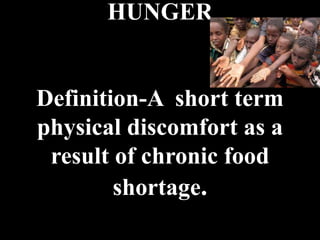
HUNGER
Definition-A short term
physical discomfort as a
result of chronic food
shortage.
FACTS
• In the world we produce enough
food to feed everyone.
• India is the second largest food
producer in the world.
• But everyday too many men and
women across the globe struggle to
feed their childrens a nutritious
meal.
CAUSES
Poverty
Natural disasters-
Earthquake, Flood,Drought.
Political&economical
instability
Diminishing natural
resources
Food shortages and
wastages
 War
Job instability
STATISTICAL
ANALYSIS
 World population -7.7 billion
795 million people(one in nine) do
not have enough food to lead a
healthy life.
Vast majority of hungry people
live in developing countries.(Asia
continent)
 One child dies every 10 seconds
from hungry
 Each year 3.1 million children
(Under 5) died due to poor
nutrition.
STATISTICAL ANALYSIS
12.9% population is undernourished.
1 in four is undernourished.
66 million school age children attend the
classes with hungry.
World food programme(WAP) calculates
3200 crores money to be needed per year to
reach a 66 million hungry school age
children.
 One out of 6 children(100million) in
developing countries is underweight.
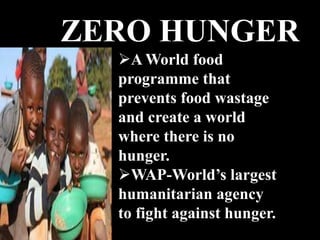
ZERO HUNGER
A World food
programme that
prevents food wastage
and create a world
where there is no
hunger.
WAP-World’s largest
humanitarian agency
to fight against hunger.
ZERO HUNGER CHALLENGE
• Launched by UN Secretary-
General Mr.Bankimoon in June 2012
• He Announced a Global challenge: Create
the world where no one is hungry by 2030
• Mr.Bankimoon called this initiative as the
ZERO HUNGER CHALLENGE
AIM
It aims to End hunger
and ensure access by all
people in vulnerable
conditions including
infants to safe
nutritious &sufficient
food all year around.
THE CHALLENGES
• 1.Make all food systems are sustainable:
From production to consumption.
• 2.End rural poverty: Double small scalar
producers income &production.
• 3.Eliminate waste of food.
• 4.Access adequate food and healthy diets for
people.
• 5.End malnutrition.
1.END POVERTY
Create jobs-When people have jobs
they have income.
Invest& implement agricultural
programmes
Educating woman programmes
Gender equality-Gender equality
raises household income.
2.END MALNUTRITION
Proper education to people regarding
importance of food
Use modern agricultural techniques to
increase agricultural production
Government projects to provide healthy
food to infants and pregnant woman
Global public health and disease control
measures
3.FOOD DONATION
Simplest way to fight hunger
Nowadays many mobile apps are
available to donate food.
E.g. –No food waste
 Feeding India
 Olio
4.SUPPORT SMALL FARMERS
Governments &NGOs
support and train small
farmers is the best solution to
future food security
Buy organic foods
Buy local farmers
Volunteer at a small farm
5.ROLLOUT BIOTECHNOLOGY
Produce climate
resilient crops for
higher yields and to
withstand climate
change
Gene splicing
crops-Help the plant
to withstand
drought &flood
6.SUSTAINABLE AGRICULTURE
Produce sufficient food to
meet the needs without
destroying ecological assets
Focus on producing long
term crops helping farmers
to improve their techniques
and quality of life
7.AGRICULTURAL SUBSIDIES
Financial assistance
provided by the
Government
To ensure food
production and
encouragement
Don't waste food.
Those who are financially stable
should try &help to needy people
Those who are healthy should
try& volunteer to help them
If we want to see a world free of hunger by
2030,government, citizens, civil society
organization& private sectors must
coordinate to invest, innovate & create
permanent solutions
Zero hunger
Zero hunger
Zero hunger

Zero hunger

  • 2.
    Presented by, Mrs.J.Jeba M.Sc.,M.Phil., AssistantProfessor, Annasamy Rajammal College of Nursing, Athiyoothu.
  • 3.
    HUNGER Definition-A short term physicaldiscomfort as a result of chronic food shortage.
  • 4.
    FACTS • In theworld we produce enough food to feed everyone. • India is the second largest food producer in the world. • But everyday too many men and women across the globe struggle to feed their childrens a nutritious meal.
  • 5.
  • 6.
    STATISTICAL ANALYSIS  World population-7.7 billion 795 million people(one in nine) do not have enough food to lead a healthy life. Vast majority of hungry people live in developing countries.(Asia continent)  One child dies every 10 seconds from hungry  Each year 3.1 million children (Under 5) died due to poor nutrition.
  • 7.
    STATISTICAL ANALYSIS 12.9% populationis undernourished. 1 in four is undernourished. 66 million school age children attend the classes with hungry. World food programme(WAP) calculates 3200 crores money to be needed per year to reach a 66 million hungry school age children.  One out of 6 children(100million) in developing countries is underweight.
  • 8.
    ZERO HUNGER A Worldfood programme that prevents food wastage and create a world where there is no hunger. WAP-World’s largest humanitarian agency to fight against hunger.
  • 9.
    ZERO HUNGER CHALLENGE •Launched by UN Secretary- General Mr.Bankimoon in June 2012 • He Announced a Global challenge: Create the world where no one is hungry by 2030 • Mr.Bankimoon called this initiative as the ZERO HUNGER CHALLENGE
  • 10.
    AIM It aims toEnd hunger and ensure access by all people in vulnerable conditions including infants to safe nutritious &sufficient food all year around.
  • 11.
    THE CHALLENGES • 1.Makeall food systems are sustainable: From production to consumption. • 2.End rural poverty: Double small scalar producers income &production. • 3.Eliminate waste of food. • 4.Access adequate food and healthy diets for people. • 5.End malnutrition.
  • 13.
    1.END POVERTY Create jobs-Whenpeople have jobs they have income. Invest& implement agricultural programmes Educating woman programmes Gender equality-Gender equality raises household income.
  • 15.
    2.END MALNUTRITION Proper educationto people regarding importance of food Use modern agricultural techniques to increase agricultural production Government projects to provide healthy food to infants and pregnant woman Global public health and disease control measures
  • 16.
    3.FOOD DONATION Simplest wayto fight hunger Nowadays many mobile apps are available to donate food. E.g. –No food waste  Feeding India  Olio
  • 17.
    4.SUPPORT SMALL FARMERS Governments&NGOs support and train small farmers is the best solution to future food security Buy organic foods Buy local farmers Volunteer at a small farm
  • 18.
    5.ROLLOUT BIOTECHNOLOGY Produce climate resilientcrops for higher yields and to withstand climate change Gene splicing crops-Help the plant to withstand drought &flood
  • 19.
    6.SUSTAINABLE AGRICULTURE Produce sufficientfood to meet the needs without destroying ecological assets Focus on producing long term crops helping farmers to improve their techniques and quality of life
  • 20.
    7.AGRICULTURAL SUBSIDIES Financial assistance providedby the Government To ensure food production and encouragement
  • 22.
    Don't waste food. Thosewho are financially stable should try &help to needy people Those who are healthy should try& volunteer to help them
  • 23.
    If we wantto see a world free of hunger by 2030,government, citizens, civil society organization& private sectors must coordinate to invest, innovate & create permanent solutions