Sales management means planning, direction and
control of personal selling, including
recruiting,selecting,equipping,assigning,routing,super
vising,paying and motivating as these tasks apply to
the personal sales force
AMERICAN MARKETING ASSOCIATION
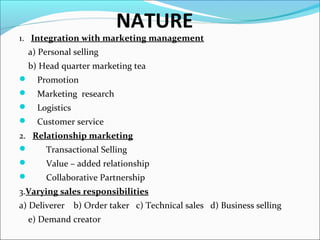
NATURE
1. Integration with marketing management
a) Personal selling
b) Head quarter marketing tea
 Promotion
 Marketing research
 Logistics
 Customer service
2. Relationship marketing
 Transactional Selling
 Value – added relationship
 Collaborative Partnership
3.Varying sales responsibilities
a) Deliverer b) Order taker c) Technical sales d) Business selling
e) Demand creator
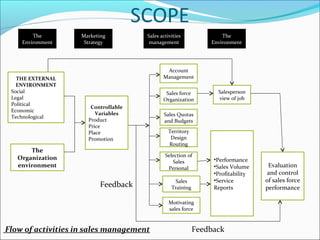
SCOPE
Feedback
Flow of activities in sales management Feedback
The
Environment
Marketing
Strategy
Sales activities
management
The
Environment
THE EXTERNAL
ENVIRONMENT
Social
Legal
Political
Economic
Technological
The
Organization
environment
Controllable
Variables
Product
Price
Place
Promotion
Account
Management
Sales force
Organization
Sales Quotas
and Budgets
Territory
Design
Routing
Selection of
Sales
Personal
Sales
Training
Motivating
sales force
Salesperson
view of job
Evaluation
and control
of sales force
performance
•Performance
•Sales Volume
•Profitability
•Service
Reports
Formulating Personal Selling Objectives
Analyzing Market Potential
1. Market identification
2.Market Motivation
3. Analysis of market sales
Market Indexes : A market index is a numerical expression
indicating the degree to which one or more factors
associated with a given product’s demand in a given
market segment
Formulating Personal Selling Objectives
Sales Forecasting : It indicates how much a
company with the given amount of resources can sell
if it implements a particular marketing program.
Methods of sales forecasting
1. Jury of executive opinion
2.Poll of sales force opinion
3. Projection of past sales
a) Time series analysis
b) Moving average method
4. Regression analysis
Formulating Personal Selling Objectives
Converting industry forecast to company sales
forecast.
Derivation of sales volume objective
Evaluation of forecasts
Formulate the objectives
Recruitment of Sales Personal
The Prerecruiting Reservoir: Files of individuals
who might be recruited when the need arises
Sources
1. People coming for job opportunities
2.Sales personal comes in contact at professional
meetings
3. People meeting in clubs, parties
Recruitment of Sales Personal
Recruiting Source Evaluation: One approach to
evaluating the sources of recruits is to study those
used in the past. Analysis of each sources of recruits is
to study those used in the past.
Recruitment of Sales Personal
Sources within the company
1) Company sales personal
2) Company executive
3) Internal transfers
Recruitment of Sales Personal
Sources outside the company
1) Direct unsolicited applications
2)Employment agencies
3)Salespeople making calls on the company
4)Employees of customers
5)Sales executives clubs
6)Sales forces of non competing companies
7)Sales forces of competing companies
8)Educational institutions
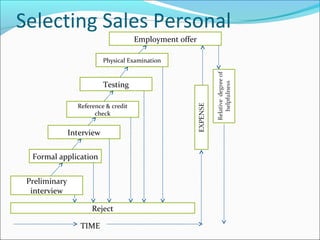
Selecting Sales Personal
TIME
Preliminary
interview
Formal application
Interview
Reference & credit
check
Testing
Physical Examination
Employment offer
Reject
Selecting Sales Personal
Preliminary Interview :- The purpose of preliminary
interview is to eliminate unqualified applicants, thus
saving the time of interviewers and applicants.
Formal application form :- It serves as a central
record for all pertinent information collected during
selection process.
sales1.jpg
sales2.jpg
sales 3.jpg
sales 4.jpg
Selecting Sales Personal
Interview :- It judges the individual’s oral
communication, personal appearance and manners,
attitude towards selling and life in general, reaction to
obstacles presented face to face, and personal impact upon
others.
Types of interview :
1) Patterned interview: Interviewer uses a prepared
outline of questions designed to elicit a basic core of
information
2) Nondirective interview: In this technique the applicant
is encouraged to speak freely about his/her experience and
future plans
3) Stress interview : It simulates the stress the applicant
would meet in actual selling and provides a way to observe
the applicant’s reaction to them
Selecting Sales Personal
References : It provides information not available
from other sources.
Sources :
1) Present or former employers
2)Former customers
3)Mutual acquaintances
Selecting Sales Personal
Credit Checks : Many companies run credit checks
on applicants for sales positions. (e.g. Dun &
Bradstreet)
Physical Examinations : Since good health is
required for salesperson’s success, most companies
physical examinations
Employment Offer : The applicants who have
fulfilled the criteria's and cleared all the test will be
given an appointment letter
Developing Sales Training Program
Identifying Initial Training Needs
1. Job Specification
2.Trainee’s background & experience
3. Sales related marketing policies
Identifying Continuing Training Needs
Deciding Training Content
1. Product Data
2.Sales technique
3. Markets
4.Company information
Developing Sales Training Program
Selecting Training Methods
1. The Lecture
2.Personal conference
3. Demonstrations
4.Role playing
5.Case Discussion
6.On the job training
Conducting Sales training Program
Preparation of training time table
Arranging internal & external trainers
Making travel arrangement of participants
Arranging the conference hall & teaching aids
Final checking 1 or 2 days prior to commencement of
the training program

Sales management 1

  • 1.
    Sales management meansplanning, direction and control of personal selling, including recruiting,selecting,equipping,assigning,routing,super vising,paying and motivating as these tasks apply to the personal sales force AMERICAN MARKETING ASSOCIATION
  • 2.
    NATURE 1. Integration withmarketing management a) Personal selling b) Head quarter marketing tea  Promotion  Marketing research  Logistics  Customer service 2. Relationship marketing  Transactional Selling  Value – added relationship  Collaborative Partnership 3.Varying sales responsibilities a) Deliverer b) Order taker c) Technical sales d) Business selling e) Demand creator
  • 3.
    SCOPE Feedback Flow of activitiesin sales management Feedback The Environment Marketing Strategy Sales activities management The Environment THE EXTERNAL ENVIRONMENT Social Legal Political Economic Technological The Organization environment Controllable Variables Product Price Place Promotion Account Management Sales force Organization Sales Quotas and Budgets Territory Design Routing Selection of Sales Personal Sales Training Motivating sales force Salesperson view of job Evaluation and control of sales force performance •Performance •Sales Volume •Profitability •Service Reports
  • 4.
    Formulating Personal SellingObjectives Analyzing Market Potential 1. Market identification 2.Market Motivation 3. Analysis of market sales Market Indexes : A market index is a numerical expression indicating the degree to which one or more factors associated with a given product’s demand in a given market segment
  • 5.
    Formulating Personal SellingObjectives Sales Forecasting : It indicates how much a company with the given amount of resources can sell if it implements a particular marketing program. Methods of sales forecasting 1. Jury of executive opinion 2.Poll of sales force opinion 3. Projection of past sales a) Time series analysis b) Moving average method 4. Regression analysis
  • 6.
    Formulating Personal SellingObjectives Converting industry forecast to company sales forecast. Derivation of sales volume objective Evaluation of forecasts Formulate the objectives
  • 7.
    Recruitment of SalesPersonal The Prerecruiting Reservoir: Files of individuals who might be recruited when the need arises Sources 1. People coming for job opportunities 2.Sales personal comes in contact at professional meetings 3. People meeting in clubs, parties
  • 8.
    Recruitment of SalesPersonal Recruiting Source Evaluation: One approach to evaluating the sources of recruits is to study those used in the past. Analysis of each sources of recruits is to study those used in the past.
  • 9.
    Recruitment of SalesPersonal Sources within the company 1) Company sales personal 2) Company executive 3) Internal transfers
  • 10.
    Recruitment of SalesPersonal Sources outside the company 1) Direct unsolicited applications 2)Employment agencies 3)Salespeople making calls on the company 4)Employees of customers 5)Sales executives clubs 6)Sales forces of non competing companies 7)Sales forces of competing companies 8)Educational institutions
  • 11.
    Selecting Sales Personal TIME Preliminary interview Formalapplication Interview Reference & credit check Testing Physical Examination Employment offer Reject
  • 12.
    Selecting Sales Personal PreliminaryInterview :- The purpose of preliminary interview is to eliminate unqualified applicants, thus saving the time of interviewers and applicants. Formal application form :- It serves as a central record for all pertinent information collected during selection process. sales1.jpg sales2.jpg sales 3.jpg sales 4.jpg
  • 13.
    Selecting Sales Personal Interview:- It judges the individual’s oral communication, personal appearance and manners, attitude towards selling and life in general, reaction to obstacles presented face to face, and personal impact upon others. Types of interview : 1) Patterned interview: Interviewer uses a prepared outline of questions designed to elicit a basic core of information 2) Nondirective interview: In this technique the applicant is encouraged to speak freely about his/her experience and future plans 3) Stress interview : It simulates the stress the applicant would meet in actual selling and provides a way to observe the applicant’s reaction to them
  • 14.
    Selecting Sales Personal References: It provides information not available from other sources. Sources : 1) Present or former employers 2)Former customers 3)Mutual acquaintances
  • 15.
    Selecting Sales Personal CreditChecks : Many companies run credit checks on applicants for sales positions. (e.g. Dun & Bradstreet) Physical Examinations : Since good health is required for salesperson’s success, most companies physical examinations Employment Offer : The applicants who have fulfilled the criteria's and cleared all the test will be given an appointment letter
  • 16.
    Developing Sales TrainingProgram Identifying Initial Training Needs 1. Job Specification 2.Trainee’s background & experience 3. Sales related marketing policies Identifying Continuing Training Needs Deciding Training Content 1. Product Data 2.Sales technique 3. Markets 4.Company information
  • 17.
    Developing Sales TrainingProgram Selecting Training Methods 1. The Lecture 2.Personal conference 3. Demonstrations 4.Role playing 5.Case Discussion 6.On the job training
  • 18.
    Conducting Sales trainingProgram Preparation of training time table Arranging internal & external trainers Making travel arrangement of participants Arranging the conference hall & teaching aids Final checking 1 or 2 days prior to commencement of the training program