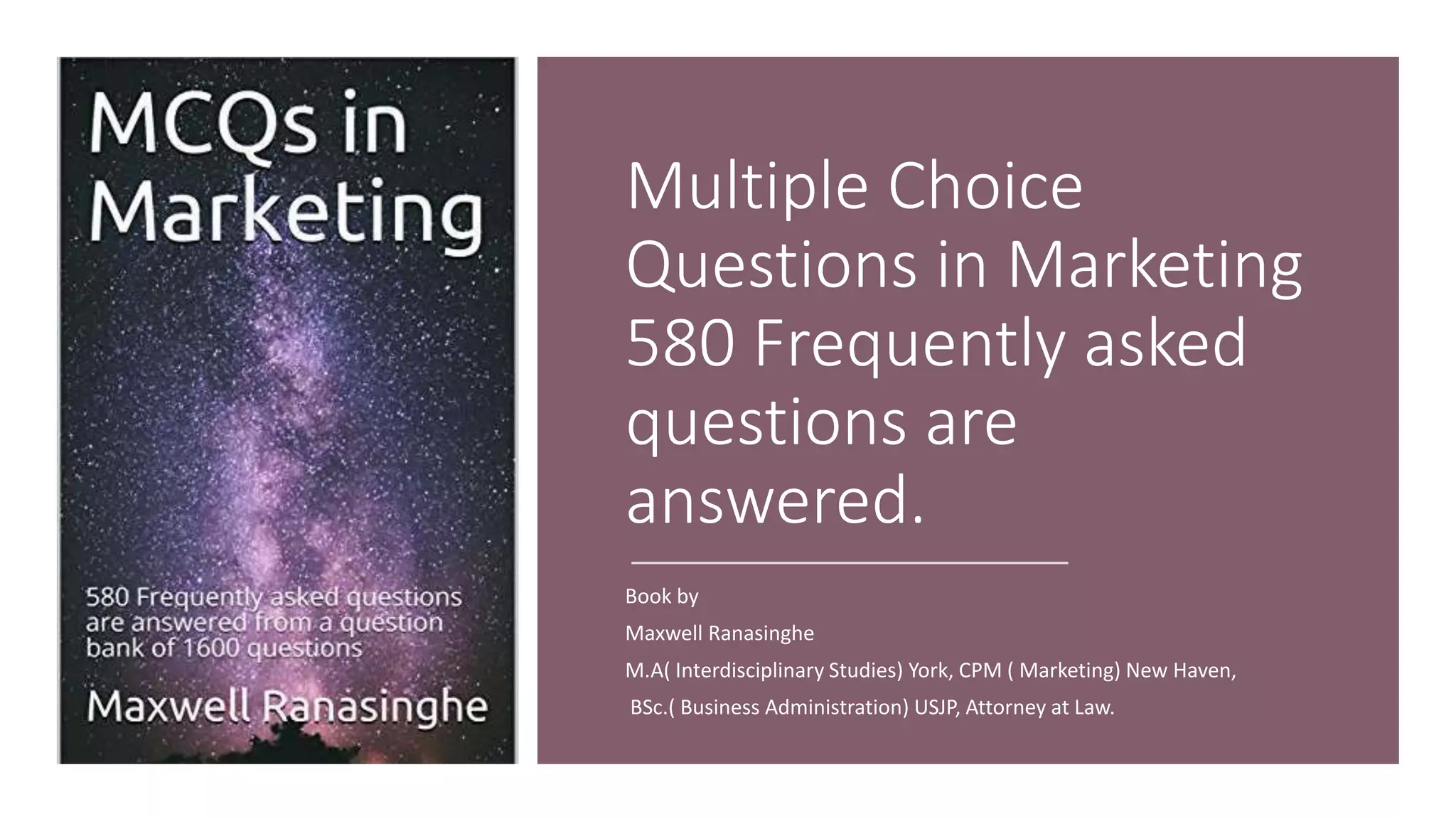
Multiple Choice
Questions in Marketing
580 Frequently asked
questions are
answered.
Book by
Maxwell Ranasinghe
M.A( Interdisciplinary Studies) York, CPM ( Marketing) New Haven,
BSc.( Business Administration) USJP, Attorney at Law.
I have taught marketing for last 20 years in number of
universities and professional institutes. Further I have
conducted various marketing and management related
workshops to the corporate sector.
MCQs are now a very important part of marketing
examinations all over the world. As such, I wrote this book on
Multiple Questions to help students in passing exams.
I gathered question papers on MCQs of many universities, and
professional institutes
I analyzed more than 1600 questions and found that there are
a set of questions that are frequently asked. It came to around
580 questions, and I answered all these questions in my e-
book.
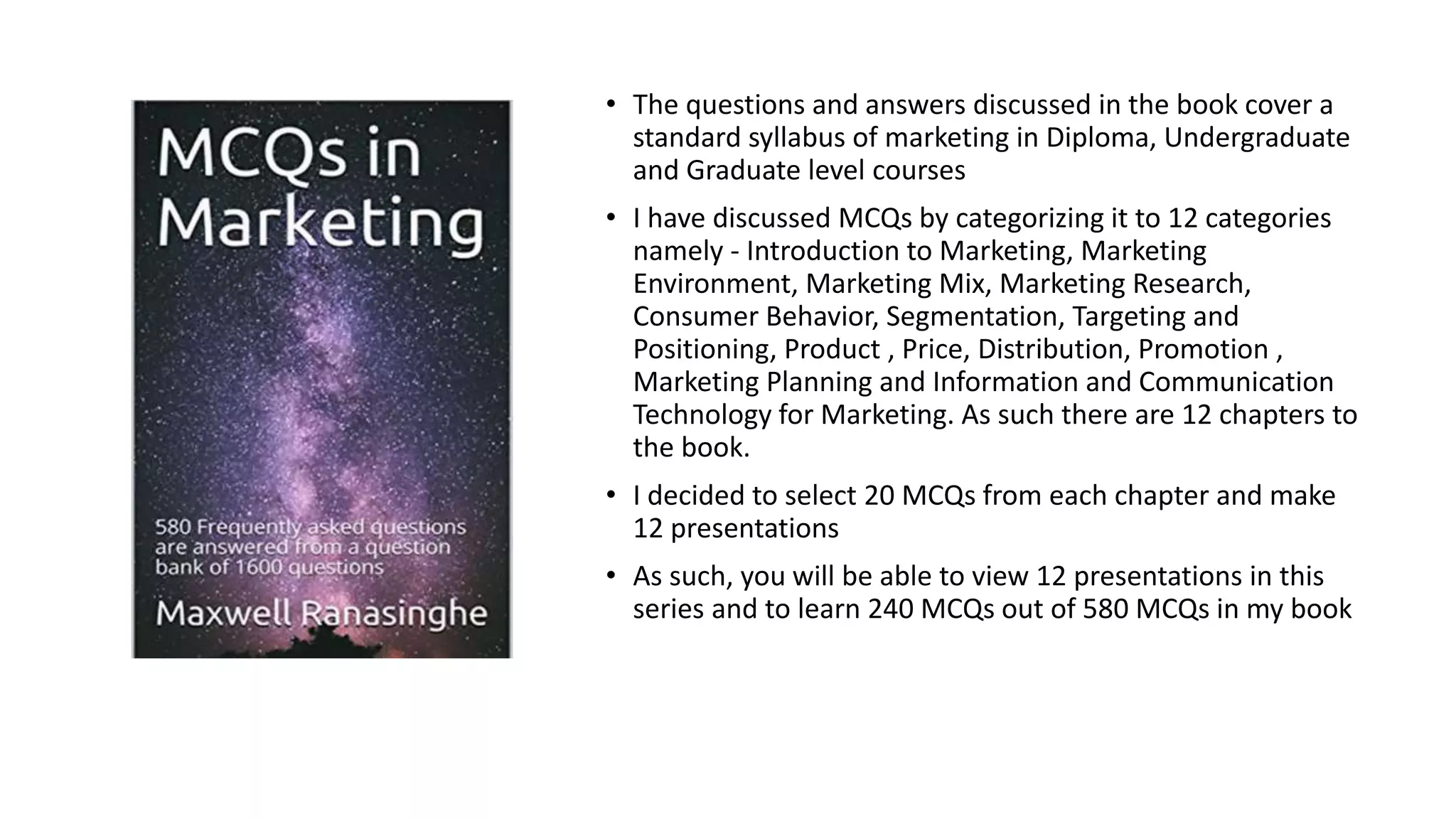
• The questions and answers discussed in the book cover a
standard syllabus of marketing in Diploma, Undergraduate
and Graduate level courses
• I have discussed MCQs by categorizing it to 12 categories
namely - Introduction to Marketing, Marketing
Environment, Marketing Mix, Marketing Research,
Consumer Behavior, Segmentation, Targeting and
Positioning, Product , Price, Distribution, Promotion ,
Marketing Planning and Information and Communication
Technology for Marketing. As such there are 12 chapters to
the book.
• I decided to select 20 MCQs from each chapter and make
12 presentations
• As such, you will be able to view 12 presentations in this
series and to learn 240 MCQs out of 580 MCQs in my book
Now take a piece of paper and a pen, get ready for
an MCQ Exam
In this
presentation, I
will discuss 20
MCQs selected
from Chapter
11 of my book
Strategic
Marketing
Planning
1. Strategic Plan is
• 1. A plan that guides and the implements the
activities need to achieve strategic plan
• 2. A plan that develops to win competition
with a strong competitor in the market place
• 3. Process of determining an organizations
main objectives and articulating the ways and
means of achieving those objectives
• 4. An action that is taken by a company to
achieve short term goals in the market place
2. Tactical
plan is
1. Tactics that a marker uses to win the long
term objectives of the company
2. That guides the implementation of
activities in the strategic plan of the company
3. Temporarily withdrawing from a specific
market with an idea of returning later
4. Unethical practices adopted by a marketer
to grab market share of the competitors
3. Who is
responsible
in strategic
planning
1. Marketing Director
2. Top Management , Board of
Directors and CEO of companies
3. Middle managers
4. Marketing Consultants
4. In the process
of marketing
planning ,
formulating
marketing
strategy
commences
• 1. After mission, vision,
objectives and business
environmental assessment
• 2. Before all of the activities
stated in answer number one
• 3. Soon after the objectives
• 3. After setting the sales
objectives
5. A company is in
the process of
analysing the
strength of its
major
competitors. In
what stage of the
planning process
is this activity is
done ?
1. In making organisational
objectives
2. In the stage of operational plans
3. In the stage of business
environmental assessment
4. At the stage of monitoring
activities
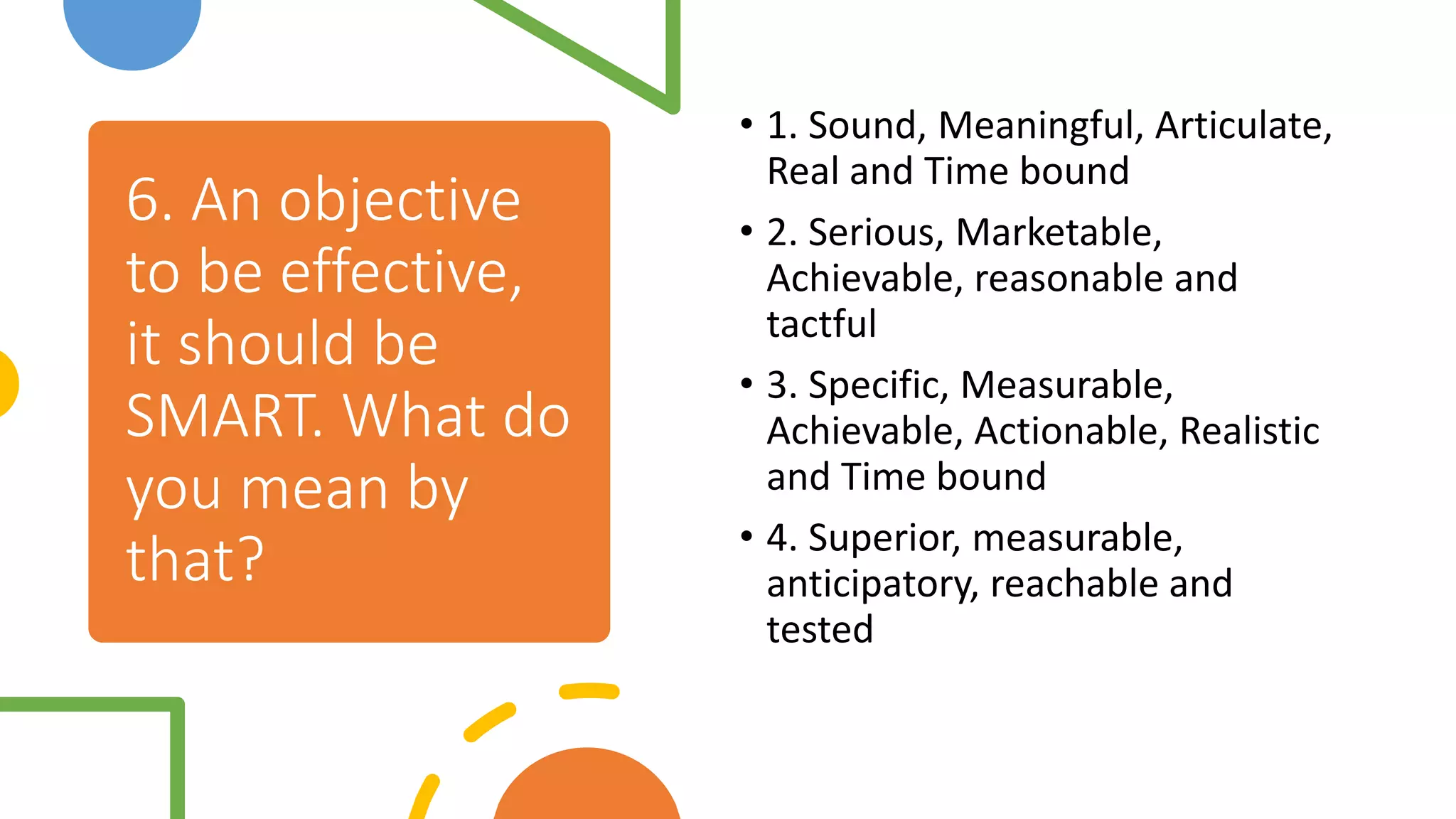
6. An objective
to be effective,
it should be
SMART. What do
you mean by
that?
• 1. Sound, Meaningful, Articulate,
Real and Time bound
• 2. Serious, Marketable,
Achievable, reasonable and
tactful
• 3. Specific, Measurable,
Achievable, Actionable, Realistic
and Time bound
• 4. Superior, measurable,
anticipatory, reachable and
tested
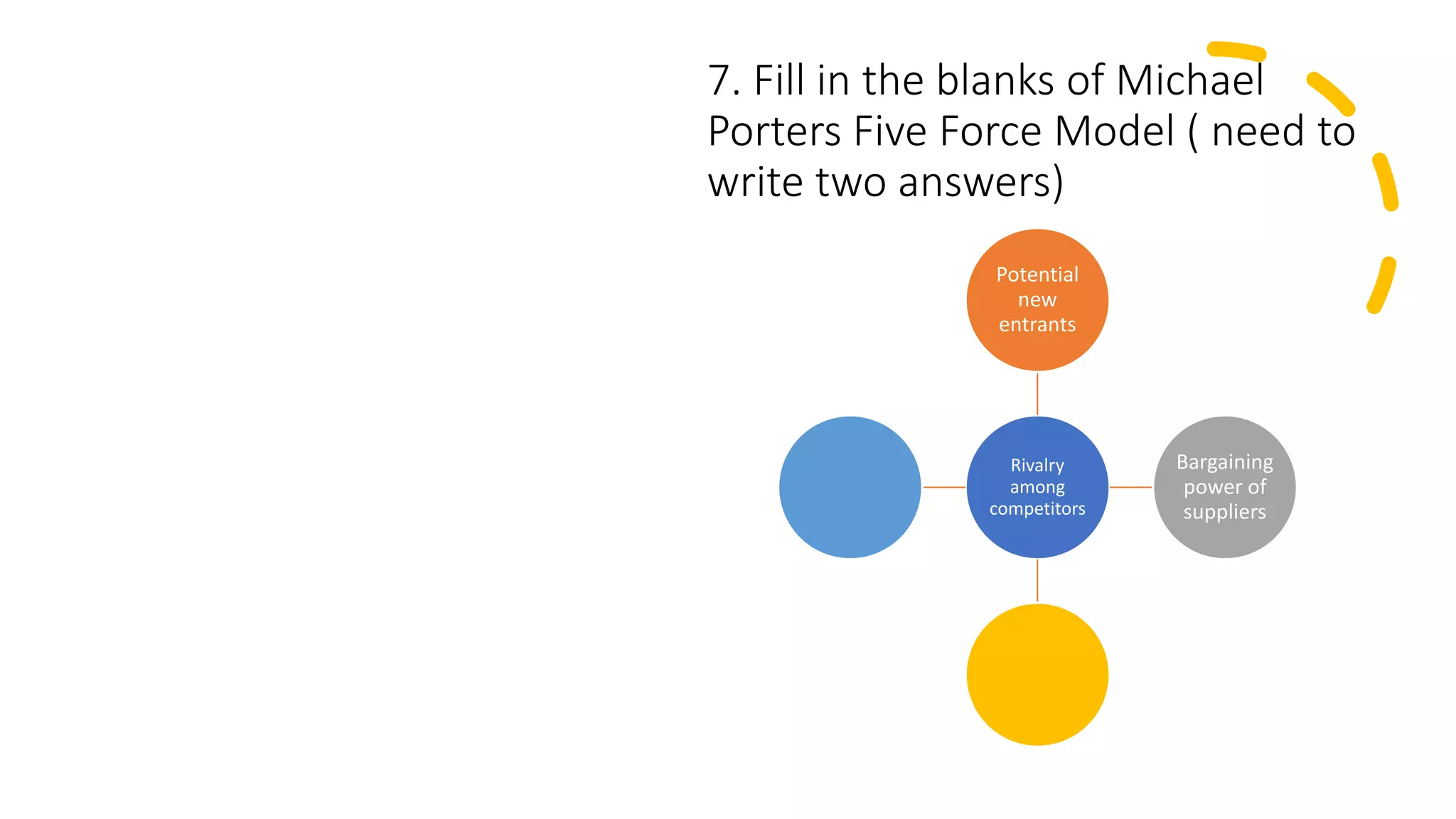
7. Fill in the blanks of Michael
Porters Five Force Model ( need to
write two answers)
Rivalry
among
competitors
Potential
new
entrants
Bargaining
power of
suppliers
8. Michael
Porters Five
Force model
evaluates
• 1. Attractiveness and risk in the
market for the firm
• 2. Size of the market and its
competitors
• 3. Consumer buyer behavior
• 4. Innovations taking place in
marketing planning
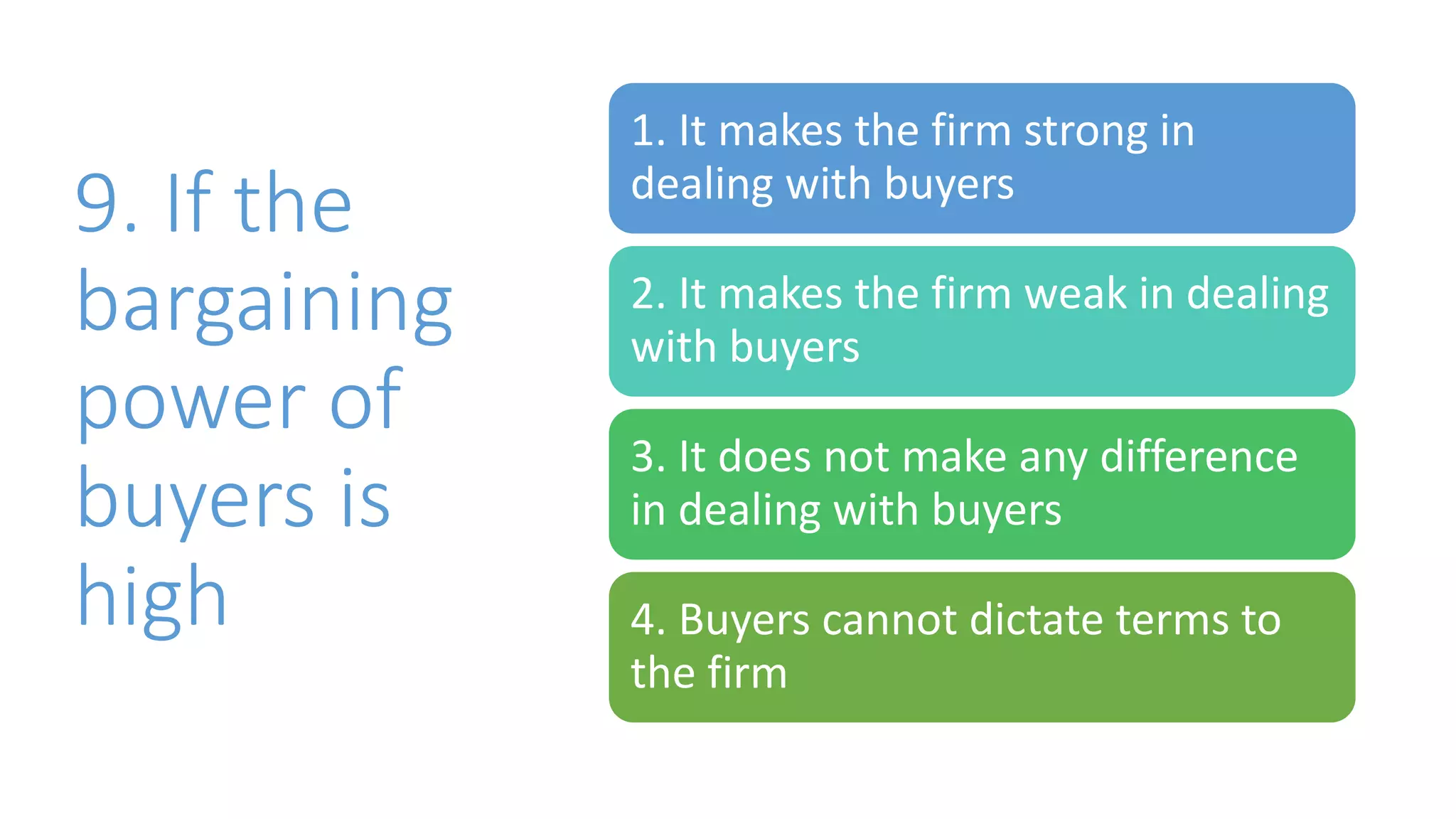
9. If the
bargaining
power of
buyers is
high
1. It makes the firm strong in
dealing with buyers
2. It makes the firm weak in dealing
with buyers
3. It does not make any difference
in dealing with buyers
4. Buyers cannot dictate terms to
the firm
10. The
elements
of SWOT
analysis is
Strength, Work, Organisation and
Technology
Sourcing, Worldwide, Open, Treaties
Strength, Weaknesses, Opportunities,
Threats
Threats
4. Sectional, Workings, Offences, Trust
11. A firm finds a
best fit period that
the core
requirement of
the market and
particular
competencies of
the company fits
together. It is
called
1. Target Market
2. Penetration point
3. Strategic window
4. Niche Market
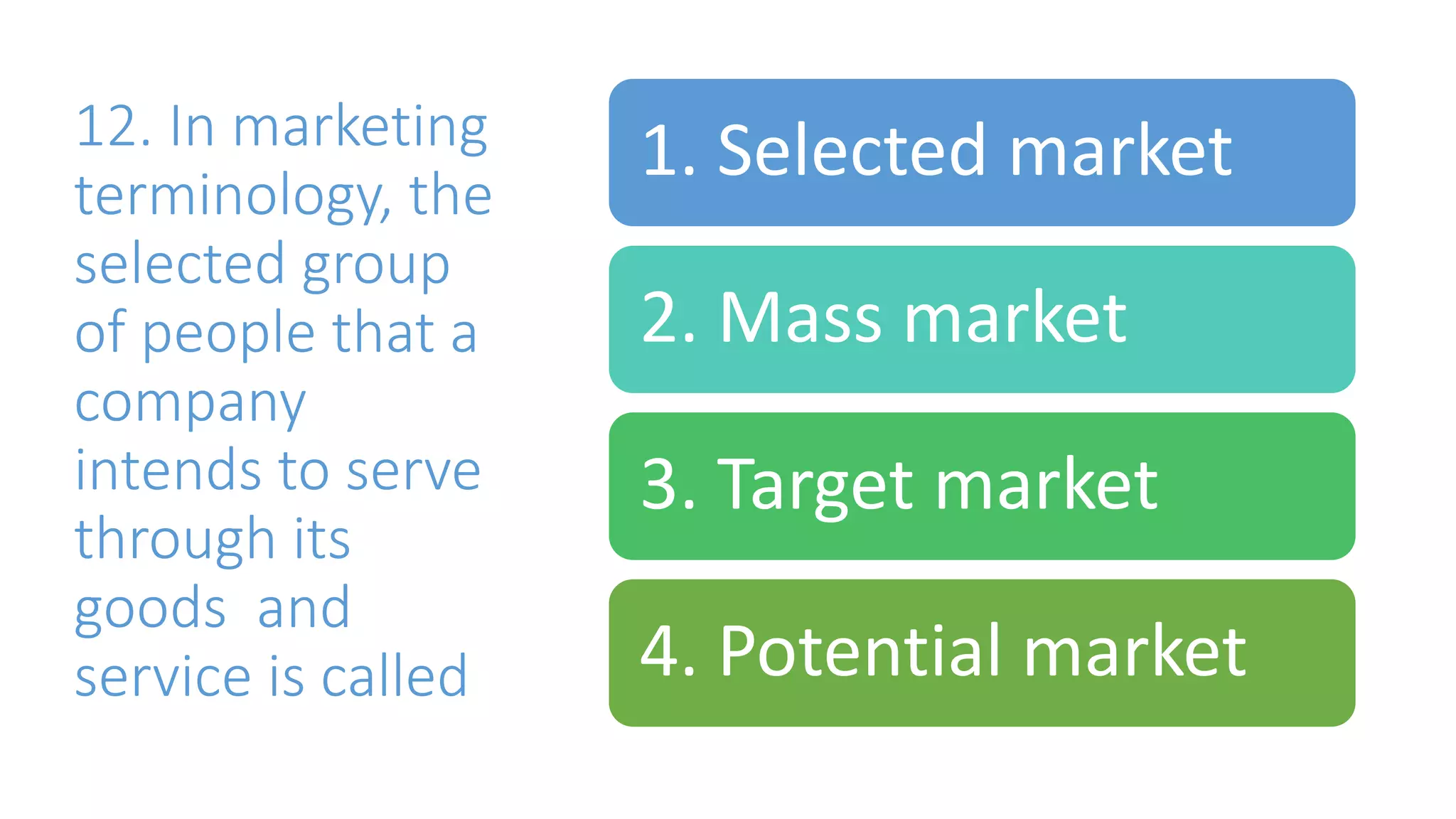
12. In marketing
terminology, the
selected group
of people that a
company
intends to serve
through its
goods and
service is called
1. Selected market
2. Mass market
3. Target market
4. Potential market
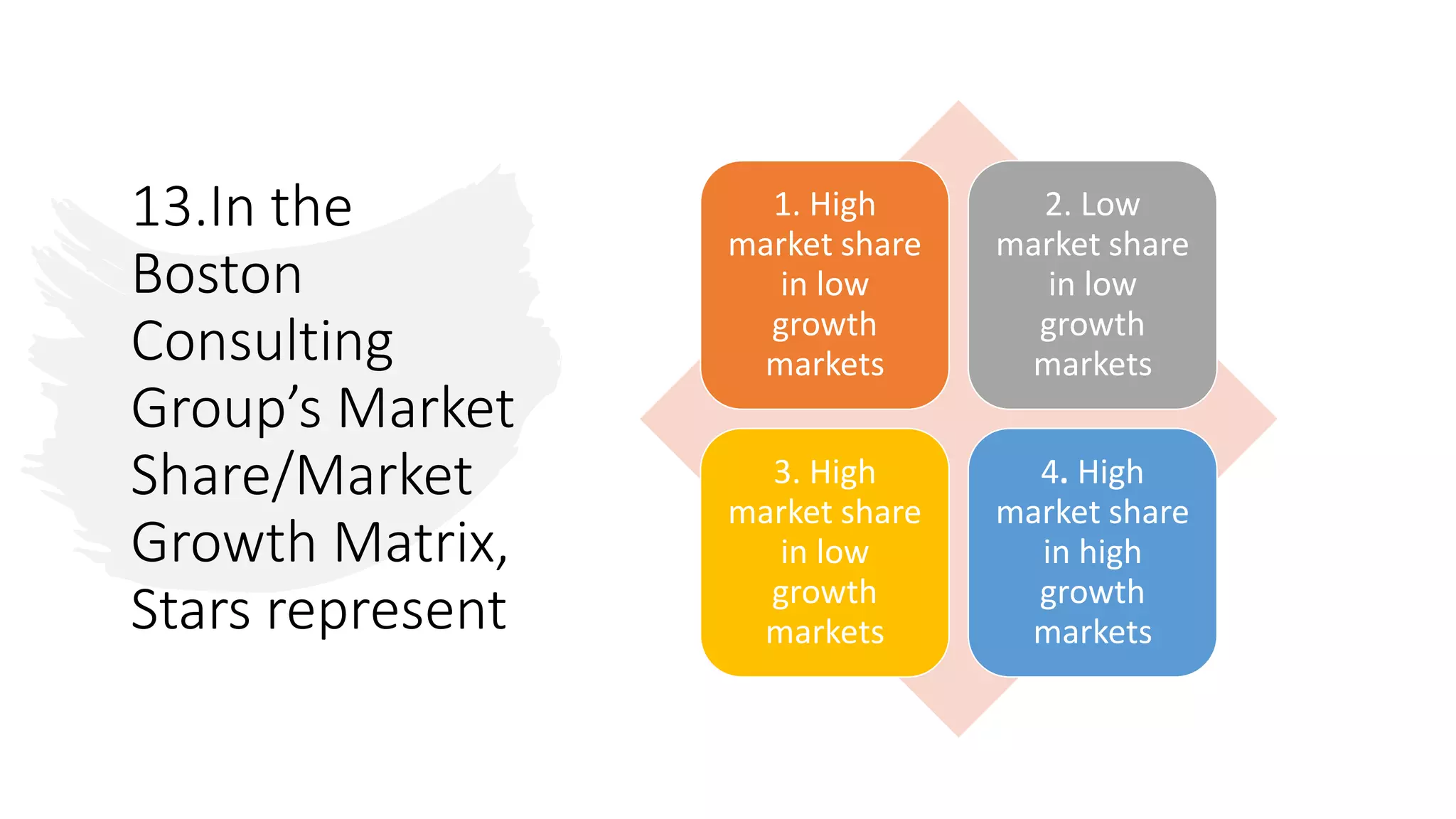
13.In the
Boston
Consulting
Group’s Market
Share/Market
Growth Matrix,
Stars represent
1. High
market share
in low
growth
markets
2. Low
market share
in low
growth
markets
3. High
market share
in low
growth
markets
4. High
market share
in high
growth
markets
14. In the
Boston
Consulting
Group’s Market
Share/Market
Growth Matrix,
Question Marks
represent
1. Business
units that
generate little
profit
2. Business
units that have
potential to
become stars
or cash cows
3. Business
units that
generate
considerable
income
4. Business
units that
generate
strong cash
flows
15. In the
Boston
Consulting
Group’s Market
Share/Market
Growth Matrix,
if a business
unit is a Cash
Cow
1. It should consider withdrawing form the
market
2. It should use profits to finance growth of
stars and question marks
3. It should invest more fund for future
growth
4. It should either invest more funds for
growth or consider divesting
16. In the Boston
Consulting
Group’s Market
Share/Market
Growth Matrix, if
the business unit
is generating little
profits, it is called
1.DOGS 2. STARS
3. CASH COW 4. QUESTION
MARKS
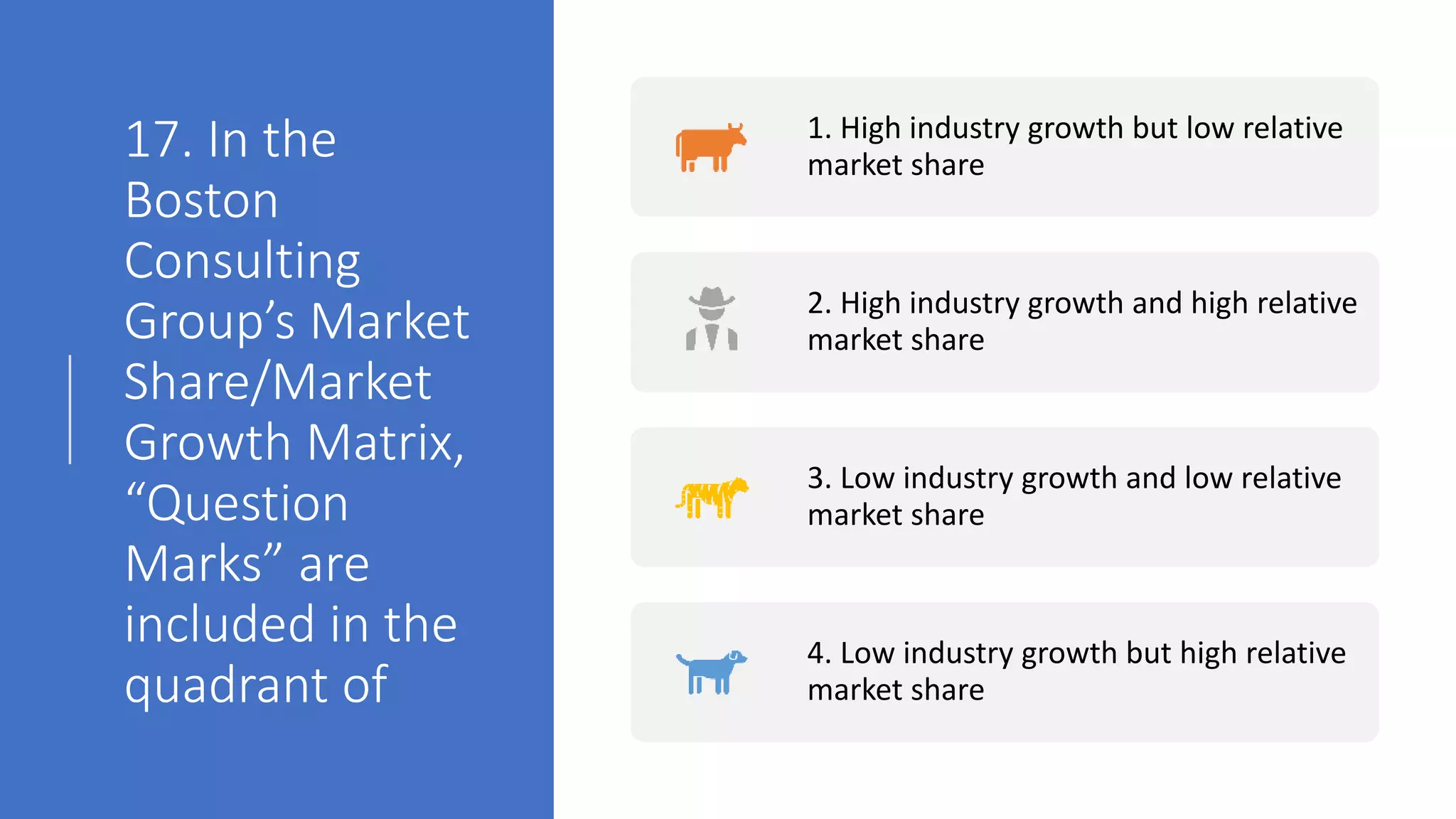
17. In the
Boston
Consulting
Group’s Market
Share/Market
Growth Matrix,
“Question
Marks” are
included in the
quadrant of
1. High industry growth but low relative
market share
2. High industry growth and high relative
market share
3. Low industry growth and low relative
market share
4. Low industry growth but high relative
market share
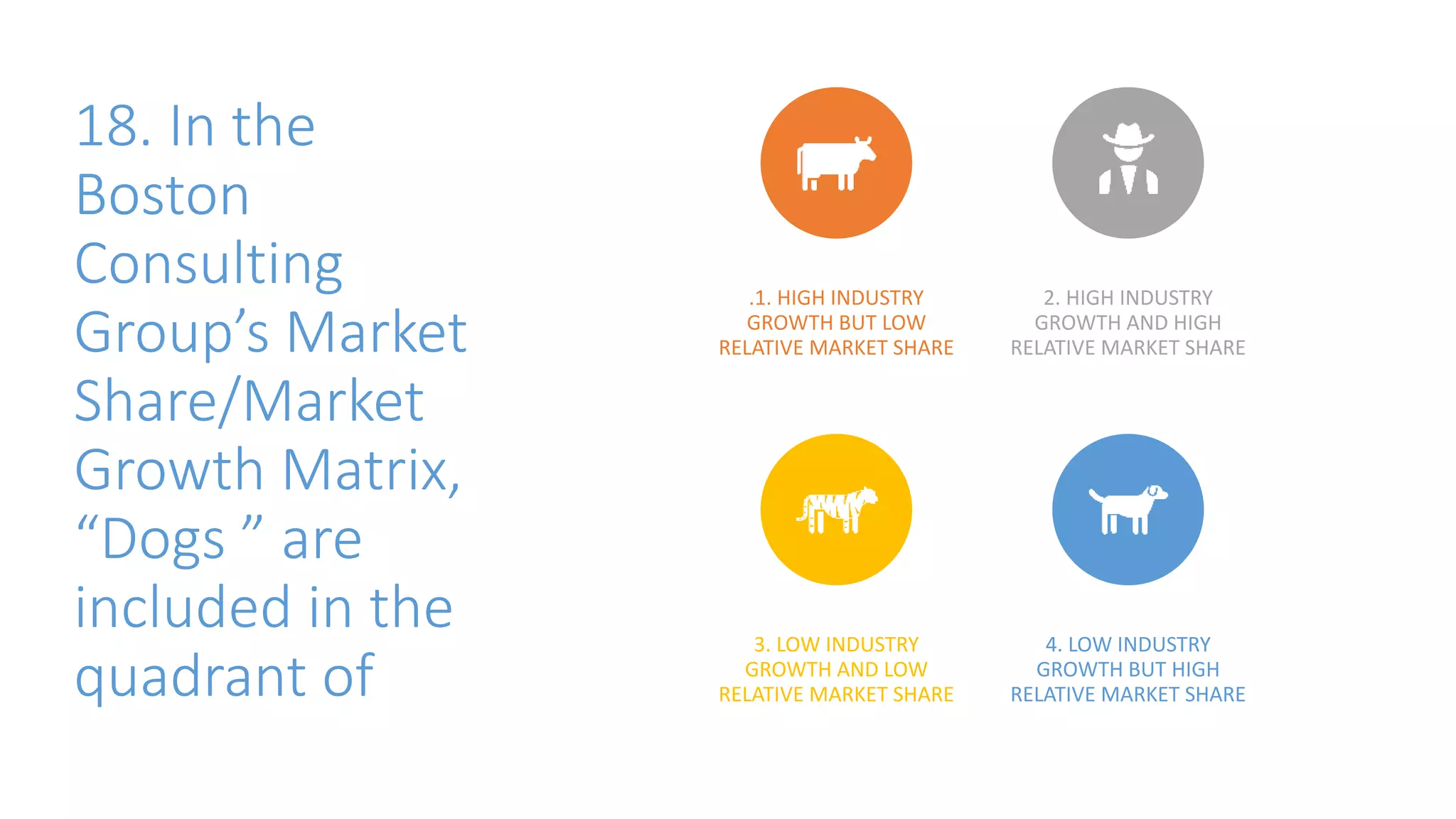
18. In the
Boston
Consulting
Group’s Market
Share/Market
Growth Matrix,
“Dogs ” are
included in the
quadrant of
.1. HIGH INDUSTRY
GROWTH BUT LOW
RELATIVE MARKET SHARE
2. HIGH INDUSTRY
GROWTH AND HIGH
RELATIVE MARKET SHARE
3. LOW INDUSTRY
GROWTH AND LOW
RELATIVE MARKET SHARE
4. LOW INDUSTRY
GROWTH BUT HIGH
RELATIVE MARKET SHARE
19. Strategic Business Unit ( SBU) in
a business may have its own
managers, resources, objectives
and competitors. It could be a
• 1. Relatively autonomous division within
a company
• 2. A product line of a division of a
company
• 3. A single product of a product line of a
company
• 4. Any of the above
20. To find out
the market
status of the
different
strategic
business units,
widely used
methods is
• 1. Michael Porter’s Five Force model
• 2. Boston Consulting Groups BCG Matrix
• 3. Ansof’s Growth Opportunity Matrix
• 4. SWOT Analysis
• If you are interested in viewing the whole book, which has
580 Questions and Answers, please Log on to Amazon.com
and search
• “Marketing MCQs by Maxwell Ranasinghe”
• You can read the digital version free or download it by just
paying USD4.99
• I strongly believe it is a very good investment for you and I
also consider it as an appreciation of my work towards the
student community
• Next slide has the answers to the questions in this
presentation
• Answers to questions in this presentation appears on the
next slide
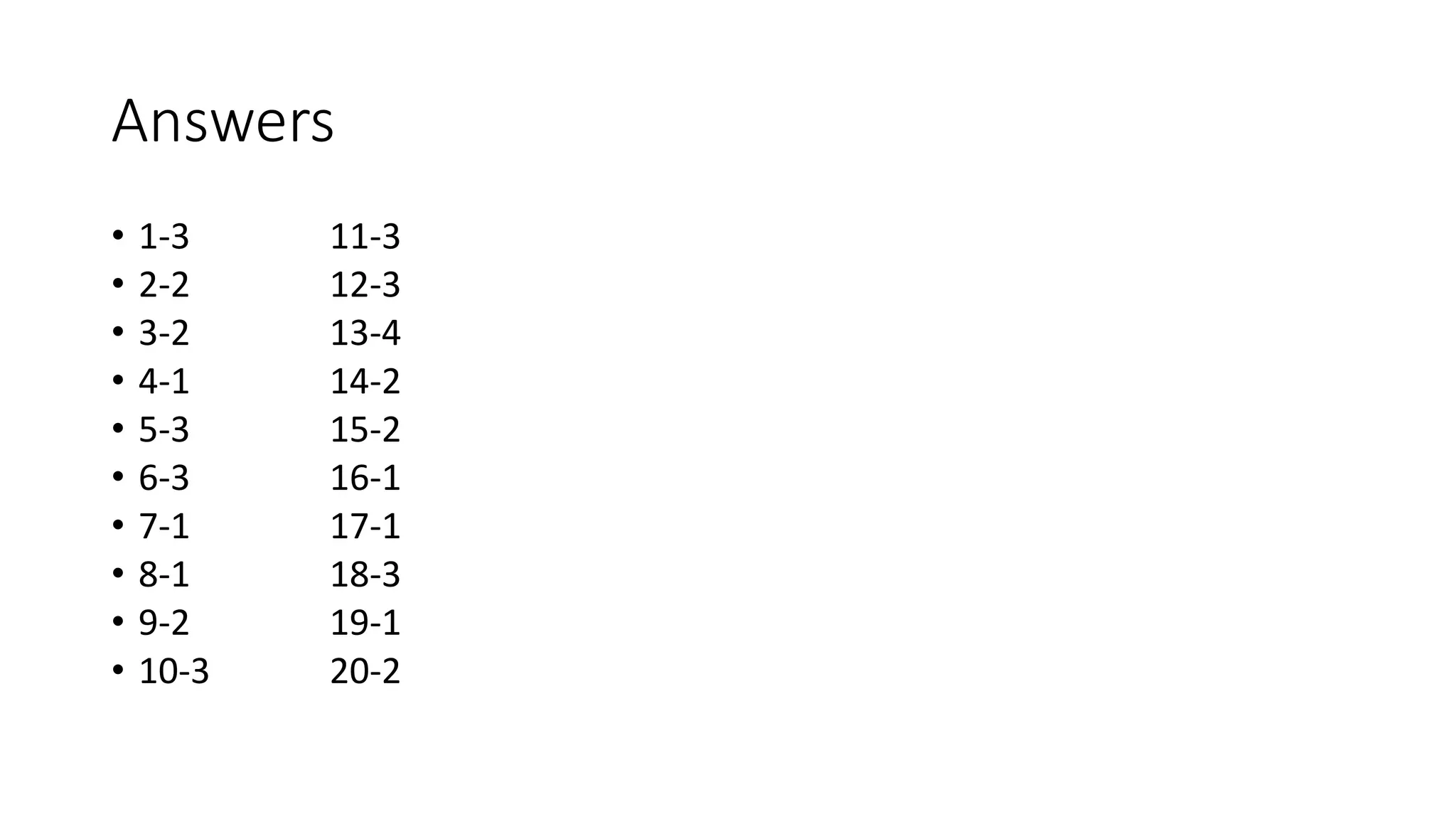
Answers
• 1-3 11-3
• 2-2 12-3
• 3-2 13-4
• 4-1 14-2
• 5-3 15-2
• 6-3 16-1
• 7-1 17-1
• 8-1 18-3
• 9-2 19-1
• 10-3 20-2

Marketing Planning- Multiple Choice Questions ( MCQs)

  • 1.
    Multiple Choice Questions inMarketing 580 Frequently asked questions are answered. Book by Maxwell Ranasinghe M.A( Interdisciplinary Studies) York, CPM ( Marketing) New Haven, BSc.( Business Administration) USJP, Attorney at Law.
  • 2.
    I have taughtmarketing for last 20 years in number of universities and professional institutes. Further I have conducted various marketing and management related workshops to the corporate sector. MCQs are now a very important part of marketing examinations all over the world. As such, I wrote this book on Multiple Questions to help students in passing exams. I gathered question papers on MCQs of many universities, and professional institutes I analyzed more than 1600 questions and found that there are a set of questions that are frequently asked. It came to around 580 questions, and I answered all these questions in my e- book.
  • 3.
    • The questionsand answers discussed in the book cover a standard syllabus of marketing in Diploma, Undergraduate and Graduate level courses • I have discussed MCQs by categorizing it to 12 categories namely - Introduction to Marketing, Marketing Environment, Marketing Mix, Marketing Research, Consumer Behavior, Segmentation, Targeting and Positioning, Product , Price, Distribution, Promotion , Marketing Planning and Information and Communication Technology for Marketing. As such there are 12 chapters to the book. • I decided to select 20 MCQs from each chapter and make 12 presentations • As such, you will be able to view 12 presentations in this series and to learn 240 MCQs out of 580 MCQs in my book
  • 4.
    Now take apiece of paper and a pen, get ready for an MCQ Exam In this presentation, I will discuss 20 MCQs selected from Chapter 11 of my book Strategic Marketing Planning
  • 5.
    1. Strategic Planis • 1. A plan that guides and the implements the activities need to achieve strategic plan • 2. A plan that develops to win competition with a strong competitor in the market place • 3. Process of determining an organizations main objectives and articulating the ways and means of achieving those objectives • 4. An action that is taken by a company to achieve short term goals in the market place
  • 6.
    2. Tactical plan is 1.Tactics that a marker uses to win the long term objectives of the company 2. That guides the implementation of activities in the strategic plan of the company 3. Temporarily withdrawing from a specific market with an idea of returning later 4. Unethical practices adopted by a marketer to grab market share of the competitors
  • 7.
    3. Who is responsible instrategic planning 1. Marketing Director 2. Top Management , Board of Directors and CEO of companies 3. Middle managers 4. Marketing Consultants
  • 8.
    4. In theprocess of marketing planning , formulating marketing strategy commences • 1. After mission, vision, objectives and business environmental assessment • 2. Before all of the activities stated in answer number one • 3. Soon after the objectives • 3. After setting the sales objectives
  • 9.
    5. A companyis in the process of analysing the strength of its major competitors. In what stage of the planning process is this activity is done ? 1. In making organisational objectives 2. In the stage of operational plans 3. In the stage of business environmental assessment 4. At the stage of monitoring activities
  • 10.
    6. An objective tobe effective, it should be SMART. What do you mean by that? • 1. Sound, Meaningful, Articulate, Real and Time bound • 2. Serious, Marketable, Achievable, reasonable and tactful • 3. Specific, Measurable, Achievable, Actionable, Realistic and Time bound • 4. Superior, measurable, anticipatory, reachable and tested
  • 11.
    7. Fill inthe blanks of Michael Porters Five Force Model ( need to write two answers) Rivalry among competitors Potential new entrants Bargaining power of suppliers
  • 12.
    8. Michael Porters Five Forcemodel evaluates • 1. Attractiveness and risk in the market for the firm • 2. Size of the market and its competitors • 3. Consumer buyer behavior • 4. Innovations taking place in marketing planning
  • 13.
    9. If the bargaining powerof buyers is high 1. It makes the firm strong in dealing with buyers 2. It makes the firm weak in dealing with buyers 3. It does not make any difference in dealing with buyers 4. Buyers cannot dictate terms to the firm
  • 14.
    10. The elements of SWOT analysisis Strength, Work, Organisation and Technology Sourcing, Worldwide, Open, Treaties Strength, Weaknesses, Opportunities, Threats Threats 4. Sectional, Workings, Offences, Trust
  • 15.
    11. A firmfinds a best fit period that the core requirement of the market and particular competencies of the company fits together. It is called 1. Target Market 2. Penetration point 3. Strategic window 4. Niche Market
  • 16.
    12. In marketing terminology,the selected group of people that a company intends to serve through its goods and service is called 1. Selected market 2. Mass market 3. Target market 4. Potential market
  • 17.
    13.In the Boston Consulting Group’s Market Share/Market GrowthMatrix, Stars represent 1. High market share in low growth markets 2. Low market share in low growth markets 3. High market share in low growth markets 4. High market share in high growth markets
  • 18.
    14. In the Boston Consulting Group’sMarket Share/Market Growth Matrix, Question Marks represent 1. Business units that generate little profit 2. Business units that have potential to become stars or cash cows 3. Business units that generate considerable income 4. Business units that generate strong cash flows
  • 19.
    15. In the Boston Consulting Group’sMarket Share/Market Growth Matrix, if a business unit is a Cash Cow 1. It should consider withdrawing form the market 2. It should use profits to finance growth of stars and question marks 3. It should invest more fund for future growth 4. It should either invest more funds for growth or consider divesting
  • 20.
    16. In theBoston Consulting Group’s Market Share/Market Growth Matrix, if the business unit is generating little profits, it is called 1.DOGS 2. STARS 3. CASH COW 4. QUESTION MARKS
  • 21.
    17. In the Boston Consulting Group’sMarket Share/Market Growth Matrix, “Question Marks” are included in the quadrant of 1. High industry growth but low relative market share 2. High industry growth and high relative market share 3. Low industry growth and low relative market share 4. Low industry growth but high relative market share
  • 22.
    18. In the Boston Consulting Group’sMarket Share/Market Growth Matrix, “Dogs ” are included in the quadrant of .1. HIGH INDUSTRY GROWTH BUT LOW RELATIVE MARKET SHARE 2. HIGH INDUSTRY GROWTH AND HIGH RELATIVE MARKET SHARE 3. LOW INDUSTRY GROWTH AND LOW RELATIVE MARKET SHARE 4. LOW INDUSTRY GROWTH BUT HIGH RELATIVE MARKET SHARE
  • 23.
    19. Strategic BusinessUnit ( SBU) in a business may have its own managers, resources, objectives and competitors. It could be a • 1. Relatively autonomous division within a company • 2. A product line of a division of a company • 3. A single product of a product line of a company • 4. Any of the above
  • 24.
    20. To findout the market status of the different strategic business units, widely used methods is • 1. Michael Porter’s Five Force model • 2. Boston Consulting Groups BCG Matrix • 3. Ansof’s Growth Opportunity Matrix • 4. SWOT Analysis
  • 25.
    • If youare interested in viewing the whole book, which has 580 Questions and Answers, please Log on to Amazon.com and search • “Marketing MCQs by Maxwell Ranasinghe” • You can read the digital version free or download it by just paying USD4.99 • I strongly believe it is a very good investment for you and I also consider it as an appreciation of my work towards the student community • Next slide has the answers to the questions in this presentation • Answers to questions in this presentation appears on the next slide
  • 26.
    Answers • 1-3 11-3 •2-2 12-3 • 3-2 13-4 • 4-1 14-2 • 5-3 15-2 • 6-3 16-1 • 7-1 17-1 • 8-1 18-3 • 9-2 19-1 • 10-3 20-2