By- Avinash Kumar [email_address] Retention strategy
Why Focus on Customer Retention (CR)? Service encounter failures Inconvenience Response to failed service  Pricing Competition Ethical concerns Involuntary switching Other factors (Keveaney, S.M., 1995)
Reicheld on Customer Retention Service companies  must retain the best personnel to win and keep good customers It’s impossible  to build a loyal bank of customers without a loyal employee base On average , U.S. corporations lose half of their customers in 5 years A typical company  has a customer defection rate of 10-30% per year Raising the customer retention  rate by 5% can increase the value of an average customer  (lifetime profits) by 25-100%
Philips Kotler on Customer Retention  The key to customer retention is  customer satisfaction Satisfied Customers Stay loyal longer Talk favorably about the organization Pay less attention to the competition Are less price sensitive Offer service ideas to the organization Cost less to serve than new customers
The Cost of  Lost Business  for a Hospital 15,000 patients annually 3,750 defections  (25% defection rate, 75% retention rate) $2,500 average patient revenue  $9.375 million = annual lost revenues $703,125 = lost profits (7.5% profit margin)
Image/Promotion  - community service, direct mail, educational  offerings, integrated marketing communications, newsletters, regular customer contact, informational materials, website Service Quality  - continuous quality initiatives, convenience,customer service training, demonstrate that customers are highly valued, mystery shopping, customer representatives/ ombudsman,  service failure training, smile, treat customers as family.  cont.. Customer Retention Tactics
Research  - analyze defection rates/reasons, classify customers by usage/satisfaction/loyalty, develop targeted retention programs. Internal Marketing  - loyalty task force, prepare “solutions” to recurring problems, share appropriate customer data with staff,  reward and publicize customer care person of the month. *  Customer-Centered   - “dialogue” marketing, customer bill of  rights, customer care councils, understand customer expectations. Customer Retention Tactics  -  cont.
A  Customer  Value/  Retention  Model ☛ The CV/retention model offers a good way of explaining the key relationships among the core elements that create value in an organization ☛ Customer value is built through the proper mix of  SQIP  (service, quality, image & price) - elements that attract and keep customers
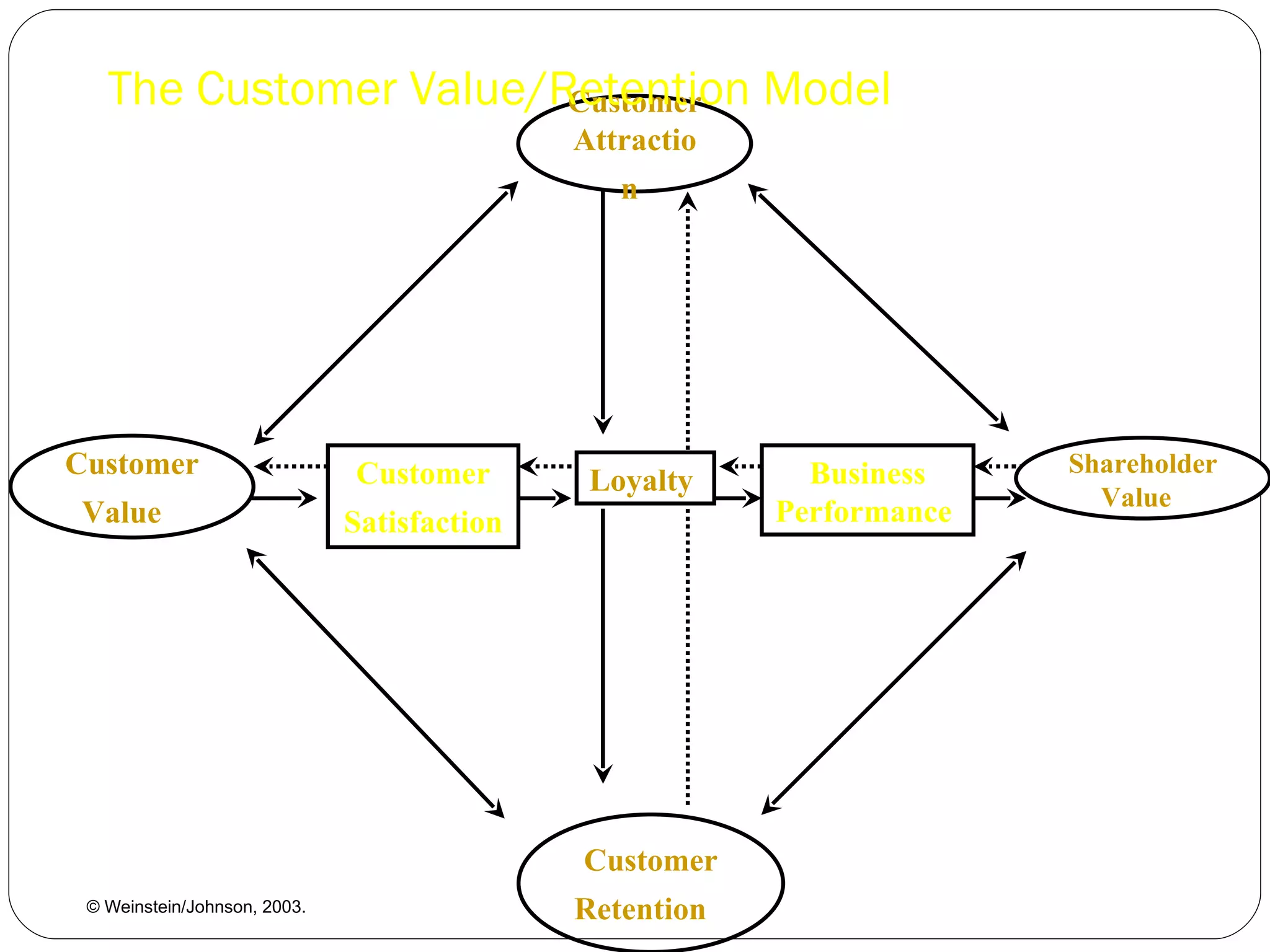
The Customer Value/Retention Model Customer Attraction   Customer Retention   Shareholder Value   Customer Value   Customer Satisfaction   Loyalty  Business Performance   © Weinstein/Johnson, 2003.
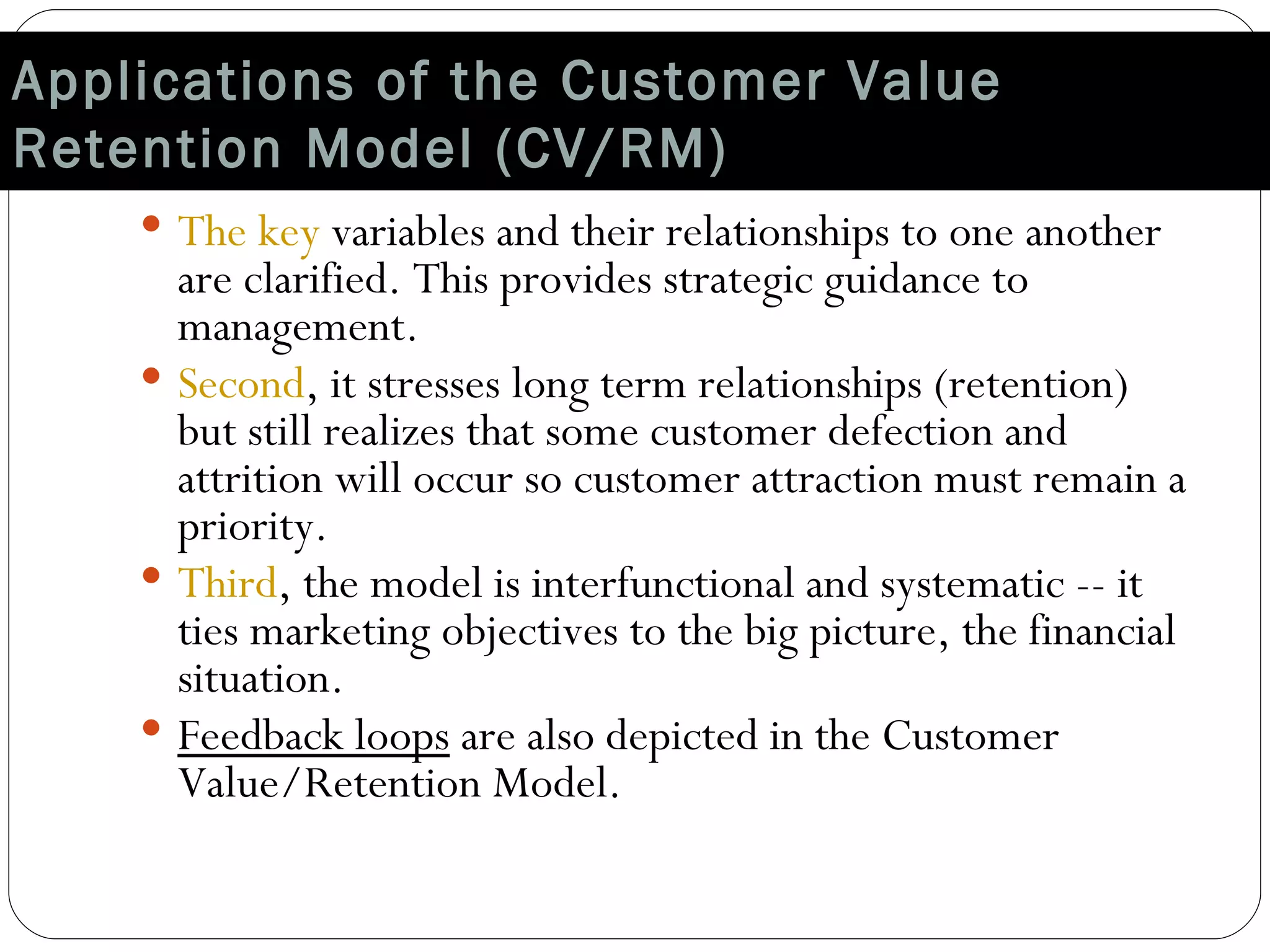
Applications of the Customer Value Retention Model (CV/RM) The key  variables and their relationships to one another are clarified. This provides strategic guidance to management. Second , it stresses long term relationships (retention) but still realizes that some customer defection and attrition will occur so customer attraction must remain a priority. Third , the model is interfunctional and systematic -- it ties marketing objectives to the big picture, the financial situation. Feedback loops  are also depicted in the Customer Value/Retention Model.
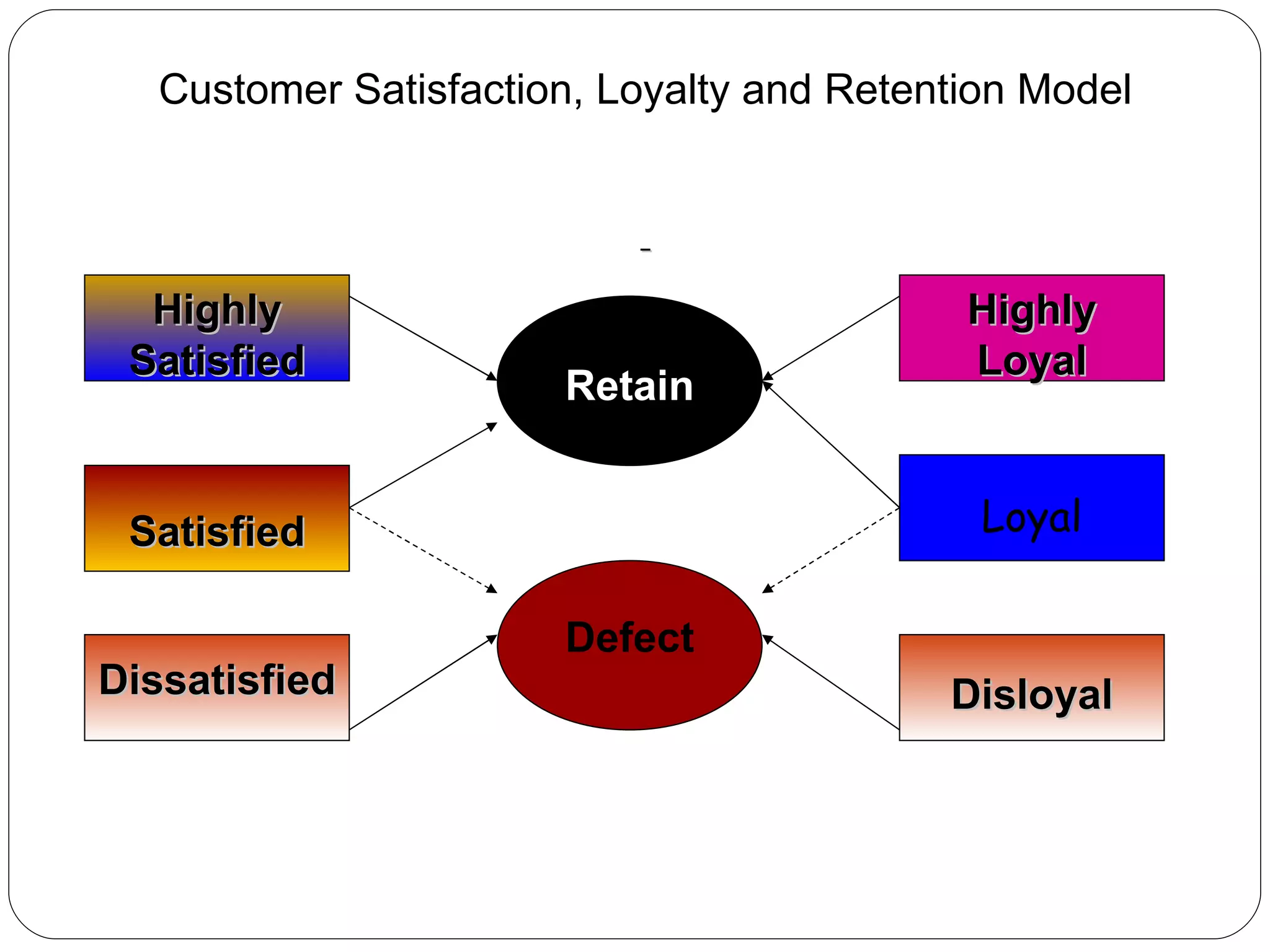
Customer Satisfaction, Loyalty and Retention Model Highly Satisfied Satisfied Dissatisfied Highly Loyal Loyal Disloyal Retain Defect
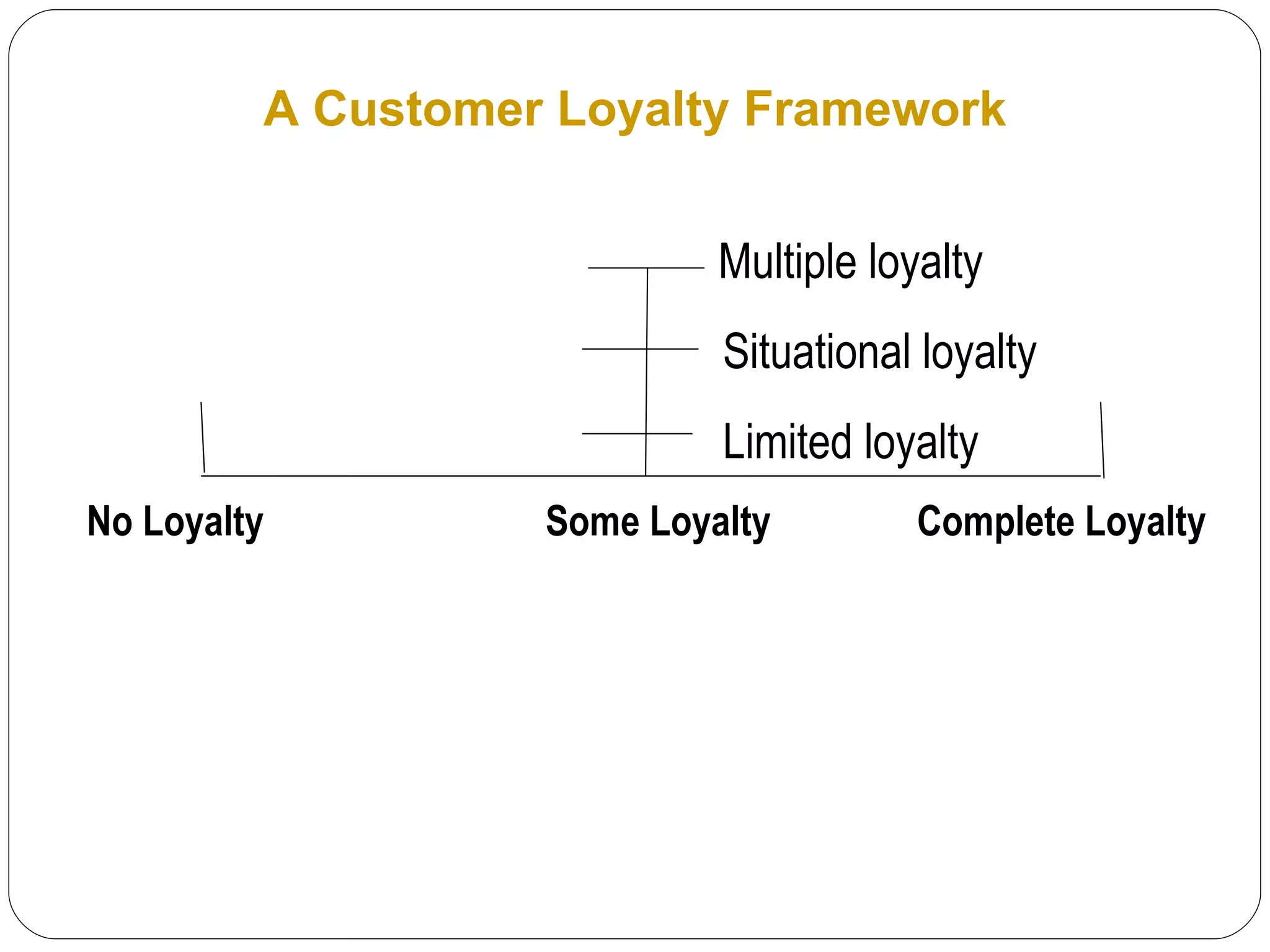
A Customer Loyalty Framework Multiple loyalty Situational loyalty Limited loyalty No Loyalty   Some Loyalty  Complete Loyalty
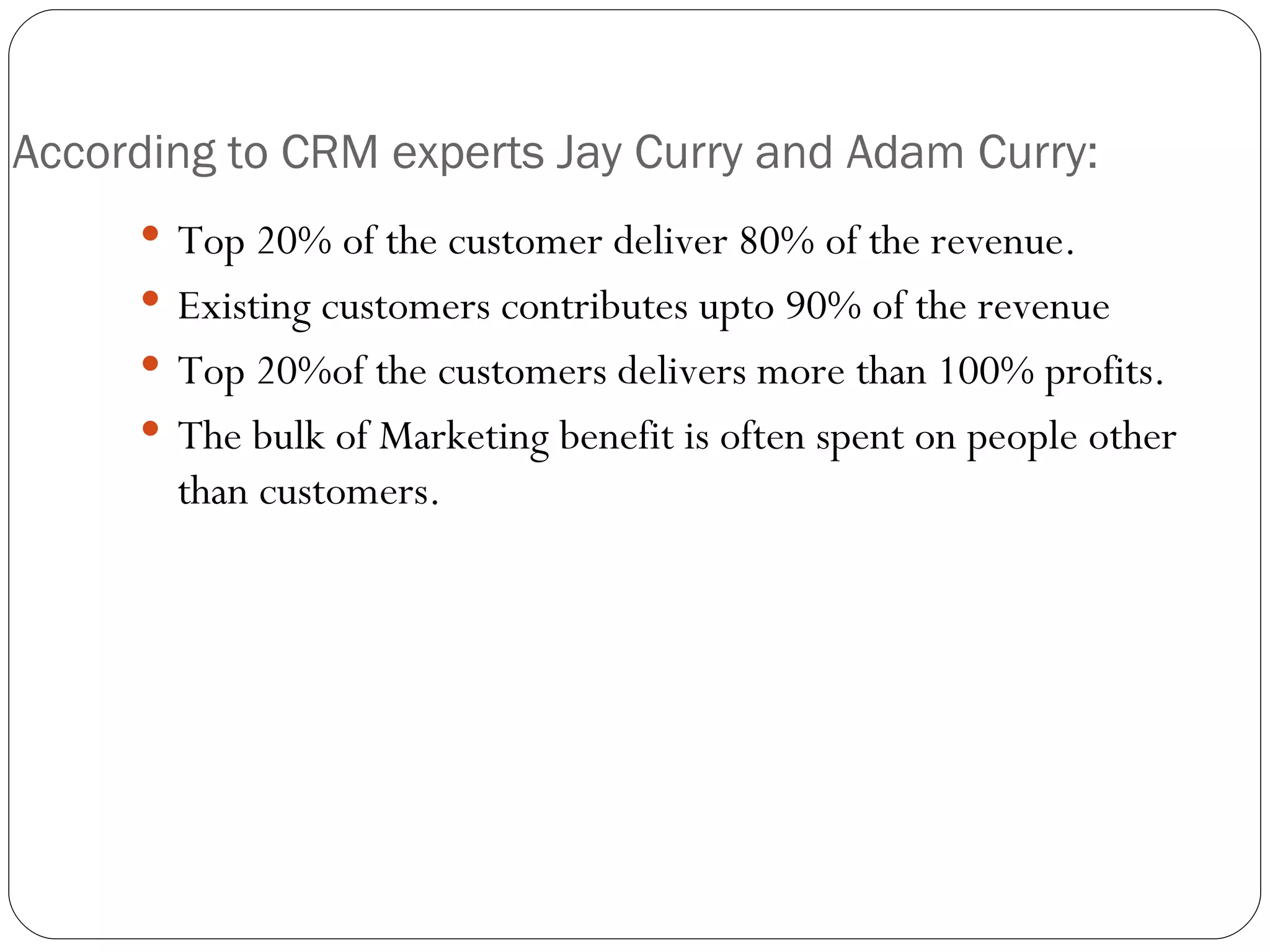
According to CRM experts Jay Curry and Adam Curry: Top 20% of the customer deliver 80% of the revenue. Existing customers contributes upto 90% of the revenue Top 20%of the customers delivers more than 100% profits. The bulk of Marketing benefit is often spent on people other than customers.
According to CRM experts Jay Curry and Adam Curry: Between 5% and 30% of all customer have the potential for moving upward the loyalty ladder. 2% upward migration in the loyalty ladder means 10% more revenue and 50% more profits.
Sequences in Retention process Exploring Evaluating Establishing Strategies Examining feedback
Attrition: The Negative Signal to Retention Increase in the number of complaint Decrease in the frequency of contacts Decrease in personal visits Decrease in enquiries Decrease in the volume of business Decrease in the number of active buyers Decrease in the extent of interaction Decrease in the flow of communication.
Brand Switching Behavior Dissatisfaction with present brand Change in fashion Promises made by competitors Change in the perceived benefits Personal characteristics of the customer concerned Pressure of salespersons  Personal reasons
B uyer or  T ry-er? Realize that a 1-time  buyer   is really a  try-er , rather than a customer To move beyond the transaction stage, organizational experiences must  meet or exceed expectations   Repeated incidents of high satisfaction are sought through the utilization of relationship marketing strategies, leading to greater customer loyalty
Classification of  Customer Loyal Segments Strangers   short-term-low profit customers Butterflies  high-profit potential but tend to be short-term and disloyal Barnacles   stay around for the long-term but generate relatively low profits True friends  are both highly profitable and are long-term customers (Reinartz, W. and Kumar, V., 2002)
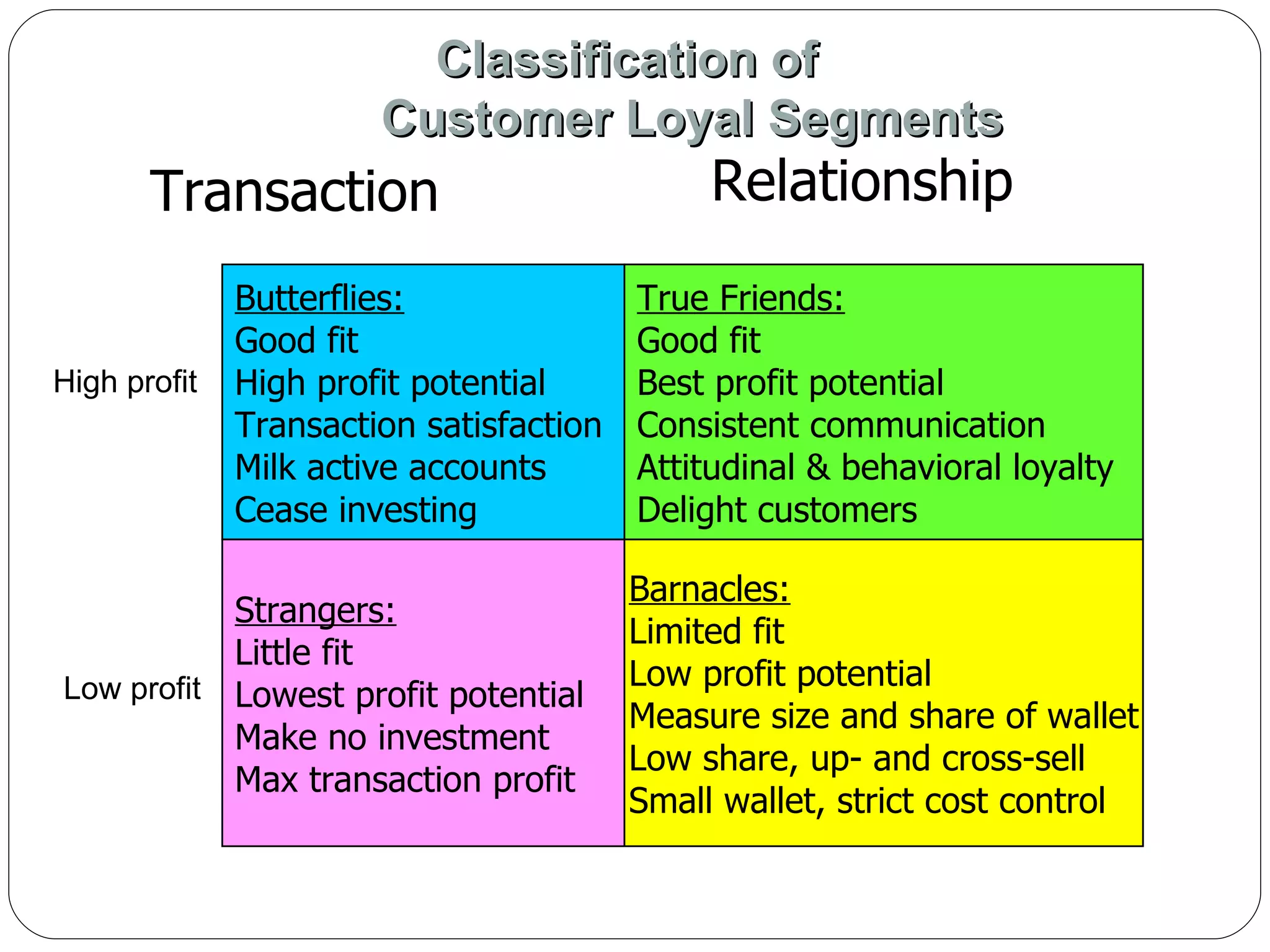
Butterflies: Good fit High profit potential Transaction satisfaction Milk active accounts Cease investing  Strangers: Little fit Lowest profit potential Make no investment Max transaction profit  True Friends: Good fit Best profit potential Consistent communication Attitudinal & behavioral loyalty Delight customers  Barnacles: Limited fit Low profit potential Measure size and share of wallet Low share, up- and cross-sell Small wallet, strict cost control  Transaction Relationship High profit Low profit Classification of    Customer Loyal Segments
Loyalty Building Strategies Send salespeople to work at the offices of  your  best customers Participate in customers events Hold a retreat with a major customer to share  best practices Invite customers to participate in training  seminars CONT..
Loyalty Building Strategies  -  CONT. ☛  Set up a customer advisory council ☛  Develop a preferred-customer pricing strategy ☛  Reward customers for referring new business ☛  Develop 3-5 year business plans with customers ☛  Partner with key accounts on industry research projects
Usage Analysis and CR Differentiated marketing strategies for  user groups: 1st-time users, repeat customers, heavy users, and former users  By classifying customer accounts based on usage frequency and variety, companies can develop effective strategies to retain and upgrade customers
Usage Analysis Tools Heavy, medium, light, former, and nonusers ( A,B,C,D,X ) Heavy half segmentation ( 80/20 rule ) Users vs. nonusers, competitive users Loyal (degree) versus nonloyal customers Product/service applications by user group Adopter categories - innovators, followers, laggards Geographic comparisons (customer penetration indices, growth)
4-Tier Usage Segmentation  Platinum Tier  – the company’s most profitable customers Gold Tier  – seek price discounts, less loyal, and use multiple vendors Iron Tier  – essential customers who provide the volume to utilize the firm’s capacity, but their spending levels, loyalty, and profitability do not merit  special treatment Lead Tier  – customers who cost the company money. They demand more attention than they are due given their spending and profitability - sometimes problem customers that complain and tie up resources.  (Rust, Zeithaml, and Lemon, 2000/2003)
RFM Analysis Recency  refers to the last service encounter/ transaction Frequency   assesses how often these customer-company experiences occur Monetary   value probes the amount that is spent, invested, or committed by customers for the firm’s offerings
How to Do an RFM Analysis * Access a summary of  each customer’s RFM transaction history. This includes most recent purchase, frequency of purchases, and monetary value spent per order. Sort customers  by purchase dates  in reverse chronological order . Divide the customer list into 5 equal segments. Tag the most  recent  customer quintile as 1 while the least recent purchases are quintile 5. Cont..
How to Do an RFM Analysis * - cont. Sort  your customers  by  frequency   (number of orders) and apply the same methodology as in #2.  Sort  your customers  by  monetary value  (average $ amount of each order) and apply the same methodology  as in #2. You now have created RFM scores for each of your customers , from your best customer segment (111) to your worst (555). Adapted from Kahan, R. (1998)
Customer Retention Approaches CR  tactics are short term in nature while CR strategies create lasting value for customers CR efforts should begin once the firm wins a customer These efforts should include Learning as much as possible about customer needs Responding promptly to any indications of disinterest Making customers feel truly cared for Resolving complaints quickly and efficiently Be willing to negotiate with high-value customers who show signs of inactivity  (Passavant, 1995)
9 Common/Effective  Approaches for Enhancing Retention Build a customer database/marketing information system Design ongoing customer programs - continuity and loyalty-based initiatives Offer long term services - membership/subscription programs Custom promotion - use reminder advertising and press releases  - cont.
Most Common/Effective  Approaches for Enhancing Retention – cont. Focus on key accounts and heavy users Use newsletters/informational materials to stay in touch with infrequent customers Attend trade shows Research customers needs and wants Welcome suggestions and complaints
Other Customer Retention Tools Customer relationship management ( CRM ), an expensive information technology, is also frequently used by large companies for business usage analyses The  80/20 principle  was integral in determining the focus & location of Fast Industries’ most important customers SWOT  analysis -- strengths, weaknesses, opportunities, and threats -- information can be gathered from each strategic customer
7 Criteria for Selecting    CR Approaches ■  Efficiency - low cost ■  Effectiveness - likelihood to succeed ■  Adaptability - strategic fit with the organizational culture ■  Consistency - works well with the current marketing plan ■  Competitive advantage ■  Ease of implementation ■  Projected profitability
5-Step Process for Designing a  Customer Retention Program Determine your current CR rate Analyze the defection problem Establish a new CR objective Invest in a targeted CR plan to enhance customer loyalty Evaluate the success of the CR program
Measuring Customer Retention Annual and targeted customer retention rates Weighted customer retention rates - accounts for usage differences Segmented retention indicators - subgroup analysis based on geographic, demographic, lifestyle, product preferences, etc. Share-of-customer Customer lifetime value ( CLTV ) Recency, frequency, and monetary value ( RFM )
Useful Metrics for CR Evaluation Innovative customer value managers should consider the measures below to gain additional insight on retention: Expected future use Anticipated regret Intent to switch Intent to remain loyal – likelihood to return to provider and to recommend provider
Questions are welcomed. End of the topic

Customer Retention Strategy

  • 1.
    By- Avinash Kumar[email_address] Retention strategy
  • 2.
    Why Focus onCustomer Retention (CR)? Service encounter failures Inconvenience Response to failed service Pricing Competition Ethical concerns Involuntary switching Other factors (Keveaney, S.M., 1995)
  • 3.
    Reicheld on CustomerRetention Service companies must retain the best personnel to win and keep good customers It’s impossible to build a loyal bank of customers without a loyal employee base On average , U.S. corporations lose half of their customers in 5 years A typical company has a customer defection rate of 10-30% per year Raising the customer retention rate by 5% can increase the value of an average customer (lifetime profits) by 25-100%
  • 4.
    Philips Kotler onCustomer Retention The key to customer retention is customer satisfaction Satisfied Customers Stay loyal longer Talk favorably about the organization Pay less attention to the competition Are less price sensitive Offer service ideas to the organization Cost less to serve than new customers
  • 5.
    The Cost of Lost Business for a Hospital 15,000 patients annually 3,750 defections (25% defection rate, 75% retention rate) $2,500 average patient revenue $9.375 million = annual lost revenues $703,125 = lost profits (7.5% profit margin)
  • 6.
    Image/Promotion -community service, direct mail, educational offerings, integrated marketing communications, newsletters, regular customer contact, informational materials, website Service Quality - continuous quality initiatives, convenience,customer service training, demonstrate that customers are highly valued, mystery shopping, customer representatives/ ombudsman, service failure training, smile, treat customers as family. cont.. Customer Retention Tactics
  • 7.
    Research -analyze defection rates/reasons, classify customers by usage/satisfaction/loyalty, develop targeted retention programs. Internal Marketing - loyalty task force, prepare “solutions” to recurring problems, share appropriate customer data with staff, reward and publicize customer care person of the month. * Customer-Centered - “dialogue” marketing, customer bill of rights, customer care councils, understand customer expectations. Customer Retention Tactics - cont.
  • 8.
    A Customer Value/ Retention Model ☛ The CV/retention model offers a good way of explaining the key relationships among the core elements that create value in an organization ☛ Customer value is built through the proper mix of SQIP (service, quality, image & price) - elements that attract and keep customers
  • 9.
    The Customer Value/RetentionModel Customer Attraction Customer Retention Shareholder Value Customer Value Customer Satisfaction Loyalty Business Performance © Weinstein/Johnson, 2003.
  • 10.
    Applications of theCustomer Value Retention Model (CV/RM) The key variables and their relationships to one another are clarified. This provides strategic guidance to management. Second , it stresses long term relationships (retention) but still realizes that some customer defection and attrition will occur so customer attraction must remain a priority. Third , the model is interfunctional and systematic -- it ties marketing objectives to the big picture, the financial situation. Feedback loops are also depicted in the Customer Value/Retention Model.
  • 11.
    Customer Satisfaction, Loyaltyand Retention Model Highly Satisfied Satisfied Dissatisfied Highly Loyal Loyal Disloyal Retain Defect
  • 12.
    A Customer LoyaltyFramework Multiple loyalty Situational loyalty Limited loyalty No Loyalty Some Loyalty Complete Loyalty
  • 13.
    According to CRMexperts Jay Curry and Adam Curry: Top 20% of the customer deliver 80% of the revenue. Existing customers contributes upto 90% of the revenue Top 20%of the customers delivers more than 100% profits. The bulk of Marketing benefit is often spent on people other than customers.
  • 14.
    According to CRMexperts Jay Curry and Adam Curry: Between 5% and 30% of all customer have the potential for moving upward the loyalty ladder. 2% upward migration in the loyalty ladder means 10% more revenue and 50% more profits.
  • 15.
    Sequences in Retentionprocess Exploring Evaluating Establishing Strategies Examining feedback
  • 16.
    Attrition: The NegativeSignal to Retention Increase in the number of complaint Decrease in the frequency of contacts Decrease in personal visits Decrease in enquiries Decrease in the volume of business Decrease in the number of active buyers Decrease in the extent of interaction Decrease in the flow of communication.
  • 17.
    Brand Switching BehaviorDissatisfaction with present brand Change in fashion Promises made by competitors Change in the perceived benefits Personal characteristics of the customer concerned Pressure of salespersons Personal reasons
  • 18.
    B uyer or T ry-er? Realize that a 1-time buyer is really a try-er , rather than a customer To move beyond the transaction stage, organizational experiences must meet or exceed expectations Repeated incidents of high satisfaction are sought through the utilization of relationship marketing strategies, leading to greater customer loyalty
  • 19.
    Classification of Customer Loyal Segments Strangers short-term-low profit customers Butterflies high-profit potential but tend to be short-term and disloyal Barnacles stay around for the long-term but generate relatively low profits True friends are both highly profitable and are long-term customers (Reinartz, W. and Kumar, V., 2002)
  • 20.
    Butterflies: Good fitHigh profit potential Transaction satisfaction Milk active accounts Cease investing Strangers: Little fit Lowest profit potential Make no investment Max transaction profit True Friends: Good fit Best profit potential Consistent communication Attitudinal & behavioral loyalty Delight customers Barnacles: Limited fit Low profit potential Measure size and share of wallet Low share, up- and cross-sell Small wallet, strict cost control Transaction Relationship High profit Low profit Classification of Customer Loyal Segments
  • 21.
    Loyalty Building StrategiesSend salespeople to work at the offices of your best customers Participate in customers events Hold a retreat with a major customer to share best practices Invite customers to participate in training seminars CONT..
  • 22.
    Loyalty Building Strategies - CONT. ☛ Set up a customer advisory council ☛ Develop a preferred-customer pricing strategy ☛ Reward customers for referring new business ☛ Develop 3-5 year business plans with customers ☛ Partner with key accounts on industry research projects
  • 23.
    Usage Analysis andCR Differentiated marketing strategies for user groups: 1st-time users, repeat customers, heavy users, and former users By classifying customer accounts based on usage frequency and variety, companies can develop effective strategies to retain and upgrade customers
  • 24.
    Usage Analysis ToolsHeavy, medium, light, former, and nonusers ( A,B,C,D,X ) Heavy half segmentation ( 80/20 rule ) Users vs. nonusers, competitive users Loyal (degree) versus nonloyal customers Product/service applications by user group Adopter categories - innovators, followers, laggards Geographic comparisons (customer penetration indices, growth)
  • 25.
    4-Tier Usage Segmentation Platinum Tier – the company’s most profitable customers Gold Tier – seek price discounts, less loyal, and use multiple vendors Iron Tier – essential customers who provide the volume to utilize the firm’s capacity, but their spending levels, loyalty, and profitability do not merit special treatment Lead Tier – customers who cost the company money. They demand more attention than they are due given their spending and profitability - sometimes problem customers that complain and tie up resources. (Rust, Zeithaml, and Lemon, 2000/2003)
  • 26.
    RFM Analysis Recency refers to the last service encounter/ transaction Frequency assesses how often these customer-company experiences occur Monetary value probes the amount that is spent, invested, or committed by customers for the firm’s offerings
  • 27.
    How to Doan RFM Analysis * Access a summary of each customer’s RFM transaction history. This includes most recent purchase, frequency of purchases, and monetary value spent per order. Sort customers by purchase dates in reverse chronological order . Divide the customer list into 5 equal segments. Tag the most recent customer quintile as 1 while the least recent purchases are quintile 5. Cont..
  • 28.
    How to Doan RFM Analysis * - cont. Sort your customers by frequency (number of orders) and apply the same methodology as in #2. Sort your customers by monetary value (average $ amount of each order) and apply the same methodology as in #2. You now have created RFM scores for each of your customers , from your best customer segment (111) to your worst (555). Adapted from Kahan, R. (1998)
  • 29.
    Customer Retention ApproachesCR tactics are short term in nature while CR strategies create lasting value for customers CR efforts should begin once the firm wins a customer These efforts should include Learning as much as possible about customer needs Responding promptly to any indications of disinterest Making customers feel truly cared for Resolving complaints quickly and efficiently Be willing to negotiate with high-value customers who show signs of inactivity (Passavant, 1995)
  • 30.
    9 Common/Effective Approaches for Enhancing Retention Build a customer database/marketing information system Design ongoing customer programs - continuity and loyalty-based initiatives Offer long term services - membership/subscription programs Custom promotion - use reminder advertising and press releases - cont.
  • 31.
    Most Common/Effective Approaches for Enhancing Retention – cont. Focus on key accounts and heavy users Use newsletters/informational materials to stay in touch with infrequent customers Attend trade shows Research customers needs and wants Welcome suggestions and complaints
  • 32.
    Other Customer RetentionTools Customer relationship management ( CRM ), an expensive information technology, is also frequently used by large companies for business usage analyses The 80/20 principle was integral in determining the focus & location of Fast Industries’ most important customers SWOT analysis -- strengths, weaknesses, opportunities, and threats -- information can be gathered from each strategic customer
  • 33.
    7 Criteria forSelecting CR Approaches ■ Efficiency - low cost ■ Effectiveness - likelihood to succeed ■ Adaptability - strategic fit with the organizational culture ■ Consistency - works well with the current marketing plan ■ Competitive advantage ■ Ease of implementation ■ Projected profitability
  • 34.
    5-Step Process forDesigning a Customer Retention Program Determine your current CR rate Analyze the defection problem Establish a new CR objective Invest in a targeted CR plan to enhance customer loyalty Evaluate the success of the CR program
  • 35.
    Measuring Customer RetentionAnnual and targeted customer retention rates Weighted customer retention rates - accounts for usage differences Segmented retention indicators - subgroup analysis based on geographic, demographic, lifestyle, product preferences, etc. Share-of-customer Customer lifetime value ( CLTV ) Recency, frequency, and monetary value ( RFM )
  • 36.
    Useful Metrics forCR Evaluation Innovative customer value managers should consider the measures below to gain additional insight on retention: Expected future use Anticipated regret Intent to switch Intent to remain loyal – likelihood to return to provider and to recommend provider
  • 37.
    Questions are welcomed.End of the topic