Dependability and Security Specification

                                                        Lecture 1


Dependability and Security Specification, CSE course, 2011          Slide 1
Topics covered

  •       Risk-driven specification
  •       Safety specification
  •       Security specification
  •       Software reliability specification


Dependability and Security Specification, CSE course, 2011   Slide 2
Dependability requirements

  •       Functional requirements to define error checking and
          recovery facilities and protection against system
          failures.
  •       Non-functional requirements defining the required
          reliability and availability of the system.
  •       Excluding requirements that define states and
          conditions that must not arise.


Dependability and Security Specification, CSE course, 2011   Slide 3
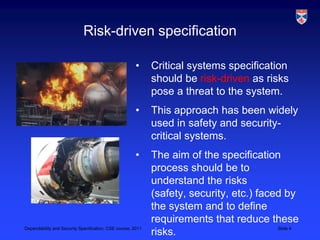
Risk-driven specification

                                                       •     Critical systems specification
                                                             should be risk-driven as risks
                                                             pose a threat to the system.
                                                       •     This approach has been widely
                                                             used in safety and security-
                                                             critical systems.
                                                       •     The aim of the specification
                                                             process should be to
                                                             understand the risks
                                                             (safety, security, etc.) faced by
                                                             the system and to define
                                                             requirements that reduce these
Dependability and Security Specification, CSE course, 2011                                Slide 4
                                                             risks.
Phased risk analysis

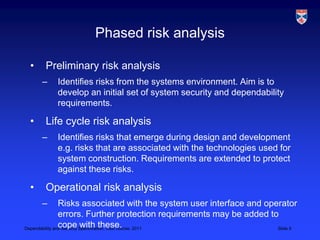
 •    Preliminary risk analysis
     –   Identifies risks from the systems environment. Aim is to
         develop an initial set of system security and dependability
         requirements.

 •    Life cycle risk analysis
     –   Identifies risks that emerge during design and development
         e.g. risks that are associated with the technologies used for
         system construction. Requirements are extended to protect
         against these risks.

 •    Operational risk analysis
     –          Risks associated with the system user interface and operator
                errors. Further protection requirements may be added to
                cope with these.
Dependability and Security Specification, CSE course, 2011             Slide 5
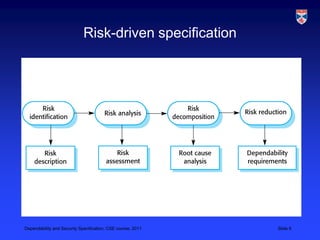
Risk-driven specification


Dependability and Security Specification, CSE course, 2011   Slide 6
Stages of risk-based analysis

   •       Risk identification
         –       Identify potential risks that may arise.

   •       Risk analysis and classification
         –       Assess the seriousness of each risk.

   •       Risk decomposition
         –       Decompose risks to discover their potential root causes.

   •       Risk reduction assessment
         –       Define how each risk must be taken into eliminated or
                 reduced when the system is designed.


Dependability and Security Specification, CSE course, 2011               Slide 7
Safety specification

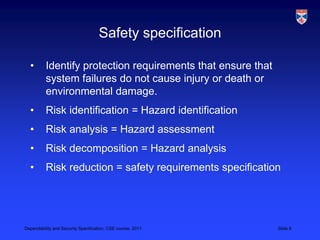
  •       Identify protection requirements that ensure that
          system failures do not cause injury or death or
          environmental damage.
  •       Risk identification = Hazard identification
  •       Risk analysis = Hazard assessment
  •       Risk decomposition = Hazard analysis
  •       Risk reduction = safety requirements specification


Dependability and Security Specification, CSE course, 2011    Slide 8
Hazard identification

                                                             •   Identify the hazards that may
                                                                 threaten the system.
                                                             •   Hazard identification may be
                                                                 based on different types of
                                                                 hazard:
                                                                 –   Physical hazards
                                                                 –   Electrical hazards
                                                                 –   Biological hazards
                                                                 –   Service failure hazards
                                                                 –   Etc.


Dependability and Security Specification, CSE course, 2011                                     Slide 9
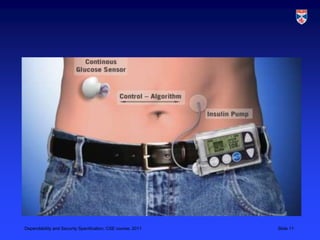
A software-controlled insulin pump
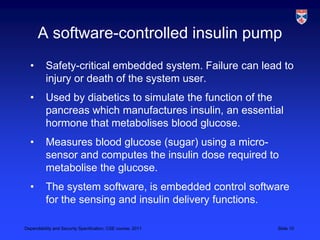
  •       Safety-critical embedded system. Failure can lead to
          injury or death of the system user.
  •       Used by diabetics to simulate the function of the
          pancreas which manufactures insulin, an essential
          hormone that metabolises blood glucose.
  •       Measures blood glucose (sugar) using a micro-
          sensor and computes the insulin dose required to
          metabolise the glucose.
  •       The system software, is embedded control software
          for the sensing and insulin delivery functions.

Dependability and Security Specification, CSE course, 2011   Slide 10
Dependability and Security Specification, CSE course, 2011   Slide 11
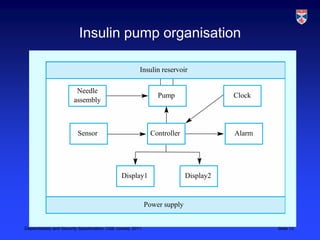
Insulin pump organisation

                                                         Insulin reservoir

                         Needle
                                                                 Pump                  Clock
                        assembly


                          Sensor                              Controller               Alarm


                                                Display1                    Display2


                                                             Power supply


Dependability and Security Specification, CSE course, 2011                                     Slide 12
Insulin pump data-flow

                                           Blood
Blood                                    parameters
                    Blood sugar                              Blood sugar   Blood sugar
                      sensor                                   analysis       level


                                                                                       Insulin
                                                                                    requirement
                                                                                    computation
                                          Pump control
  Insulin                                  commands                           Insulin
                                                               Insulin
                       Insulin                                 delivery    requirement
                        pump                                  controller


Dependability and Security Specification, CSE course, 2011                                   Slide 13
Dependability requirements

                                                             •   The system shall be available to
                                                                 deliver insulin when required to do
                                                                 so.
                                                             •   The system shall perform
                                                                 reliability and deliver the correct
                                                                 amount of insulin to counteract
                                                                 the current level of blood sugar.
                                                             •   The essential safety requirement
                                                                 is that excessive doses of insulin
                                                                 should never be delivered as this
                                                                 is potentially life threatening.


Dependability and Security Specification, CSE course, 2011                                      Slide 14
Insulin pump risks

  •       Insulin overdose (service failure).
  •       Insulin underdose (service failure).
  •       Power failure due to exhausted battery (electrical).
  •       Electrical interference with other medical equipment
          (electrical).
  •       Poor sensor and actuator contact (physical).
  •       Parts of machine break off in body (physical).
  •       Infection caused by introduction of machine
          (biological).
  •       Allergic reaction to materials or insulin (biological).
Dependability and Security Specification, CSE course, 2011     Slide 15
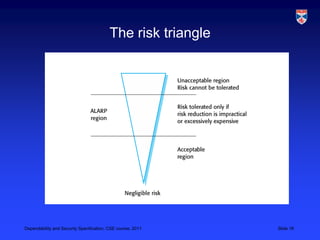
The risk triangle


Dependability and Security Specification, CSE course, 2011    Slide 16
Hazard assessment

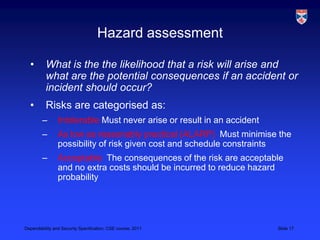
  •       What is the the likelihood that a risk will arise and
          what are the potential consequences if an accident or
          incident should occur?
  •       Risks are categorised as:
        –       Intolerable Must never arise or result in an accident
        –       As low as reasonably practical (ALARP) Must minimise the
                possibility of risk given cost and schedule constraints
        –       Acceptable The consequences of the risk are acceptable
                and no extra costs should be incurred to reduce hazard
                probability


Dependability and Security Specification, CSE course, 2011              Slide 17
Social acceptability of safety-related
                         risks
                                                      •       In most societies, the
                                                              boundaries between the
                                                              regions are pushed upwards
                                                              with time i.e. society is less
                                                              willing to accept risk
                                                             – For example, the costs of
                                                                 cleaning up pollution may be
                                                                 less than the costs of
                                                                 preventing it but this may not
                                                                 be socially acceptable.
                                                      •       Risk assessment is subjective
                                                             – Risks are identified as
                                                                probable, unlikely, etc. This
Dependability and Security Specification, CSE course, 2011
                                                                depends on who is making18Slide
Hazard assessment

                                                   •         Estimate the hazard probability
                                                             and the hazard severity.
                                                   •         It is not normally possible to do
                                                             this precisely so relative values
                                                             are used such as
                                                             ‘unlikely’, ‘rare’, ‘very high’, etc.
                                                   •         The aim is to make sure that the
                                                             system can handle hazards that
                                                             are likely to arise or that have
                                                             high severity.


Dependability and Security Specification, CSE course, 2011                                    Slide 19
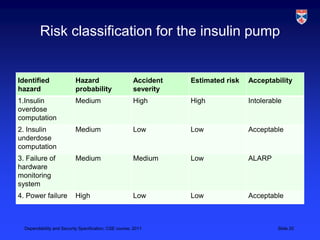
Risk classification for the insulin pump


Identified                 Hazard                      Accident   Estimated risk   Acceptability
hazard                     probability                 severity
1.Insulin                  Medium                      High       High             Intolerable
overdose
computation
2. Insulin                 Medium                      Low        Low              Acceptable
underdose
computation
3. Failure of              Medium                      Medium     Low              ALARP
hardware
monitoring
system
4. Power failure           High                        Low        Low              Acceptable


  Dependability and Security Specification, CSE course, 2011                                Slide 20
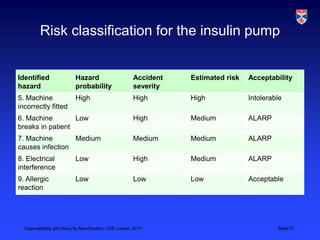
Risk classification for the insulin pump


Identified                 Hazard                      Accident   Estimated risk   Acceptability
hazard                     probability                 severity
5. Machine                 High                        High       High             Intolerable
incorrectly fitted
6. Machine        Low                                  High       Medium           ALARP
breaks in patient
7. Machine       Medium                                Medium     Medium           ALARP
causes infection
8. Electrical              Low                         High       Medium           ALARP
interference
9. Allergic                Low                         Low        Low              Acceptable
reaction


  Dependability and Security Specification, CSE course, 2011                                Slide 21
Hazard analysis

                                                •       Concerned with discovering the
                                                        root causes of risks in a particular
                                                        system.
                                                •       Techniques have been mostly
                                                        derived from safety-critical
                                                        systems and can be
                                                      –      Inductive, bottom-up techniques. Start
                                                             with a proposed system failure and
                                                             assess the hazards that could arise
                                                             from that failure;
                                                      –      Deductive, top-down techniques.
                                                             Start with a hazard and deduce what
                                                             the causes of this could be.

Dependability and Security Specification, CSE course, 2011                                   Slide 22
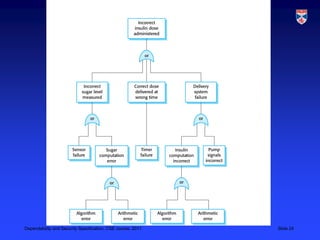
Fault-tree analysis
                                                               •   Put the risk or
                                                                   hazard at the root
                                                                   of the tree and
                                                                   identify the system
                                                                   states that could
                                                                   lead to that hazard.
                                                               •   Where
                                                                   appropriate, link
                                                                   these with ‘and’ or
                                                                   ‘or’ conditions.


                                  NO SINGLE POINT OF FAILURE

The key goal should be to minimise the number of single causes of system failure.
 Dependability and Security Specification, CSE course, 2011                    Slide 23
Dependability and Security Specification, CSE course, 2011   Slide 24
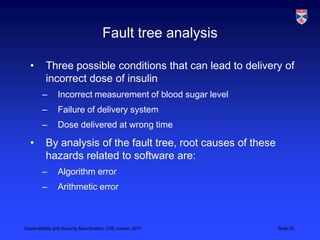
Fault tree analysis

  •       Three possible conditions that can lead to delivery of
          incorrect dose of insulin
        –       Incorrect measurement of blood sugar level
        –       Failure of delivery system
        –       Dose delivered at wrong time

  •       By analysis of the fault tree, root causes of these
          hazards related to software are:
        –       Algorithm error
        –       Arithmetic error


Dependability and Security Specification, CSE course, 2011      Slide 25
Risk reduction

                                                             •   The aim of this process is
                                                                 to identify dependability
                                                                 requirements that specify
                                                                 how the risks should be
                                                                 managed and ensure that
                                                                 accidents/incidents do
                                                                 not arise.
                                                             •   Risk reduction strategies
                                                                 –   Risk avoidance;
                                                                 –   Risk detection and removal;
                                                                 –   Damage limitation.

Dependability and Security Specification, CSE course, 2011                                Slide 26
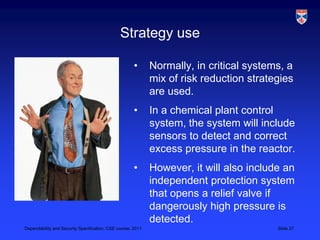
Strategy use

                                                      •      Normally, in critical systems, a
                                                             mix of risk reduction strategies
                                                             are used.
                                                      •      In a chemical plant control
                                                             system, the system will include
                                                             sensors to detect and correct
                                                             excess pressure in the reactor.
                                                      •      However, it will also include an
                                                             independent protection system
                                                             that opens a relief valve if
                                                             dangerously high pressure is
                                                             detected.
Dependability and Security Specification, CSE course, 2011                               Slide 27
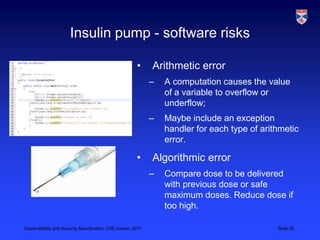
Insulin pump - software risks

                                                       •     Arithmetic error
                                                             –   A computation causes the value
                                                                 of a variable to overflow or
                                                                 underflow;
                                                             –   Maybe include an exception
                                                                 handler for each type of arithmetic
                                                                 error.

                                                       •     Algorithmic error
                                                             –   Compare dose to be delivered
                                                                 with previous dose or safe
                                                                 maximum doses. Reduce dose if
                                                                 too high.

Dependability and Security Specification, CSE course, 2011                                    Slide 28
Examples of safety requirements

SR1: The system shall not deliver a single dose of insulin that is greater
than a specified maximum dose for a system user.
SR2: The system shall not deliver a daily cumulative dose of insulin that is
greater than a specified maximum daily dose for a system user.
SR3: The system shall include a hardware diagnostic facility that shall be
executed at least four times per hour.
SR4: The system shall include an exception handler for all of the
exceptions that are identified in Table 3.
SR5: The audible alarm shall be sounded when any hardware or software
anomaly is discovered and a diagnostic message, as defined in Table
4, shall be displayed.
SR6: In the event of an alarm, insulin delivery shall be suspended until the
user has reset the system and cleared the alarm.


Dependability and Security Specification, CSE course, 2011               Slide 29
Key points

 •   Risk analysis is an important activity in the
     specification of security and dependability
     requirements. It involves identifying risks that can
     result in accidents or incidents.
 •   A hazard-driven approach may be used to
     understand the safety requirements for a system. You
     identify potential hazards and decompose these
     (using methods such as fault tree analysis) to
     discover their root causes.
 •       Safety requirements should be included to ensure
         that hazards and accidents do not arise or, if this is
         impossible, to limit the damage caused by system
Dependability and Security Specification, CSE course, 2011   Slide 30
         failure.

Safety specification (CS 5032 2012)

  • 1.
    Dependability and SecuritySpecification Lecture 1 Dependability and Security Specification, CSE course, 2011 Slide 1
  • 2.
    Topics covered • Risk-driven specification • Safety specification • Security specification • Software reliability specification Dependability and Security Specification, CSE course, 2011 Slide 2
  • 3.
    Dependability requirements • Functional requirements to define error checking and recovery facilities and protection against system failures. • Non-functional requirements defining the required reliability and availability of the system. • Excluding requirements that define states and conditions that must not arise. Dependability and Security Specification, CSE course, 2011 Slide 3
  • 4.
    Risk-driven specification • Critical systems specification should be risk-driven as risks pose a threat to the system. • This approach has been widely used in safety and security- critical systems. • The aim of the specification process should be to understand the risks (safety, security, etc.) faced by the system and to define requirements that reduce these Dependability and Security Specification, CSE course, 2011 Slide 4 risks.
  • 5.
    Phased risk analysis • Preliminary risk analysis – Identifies risks from the systems environment. Aim is to develop an initial set of system security and dependability requirements. • Life cycle risk analysis – Identifies risks that emerge during design and development e.g. risks that are associated with the technologies used for system construction. Requirements are extended to protect against these risks. • Operational risk analysis – Risks associated with the system user interface and operator errors. Further protection requirements may be added to cope with these. Dependability and Security Specification, CSE course, 2011 Slide 5
  • 6.
    Risk-driven specification Dependability andSecurity Specification, CSE course, 2011 Slide 6
  • 7.
    Stages of risk-basedanalysis • Risk identification – Identify potential risks that may arise. • Risk analysis and classification – Assess the seriousness of each risk. • Risk decomposition – Decompose risks to discover their potential root causes. • Risk reduction assessment – Define how each risk must be taken into eliminated or reduced when the system is designed. Dependability and Security Specification, CSE course, 2011 Slide 7
  • 8.
    Safety specification • Identify protection requirements that ensure that system failures do not cause injury or death or environmental damage. • Risk identification = Hazard identification • Risk analysis = Hazard assessment • Risk decomposition = Hazard analysis • Risk reduction = safety requirements specification Dependability and Security Specification, CSE course, 2011 Slide 8
  • 9.
    Hazard identification • Identify the hazards that may threaten the system. • Hazard identification may be based on different types of hazard: – Physical hazards – Electrical hazards – Biological hazards – Service failure hazards – Etc. Dependability and Security Specification, CSE course, 2011 Slide 9
  • 10.
    A software-controlled insulinpump • Safety-critical embedded system. Failure can lead to injury or death of the system user. • Used by diabetics to simulate the function of the pancreas which manufactures insulin, an essential hormone that metabolises blood glucose. • Measures blood glucose (sugar) using a micro- sensor and computes the insulin dose required to metabolise the glucose. • The system software, is embedded control software for the sensing and insulin delivery functions. Dependability and Security Specification, CSE course, 2011 Slide 10
  • 11.
    Dependability and SecuritySpecification, CSE course, 2011 Slide 11
  • 12.
    Insulin pump organisation Insulin reservoir Needle Pump Clock assembly Sensor Controller Alarm Display1 Display2 Power supply Dependability and Security Specification, CSE course, 2011 Slide 12
  • 13.
    Insulin pump data-flow Blood Blood parameters Blood sugar Blood sugar Blood sugar sensor analysis level Insulin requirement computation Pump control Insulin commands Insulin Insulin Insulin delivery requirement pump controller Dependability and Security Specification, CSE course, 2011 Slide 13
  • 14.
    Dependability requirements • The system shall be available to deliver insulin when required to do so. • The system shall perform reliability and deliver the correct amount of insulin to counteract the current level of blood sugar. • The essential safety requirement is that excessive doses of insulin should never be delivered as this is potentially life threatening. Dependability and Security Specification, CSE course, 2011 Slide 14
  • 15.
    Insulin pump risks • Insulin overdose (service failure). • Insulin underdose (service failure). • Power failure due to exhausted battery (electrical). • Electrical interference with other medical equipment (electrical). • Poor sensor and actuator contact (physical). • Parts of machine break off in body (physical). • Infection caused by introduction of machine (biological). • Allergic reaction to materials or insulin (biological). Dependability and Security Specification, CSE course, 2011 Slide 15
  • 16.
    The risk triangle Dependabilityand Security Specification, CSE course, 2011 Slide 16
  • 17.
    Hazard assessment • What is the the likelihood that a risk will arise and what are the potential consequences if an accident or incident should occur? • Risks are categorised as: – Intolerable Must never arise or result in an accident – As low as reasonably practical (ALARP) Must minimise the possibility of risk given cost and schedule constraints – Acceptable The consequences of the risk are acceptable and no extra costs should be incurred to reduce hazard probability Dependability and Security Specification, CSE course, 2011 Slide 17
  • 18.
    Social acceptability ofsafety-related risks • In most societies, the boundaries between the regions are pushed upwards with time i.e. society is less willing to accept risk – For example, the costs of cleaning up pollution may be less than the costs of preventing it but this may not be socially acceptable. • Risk assessment is subjective – Risks are identified as probable, unlikely, etc. This Dependability and Security Specification, CSE course, 2011 depends on who is making18Slide
  • 19.
    Hazard assessment • Estimate the hazard probability and the hazard severity. • It is not normally possible to do this precisely so relative values are used such as ‘unlikely’, ‘rare’, ‘very high’, etc. • The aim is to make sure that the system can handle hazards that are likely to arise or that have high severity. Dependability and Security Specification, CSE course, 2011 Slide 19
  • 20.
    Risk classification forthe insulin pump Identified Hazard Accident Estimated risk Acceptability hazard probability severity 1.Insulin Medium High High Intolerable overdose computation 2. Insulin Medium Low Low Acceptable underdose computation 3. Failure of Medium Medium Low ALARP hardware monitoring system 4. Power failure High Low Low Acceptable Dependability and Security Specification, CSE course, 2011 Slide 20
  • 21.
    Risk classification forthe insulin pump Identified Hazard Accident Estimated risk Acceptability hazard probability severity 5. Machine High High High Intolerable incorrectly fitted 6. Machine Low High Medium ALARP breaks in patient 7. Machine Medium Medium Medium ALARP causes infection 8. Electrical Low High Medium ALARP interference 9. Allergic Low Low Low Acceptable reaction Dependability and Security Specification, CSE course, 2011 Slide 21
  • 22.
    Hazard analysis • Concerned with discovering the root causes of risks in a particular system. • Techniques have been mostly derived from safety-critical systems and can be – Inductive, bottom-up techniques. Start with a proposed system failure and assess the hazards that could arise from that failure; – Deductive, top-down techniques. Start with a hazard and deduce what the causes of this could be. Dependability and Security Specification, CSE course, 2011 Slide 22
  • 23.
    Fault-tree analysis • Put the risk or hazard at the root of the tree and identify the system states that could lead to that hazard. • Where appropriate, link these with ‘and’ or ‘or’ conditions. NO SINGLE POINT OF FAILURE The key goal should be to minimise the number of single causes of system failure. Dependability and Security Specification, CSE course, 2011 Slide 23
  • 24.
    Dependability and SecuritySpecification, CSE course, 2011 Slide 24
  • 25.
    Fault tree analysis • Three possible conditions that can lead to delivery of incorrect dose of insulin – Incorrect measurement of blood sugar level – Failure of delivery system – Dose delivered at wrong time • By analysis of the fault tree, root causes of these hazards related to software are: – Algorithm error – Arithmetic error Dependability and Security Specification, CSE course, 2011 Slide 25
  • 26.
    Risk reduction • The aim of this process is to identify dependability requirements that specify how the risks should be managed and ensure that accidents/incidents do not arise. • Risk reduction strategies – Risk avoidance; – Risk detection and removal; – Damage limitation. Dependability and Security Specification, CSE course, 2011 Slide 26
  • 27.
    Strategy use • Normally, in critical systems, a mix of risk reduction strategies are used. • In a chemical plant control system, the system will include sensors to detect and correct excess pressure in the reactor. • However, it will also include an independent protection system that opens a relief valve if dangerously high pressure is detected. Dependability and Security Specification, CSE course, 2011 Slide 27
  • 28.
    Insulin pump -software risks • Arithmetic error – A computation causes the value of a variable to overflow or underflow; – Maybe include an exception handler for each type of arithmetic error. • Algorithmic error – Compare dose to be delivered with previous dose or safe maximum doses. Reduce dose if too high. Dependability and Security Specification, CSE course, 2011 Slide 28
  • 29.
    Examples of safetyrequirements SR1: The system shall not deliver a single dose of insulin that is greater than a specified maximum dose for a system user. SR2: The system shall not deliver a daily cumulative dose of insulin that is greater than a specified maximum daily dose for a system user. SR3: The system shall include a hardware diagnostic facility that shall be executed at least four times per hour. SR4: The system shall include an exception handler for all of the exceptions that are identified in Table 3. SR5: The audible alarm shall be sounded when any hardware or software anomaly is discovered and a diagnostic message, as defined in Table 4, shall be displayed. SR6: In the event of an alarm, insulin delivery shall be suspended until the user has reset the system and cleared the alarm. Dependability and Security Specification, CSE course, 2011 Slide 29
  • 30.
    Key points • Risk analysis is an important activity in the specification of security and dependability requirements. It involves identifying risks that can result in accidents or incidents. • A hazard-driven approach may be used to understand the safety requirements for a system. You identify potential hazards and decompose these (using methods such as fault tree analysis) to discover their root causes. • Safety requirements should be included to ensure that hazards and accidents do not arise or, if this is impossible, to limit the damage caused by system Dependability and Security Specification, CSE course, 2011 Slide 30 failure.