MVC
Model-View-Controller
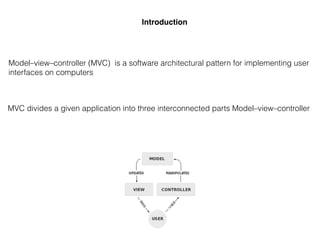
Model–view–controller (MVC) is a software architectural pattern for implementing user
interfaces on computers
Introduction
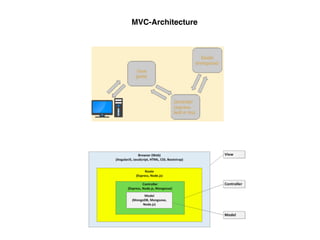
MVC divides a given application into three interconnected parts Model–view–controller
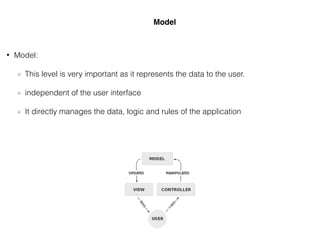
• Model:
This level is very important as it represents the data to the user.
independent of the user interface
It directly manages the data, logic and rules of the application
Model
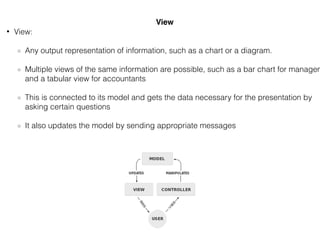
• View:
Any output representation of information, such as a chart or a diagram.
Multiple views of the same information are possible, such as a bar chart for managem
and a tabular view for accountants
This is connected to its model and gets the data necessary for the presentation by
asking certain questions
It also updates the model by sending appropriate messages
View
• Controller:
Controller is a level which acts like a brain of the entire MVC system.
It also acts as a link between a user and the system.
It provides the user with input by providing appropriate views to present it on the
screen
The controller understands user output, converts it into the appropriate messages and
passes the same to Model.
Controller
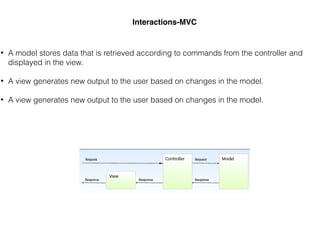
• A model stores data that is retrieved according to commands from the controller and
displayed in the view.
• A view generates new output to the user based on changes in the model.
Interactions-MVC
MVC-Architecture
MVC-Architecture-application
• Parallel development
• Code Reuse
• Multiple views
• Modification does not effect the entire model
• Support for asynchronous technique
• SEO friendly development platform
Advantages of MVC

MVC Architecture

  • 1.
  • 2.
    Model–view–controller (MVC) isa software architectural pattern for implementing user interfaces on computers Introduction MVC divides a given application into three interconnected parts Model–view–controller
  • 3.
    • Model: This levelis very important as it represents the data to the user. independent of the user interface It directly manages the data, logic and rules of the application Model
  • 4.
    • View: Any outputrepresentation of information, such as a chart or a diagram. Multiple views of the same information are possible, such as a bar chart for managem and a tabular view for accountants This is connected to its model and gets the data necessary for the presentation by asking certain questions It also updates the model by sending appropriate messages View
  • 5.
    • Controller: Controller isa level which acts like a brain of the entire MVC system. It also acts as a link between a user and the system. It provides the user with input by providing appropriate views to present it on the screen The controller understands user output, converts it into the appropriate messages and passes the same to Model. Controller
  • 6.
    • A modelstores data that is retrieved according to commands from the controller and displayed in the view. • A view generates new output to the user based on changes in the model. • A view generates new output to the user based on changes in the model. Interactions-MVC
  • 7.
  • 8.
  • 9.
    • Parallel development •Code Reuse • Multiple views • Modification does not effect the entire model • Support for asynchronous technique • SEO friendly development platform Advantages of MVC