Dependability and Security
                    Assurance
                                             Lecture 2


Dependability and Security Assurance, 2013               Slide 1
Security testing
  •       Testing the extent to which the system can protect
          itself from external attacks.
  •       Problems with security testing
        –       Security requirements are ‘shall not’ requirements i.e. they
                specify what should not happen. It is not usually possible to
                define security requirements as simple constraints that can
                be checked by the system.
        –       The people attacking a system are intelligent and look for
                vulnerabilities. They can experiment to discover weaknesses
                and loopholes in the system.
  •       Static analysis may be used to guide the testing team
          to areas of the program that may include errors and
          vulnerabilities.
Dependability and Security Assurance, 2013                               Slide 2
Security validation
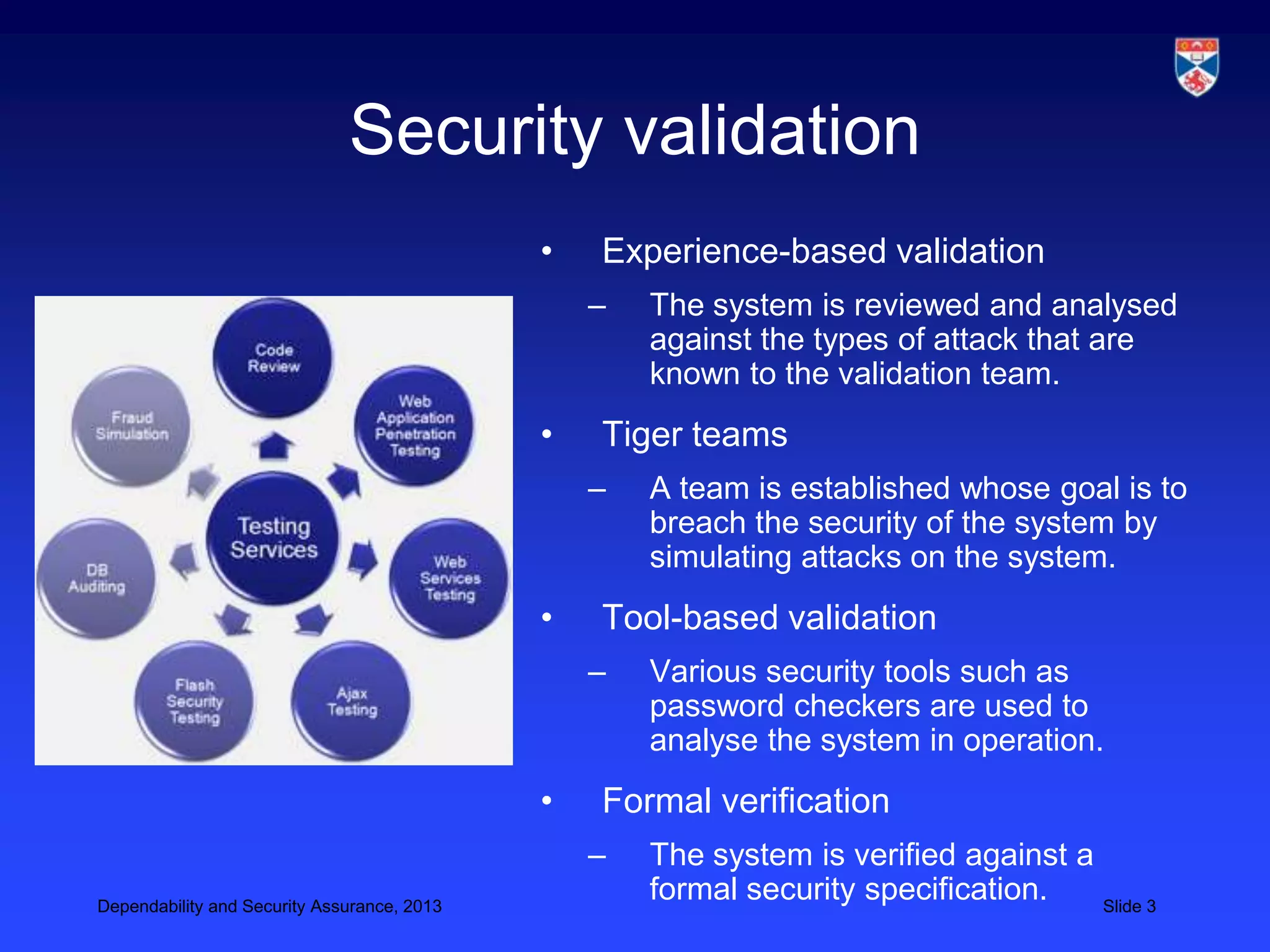
                                             •   Experience-based validation
                                                 –   The system is reviewed and analysed
                                                     against the types of attack that are
                                                     known to the validation team.
                                             •   Tiger teams
                                                 –   A team is established whose goal is to
                                                     breach the security of the system by
                                                     simulating attacks on the system.
                                             •   Tool-based validation
                                                 –   Various security tools such as
                                                     password checkers are used to
                                                     analyse the system in operation.
                                             •   Formal verification
                                                 –   The system is verified against a
Dependability and Security Assurance, 2013
                                                     formal security specification.   Slide 3
Examples of entries in a
                       security checklist
Security checklist
1. Do all files that are created in the application have appropriate access permissions? The
wrong access permissions may lead to these files being accessed by unauthorized users.
2. Does the system automatically terminate user sessions after a period of inactivity?
Sessions that are left active may allow unauthorized access through an unattended
computer.
3. If the system is written in a programming language without array bound checking, are
there situations where buffer overflow may be exploited? Buffer overflow may allow
attackers to send code strings to the system and then execute them.
4. If passwords are set, does the system check that passwords are ‘strong’? Strong
passwords consist of mixed letters, numbers, and punctuation, and are not normal dictionary
entries. They are more difficult to break than simple passwords.
5. Are inputs from the system’s environment always checked against an input specification?
Incorrect processing of badly formed inputs is a common cause of security vulnerabilities.


 Dependability and Security Assurance, 2013                                      Slide 4
Process assurance
  •       Process assurance involves defining a dependable
          process and ensuring that this process is followed
          during the system development.
  •       Process assurance focuses on:
        –       Do we have the right processes? Are the processes
                appropriate for the level of dependability required. Should
                include requirements management, change management,
                reviews and inspections, etc.
        –       Are we doing the processes right? Have these processes
                been followed by the development team.

  •       Process assurance generates documentation
        –       Agile processes therefore are rarely used for critical systems.
Dependability and Security Assurance, 2013                               Slide 5
Processes for safety assurance
  •       Process assurance is important for safety-critical
          systems development:
        –       Accidents are rare events so testing may not find all
                problems;
        –       Safety requirements are sometimes ‘shall not’ requirements
                so cannot be demonstrated through testing.

  •       Safety assurance activities may be included in the
          software process that record the analyses that have
          been carried out and the people responsible for
          these.
        –       Personal responsibility is important as system failures may
                lead to subsequent legal actions.
Dependability and Security Assurance, 2013                              Slide 6
Safety related process activities
  •       Creation of a hazard logging and monitoring system.
  •       Appointment of project safety engineers who have
          explicit responsibility for system safety.
  •       Extensive use of safety reviews.
  •       Creation of a safety certification system where the
          safety of critical components is formally certified.
  •       Detailed configuration management.


Dependability and Security Assurance, 2013                   Slide 7
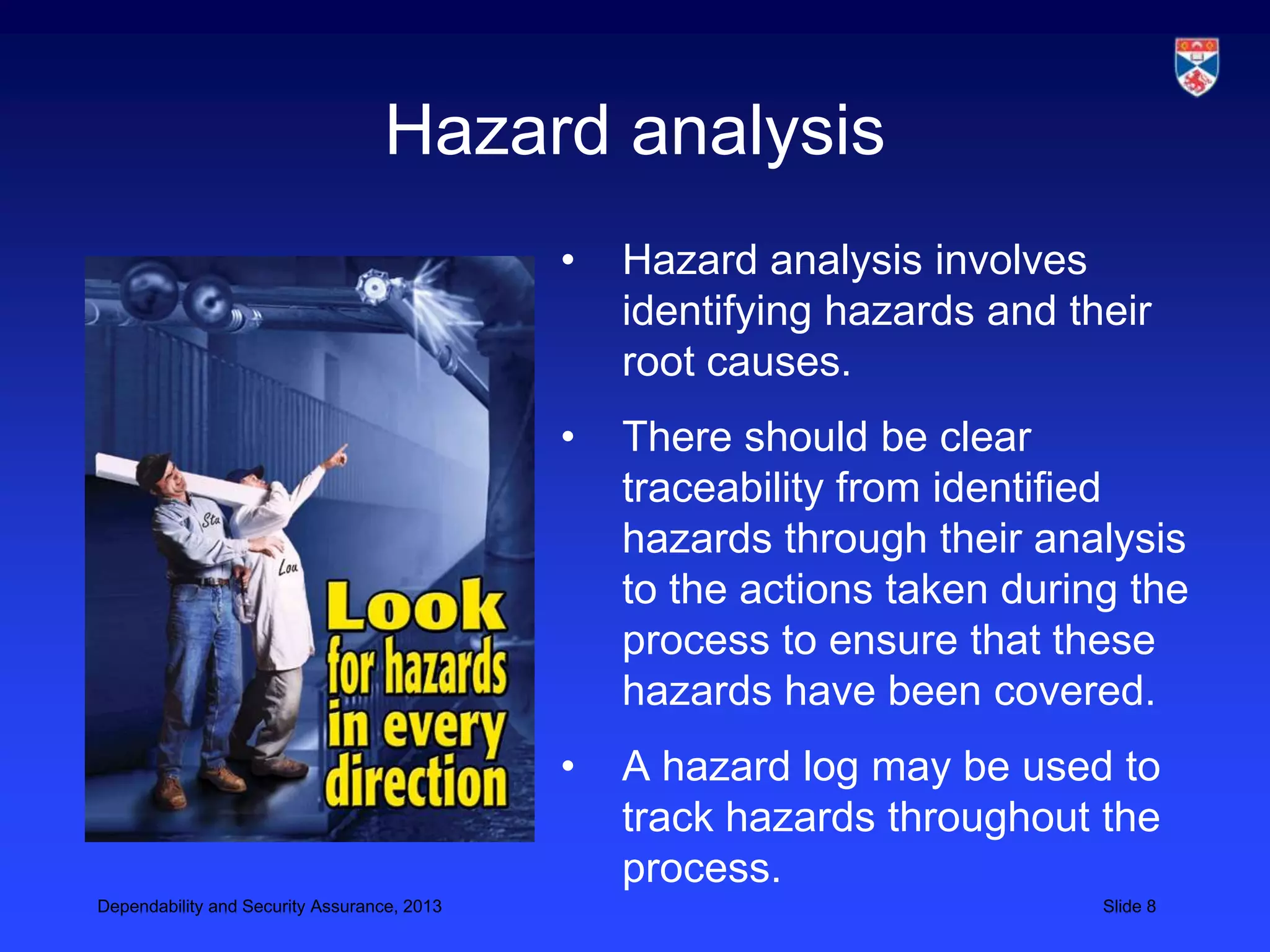
Hazard analysis
                                             •   Hazard analysis involves
                                                 identifying hazards and their
                                                 root causes.
                                             •   There should be clear
                                                 traceability from identified
                                                 hazards through their analysis
                                                 to the actions taken during the
                                                 process to ensure that these
                                                 hazards have been covered.
                                             •   A hazard log may be used to
                                                 track hazards throughout the
                                                 process.
Dependability and Security Assurance, 2013                                 Slide 8
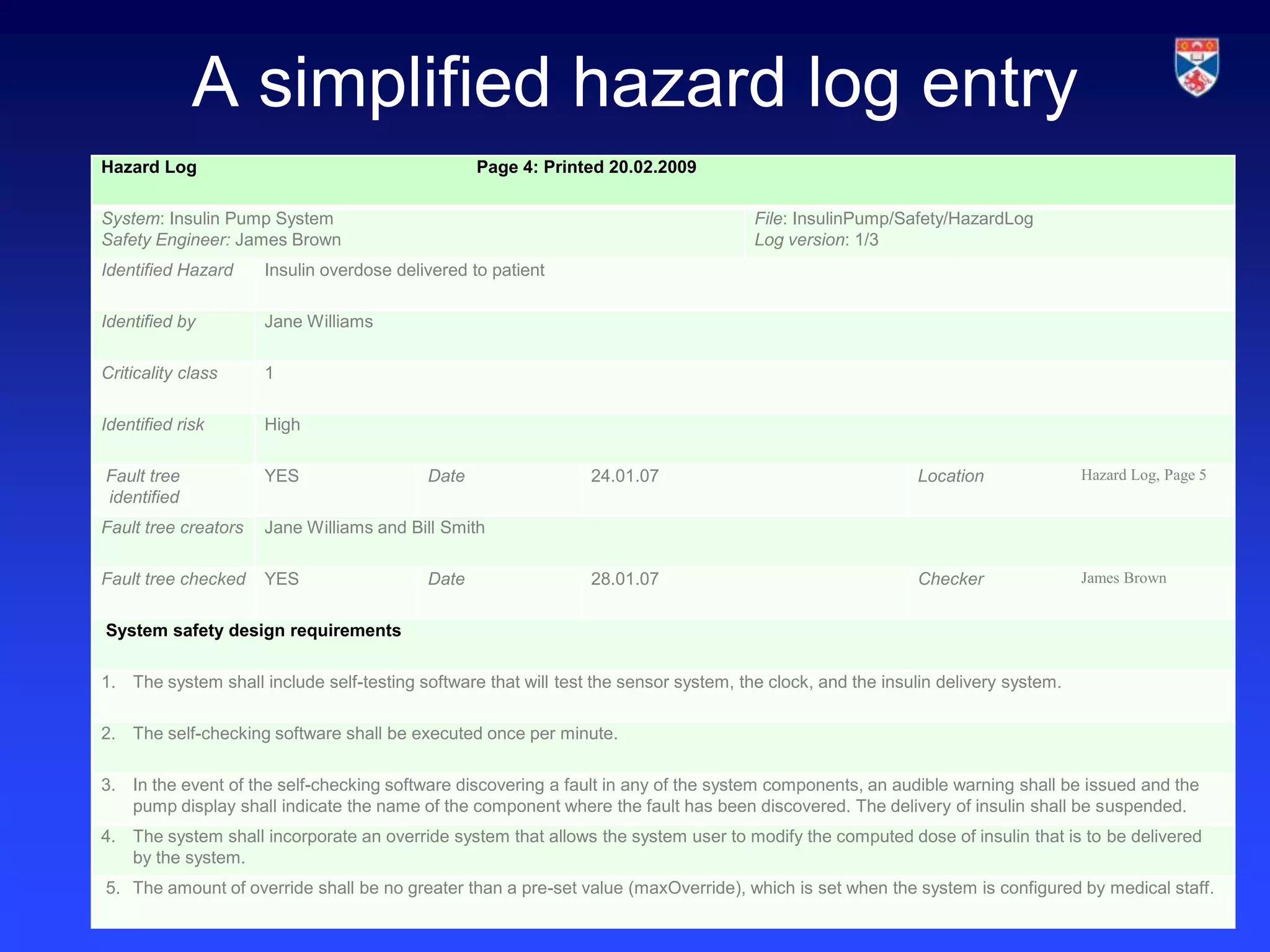
A simplified hazard log entry
Hazard Log                                        Page 4: Printed 20.02.2009

System: Insulin Pump System                                                           File: InsulinPump/Safety/HazardLog
Safety Engineer: James Brown                                                          Log version: 1/3
Identified Hazard     Insulin overdose delivered to patient

Identified by         Jane Williams

Criticality class     1

Identified risk       High

 Fault tree           YES                  Date                 24.01.07                                   Location               Hazard Log, Page 5
 identified
Fault tree creators   Jane Williams and Bill Smith

Fault tree checked    YES                  Date                 28.01.07                                   Checker                James Brown


 System safety design requirements

1. The system shall include self-testing software that will test the sensor system, the clock, and the insulin delivery system.

2. The self-checking software shall be executed once per minute.

3. In the event of the self-checking software discovering a fault in any of the system components, an audible warning shall be issued and the
   pump display shall indicate the name of the component where the fault has been discovered. The delivery of insulin shall be suspended.
4. The system shall incorporate an override system that allows the system user to modify the computed dose of insulin that is to be delivered
   by the system.
 5. The amount of override shall be no greater than a pre-set value (maxOverride), which is set when the system is configured by medical staff.
Dependability and Security Assurance, 2013                                                                                      Slide 9
Safety and dependability cases
  •       Safety and dependability cases are structured
          documents that set out detailed arguments and
          evidence that a required level of safety or
          dependability has been achieved.
  •       They are normally required by regulators before a
          system can be certified for operational use. The
          regulator’s responsibility is to check that a system is
          as safe or dependable as is practical.
  •       Regulators and developers work together and
          negotiate what needs to be included in a system
          safety/dependability case.
Dependability and Security Assurance, 2013                    Slide 10
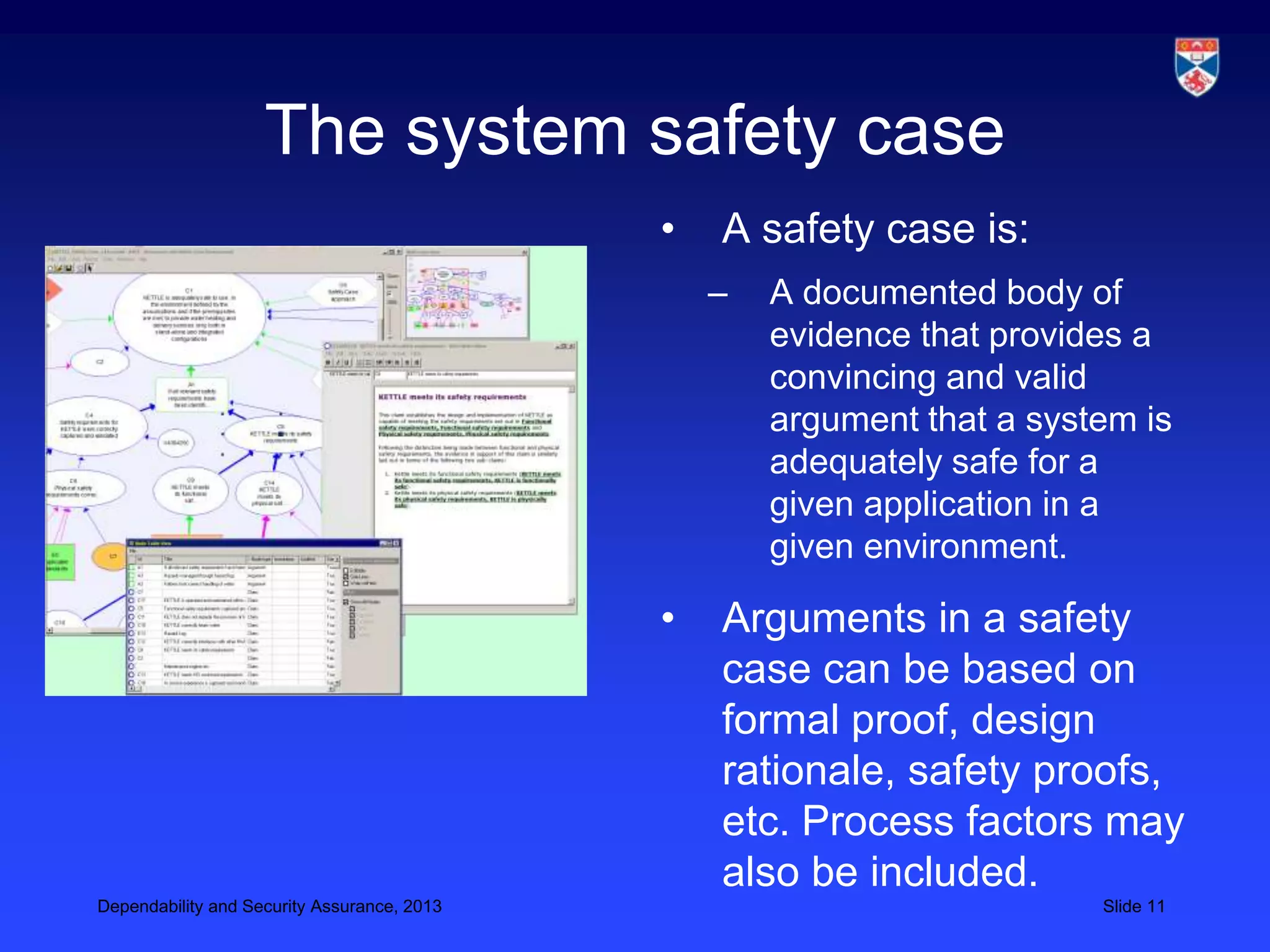
The system safety case
                                             •   A safety case is:
                                                 –   A documented body of
                                                     evidence that provides a
                                                     convincing and valid
                                                     argument that a system is
                                                     adequately safe for a
                                                     given application in a
                                                     given environment.

                                             •   Arguments in a safety
                                                 case can be based on
                                                 formal proof, design
                                                 rationale, safety proofs,
                                                 etc. Process factors may
                                                 also be included.
Dependability and Security Assurance, 2013                               Slide 11
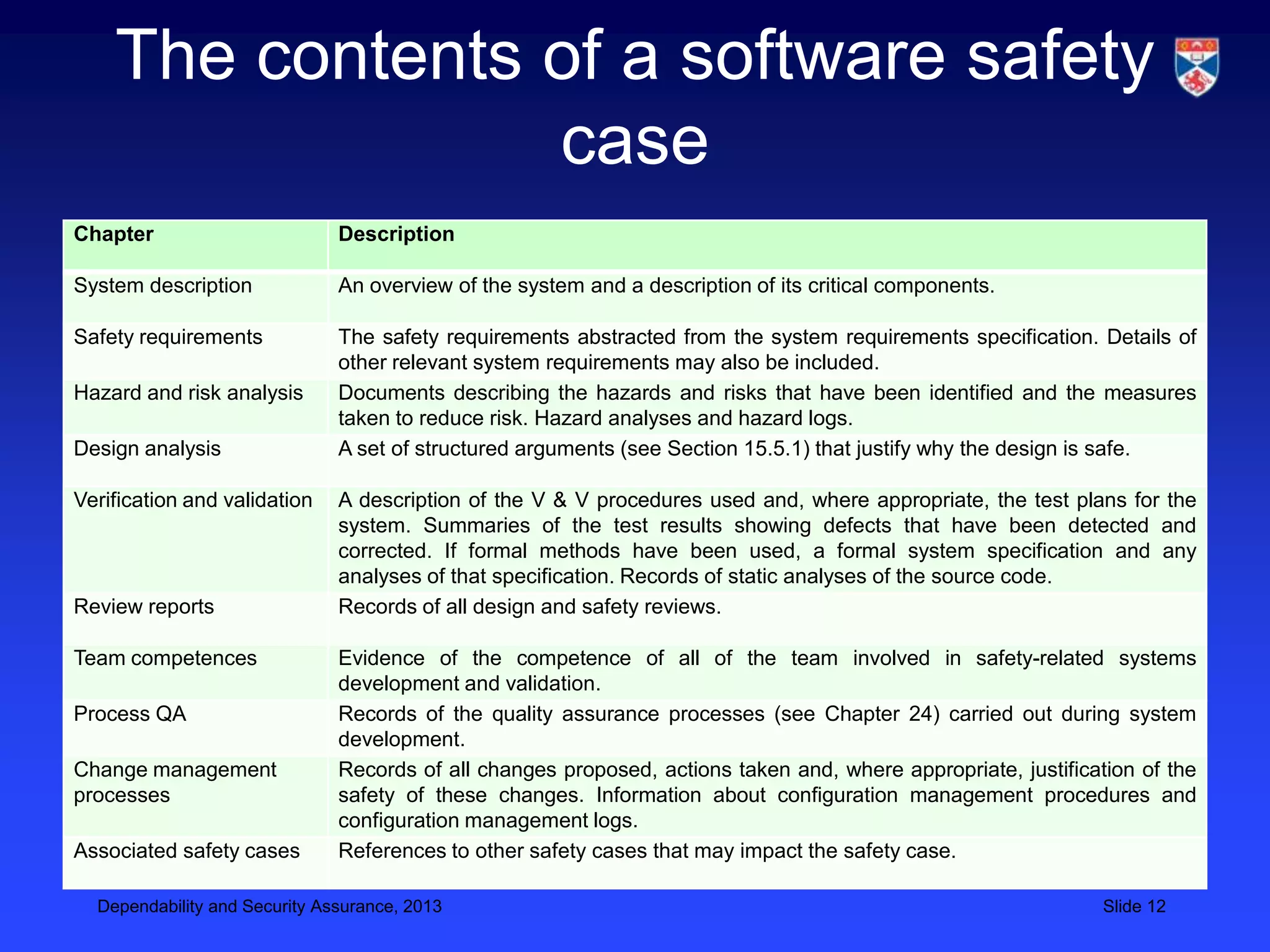
The contents of a software safety
                 case
Chapter                        Description

System description             An overview of the system and a description of its critical components.

Safety requirements            The safety requirements abstracted from the system requirements specification. Details of
                               other relevant system requirements may also be included.
Hazard and risk analysis       Documents describing the hazards and risks that have been identified and the measures
                               taken to reduce risk. Hazard analyses and hazard logs.
Design analysis                A set of structured arguments (see Section 15.5.1) that justify why the design is safe.

Verification and validation    A description of the V & V procedures used and, where appropriate, the test plans for the
                               system. Summaries of the test results showing defects that have been detected and
                               corrected. If formal methods have been used, a formal system specification and any
                               analyses of that specification. Records of static analyses of the source code.
Review reports                 Records of all design and safety reviews.

Team competences               Evidence of the competence of all of the team involved in safety-related systems
                               development and validation.
Process QA                     Records of the quality assurance processes (see Chapter 24) carried out during system
                               development.
Change management              Records of all changes proposed, actions taken and, where appropriate, justification of the
processes                      safety of these changes. Information about configuration management procedures and
                               configuration management logs.
Associated safety cases        References to other safety cases that may impact the safety case.

  Dependability and Security Assurance, 2013                                                                    Slide 12
Structured arguments
  •       Safety/dependability cases should be based around
          structured arguments that present evidence to justify
          the assertions made in these arguments.
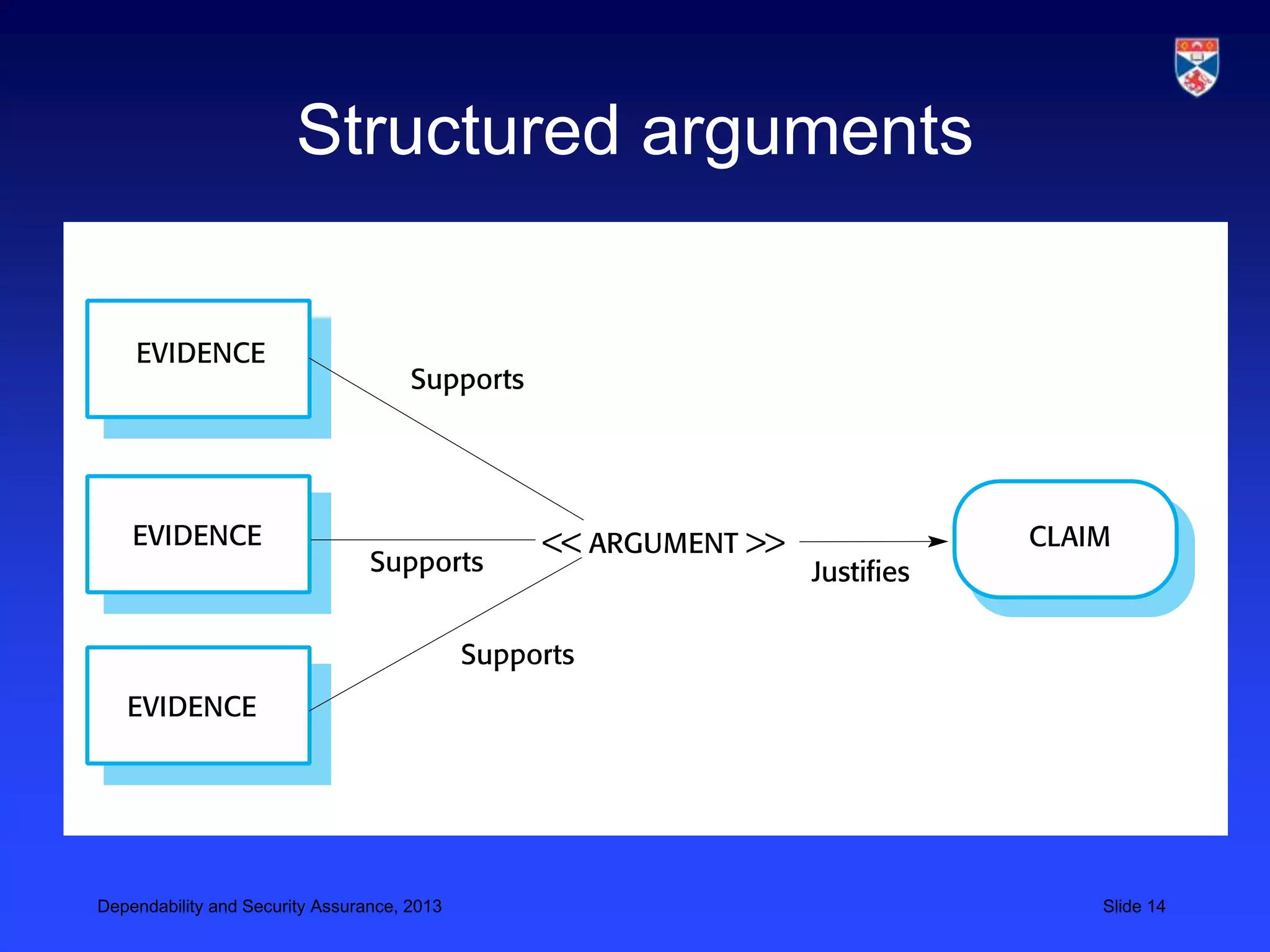
  •       The argument justifies why a claim about system
          safety/security is justified by the available evidence.


Dependability and Security Assurance, 2013                    Slide 13
Structured arguments


Dependability and Security Assurance, 2013     Slide 14
Insulin pump safety argument
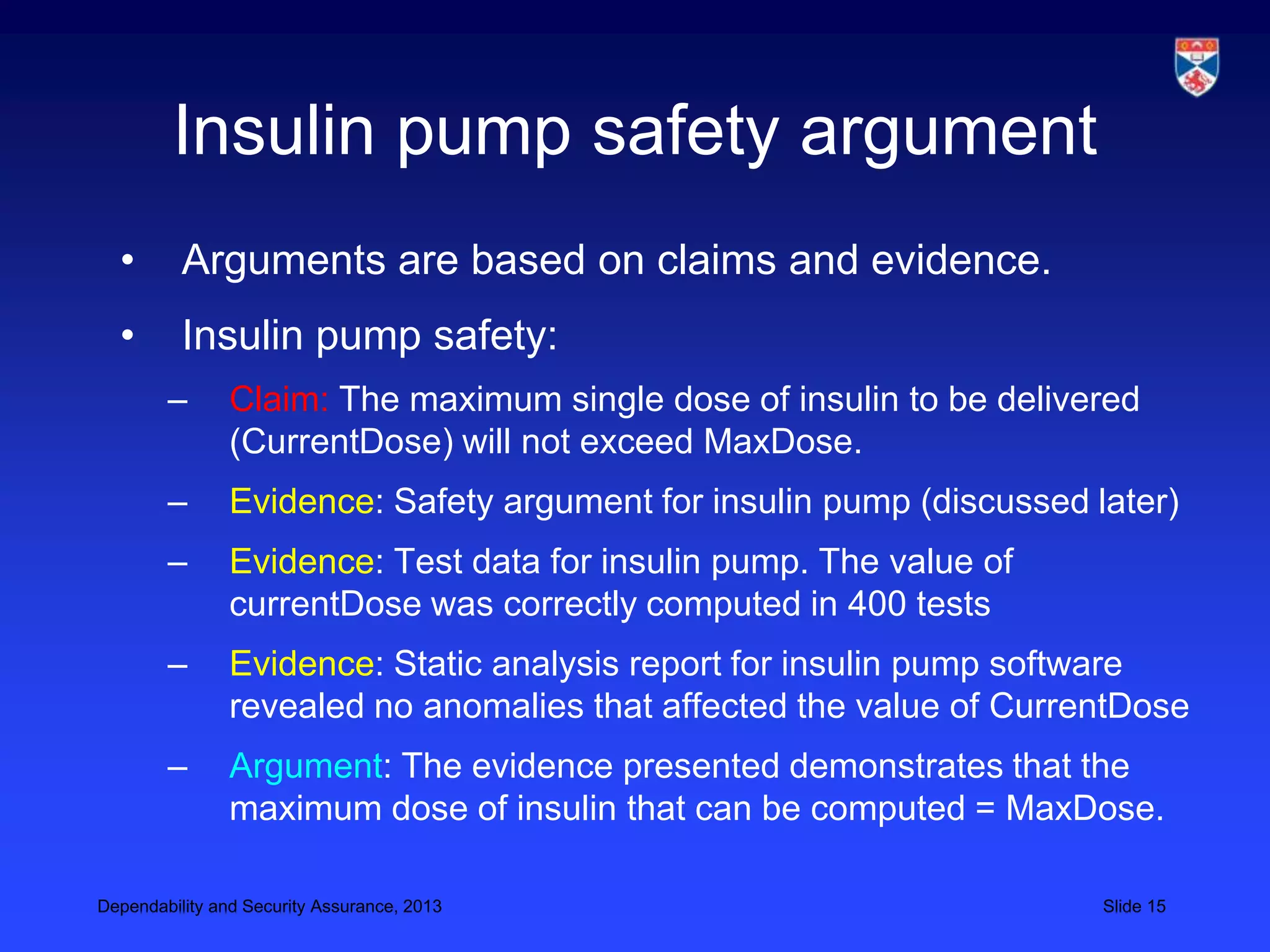
  •       Arguments are based on claims and evidence.
  •       Insulin pump safety:
        –       Claim: The maximum single dose of insulin to be delivered
                (CurrentDose) will not exceed MaxDose.
        –       Evidence: Safety argument for insulin pump (discussed later)
        –       Evidence: Test data for insulin pump. The value of
                currentDose was correctly computed in 400 tests
        –       Evidence: Static analysis report for insulin pump software
                revealed no anomalies that affected the value of CurrentDose
        –       Argument: The evidence presented demonstrates that the
                maximum dose of insulin that can be computed = MaxDose.

Dependability and Security Assurance, 2013                             Slide 15
Structured safety arguments
  •       Structured arguments that demonstrate that a system
          meets its safety obligations.
  •       It is not necessary to demonstrate that the program
          works as intended; the aim is simply to demonstrate
          safety.
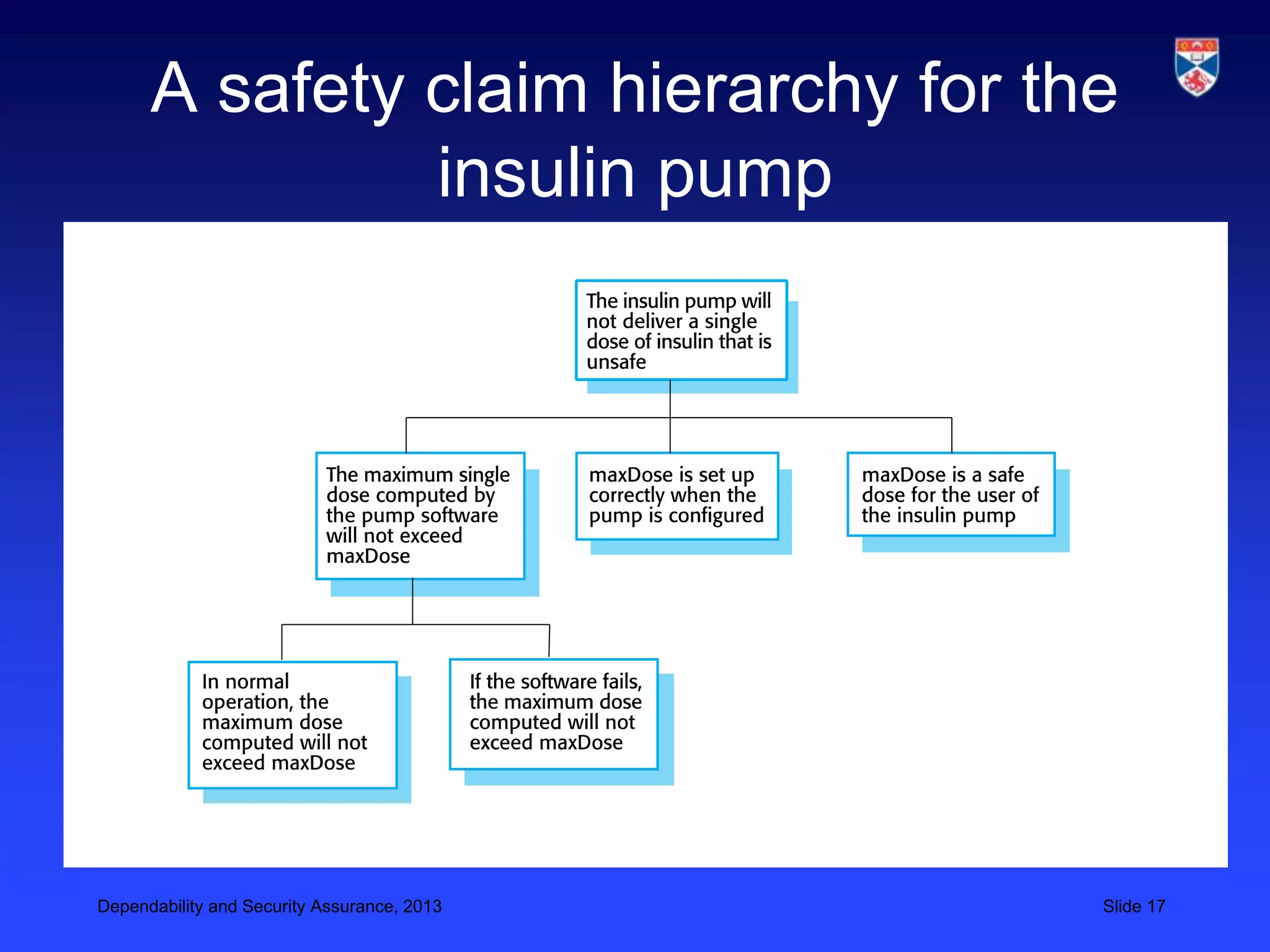
  •       Generally based on a claim hierarchy.
        –       You start at the leaves of the hierarchy and demonstrate
                safety. This implies the higher-level claims are true.


Dependability and Security Assurance, 2013                             Slide 16
A safety claim hierarchy for the
               insulin pump


Dependability and Security Assurance, 2013   Slide 17
Safety arguments
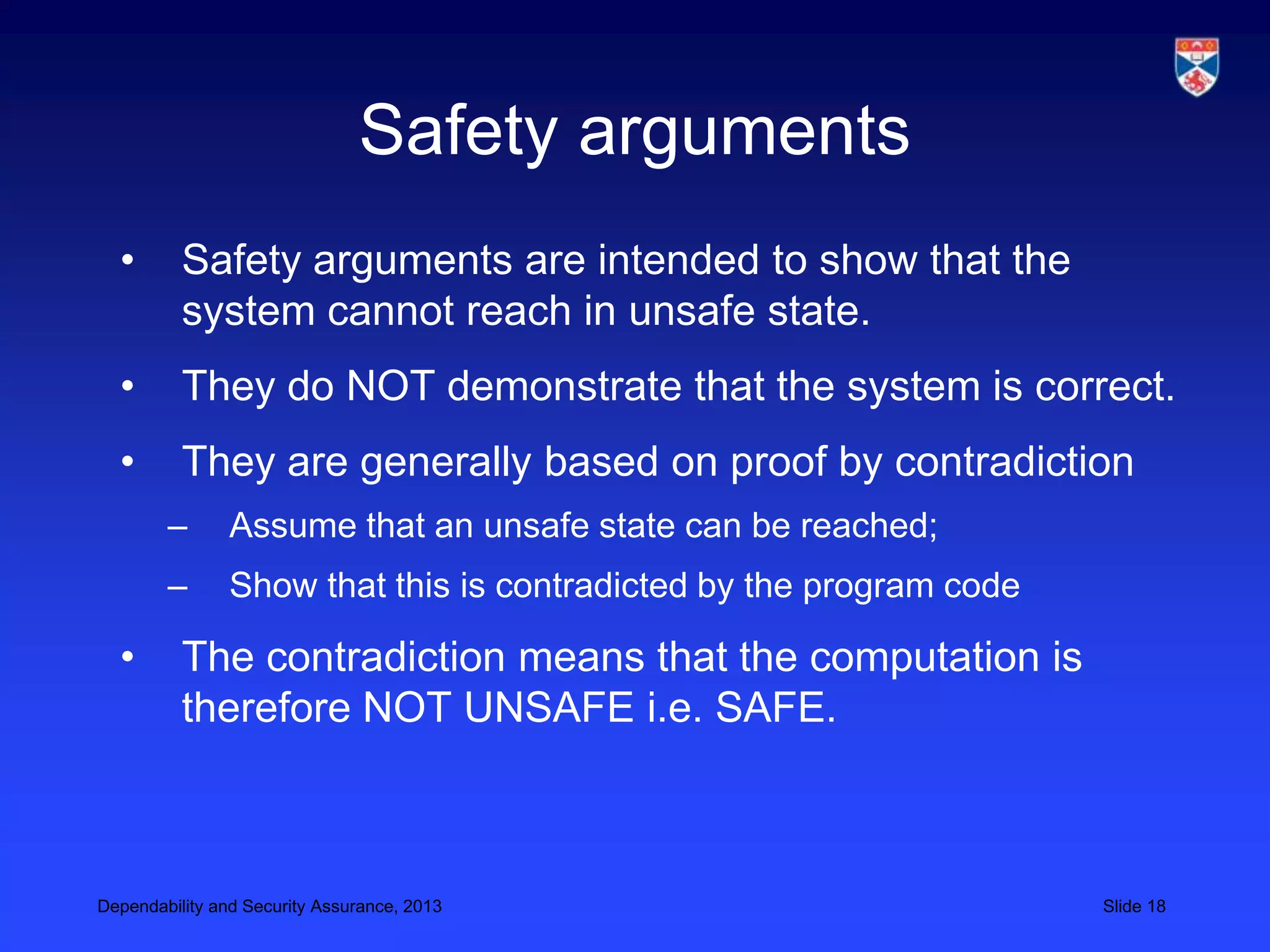
  •       Safety arguments are intended to show that the
          system cannot reach in unsafe state.
  •       They do NOT demonstrate that the system is correct.
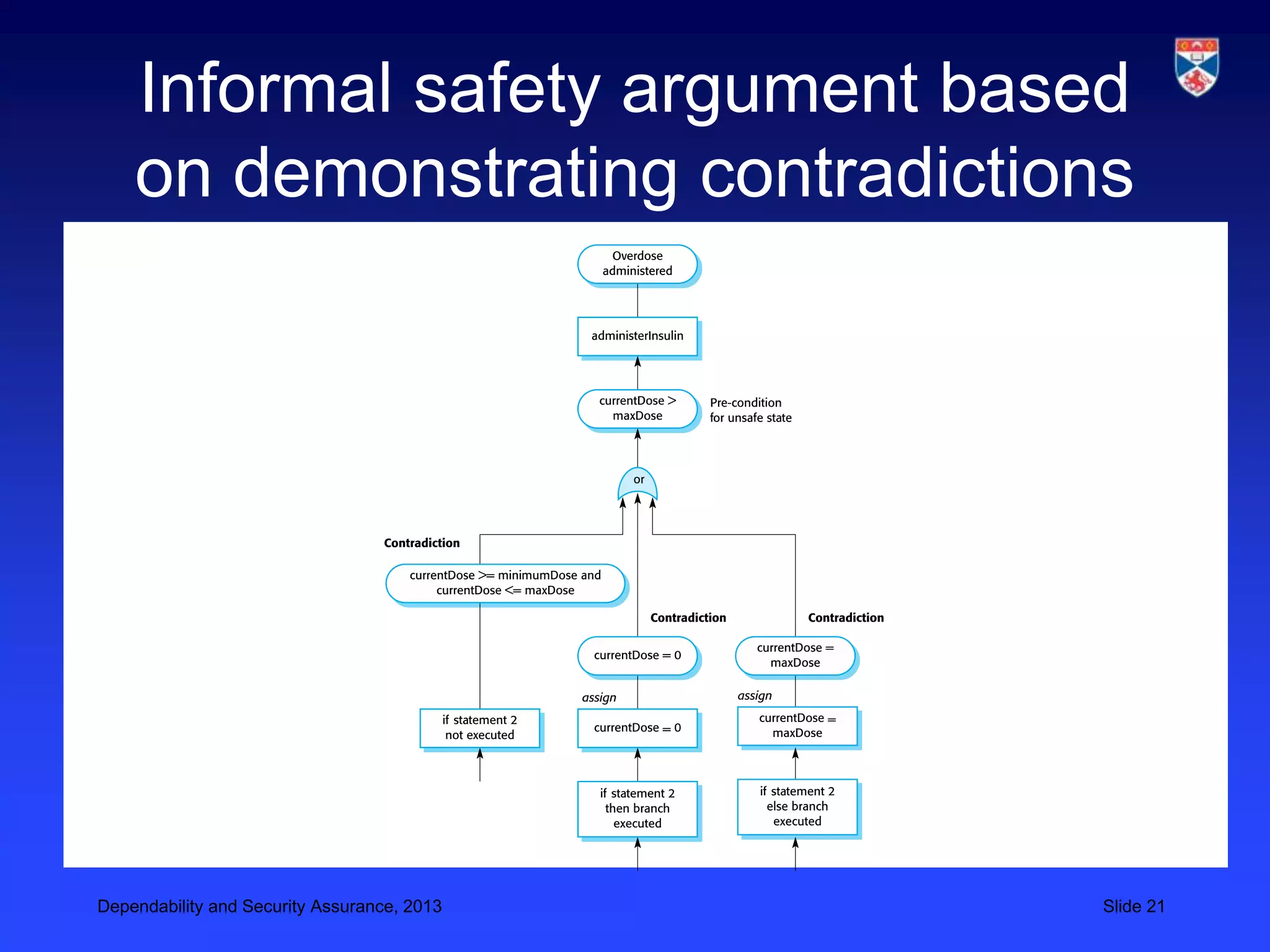
  •       They are generally based on proof by contradiction
        –       Assume that an unsafe state can be reached;
        –       Show that this is contradicted by the program code

  •       The contradiction means that the computation is
          therefore NOT UNSAFE i.e. SAFE.


Dependability and Security Assurance, 2013                           Slide 18
Construction of a safety
                          argument
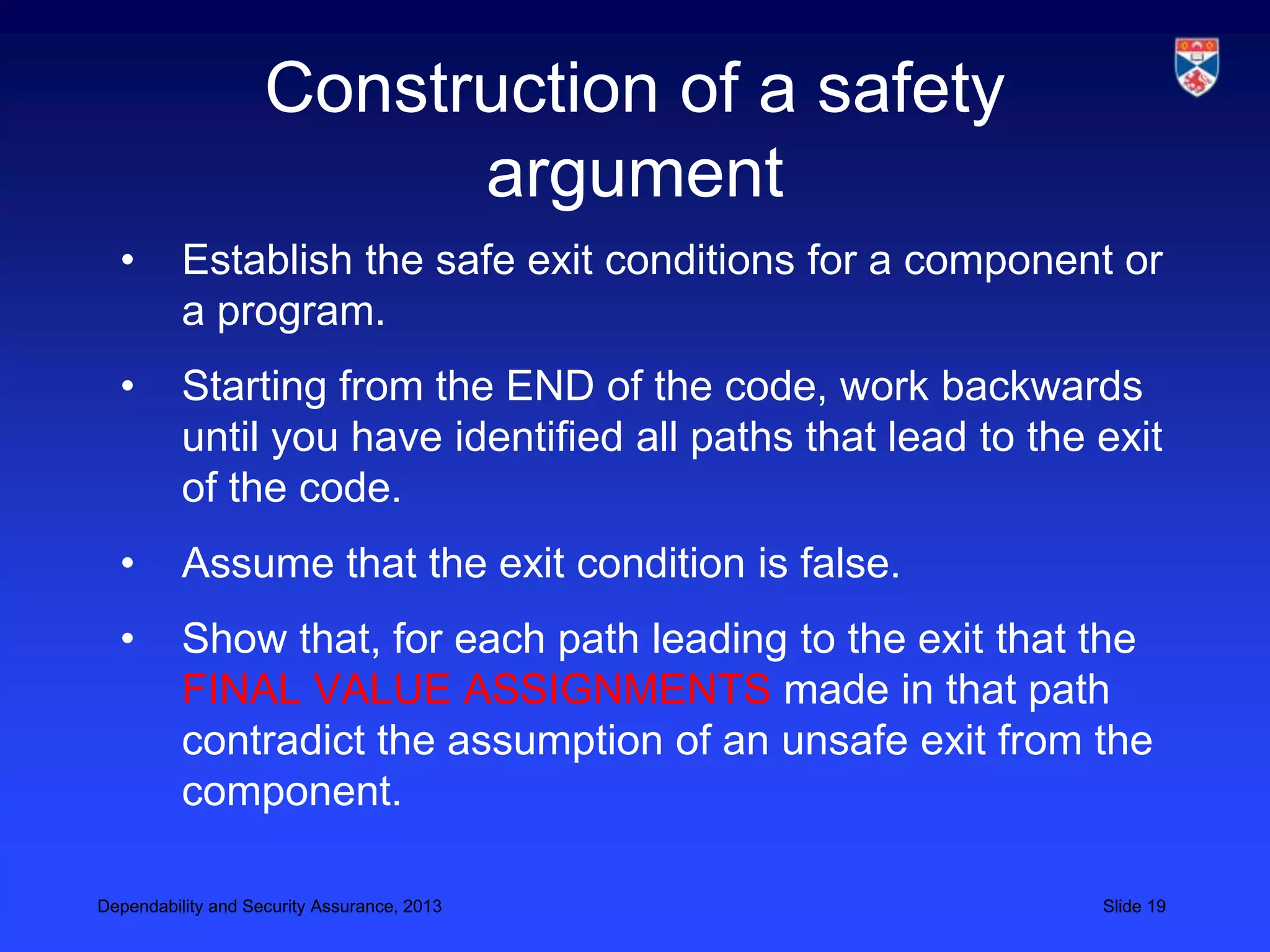
  •       Establish the safe exit conditions for a component or
          a program.
  •       Starting from the END of the code, work backwards
          until you have identified all paths that lead to the exit
          of the code.
  •       Assume that the exit condition is false.
  •       Show that, for each path leading to the exit that the
          FINAL VALUE ASSIGNMENTS made in that path
          contradict the assumption of an unsafe exit from the
          component.

Dependability and Security Assurance, 2013                     Slide 19
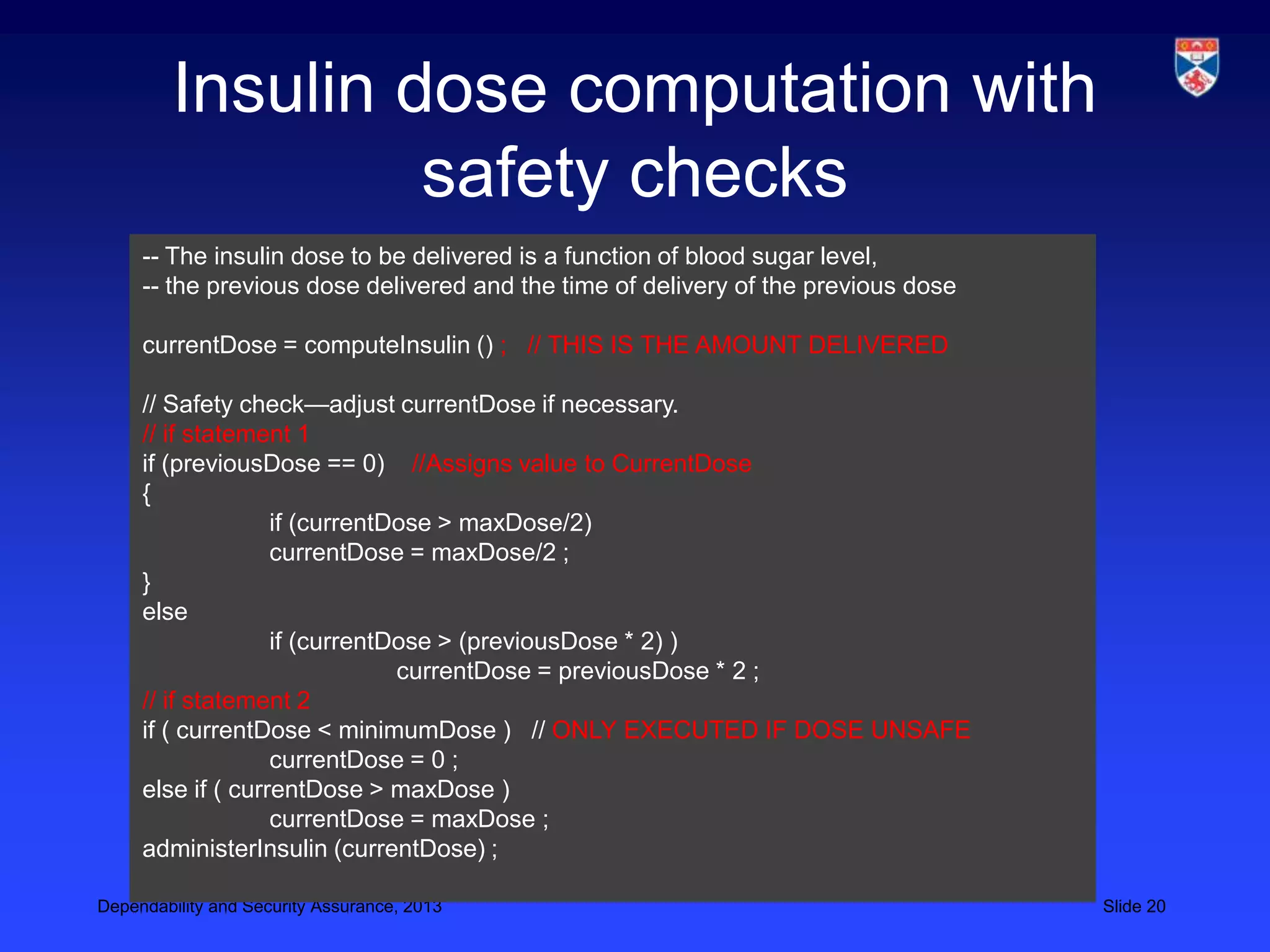
Insulin dose computation with
                  safety checks
     -- The insulin dose to be delivered is a function of blood sugar level,
     -- the previous dose delivered and the time of delivery of the previous dose

     currentDose = computeInsulin () ; // THIS IS THE AMOUNT DELIVERED

     // Safety check—adjust currentDose if necessary.
     // if statement 1
     if (previousDose == 0) //Assigns value to CurrentDose
     {
                   if (currentDose > maxDose/2)
                   currentDose = maxDose/2 ;
     }
     else
                   if (currentDose > (previousDose * 2) )
                               currentDose = previousDose * 2 ;
     // if statement 2
     if ( currentDose < minimumDose ) // ONLY EXECUTED IF DOSE UNSAFE
                   currentDose = 0 ;
     else if ( currentDose > maxDose )
                   currentDose = maxDose ;
     administerInsulin (currentDose) ;

Dependability and Security Assurance, 2013                                          Slide 20
Informal safety argument based
    on demonstrating contradictions


Dependability and Security Assurance, 2013   Slide 21
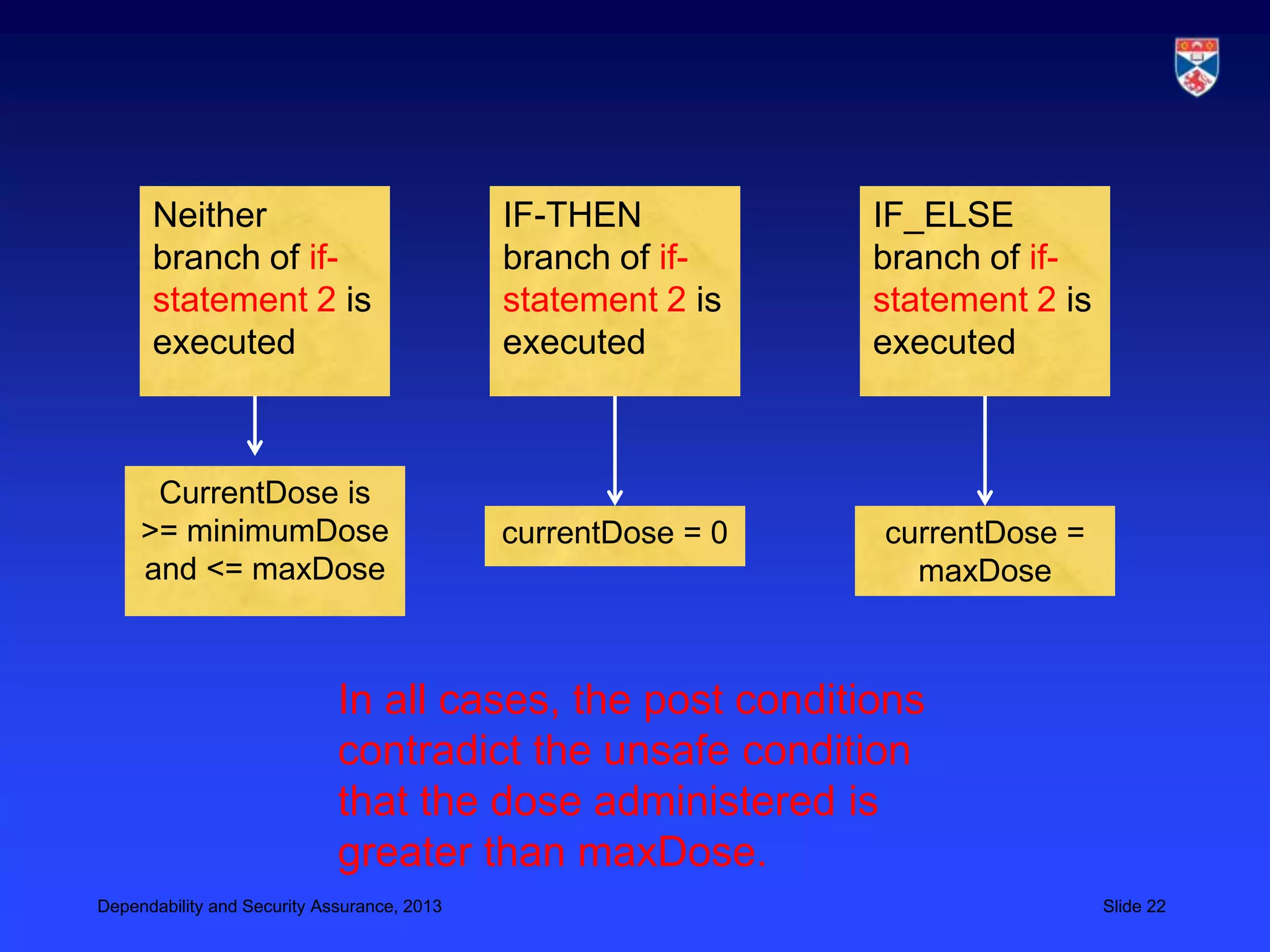
Neither                                IF-THEN           IF_ELSE
      branch of if-                          branch of if-     branch of if-
      statement 2 is                         statement 2 is    statement 2 is
      executed                               executed          executed


      CurrentDose is
     >= minimumDose                          currentDose = 0   currentDose =
     and <= maxDose                                              maxDose


                             In all cases, the post conditions
                             contradict the unsafe condition
                             that the dose administered is
                             greater than maxDose.
Dependability and Security Assurance, 2013                                      Slide 22
Key points
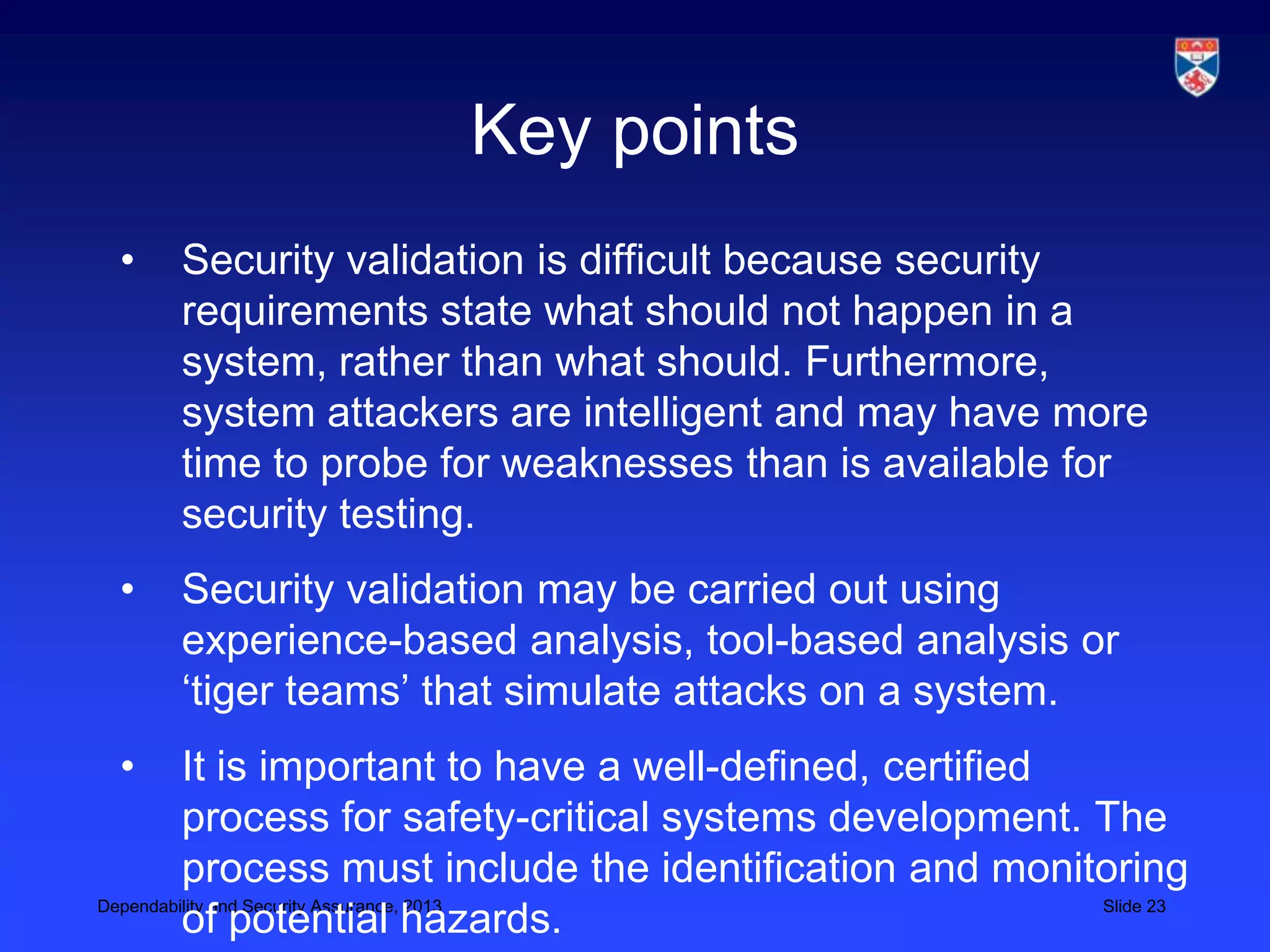
 •   Security validation is difficult because security
     requirements state what should not happen in a
     system, rather than what should. Furthermore,
     system attackers are intelligent and may have more
     time to probe for weaknesses than is available for
     security testing.
 •   Security validation may be carried out using
     experience-based analysis, tool-based analysis or
     ‘tiger teams’ that simulate attacks on a system.
 •       It is important to have a well-defined, certified
         process for safety-critical systems development. The
         process must include the identification and monitoring
Dependability and Security Assurance, 2013                 Slide 23
         of potential hazards.
Key points
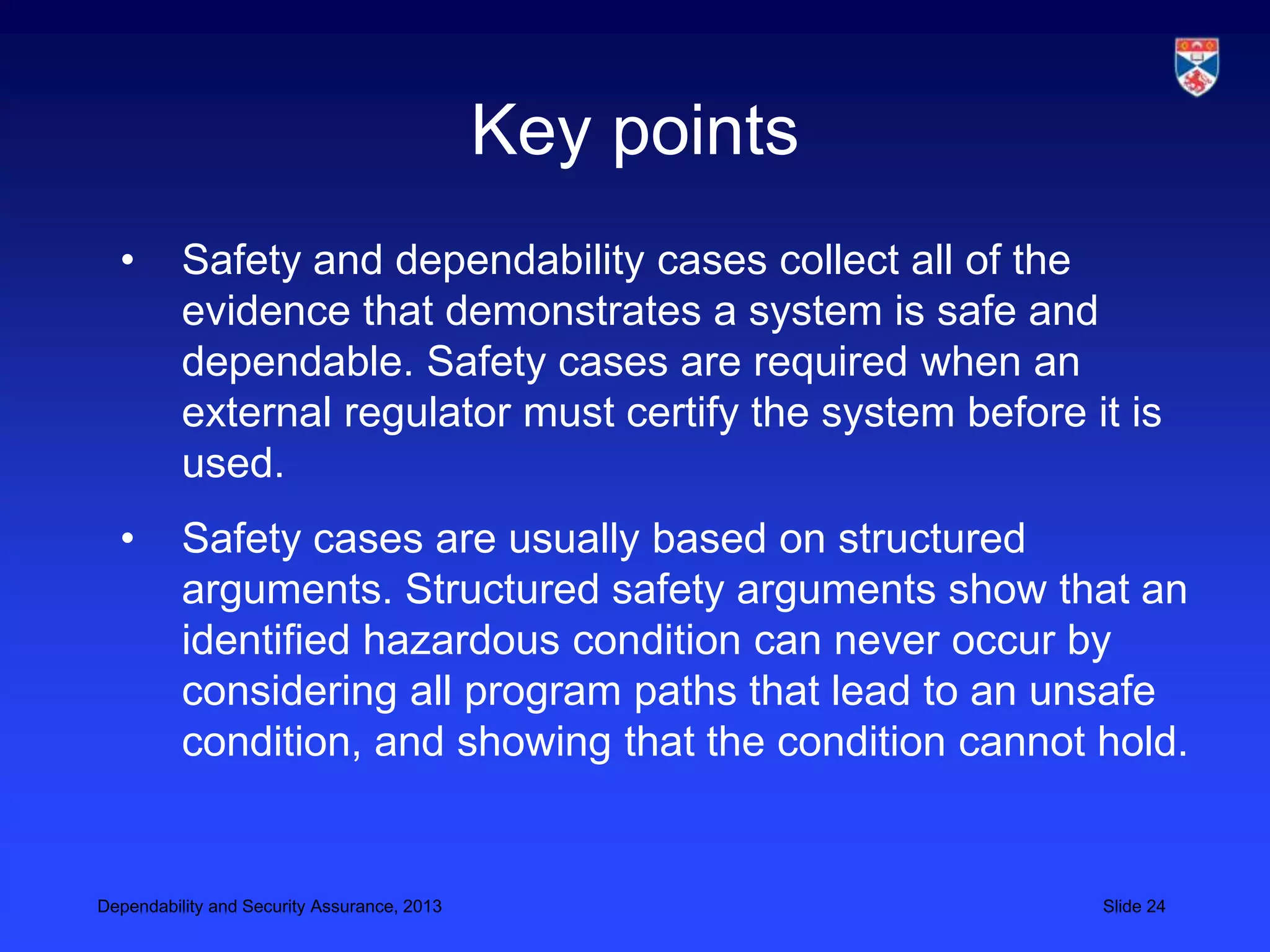
  •       Safety and dependability cases collect all of the
          evidence that demonstrates a system is safe and
          dependable. Safety cases are required when an
          external regulator must certify the system before it is
          used.
  •       Safety cases are usually based on structured
          arguments. Structured safety arguments show that an
          identified hazardous condition can never occur by
          considering all program paths that lead to an unsafe
          condition, and showing that the condition cannot hold.


Dependability and Security Assurance, 2013                   Slide 24

CS 5032 L12 security testing and dependability cases 2013

  • 1.
    Dependability and Security Assurance Lecture 2 Dependability and Security Assurance, 2013 Slide 1
  • 2.
    Security testing • Testing the extent to which the system can protect itself from external attacks. • Problems with security testing – Security requirements are ‘shall not’ requirements i.e. they specify what should not happen. It is not usually possible to define security requirements as simple constraints that can be checked by the system. – The people attacking a system are intelligent and look for vulnerabilities. They can experiment to discover weaknesses and loopholes in the system. • Static analysis may be used to guide the testing team to areas of the program that may include errors and vulnerabilities. Dependability and Security Assurance, 2013 Slide 2
  • 3.
    Security validation • Experience-based validation – The system is reviewed and analysed against the types of attack that are known to the validation team. • Tiger teams – A team is established whose goal is to breach the security of the system by simulating attacks on the system. • Tool-based validation – Various security tools such as password checkers are used to analyse the system in operation. • Formal verification – The system is verified against a Dependability and Security Assurance, 2013 formal security specification. Slide 3
  • 4.
    Examples of entriesin a security checklist Security checklist 1. Do all files that are created in the application have appropriate access permissions? The wrong access permissions may lead to these files being accessed by unauthorized users. 2. Does the system automatically terminate user sessions after a period of inactivity? Sessions that are left active may allow unauthorized access through an unattended computer. 3. If the system is written in a programming language without array bound checking, are there situations where buffer overflow may be exploited? Buffer overflow may allow attackers to send code strings to the system and then execute them. 4. If passwords are set, does the system check that passwords are ‘strong’? Strong passwords consist of mixed letters, numbers, and punctuation, and are not normal dictionary entries. They are more difficult to break than simple passwords. 5. Are inputs from the system’s environment always checked against an input specification? Incorrect processing of badly formed inputs is a common cause of security vulnerabilities. Dependability and Security Assurance, 2013 Slide 4
  • 5.
    Process assurance • Process assurance involves defining a dependable process and ensuring that this process is followed during the system development. • Process assurance focuses on: – Do we have the right processes? Are the processes appropriate for the level of dependability required. Should include requirements management, change management, reviews and inspections, etc. – Are we doing the processes right? Have these processes been followed by the development team. • Process assurance generates documentation – Agile processes therefore are rarely used for critical systems. Dependability and Security Assurance, 2013 Slide 5
  • 6.
    Processes for safetyassurance • Process assurance is important for safety-critical systems development: – Accidents are rare events so testing may not find all problems; – Safety requirements are sometimes ‘shall not’ requirements so cannot be demonstrated through testing. • Safety assurance activities may be included in the software process that record the analyses that have been carried out and the people responsible for these. – Personal responsibility is important as system failures may lead to subsequent legal actions. Dependability and Security Assurance, 2013 Slide 6
  • 7.
    Safety related processactivities • Creation of a hazard logging and monitoring system. • Appointment of project safety engineers who have explicit responsibility for system safety. • Extensive use of safety reviews. • Creation of a safety certification system where the safety of critical components is formally certified. • Detailed configuration management. Dependability and Security Assurance, 2013 Slide 7
  • 8.
    Hazard analysis • Hazard analysis involves identifying hazards and their root causes. • There should be clear traceability from identified hazards through their analysis to the actions taken during the process to ensure that these hazards have been covered. • A hazard log may be used to track hazards throughout the process. Dependability and Security Assurance, 2013 Slide 8
  • 9.
    A simplified hazardlog entry Hazard Log Page 4: Printed 20.02.2009 System: Insulin Pump System File: InsulinPump/Safety/HazardLog Safety Engineer: James Brown Log version: 1/3 Identified Hazard Insulin overdose delivered to patient Identified by Jane Williams Criticality class 1 Identified risk High Fault tree YES Date 24.01.07 Location Hazard Log, Page 5 identified Fault tree creators Jane Williams and Bill Smith Fault tree checked YES Date 28.01.07 Checker James Brown System safety design requirements 1. The system shall include self-testing software that will test the sensor system, the clock, and the insulin delivery system. 2. The self-checking software shall be executed once per minute. 3. In the event of the self-checking software discovering a fault in any of the system components, an audible warning shall be issued and the pump display shall indicate the name of the component where the fault has been discovered. The delivery of insulin shall be suspended. 4. The system shall incorporate an override system that allows the system user to modify the computed dose of insulin that is to be delivered by the system. 5. The amount of override shall be no greater than a pre-set value (maxOverride), which is set when the system is configured by medical staff. Dependability and Security Assurance, 2013 Slide 9
  • 10.
    Safety and dependabilitycases • Safety and dependability cases are structured documents that set out detailed arguments and evidence that a required level of safety or dependability has been achieved. • They are normally required by regulators before a system can be certified for operational use. The regulator’s responsibility is to check that a system is as safe or dependable as is practical. • Regulators and developers work together and negotiate what needs to be included in a system safety/dependability case. Dependability and Security Assurance, 2013 Slide 10
  • 11.
    The system safetycase • A safety case is: – A documented body of evidence that provides a convincing and valid argument that a system is adequately safe for a given application in a given environment. • Arguments in a safety case can be based on formal proof, design rationale, safety proofs, etc. Process factors may also be included. Dependability and Security Assurance, 2013 Slide 11
  • 12.
    The contents ofa software safety case Chapter Description System description An overview of the system and a description of its critical components. Safety requirements The safety requirements abstracted from the system requirements specification. Details of other relevant system requirements may also be included. Hazard and risk analysis Documents describing the hazards and risks that have been identified and the measures taken to reduce risk. Hazard analyses and hazard logs. Design analysis A set of structured arguments (see Section 15.5.1) that justify why the design is safe. Verification and validation A description of the V & V procedures used and, where appropriate, the test plans for the system. Summaries of the test results showing defects that have been detected and corrected. If formal methods have been used, a formal system specification and any analyses of that specification. Records of static analyses of the source code. Review reports Records of all design and safety reviews. Team competences Evidence of the competence of all of the team involved in safety-related systems development and validation. Process QA Records of the quality assurance processes (see Chapter 24) carried out during system development. Change management Records of all changes proposed, actions taken and, where appropriate, justification of the processes safety of these changes. Information about configuration management procedures and configuration management logs. Associated safety cases References to other safety cases that may impact the safety case. Dependability and Security Assurance, 2013 Slide 12
  • 13.
    Structured arguments • Safety/dependability cases should be based around structured arguments that present evidence to justify the assertions made in these arguments. • The argument justifies why a claim about system safety/security is justified by the available evidence. Dependability and Security Assurance, 2013 Slide 13
  • 14.
    Structured arguments Dependability andSecurity Assurance, 2013 Slide 14
  • 15.
    Insulin pump safetyargument • Arguments are based on claims and evidence. • Insulin pump safety: – Claim: The maximum single dose of insulin to be delivered (CurrentDose) will not exceed MaxDose. – Evidence: Safety argument for insulin pump (discussed later) – Evidence: Test data for insulin pump. The value of currentDose was correctly computed in 400 tests – Evidence: Static analysis report for insulin pump software revealed no anomalies that affected the value of CurrentDose – Argument: The evidence presented demonstrates that the maximum dose of insulin that can be computed = MaxDose. Dependability and Security Assurance, 2013 Slide 15
  • 16.
    Structured safety arguments • Structured arguments that demonstrate that a system meets its safety obligations. • It is not necessary to demonstrate that the program works as intended; the aim is simply to demonstrate safety. • Generally based on a claim hierarchy. – You start at the leaves of the hierarchy and demonstrate safety. This implies the higher-level claims are true. Dependability and Security Assurance, 2013 Slide 16
  • 17.
    A safety claimhierarchy for the insulin pump Dependability and Security Assurance, 2013 Slide 17
  • 18.
    Safety arguments • Safety arguments are intended to show that the system cannot reach in unsafe state. • They do NOT demonstrate that the system is correct. • They are generally based on proof by contradiction – Assume that an unsafe state can be reached; – Show that this is contradicted by the program code • The contradiction means that the computation is therefore NOT UNSAFE i.e. SAFE. Dependability and Security Assurance, 2013 Slide 18
  • 19.
    Construction of asafety argument • Establish the safe exit conditions for a component or a program. • Starting from the END of the code, work backwards until you have identified all paths that lead to the exit of the code. • Assume that the exit condition is false. • Show that, for each path leading to the exit that the FINAL VALUE ASSIGNMENTS made in that path contradict the assumption of an unsafe exit from the component. Dependability and Security Assurance, 2013 Slide 19
  • 20.
    Insulin dose computationwith safety checks -- The insulin dose to be delivered is a function of blood sugar level, -- the previous dose delivered and the time of delivery of the previous dose currentDose = computeInsulin () ; // THIS IS THE AMOUNT DELIVERED // Safety check—adjust currentDose if necessary. // if statement 1 if (previousDose == 0) //Assigns value to CurrentDose { if (currentDose > maxDose/2) currentDose = maxDose/2 ; } else if (currentDose > (previousDose * 2) ) currentDose = previousDose * 2 ; // if statement 2 if ( currentDose < minimumDose ) // ONLY EXECUTED IF DOSE UNSAFE currentDose = 0 ; else if ( currentDose > maxDose ) currentDose = maxDose ; administerInsulin (currentDose) ; Dependability and Security Assurance, 2013 Slide 20
  • 21.
    Informal safety argumentbased on demonstrating contradictions Dependability and Security Assurance, 2013 Slide 21
  • 22.
    Neither IF-THEN IF_ELSE branch of if- branch of if- branch of if- statement 2 is statement 2 is statement 2 is executed executed executed CurrentDose is >= minimumDose currentDose = 0 currentDose = and <= maxDose maxDose In all cases, the post conditions contradict the unsafe condition that the dose administered is greater than maxDose. Dependability and Security Assurance, 2013 Slide 22
  • 23.
    Key points • Security validation is difficult because security requirements state what should not happen in a system, rather than what should. Furthermore, system attackers are intelligent and may have more time to probe for weaknesses than is available for security testing. • Security validation may be carried out using experience-based analysis, tool-based analysis or ‘tiger teams’ that simulate attacks on a system. • It is important to have a well-defined, certified process for safety-critical systems development. The process must include the identification and monitoring Dependability and Security Assurance, 2013 Slide 23 of potential hazards.
  • 24.
    Key points • Safety and dependability cases collect all of the evidence that demonstrates a system is safe and dependable. Safety cases are required when an external regulator must certify the system before it is used. • Safety cases are usually based on structured arguments. Structured safety arguments show that an identified hazardous condition can never occur by considering all program paths that lead to an unsafe condition, and showing that the condition cannot hold. Dependability and Security Assurance, 2013 Slide 24