Critical infrastructure 2

                                   SCADA systems


Critical Infrastructure 2,, 2013                    Slide 1
Infrastructure classes
 •       Physical infrastructure
       –        Physical facilities and assets such as pumping
                stations, pipelines, railways, roads, etc.

 •       Digital infrastructure
       –        Networks, software and physical facilities required for their
                operation, such as data centres

 •       Organisational infrastructure
       –        Services such as emergency services, medical
                services, government

 •       Focus in this lecture will be on physical infrastructure
         and critical control systems for that infrastructure
Critical Infrastructure 2,, 2013                                           Slide 2
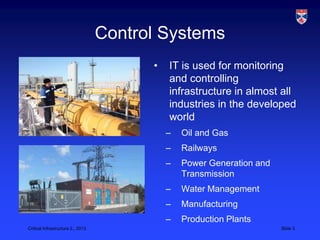
Control Systems
                                         •   IT is used for monitoring
                                             and controlling
                                             infrastructure in almost all
                                             industries in the developed
                                             world
                                             –   Oil and Gas
                                             –   Railways
                                             –   Power Generation and
                                                 Transmission
                                             –   Water Management
                                             –   Manufacturing
                                             –   Production Plants
Critical Infrastructure 2,, 2013                                        Slide 3
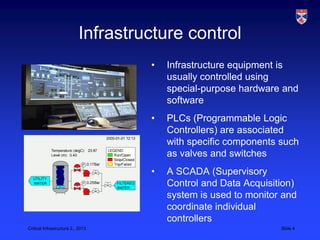
Infrastructure control
                                    •   Infrastructure equipment is
                                        usually controlled using
                                        special-purpose hardware and
                                        software
                                    •   PLCs (Programmable Logic
                                        Controllers) are associated
                                        with specific components such
                                        as valves and switches
                                    •   A SCADA (Supervisory
                                        Control and Data Acquisition)
                                        system is used to monitor and
                                        coordinate individual
                                        controllers
Critical Infrastructure 2,, 2013                                 Slide 4
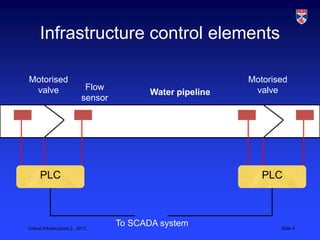
Infrastructure control elements

Motorised                                                     Motorised
 valve                        Flow                             valve
                                             Water pipeline
                             sensor


      PLC                                                        PLC


Critical Infrastructure 2,, 2013
                                      To SCADA system                Slide 5
Programmable Logic Controllers
 •       Stand-alone units which are associated with a
         controlled element or a group of controlled elements.
 •       Send signals to actuators associated with that
         element e.g. to motors that can open or close a valve
 •       Usually have associated sensors that determine the
         state of the element itself as well as sensors that
         sense whatever is being controlled (e.g. gas flow)
 •       Can act autonomously – e.g. to shut down an
         element or (more frequently) connected to a SCADA
         system that manages and controls all system
         elements
Critical Infrastructure 2,, 2013                           Slide 6
What is SCADA?
 •       An architectural pattern for industrial control systems
         with many components that are often distributed over
         a wide area
 •       A configurable software system that is used to
         implement large-scale control systems where:
       –        Programmable logic units control infrastructure components
       –        Data acquisition by remote terminal units (RTUs)
       –        Data sent to control centre, running the SCADA system
       –        Control Centre monitors system,displays system status and
                issues commands
 •       Based on standard industrial communication
         protocols
Critical Infrastructure 2,, 2013                                        Slide 7
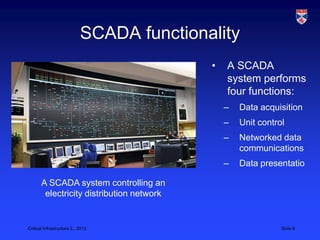
SCADA functionality
                                           •   A SCADA
                                               system performs
                                               four functions:
                                               –   Data acquisition
                                               –   Unit control
                                               –   Networked data
                                                   communications
                                               –   Data presentatio

       A SCADA system controlling an
        electricity distribution network


Critical Infrastructure 2,, 2013                              Slide 8
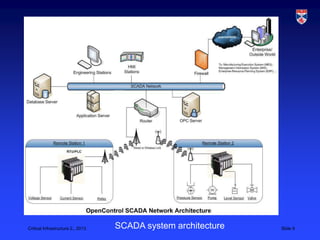
Critical Infrastructure 2,, 2013   SCADA system architecture   Slide 9
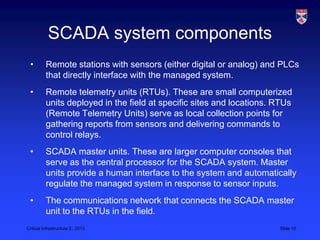
SCADA system components
 •        Remote stations with sensors (either digital or analog) and PLCs
          that directly interface with the managed system.
 •        Remote telemetry units (RTUs). These are small computerized
          units deployed in the field at specific sites and locations. RTUs
          (Remote Telemetry Units) serve as local collection points for
          gathering reports from sensors and delivering commands to
          control relays.
 •        SCADA master units. These are larger computer consoles that
          serve as the central processor for the SCADA system. Master
          units provide a human interface to the system and automatically
          regulate the managed system in response to sensor inputs.
 •        The communications network that connects the SCADA master
          unit to the RTUs in the field.
Critical Infrastructure 2,, 2013                                       Slide 10
SCADA application areas
                                   •   Electric power
                                       generation, transmission
                                       and distribution
                                   •   Water and sewage
                                   •   Buildings, facilities and
                                       environments
                                   •   Manufacturing
                                   •   Mass transit
                                   •   Traffic signals

Critical Infrastructure 2,, 2013                                   Slide 11
Critical SCADA systems
 •   Failure of controlled systems can lead to direct loss of
     life due to equipment failure or indirect losses does to
     failure of critical infrastructure controlled by SCADA
     systems
 •   SCADA issues are therefore
     –   Safety and reliability
     –   Security

 •   SCADA safety and reliability
     –   Needs specific safety analysis techniques for PLCs because
         they are programmed in a different way (ladder logic)
     –            SCADA systems usually have redundancy and
                  backup, which contributes to the availability of these systems
Critical Infrastructure 2,, 2013                                             Slide 12
SCADA generations
 •        1st generation (1970s). Co-located control
        –        Controlled units were on the same site as the controlling
                 computer with hard-wired connections between them
        –        No network so no potential for external attack. Very limited
                 chance of insider attack because operation by teams rather
                 than individuals

 •        2nd generation (1980s/90s) Distributed control
        –        SCADA systems networked with devices using special-
                 purpose protocols
        –        No external network connection
        –        Vulnerable to insider attacks because of distributed sites

Critical Infrastructure 2,, 2013                                              Slide 13
SCADA generations
 •        3rd generation (2000s).               Networked systems
        –        SCADA systems no longer isolated but connected to external
                 networks
        –        External connection through computers (particularly PCs)
                 that are directly connected to the Internet
        –        May also interface with other Internet-connected systems
                 such as manufacturing control systems
        –        More use of standard protocols such as TCP/IP for
                 communications
        –        Remote system monitoring and upgrades from providers
                 requires network connection


Critical Infrastructure 2,, 2013                                        Slide 14
SCADA security
                                         •   Security is a particular
                                             concern for SCADA
                                             systems
                                             –   Considerable potential for
                                                 large-scale damage to critical
                                                 infrastructure by attacker
                                             –   Security through isolation.
                                                 SCADA
                                                 systems, historically, were
                                                 unconcerned with security
                                                 because they were isolated
                                                 systems
                                             –   Security through obscurity.
Critical Infrastructure 2,, 2013
                                                 Non-standard programming15
                                                                         Slide
                                                 languages and protocols
Security through isolation
    •        If a system is not connected to the Internet, then it
             cannot be penetrated by attacks from the Internet
    • Until recently, SCADA systems were isolated
      networks. But now:
                  •       Direct connections to vendors for maintenance, stock
                          ordering etc.
                  •       Connected to enterprise systems, which in turn are on the
                          Internet.
                  •       PCs used by operators may be multi-functional and
                          internet connected
                  •       Operators transfer information using USB drives
Critical Infrastructure 2,, 2013                                              Slide 16
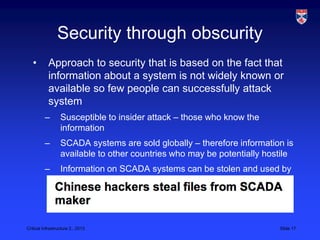
Security through obscurity
   •       Approach to security that is based on the fact that
           information about a system is not widely known or
           available so few people can successfully attack
           system
          –       Susceptible to insider attack – those who know the
                  information
          –       SCADA systems are sold globally – therefore information is
                  available to other countries who may be potentially hostile
          –       Information on SCADA systems can be stolen and used by
                  attackers


Critical Infrastructure 2,, 2013                                         Slide 17
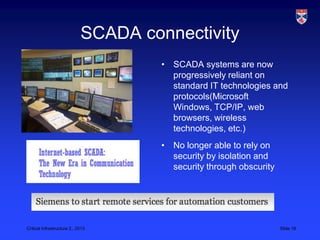
SCADA connectivity
                                      • SCADA systems are now
                                        progressively reliant on
                                        standard IT technologies and
                                        protocols(Microsoft
                                        Windows, TCP/IP, web
                                        browsers, wireless
                                        technologies, etc.)
                                      • No longer able to rely on
                                        security by isolation and
                                        security through obscurity


Critical Infrastructure 2,, 2013                                     Slide 18
SCADA legacy systems
 •        There are a huge number of 2nd generation SCADA
          systems that are still in use and are likely to remain in
          use for many years
        –        Infrastructure systems can have a 20+ year lifetime

 •        However, these are now being ‘updated’ with new
          equipment which is network-connected
 •        These older legacy systems were developed without
          security awareness and so are particularly vulnerable
          to attack


Critical Infrastructure 2,, 2013                                       Slide 19
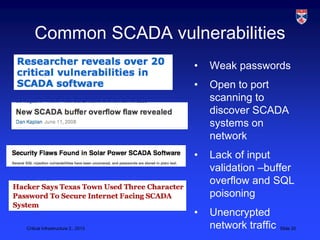
Common SCADA vulnerabilities
                                   •   Weak passwords
                                   •   Open to port
                                       scanning to
                                       discover SCADA
                                       systems on
                                       network
                                   •   Lack of input
                                       validation –buffer
                                       overflow and SQL
                                       poisoning
                                   •   Unencrypted
Critical Infrastructure 2,, 2013       network traffic   Slide 20
SCADA security challenges
 •        Infrastructure providers and SCADA developers have no
          background in IT security
 •        Not always possible to use standard security tools and
          techniques:
        –        For example, It may not be possible to install anti-virus
                 protection on process control systems, owing to the lack of
                 processor power on legacy systems, the age of operating
                 systems or the lack of vendor certification.
        –        Security testing on process control systems must also be
                 approached with extreme caution – security scanning can
                 seriously affect the operation of many control devices.
        –        There are sometimes few opportunities to take the systems
                 off-line for routine testing, patching and maintenance.


Critical Infrastructure 2,, 2013                                          Slide 21
Improving SCADA security
                                   •   Government and industry
                                       reports to raise awareness of
                                       SCADA security issues
                                   •   Establishment of bodies
                                       (CPNI) specifically
                                       concerned with infrastructure
                                       protection
                                   •   Need for regulators to
                                       become involved – security
                                       certification
                                   •   Better security education and
Critical Infrastructure 2,, 2013       training for SCADA       Slide 22
© NationalGeographic.com
Critical Infrastructure 2,, 2013                              Slide 23
Key Points
• SCADA systems are the most common control systems
  for large-scale national infrastructure
• These systems coordinate and communicate with a
  network of sensors and actuators that control
  equipment such as valves and pumps
• SCADA systems are often old systems that were built
  without security concerns – therefore are vulnerable to
  external attack
• Government organisations are seriously concerned
  about the vulnerability of these systems to failures and
  attack
Critical Infrastructure 2,, 2013                       Slide 24

CS 5032 L18 Critical infrastructure 2: SCADA systems

  • 1.
    Critical infrastructure 2 SCADA systems Critical Infrastructure 2,, 2013 Slide 1
  • 2.
    Infrastructure classes • Physical infrastructure – Physical facilities and assets such as pumping stations, pipelines, railways, roads, etc. • Digital infrastructure – Networks, software and physical facilities required for their operation, such as data centres • Organisational infrastructure – Services such as emergency services, medical services, government • Focus in this lecture will be on physical infrastructure and critical control systems for that infrastructure Critical Infrastructure 2,, 2013 Slide 2
  • 3.
    Control Systems • IT is used for monitoring and controlling infrastructure in almost all industries in the developed world – Oil and Gas – Railways – Power Generation and Transmission – Water Management – Manufacturing – Production Plants Critical Infrastructure 2,, 2013 Slide 3
  • 4.
    Infrastructure control • Infrastructure equipment is usually controlled using special-purpose hardware and software • PLCs (Programmable Logic Controllers) are associated with specific components such as valves and switches • A SCADA (Supervisory Control and Data Acquisition) system is used to monitor and coordinate individual controllers Critical Infrastructure 2,, 2013 Slide 4
  • 5.
    Infrastructure control elements Motorised Motorised valve Flow valve Water pipeline sensor PLC PLC Critical Infrastructure 2,, 2013 To SCADA system Slide 5
  • 6.
    Programmable Logic Controllers • Stand-alone units which are associated with a controlled element or a group of controlled elements. • Send signals to actuators associated with that element e.g. to motors that can open or close a valve • Usually have associated sensors that determine the state of the element itself as well as sensors that sense whatever is being controlled (e.g. gas flow) • Can act autonomously – e.g. to shut down an element or (more frequently) connected to a SCADA system that manages and controls all system elements Critical Infrastructure 2,, 2013 Slide 6
  • 7.
    What is SCADA? • An architectural pattern for industrial control systems with many components that are often distributed over a wide area • A configurable software system that is used to implement large-scale control systems where: – Programmable logic units control infrastructure components – Data acquisition by remote terminal units (RTUs) – Data sent to control centre, running the SCADA system – Control Centre monitors system,displays system status and issues commands • Based on standard industrial communication protocols Critical Infrastructure 2,, 2013 Slide 7
  • 8.
    SCADA functionality • A SCADA system performs four functions: – Data acquisition – Unit control – Networked data communications – Data presentatio A SCADA system controlling an electricity distribution network Critical Infrastructure 2,, 2013 Slide 8
  • 9.
    Critical Infrastructure 2,,2013 SCADA system architecture Slide 9
  • 10.
    SCADA system components • Remote stations with sensors (either digital or analog) and PLCs that directly interface with the managed system. • Remote telemetry units (RTUs). These are small computerized units deployed in the field at specific sites and locations. RTUs (Remote Telemetry Units) serve as local collection points for gathering reports from sensors and delivering commands to control relays. • SCADA master units. These are larger computer consoles that serve as the central processor for the SCADA system. Master units provide a human interface to the system and automatically regulate the managed system in response to sensor inputs. • The communications network that connects the SCADA master unit to the RTUs in the field. Critical Infrastructure 2,, 2013 Slide 10
  • 11.
    SCADA application areas • Electric power generation, transmission and distribution • Water and sewage • Buildings, facilities and environments • Manufacturing • Mass transit • Traffic signals Critical Infrastructure 2,, 2013 Slide 11
  • 12.
    Critical SCADA systems • Failure of controlled systems can lead to direct loss of life due to equipment failure or indirect losses does to failure of critical infrastructure controlled by SCADA systems • SCADA issues are therefore – Safety and reliability – Security • SCADA safety and reliability – Needs specific safety analysis techniques for PLCs because they are programmed in a different way (ladder logic) – SCADA systems usually have redundancy and backup, which contributes to the availability of these systems Critical Infrastructure 2,, 2013 Slide 12
  • 13.
    SCADA generations • 1st generation (1970s). Co-located control – Controlled units were on the same site as the controlling computer with hard-wired connections between them – No network so no potential for external attack. Very limited chance of insider attack because operation by teams rather than individuals • 2nd generation (1980s/90s) Distributed control – SCADA systems networked with devices using special- purpose protocols – No external network connection – Vulnerable to insider attacks because of distributed sites Critical Infrastructure 2,, 2013 Slide 13
  • 14.
    SCADA generations • 3rd generation (2000s). Networked systems – SCADA systems no longer isolated but connected to external networks – External connection through computers (particularly PCs) that are directly connected to the Internet – May also interface with other Internet-connected systems such as manufacturing control systems – More use of standard protocols such as TCP/IP for communications – Remote system monitoring and upgrades from providers requires network connection Critical Infrastructure 2,, 2013 Slide 14
  • 15.
    SCADA security • Security is a particular concern for SCADA systems – Considerable potential for large-scale damage to critical infrastructure by attacker – Security through isolation. SCADA systems, historically, were unconcerned with security because they were isolated systems – Security through obscurity. Critical Infrastructure 2,, 2013 Non-standard programming15 Slide languages and protocols
  • 16.
    Security through isolation • If a system is not connected to the Internet, then it cannot be penetrated by attacks from the Internet • Until recently, SCADA systems were isolated networks. But now: • Direct connections to vendors for maintenance, stock ordering etc. • Connected to enterprise systems, which in turn are on the Internet. • PCs used by operators may be multi-functional and internet connected • Operators transfer information using USB drives Critical Infrastructure 2,, 2013 Slide 16
  • 17.
    Security through obscurity • Approach to security that is based on the fact that information about a system is not widely known or available so few people can successfully attack system – Susceptible to insider attack – those who know the information – SCADA systems are sold globally – therefore information is available to other countries who may be potentially hostile – Information on SCADA systems can be stolen and used by attackers Critical Infrastructure 2,, 2013 Slide 17
  • 18.
    SCADA connectivity • SCADA systems are now progressively reliant on standard IT technologies and protocols(Microsoft Windows, TCP/IP, web browsers, wireless technologies, etc.) • No longer able to rely on security by isolation and security through obscurity Critical Infrastructure 2,, 2013 Slide 18
  • 19.
    SCADA legacy systems • There are a huge number of 2nd generation SCADA systems that are still in use and are likely to remain in use for many years – Infrastructure systems can have a 20+ year lifetime • However, these are now being ‘updated’ with new equipment which is network-connected • These older legacy systems were developed without security awareness and so are particularly vulnerable to attack Critical Infrastructure 2,, 2013 Slide 19
  • 20.
    Common SCADA vulnerabilities • Weak passwords • Open to port scanning to discover SCADA systems on network • Lack of input validation –buffer overflow and SQL poisoning • Unencrypted Critical Infrastructure 2,, 2013 network traffic Slide 20
  • 21.
    SCADA security challenges • Infrastructure providers and SCADA developers have no background in IT security • Not always possible to use standard security tools and techniques: – For example, It may not be possible to install anti-virus protection on process control systems, owing to the lack of processor power on legacy systems, the age of operating systems or the lack of vendor certification. – Security testing on process control systems must also be approached with extreme caution – security scanning can seriously affect the operation of many control devices. – There are sometimes few opportunities to take the systems off-line for routine testing, patching and maintenance. Critical Infrastructure 2,, 2013 Slide 21
  • 22.
    Improving SCADA security • Government and industry reports to raise awareness of SCADA security issues • Establishment of bodies (CPNI) specifically concerned with infrastructure protection • Need for regulators to become involved – security certification • Better security education and Critical Infrastructure 2,, 2013 training for SCADA Slide 22
  • 23.
  • 24.
    Key Points • SCADAsystems are the most common control systems for large-scale national infrastructure • These systems coordinate and communicate with a network of sensors and actuators that control equipment such as valves and pumps • SCADA systems are often old systems that were built without security concerns – therefore are vulnerable to external attack • Government organisations are seriously concerned about the vulnerability of these systems to failures and attack Critical Infrastructure 2,, 2013 Slide 24

Editor's Notes

  • #7 This is the parlance of CPNT