Chapter 12 – Dependability and Security SpecificationLecture 11Chapter 12 Dependability and Security Specification
Topics coveredRisk-driven specificationSafety specificationSecurity specificationSoftware reliability specification2Chapter 12 Dependability and Security Specification
Dependability requirementsFunctional requirements to define error checking and recovery facilities and protection against system failures.Non-functional requirements defining the required reliability and availability of the system.Excluding requirements that define states and conditions that must not arise.3Chapter 12 Dependability and Security Specification
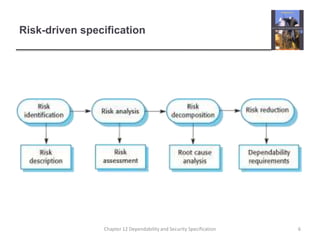
Risk-driven specificationCritical systems specification should be risk-driven.This approach has been widely used in safety and security-critical systems.The aim of the specification process should be to understand the risks (safety, security, etc.) faced by the system and to define requirements that reduce these risks.4Chapter 12 Dependability and Security Specification
Stages of risk-based analysisRisk identificationIdentify potential risks that may arise.Risk analysis and classificationAssess the seriousness of each risk.Risk decompositionDecompose risks to discover their potential root causes.Risk reduction assessmentDefine how each risk must be taken into eliminated or reduced when the system is designed.5Chapter 12 Dependability and Security Specification
Risk-driven specification6Chapter 12 Dependability and Security Specification
Phased risk analysisPreliminary risk analysisIdentifies risks from the systems environment. Aim is to develop an initial set of system security and dependability requirements.Life cycle risk analysisIdentifies risks that emerge during design and development e.g. risks that are associated with the technologies used for system construction. Requirements are extended to protect against these risks.Operational risk analysisRisks associated with the system user interface and operator errors. Further protection requirements may be added to cope with these.7Chapter 12 Dependability and Security Specification
Safety specificationGoal is to identify protection requirements that ensure that system failures do not cause injury or death or environmental damage.Risk identification = Hazard identificationRisk analysis = Hazard assessmentRisk decomposition = Hazard analysisRisk reduction = safety requirements specification8Chapter 12 Dependability and Security Specification
Hazard identificationIdentify the hazards that may threaten the system.Hazard identification may be based on different types of hazard:Physical hazardsElectrical hazardsBiological hazardsService failure hazardsEtc.9Chapter 12 Dependability and Security Specification
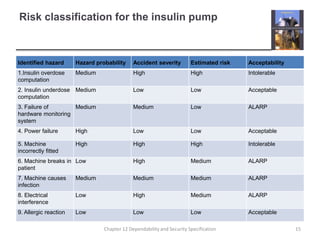
Insulin pump risksInsulin overdose (service failure).Insulin underdose (service failure).Power failure due to exhausted battery (electrical).Electrical interference with other medical equipment (electrical).Poor sensor and actuator contact (physical).Parts of machine break off in body (physical).Infection caused by introduction of machine (biological).Allergic reaction to materials or insulin (biological).10Chapter 12 Dependability and Security Specification
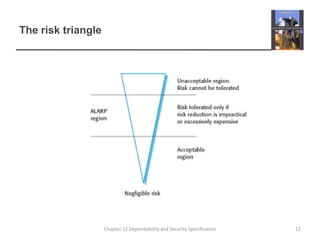
Hazard assessmentThe process is concerned with understanding the likelihood that a risk will arise and the potential consequences if an accident or incident should occur.Risks may be categorised as:Intolerable. Must never arise or result in an accidentAs low as reasonably practical(ALARP). Must minimise the possibility of risk given cost and schedule constraintsAcceptable. The consequences of the risk are acceptable and no extra costs should be incurred to reduce hazard probability11Chapter 12 Dependability and Security Specification
The risk triangle12Chapter 12 Dependability and Security Specification
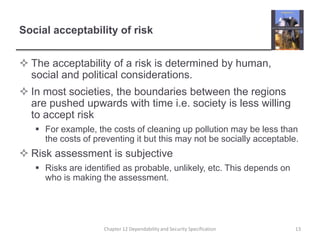
Social acceptability of riskThe acceptability of a risk is determined by human, social and political considerations.In most societies, the boundaries between the regions are pushed upwards with time i.e. society is less willing to accept riskFor example, the costs of cleaning up pollution may be less than the costs of preventing it but this may not be socially acceptable.Risk assessment is subjectiveRisks are identified as probable, unlikely, etc. This depends on who is making the assessment.13Chapter 12 Dependability and Security Specification
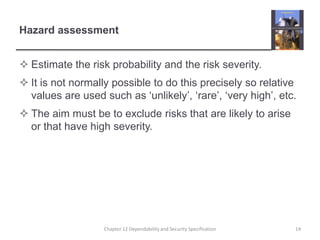
Hazard assessmentEstimate the risk probability and the risk severity.It is not normally possible to do this precisely so relative values are used such as ‘unlikely’, ‘rare’, ‘very high’, etc.The aim must be to exclude risks that are likely to arise or that have high severity.14Chapter 12 Dependability and Security Specification
Risk classification for the insulin pump15Chapter 12 Dependability and Security Specification
Hazard analysisConcerned with discovering the root causes of risks in a particular system.Techniques have been mostly derived from safety-critical systems and can beInductive, bottom-up techniques. Start with a proposed system failure and assess the hazards that could arise from that failure;Deductive, top-down techniques. Start with a hazard and deduce what the causes of this could be.16Chapter 12 Dependability and Security Specification
Fault-tree analysisA deductive top-down technique.Put the risk or hazard at the root of the tree and identify the system states that could lead to that hazard.Where appropriate, link these with ‘and’ or ‘or’ conditions.A goal should be to minimise the number of single causes of system failure.17Chapter 12 Dependability and Security Specification
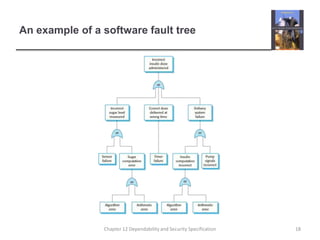
An example of a software fault tree18Chapter 12 Dependability and Security Specification
Fault tree analysisThree possible conditions that can lead to delivery of incorrect dose of insulinIncorrect measurement of blood sugar levelFailure of delivery systemDose delivered at wrong timeBy analysis of the fault tree, root causes of these hazards related to software are:Algorithm errorArithmetic error19Chapter 12 Dependability and Security Specification
Risk reductionThe aim of this process is to identify dependability requirements that specify how the risks should be managed and ensure that accidents/incidents do not arise.Risk reduction strategiesRisk avoidance;Risk detection and removal;Damage limitation.20Chapter 12 Dependability and Security Specification
Strategy useNormally, in critical systems, a mix of risk reduction strategies are used.In a chemical plant control system, the system will include sensors to detect and correct excess pressure in the reactor.However, it will also include an independent protection system that opens a relief valve if dangerously high pressure is detected.21Chapter 12 Dependability and Security Specification
Insulin pump - software risksArithmetic errorA computation causes the value of a variable to overflow or underflow;Maybe include an exception handler for each type of arithmetic error.Algorithmic errorCompare dose to be delivered with previous dose or safe maximum doses. Reduce dose if too high.22Chapter 12 Dependability and Security Specification
Examples of safety requirementsSR1: The system shall not deliver a single dose of insulin that is greater than a specified maximum dose for a system user.SR2: The system shall not deliver a daily cumulative dose of insulin that is greater than a specified maximum daily dose for a system user.SR3: The system shall include a hardware diagnostic facility that shall be executed at least four times per hour.SR4: The system shall include an exception handler for all of the exceptions that are identified in Table 3.SR5: The audible alarm shall be sounded when any hardware or software anomaly is discovered and a diagnostic message, as defined in Table 4, shall be displayed.SR6: In the event of an alarm, insulin delivery shall be suspended until the user has reset the system and cleared the alarm.23Chapter 12 Dependability and Security Specification
Key pointsRisk analysis is an important activity in the specification of security and dependability requirements. It involves identifying risks that can result in accidents or incidents. A hazard-driven approach may be used to understand the safety requirements for a system. You identify potential hazards and decompose these (using methods such as fault tree analysis) to discover their root causes.Safety requirements should be included to ensure that hazards and accidents do not arise or, if this is impossible, to limit the damage caused by system failure.24Chapter 12 Dependability and Security Specification
Chapter 12 – Dependability and Security SpecificationLecture 225Chapter 12 Dependability and Security Specification
System reliability specificationReliability is a measurable system attribute so non-functional reliability requirements may be specified quantitatively. These define the number of failures that are acceptable during normal use of the system or the time in which the system must be available. Functional reliability requirements define system and software functions that avoid, detect or tolerate faults in the software and so ensure that these faults do not lead to system failure.Software reliability requirements may also be included to cope with hardware failure or operator error.26Chapter 12 Dependability and Security Specification
Reliability specification processRisk identificationIdentify the types of system failure that may lead to economic losses.Risk analysisEstimate the costs and consequences of the different types of software failure.Risk decompositionIdentify the root causes of system failure.Risk reductionGenerate reliability specifications, including quantitative requirements defining the acceptable levels of failure.27Chapter 12 Dependability and Security Specification
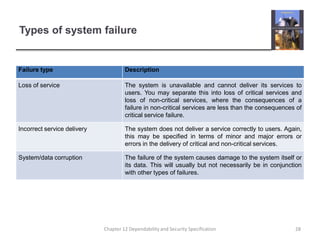
Types of system failure28Chapter 12 Dependability and Security Specification
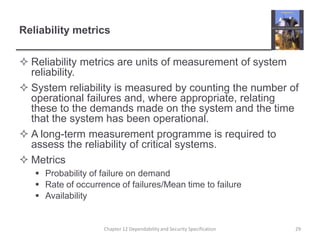
Reliability metricsReliability metrics are units of measurement of system reliability.System reliability is measured by counting the number of operational failures and, where appropriate, relating these to the demands made on the system and the time that the system has been operational.A long-term measurement programme is required to assess the reliability of critical systems.MetricsProbability of failure on demandRate of occurrence of failures/Mean time to failureAvailability29Chapter 12 Dependability and Security Specification
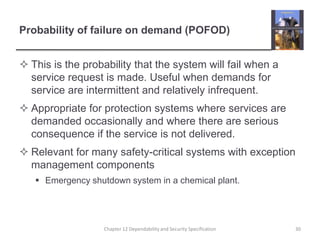
Probability of failure on demand (POFOD)This is the probability that the system will fail when a service request is made. Useful when demands for service are intermittent and relatively infrequent.Appropriate for protection systems where services are demanded occasionally and where there are serious consequence if the service is not delivered.Relevant for many safety-critical systems with exception management componentsEmergency shutdown system in a chemical plant.30Chapter 12 Dependability and Security Specification
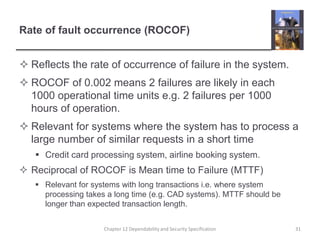
Rate of fault occurrence (ROCOF)Reflects the rate of occurrence of failure in the system.ROCOF of 0.002 means 2 failures are likely in each 1000 operational time units e.g. 2 failures per 1000 hours of operation.Relevant for systems where the system has to process a large number of similar requests in a short timeCredit card processing system, airline booking system.Reciprocal of ROCOF is Mean time to Failure (MTTF)Relevant for systems with long transactions i.e. where system processing takes a long time (e.g. CAD systems). MTTF should be longer than expected transaction length.31Chapter 12 Dependability and Security Specification
AvailabilityMeasure of the fraction of the time that the system is available for use.Takes repair and restart time into accountAvailability of 0.998 means software is available for 998 out of 1000 time units.Relevant for non-stop, continuously running systems telephone switching systems, railway signalling systems.32Chapter 12 Dependability and Security Specification
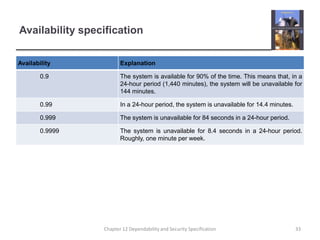
Availability specification33Chapter 12 Dependability and Security Specification
Failure consequencesWhen specifying reliability, it is not just the number of system failures that matter but the consequences of these failures.Failures that have serious consequences are clearly more damaging than those where repair and recovery is straightforward.In some cases, therefore, different reliability specifications for different types of failure may be defined.34Chapter 12 Dependability and Security Specification
Over-specification of reliabilityOver-specification of reliability is a situation where a high-level of reliability is specified but it is not cost-effective to achieve this.In many cases, it is cheaper to accept and deal with failures rather than avoid them occurring.To avoid over-specificationSpecify reliability requirements for different types of failure. Minor failures may be acceptable.Specify requirements for different services separately. Critical services should have the highest reliability requirements.Decide whether or not high reliability is really required or if dependability goals can be achieved in some other way.	35Chapter 12 Dependability and Security Specification
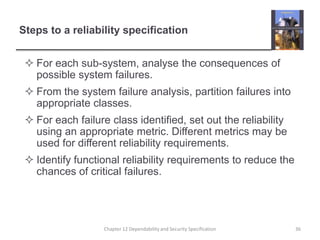
Steps to a reliability specificationFor each sub-system, analyse the consequences of possible system failures.From the system failure analysis, partition failures into appropriate classes.For each failure class identified, set out the reliability using an appropriate metric. Different metrics may be used for different reliability requirements.Identify functional reliability requirements to reduce the chances of critical failures.36Chapter 12 Dependability and Security Specification
Insulin pump specificationProbability of failure (POFOD) is the most appropriate metric.Transient failures that can be repaired by user actions such as recalibration of the machine. A relatively low value of POFOD is acceptable (say 0.002) – one failure may occur in every 500 demands.Permanent failures require the software to be re-installed by the manufacturer. This should occur no more than once per year. POFOD for this situation should be less than 0.00002.37Chapter 12 Dependability and Security Specification
Functional reliability requirementsChecking requirements that identify checks to ensure that incorrect data is detected before it leads to a failure.Recovery requirements that are geared to help the system recover after a failure has occurred.Redundancy requirements that specify redundant features of the system to be included.Process requirements for reliability which specify the development process to be used may also be included.38Chapter 12 Dependability and Security Specification
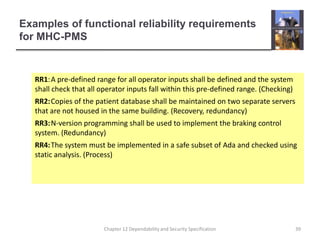
Examples of functional reliability requirements for MHC-PMSRR1:	A pre-defined range for all operator inputs shall be defined and the system shall check that all operator inputs fall within this pre-defined range. (Checking)RR2:	Copies of the patient database shall be maintained on two separate servers that are not housed in the same building. (Recovery, redundancy)RR3:	N-version programming shall be used to implement the braking control system. (Redundancy)RR4:	The system must be implemented in a safe subset of Ada and checked using static analysis. (Process)39Chapter 12 Dependability and Security Specification
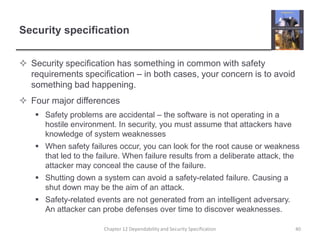
Security specificationSecurity specification has something in common with safety requirements specification – in both cases, your concern is to avoid something bad happening.Four major differencesSafety problems are accidental – the software is not operating in a hostile environment. In security, you must assume that attackers have knowledge of system weaknessesWhen safety failures occur, you can look for the root cause or weakness that led to the failure. When failure results from a deliberate attack, the attacker may conceal the cause of the failure.Shutting down a system can avoid a safety-related failure. Causing a shut down may be the aim of an attack.Safety-related events are not generated from an intelligent adversary. An attacker can probe defenses over time to discover weaknesses.40Chapter 12 Dependability and Security Specification
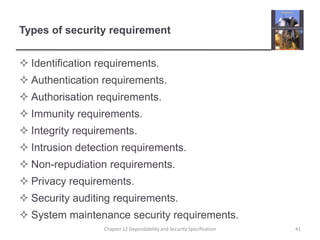
Types of security requirementIdentification requirements.Authentication requirements.Authorisation requirements.Immunity requirements.Integrity requirements.Intrusion detection requirements.Non-repudiation requirements.Privacy requirements.Security auditing requirements.System maintenance security requirements.41Chapter 12 Dependability and Security Specification
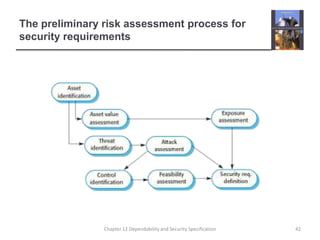
The preliminary risk assessment process for security requirements42Chapter 12 Dependability and Security Specification
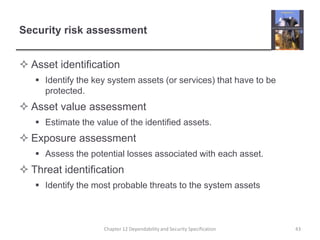
Security risk assessmentAsset identificationIdentify the key system assets (or services) that have to be protected.Asset value assessmentEstimate the value of the identified assets.Exposure assessmentAssess the potential losses associated with each asset.Threat identificationIdentify the most probable threats to the system assets43Chapter 12 Dependability and Security Specification
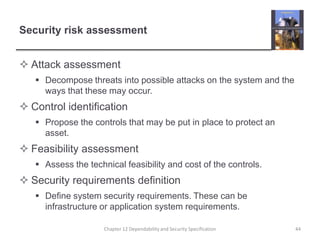
Security risk assessmentAttack assessmentDecompose threats into possible attacks on the system and the ways that these may occur.Control identificationPropose the controls that may be put in place to protect an asset.Feasibility assessmentAssess the technical feasibility and cost of the controls.Security requirements definitionDefine system security requirements. These can be infrastructure or application system requirements.44Chapter 12 Dependability and Security Specification
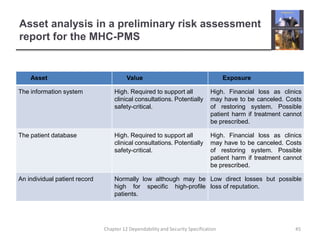
Asset analysis in a preliminary risk assessment report for the MHC-PMS45Chapter 12 Dependability and Security Specification
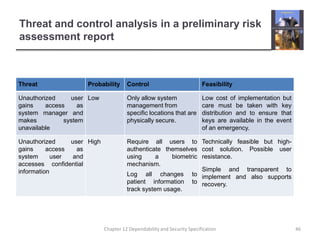
Threat and control analysis in a preliminary risk assessment report46Chapter 12 Dependability and Security Specification
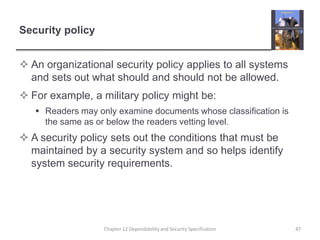
Security policyAn organizational security policy applies to all systems and sets out what should and should not be allowed.For example, a military policy might be:Readers may only examine documents whose classification is the same as or below the readers vetting level.A security policy sets out the conditions that must be maintained by a security system and so helps identify system security requirements.47Chapter 12 Dependability and Security Specification
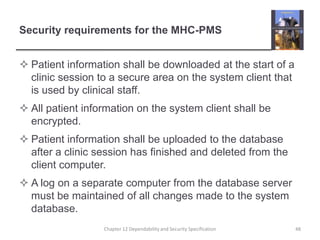
Security requirements for the MHC-PMSPatient information shall be downloaded at the start of a clinic session to a secure area on the system client that is used by clinical staff.All patient information on the system client shall be encrypted.Patient information shall be uploaded to the database after a clinic session has finished and deleted from the client computer.A log on a separate computer from the database server must be maintained of all changes made to the system database.48Chapter 12 Dependability and Security Specification
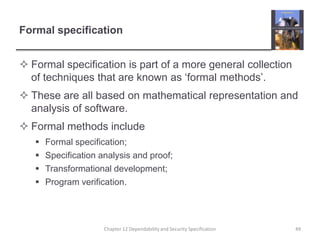
Formal specificationFormal specification is part of a more general collection of techniques that are known as ‘formal methods’.These are all based on mathematical representation and analysis of software.Formal methods includeFormal specification;Specification analysis and proof;Transformational development;Program verification.49Chapter 12 Dependability and Security Specification
Use of formal methodsThe principal benefits of formal methods are in reducing the number of faults in systems.Consequently, their main area of applicability is in critical systems engineering. There have been several successful projects where formal methods have been used in this area.In this area, the use of formal methods is most likely to be cost-effective because high system failure costs must be avoided. 50Chapter 12 Dependability and Security Specification
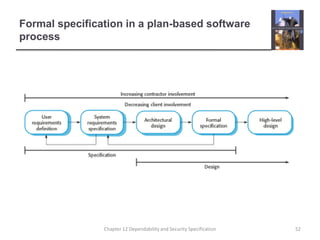
Specification in the software processSpecification and design are inextricably intermingled.Architectural design is essential to structure a specification and the specification process.Formal specifications are expressed in a mathematical notation with precisely defined vocabulary, syntax and semantics.51Chapter 12 Dependability and Security Specification
Formal specification in a plan-based software process52Chapter 12 Dependability and Security Specification
Benefits of formal specificationDeveloping a formal specification requires the system requirements to be analyzed in detail. This helps to detect problems, inconsistencies and incompleteness in the requirements.As the specification is expressed in a formal language, it can be automatically analyzed to discover inconsistencies and incompleteness.If you use a formal method such as the B method, you can transform the formal specification into a ‘correct’ program.Program testing costs may be reduced if the program is formally verified against its specification.53Chapter 12 Dependability and Security Specification
Acceptance of formal methodsFormal methods have had limited impact on practical software development:Problem owners cannot understand a formal specification and so cannot assess if it is an accurate representation of their requirements.It is easy to assess the costs of developing a formal specification but harder to assess the benefits. Managers may therefore be unwilling to invest in formal methods.Software engineers are  unfamiliar with this approach and are therefore reluctant to propose the use of FM.Formal methods are still hard to scale up to large systems.Formal specification is not really compatible with agile development methods.54Chapter 12 Dependability and Security Specification
Key pointsReliability requirements can be defined quantitatively. They include probability of failure on demand (POFOD), rate of occurrence of failure (ROCOF) and availability (AVAIL). Security requirements are more difficult to identify than safety requirements because a system attacker can use knowledge of system vulnerabilities to plan a system attack, and can learn about vulnerabilities from unsuccessful attacks.To specify security requirements, you should identify the assets that are to be protected and define how security techniques and technology should be used to protect these assets.Formal methods of software development rely on a system specification that is expressed as a mathematical model. The use of formal methods avoids ambiguity in a critical systems specification.55Chapter 12 Dependability and Security Specification

Ch12-Software Engineering 9

  • 1.
    Chapter 12 –Dependability and Security SpecificationLecture 11Chapter 12 Dependability and Security Specification
  • 2.
    Topics coveredRisk-driven specificationSafetyspecificationSecurity specificationSoftware reliability specification2Chapter 12 Dependability and Security Specification
  • 3.
    Dependability requirementsFunctional requirementsto define error checking and recovery facilities and protection against system failures.Non-functional requirements defining the required reliability and availability of the system.Excluding requirements that define states and conditions that must not arise.3Chapter 12 Dependability and Security Specification
  • 4.
    Risk-driven specificationCritical systemsspecification should be risk-driven.This approach has been widely used in safety and security-critical systems.The aim of the specification process should be to understand the risks (safety, security, etc.) faced by the system and to define requirements that reduce these risks.4Chapter 12 Dependability and Security Specification
  • 5.
    Stages of risk-basedanalysisRisk identificationIdentify potential risks that may arise.Risk analysis and classificationAssess the seriousness of each risk.Risk decompositionDecompose risks to discover their potential root causes.Risk reduction assessmentDefine how each risk must be taken into eliminated or reduced when the system is designed.5Chapter 12 Dependability and Security Specification
  • 6.
    Risk-driven specification6Chapter 12Dependability and Security Specification
  • 7.
    Phased risk analysisPreliminaryrisk analysisIdentifies risks from the systems environment. Aim is to develop an initial set of system security and dependability requirements.Life cycle risk analysisIdentifies risks that emerge during design and development e.g. risks that are associated with the technologies used for system construction. Requirements are extended to protect against these risks.Operational risk analysisRisks associated with the system user interface and operator errors. Further protection requirements may be added to cope with these.7Chapter 12 Dependability and Security Specification
  • 8.
    Safety specificationGoal isto identify protection requirements that ensure that system failures do not cause injury or death or environmental damage.Risk identification = Hazard identificationRisk analysis = Hazard assessmentRisk decomposition = Hazard analysisRisk reduction = safety requirements specification8Chapter 12 Dependability and Security Specification
  • 9.
    Hazard identificationIdentify thehazards that may threaten the system.Hazard identification may be based on different types of hazard:Physical hazardsElectrical hazardsBiological hazardsService failure hazardsEtc.9Chapter 12 Dependability and Security Specification
  • 10.
    Insulin pump risksInsulinoverdose (service failure).Insulin underdose (service failure).Power failure due to exhausted battery (electrical).Electrical interference with other medical equipment (electrical).Poor sensor and actuator contact (physical).Parts of machine break off in body (physical).Infection caused by introduction of machine (biological).Allergic reaction to materials or insulin (biological).10Chapter 12 Dependability and Security Specification
  • 11.
    Hazard assessmentThe processis concerned with understanding the likelihood that a risk will arise and the potential consequences if an accident or incident should occur.Risks may be categorised as:Intolerable. Must never arise or result in an accidentAs low as reasonably practical(ALARP). Must minimise the possibility of risk given cost and schedule constraintsAcceptable. The consequences of the risk are acceptable and no extra costs should be incurred to reduce hazard probability11Chapter 12 Dependability and Security Specification
  • 12.
    The risk triangle12Chapter12 Dependability and Security Specification
  • 13.
    Social acceptability ofriskThe acceptability of a risk is determined by human, social and political considerations.In most societies, the boundaries between the regions are pushed upwards with time i.e. society is less willing to accept riskFor example, the costs of cleaning up pollution may be less than the costs of preventing it but this may not be socially acceptable.Risk assessment is subjectiveRisks are identified as probable, unlikely, etc. This depends on who is making the assessment.13Chapter 12 Dependability and Security Specification
  • 14.
    Hazard assessmentEstimate therisk probability and the risk severity.It is not normally possible to do this precisely so relative values are used such as ‘unlikely’, ‘rare’, ‘very high’, etc.The aim must be to exclude risks that are likely to arise or that have high severity.14Chapter 12 Dependability and Security Specification
  • 15.
    Risk classification forthe insulin pump15Chapter 12 Dependability and Security Specification
  • 16.
    Hazard analysisConcerned withdiscovering the root causes of risks in a particular system.Techniques have been mostly derived from safety-critical systems and can beInductive, bottom-up techniques. Start with a proposed system failure and assess the hazards that could arise from that failure;Deductive, top-down techniques. Start with a hazard and deduce what the causes of this could be.16Chapter 12 Dependability and Security Specification
  • 17.
    Fault-tree analysisA deductivetop-down technique.Put the risk or hazard at the root of the tree and identify the system states that could lead to that hazard.Where appropriate, link these with ‘and’ or ‘or’ conditions.A goal should be to minimise the number of single causes of system failure.17Chapter 12 Dependability and Security Specification
  • 18.
    An example ofa software fault tree18Chapter 12 Dependability and Security Specification
  • 19.
    Fault tree analysisThreepossible conditions that can lead to delivery of incorrect dose of insulinIncorrect measurement of blood sugar levelFailure of delivery systemDose delivered at wrong timeBy analysis of the fault tree, root causes of these hazards related to software are:Algorithm errorArithmetic error19Chapter 12 Dependability and Security Specification
  • 20.
    Risk reductionThe aimof this process is to identify dependability requirements that specify how the risks should be managed and ensure that accidents/incidents do not arise.Risk reduction strategiesRisk avoidance;Risk detection and removal;Damage limitation.20Chapter 12 Dependability and Security Specification
  • 21.
    Strategy useNormally, incritical systems, a mix of risk reduction strategies are used.In a chemical plant control system, the system will include sensors to detect and correct excess pressure in the reactor.However, it will also include an independent protection system that opens a relief valve if dangerously high pressure is detected.21Chapter 12 Dependability and Security Specification
  • 22.
    Insulin pump -software risksArithmetic errorA computation causes the value of a variable to overflow or underflow;Maybe include an exception handler for each type of arithmetic error.Algorithmic errorCompare dose to be delivered with previous dose or safe maximum doses. Reduce dose if too high.22Chapter 12 Dependability and Security Specification
  • 23.
    Examples of safetyrequirementsSR1: The system shall not deliver a single dose of insulin that is greater than a specified maximum dose for a system user.SR2: The system shall not deliver a daily cumulative dose of insulin that is greater than a specified maximum daily dose for a system user.SR3: The system shall include a hardware diagnostic facility that shall be executed at least four times per hour.SR4: The system shall include an exception handler for all of the exceptions that are identified in Table 3.SR5: The audible alarm shall be sounded when any hardware or software anomaly is discovered and a diagnostic message, as defined in Table 4, shall be displayed.SR6: In the event of an alarm, insulin delivery shall be suspended until the user has reset the system and cleared the alarm.23Chapter 12 Dependability and Security Specification
  • 24.
    Key pointsRisk analysisis an important activity in the specification of security and dependability requirements. It involves identifying risks that can result in accidents or incidents. A hazard-driven approach may be used to understand the safety requirements for a system. You identify potential hazards and decompose these (using methods such as fault tree analysis) to discover their root causes.Safety requirements should be included to ensure that hazards and accidents do not arise or, if this is impossible, to limit the damage caused by system failure.24Chapter 12 Dependability and Security Specification
  • 25.
    Chapter 12 –Dependability and Security SpecificationLecture 225Chapter 12 Dependability and Security Specification
  • 26.
    System reliability specificationReliabilityis a measurable system attribute so non-functional reliability requirements may be specified quantitatively. These define the number of failures that are acceptable during normal use of the system or the time in which the system must be available. Functional reliability requirements define system and software functions that avoid, detect or tolerate faults in the software and so ensure that these faults do not lead to system failure.Software reliability requirements may also be included to cope with hardware failure or operator error.26Chapter 12 Dependability and Security Specification
  • 27.
    Reliability specification processRiskidentificationIdentify the types of system failure that may lead to economic losses.Risk analysisEstimate the costs and consequences of the different types of software failure.Risk decompositionIdentify the root causes of system failure.Risk reductionGenerate reliability specifications, including quantitative requirements defining the acceptable levels of failure.27Chapter 12 Dependability and Security Specification
  • 28.
    Types of systemfailure28Chapter 12 Dependability and Security Specification
  • 29.
    Reliability metricsReliability metricsare units of measurement of system reliability.System reliability is measured by counting the number of operational failures and, where appropriate, relating these to the demands made on the system and the time that the system has been operational.A long-term measurement programme is required to assess the reliability of critical systems.MetricsProbability of failure on demandRate of occurrence of failures/Mean time to failureAvailability29Chapter 12 Dependability and Security Specification
  • 30.
    Probability of failureon demand (POFOD)This is the probability that the system will fail when a service request is made. Useful when demands for service are intermittent and relatively infrequent.Appropriate for protection systems where services are demanded occasionally and where there are serious consequence if the service is not delivered.Relevant for many safety-critical systems with exception management componentsEmergency shutdown system in a chemical plant.30Chapter 12 Dependability and Security Specification
  • 31.
    Rate of faultoccurrence (ROCOF)Reflects the rate of occurrence of failure in the system.ROCOF of 0.002 means 2 failures are likely in each 1000 operational time units e.g. 2 failures per 1000 hours of operation.Relevant for systems where the system has to process a large number of similar requests in a short timeCredit card processing system, airline booking system.Reciprocal of ROCOF is Mean time to Failure (MTTF)Relevant for systems with long transactions i.e. where system processing takes a long time (e.g. CAD systems). MTTF should be longer than expected transaction length.31Chapter 12 Dependability and Security Specification
  • 32.
    AvailabilityMeasure of thefraction of the time that the system is available for use.Takes repair and restart time into accountAvailability of 0.998 means software is available for 998 out of 1000 time units.Relevant for non-stop, continuously running systems telephone switching systems, railway signalling systems.32Chapter 12 Dependability and Security Specification
  • 33.
    Availability specification33Chapter 12Dependability and Security Specification
  • 34.
    Failure consequencesWhen specifyingreliability, it is not just the number of system failures that matter but the consequences of these failures.Failures that have serious consequences are clearly more damaging than those where repair and recovery is straightforward.In some cases, therefore, different reliability specifications for different types of failure may be defined.34Chapter 12 Dependability and Security Specification
  • 35.
    Over-specification of reliabilityOver-specificationof reliability is a situation where a high-level of reliability is specified but it is not cost-effective to achieve this.In many cases, it is cheaper to accept and deal with failures rather than avoid them occurring.To avoid over-specificationSpecify reliability requirements for different types of failure. Minor failures may be acceptable.Specify requirements for different services separately. Critical services should have the highest reliability requirements.Decide whether or not high reliability is really required or if dependability goals can be achieved in some other way. 35Chapter 12 Dependability and Security Specification
  • 36.
    Steps to areliability specificationFor each sub-system, analyse the consequences of possible system failures.From the system failure analysis, partition failures into appropriate classes.For each failure class identified, set out the reliability using an appropriate metric. Different metrics may be used for different reliability requirements.Identify functional reliability requirements to reduce the chances of critical failures.36Chapter 12 Dependability and Security Specification
  • 37.
    Insulin pump specificationProbabilityof failure (POFOD) is the most appropriate metric.Transient failures that can be repaired by user actions such as recalibration of the machine. A relatively low value of POFOD is acceptable (say 0.002) – one failure may occur in every 500 demands.Permanent failures require the software to be re-installed by the manufacturer. This should occur no more than once per year. POFOD for this situation should be less than 0.00002.37Chapter 12 Dependability and Security Specification
  • 38.
    Functional reliability requirementsCheckingrequirements that identify checks to ensure that incorrect data is detected before it leads to a failure.Recovery requirements that are geared to help the system recover after a failure has occurred.Redundancy requirements that specify redundant features of the system to be included.Process requirements for reliability which specify the development process to be used may also be included.38Chapter 12 Dependability and Security Specification
  • 39.
    Examples of functionalreliability requirements for MHC-PMSRR1: A pre-defined range for all operator inputs shall be defined and the system shall check that all operator inputs fall within this pre-defined range. (Checking)RR2: Copies of the patient database shall be maintained on two separate servers that are not housed in the same building. (Recovery, redundancy)RR3: N-version programming shall be used to implement the braking control system. (Redundancy)RR4: The system must be implemented in a safe subset of Ada and checked using static analysis. (Process)39Chapter 12 Dependability and Security Specification
  • 40.
    Security specificationSecurity specificationhas something in common with safety requirements specification – in both cases, your concern is to avoid something bad happening.Four major differencesSafety problems are accidental – the software is not operating in a hostile environment. In security, you must assume that attackers have knowledge of system weaknessesWhen safety failures occur, you can look for the root cause or weakness that led to the failure. When failure results from a deliberate attack, the attacker may conceal the cause of the failure.Shutting down a system can avoid a safety-related failure. Causing a shut down may be the aim of an attack.Safety-related events are not generated from an intelligent adversary. An attacker can probe defenses over time to discover weaknesses.40Chapter 12 Dependability and Security Specification
  • 41.
    Types of securityrequirementIdentification requirements.Authentication requirements.Authorisation requirements.Immunity requirements.Integrity requirements.Intrusion detection requirements.Non-repudiation requirements.Privacy requirements.Security auditing requirements.System maintenance security requirements.41Chapter 12 Dependability and Security Specification
  • 42.
    The preliminary riskassessment process for security requirements42Chapter 12 Dependability and Security Specification
  • 43.
    Security risk assessmentAssetidentificationIdentify the key system assets (or services) that have to be protected.Asset value assessmentEstimate the value of the identified assets.Exposure assessmentAssess the potential losses associated with each asset.Threat identificationIdentify the most probable threats to the system assets43Chapter 12 Dependability and Security Specification
  • 44.
    Security risk assessmentAttackassessmentDecompose threats into possible attacks on the system and the ways that these may occur.Control identificationPropose the controls that may be put in place to protect an asset.Feasibility assessmentAssess the technical feasibility and cost of the controls.Security requirements definitionDefine system security requirements. These can be infrastructure or application system requirements.44Chapter 12 Dependability and Security Specification
  • 45.
    Asset analysis ina preliminary risk assessment report for the MHC-PMS45Chapter 12 Dependability and Security Specification
  • 46.
    Threat and controlanalysis in a preliminary risk assessment report46Chapter 12 Dependability and Security Specification
  • 47.
    Security policyAn organizationalsecurity policy applies to all systems and sets out what should and should not be allowed.For example, a military policy might be:Readers may only examine documents whose classification is the same as or below the readers vetting level.A security policy sets out the conditions that must be maintained by a security system and so helps identify system security requirements.47Chapter 12 Dependability and Security Specification
  • 48.
    Security requirements forthe MHC-PMSPatient information shall be downloaded at the start of a clinic session to a secure area on the system client that is used by clinical staff.All patient information on the system client shall be encrypted.Patient information shall be uploaded to the database after a clinic session has finished and deleted from the client computer.A log on a separate computer from the database server must be maintained of all changes made to the system database.48Chapter 12 Dependability and Security Specification
  • 49.
    Formal specificationFormal specificationis part of a more general collection of techniques that are known as ‘formal methods’.These are all based on mathematical representation and analysis of software.Formal methods includeFormal specification;Specification analysis and proof;Transformational development;Program verification.49Chapter 12 Dependability and Security Specification
  • 50.
    Use of formalmethodsThe principal benefits of formal methods are in reducing the number of faults in systems.Consequently, their main area of applicability is in critical systems engineering. There have been several successful projects where formal methods have been used in this area.In this area, the use of formal methods is most likely to be cost-effective because high system failure costs must be avoided. 50Chapter 12 Dependability and Security Specification
  • 51.
    Specification in thesoftware processSpecification and design are inextricably intermingled.Architectural design is essential to structure a specification and the specification process.Formal specifications are expressed in a mathematical notation with precisely defined vocabulary, syntax and semantics.51Chapter 12 Dependability and Security Specification
  • 52.
    Formal specification ina plan-based software process52Chapter 12 Dependability and Security Specification
  • 53.
    Benefits of formalspecificationDeveloping a formal specification requires the system requirements to be analyzed in detail. This helps to detect problems, inconsistencies and incompleteness in the requirements.As the specification is expressed in a formal language, it can be automatically analyzed to discover inconsistencies and incompleteness.If you use a formal method such as the B method, you can transform the formal specification into a ‘correct’ program.Program testing costs may be reduced if the program is formally verified against its specification.53Chapter 12 Dependability and Security Specification
  • 54.
    Acceptance of formalmethodsFormal methods have had limited impact on practical software development:Problem owners cannot understand a formal specification and so cannot assess if it is an accurate representation of their requirements.It is easy to assess the costs of developing a formal specification but harder to assess the benefits. Managers may therefore be unwilling to invest in formal methods.Software engineers are unfamiliar with this approach and are therefore reluctant to propose the use of FM.Formal methods are still hard to scale up to large systems.Formal specification is not really compatible with agile development methods.54Chapter 12 Dependability and Security Specification
  • 55.
    Key pointsReliability requirementscan be defined quantitatively. They include probability of failure on demand (POFOD), rate of occurrence of failure (ROCOF) and availability (AVAIL). Security requirements are more difficult to identify than safety requirements because a system attacker can use knowledge of system vulnerabilities to plan a system attack, and can learn about vulnerabilities from unsuccessful attacks.To specify security requirements, you should identify the assets that are to be protected and define how security techniques and technology should be used to protect these assets.Formal methods of software development rely on a system specification that is expressed as a mathematical model. The use of formal methods avoids ambiguity in a critical systems specification.55Chapter 12 Dependability and Security Specification