



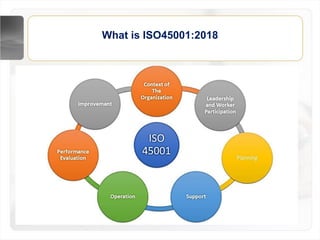


What is ISO45001:2018
• ISO45001isan internationally agreed standard that setsout therequirements
for anoccupational Health and Safety management system.
• It helpsorganizationsimprovethe Safety performancethrough more efficient
useof resourcesand stopping of accidents ,gainingacompetitive advantage
and the trust of stakeholders.
Benefits to the business
Users of the standard have reported that ISO 45001:2018 helps:
• Demonstrate compliance with current and future statutory and
regulatory requirements
• Increase leadership involvement and engagement of employees
• Improve company reputation and the confidence of stakeholders
through strategic communication
Benefits to the business
• Achieve strategic business aims by incorporating health and safety
issues into business management
• Provide a competitive and financial advantage through improved
efficiencies and reduced costs
• Encourage better safety performance of staff , suppliers and
contractors by integrating them into the organization’s business
systems
What is ISO45001:2018
• ISO14001isan internationally agreed standard that setsout therequirements
for anenvironmental management system.
• It helpsorganizationsimprovetheir environmental performancethrough more
efficient useof resourcesand reduction of waste,gainingacompetitive
advantage and the trust of stakeholders.
The key improvement
ISO 45001:2018 now requires:
• Safety management to be more prominent within the organization’s
strategic direction
• A greater commitment from leadership
• The implementation of proactive initiatives to protect the people and
work place from harm and accidents
• The addition of a stakeholder-focused communication strategy
• It also allows for easier integration into other management systems
ISO 45001:2018 standard
requirements
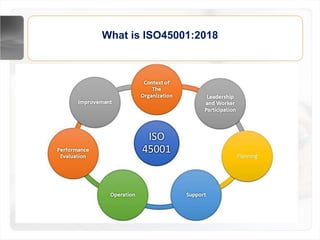
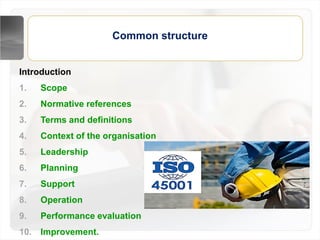
Common structure
Introduction
1. Scope
2. Normative references
3. Terms and definitions
4. Context of the organisation
5. Leadership
6. Planning
7. Support
8. Operation
9. Performance evaluation
10. Improvement.
What is ISO45001:2018
• ISO14001isan internationally agreed standard that setsout therequirements
for anenvironmental management system.
• It helpsorganizationsimprovetheir environmental performancethrough more
efficient useof resourcesand reduction of waste,gainingacompetitive
advantage and the trust of stakeholders.
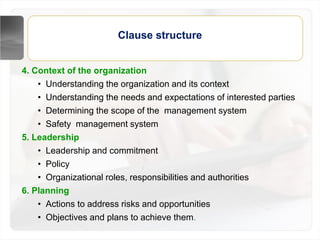
Clause structure
4. Context of the organization
• Understanding the organization and its context
• Understanding the needs and expectations of interested parties
• Determining the scope of the management system
• Safety management system
5. Leadership
• Leadership and commitment
• Policy
• Organizational roles, responsibilities and authorities
6. Planning
• Actions to address risks and opportunities
• Objectives and plans to achieve them.
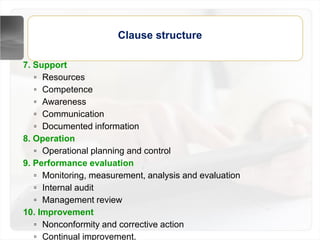
Clause structure
7. Support
▫ Resources
▫ Competence
▫ Awareness
▫ Communication
▫ Documented information
8. Operation
▫ Operational planning and control
9. Performance evaluation
▫ Monitoring, measurement, analysis and evaluation
▫ Internal audit
▫ Management review
10. Improvement
▫ Nonconformity and corrective action
▫ Continual improvement.
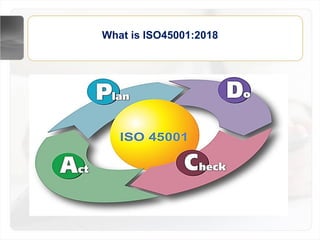
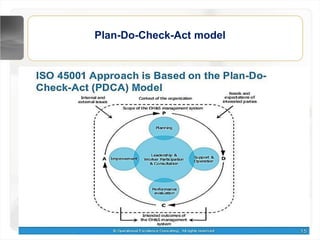
Plan-Do-Check-Act model
Context of the organisation
Context of the organization requirements
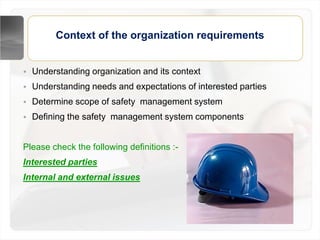
• Understanding organization and its context
• Understanding needs and expectations of interested parties
• Determine scope of safety management system
• Defining the safety management system components
Please check the following definitions :-
Interested parties
Internal and external issues
Leadership
Leadership requirements
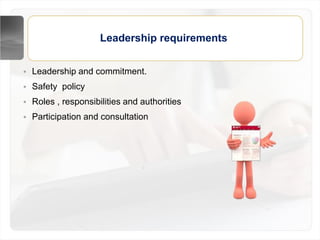
• Leadership and commitment.
• Safety policy
• Roles , responsibilities and authorities
• Participation and consultation
Leadership requirements
Planning
Planning requirements
• General Actions to address risks and opportunities
• Hazards identification and risk assessment
• Compliance obligations
• Planning action
• Safety objectives
• OHS opportunities and other opportunities
Please check the following definitions :-
• Risks and opportunities
• Compliance obligations
Planning requirements
Support
Support requirements
• Resources
• Competence
• Awareness
• Information and Communication
• Documented information
Please check the following definitions
• Competence
• Documented information
Support requirements
Operation
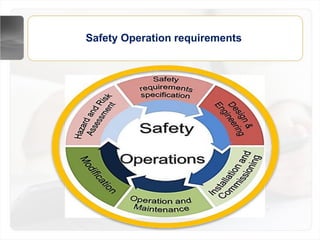
Safety Operation requirements
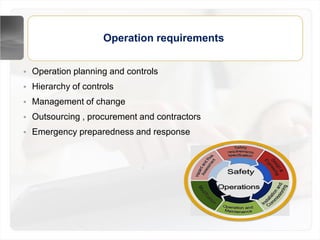
• Operation planning and controls
• Hierarchy of controls
• Management of change
• Outsourcing , procurement and contractors
• Emergency preparedness and response
Operation requirements
Performance Evaluation
Performance evaluation requirements
• Monitoring , measurements analysis and evaluation
• Evaluation of compliance
• Internal audit
• Management review
Please check the following definitions
• Effectiveness
• Monitoring
• Measurement
• Performance
Performance evaluation requirements
Improvement
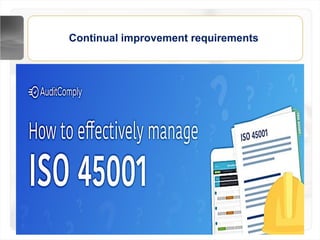
Continual improvement requirements
• Incidents , Non-conformity and corrective actions
• Continual improvement process
• Continual improvement objectives
Continual improvement requirements
Making effective OHSMS
Effective OHSMS
Effective OHS / Critical decisions
• Top management commitment is key factor to making this a
success.
• Top management assign the Safety tasks for each project after
submission of safety management system guide ( safety manual
and practical training completion.
• Safety team developing the supervision , documents updates ,
communication , awareness and auditing tasks in collaboration with
project manager and project assigned safety staff .
• Each project will be considered as one safety management system
unit , should be controlled as per the full safety management system
guidelines
Effective OHS / continuous tasks
• Review systems, policies, procedures and processes you have in
place – you may already do much of what’s in the standard and make it
work for your business.
• Speak to your clients and suppliers. They may be able to suggest
improvements and give feedback on your service.
• Train your staff to carry out internal audits. This can help with their
understanding, but it could also provide valuable feedback on potential
problems or opportunities for improvement.
• Keep staff informed of what’s going on, create a team or assign a
champion, as this will increase motivation. This could include a well
communicated plan of activities and timescales.
• Think about how different departments work together to avoid confusion
of duplication .
• Make sure the organization works as a team for the benefit of clients
and the organization.
Any Questions?
Continually improve and make
excellence a habit
ISO 45001 018 . 2018 م.71-مبادرة#تواصل_تطوير-د.محمد عبدالمجيد-التعريف بمتطلبات المواصفة العالمية للسلامة المهنية

ISO 45001 018 . 2018 م.71-مبادرة#تواصل_تطوير-د.محمد عبدالمجيد-التعريف بمتطلبات المواصفة العالمية للسلامة المهنية

  • 4.
  • 5.
    What is ISO45001:2018 •ISO45001isan internationally agreed standard that setsout therequirements for anoccupational Health and Safety management system. • It helpsorganizationsimprovethe Safety performancethrough more efficient useof resourcesand stopping of accidents ,gainingacompetitive advantage and the trust of stakeholders.
  • 6.
    Benefits to thebusiness Users of the standard have reported that ISO 45001:2018 helps: • Demonstrate compliance with current and future statutory and regulatory requirements • Increase leadership involvement and engagement of employees • Improve company reputation and the confidence of stakeholders through strategic communication
  • 7.
    Benefits to thebusiness • Achieve strategic business aims by incorporating health and safety issues into business management • Provide a competitive and financial advantage through improved efficiencies and reduced costs • Encourage better safety performance of staff , suppliers and contractors by integrating them into the organization’s business systems
  • 8.
  • 9.
    What is ISO45001:2018 •ISO14001isan internationally agreed standard that setsout therequirements for anenvironmental management system. • It helpsorganizationsimprovetheir environmental performancethrough more efficient useof resourcesand reduction of waste,gainingacompetitive advantage and the trust of stakeholders.
  • 10.
    The key improvement ISO45001:2018 now requires: • Safety management to be more prominent within the organization’s strategic direction • A greater commitment from leadership • The implementation of proactive initiatives to protect the people and work place from harm and accidents • The addition of a stakeholder-focused communication strategy • It also allows for easier integration into other management systems
  • 11.
  • 12.
    Common structure Introduction 1. Scope 2.Normative references 3. Terms and definitions 4. Context of the organisation 5. Leadership 6. Planning 7. Support 8. Operation 9. Performance evaluation 10. Improvement.
  • 13.
    What is ISO45001:2018 •ISO14001isan internationally agreed standard that setsout therequirements for anenvironmental management system. • It helpsorganizationsimprovetheir environmental performancethrough more efficient useof resourcesand reduction of waste,gainingacompetitive advantage and the trust of stakeholders.
  • 14.
    Clause structure 4. Contextof the organization • Understanding the organization and its context • Understanding the needs and expectations of interested parties • Determining the scope of the management system • Safety management system 5. Leadership • Leadership and commitment • Policy • Organizational roles, responsibilities and authorities 6. Planning • Actions to address risks and opportunities • Objectives and plans to achieve them.
  • 15.
    Clause structure 7. Support ▫Resources ▫ Competence ▫ Awareness ▫ Communication ▫ Documented information 8. Operation ▫ Operational planning and control 9. Performance evaluation ▫ Monitoring, measurement, analysis and evaluation ▫ Internal audit ▫ Management review 10. Improvement ▫ Nonconformity and corrective action ▫ Continual improvement.
  • 16.
  • 17.
    Context of theorganisation
  • 18.
    Context of theorganization requirements
  • 19.
    Context of theorganization requirements • Understanding organization and its context • Understanding needs and expectations of interested parties • Determine scope of safety management system • Defining the safety management system components Please check the following definitions :- Interested parties Internal and external issues
  • 20.
  • 21.
  • 22.
    • Leadership andcommitment. • Safety policy • Roles , responsibilities and authorities • Participation and consultation Leadership requirements
  • 23.
  • 24.
  • 25.
    • General Actionsto address risks and opportunities • Hazards identification and risk assessment • Compliance obligations • Planning action • Safety objectives • OHS opportunities and other opportunities Please check the following definitions :- • Risks and opportunities • Compliance obligations Planning requirements
  • 26.
  • 27.
  • 28.
    • Resources • Competence •Awareness • Information and Communication • Documented information Please check the following definitions • Competence • Documented information Support requirements
  • 29.
  • 30.
  • 31.
    • Operation planningand controls • Hierarchy of controls • Management of change • Outsourcing , procurement and contractors • Emergency preparedness and response Operation requirements
  • 32.
  • 33.
  • 34.
    • Monitoring ,measurements analysis and evaluation • Evaluation of compliance • Internal audit • Management review Please check the following definitions • Effectiveness • Monitoring • Measurement • Performance Performance evaluation requirements
  • 35.
  • 36.
  • 37.
    • Incidents ,Non-conformity and corrective actions • Continual improvement process • Continual improvement objectives Continual improvement requirements
  • 38.
  • 39.
  • 40.
    Effective OHS /Critical decisions • Top management commitment is key factor to making this a success. • Top management assign the Safety tasks for each project after submission of safety management system guide ( safety manual and practical training completion. • Safety team developing the supervision , documents updates , communication , awareness and auditing tasks in collaboration with project manager and project assigned safety staff . • Each project will be considered as one safety management system unit , should be controlled as per the full safety management system guidelines
  • 41.
    Effective OHS /continuous tasks • Review systems, policies, procedures and processes you have in place – you may already do much of what’s in the standard and make it work for your business. • Speak to your clients and suppliers. They may be able to suggest improvements and give feedback on your service. • Train your staff to carry out internal audits. This can help with their understanding, but it could also provide valuable feedback on potential problems or opportunities for improvement. • Keep staff informed of what’s going on, create a team or assign a champion, as this will increase motivation. This could include a well communicated plan of activities and timescales. • Think about how different departments work together to avoid confusion of duplication . • Make sure the organization works as a team for the benefit of clients and the organization.
  • 42.
    Any Questions? Continually improveand make excellence a habit