Introduction to
OSHA
Lecturer : Khan M Shinwary
Eng.khanm.sh@gmail.com
+937884-204-93
1
Lesson Overview
Purpose:
• To provide workers with introductory information about OSHA
Topics:
1. Why is OSHA important to you?
2. What rights do you have under OSHA?
3. What responsibilities does your employer have under OSHA?
4. What do the OSHA standards say?
5. How are OSHA inspections conducted?
6. Where can you go for help?
2
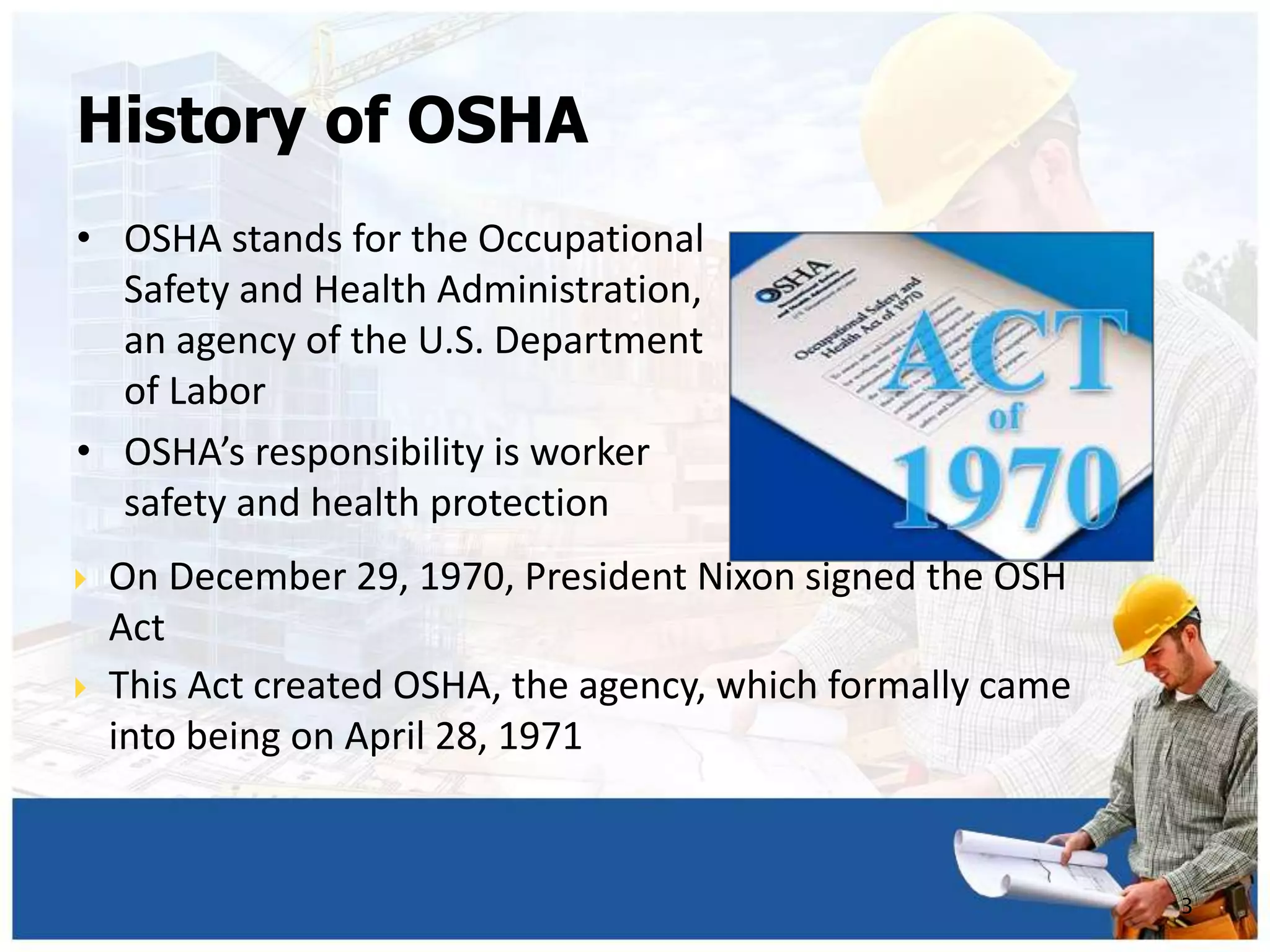
• OSHA stands for the Occupational
Safety and Health Administration,
an agency of the U.S. Department
of Labor
• OSHA’s responsibility is worker
safety and health protection
3
 On December 29, 1970, President Nixon signed the OSH
Act
 This Act created OSHA, the agency, which formally came
into being on April 28, 1971
History of OSHA
• OSHA began because, until 1970, there were no national laws for safety
and health hazards.
• On average, 15 workers die every day from job injuries
• Over 5,600 Americans die from workplace injuries annually
• Over 4 million non-fatal workplace injuries and illnesses are reported
4
Topic 1:
Why is OSHA Important to You?
OSHA’s Mission
• The mission of OSHA is to save lives, prevent injuries and protect the
health of America’s(all people) workers.
• Some of the things OSHA does to carry out its mission are:
– developing job safety and health standards and enforcing them
through worksite inspections,
– maintaining a reporting and recordkeeping system to keep track
of job-related injuries and illnesses, and
– providing training programs to increase knowledge about
occupational safety and health.
5
Topic 2:
What Rights Do You Have Under
OSHA?
• You have the right to:
– A safe and healthful workplace
– Know about hazardous chemicals
– Information about injuries and illnesses in your workplace
– Complain or request hazard correction from employer
– Training
– Hazard exposure and medical records
– File a complaint with OSHA
– Participate in an OSHA inspection
– Be free from retaliation for exercising safety and health rights
6
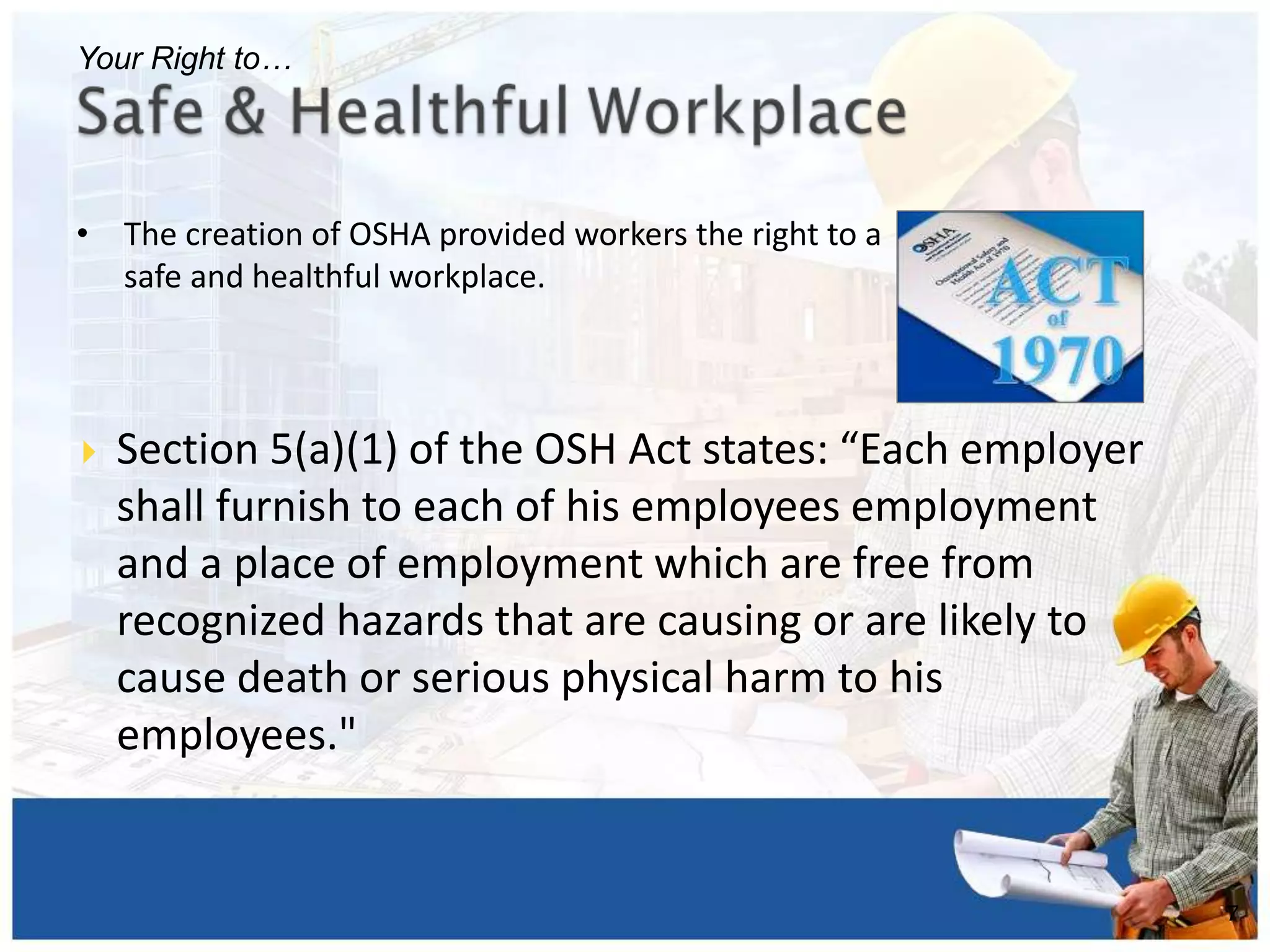
• The creation of OSHA provided workers the right to a
safe and healthful workplace.
7
Your Right to…
 Section 5(a)(1) of the OSH Act states: “Each employer
shall furnish to each of his employees employment
and a place of employment which are free from
recognized hazards that are causing or are likely to
cause death or serious physical harm to his
employees."
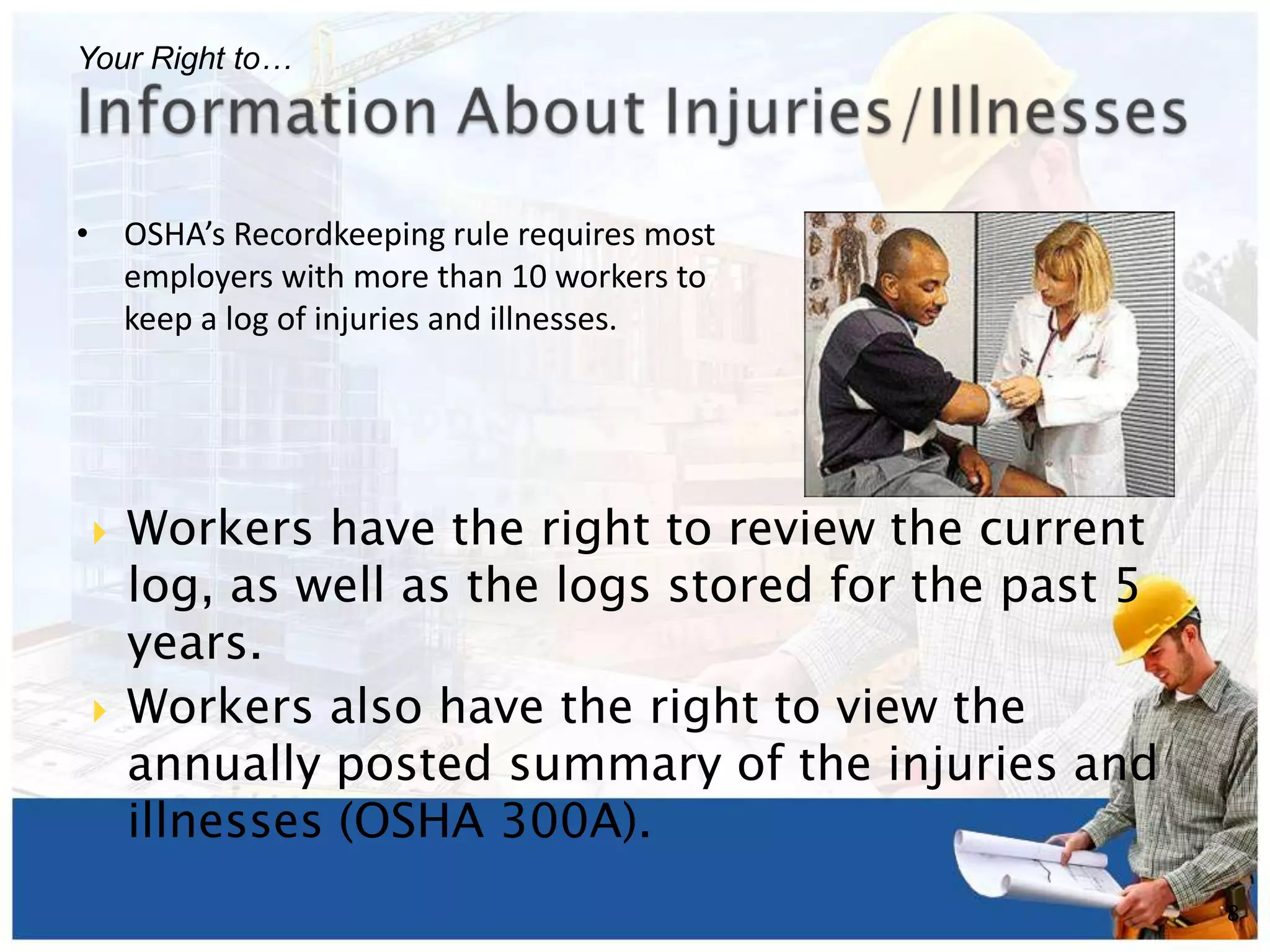
• OSHA’s Recordkeeping rule requires most
employers with more than 10 workers to
keep a log of injuries and illnesses.
8
Your Right to…
 Workers have the right to review the current
log, as well as the logs stored for the past 5
years.
 Workers also have the right to view the
annually posted summary of the injuries and
illnesses (OSHA 300A).
• Workers may bring up safety and health concerns in the workplace to their
employers without fear of discharge or discrimination, as long as the
complaint is made in good faith.
• OSHA regulations [29CFR 1977.9(c)] protect workers who complain to
their employer about unsafe or unhealthful conditions in the workplace.
9
Your Right to…
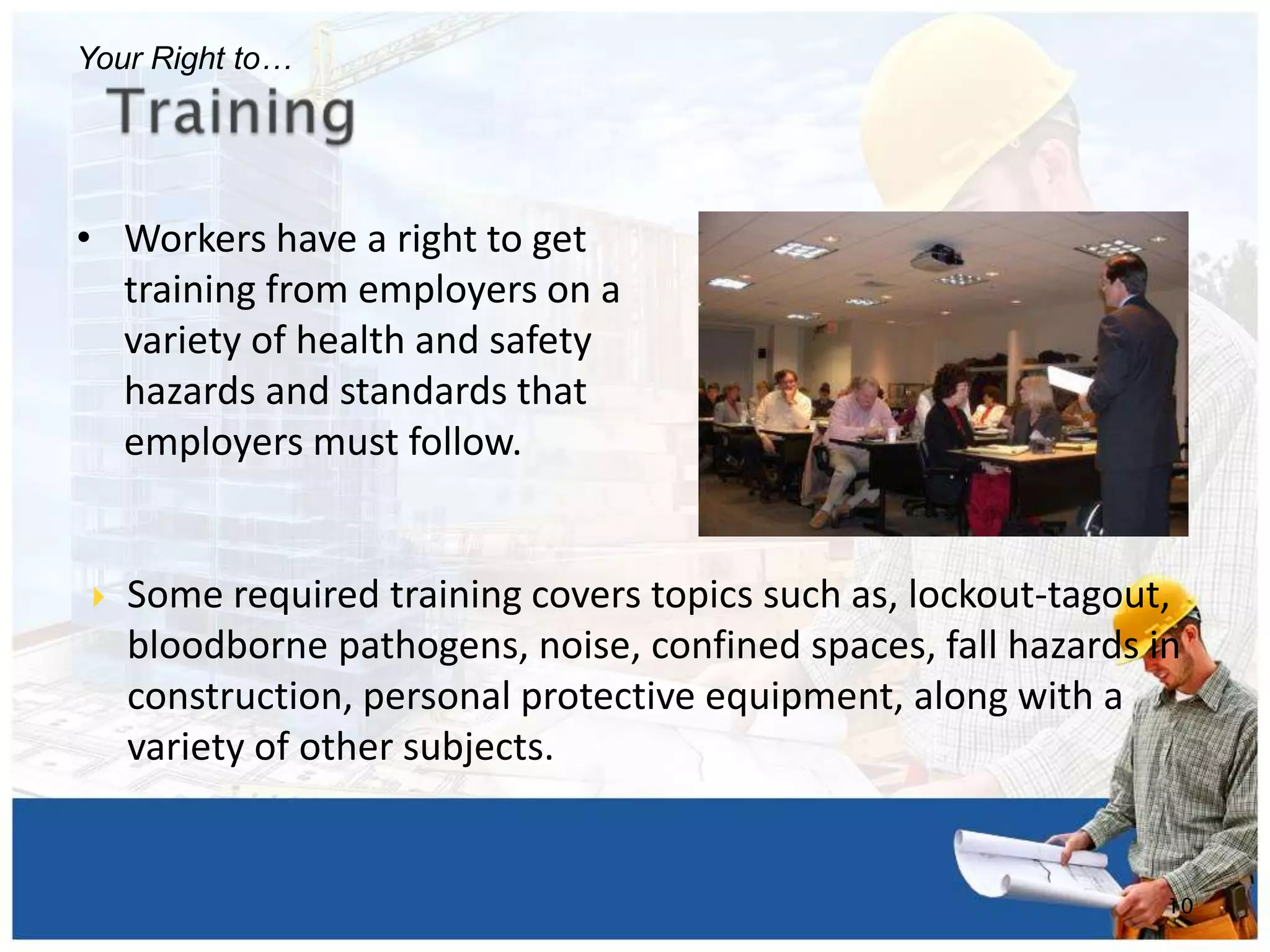
• Workers have a right to get
training from employers on a
variety of health and safety
hazards and standards that
employers must follow.
10
Your Right to…
 Some required training covers topics such as, lockout-tagout,
bloodborne pathogens, noise, confined spaces, fall hazards in
construction, personal protective equipment, along with a
variety of other subjects.
• Employee representative can accompany OSHA inspector
• Workers can talk to the inspector privately.
• Workers may point out hazards, describe injuries, illnesses or near misses
that resulted from those hazards and describe any concern you have
about a safety or health issue.
• Workers can find out about inspection results, abatement measures and
may object to dates set for violation to be corrected.
1
1
Your Right to…
• Workers have the right to be free from retaliation for exercising safety and
health rights.
• Workers have a right to seek safety and health on the job without fear of
punishment.
• This right is spelled out in Section 11(c) of the OSH Act.
• Workers have 30 days to contact OSHA if they feel they have been
punished for exercising their safety and health rights.
1
2
Your Right to…
• Provide a workplace free from recognized hazards and comply with
OSHA standards
• Provide training required by OSHA standards
• Keep records of injuries and illnesses
• Provide medical exams when required by OSHA standards and
provide workers access to their exposure and medical records
• Not discriminate against workers who exercise their rights under
the Act (Section 11(c))
• Post OSHA citations and abatement verification notices
• Provide and pay for PPE
1
3
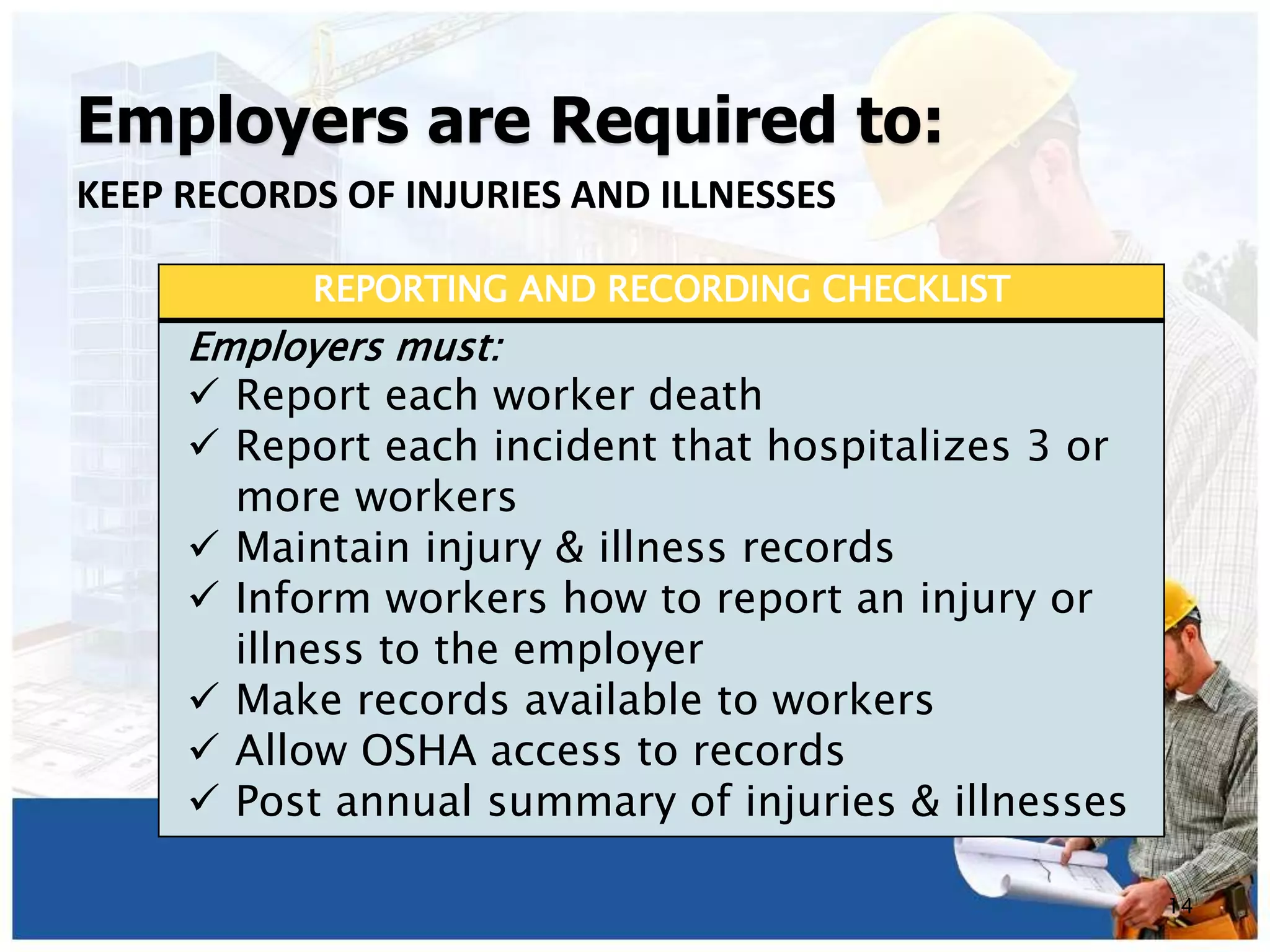
Employers are Required to:
KEEP RECORDS OF INJURIES AND ILLNESSES
14
REPORTING AND RECORDING CHECKLIST
Employers must:
 Report each worker death
 Report each incident that hospitalizes 3 or
more workers
 Maintain injury & illness records
 Inform workers how to report an injury or
illness to the employer
 Make records available to workers
 Allow OSHA access to records
 Post annual summary of injuries & illnesses
Topic 4:
What do the OSHA Standards Say?
• OSHA standards fall into four categories: General Industry, Construction,
Maritime, and Agriculture.
• OSHA issues standards for a wide variety of workplace hazards
• Where there are no specific OSHA standards, employers must comply with
The General Duty Clause, Section 5(a)(1)
15
• The OSH Act authorizes OSHA compliance safety and health officers
(CSHOs) to conduct workplace inspections at reasonable times.
• OSHA conducts inspections without advance notice, except in rare
circumstances (e.g. Imminent Danger)
• In fact, anyone who tells an employer about an OSHA inspection in
advance can receive fines and a jail term.
1
6
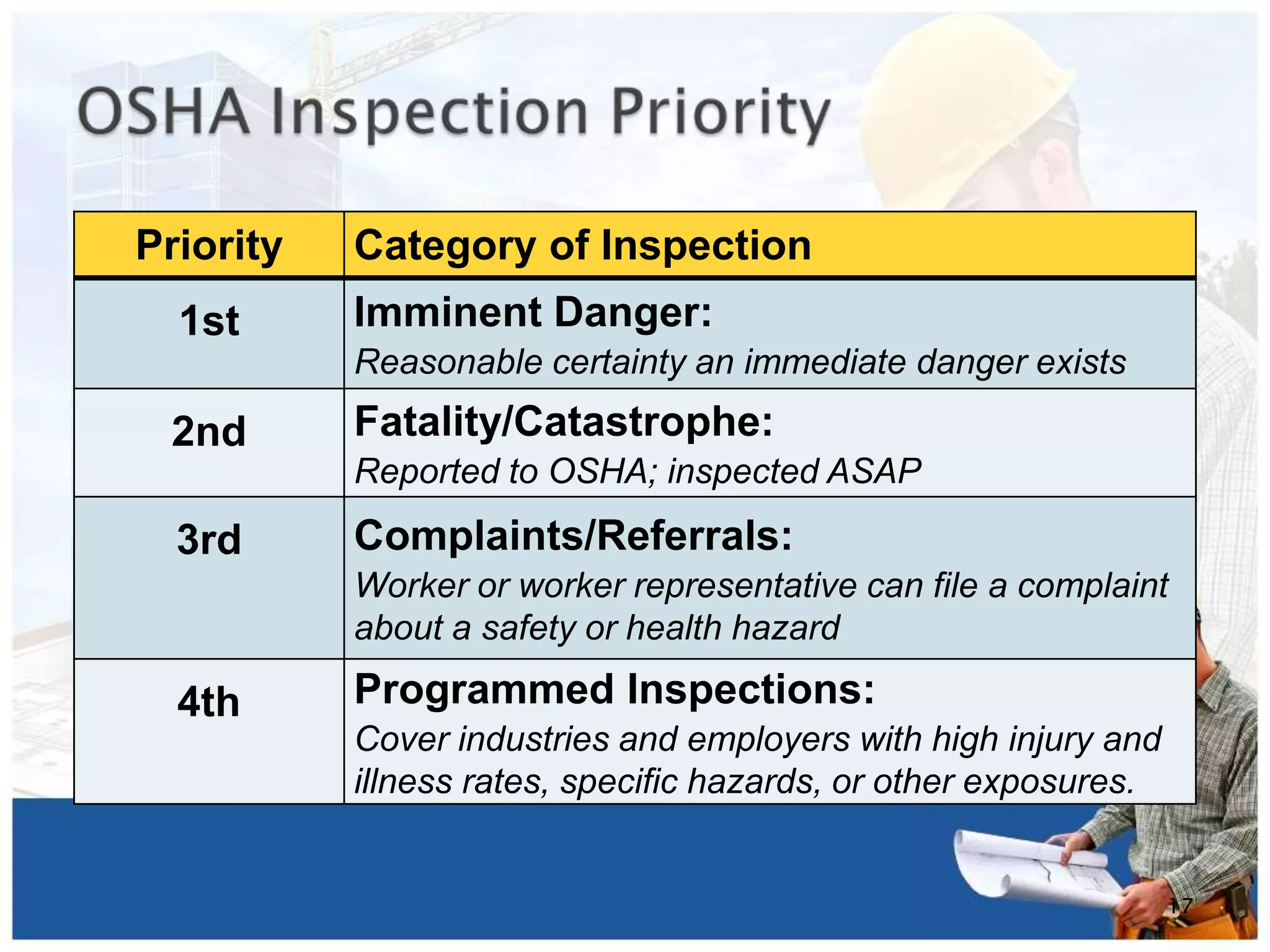
Priority Category of Inspection
1st Imminent Danger:
Reasonable certainty an immediate danger exists
2nd Fatality/Catastrophe:
Reported to OSHA; inspected ASAP
3rd Complaints/Referrals:
Worker or worker representative can file a complaint
about a safety or health hazard
4th Programmed Inspections:
Cover industries and employers with high injury and
illness rates, specific hazards, or other exposures.
17
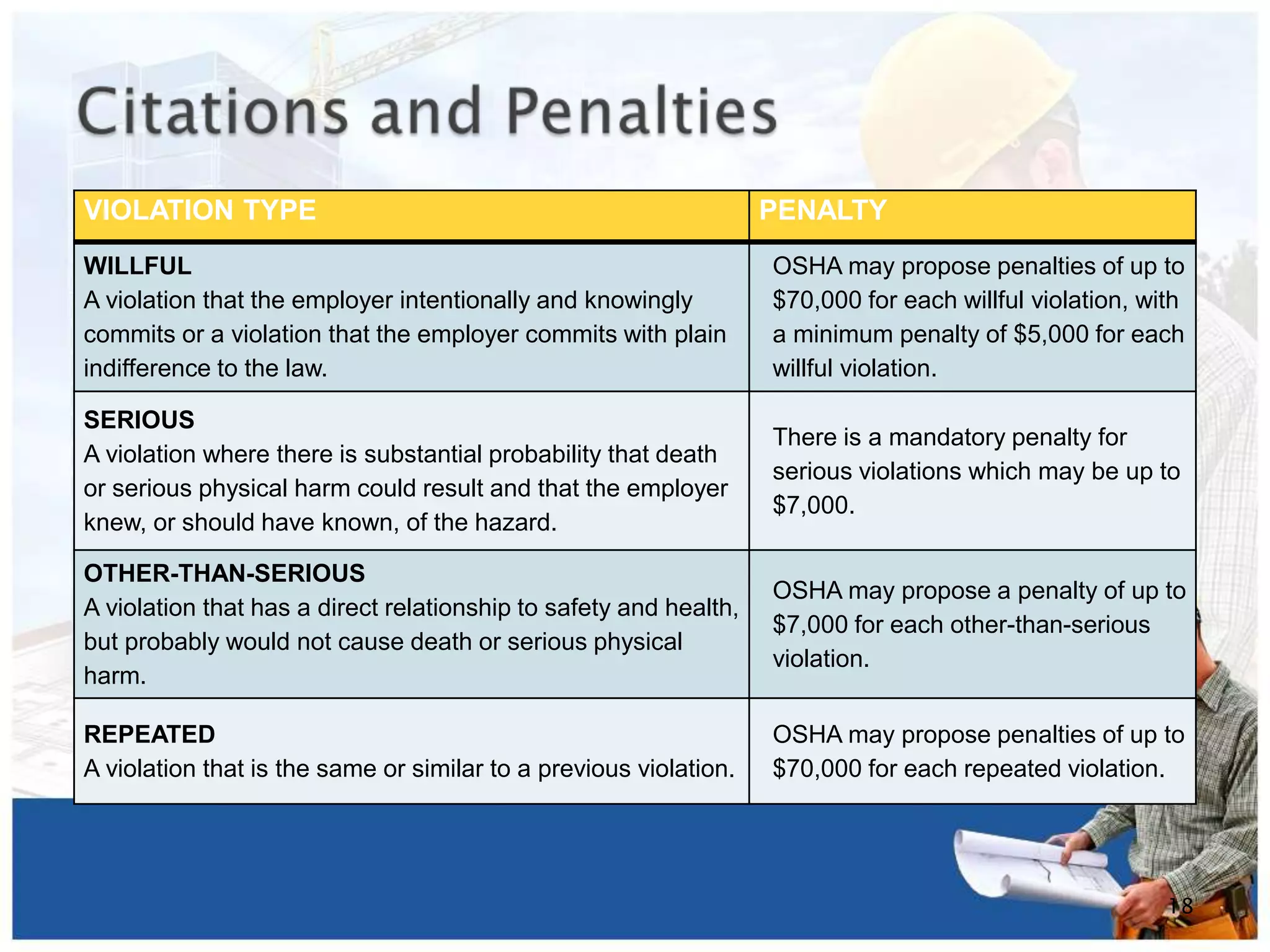
VIOLATION TYPE PENALTY
WILLFUL
A violation that the employer intentionally and knowingly
commits or a violation that the employer commits with plain
indifference to the law.
OSHA may propose penalties of up to
$70,000 for each willful violation, with
a minimum penalty of $5,000 for each
willful violation.
SERIOUS
A violation where there is substantial probability that death
or serious physical harm could result and that the employer
knew, or should have known, of the hazard.
There is a mandatory penalty for
serious violations which may be up to
$7,000.
OTHER-THAN-SERIOUS
A violation that has a direct relationship to safety and health,
but probably would not cause death or serious physical
harm.
OSHA may propose a penalty of up to
$7,000 for each other-than-serious
violation.
REPEATED
A violation that is the same or similar to a previous violation.
OSHA may propose penalties of up to
$70,000 for each repeated violation.
18
• Sources within the workplace/worksite
• Sources outside the workplace/worksite
• How to file an OSHA complaint
1
9
• Employer or supervisor, co-workers and union representatives
• Safety Data Sheet (SDS) for information on chemicals
• Labels and warning signs
• Employee orientation manuals or other training materials
• Work tasks and procedures instruction
2
0
• OSHA website: http://www.osha.gov and OSHA offices (you can call or
write)
• Compliance Assistance Specialists in the area offices
• National Institute for Occupational Safety and Health (NIOSH) – OSHA’s
sister agency
• OSHA Training Institute Education Centers
• Doctors, nurses, other health care providers
• Public libraries
• Other local, community-based resources
2
1
• Download the OSHA complaint form from OSHA’s website
• File the complaint online
– Workers can file a complaint
– A worker representative can file a complaint
• Telephone or visit local regional or area offices to discuss your
concerns
• Complete the form – be specific and include appropriate
details
• OSHA determines if an inspection is necessary
• Workers do not have to reveal their name
2
2

Introduction to OSHA

  • 1.
    Introduction to OSHA Lecturer :Khan M Shinwary Eng.khanm.sh@gmail.com +937884-204-93 1
  • 2.
    Lesson Overview Purpose: • Toprovide workers with introductory information about OSHA Topics: 1. Why is OSHA important to you? 2. What rights do you have under OSHA? 3. What responsibilities does your employer have under OSHA? 4. What do the OSHA standards say? 5. How are OSHA inspections conducted? 6. Where can you go for help? 2
  • 3.
    • OSHA standsfor the Occupational Safety and Health Administration, an agency of the U.S. Department of Labor • OSHA’s responsibility is worker safety and health protection 3  On December 29, 1970, President Nixon signed the OSH Act  This Act created OSHA, the agency, which formally came into being on April 28, 1971 History of OSHA
  • 4.
    • OSHA beganbecause, until 1970, there were no national laws for safety and health hazards. • On average, 15 workers die every day from job injuries • Over 5,600 Americans die from workplace injuries annually • Over 4 million non-fatal workplace injuries and illnesses are reported 4 Topic 1: Why is OSHA Important to You?
  • 5.
    OSHA’s Mission • Themission of OSHA is to save lives, prevent injuries and protect the health of America’s(all people) workers. • Some of the things OSHA does to carry out its mission are: – developing job safety and health standards and enforcing them through worksite inspections, – maintaining a reporting and recordkeeping system to keep track of job-related injuries and illnesses, and – providing training programs to increase knowledge about occupational safety and health. 5
  • 6.
    Topic 2: What RightsDo You Have Under OSHA? • You have the right to: – A safe and healthful workplace – Know about hazardous chemicals – Information about injuries and illnesses in your workplace – Complain or request hazard correction from employer – Training – Hazard exposure and medical records – File a complaint with OSHA – Participate in an OSHA inspection – Be free from retaliation for exercising safety and health rights 6
  • 7.
    • The creationof OSHA provided workers the right to a safe and healthful workplace. 7 Your Right to…  Section 5(a)(1) of the OSH Act states: “Each employer shall furnish to each of his employees employment and a place of employment which are free from recognized hazards that are causing or are likely to cause death or serious physical harm to his employees."
  • 8.
    • OSHA’s Recordkeepingrule requires most employers with more than 10 workers to keep a log of injuries and illnesses. 8 Your Right to…  Workers have the right to review the current log, as well as the logs stored for the past 5 years.  Workers also have the right to view the annually posted summary of the injuries and illnesses (OSHA 300A).
  • 9.
    • Workers maybring up safety and health concerns in the workplace to their employers without fear of discharge or discrimination, as long as the complaint is made in good faith. • OSHA regulations [29CFR 1977.9(c)] protect workers who complain to their employer about unsafe or unhealthful conditions in the workplace. 9 Your Right to…
  • 10.
    • Workers havea right to get training from employers on a variety of health and safety hazards and standards that employers must follow. 10 Your Right to…  Some required training covers topics such as, lockout-tagout, bloodborne pathogens, noise, confined spaces, fall hazards in construction, personal protective equipment, along with a variety of other subjects.
  • 11.
    • Employee representativecan accompany OSHA inspector • Workers can talk to the inspector privately. • Workers may point out hazards, describe injuries, illnesses or near misses that resulted from those hazards and describe any concern you have about a safety or health issue. • Workers can find out about inspection results, abatement measures and may object to dates set for violation to be corrected. 1 1 Your Right to…
  • 12.
    • Workers havethe right to be free from retaliation for exercising safety and health rights. • Workers have a right to seek safety and health on the job without fear of punishment. • This right is spelled out in Section 11(c) of the OSH Act. • Workers have 30 days to contact OSHA if they feel they have been punished for exercising their safety and health rights. 1 2 Your Right to…
  • 13.
    • Provide aworkplace free from recognized hazards and comply with OSHA standards • Provide training required by OSHA standards • Keep records of injuries and illnesses • Provide medical exams when required by OSHA standards and provide workers access to their exposure and medical records • Not discriminate against workers who exercise their rights under the Act (Section 11(c)) • Post OSHA citations and abatement verification notices • Provide and pay for PPE 1 3
  • 14.
    Employers are Requiredto: KEEP RECORDS OF INJURIES AND ILLNESSES 14 REPORTING AND RECORDING CHECKLIST Employers must:  Report each worker death  Report each incident that hospitalizes 3 or more workers  Maintain injury & illness records  Inform workers how to report an injury or illness to the employer  Make records available to workers  Allow OSHA access to records  Post annual summary of injuries & illnesses
  • 15.
    Topic 4: What dothe OSHA Standards Say? • OSHA standards fall into four categories: General Industry, Construction, Maritime, and Agriculture. • OSHA issues standards for a wide variety of workplace hazards • Where there are no specific OSHA standards, employers must comply with The General Duty Clause, Section 5(a)(1) 15
  • 16.
    • The OSHAct authorizes OSHA compliance safety and health officers (CSHOs) to conduct workplace inspections at reasonable times. • OSHA conducts inspections without advance notice, except in rare circumstances (e.g. Imminent Danger) • In fact, anyone who tells an employer about an OSHA inspection in advance can receive fines and a jail term. 1 6
  • 17.
    Priority Category ofInspection 1st Imminent Danger: Reasonable certainty an immediate danger exists 2nd Fatality/Catastrophe: Reported to OSHA; inspected ASAP 3rd Complaints/Referrals: Worker or worker representative can file a complaint about a safety or health hazard 4th Programmed Inspections: Cover industries and employers with high injury and illness rates, specific hazards, or other exposures. 17
  • 18.
    VIOLATION TYPE PENALTY WILLFUL Aviolation that the employer intentionally and knowingly commits or a violation that the employer commits with plain indifference to the law. OSHA may propose penalties of up to $70,000 for each willful violation, with a minimum penalty of $5,000 for each willful violation. SERIOUS A violation where there is substantial probability that death or serious physical harm could result and that the employer knew, or should have known, of the hazard. There is a mandatory penalty for serious violations which may be up to $7,000. OTHER-THAN-SERIOUS A violation that has a direct relationship to safety and health, but probably would not cause death or serious physical harm. OSHA may propose a penalty of up to $7,000 for each other-than-serious violation. REPEATED A violation that is the same or similar to a previous violation. OSHA may propose penalties of up to $70,000 for each repeated violation. 18
  • 19.
    • Sources withinthe workplace/worksite • Sources outside the workplace/worksite • How to file an OSHA complaint 1 9
  • 20.
    • Employer orsupervisor, co-workers and union representatives • Safety Data Sheet (SDS) for information on chemicals • Labels and warning signs • Employee orientation manuals or other training materials • Work tasks and procedures instruction 2 0
  • 21.
    • OSHA website:http://www.osha.gov and OSHA offices (you can call or write) • Compliance Assistance Specialists in the area offices • National Institute for Occupational Safety and Health (NIOSH) – OSHA’s sister agency • OSHA Training Institute Education Centers • Doctors, nurses, other health care providers • Public libraries • Other local, community-based resources 2 1
  • 22.
    • Download theOSHA complaint form from OSHA’s website • File the complaint online – Workers can file a complaint – A worker representative can file a complaint • Telephone or visit local regional or area offices to discuss your concerns • Complete the form – be specific and include appropriate details • OSHA determines if an inspection is necessary • Workers do not have to reveal their name 2 2