14/06/2015
1
6/14/20151
412 PHYS
Lasers and their Applications
Department of Physics
Faculty of Science
Jazan University
KSA
Lecture-5
Laser Beam characteristics
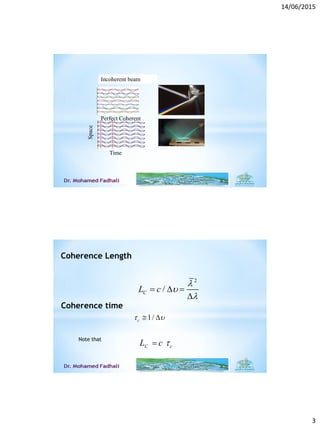
• Monochromaticity
• High directionality
• Coherence
• Low divergence
• Brightness or radiance
• Focusing characteristics
• Pulsed and CW operation
• Available high power operations
• Tunability
• Ultra-short duration pulse
Laser Beam Characteristics
14/06/2015
2
0 /D   
• Monochromaticity
0  Monochromaticity
0 Central
frequency
Single wavelength
Coherence is a measure of the correlation between the phases measured at
different (temporal and spatial) points on a wave
Coherence theory is a study of the correlation properties of random light
which is also known as the statistical optics
Coherence
14/06/2015
3
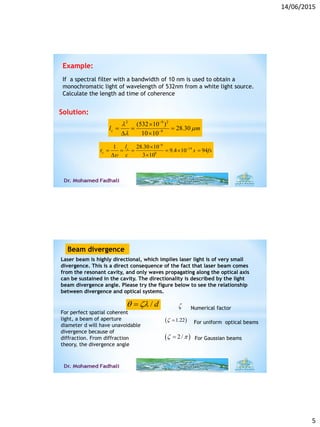
Monochromatic & Coherence:
Incoherent beam
Time
Space
Perfect Coherent
2
/CL c



  

Coherence Length
1/c  
Coherence time
Note that
C cL c 
14/06/2015
4
14/06/2015
5
Example:
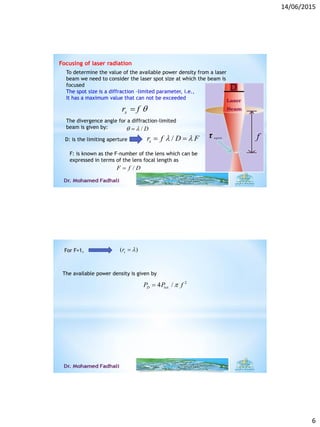
If a spectral filter with a bandwidth of 10 nm is used to obtain a
monochromatic light of wavelength of 532nm from a white light source.
Calculate the length ad time of coherence
2 9 2
9
(532 10 )
28.30
10 10
cl m






  
 
Solution:
6
14
8
1 28.30 10
9.4 10 94
3 10
c
c
l
s fs
c




     
 
Beam divergence
Laser beam is highly directional, which implies laser light is of very small
divergence. This is a direct consequence of the fact that laser beam comes
from the resonant cavity, and only waves propagating along the optical axis
can be sustained in the cavity. The directionality is described by the light
beam divergence angle. Please try the figure below to see the relationship
between divergence and optical systems.
/ d   Numerical factor
 1.22  For uniform optical beams
 2/  For Gaussian beams
For perfect spatial coherent
light, a beam of aperture
diameter d will have unavoidable
divergence because of
diffraction. From diffraction
theory, the divergence angle
14/06/2015
6
Focusing of laser radiation
To determine the value of the available power density from a laser
beam we need to consider the laser spot size at which the beam is
focused
The spot size is a diffraction –limited parameter, i.e.,
It has a maximum value that can not be exceeded
sr f 
The divergence angle for a diffraction-limited
beam is given by: / D 
D: is the limiting aperture /sr f D F  
F: is known as the F-number of the lens which can be
expressed in terms of the lens focal length as
/F f D
For F=1, ( )sr 
The available power density is given by
2
.4 /D totP P f
14/06/2015
7
Beam expander for low divergence beam
ffii dd  
In terms of focal length
12i fd f f
Example
A He-Ne Laser with a wavelength of 633nm. Its beam radius measured at 2
1/ e
From maximum intensity is 50 m, what will be its value at waist?
Solution
0/ ( )d w  The divergence angle is given by
sin( / 2) tan( / 2) / 2  
3 9
4 4
0
0
50 10 633 10
/ 2 2.5 10 5 10
200 3.14
0.04
d
w
w mm
 
 
  
      
 
14/06/2015
8
Example
A beam from a He-Ne laser with a diameter of 1.5 mm and a divergence of
1mrad. If a beam expander system consists of two convex lenses of focal
lengths of 1 cm and 5 cm is used. Find the diameter and divergence of the
resulted beam
Solution
31 1 2 2
2 1
2 2 1 1
1.5 5 7.5 10
f d f
d d mm
f d f



       
3
2 1 21/ 1 10 / 5 0.167f f mrad  
   
Depth of focus
This a very important property of the laser beam
It is defined as the distance from waist point at which the intensity
decreases from its maximum by 5% at both sides
It is usually defined as the double of the Rayleigh range
2
0
0
2
2f
w
D z


 
And in terms of the lens F-number
2
2 s
f
r
D F   
2w0
DOF
rs
f
14/06/2015
9
Example:
Find the intensity and depth of focus for an Ar laser beam with a
power of 1W and divergence of 0.5mrad if the beam is collimated
by a convex lend of a focal length of 5 cm?
solution
3 3
5 (0.5 10 ) 2.5 10s sr f r cm  
      
2 3 2 6 2
(2.5 10 ) 20 10sA r cm   
    
Spot size
Spot area
4 2 8 2
6
1
5 10 [ / ] 5 10 [ / ]
20 10
P
I W cm W m
A 
     
The intensity
2 3 2 2
7
(2.5 10 )
0.099 1
633 10
s
f
r cm
D cm mm
cm



   

The depth of focus
The brightness of a light source is defined as the power emitted per unit
surface area per unit solid angle.
Brightness
cos( )
P
B
ds d


Spectral brightness
cos( )
P
B
ds d

 

 
14/06/2015
10
Example
Compare an ordinary light source of a wavelength of 546nm and
brightness 2
95( / )W cm sr
With a diffraction – limited Argon laser beam of a wavelength of 514.5nm
and a power of 1W
Solution 1.2 /d D   For a diffraction-limited beam
2 2 2
4
( / 2) (1.2 )
P P P
B
dS d D   
  

For Ar laser 12 2
9 2
4(1)
1.531 10 / ( )
(1.2 3.14 514.5 10 )
ArB W m sr
  
  
8
61.531 10
1.611 10
95
Ratio

 

Laser lecture 05

  • 1.
    14/06/2015 1 6/14/20151 412 PHYS Lasers andtheir Applications Department of Physics Faculty of Science Jazan University KSA Lecture-5 Laser Beam characteristics • Monochromaticity • High directionality • Coherence • Low divergence • Brightness or radiance • Focusing characteristics • Pulsed and CW operation • Available high power operations • Tunability • Ultra-short duration pulse Laser Beam Characteristics
  • 2.
    14/06/2015 2 0 /D   • Monochromaticity 0  Monochromaticity 0 Central frequency Single wavelength Coherence is a measure of the correlation between the phases measured at different (temporal and spatial) points on a wave Coherence theory is a study of the correlation properties of random light which is also known as the statistical optics Coherence
  • 3.
    14/06/2015 3 Monochromatic & Coherence: Incoherentbeam Time Space Perfect Coherent 2 /CL c        Coherence Length 1/c   Coherence time Note that C cL c 
  • 4.
  • 5.
    14/06/2015 5 Example: If a spectralfilter with a bandwidth of 10 nm is used to obtain a monochromatic light of wavelength of 532nm from a white light source. Calculate the length ad time of coherence 2 9 2 9 (532 10 ) 28.30 10 10 cl m            Solution: 6 14 8 1 28.30 10 9.4 10 94 3 10 c c l s fs c             Beam divergence Laser beam is highly directional, which implies laser light is of very small divergence. This is a direct consequence of the fact that laser beam comes from the resonant cavity, and only waves propagating along the optical axis can be sustained in the cavity. The directionality is described by the light beam divergence angle. Please try the figure below to see the relationship between divergence and optical systems. / d   Numerical factor  1.22  For uniform optical beams  2/  For Gaussian beams For perfect spatial coherent light, a beam of aperture diameter d will have unavoidable divergence because of diffraction. From diffraction theory, the divergence angle
  • 6.
    14/06/2015 6 Focusing of laserradiation To determine the value of the available power density from a laser beam we need to consider the laser spot size at which the beam is focused The spot size is a diffraction –limited parameter, i.e., It has a maximum value that can not be exceeded sr f  The divergence angle for a diffraction-limited beam is given by: / D  D: is the limiting aperture /sr f D F   F: is known as the F-number of the lens which can be expressed in terms of the lens focal length as /F f D For F=1, ( )sr  The available power density is given by 2 .4 /D totP P f
  • 7.
    14/06/2015 7 Beam expander forlow divergence beam ffii dd   In terms of focal length 12i fd f f Example A He-Ne Laser with a wavelength of 633nm. Its beam radius measured at 2 1/ e From maximum intensity is 50 m, what will be its value at waist? Solution 0/ ( )d w  The divergence angle is given by sin( / 2) tan( / 2) / 2   3 9 4 4 0 0 50 10 633 10 / 2 2.5 10 5 10 200 3.14 0.04 d w w mm                
  • 8.
    14/06/2015 8 Example A beam froma He-Ne laser with a diameter of 1.5 mm and a divergence of 1mrad. If a beam expander system consists of two convex lenses of focal lengths of 1 cm and 5 cm is used. Find the diameter and divergence of the resulted beam Solution 31 1 2 2 2 1 2 2 1 1 1.5 5 7.5 10 f d f d d mm f d f            3 2 1 21/ 1 10 / 5 0.167f f mrad       Depth of focus This a very important property of the laser beam It is defined as the distance from waist point at which the intensity decreases from its maximum by 5% at both sides It is usually defined as the double of the Rayleigh range 2 0 0 2 2f w D z     And in terms of the lens F-number 2 2 s f r D F    2w0 DOF rs f
  • 9.
    14/06/2015 9 Example: Find the intensityand depth of focus for an Ar laser beam with a power of 1W and divergence of 0.5mrad if the beam is collimated by a convex lend of a focal length of 5 cm? solution 3 3 5 (0.5 10 ) 2.5 10s sr f r cm          2 3 2 6 2 (2.5 10 ) 20 10sA r cm         Spot size Spot area 4 2 8 2 6 1 5 10 [ / ] 5 10 [ / ] 20 10 P I W cm W m A        The intensity 2 3 2 2 7 (2.5 10 ) 0.099 1 633 10 s f r cm D cm mm cm         The depth of focus The brightness of a light source is defined as the power emitted per unit surface area per unit solid angle. Brightness cos( ) P B ds d   Spectral brightness cos( ) P B ds d      
  • 10.
    14/06/2015 10 Example Compare an ordinarylight source of a wavelength of 546nm and brightness 2 95( / )W cm sr With a diffraction – limited Argon laser beam of a wavelength of 514.5nm and a power of 1W Solution 1.2 /d D   For a diffraction-limited beam 2 2 2 4 ( / 2) (1.2 ) P P P B dS d D        For Ar laser 12 2 9 2 4(1) 1.531 10 / ( ) (1.2 3.14 514.5 10 ) ArB W m sr       8 61.531 10 1.611 10 95 Ratio   