Public health policy, evidence, and causationLessons from the studies on obesityFederica RussoPhilosophy, Kent
Prologue2
Causality Across the Levels:Biomedical Mechanisms and Public Health PoliciesA British Academy funded project at KentGenuine distinction between generic and single-caseYet, poorly understood, crucial questions remainDifferent notions at different levels?How to draw inferences from one level to another?How socio-economic variables affect health variables (and vice-versa)?…3
Food for thoughtStudies on obesity provide a diversifiedand balanced philosophical dietMulti-levelMechanismEvidenceAction…4
The fat generation5
FactsIn more and more Member States of EUMore than 20% adult population is obeseMore than 50% adult population is overweightUp to 20% of children are overweightCheck out stats:http://www.hopeproject.eu/index.php?nav_id=1http://www.ic.nhs.uk/statistics-and-data-collections/health-and-lifestyles/obesity/statistics-on-obesity-physical-activity-and-diet-england-2010http://www.who.int/mediacentre/factsheets/fs311/en/index.html…6
Causes and effectsWhat are the causes of obesity?What are the causes of the increased prevalence of obesity?Health effects: cardiovascular diseases, cancer, diabetes …Socio-economic effects: standard seat width increased, office furniture, average passengers weight implications for fuel used by airlines, equipment in hospitals ..7
Something must be donePublic health actionsWorksite health promotion programmesSchool-based interventionsInformation on healthy eating …What should we base public health actions upon?8
A plea for causally-based public health9
OverviewTake-home messagePublic health actions need 3 types of evidence, having each a different role in informing actionsA 3-step argumentPublic health and epidemiology. A population-level perspective on disease causationEvidence-based public health.Evidence assessment isn’t enoughCausally-based public health.Causal assessment has 3 evidential components: difference-making, levels, mechanisms10
Public health and epidemiology11
Public-health is population-levelPH aims to:Preventing diseaseProlonging lifePromoting healthActions to reach those aims are based on population-level analysesEpidemiology is essential for public health12
Epidemiology and disease causationEpidemiology studies how the distributions of diseaseand their biological and socio-economic determinantsvary within and across different populations.Descriptive epidemiologyWho, what, when, where.Focus on risks of exposure.Analytic epidemiologyHow and why.Focus on measures of associations to identify causes of disease,reinforce causal hypotheses with mechanistic explanations13
Two goals of epidemiology, arguably(1) To understand and learn about disease and(2) To take action in order to reduce the burden of disease at the population levelDrawing causal conclusions from evidenceQuestions about what evidencefor disease causation are upfrontDifference-Making & LevelsMechanisms[See also Russo & Williamson (2007 and 2011)]14
evidence-based public health15
(2) Taking action to reduce the burden of diseaseEvidence-based public health is defined as the development, implementation, and evaluation of effective programs and policies in public health through application of principles of scientific reasoning, including systematic uses of data and information systems, and appropriate use of behavioral science theory and program.(Brownson et al., 2003)Evidence-based public health is the process involved in providing the best available evidence to influence decisions about the effectiveness of policies and interventions and secure improvements in health and reductions in health inequalities.Killoranand Kelly (2010, p. xxii)16
Evidence galoreEBPH inherits from epidemiologycrucial questions about evidenceEvidence on focusEvidence on which one’s practice or policy is basedSoundness of evidenceStrength of inference permitted by evidence…Whence the importance of evidence-assessmentto assess the best evidence17
But what evidence serveswhat purpose?
Causally-based public health19
The underlying intuitionArguably, making good decisions and taking good actionsdependon having a good understanding of the phenomenon or situation.In public health policy, the better our understandingof the disease, the better too the interventionsto reduce the burden of disease.Thus, if we accept the idea that understanding disease causationinvolves making considerations about different types of evidence,then those different types of evidencewill also serve different roles in setting public health policies.20
A key feature of EBPH:Conceptual plausibility“An understanding of causal pathways defining the factors influencing health and the potential for intervention; use of different types of evidence to determine what works for whom in what circumstances.”										(Killoran & Kelly 2010)What evidence gives us such information?21
What works for whomin what circumstances22
Difference-making evidenceCorrelations, probabilistic and counterfactual dependencies, etc.This is typically provided by descriptive epidemiologyInforms about who, what, when, where.23
Evidence about the levels‘Vertical’ levelWhether interventions have to targetthe whole population, or only subgroupsor individuals that fall under certain categories;‘Horizontal’ levelWhether it is most efficient to intervene onthe social or biological factors of disease(or on both simultaneously)[See also Russo (2009) and (2010)]24
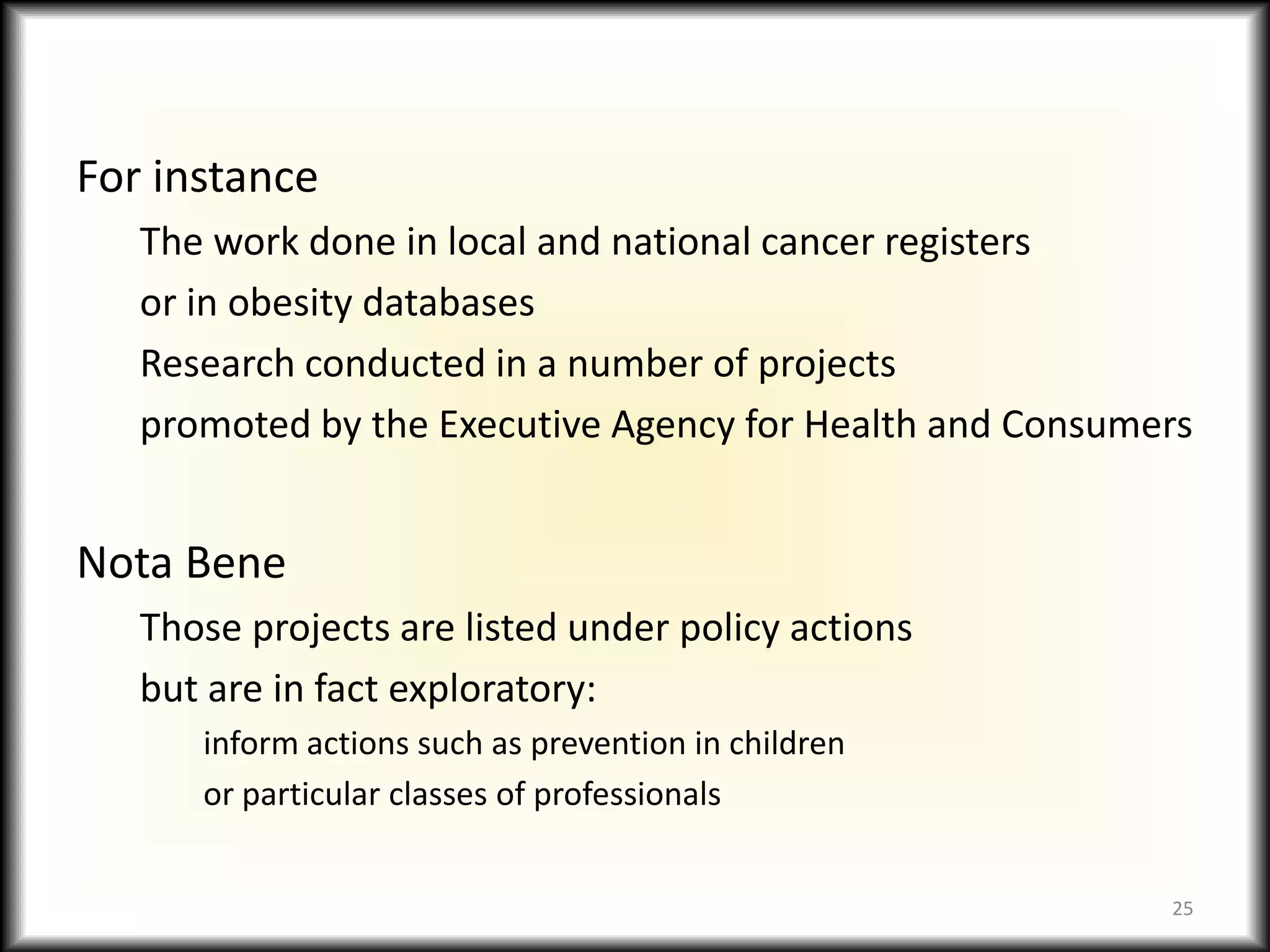
For instanceThe work done in local and national cancer registersor in obesity databasesResearch conducted in a number of projectspromoted by the Executive Agency for Health and ConsumersNota BeneThose projects are listed under policy actions but are in fact exploratory:inform actions such as prevention in childrenor particular classes of professionals25
Causal pathways26
Mechanistic evidenceStudies to test epidemiological hypotheses coming from descriptive epidemiologyAnalytic epidemiologyTests explanatory causal hypothesesThat is, mechanistic hypotheses Answer questions about how and why27
For instanceStudies on type 2 diabetes andon mechanisms regulating insulineresistanceendocrine deregulation syndromesStudies on changes in dietary habits due tochanges in socio-economic environments…Motivation:descriptive studies that discovered neat correlationsand identified high risks28
Mechanisms and LevelsMechanistic evidence is concernedabout the levels of causation tooAverage mechanisms vs single-case mechanismsNo ‘conceptual’ priority ofone type of evidence over the otherTrue, different types of evidence may haveunequal weights in assessingdifferent hypotheses of disease causation29
To sum up and conclude30
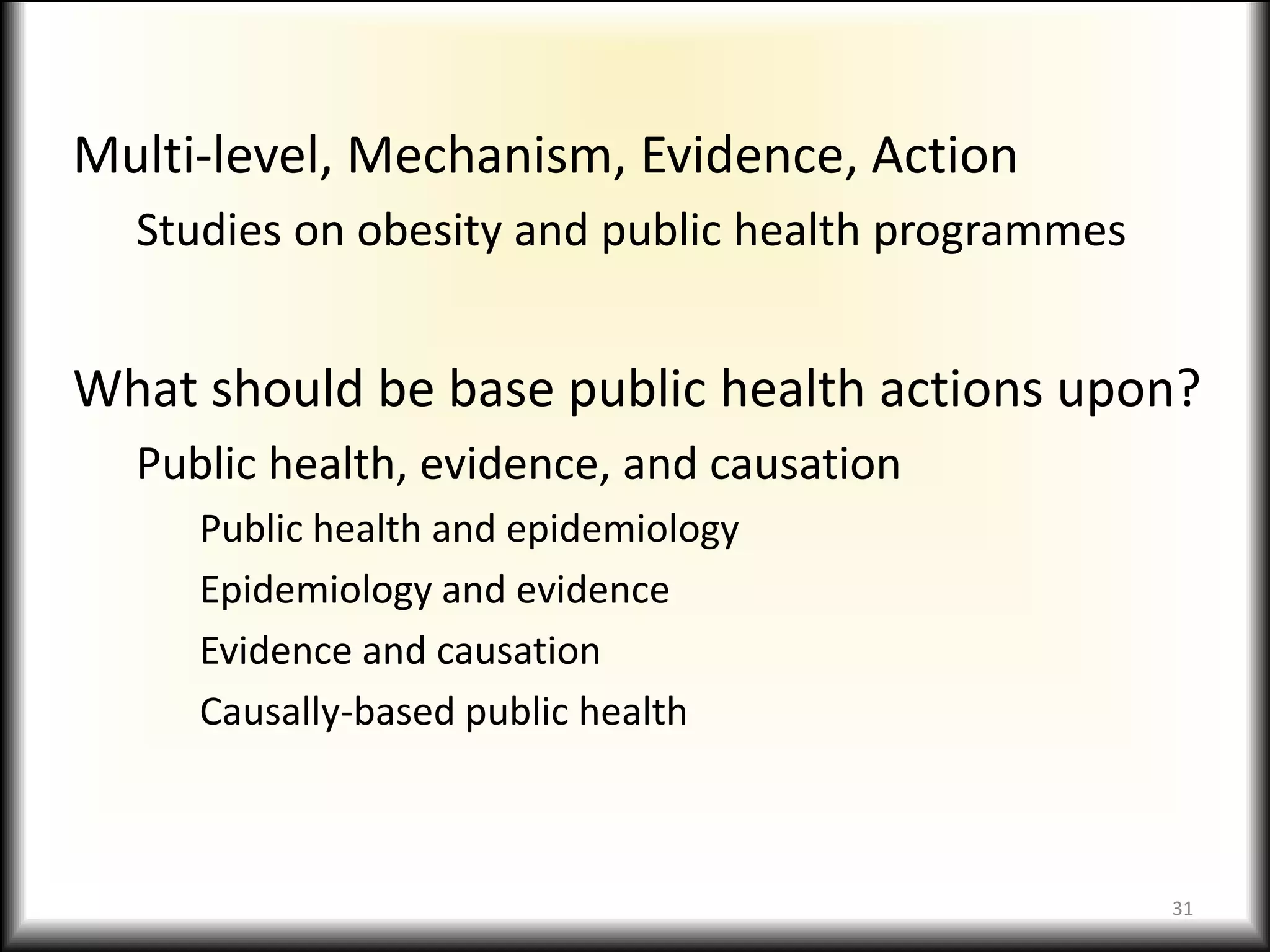
Multi-level, Mechanism, Evidence, ActionStudies on obesity and public health programmesWhat should be base public health actions upon?Public health, evidence, and causationPublic health and epidemiologyEpidemiology and evidenceEvidence and causationCausally-based public health31
Selected bibliographyBrownson, R. C., andT. L. Leet, E. A. B., and Gillespie, K. N. (2003). Evidence-Based Public Health. Oxford University Press, New York.Cartwright, N. (2008). Evidence for evidenced-based policy. Talk at a Home Office Seminar on Criminology and Evidence-Based Policy.Cartwright, N. (2009). Causality, invariance, and policy. In Kincaid, H. and Ross, D., editors, The Oxford Handbook of Philosophy of Economics, chapter 15, pages 410{421. Oxford University Press.Glasziou, P., Chalmers, I., Rawlins, M., and McCulloch, P. (2007). When are randomised trials unnecessary? Picking signal from noise. British Medical Journal, 334:349-351.Greener, J., Douglas, F., and van Teijlingen, E. (2010). More of the same? Conflicting perspectives of obesity causation and intervention amongst overweight people, health professionals and policy makers. Social Science & Medicine, 70:1042-1049.Guyatt, G. and Drummond, R. (2002). Users Guides to the Medical Literature: A Manual for Evidence-Based Practice. American Medical Association, Chicago.Killoran, A. and Kelly, M. P., editors (2010). Evidence-based public health. Effectiveness and efficiency. Oxford University Press, New York.Philipson, T. and Posner, R. (2008). Is the obesity epidemic a public health problem? A decade of research on the economics of obesity. Technical Report Working paper 14010, The National Bureau of Economic Research.Power, M. and Schulkin, J. (2009). The evolution of obesity. The John Hopkins University Press, Baltimore.Riboli, E. and Lambert, R., editors (2002). Nutrition and lifestyle: opportunities for cancer prevention. Number 156. IARC Scientic publications.Russo, F. (2009). Variational causal claims in epidemiology. Perspectives in Biology and Medicine, 52(4):540-554.Russo, F. (2010). Causal webs in epidemiology. Paradigmi.Russo, F. and Williamson, J. (2007). Interpreting causality in the health sciences. International Studies in Philosophy of Science, 21(2):157-170.Russo, F. and Williamson, J. (2011). Generic vs. single-case causal knowledge. The case of autopsy. European Journal for Philosophy of Science.Rychetnik, L., Hawe, P., Waters, E., Barratt, A., and Frommer, M. (2004). A glossary for evidence based public health. Journal of Epidemiology and Community Health, 58:538-545.32

Russo Obesity Presentation Paris

  • 1.
    Public health policy,evidence, and causationLessons from the studies on obesityFederica RussoPhilosophy, Kent
  • 2.
  • 3.
    Causality Across theLevels:Biomedical Mechanisms and Public Health PoliciesA British Academy funded project at KentGenuine distinction between generic and single-caseYet, poorly understood, crucial questions remainDifferent notions at different levels?How to draw inferences from one level to another?How socio-economic variables affect health variables (and vice-versa)?…3
  • 4.
    Food for thoughtStudieson obesity provide a diversifiedand balanced philosophical dietMulti-levelMechanismEvidenceAction…4
  • 5.
  • 6.
    FactsIn more andmore Member States of EUMore than 20% adult population is obeseMore than 50% adult population is overweightUp to 20% of children are overweightCheck out stats:http://www.hopeproject.eu/index.php?nav_id=1http://www.ic.nhs.uk/statistics-and-data-collections/health-and-lifestyles/obesity/statistics-on-obesity-physical-activity-and-diet-england-2010http://www.who.int/mediacentre/factsheets/fs311/en/index.html…6
  • 7.
    Causes and effectsWhatare the causes of obesity?What are the causes of the increased prevalence of obesity?Health effects: cardiovascular diseases, cancer, diabetes …Socio-economic effects: standard seat width increased, office furniture, average passengers weight implications for fuel used by airlines, equipment in hospitals ..7
  • 8.
    Something must bedonePublic health actionsWorksite health promotion programmesSchool-based interventionsInformation on healthy eating …What should we base public health actions upon?8
  • 9.
    A plea forcausally-based public health9
  • 10.
    OverviewTake-home messagePublic healthactions need 3 types of evidence, having each a different role in informing actionsA 3-step argumentPublic health and epidemiology. A population-level perspective on disease causationEvidence-based public health.Evidence assessment isn’t enoughCausally-based public health.Causal assessment has 3 evidential components: difference-making, levels, mechanisms10
  • 11.
    Public health andepidemiology11
  • 12.
    Public-health is population-levelPHaims to:Preventing diseaseProlonging lifePromoting healthActions to reach those aims are based on population-level analysesEpidemiology is essential for public health12
  • 13.
    Epidemiology and diseasecausationEpidemiology studies how the distributions of diseaseand their biological and socio-economic determinantsvary within and across different populations.Descriptive epidemiologyWho, what, when, where.Focus on risks of exposure.Analytic epidemiologyHow and why.Focus on measures of associations to identify causes of disease,reinforce causal hypotheses with mechanistic explanations13
  • 14.
    Two goals ofepidemiology, arguably(1) To understand and learn about disease and(2) To take action in order to reduce the burden of disease at the population levelDrawing causal conclusions from evidenceQuestions about what evidencefor disease causation are upfrontDifference-Making & LevelsMechanisms[See also Russo & Williamson (2007 and 2011)]14
  • 15.
  • 16.
    (2) Taking actionto reduce the burden of diseaseEvidence-based public health is defined as the development, implementation, and evaluation of effective programs and policies in public health through application of principles of scientific reasoning, including systematic uses of data and information systems, and appropriate use of behavioral science theory and program.(Brownson et al., 2003)Evidence-based public health is the process involved in providing the best available evidence to influence decisions about the effectiveness of policies and interventions and secure improvements in health and reductions in health inequalities.Killoranand Kelly (2010, p. xxii)16
  • 17.
    Evidence galoreEBPH inheritsfrom epidemiologycrucial questions about evidenceEvidence on focusEvidence on which one’s practice or policy is basedSoundness of evidenceStrength of inference permitted by evidence…Whence the importance of evidence-assessmentto assess the best evidence17
  • 18.
    But what evidenceserveswhat purpose?
  • 19.
  • 20.
    The underlying intuitionArguably,making good decisions and taking good actionsdependon having a good understanding of the phenomenon or situation.In public health policy, the better our understandingof the disease, the better too the interventionsto reduce the burden of disease.Thus, if we accept the idea that understanding disease causationinvolves making considerations about different types of evidence,then those different types of evidencewill also serve different roles in setting public health policies.20
  • 21.
    A key featureof EBPH:Conceptual plausibility“An understanding of causal pathways defining the factors influencing health and the potential for intervention; use of different types of evidence to determine what works for whom in what circumstances.” (Killoran & Kelly 2010)What evidence gives us such information?21
  • 22.
    What works forwhomin what circumstances22
  • 23.
    Difference-making evidenceCorrelations, probabilisticand counterfactual dependencies, etc.This is typically provided by descriptive epidemiologyInforms about who, what, when, where.23
  • 24.
    Evidence about thelevels‘Vertical’ levelWhether interventions have to targetthe whole population, or only subgroupsor individuals that fall under certain categories;‘Horizontal’ levelWhether it is most efficient to intervene onthe social or biological factors of disease(or on both simultaneously)[See also Russo (2009) and (2010)]24
  • 25.
    For instanceThe workdone in local and national cancer registersor in obesity databasesResearch conducted in a number of projectspromoted by the Executive Agency for Health and ConsumersNota BeneThose projects are listed under policy actions but are in fact exploratory:inform actions such as prevention in childrenor particular classes of professionals25
  • 26.
  • 27.
    Mechanistic evidenceStudies totest epidemiological hypotheses coming from descriptive epidemiologyAnalytic epidemiologyTests explanatory causal hypothesesThat is, mechanistic hypotheses Answer questions about how and why27
  • 28.
    For instanceStudies ontype 2 diabetes andon mechanisms regulating insulineresistanceendocrine deregulation syndromesStudies on changes in dietary habits due tochanges in socio-economic environments…Motivation:descriptive studies that discovered neat correlationsand identified high risks28
  • 29.
    Mechanisms and LevelsMechanisticevidence is concernedabout the levels of causation tooAverage mechanisms vs single-case mechanismsNo ‘conceptual’ priority ofone type of evidence over the otherTrue, different types of evidence may haveunequal weights in assessingdifferent hypotheses of disease causation29
  • 30.
    To sum upand conclude30
  • 31.
    Multi-level, Mechanism, Evidence,ActionStudies on obesity and public health programmesWhat should be base public health actions upon?Public health, evidence, and causationPublic health and epidemiologyEpidemiology and evidenceEvidence and causationCausally-based public health31
  • 32.
    Selected bibliographyBrownson, R.C., andT. L. Leet, E. A. B., and Gillespie, K. N. (2003). Evidence-Based Public Health. Oxford University Press, New York.Cartwright, N. (2008). Evidence for evidenced-based policy. Talk at a Home Office Seminar on Criminology and Evidence-Based Policy.Cartwright, N. (2009). Causality, invariance, and policy. In Kincaid, H. and Ross, D., editors, The Oxford Handbook of Philosophy of Economics, chapter 15, pages 410{421. Oxford University Press.Glasziou, P., Chalmers, I., Rawlins, M., and McCulloch, P. (2007). When are randomised trials unnecessary? Picking signal from noise. British Medical Journal, 334:349-351.Greener, J., Douglas, F., and van Teijlingen, E. (2010). More of the same? Conflicting perspectives of obesity causation and intervention amongst overweight people, health professionals and policy makers. Social Science & Medicine, 70:1042-1049.Guyatt, G. and Drummond, R. (2002). Users Guides to the Medical Literature: A Manual for Evidence-Based Practice. American Medical Association, Chicago.Killoran, A. and Kelly, M. P., editors (2010). Evidence-based public health. Effectiveness and efficiency. Oxford University Press, New York.Philipson, T. and Posner, R. (2008). Is the obesity epidemic a public health problem? A decade of research on the economics of obesity. Technical Report Working paper 14010, The National Bureau of Economic Research.Power, M. and Schulkin, J. (2009). The evolution of obesity. The John Hopkins University Press, Baltimore.Riboli, E. and Lambert, R., editors (2002). Nutrition and lifestyle: opportunities for cancer prevention. Number 156. IARC Scientic publications.Russo, F. (2009). Variational causal claims in epidemiology. Perspectives in Biology and Medicine, 52(4):540-554.Russo, F. (2010). Causal webs in epidemiology. Paradigmi.Russo, F. and Williamson, J. (2007). Interpreting causality in the health sciences. International Studies in Philosophy of Science, 21(2):157-170.Russo, F. and Williamson, J. (2011). Generic vs. single-case causal knowledge. The case of autopsy. European Journal for Philosophy of Science.Rychetnik, L., Hawe, P., Waters, E., Barratt, A., and Frommer, M. (2004). A glossary for evidence based public health. Journal of Epidemiology and Community Health, 58:538-545.32