Dr Nirmal Kandel, MBBS, MA (Anthropology), MPH, EMBA – Public Health Specialist
1 |
2nd National Scientific Conference on
Epidemiology
17 -19 October, Bandung
Epidemiology and Health Systems
Dr Nirmal Kandel , MBBS, MA (Anthropology), MPH, EMBA
Public Health Specialist
Dr Nirmal Kandel, MBBS, MA (Anthropology), MPH, EMBA – Public Health Specialist
2 |
Outline
 Setting up the scenario – Epidemiology
 Skills of Epidemiology Trainings
 Uses of Epidemiology
 Health Systems and Framework
 System thinking
 Epidemiological Model for Health Systems
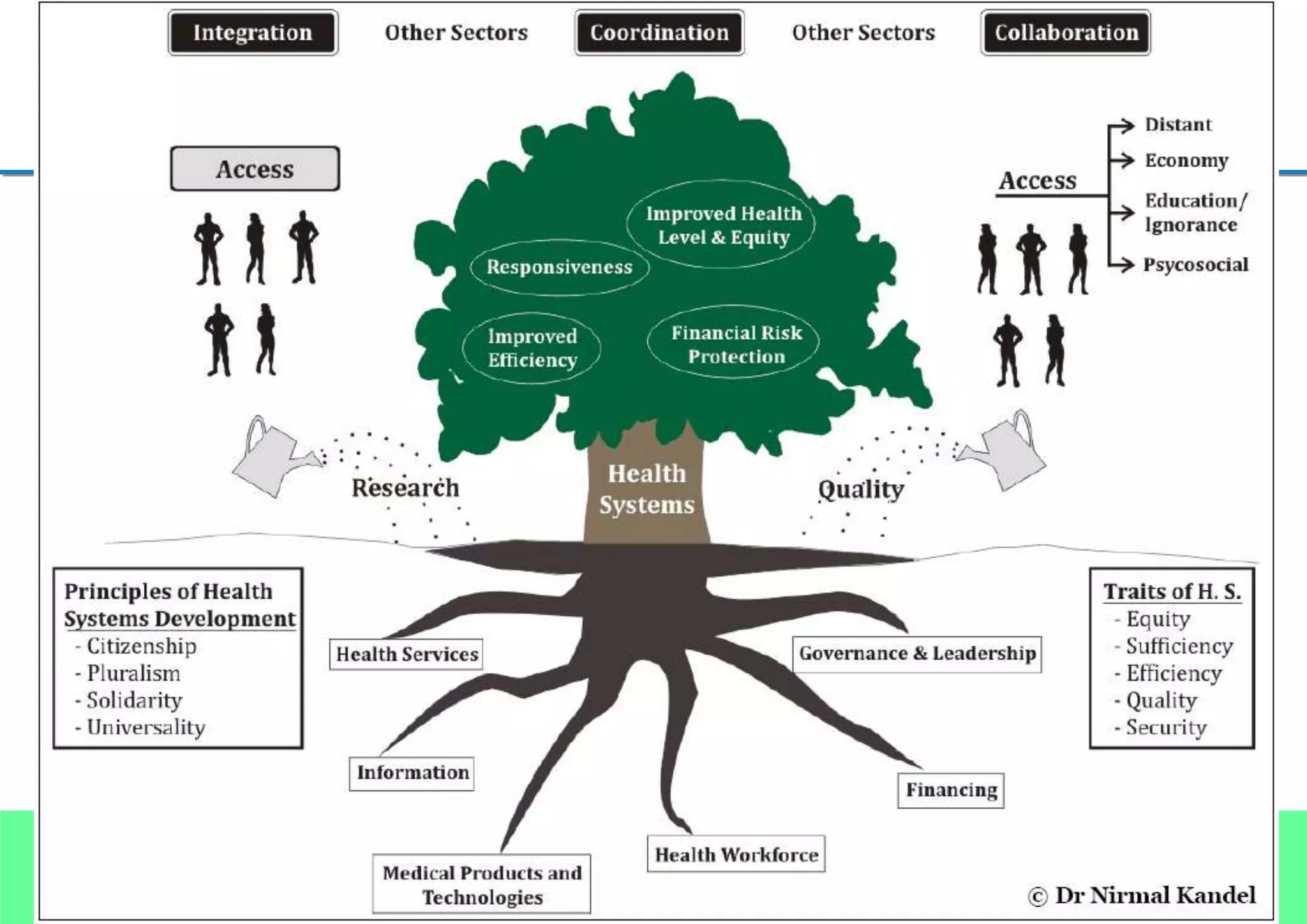
 Tree Model of Health System Framework
Dr Nirmal Kandel, MBBS, MA (Anthropology), MPH, EMBA – Public Health Specialist
3 |
Epidemiology –What is this…
let me ask people around
Dr Nirmal Kandel, MBBS, MA (Anthropology), MPH, EMBA – Public Health Specialist
4 |
What do you mean by Epidemiology
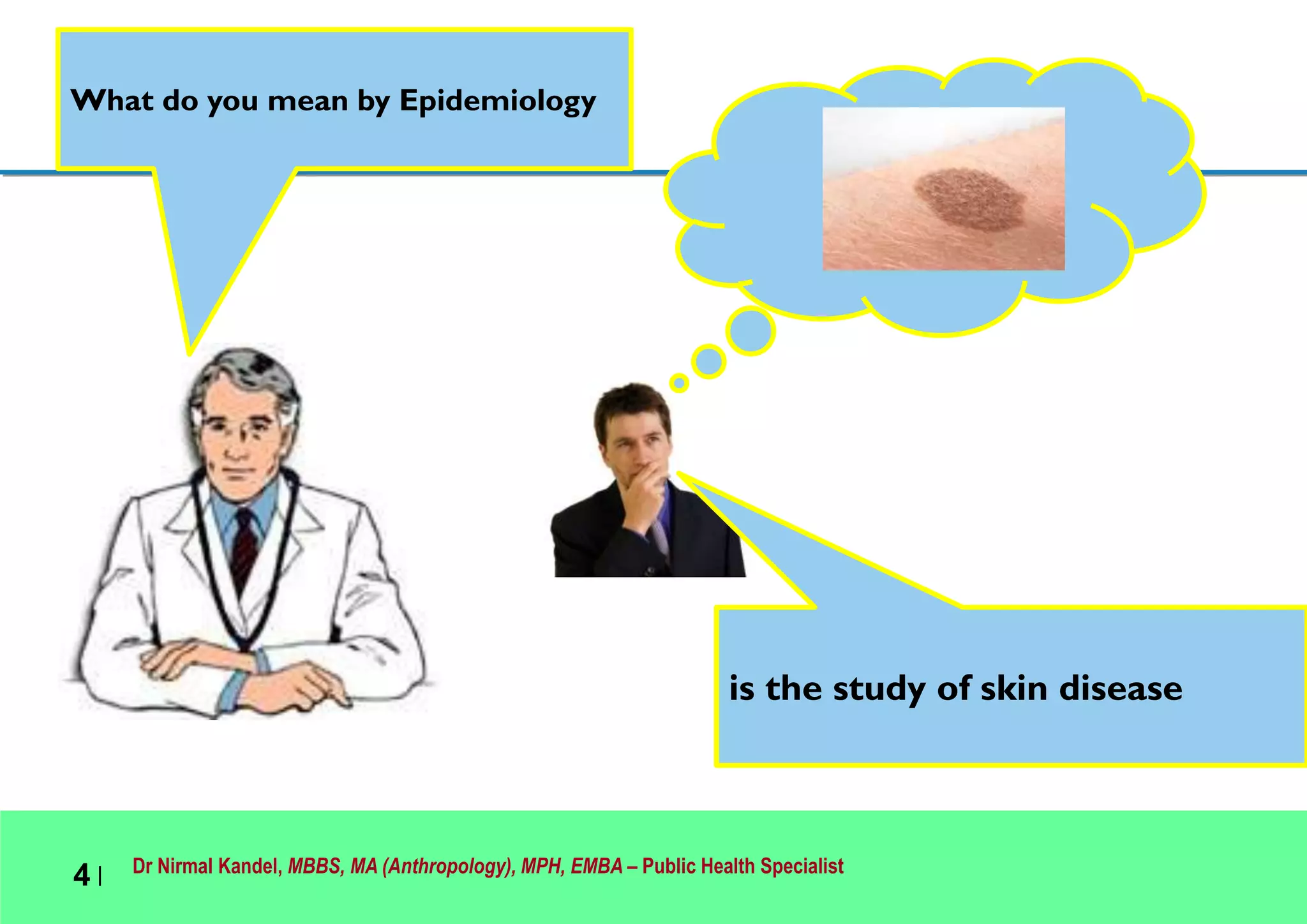
is the study of skin disease
Dr Nirmal Kandel, MBBS, MA (Anthropology), MPH, EMBA – Public Health Specialist
5 |
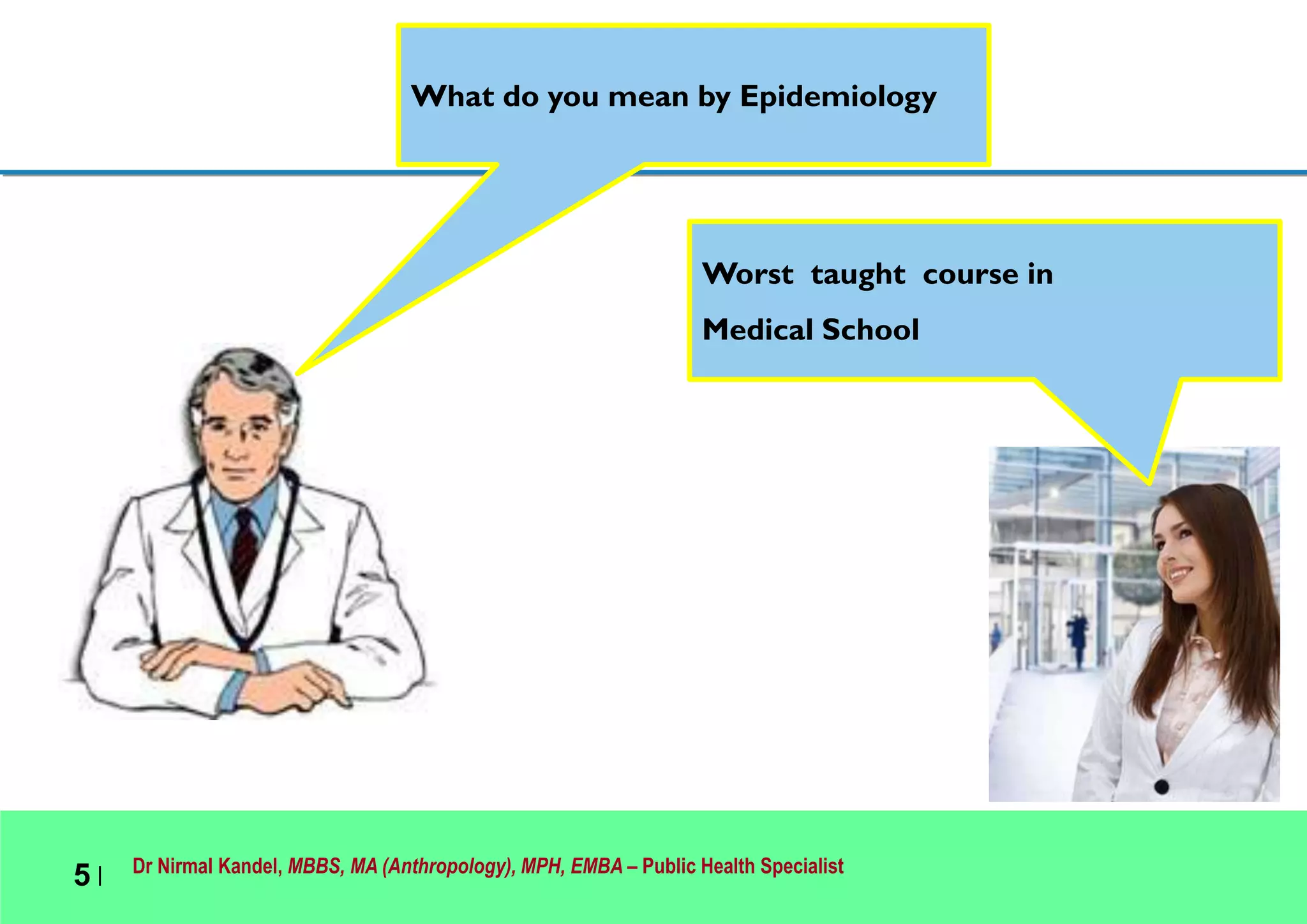
What do you mean by Epidemiology
Worst taught course in
Medical School
Dr Nirmal Kandel, MBBS, MA (Anthropology), MPH, EMBA – Public Health Specialist
6 |
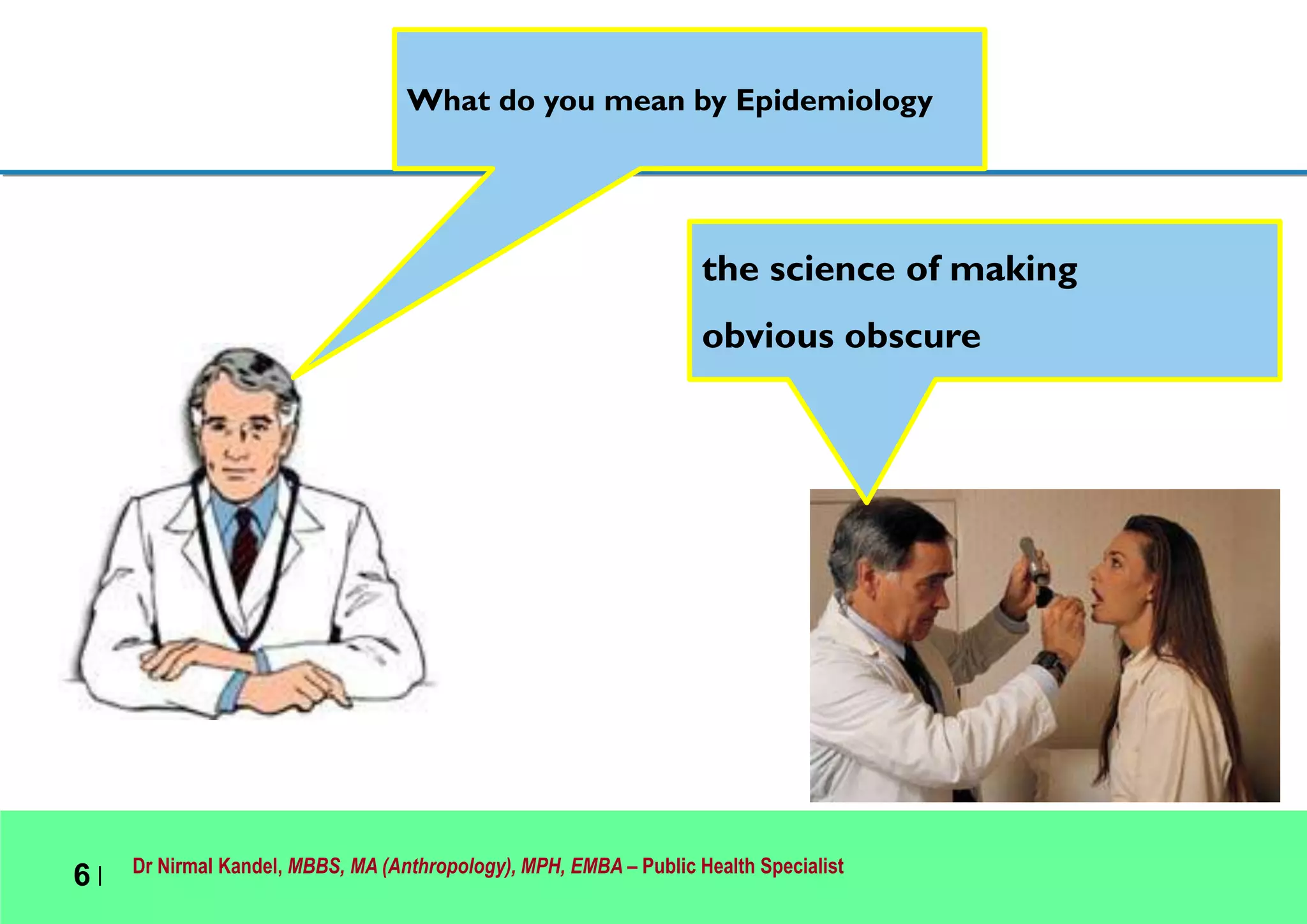
What do you mean by Epidemiology
the science of making
obvious obscure
Dr Nirmal Kandel, MBBS, MA (Anthropology), MPH, EMBA – Public Health Specialist
7 |
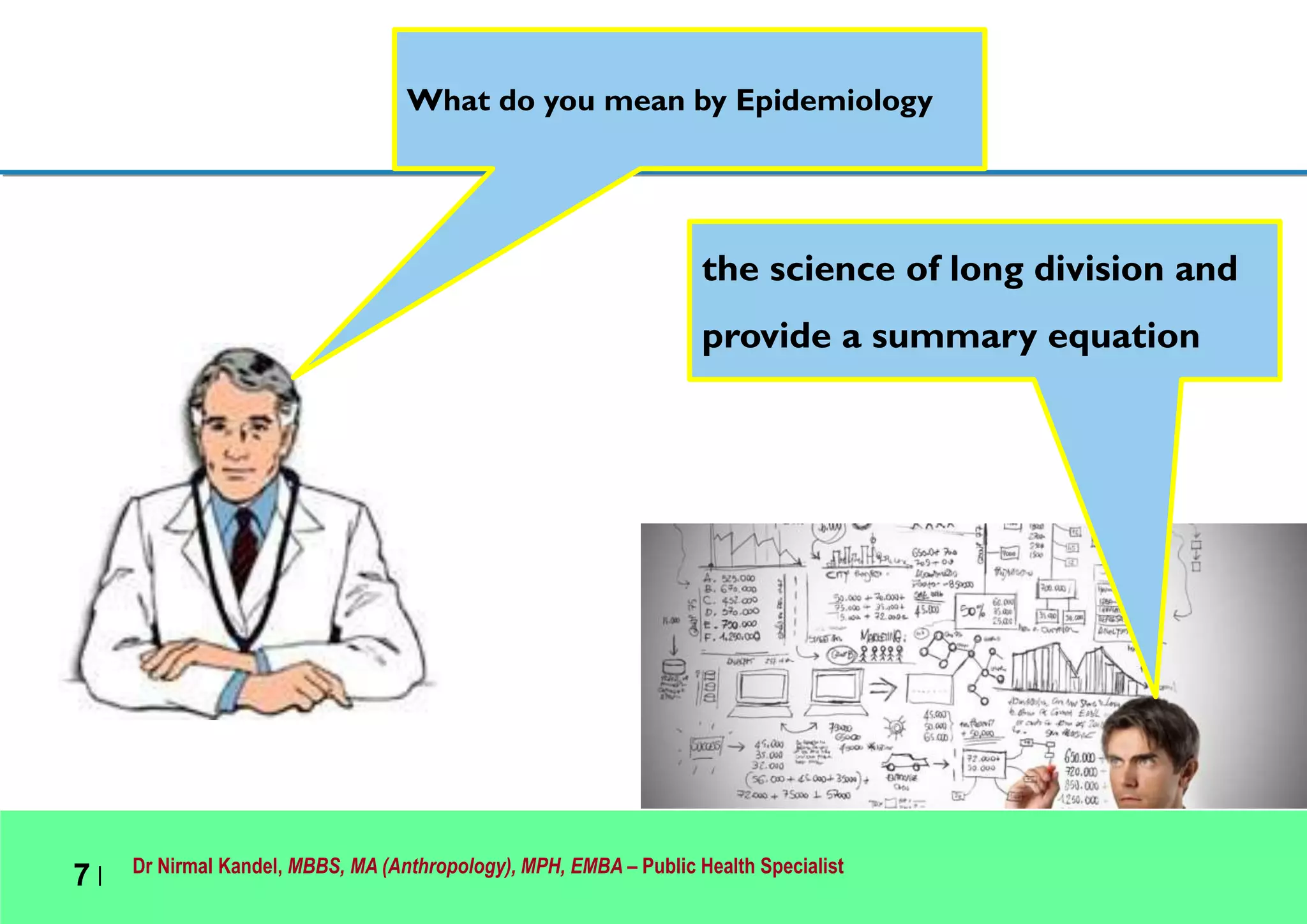
What do you mean by Epidemiology
the science of long division and
provide a summary equation
Dr Nirmal Kandel, MBBS, MA (Anthropology), MPH, EMBA – Public Health Specialist
8 |
BUT
The emphasis is not on statistics,
formulas, or computation, but on
epidemiologic principles and
concepts”.
Make statistics as simple as
possible…so that everybody can
absorb
Dr Nirmal Kandel, MBBS, MA (Anthropology), MPH, EMBA – Public Health Specialist
9 |
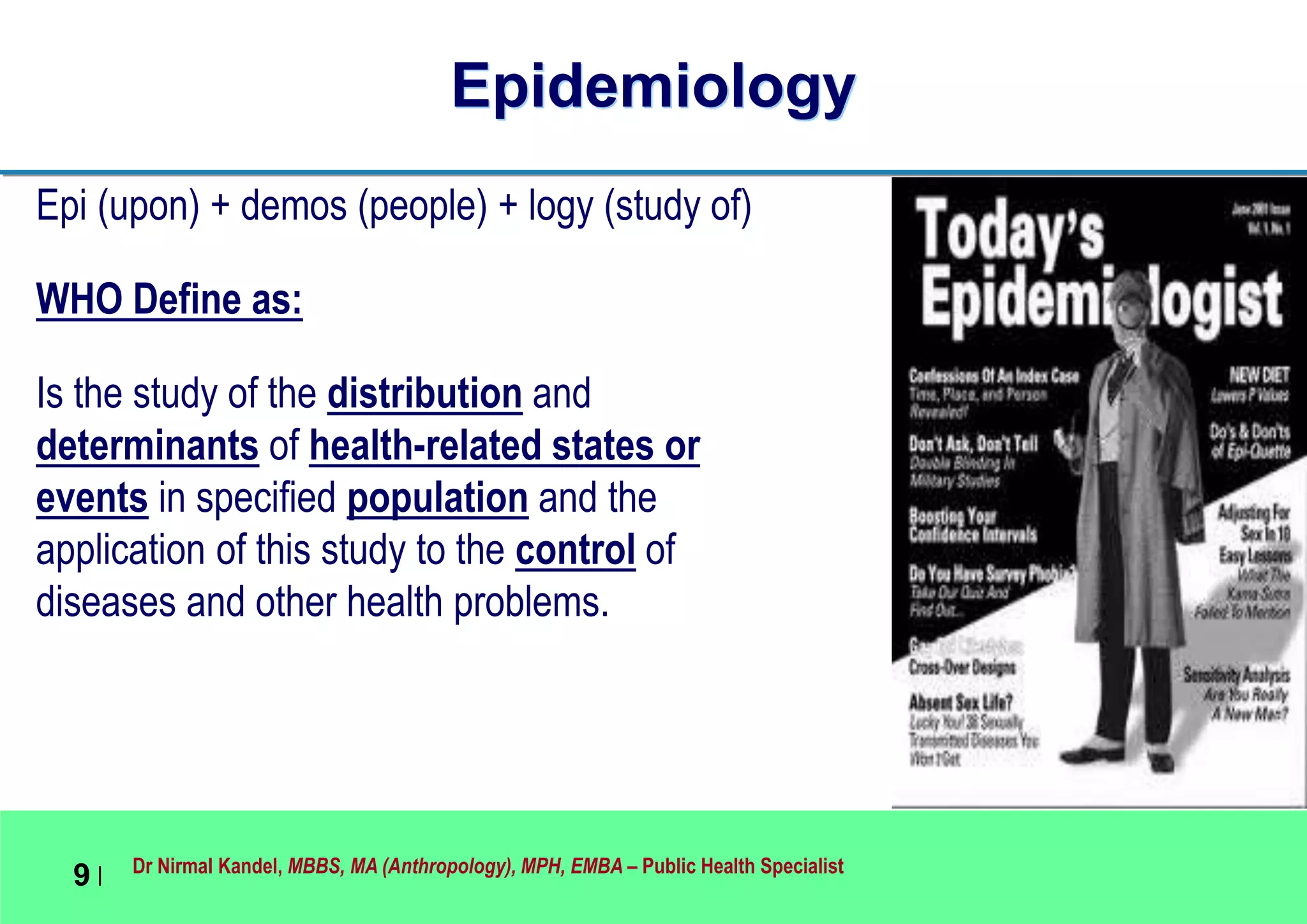
Epidemiology
Epi (upon) + demos (people) + logy (study of)
WHO Define as:
Is the study of the distribution and
determinants of health-related states or
events in specified population and the
application of this study to the control of
diseases and other health problems.
Dr Nirmal Kandel, MBBS, MA (Anthropology), MPH, EMBA – Public Health Specialist
10 |
Lets Analyze the Definition
 Study – it is the basic science of public health
 Distribution – Time, Place and Persons
 Determinants – search for the causes (all WH questions)
 Health Related states/events – whole spectrum of health – related
events
 Populations – Deals with Population rather than individual
 Control – Steers public health decisions on developing and evaluating
interventions
Dr Nirmal Kandel, MBBS, MA (Anthropology), MPH, EMBA – Public Health Specialist
11 |
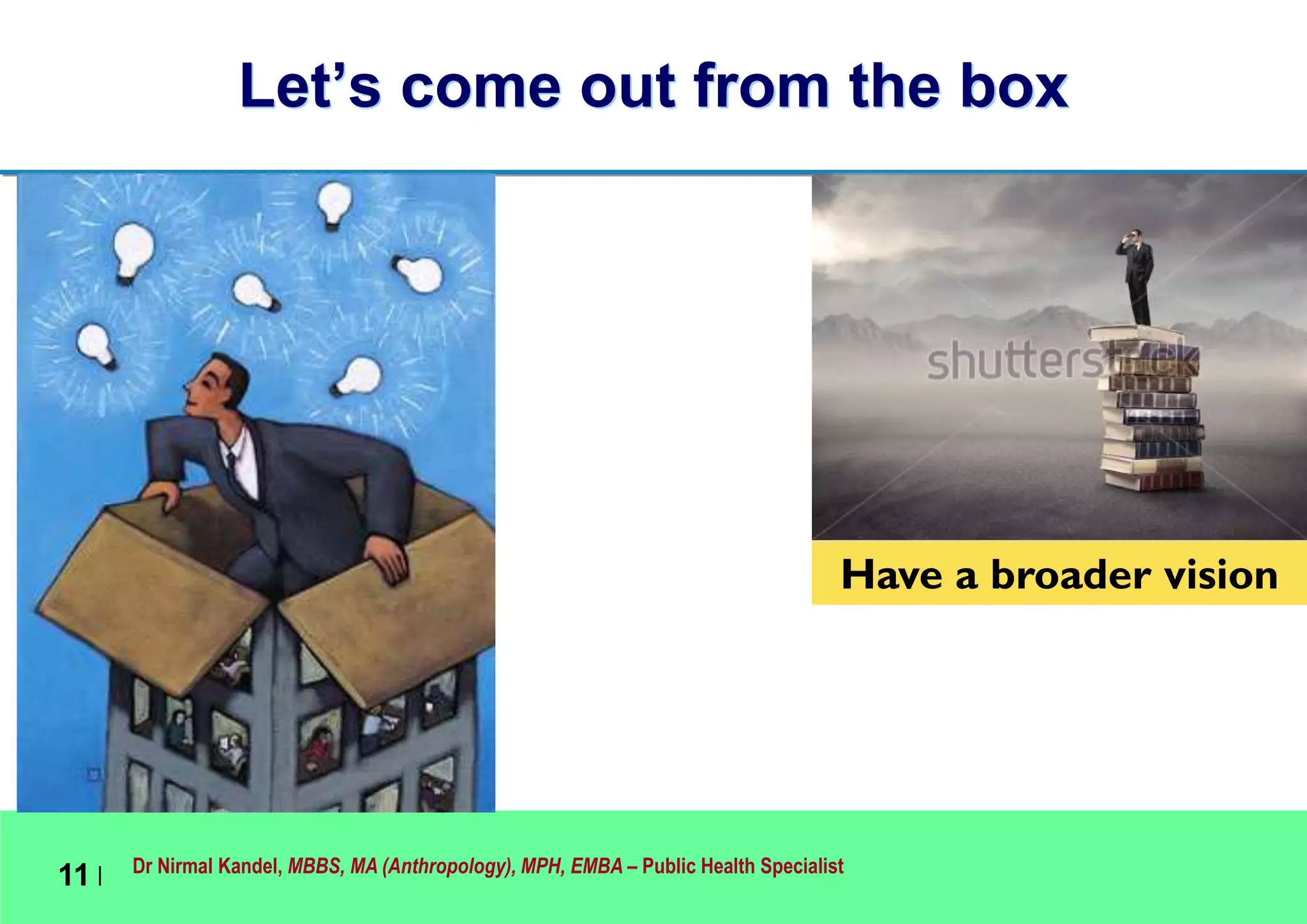
Let’s come out from the box
Have a broader vision
Dr Nirmal Kandel, MBBS, MA (Anthropology), MPH, EMBA – Public Health Specialist
12 |
The evolving conception of epidemiology as a liberal art
Epidemiology is often considered to be a biomedical science that relies on
a specific methodology and high-level technical skills.
 Its not only about diseases and outbreak investigation
 Its not only talk about statistical significance and regression analysis…
Infact, epidemiology in many respects also is “low-tech” science
that can be appreciated by those who don not specialize in this
field.
The biggest CONFOUNDER is that
Dr Nirmal Kandel, MBBS, MA (Anthropology), MPH, EMBA – Public Health Specialist
13 |
Skills Acquired Through
Epidemiological Training
 Use of Interdisciplinary Approach
– Mathematics and biostatistics (for quantitative methods)
– History (for historical accounts of states/events and early epidemiological
methods
– Sociology (social determinants of states/events)
– Demography and geography (population structures and location of
states/events)
– Behavioral sciences (models of states/events, design of health promotion
programs)
– Economics (economic determinants of Health)
– Law (examining evidence to establish causality; legal based for health policy)
Dr Nirmal Kandel, MBBS, MA (Anthropology), MPH, EMBA – Public Health Specialist
14 |
Skills Acquired Through
Epidemiological Training
 Use of the Scientific Method
 Enhancement of Critical Thinking Ability
 Use of quantitative and Computer Methods
 Communications skills
Dr Nirmal Kandel, MBBS, MA (Anthropology), MPH, EMBA – Public Health Specialist
15 |
Briefly
Current Uses of Epidemiology
– Historical: study the history of the health of populations (epidemiological
transitions)
– Community health use: diagnose the health of the community ( to measure the
true dimensions and distribution of ill-health in terms of incidence, prevalence,
disability and mortality; to set health problems in perspective and define their
relative importance to identify groups needing special attentions.
– Health services use: study the working of health services (Operational
research and disease management)
– Risk assessment use: estimate individuals’ risks of disease, accident, or
defect)
– Disease causality use: search for the causes of health and diseases
Dr Nirmal Kandel, MBBS, MA (Anthropology), MPH, EMBA – Public Health Specialist
16 |
Application of Epidemiology on
Health Systems Development
 Health system strengthening has become a recognized priority for
achieving major public health goals such as those identified by disease-
specific global health initiatives, disease eradication, MDGs, universal
coverage etc.
 The most important single contribution that public health makes to
strengthening health systems is provision of relevant and
scientifically valid epidemiologic data upon which to base decisions
and policies affecting all aspects of the larger health system
 Providing the right kind of care to the right people in the right way at the
right time.
Dr Nirmal Kandel, MBBS, MA (Anthropology), MPH, EMBA – Public Health Specialist
17 |
Health Systems
A health system is the sum total of all the organizations,
institutions and resources whose primary purpose is to improve
health.
A health system needs staff, funds, information, supplies,
transport, communications and overall guidance and direction.
And it needs to provide services that are responsive and
financially fair, while treating people decently.
Dr Nirmal Kandel, MBBS, MA (Anthropology), MPH, EMBA – Public Health Specialist
18 |
Health System Framework
Dr Nirmal Kandel, MBBS, MA (Anthropology), MPH, EMBA – Public Health Specialist
19 |
System Thinking in Health Systems
 Systems thinking is an approach to problem solving that view
‘problem’ as part of a wider dynamic system.
 Systems thinking involves much more than a reaction to
present outcomes or events.
 It demands a deeper understanding of the linkages,
relationships, interactions and behaviors among the elements
that characterize the entire system.
Dr Nirmal Kandel, MBBS, MA (Anthropology), MPH, EMBA – Public Health Specialist
20 |
System Thinking in Health Systems
Hence, system thinking includes:
– the nature of relationships among the building blocks
– the spaces between the blocks (and understanding what
happens there)
– the synergies emerging from interactions among the
blocks.
Dr Nirmal Kandel, MBBS, MA (Anthropology), MPH, EMBA – Public Health Specialist
21 |
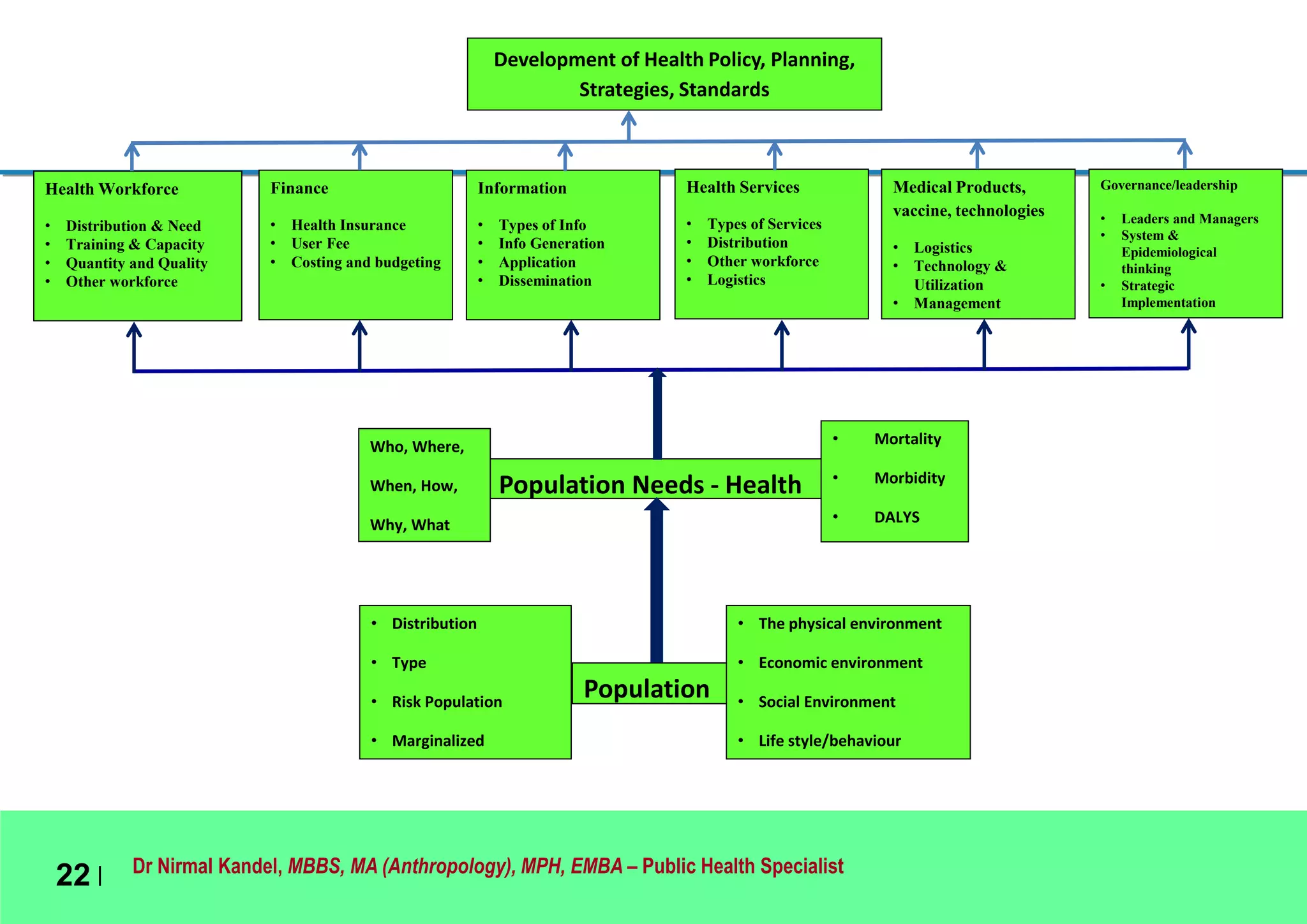
Epidemiological Model for
Health Systems
Dr Nirmal Kandel, MBBS, MA (Anthropology), MPH, EMBA – Public Health Specialist
22 |
Population
• The physical environment
• Economic environment
• Social Environment
• Life style/behaviour
• Distribution
• Type
• Risk Population
• Marginalized
Population Needs - Health
• Mortality
• Morbidity
• DALYS
Who, Where,
When, How,
Why, What
Health Workforce
• Distribution & Need
• Training & Capacity
• Quantity and Quality
• Other workforce
Finance
• Health Insurance
• User Fee
• Costing and budgeting
Information
• Types of Info
• Info Generation
• Application
• Dissemination
Health Services
• Types of Services
• Distribution
• Other workforce
• Logistics
Medical Products,
vaccine, technologies
• Logistics
• Technology &
Utilization
• Management
Governance/leadership
• Leaders and Managers
• System &
Epidemiological
thinking
• Strategic
Implementation
Development of Health Policy, Planning,
Strategies, Standards
Dr Nirmal Kandel, MBBS, MA (Anthropology), MPH, EMBA – Public Health Specialist
23 |
Monitoring of the health system,
organizational and programs
performance
with epidemiological techniques
Dr Nirmal Kandel, MBBS, MA (Anthropology), MPH, EMBA – Public Health Specialist
24 |
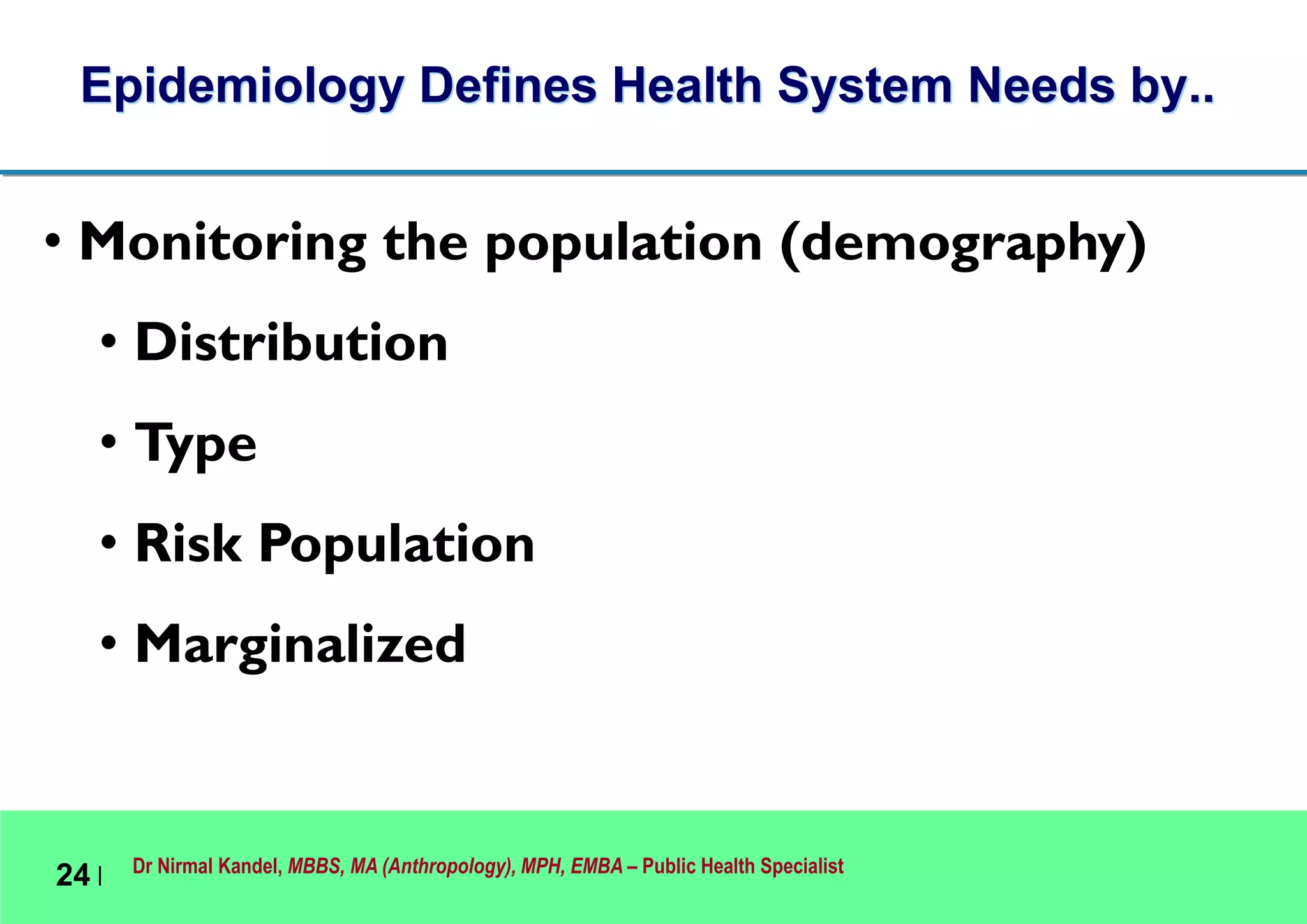
Epidemiology Defines Health System Needs by..
• Monitoring the population (demography)
• Distribution
• Type
• Risk Population
• Marginalized
Dr Nirmal Kandel, MBBS, MA (Anthropology), MPH, EMBA – Public Health Specialist
25 |
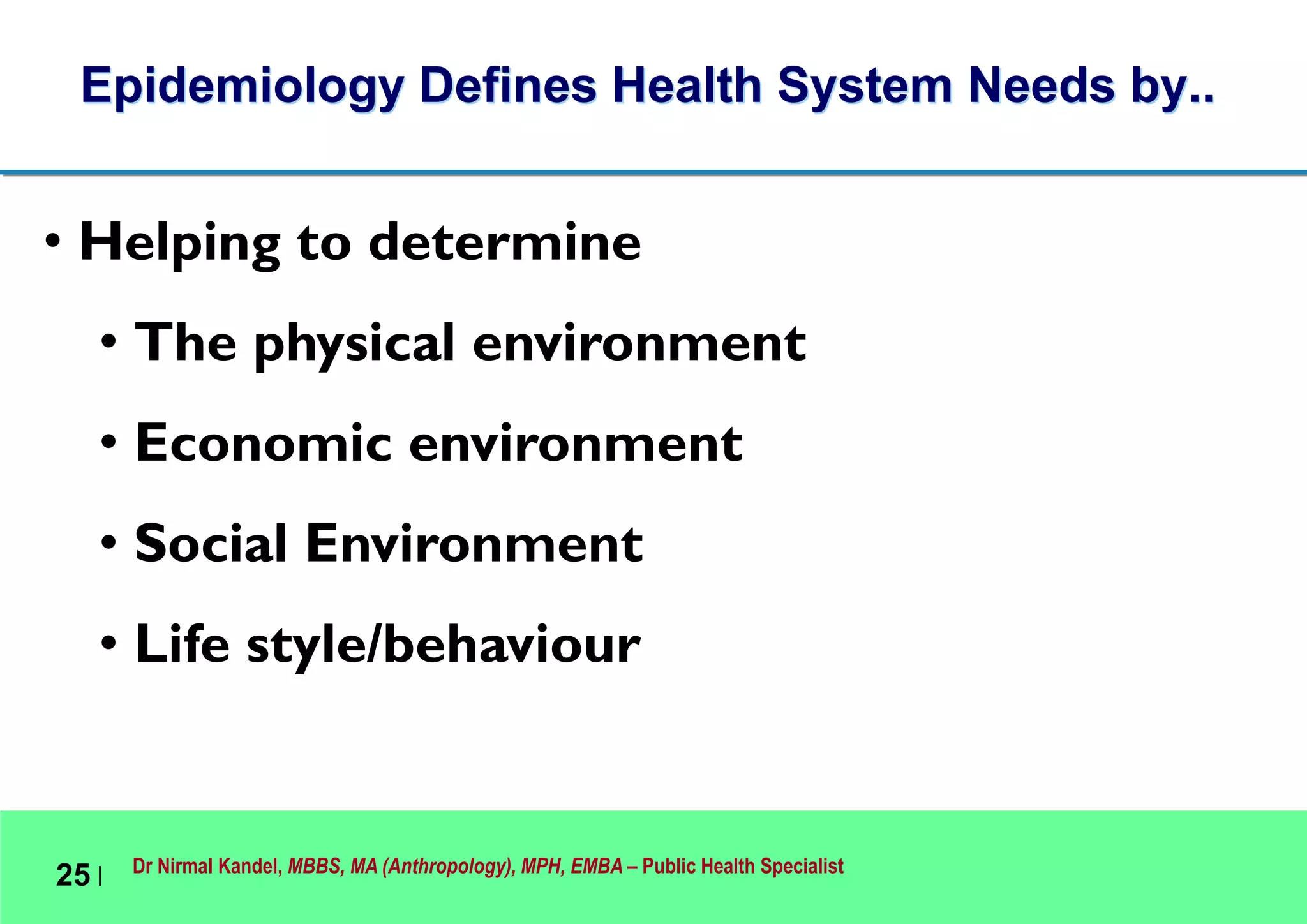
Epidemiology Defines Health System Needs by..
• Helping to determine
• The physical environment
• Economic environment
• Social Environment
• Life style/behaviour
Dr Nirmal Kandel, MBBS, MA (Anthropology), MPH, EMBA – Public Health Specialist
26 |
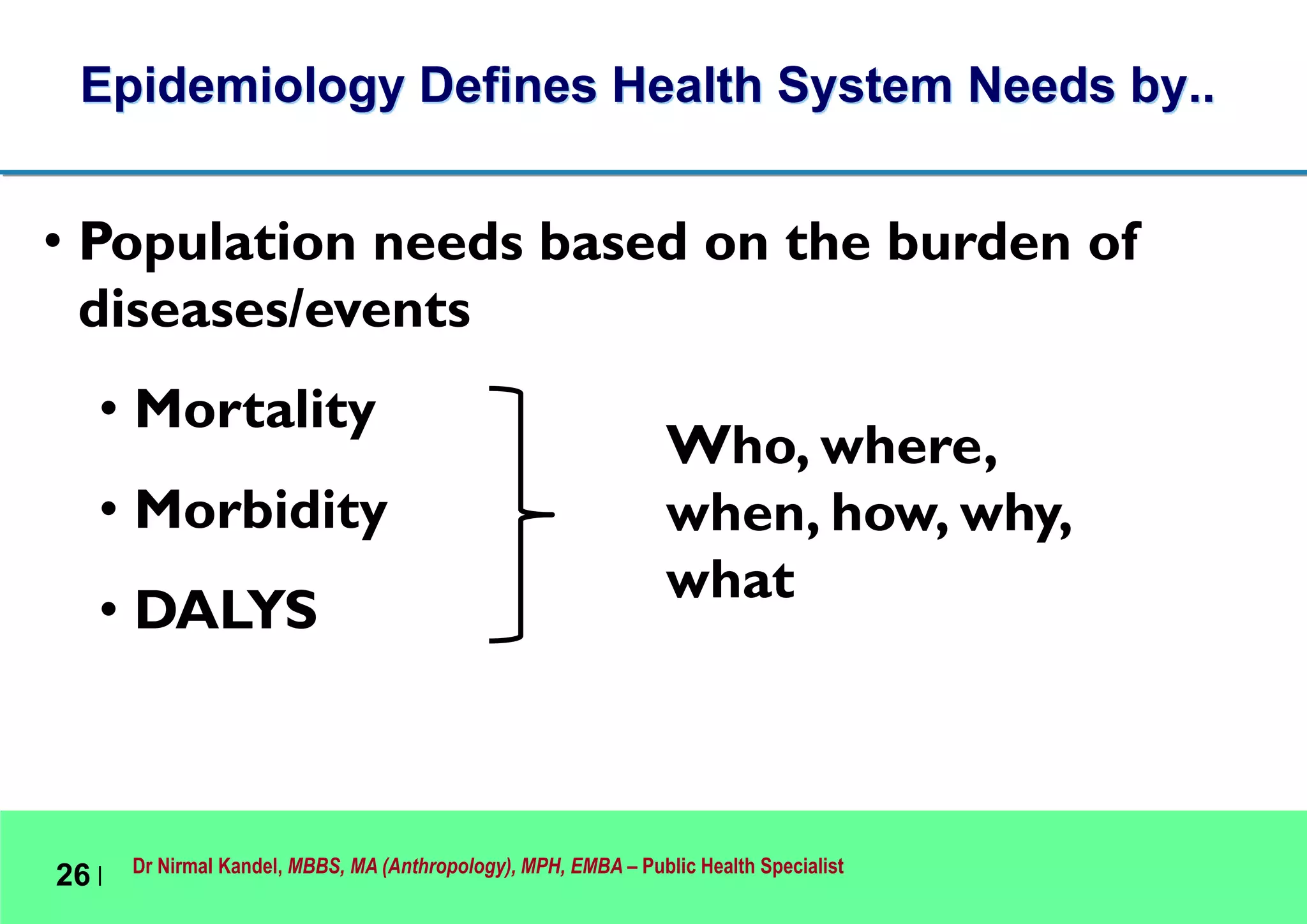
Epidemiology Defines Health System Needs by..
• Population needs based on the burden of
diseases/events
• Mortality
• Morbidity
• DALYS
Who, where,
when, how, why,
what
Dr Nirmal Kandel, MBBS, MA (Anthropology), MPH, EMBA – Public Health Specialist
27 |
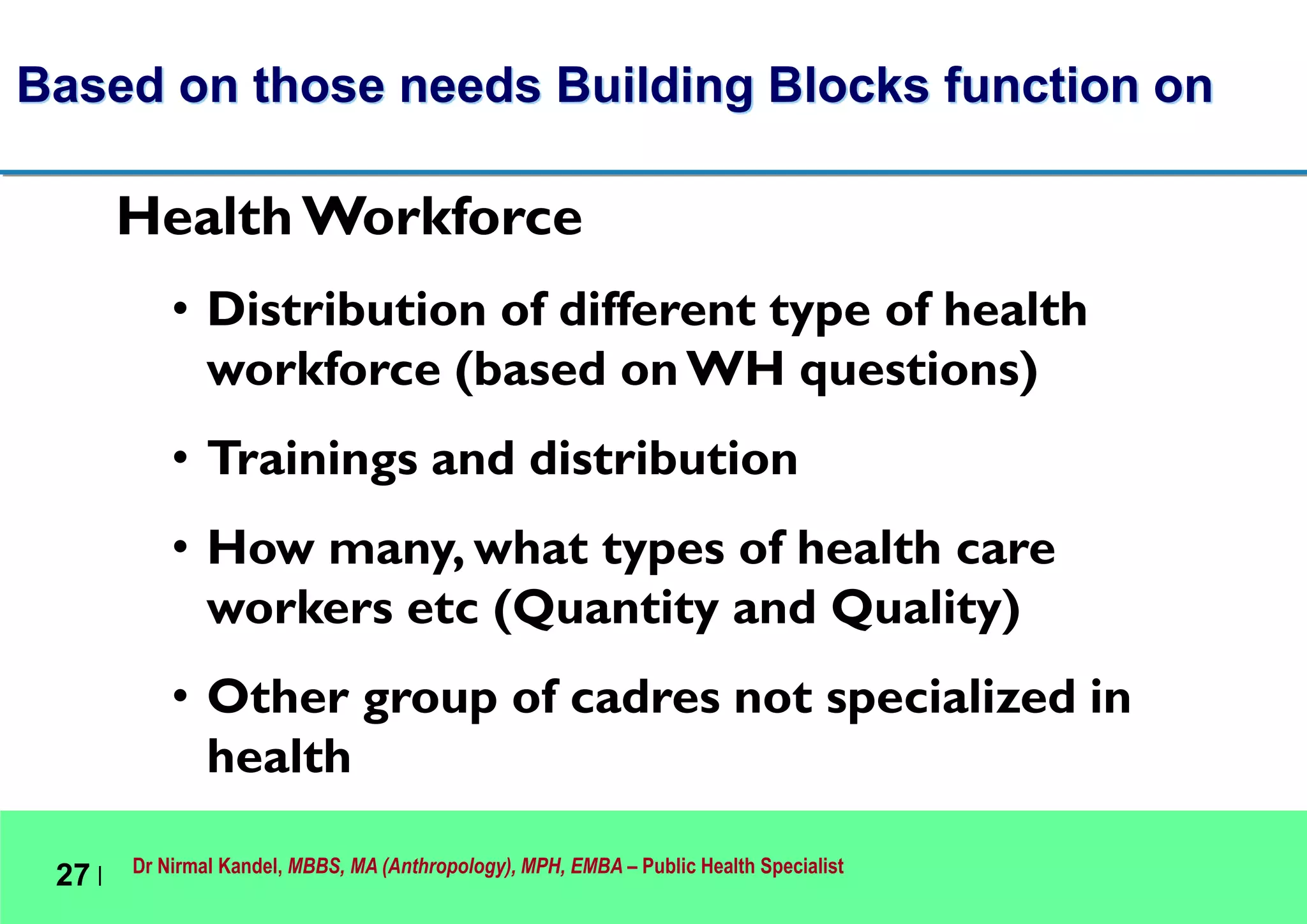
Based on those needs Building Blocks function on
Health Workforce
• Distribution of different type of health
workforce (based onWH questions)
• Trainings and distribution
• How many, what types of health care
workers etc (Quantity and Quality)
• Other group of cadres not specialized in
health
Dr Nirmal Kandel, MBBS, MA (Anthropology), MPH, EMBA – Public Health Specialist
28 |
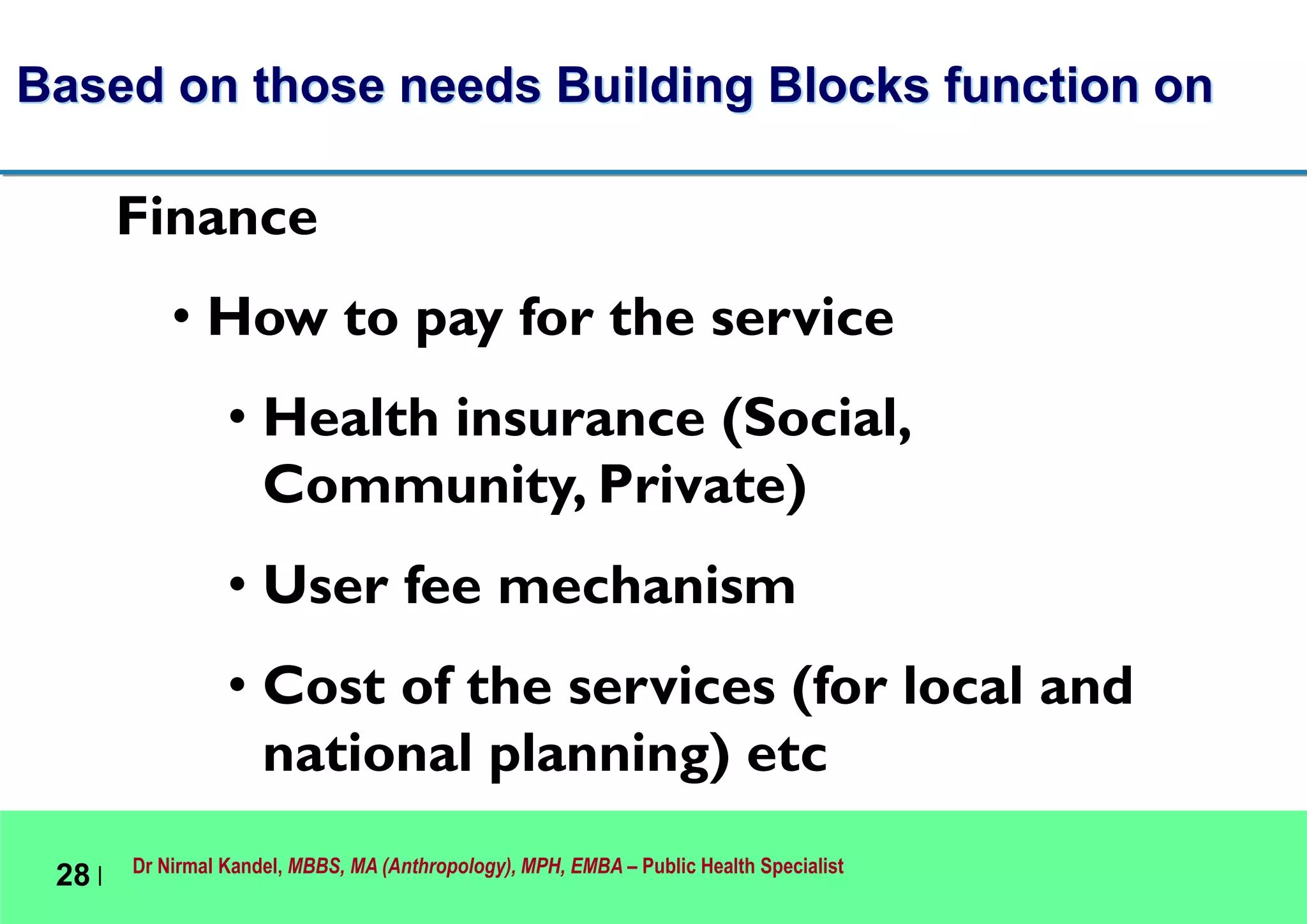
Based on those needs Building Blocks function on
Finance
• How to pay for the service
• Health insurance (Social,
Community, Private)
• User fee mechanism
• Cost of the services (for local and
national planning) etc
Dr Nirmal Kandel, MBBS, MA (Anthropology), MPH, EMBA – Public Health Specialist
29 |
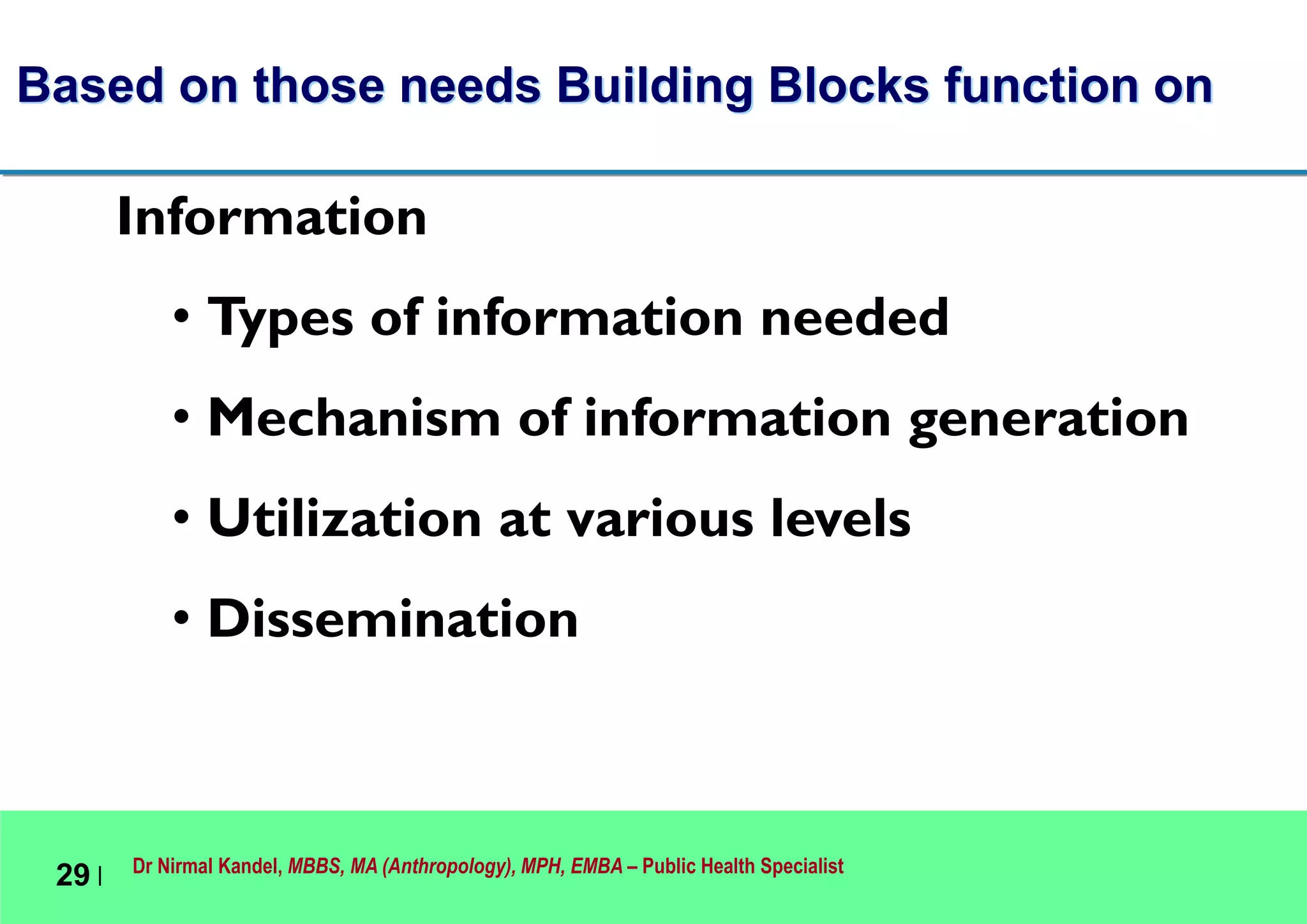
Based on those needs Building Blocks function on
Information
• Types of information needed
• Mechanism of information generation
• Utilization at various levels
• Dissemination
Dr Nirmal Kandel, MBBS, MA (Anthropology), MPH, EMBA – Public Health Specialist
30 |
• Health Services (service delivery)
• Types of services implementation
(Immunization, mass campaign, clinical
facilities, prevention and health education and
list goes on)
• Where and how to distribute the services
• Who are going to deliver, rational distribution
of health workforce and other logistics
• Supporting services
Based on those needs Building Blocks function on
Dr Nirmal Kandel, MBBS, MA (Anthropology), MPH, EMBA – Public Health Specialist
31 |
Medical Products,Vaccine andTechnologies
• What are the essential list of medicine,
vaccines and equipment
• Need for new technology, innovation
and utilization
• Distribution and management of supply
chain etc
Based on those needs Building Blocks function on
Dr Nirmal Kandel, MBBS, MA (Anthropology), MPH, EMBA – Public Health Specialist
32 |
Governance and Leadership
• System thinking or epidemiological thinking
capacity for managers and leaders
• Development of contextual policy as per the
need
• Centralization or decentralization
Based on those needs Building Blocks
function on
Dr Nirmal Kandel, MBBS, MA (Anthropology), MPH, EMBA – Public Health Specialist
33 |
Based on above we have to develop
• Health Policy
• Health Planning
• Health Strategies
• Health Standards
Based on those needs Building Blocks function on
Dr Nirmal Kandel, MBBS, MA (Anthropology), MPH, EMBA – Public Health Specialist
34 |
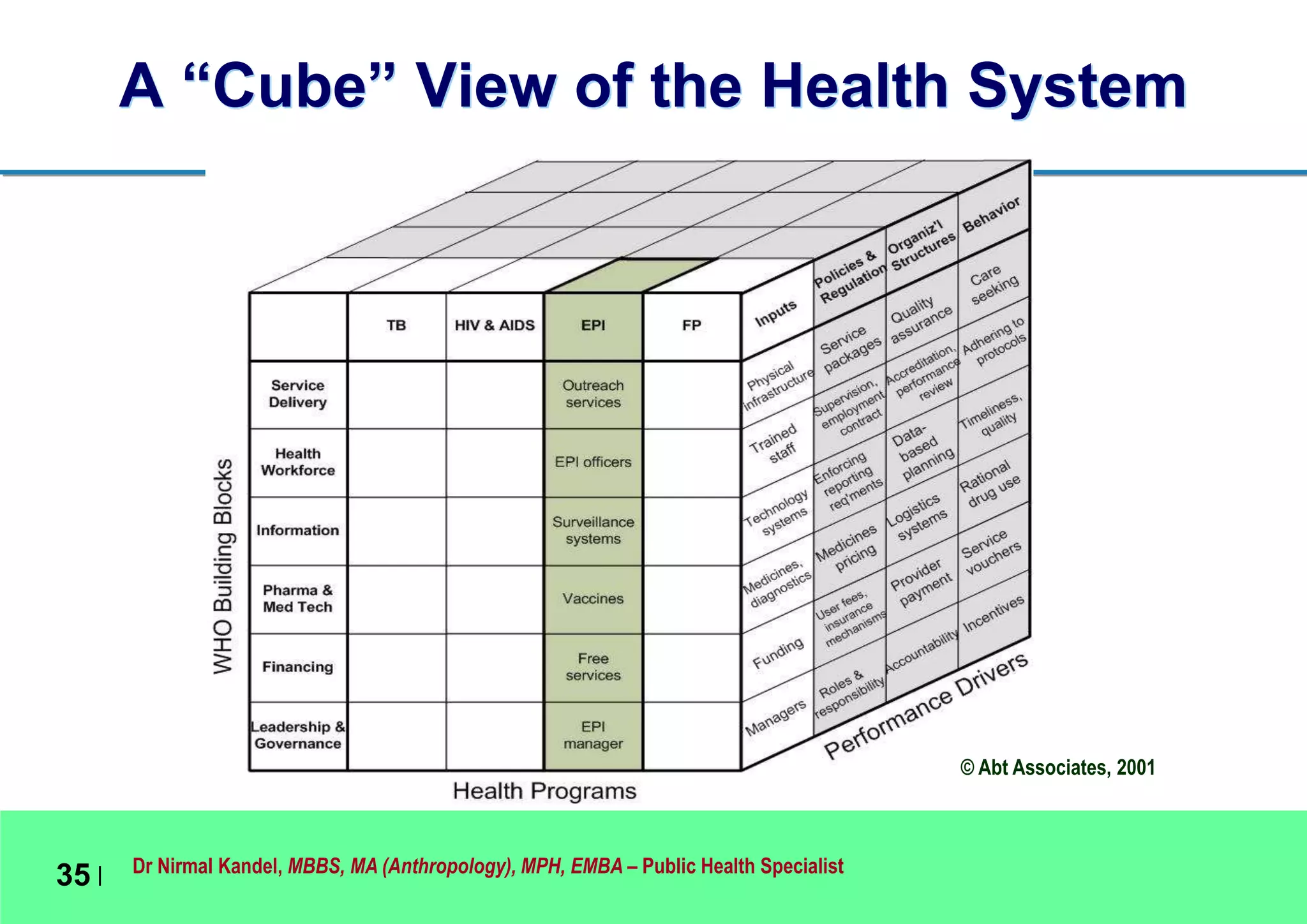
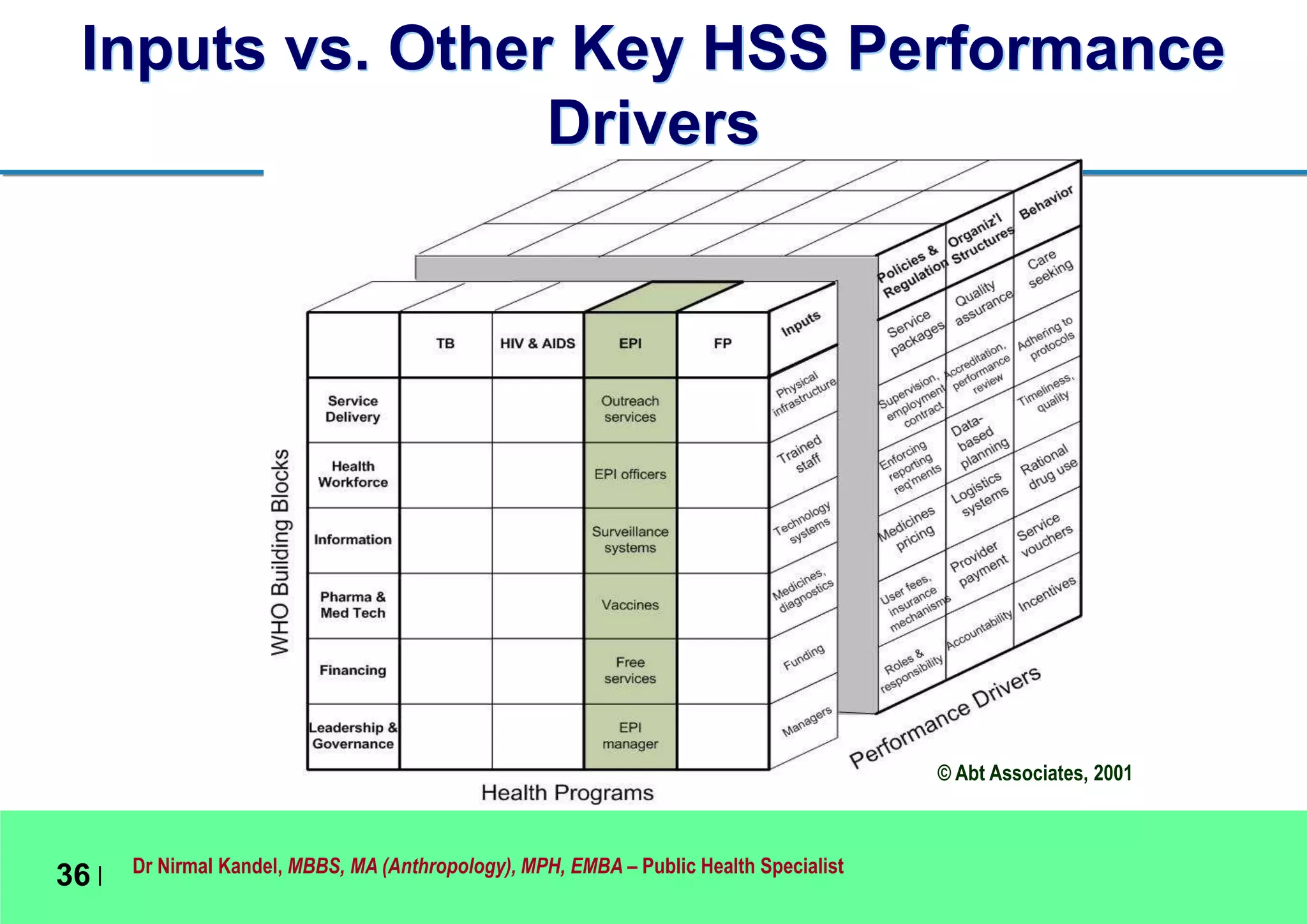
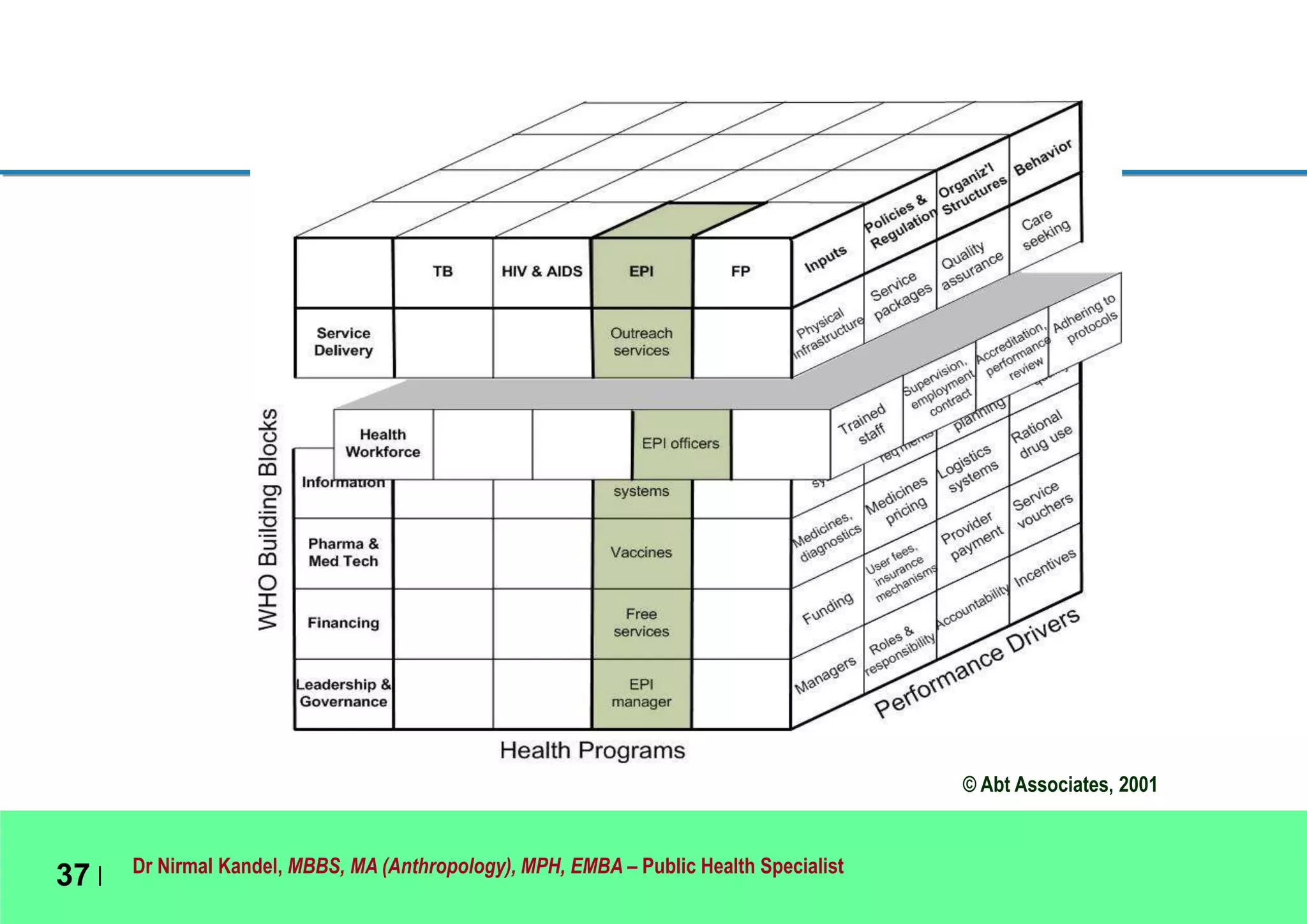
The 3 Dimensions of Health Systems
(1) Health system building blocks
(2) Program/disease areas
(3) Performance drivers
• Inputs
• Policies & regulations
• Organizational Structures
• Behaviors of HS actors
Dr Nirmal Kandel, MBBS, MA (Anthropology), MPH, EMBA – Public Health Specialist
35 |
A “Cube” View of the Health System
© Abt Associates, 2001
Dr Nirmal Kandel, MBBS, MA (Anthropology), MPH, EMBA – Public Health Specialist
36 |
Inputs vs. Other Key HSS Performance
Drivers
© Abt Associates, 2001
Dr Nirmal Kandel, MBBS, MA (Anthropology), MPH, EMBA – Public Health Specialist
37 |
© Abt Associates, 2001
Dr Nirmal Kandel, MBBS, MA (Anthropology), MPH, EMBA – Public Health Specialist
38 |
Dr Nirmal Kandel, MBBS, MA (Anthropology), MPH, EMBA – Public Health Specialist
39 |
Acknowledgement and References
1. All the available pictures downloaded from Google Image
2. Everybody’s Business – WHO Framework for Action (Accessed
from http://www.who.int/healthsystems/strategy/en/ )
3. World Health Organization – www.who.int
4. Dr Kenneth J. Rothman (his text books on epidmiology)
5. Ann Lion. Strengthening Health Systems - Moving Beyond
Supporting the Health System, Health Systems 20/20
Disclaimer: These references and contents are only used for teaching
purpose.
Dr Nirmal Kandel, MBBS, MA (Anthropology), MPH, EMBA – Public Health Specialist
40 |
Thank You
Email
kandeln@gmail.com

Epidemiology and Health Systems

  • 1.
    Dr Nirmal Kandel,MBBS, MA (Anthropology), MPH, EMBA – Public Health Specialist 1 | 2nd National Scientific Conference on Epidemiology 17 -19 October, Bandung Epidemiology and Health Systems Dr Nirmal Kandel , MBBS, MA (Anthropology), MPH, EMBA Public Health Specialist
  • 2.
    Dr Nirmal Kandel,MBBS, MA (Anthropology), MPH, EMBA – Public Health Specialist 2 | Outline  Setting up the scenario – Epidemiology  Skills of Epidemiology Trainings  Uses of Epidemiology  Health Systems and Framework  System thinking  Epidemiological Model for Health Systems  Tree Model of Health System Framework
  • 3.
    Dr Nirmal Kandel,MBBS, MA (Anthropology), MPH, EMBA – Public Health Specialist 3 | Epidemiology –What is this… let me ask people around
  • 4.
    Dr Nirmal Kandel,MBBS, MA (Anthropology), MPH, EMBA – Public Health Specialist 4 | What do you mean by Epidemiology is the study of skin disease
  • 5.
    Dr Nirmal Kandel,MBBS, MA (Anthropology), MPH, EMBA – Public Health Specialist 5 | What do you mean by Epidemiology Worst taught course in Medical School
  • 6.
    Dr Nirmal Kandel,MBBS, MA (Anthropology), MPH, EMBA – Public Health Specialist 6 | What do you mean by Epidemiology the science of making obvious obscure
  • 7.
    Dr Nirmal Kandel,MBBS, MA (Anthropology), MPH, EMBA – Public Health Specialist 7 | What do you mean by Epidemiology the science of long division and provide a summary equation
  • 8.
    Dr Nirmal Kandel,MBBS, MA (Anthropology), MPH, EMBA – Public Health Specialist 8 | BUT The emphasis is not on statistics, formulas, or computation, but on epidemiologic principles and concepts”. Make statistics as simple as possible…so that everybody can absorb
  • 9.
    Dr Nirmal Kandel,MBBS, MA (Anthropology), MPH, EMBA – Public Health Specialist 9 | Epidemiology Epi (upon) + demos (people) + logy (study of) WHO Define as: Is the study of the distribution and determinants of health-related states or events in specified population and the application of this study to the control of diseases and other health problems.
  • 10.
    Dr Nirmal Kandel,MBBS, MA (Anthropology), MPH, EMBA – Public Health Specialist 10 | Lets Analyze the Definition  Study – it is the basic science of public health  Distribution – Time, Place and Persons  Determinants – search for the causes (all WH questions)  Health Related states/events – whole spectrum of health – related events  Populations – Deals with Population rather than individual  Control – Steers public health decisions on developing and evaluating interventions
  • 11.
    Dr Nirmal Kandel,MBBS, MA (Anthropology), MPH, EMBA – Public Health Specialist 11 | Let’s come out from the box Have a broader vision
  • 12.
    Dr Nirmal Kandel,MBBS, MA (Anthropology), MPH, EMBA – Public Health Specialist 12 | The evolving conception of epidemiology as a liberal art Epidemiology is often considered to be a biomedical science that relies on a specific methodology and high-level technical skills.  Its not only about diseases and outbreak investigation  Its not only talk about statistical significance and regression analysis… Infact, epidemiology in many respects also is “low-tech” science that can be appreciated by those who don not specialize in this field. The biggest CONFOUNDER is that
  • 13.
    Dr Nirmal Kandel,MBBS, MA (Anthropology), MPH, EMBA – Public Health Specialist 13 | Skills Acquired Through Epidemiological Training  Use of Interdisciplinary Approach – Mathematics and biostatistics (for quantitative methods) – History (for historical accounts of states/events and early epidemiological methods – Sociology (social determinants of states/events) – Demography and geography (population structures and location of states/events) – Behavioral sciences (models of states/events, design of health promotion programs) – Economics (economic determinants of Health) – Law (examining evidence to establish causality; legal based for health policy)
  • 14.
    Dr Nirmal Kandel,MBBS, MA (Anthropology), MPH, EMBA – Public Health Specialist 14 | Skills Acquired Through Epidemiological Training  Use of the Scientific Method  Enhancement of Critical Thinking Ability  Use of quantitative and Computer Methods  Communications skills
  • 15.
    Dr Nirmal Kandel,MBBS, MA (Anthropology), MPH, EMBA – Public Health Specialist 15 | Briefly Current Uses of Epidemiology – Historical: study the history of the health of populations (epidemiological transitions) – Community health use: diagnose the health of the community ( to measure the true dimensions and distribution of ill-health in terms of incidence, prevalence, disability and mortality; to set health problems in perspective and define their relative importance to identify groups needing special attentions. – Health services use: study the working of health services (Operational research and disease management) – Risk assessment use: estimate individuals’ risks of disease, accident, or defect) – Disease causality use: search for the causes of health and diseases
  • 16.
    Dr Nirmal Kandel,MBBS, MA (Anthropology), MPH, EMBA – Public Health Specialist 16 | Application of Epidemiology on Health Systems Development  Health system strengthening has become a recognized priority for achieving major public health goals such as those identified by disease- specific global health initiatives, disease eradication, MDGs, universal coverage etc.  The most important single contribution that public health makes to strengthening health systems is provision of relevant and scientifically valid epidemiologic data upon which to base decisions and policies affecting all aspects of the larger health system  Providing the right kind of care to the right people in the right way at the right time.
  • 17.
    Dr Nirmal Kandel,MBBS, MA (Anthropology), MPH, EMBA – Public Health Specialist 17 | Health Systems A health system is the sum total of all the organizations, institutions and resources whose primary purpose is to improve health. A health system needs staff, funds, information, supplies, transport, communications and overall guidance and direction. And it needs to provide services that are responsive and financially fair, while treating people decently.
  • 18.
    Dr Nirmal Kandel,MBBS, MA (Anthropology), MPH, EMBA – Public Health Specialist 18 | Health System Framework
  • 19.
    Dr Nirmal Kandel,MBBS, MA (Anthropology), MPH, EMBA – Public Health Specialist 19 | System Thinking in Health Systems  Systems thinking is an approach to problem solving that view ‘problem’ as part of a wider dynamic system.  Systems thinking involves much more than a reaction to present outcomes or events.  It demands a deeper understanding of the linkages, relationships, interactions and behaviors among the elements that characterize the entire system.
  • 20.
    Dr Nirmal Kandel,MBBS, MA (Anthropology), MPH, EMBA – Public Health Specialist 20 | System Thinking in Health Systems Hence, system thinking includes: – the nature of relationships among the building blocks – the spaces between the blocks (and understanding what happens there) – the synergies emerging from interactions among the blocks.
  • 21.
    Dr Nirmal Kandel,MBBS, MA (Anthropology), MPH, EMBA – Public Health Specialist 21 | Epidemiological Model for Health Systems
  • 22.
    Dr Nirmal Kandel,MBBS, MA (Anthropology), MPH, EMBA – Public Health Specialist 22 | Population • The physical environment • Economic environment • Social Environment • Life style/behaviour • Distribution • Type • Risk Population • Marginalized Population Needs - Health • Mortality • Morbidity • DALYS Who, Where, When, How, Why, What Health Workforce • Distribution & Need • Training & Capacity • Quantity and Quality • Other workforce Finance • Health Insurance • User Fee • Costing and budgeting Information • Types of Info • Info Generation • Application • Dissemination Health Services • Types of Services • Distribution • Other workforce • Logistics Medical Products, vaccine, technologies • Logistics • Technology & Utilization • Management Governance/leadership • Leaders and Managers • System & Epidemiological thinking • Strategic Implementation Development of Health Policy, Planning, Strategies, Standards
  • 23.
    Dr Nirmal Kandel,MBBS, MA (Anthropology), MPH, EMBA – Public Health Specialist 23 | Monitoring of the health system, organizational and programs performance with epidemiological techniques
  • 24.
    Dr Nirmal Kandel,MBBS, MA (Anthropology), MPH, EMBA – Public Health Specialist 24 | Epidemiology Defines Health System Needs by.. • Monitoring the population (demography) • Distribution • Type • Risk Population • Marginalized
  • 25.
    Dr Nirmal Kandel,MBBS, MA (Anthropology), MPH, EMBA – Public Health Specialist 25 | Epidemiology Defines Health System Needs by.. • Helping to determine • The physical environment • Economic environment • Social Environment • Life style/behaviour
  • 26.
    Dr Nirmal Kandel,MBBS, MA (Anthropology), MPH, EMBA – Public Health Specialist 26 | Epidemiology Defines Health System Needs by.. • Population needs based on the burden of diseases/events • Mortality • Morbidity • DALYS Who, where, when, how, why, what
  • 27.
    Dr Nirmal Kandel,MBBS, MA (Anthropology), MPH, EMBA – Public Health Specialist 27 | Based on those needs Building Blocks function on Health Workforce • Distribution of different type of health workforce (based onWH questions) • Trainings and distribution • How many, what types of health care workers etc (Quantity and Quality) • Other group of cadres not specialized in health
  • 28.
    Dr Nirmal Kandel,MBBS, MA (Anthropology), MPH, EMBA – Public Health Specialist 28 | Based on those needs Building Blocks function on Finance • How to pay for the service • Health insurance (Social, Community, Private) • User fee mechanism • Cost of the services (for local and national planning) etc
  • 29.
    Dr Nirmal Kandel,MBBS, MA (Anthropology), MPH, EMBA – Public Health Specialist 29 | Based on those needs Building Blocks function on Information • Types of information needed • Mechanism of information generation • Utilization at various levels • Dissemination
  • 30.
    Dr Nirmal Kandel,MBBS, MA (Anthropology), MPH, EMBA – Public Health Specialist 30 | • Health Services (service delivery) • Types of services implementation (Immunization, mass campaign, clinical facilities, prevention and health education and list goes on) • Where and how to distribute the services • Who are going to deliver, rational distribution of health workforce and other logistics • Supporting services Based on those needs Building Blocks function on
  • 31.
    Dr Nirmal Kandel,MBBS, MA (Anthropology), MPH, EMBA – Public Health Specialist 31 | Medical Products,Vaccine andTechnologies • What are the essential list of medicine, vaccines and equipment • Need for new technology, innovation and utilization • Distribution and management of supply chain etc Based on those needs Building Blocks function on
  • 32.
    Dr Nirmal Kandel,MBBS, MA (Anthropology), MPH, EMBA – Public Health Specialist 32 | Governance and Leadership • System thinking or epidemiological thinking capacity for managers and leaders • Development of contextual policy as per the need • Centralization or decentralization Based on those needs Building Blocks function on
  • 33.
    Dr Nirmal Kandel,MBBS, MA (Anthropology), MPH, EMBA – Public Health Specialist 33 | Based on above we have to develop • Health Policy • Health Planning • Health Strategies • Health Standards Based on those needs Building Blocks function on
  • 34.
    Dr Nirmal Kandel,MBBS, MA (Anthropology), MPH, EMBA – Public Health Specialist 34 | The 3 Dimensions of Health Systems (1) Health system building blocks (2) Program/disease areas (3) Performance drivers • Inputs • Policies & regulations • Organizational Structures • Behaviors of HS actors
  • 35.
    Dr Nirmal Kandel,MBBS, MA (Anthropology), MPH, EMBA – Public Health Specialist 35 | A “Cube” View of the Health System © Abt Associates, 2001
  • 36.
    Dr Nirmal Kandel,MBBS, MA (Anthropology), MPH, EMBA – Public Health Specialist 36 | Inputs vs. Other Key HSS Performance Drivers © Abt Associates, 2001
  • 37.
    Dr Nirmal Kandel,MBBS, MA (Anthropology), MPH, EMBA – Public Health Specialist 37 | © Abt Associates, 2001
  • 38.
    Dr Nirmal Kandel,MBBS, MA (Anthropology), MPH, EMBA – Public Health Specialist 38 |
  • 39.
    Dr Nirmal Kandel,MBBS, MA (Anthropology), MPH, EMBA – Public Health Specialist 39 | Acknowledgement and References 1. All the available pictures downloaded from Google Image 2. Everybody’s Business – WHO Framework for Action (Accessed from http://www.who.int/healthsystems/strategy/en/ ) 3. World Health Organization – www.who.int 4. Dr Kenneth J. Rothman (his text books on epidmiology) 5. Ann Lion. Strengthening Health Systems - Moving Beyond Supporting the Health System, Health Systems 20/20 Disclaimer: These references and contents are only used for teaching purpose.
  • 40.
    Dr Nirmal Kandel,MBBS, MA (Anthropology), MPH, EMBA – Public Health Specialist 40 | Thank You Email kandeln@gmail.com