Running the a structured
Idea Generation Session
The Golden Rules
1. Be clear on what your aims are for the session
2. No negativity! Leave current processes and strong internal
views at the door
3. Write down and record everything!
4. Love your participants
5. Always start with an ice breaker
6. Don’t start with a solution in mind
7. Be strict with your timing
8. Prepare, prepare, prepare!
The Environment
1. Consider your location
2. Keep people fuelled
3. Try to get a mix of people in the room
4. Timing: morning always wins!
5. Pre work
6. Think about stimulus, (images, samples, quotes)
7. Plan your materials ahead of the session
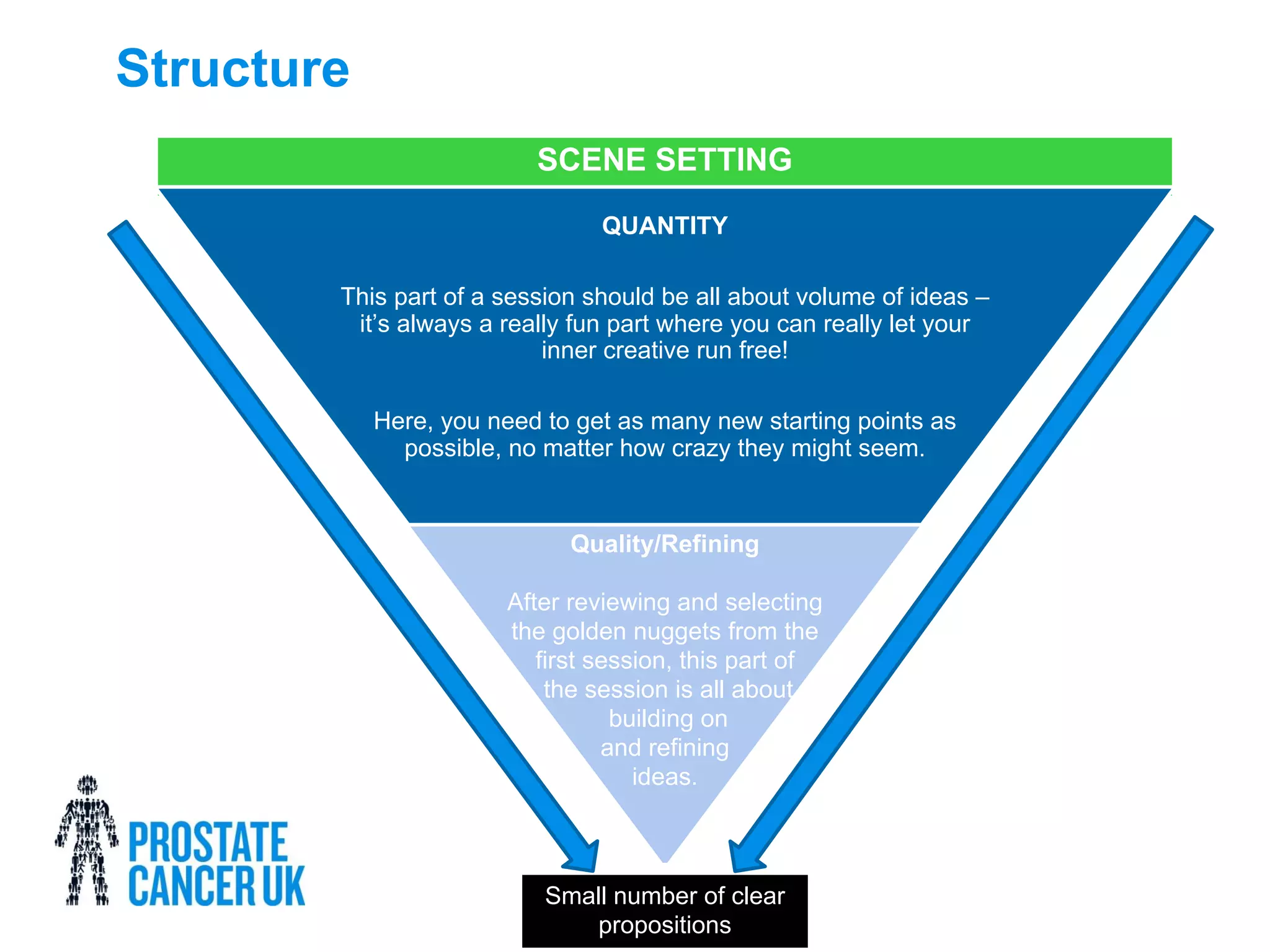
Structure
SCENE SETTING
QUANTITY
This part of a session should be all about volume of ideas –
it’s always a really fun part where you can really let your
inner creative run free!
Here, you need to get as many new starting points as
possible, no matter how crazy they might seem.
Quality/Refining
After reviewing and selecting
the golden nuggets from the
first session, this part of
the session is all about
building on
and refining
ideas.
Small number of clear
propositions
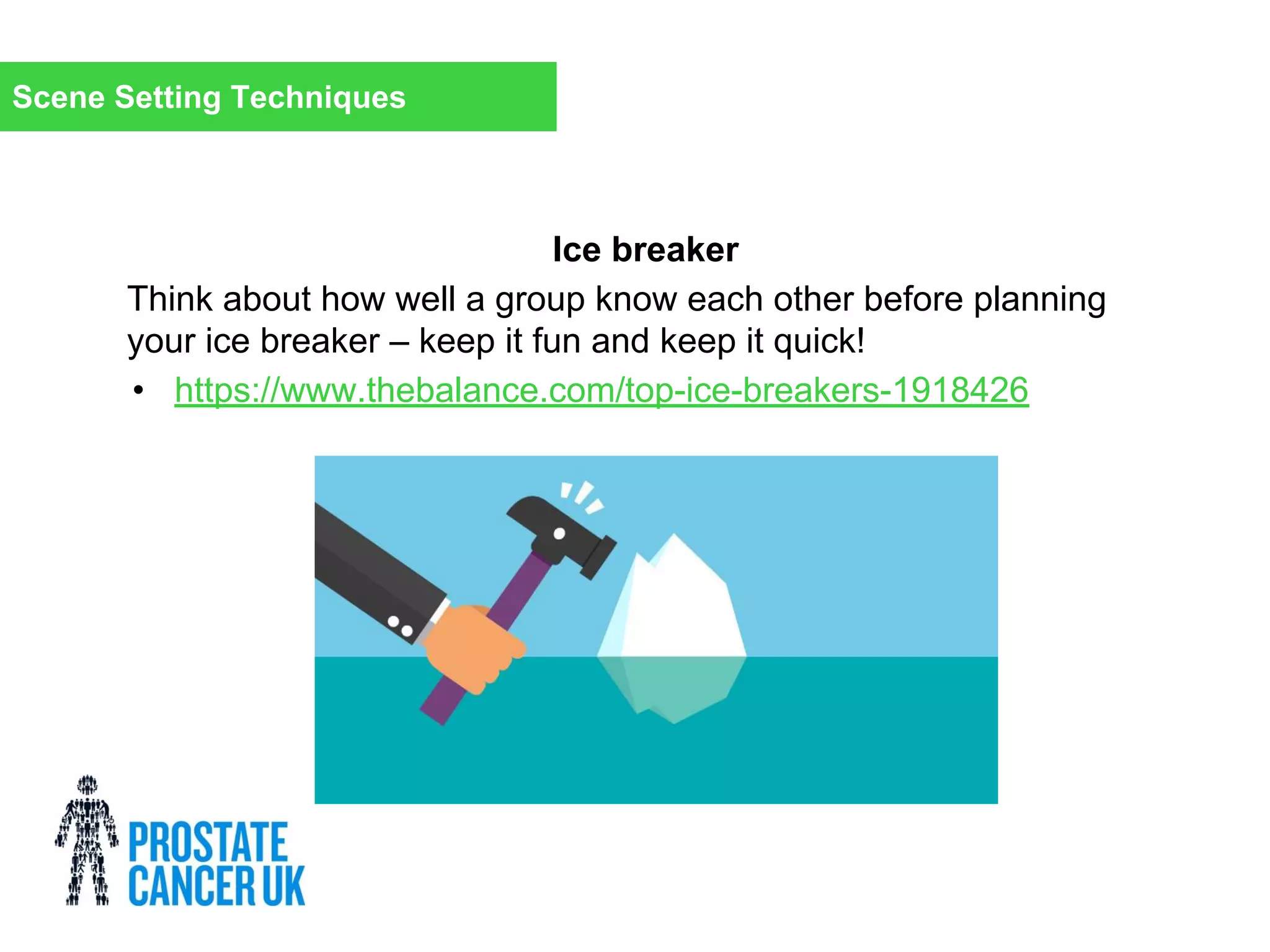
Ice breaker
Think about how well a group know each other before planning
your ice breaker – keep it fun and keep it quick!
• https://www.thebalance.com/top-ice-breakers-1918426
Scene Setting Techniques
Get to know the audience
• If a session is geared around a certain audience type, really
useful to do this.
• Best to ask specific questions for people to answer
individually/in small groups.
• Even is a session is based on a product, ask questions about
the existing audience types.
• Stimulus always really useful here
Scene Setting Techniques
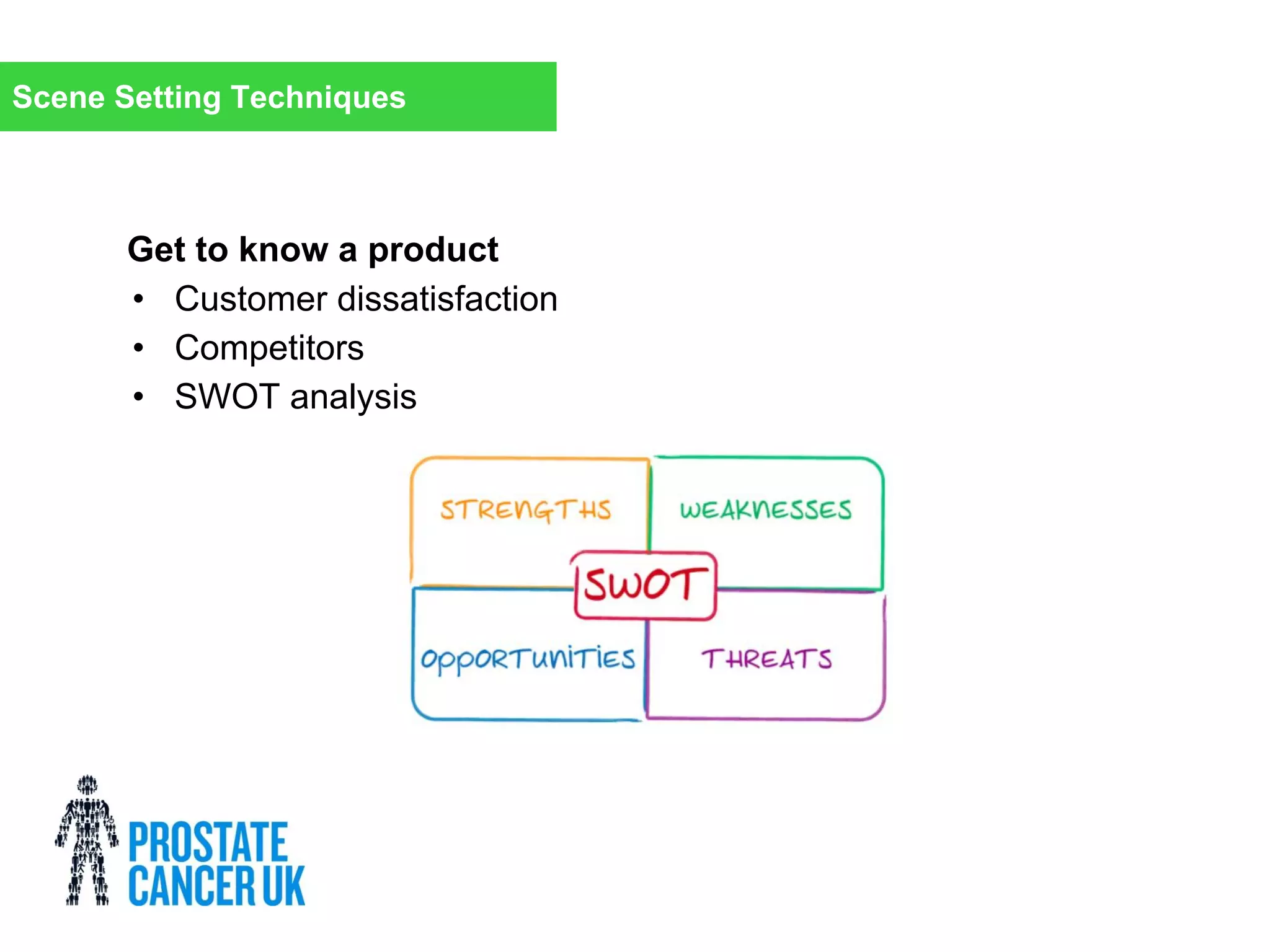
Get to know a product
• Customer dissatisfaction
• Competitors
• SWOT analysis
Scene Setting Techniques
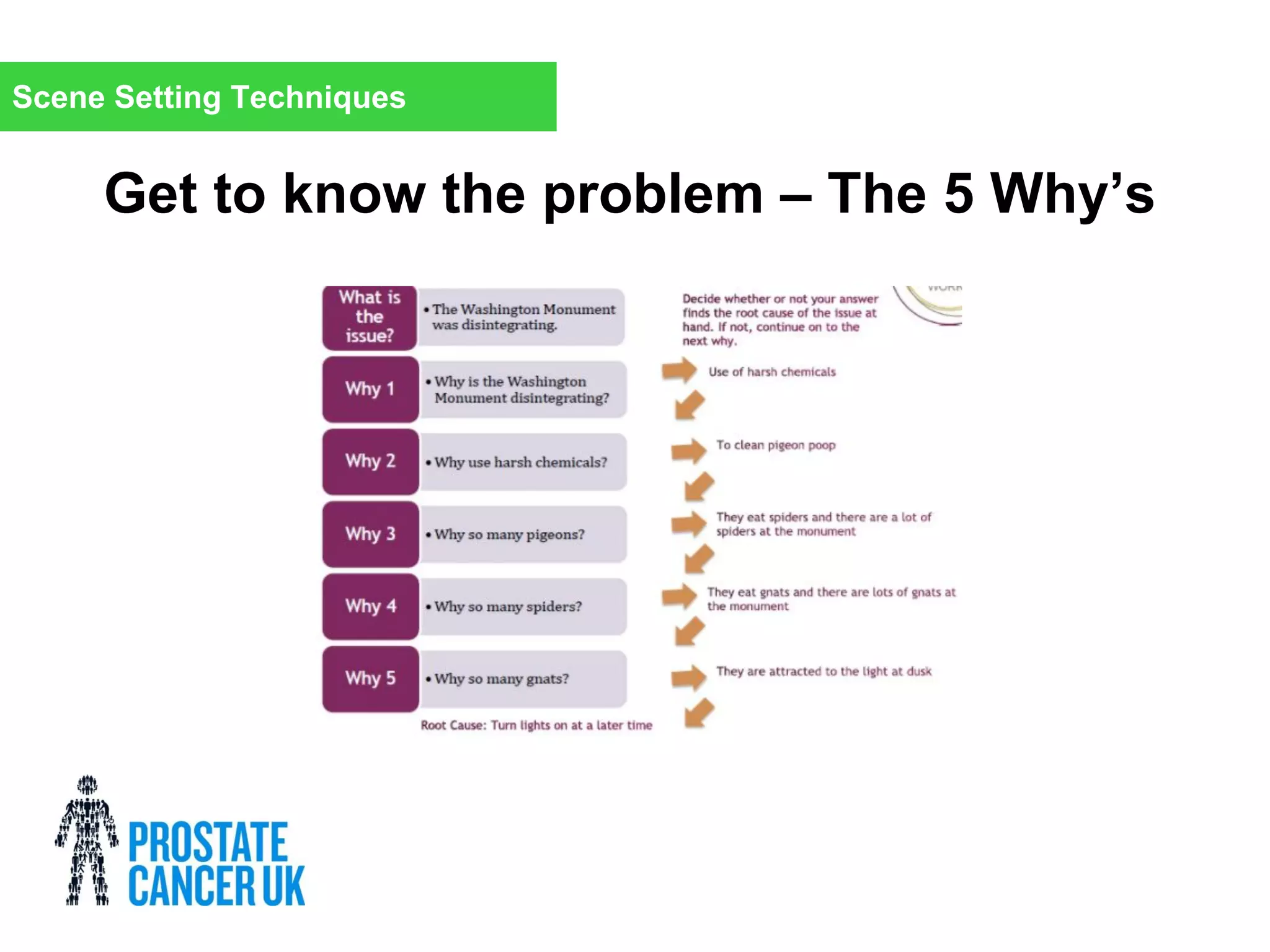
Get to know the problem – The 5 Why’s
Quick Fire Post It – 5 minutes
Start with a few broad topics e.g. “A tea party host”
With 1-2 minutes on the clock – how many words can you
associate with that one word?
OR
Asking a set of specific questions e.g. “Things men do in their past
time”
With 1-2 minutes on the clock, write as many answers as possible
Quantity Techniques
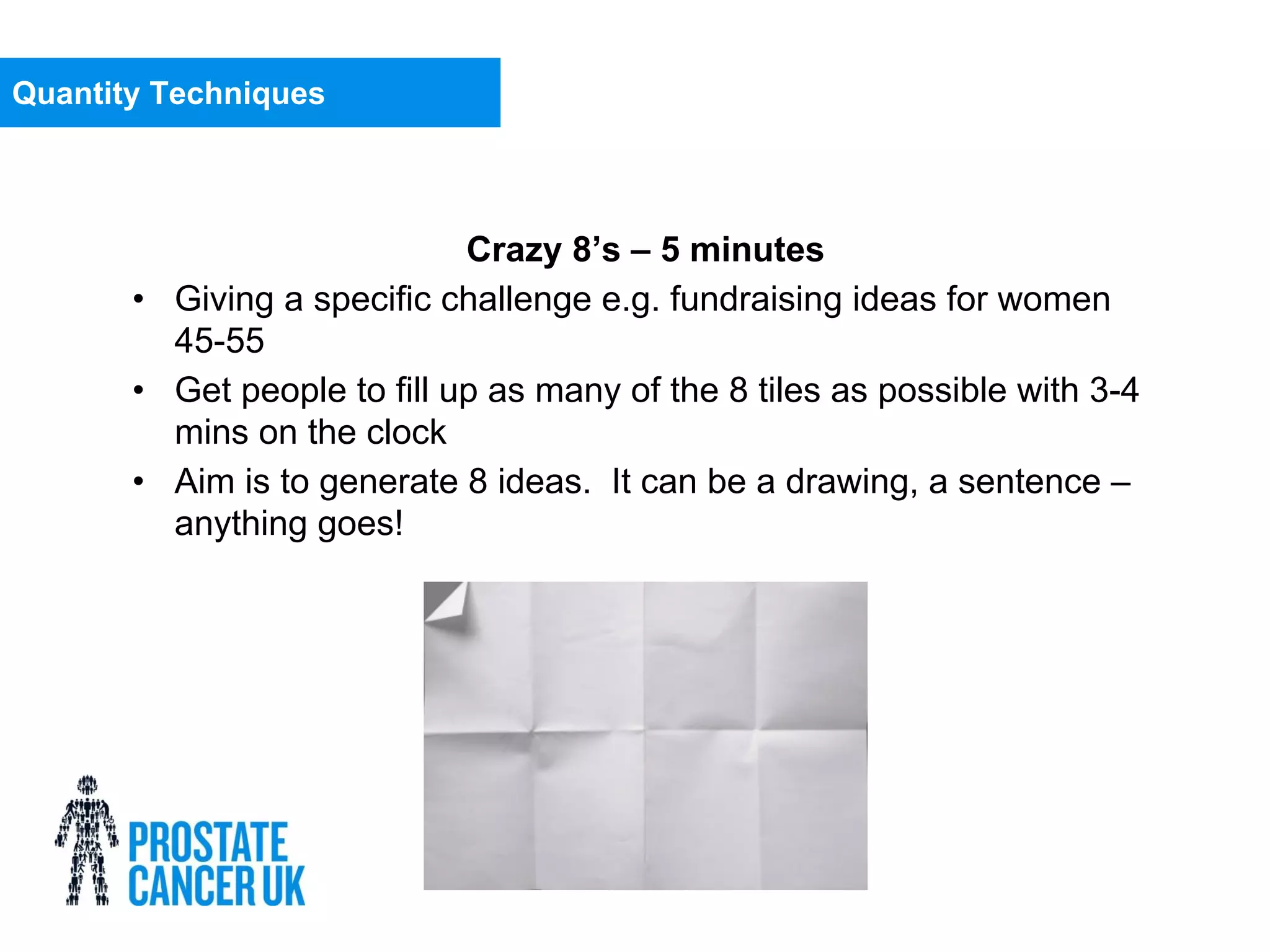
Crazy 8’s – 5 minutes
• Giving a specific challenge e.g. fundraising ideas for women
45-55
• Get people to fill up as many of the 8 tiles as possible with 3-4
mins on the clock
• Aim is to generate 8 ideas. It can be a drawing, a sentence –
anything goes!
Quantity Techniques
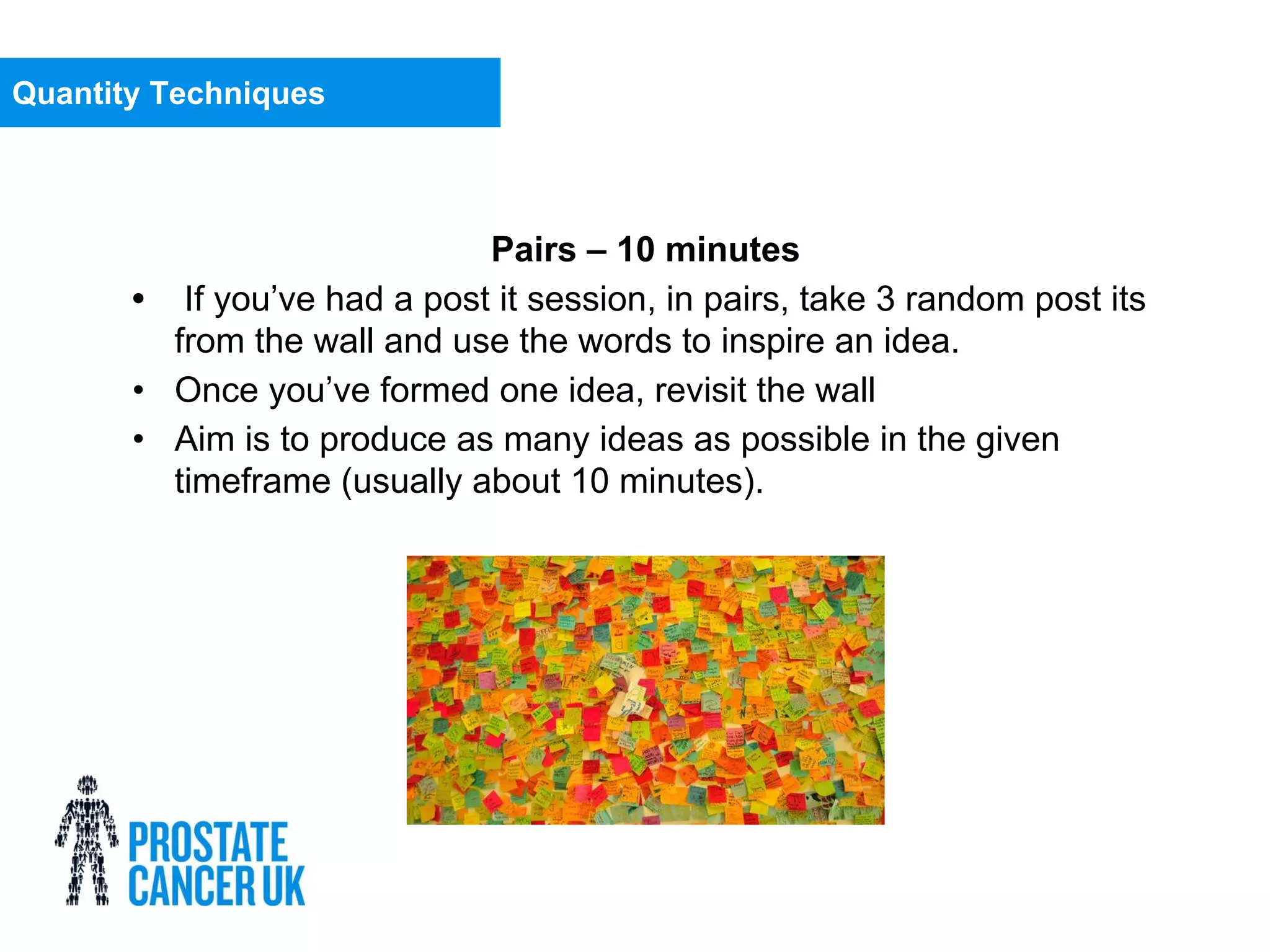
Pairs – 10 minutes
• If you’ve had a post it session, in pairs, take 3 random post its
from the wall and use the words to inspire an idea.
• Once you’ve formed one idea, revisit the wall
• Aim is to produce as many ideas as possible in the given
timeframe (usually about 10 minutes).
Quantity Techniques
Sharing
• After each high volume session you do (and I’d recommend
doing at least 2), it’s important that the participants regroup and
share their best ideas.
• Taking in turns, go around the room sharing your best ideas.
Quality Techniques
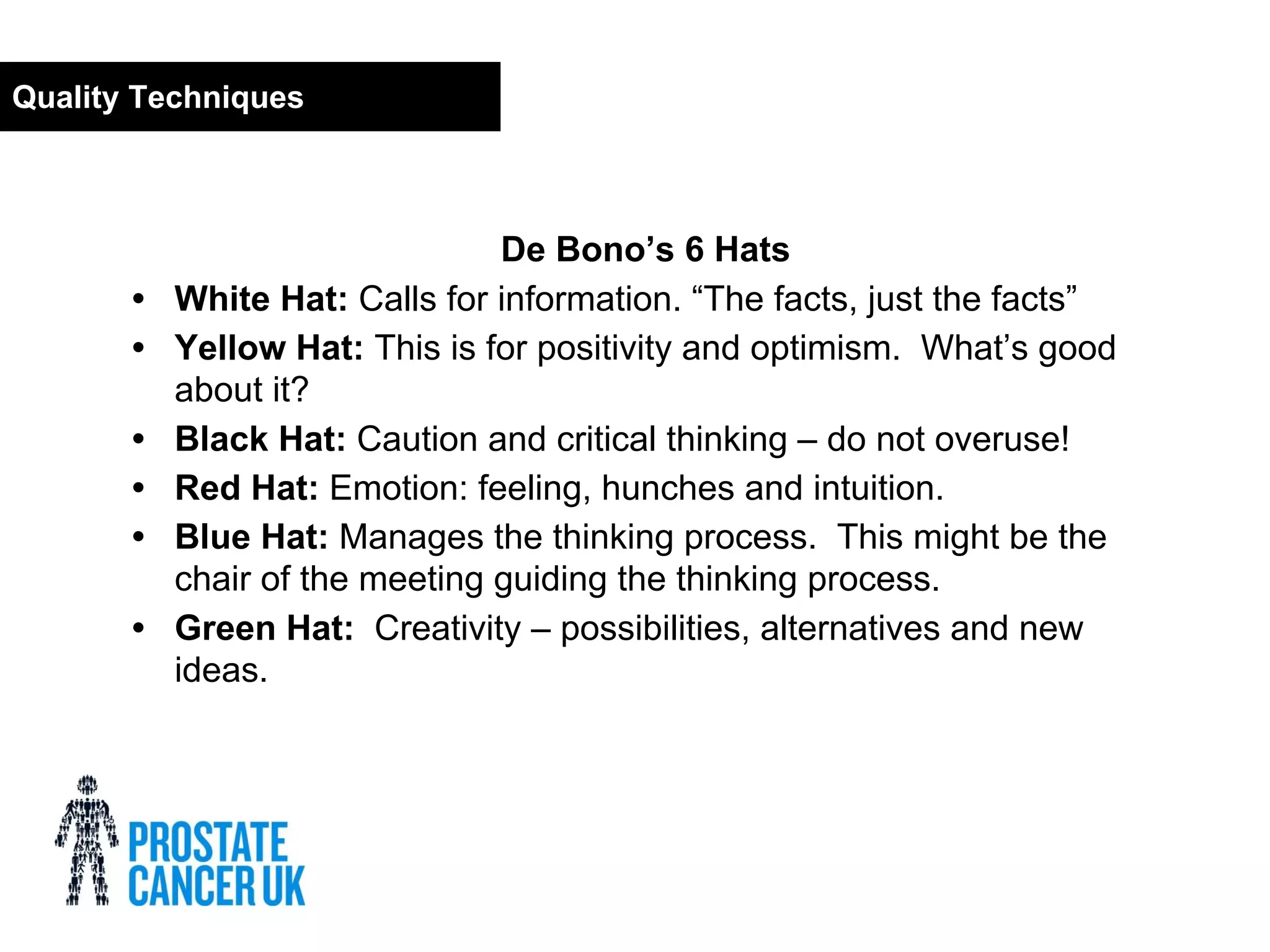
De Bono’s 6 Hats
• White Hat: Calls for information. “The facts, just the facts”
• Yellow Hat: This is for positivity and optimism. What’s good
about it?
• Black Hat: Caution and critical thinking – do not overuse!
• Red Hat: Emotion: feeling, hunches and intuition.
• Blue Hat: Manages the thinking process. This might be the
chair of the meeting guiding the thinking process.
• Green Hat: Creativity – possibilities, alternatives and new
ideas.
Quality Techniques
Build upon
• Depending on the size of the group, split them into groups of 3
– 6
• Ask them to decide as a group which idea they would like to
take forwards and build upon.
• Task them with now building on this idea to a more solid,
robust, workable concept.
• You might want to guide this exercise by having specific
questions on a screen.
Quality Techniques
Today’s case study: developing a new
fundraising product for men aged 45 - 60
“I love
accomplishing a
challenge”
“I love creating
something”
“Completing
something is my
biggest motivator”
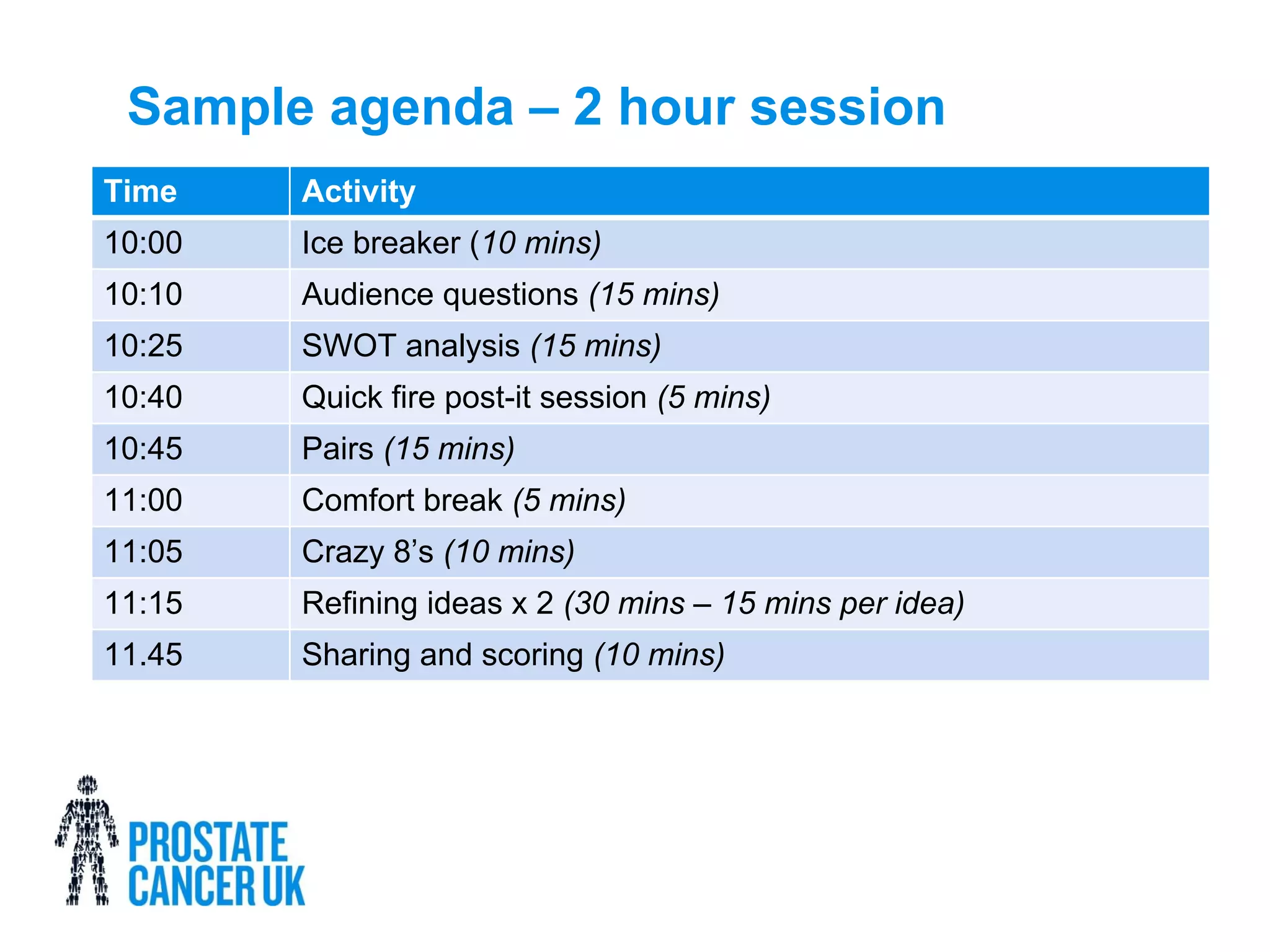
Sample agenda – 2 hour session
Time Activity
10:00 Ice breaker (10 mins)
10:10 Audience questions (15 mins)
10:25 SWOT analysis (15 mins)
10:40 Quick fire post-it session (5 mins)
10:45 Pairs (15 mins)
11:00 Comfort break (5 mins)
11:05 Crazy 8’s (10 mins)
11:15 Refining ideas x 2 (30 mins – 15 mins per idea)
11.45 Sharing and scoring (10 mins)
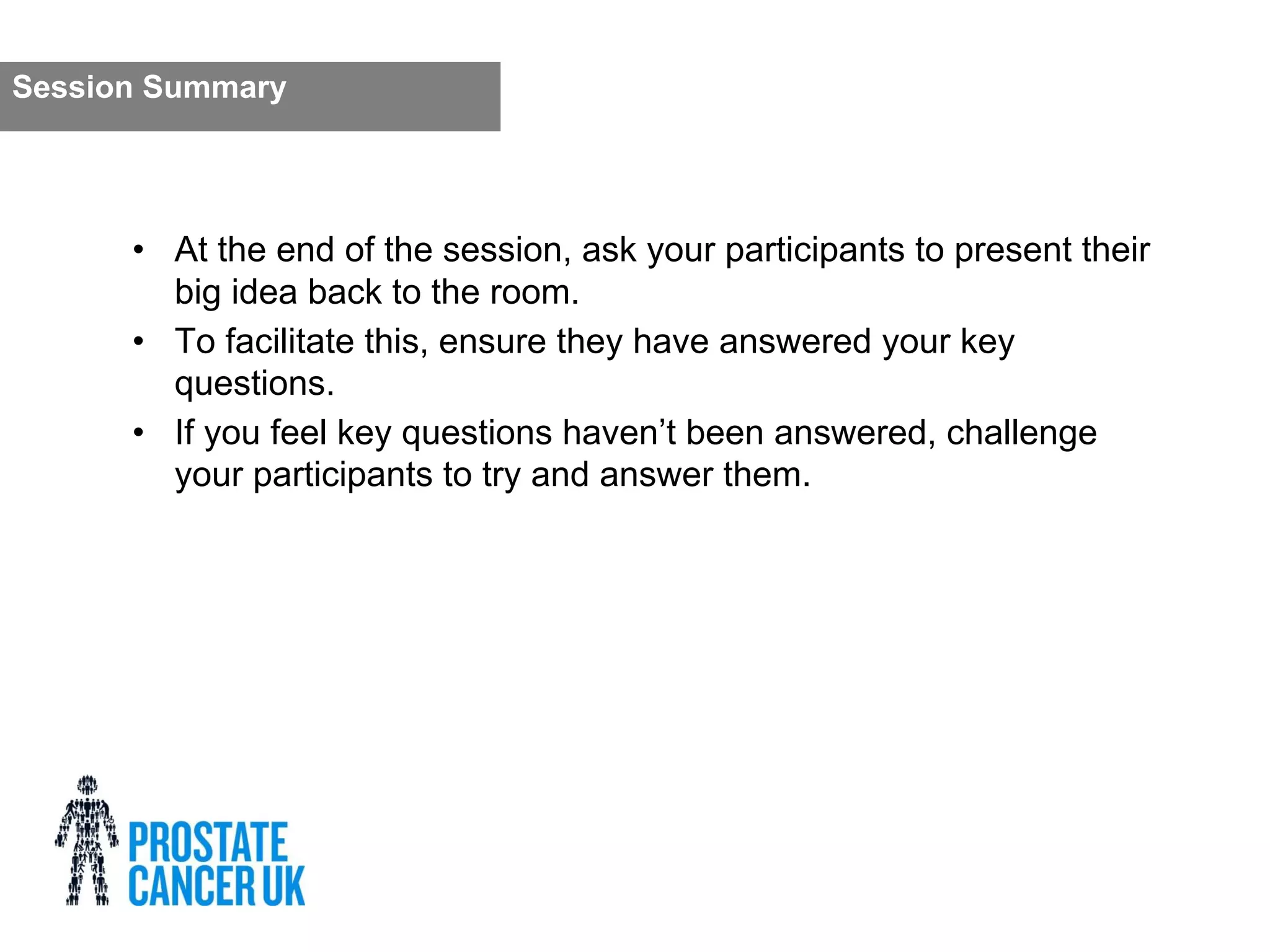
• At the end of the session, ask your participants to present their
big idea back to the room.
• To facilitate this, ensure they have answered your key
questions.
• If you feel key questions haven’t been answered, challenge
your participants to try and answer them.
Session Summary
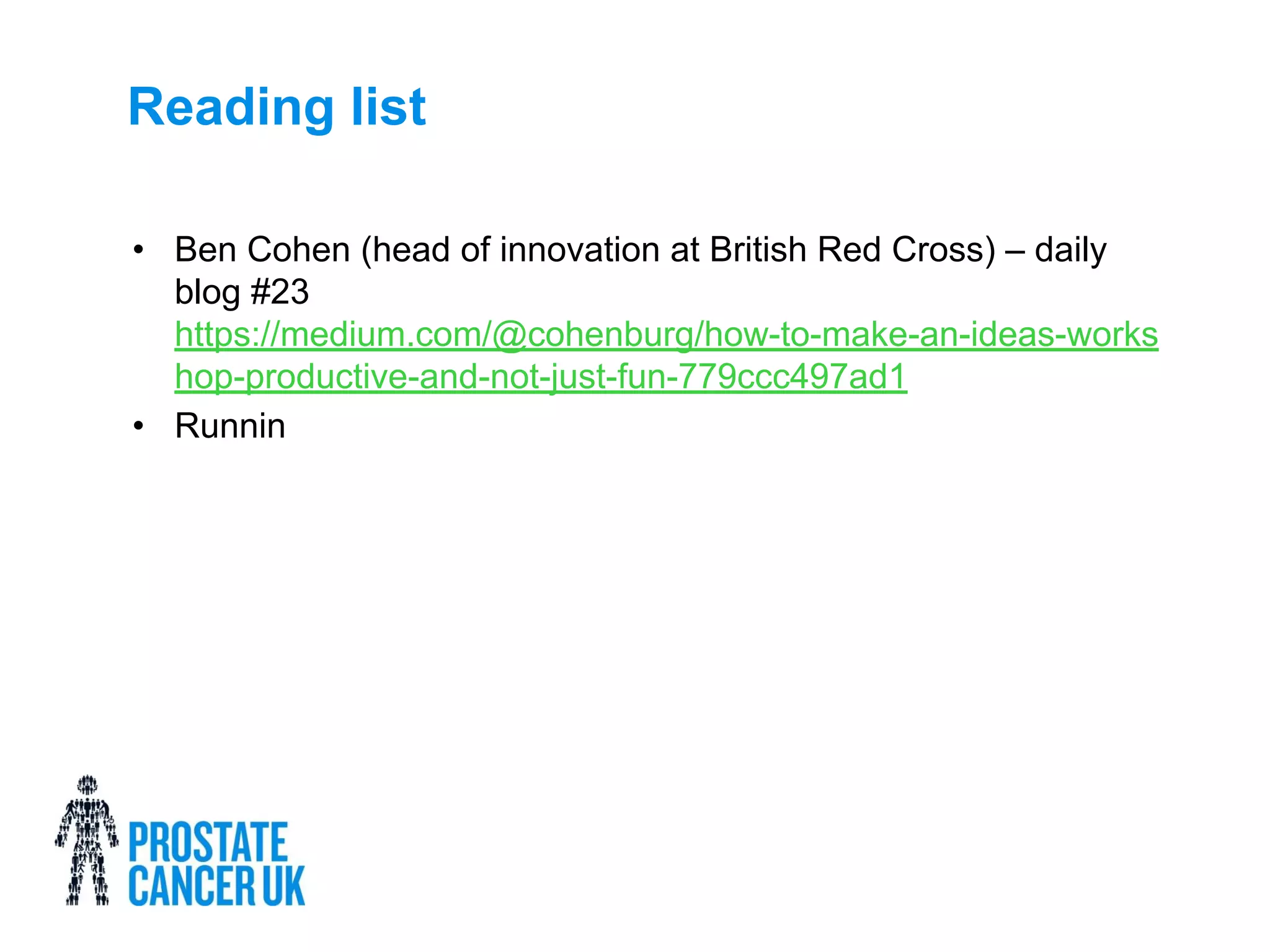
Reading list
• Ben Cohen (head of innovation at British Red Cross) – daily
blog #23
https://medium.com/@cohenburg/how-to-make-an-ideas-works
hop-productive-and-not-just-fun-779ccc497ad1
• Runnin

Running an idea generation workshop

  • 1.
    Running the astructured Idea Generation Session
  • 2.
    The Golden Rules 1.Be clear on what your aims are for the session 2. No negativity! Leave current processes and strong internal views at the door 3. Write down and record everything! 4. Love your participants 5. Always start with an ice breaker 6. Don’t start with a solution in mind 7. Be strict with your timing 8. Prepare, prepare, prepare!
  • 3.
    The Environment 1. Consideryour location 2. Keep people fuelled 3. Try to get a mix of people in the room 4. Timing: morning always wins! 5. Pre work 6. Think about stimulus, (images, samples, quotes) 7. Plan your materials ahead of the session
  • 4.
    Structure SCENE SETTING QUANTITY This partof a session should be all about volume of ideas – it’s always a really fun part where you can really let your inner creative run free! Here, you need to get as many new starting points as possible, no matter how crazy they might seem. Quality/Refining After reviewing and selecting the golden nuggets from the first session, this part of the session is all about building on and refining ideas. Small number of clear propositions
  • 5.
    Ice breaker Think abouthow well a group know each other before planning your ice breaker – keep it fun and keep it quick! • https://www.thebalance.com/top-ice-breakers-1918426 Scene Setting Techniques
  • 6.
    Get to knowthe audience • If a session is geared around a certain audience type, really useful to do this. • Best to ask specific questions for people to answer individually/in small groups. • Even is a session is based on a product, ask questions about the existing audience types. • Stimulus always really useful here Scene Setting Techniques
  • 7.
    Get to knowa product • Customer dissatisfaction • Competitors • SWOT analysis Scene Setting Techniques
  • 8.
    Scene Setting Techniques Getto know the problem – The 5 Why’s
  • 9.
    Quick Fire PostIt – 5 minutes Start with a few broad topics e.g. “A tea party host” With 1-2 minutes on the clock – how many words can you associate with that one word? OR Asking a set of specific questions e.g. “Things men do in their past time” With 1-2 minutes on the clock, write as many answers as possible Quantity Techniques
  • 10.
    Crazy 8’s –5 minutes • Giving a specific challenge e.g. fundraising ideas for women 45-55 • Get people to fill up as many of the 8 tiles as possible with 3-4 mins on the clock • Aim is to generate 8 ideas. It can be a drawing, a sentence – anything goes! Quantity Techniques
  • 11.
    Pairs – 10minutes • If you’ve had a post it session, in pairs, take 3 random post its from the wall and use the words to inspire an idea. • Once you’ve formed one idea, revisit the wall • Aim is to produce as many ideas as possible in the given timeframe (usually about 10 minutes). Quantity Techniques
  • 12.
    Sharing • After eachhigh volume session you do (and I’d recommend doing at least 2), it’s important that the participants regroup and share their best ideas. • Taking in turns, go around the room sharing your best ideas. Quality Techniques
  • 13.
    De Bono’s 6Hats • White Hat: Calls for information. “The facts, just the facts” • Yellow Hat: This is for positivity and optimism. What’s good about it? • Black Hat: Caution and critical thinking – do not overuse! • Red Hat: Emotion: feeling, hunches and intuition. • Blue Hat: Manages the thinking process. This might be the chair of the meeting guiding the thinking process. • Green Hat: Creativity – possibilities, alternatives and new ideas. Quality Techniques
  • 14.
    Build upon • Dependingon the size of the group, split them into groups of 3 – 6 • Ask them to decide as a group which idea they would like to take forwards and build upon. • Task them with now building on this idea to a more solid, robust, workable concept. • You might want to guide this exercise by having specific questions on a screen. Quality Techniques
  • 15.
    Today’s case study:developing a new fundraising product for men aged 45 - 60 “I love accomplishing a challenge” “I love creating something” “Completing something is my biggest motivator”
  • 16.
    Sample agenda –2 hour session Time Activity 10:00 Ice breaker (10 mins) 10:10 Audience questions (15 mins) 10:25 SWOT analysis (15 mins) 10:40 Quick fire post-it session (5 mins) 10:45 Pairs (15 mins) 11:00 Comfort break (5 mins) 11:05 Crazy 8’s (10 mins) 11:15 Refining ideas x 2 (30 mins – 15 mins per idea) 11.45 Sharing and scoring (10 mins)
  • 17.
    • At theend of the session, ask your participants to present their big idea back to the room. • To facilitate this, ensure they have answered your key questions. • If you feel key questions haven’t been answered, challenge your participants to try and answer them. Session Summary
  • 18.
    Reading list • BenCohen (head of innovation at British Red Cross) – daily blog #23 https://medium.com/@cohenburg/how-to-make-an-ideas-works hop-productive-and-not-just-fun-779ccc497ad1 • Runnin