CharityComms
Trends in a turbulent world
Michele Madden
2
Sources
3
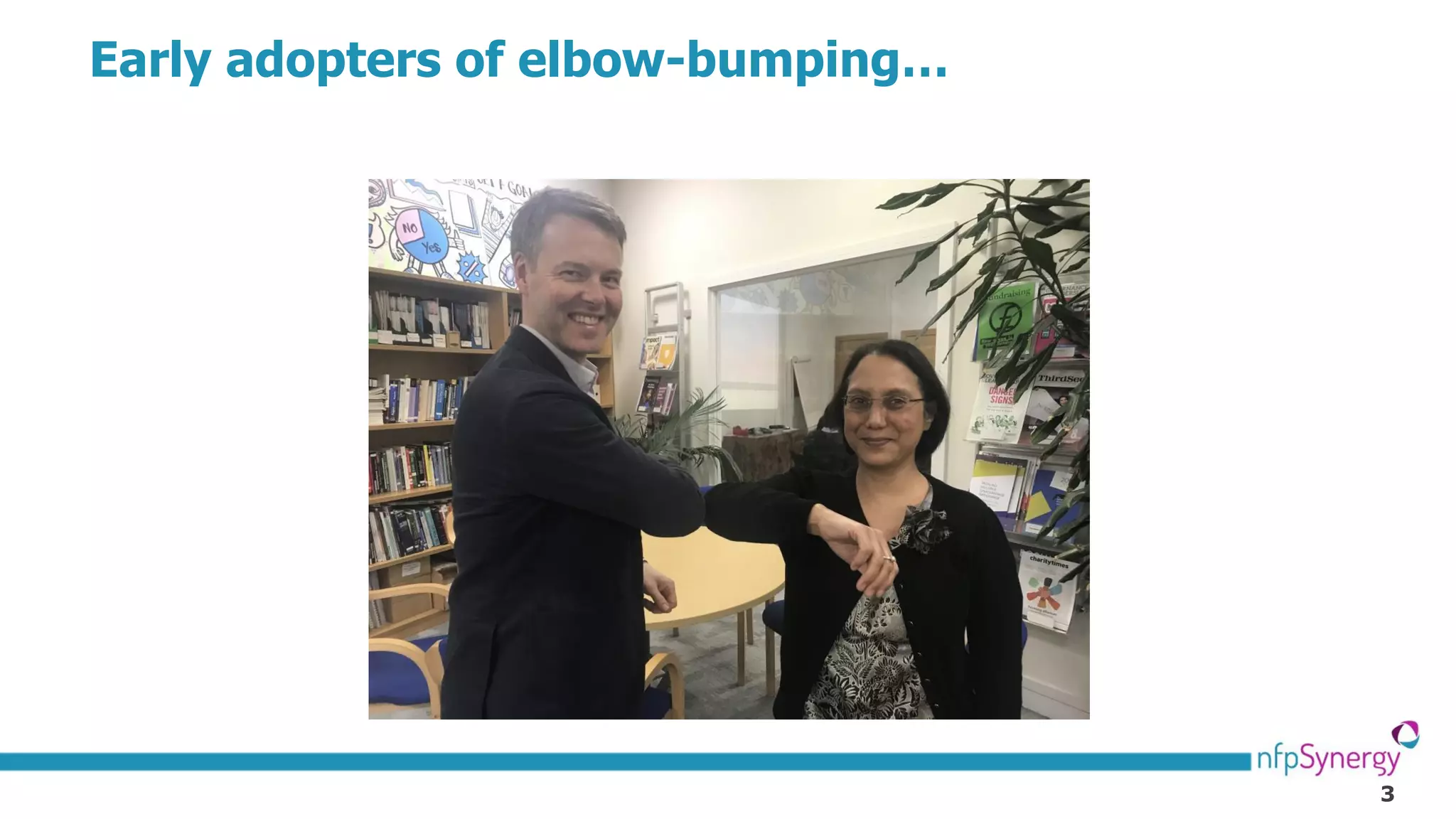
Early adopters of elbow-bumping…
4
Different ways of working
• Steady increase in flexible working across nearly all sectors in response to technological and cultural changes
– Globalisation, growth in the service economy, and increase in gig economy have changed the relationship between
workers and their employers
• Workers beginning to join together again, technology enabling that to happen – WhatsApp
– New types of organisations such as Organise, Earwig and Workerbird
• The value of unpaid work is beginning to be recognised – ONS calculator
• Not just working from home, but flexible hours, different models of reporting, structures…
• Many organisations have been fearful of these changes. Will Covid-19 create a step-change in practice?
• Will these changes enable us to do our jobs better?
5
Youth rising
• Increased longevity means many generations living on top of each other
• Major events have solidified our views on key topics (2008, 2016) leading to conflict between generations
– Brexit and the blame for climate crisis placed on older generations
• Different generations have different versions of the ideal charity
– Millennials are not increasing their awareness of charities as they get older
• It was ever thus….. but need to understand how generational changes are going to affect your organisation in the
medium / long term
• How to enable and listen to new generations’ views and demands
• And see how we can help to heal the divide?
6
Westminster refresh
• Echoes of Brexit will still resound in parliament but primary legislation is back. Charities can now plan their long
term strategies
• While the change of MPs has resulted in a loss of relationships charities had built up, there are new MPs to work
with to shape the relationship with from the start
• The parliamentary majority means the government is not currently in 'listening mode’ and…
• …therefore the power of the electorate has diminished, how can charities hold government to account in a more
hostile environment?
• Charities need to think about not only reframing their issues for Conservative MPs, but also for a Conservative
public
7
Local connections
• Technology is enabling people to connect with their peers for personal and commercial gain
• Group buying is growing – with consumers joining together to buy in bulk to achieve discounts.
– Group purchases of big-ticket items like cars enable consumers to share costs – both financial and environmental
• Health-based peer communities online have been around for a while, but this is now happening IRL
– Group doctor’s appointments
• Try to tap into local networks to build community fundraising and set up crowdfunding models for specific
projects.
• Can past beneficiaries help those currently in need?
8
Fundraising will change in next decade
• See the gradual decline in direct debits, tin-rattling, cheques and door to door collections
• Lotteries, events and major donors will be thriving
• Legacy giving will stagnate
• New methods will continue to appear – eg birthday giving
• The move to cashless is complicated
– Issues of privacy and anonymity
– Need to be careful to not inadvertently discriminate against those who don’t have access to the digital economy
• Charities fundraising to complement public service provision will become more mainstream, but will this muddy
the distinctiveness of the voluntary sector?
9
Mental health
• As an issue has been rising up the agenda through increased media coverage and high profile campaigns
– of increasing concern to the general public and politicians
• Toxic nature of engagements on social media, parliament + turbulent times
– Death of Caroline Flack
– Online attacks of (mainly) female politicians and public figures
– Fear and anger are the emotions that have increased the most when we ask the general public about the environment
– Cuts to the NHS – this worry may increase now in light of Covid-19
• Mental health is one of the areas where brand awareness is out-performing the trend with younger people
• Difficult to get the balance right – dial up concern and anxiety about the world or try and reassure?
• All need to get better at dealing with, supporting and working to improve mental health in all aspects of life
10
The environment in the Adaptive Age
• Urgency and acceptance of climate change as an issue has increased across all audiences
– growth in protest and eco-anxiety
– growing number who rate a healthy environment as more important than a healthy economy
• We now need to adapt as well as prevent. Beginning to see changes in how people organise and live their lives –
flood proofing, energy efficiencies, changing diet, travel and work patterns
– unexpected events can cause big changes
• For those in the environmental field, how to make the most of this step-change, give the big picture and clear
actions for individuals and groups at different levels (personal action, campaigning)
• For those in other areas making sure that services and activities are responsive to the new normal – clear
recycling, work at home and travel policies,
11
Pop up culture
• Space is expensive, pop-ups allow freedom from commitment but also freedom to experiment
– we’re more likely to go to something it its only there for a limited time
• Charity shops – allow charities to test the demographic in a particular area and try new things with less risk
• Service delivery
– Asda hosted alcohol advisers from DrinkAware
– Grocery stores host nutrition classes
• Fundraising – community events, promotions, campaigns
• Opportunities to partner with brands?
12
Spoken word
• We are accompanied by audio at all times with near-constant access to audio content
• Sound allows us to multitask, able to listen to content while doing other things like travelling, cooking and
working
• 7.1 million people in the UK now listen to podcasts each week, how can you get into people’s homes?
• Create your own or piggy-back someone else’s?
• Voice assistant use is set to grow even more
• Sonic logos – what’s your aural identity?
13
Free reports
https://nfpsynergy.net/free-reports-and-presentations
14
2-6 Tenter Ground
Spitalfields
London E1 7NH
www.nfpsynergy.net
+44 (0)20 7426 8888
insight@nfpsynergy.net
nfpsynergy
nfpsynergy
nfpsynergy
Registered office: 2-6 Tenter Ground Spitalfields London E1 7NH. Registered in England No. 04387900. VAT Registration 839 8186 72
5 March 2020
Conference: Changing hearts and
minds: social science insights for
communicators
Visit the CharityComms website to view
slides from past events, see what events
we have coming up and to check out
what else we do:
www.charitycomms.org.uk

Trends in a turbulent world

  • 1.
    CharityComms Trends in aturbulent world Michele Madden
  • 2.
  • 3.
    3 Early adopters ofelbow-bumping…
  • 4.
    4 Different ways ofworking • Steady increase in flexible working across nearly all sectors in response to technological and cultural changes – Globalisation, growth in the service economy, and increase in gig economy have changed the relationship between workers and their employers • Workers beginning to join together again, technology enabling that to happen – WhatsApp – New types of organisations such as Organise, Earwig and Workerbird • The value of unpaid work is beginning to be recognised – ONS calculator • Not just working from home, but flexible hours, different models of reporting, structures… • Many organisations have been fearful of these changes. Will Covid-19 create a step-change in practice? • Will these changes enable us to do our jobs better?
  • 5.
    5 Youth rising • Increasedlongevity means many generations living on top of each other • Major events have solidified our views on key topics (2008, 2016) leading to conflict between generations – Brexit and the blame for climate crisis placed on older generations • Different generations have different versions of the ideal charity – Millennials are not increasing their awareness of charities as they get older • It was ever thus….. but need to understand how generational changes are going to affect your organisation in the medium / long term • How to enable and listen to new generations’ views and demands • And see how we can help to heal the divide?
  • 6.
    6 Westminster refresh • Echoesof Brexit will still resound in parliament but primary legislation is back. Charities can now plan their long term strategies • While the change of MPs has resulted in a loss of relationships charities had built up, there are new MPs to work with to shape the relationship with from the start • The parliamentary majority means the government is not currently in 'listening mode’ and… • …therefore the power of the electorate has diminished, how can charities hold government to account in a more hostile environment? • Charities need to think about not only reframing their issues for Conservative MPs, but also for a Conservative public
  • 7.
    7 Local connections • Technologyis enabling people to connect with their peers for personal and commercial gain • Group buying is growing – with consumers joining together to buy in bulk to achieve discounts. – Group purchases of big-ticket items like cars enable consumers to share costs – both financial and environmental • Health-based peer communities online have been around for a while, but this is now happening IRL – Group doctor’s appointments • Try to tap into local networks to build community fundraising and set up crowdfunding models for specific projects. • Can past beneficiaries help those currently in need?
  • 8.
    8 Fundraising will changein next decade • See the gradual decline in direct debits, tin-rattling, cheques and door to door collections • Lotteries, events and major donors will be thriving • Legacy giving will stagnate • New methods will continue to appear – eg birthday giving • The move to cashless is complicated – Issues of privacy and anonymity – Need to be careful to not inadvertently discriminate against those who don’t have access to the digital economy • Charities fundraising to complement public service provision will become more mainstream, but will this muddy the distinctiveness of the voluntary sector?
  • 9.
    9 Mental health • Asan issue has been rising up the agenda through increased media coverage and high profile campaigns – of increasing concern to the general public and politicians • Toxic nature of engagements on social media, parliament + turbulent times – Death of Caroline Flack – Online attacks of (mainly) female politicians and public figures – Fear and anger are the emotions that have increased the most when we ask the general public about the environment – Cuts to the NHS – this worry may increase now in light of Covid-19 • Mental health is one of the areas where brand awareness is out-performing the trend with younger people • Difficult to get the balance right – dial up concern and anxiety about the world or try and reassure? • All need to get better at dealing with, supporting and working to improve mental health in all aspects of life
  • 10.
    10 The environment inthe Adaptive Age • Urgency and acceptance of climate change as an issue has increased across all audiences – growth in protest and eco-anxiety – growing number who rate a healthy environment as more important than a healthy economy • We now need to adapt as well as prevent. Beginning to see changes in how people organise and live their lives – flood proofing, energy efficiencies, changing diet, travel and work patterns – unexpected events can cause big changes • For those in the environmental field, how to make the most of this step-change, give the big picture and clear actions for individuals and groups at different levels (personal action, campaigning) • For those in other areas making sure that services and activities are responsive to the new normal – clear recycling, work at home and travel policies,
  • 11.
    11 Pop up culture •Space is expensive, pop-ups allow freedom from commitment but also freedom to experiment – we’re more likely to go to something it its only there for a limited time • Charity shops – allow charities to test the demographic in a particular area and try new things with less risk • Service delivery – Asda hosted alcohol advisers from DrinkAware – Grocery stores host nutrition classes • Fundraising – community events, promotions, campaigns • Opportunities to partner with brands?
  • 12.
    12 Spoken word • Weare accompanied by audio at all times with near-constant access to audio content • Sound allows us to multitask, able to listen to content while doing other things like travelling, cooking and working • 7.1 million people in the UK now listen to podcasts each week, how can you get into people’s homes? • Create your own or piggy-back someone else’s? • Voice assistant use is set to grow even more • Sonic logos – what’s your aural identity?
  • 13.
  • 14.
    14 2-6 Tenter Ground Spitalfields LondonE1 7NH www.nfpsynergy.net +44 (0)20 7426 8888 insight@nfpsynergy.net nfpsynergy nfpsynergy nfpsynergy Registered office: 2-6 Tenter Ground Spitalfields London E1 7NH. Registered in England No. 04387900. VAT Registration 839 8186 72
  • 15.
    5 March 2020 Conference:Changing hearts and minds: social science insights for communicators
  • 16.
    Visit the CharityCommswebsite to view slides from past events, see what events we have coming up and to check out what else we do: www.charitycomms.org.uk