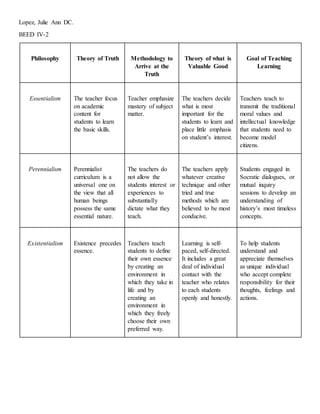
Lopez, Julie Ann DC.
BEED IV-2
Philosophy Theory of Truth Methodology to
Arrive at the
Truth
Theory of what is
Valuable Good
Goal of Teaching
Learning
Essentialism The teacher focus
on academic
content for
students to learn
the basic skills.
Teacher emphasize
mastery of subject
matter.
The teachers decide
what is most
important for the
students to learn and
place little emphasis
on student’s interest.
Teachers teach to
transmit the traditional
moral values and
intellectual knowledge
that students need to
become model
citizens.
Perennialism Perennialist
curriculum is a
universal one on
the view that all
human beings
possess the same
essential nature.
The teachers do
not allow the
students interest or
experiences to
substantially
dictate what they
teach.
The teachers apply
whatever creative
technique and other
tried and true
methods which are
believed to be most
conducive.
Students engaged in
Socratic dialogues, or
mutual inquiry
sessions to develop an
understanding of
history’s most timeless
concepts.
Existentialism Existence precedes
essence.
Teachers teach
students to define
their own essence
by creating an
environment in
which they take in
life and by
creating an
environment in
which they freely
choose their own
preferred way.
Learning is self-
paced, self-directed.
It includes a great
deal of individual
contact with the
teacher who relates
to each students
openly and honestly.
To help students
understand and
appreciate themselves
as unique individual
who accept complete
responsibility for their
thoughts, feelings and
actions.
Linguistic The more
language one
speaks, the better
students can
communicate with
the world.
Make them
experience sending
and receiving
messages through
verbal, non-verbal
and paraverbal.
Teachers teach
students to speak as
many as they can.
To develop the
communication skills
of the learner because
the ability to
articulates, to voice
out the meaning and
values of things that
one obtains from
his/her experience of
life and the world is
the very essence of
man.
Behaviorism Behaviorist are
concerned with
shaping of
students behavior
by providing for a
favorable
environment.
Teachers ought to
arrange
environmental
conditions so that
students can make
the responses to
stimuli.
Values are also
caught (catch) not
only taught (teach).
Develop student’s
behavior.
Constructivism Knowledge is
constructed by
learners through
an active, mental
process of
development.
Teachers must
provide students
with data or
experiences than
allow them to
hypothesize,
predict, manipulate
objects, pose
questions,
research,
investigate,
imagine and
invent.
Constructivist
classroom is
interactive, it
promotes dialogical
exchange of ideas
among learners and
between teacher and
learners.
To develop
intrinsically motivated
and independent
learners adequately
equipped with learning
skills for them to able
to construct
knowledge and
making meaning of
them.
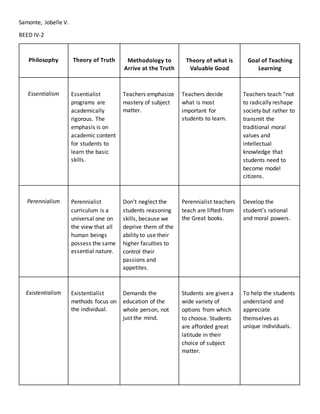
Samonte, Jobelle V.
BEED IV-2
Philosophy Theory of Truth Methodology to
Arrive at the Truth
Theory of what is
Valuable Good
Goal of Teaching
Learning
Essentialism Essentialist
programs are
academically
rigorous. The
emphasis is on
academic content
for students to
learn the basic
skills.
Teachers emphasize
mastery of subject
matter.
Teachers decide
what is most
important for
students to learn.
Teachers teach “not
to radically reshape
society but rather to
transmit the
traditional moral
values and
intellectual
knowledge that
students need to
become model
citizens.
Perennialism Perennialist
curriculum is a
universal one on
the view that all
human beings
possess the same
essential nature.
Don’t neglect the
students reasoning
skills, because we
deprive them of the
ability to use their
higher faculties to
control their
passions and
appetites.
Perennialist teachers
teach are lifted from
the Great books.
Develop the
student’s rational
and moral powers.
Existentialism Existentialist
methods focus on
the individual.
Demands the
education of the
whole person, not
just the mind.
Students are given a
wide variety of
options from which
to choose. Students
are afforded great
latitude in their
choice of subject
matter.
To help the students
understand and
appreciate
themselves as
unique individuals.
Behaviorism
Linguistic Communication is
the ability to
articulate, to
voice out the
meaning of things
that one’s
obtains.
Learners should be
taught to
communicate
clearly.
Teachers teach
students to
communicate in
experiential way.
To help the students
to develop their
communication
skills.
Constructivism Learners are the
builders and
creators of
meaning and
knowledge.
Teacher provides
interactive
classroom.
Promotes dialogical
exchange of ideas
among learners and
between teacher
and learners.
Teachers let the
students to be able
to construct
knowledge and make
meaning of them.
Help the students
construct their own
ideas and knowledge
though active and
mental process.
Francia, Agustina A.
BEED IV-2
Philosophy Theory of Truth Methodology to
Arrive at the
Truth
Theory of what is
Valuable Good
Goal of Teaching
Learning
Essentialism Teachers teach
not to radically
reshape society
but rather to
transmit the
traditional moral
values and
intellectual
knowledge that
students need to
become model
citizens.
Essentialist
teachers must
have their mastery
of subject matter.
The teachers teach
the students what
is most important
or what the
students need.
Teachers help the
students to acquire
basic knowledge.
Perennialism “all human
beings possess
the same
essential
nature.”
Let the students
use their
reasoning skills.
The perennialist
teachers teach are
lifted from the
Great Books.
Schools should
develop the
students rational
and moral powers.
Existentialism Existentialists
focus upon the
actions of
historical
individuals.
Provide students
with vicarious
experiences that
will help unleash
their own creativity
and self-
expassion.
Learning is self-
paced, self-
directed.
Existentialist focus
on individual.
To help the
students know
themselves and
their place in
society.
Behaviorism
Linguistic Learners should
be taught to
communicate
clearly.
Teach them to use
language clearly.
Teach them the 3
ways of
communication,
the verbal, non-
verbal and
paraverbal.
Teachers facilitate
dialogue with
her/his students
because in the
exchange of words
there is also
exchange of ideas.
To help the
students develop
their
communication
skills that they will
use in their
everyday life.
Constructivism Their minds are
not empty.
Instead, their
minds are full of
ideas waiting to
be “midwifed” by
the teacher with
his/her skillful
facilitating skills.
Let the learners
create their own
ideas, let them
hypothesize,
predict, manipulate
objects,
investigate and
invent.
Learners are able
to use their own
ideas to
construct/build
meaning and
knowledge.
To develop
intrinsically
motivated and
independent
learners
adequately
equipped with
learning kills for
them to be able to
construct
knowledge and
make meaning of
them.

Philosophy in teaching

  • 1.
    Lopez, Julie AnnDC. BEED IV-2 Philosophy Theory of Truth Methodology to Arrive at the Truth Theory of what is Valuable Good Goal of Teaching Learning Essentialism The teacher focus on academic content for students to learn the basic skills. Teacher emphasize mastery of subject matter. The teachers decide what is most important for the students to learn and place little emphasis on student’s interest. Teachers teach to transmit the traditional moral values and intellectual knowledge that students need to become model citizens. Perennialism Perennialist curriculum is a universal one on the view that all human beings possess the same essential nature. The teachers do not allow the students interest or experiences to substantially dictate what they teach. The teachers apply whatever creative technique and other tried and true methods which are believed to be most conducive. Students engaged in Socratic dialogues, or mutual inquiry sessions to develop an understanding of history’s most timeless concepts. Existentialism Existence precedes essence. Teachers teach students to define their own essence by creating an environment in which they take in life and by creating an environment in which they freely choose their own preferred way. Learning is self- paced, self-directed. It includes a great deal of individual contact with the teacher who relates to each students openly and honestly. To help students understand and appreciate themselves as unique individual who accept complete responsibility for their thoughts, feelings and actions.
  • 2.
    Linguistic The more languageone speaks, the better students can communicate with the world. Make them experience sending and receiving messages through verbal, non-verbal and paraverbal. Teachers teach students to speak as many as they can. To develop the communication skills of the learner because the ability to articulates, to voice out the meaning and values of things that one obtains from his/her experience of life and the world is the very essence of man. Behaviorism Behaviorist are concerned with shaping of students behavior by providing for a favorable environment. Teachers ought to arrange environmental conditions so that students can make the responses to stimuli. Values are also caught (catch) not only taught (teach). Develop student’s behavior. Constructivism Knowledge is constructed by learners through an active, mental process of development. Teachers must provide students with data or experiences than allow them to hypothesize, predict, manipulate objects, pose questions, research, investigate, imagine and invent. Constructivist classroom is interactive, it promotes dialogical exchange of ideas among learners and between teacher and learners. To develop intrinsically motivated and independent learners adequately equipped with learning skills for them to able to construct knowledge and making meaning of them.
  • 3.
    Samonte, Jobelle V. BEEDIV-2 Philosophy Theory of Truth Methodology to Arrive at the Truth Theory of what is Valuable Good Goal of Teaching Learning Essentialism Essentialist programs are academically rigorous. The emphasis is on academic content for students to learn the basic skills. Teachers emphasize mastery of subject matter. Teachers decide what is most important for students to learn. Teachers teach “not to radically reshape society but rather to transmit the traditional moral values and intellectual knowledge that students need to become model citizens. Perennialism Perennialist curriculum is a universal one on the view that all human beings possess the same essential nature. Don’t neglect the students reasoning skills, because we deprive them of the ability to use their higher faculties to control their passions and appetites. Perennialist teachers teach are lifted from the Great books. Develop the student’s rational and moral powers. Existentialism Existentialist methods focus on the individual. Demands the education of the whole person, not just the mind. Students are given a wide variety of options from which to choose. Students are afforded great latitude in their choice of subject matter. To help the students understand and appreciate themselves as unique individuals.
  • 4.
    Behaviorism Linguistic Communication is theability to articulate, to voice out the meaning of things that one’s obtains. Learners should be taught to communicate clearly. Teachers teach students to communicate in experiential way. To help the students to develop their communication skills. Constructivism Learners are the builders and creators of meaning and knowledge. Teacher provides interactive classroom. Promotes dialogical exchange of ideas among learners and between teacher and learners. Teachers let the students to be able to construct knowledge and make meaning of them. Help the students construct their own ideas and knowledge though active and mental process.
  • 5.
    Francia, Agustina A. BEEDIV-2 Philosophy Theory of Truth Methodology to Arrive at the Truth Theory of what is Valuable Good Goal of Teaching Learning Essentialism Teachers teach not to radically reshape society but rather to transmit the traditional moral values and intellectual knowledge that students need to become model citizens. Essentialist teachers must have their mastery of subject matter. The teachers teach the students what is most important or what the students need. Teachers help the students to acquire basic knowledge. Perennialism “all human beings possess the same essential nature.” Let the students use their reasoning skills. The perennialist teachers teach are lifted from the Great Books. Schools should develop the students rational and moral powers. Existentialism Existentialists focus upon the actions of historical individuals. Provide students with vicarious experiences that will help unleash their own creativity and self- expassion. Learning is self- paced, self- directed. Existentialist focus on individual. To help the students know themselves and their place in society. Behaviorism
  • 6.
    Linguistic Learners should betaught to communicate clearly. Teach them to use language clearly. Teach them the 3 ways of communication, the verbal, non- verbal and paraverbal. Teachers facilitate dialogue with her/his students because in the exchange of words there is also exchange of ideas. To help the students develop their communication skills that they will use in their everyday life. Constructivism Their minds are not empty. Instead, their minds are full of ideas waiting to be “midwifed” by the teacher with his/her skillful facilitating skills. Let the learners create their own ideas, let them hypothesize, predict, manipulate objects, investigate and invent. Learners are able to use their own ideas to construct/build meaning and knowledge. To develop intrinsically motivated and independent learners adequately equipped with learning kills for them to be able to construct knowledge and make meaning of them.