ARTERIAL
HYPERTENSION
K A R O L I N A S Ę C Z KO W S K A
5 D M 3 C
D E F I N I T I O N :
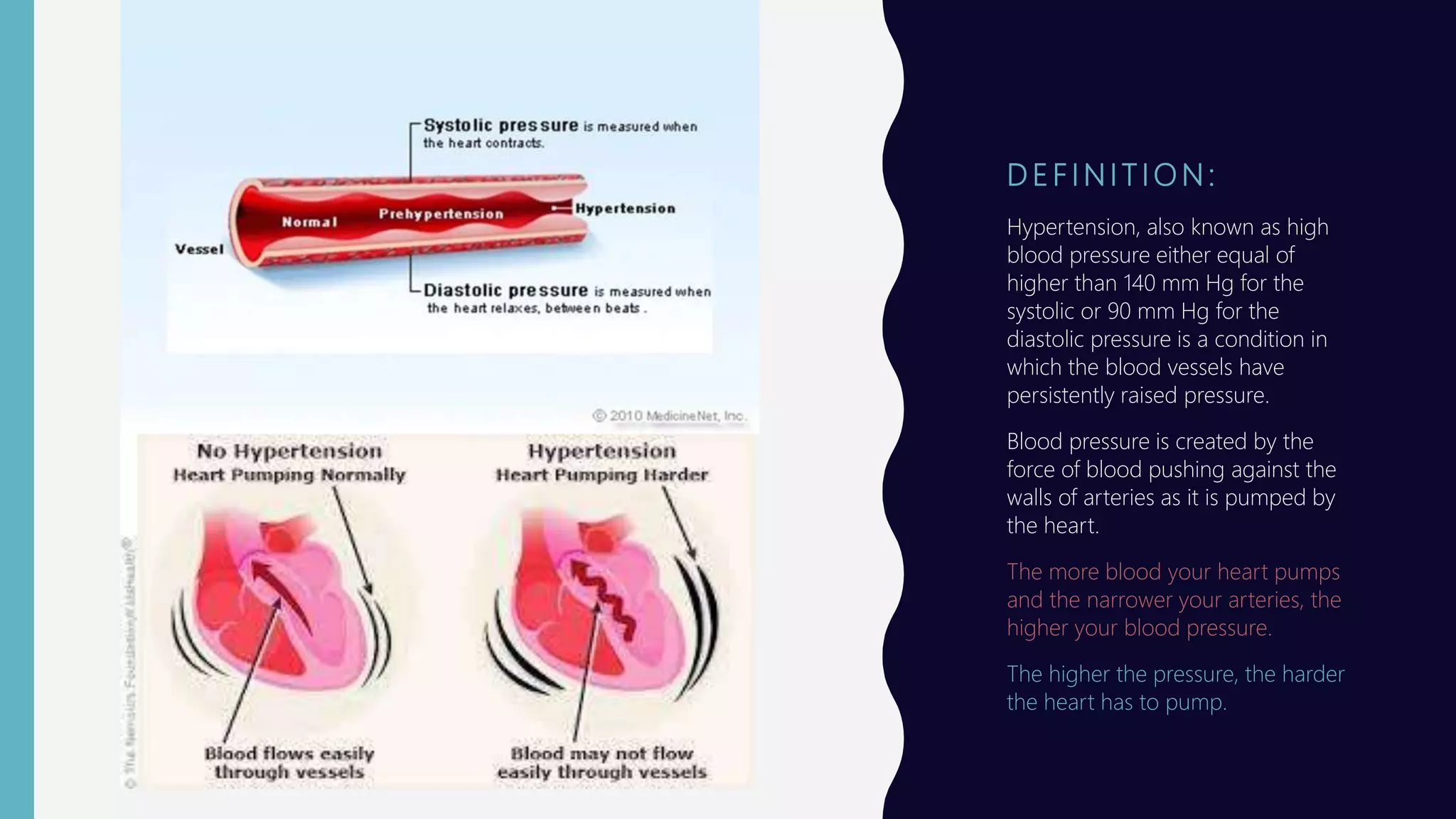
Hypertension, also known as high
blood pressure either equal of
higher than 140 mm Hg for the
systolic or 90 mm Hg for the
diastolic pressure is a condition in
which the blood vessels have
persistently raised pressure.
Blood pressure is created by the
force of blood pushing against the
walls of arteries as it is pumped by
the heart.
The more blood your heart pumps
and the narrower your arteries, the
higher your blood pressure.
The higher the pressure, the harder
the heart has to pump.
SIGNS AND SYMPTOMS
Most people with high blood pressure have no
signs or symptoms, even if blood pressure
readings reach dangerously high levels!
A few people with high blood pressure may
have shortness of breath, early morning
headaches, nosebleeds, irregular heart
rhythms, vision changes, and buzzing in the
ears but these signs and symptoms aren't
specific and usually don't occur until high
blood pressure has reached a severe or life-
threatening stage.
More severe forms may exhibit fatigue,
nausea, vomiting, confusion, anxiety, chest
pain, and muscle tremors. If left untreated,
hypertension can cause persistent chest pain
(also called angina), heart attacks, heart failure,
and an irregular heartbeat, which can lead to a
sudden death.
Hypertension can also cause strokes by
blocking or bursting arteries that supply blood
and oxygen to the brain, as well as kidney
damage, which can lead to kidney failure. High
blood pressure causes damage to the heart by
hardening arteries and decreasing the flood of
blood and oxygen to the heart.
DIAGNOSIS AND MEASURMENT
Blood pressure is measured using a blood pressure cuff, which can detect the pressure inside arteries,
conveying numerical values using a sphygmomanometer or an electronic device.
Resting blood pressure is considered the most accurate reading. To get this measurement:
• Blood pressure should be recorded in a quiet, warm environment after sitting quietly for at least five
minutes with feet supported.
• You should not have used caffeine or tobacco products for at least 30 minutes prior to the test.
• Some people have elevated resting blood pressures in the healthcare provider's office, but have
normal resting blood pressures at other times. This pattern is called white coat hypertension, and it
usually occurs due to anxiety. repeat checks may be necessary if this occurs.
• Several types of medicine can be used to help control high blood pressure- Many people need to take
a combination of different medicines.
RISKS:
• Heart attack or stroke- High blood pressure can cause hardening and thickening of the arteries
(atherosclerosis), which can lead to a heart attack
• Aneurysm- Increased blood pressure can cause your blood vessels to weaken and bulge, forming an
aneurysm. If an aneurysm ruptures, it can be life-threatening.
• Heart failure- To pump blood against the higher pressure in your vessels, the heart has to work harder. This
causes the walls of the heart's pumping chamber to thicken (left ventricular hypertrophy). Eventually, the
thickened muscle may have a hard time pumping enough blood to meet your body's needs, which can lead
to heart failure.
• Weakened and narrowed blood vessels in your kidneys- These damaged arteries are not able to deliver
enough blood to the kidney tissue. Damaged kidney arteries do not filter blood well.
• Thickened, narrowed or torn blood vessels in the eyes- This can result in vision loss.
• Metabolic syndrome- This syndrome is a group of disorders of your body's metabolism, including increased
waist size, high triglycerides, decreased high-density lipoprotein (HDL) cholesterol, high blood pressure and
high insulin levels.
• Problems with memory and understanding
CLASSIFICATION
THE DIFFERENCE BETWEEN PRIMARY AND SECONDARY
HYPERTENSION?
High blood pressure that doesn’t have a
known cause is called primary
hypertension. In contrast, secondary
hypertension has a known cause.
PRIMARY HYPERTENSION
• Primary hypertension is the form of hypertension that by definition has no identifiable
secondary cause. It is the most common type affecting 85% of people.
• Primary hypertension tends to be familial and is likely to be the consequence of an
interaction between environmental and genetic factors.
• Prevalence of primary hypertension increases with age, and individuals with relatively
high blood pressure at younger ages are at increased risk for the subsequent
development of hypertension.
• The following factors may increase risk of developing primary hypertension: diet,
stress, minimal physical activity, being overweight.
PREVENTION
If you have elevated blood pressure or hypertension, your doctor will recommend
lifestyle changes to lower your blood pressure.
• Exercise at least 30 minutes a day.
• Lose weight if you’re overweight.
• Quit smoking.
• Limit your alcohol intake
• Reduce your stress levels.
• Eat a low-sodium, heart-healthy diet that’s rich in potassium and fiber.
SECONDARY HYPERTENSION
• Secondary hypertension is high blood pressure caused by another condition or
disease.
• Conditions that may cause secondary hypertension include kidney disease, adrenal
disease, thyroid problems and obstructive sleep apnea.
• Secondary hypertension has a positive outlook with treatment. Early detection and
treatment can help minimize the possibility of serious damage due to abnormal blood
vessel shape or tumors.
MEDS:ACE INHIBITORS
Angiotensin-converting enzyme
(ACE) inhibitors reduce blood
pressure by relaxing your blood
vessels.
Common examples are enalapril,
lisinopril, perindopril and ramipril.
The most common side effect is a
persistent dry cough. Other
possible side effects include
headaches, dizziness and a rash.
MEDS:ANGIOTENSIN-2 RECEPTOR
BLOCKERS (ARBS)
ARBs work in a similar way to
ACE inhibitors. They're often
recommended if ACE inhibitors
cause troublesome side effects.
Common examples are
candesartan, irbesartan,
losartan, valsartan and
olmesartan.
Possible side effects include
dizziness, headaches, and cold
or flu-like symptoms.
MEDS:CALCIUM CHANNEL BLOCKERS
Calcium channel blockers
reduce blood pressure by
widening your blood
vessels.
Common examples are
amlodipine, felodipine,
nifedipine. diltiazem and
verapamil.
Possible side effects
include headaches, swollen
ankles and constipation.
Drinking grapefruit juice
while taking some
channel blockers can
increase your risk of side
effects!
MEDS:DIURETICS
Work by flushing excess water
and salt from the body with the
urine.
They're often used if calcium
channel blockers cause
troublesome side effects.
Common examples are
furosemid, indapamide and
bendroflumethiazide.
Possible side effects include
dizziness when standing up,
increased thirst and increased
amount of urine, sometimes a
rash.
Low potassium and low sodium
after long-term use.
MEDS: BETA BLOCKERS
Beta blockers can reduce
blood pressure by making
your heart beat more
slowly and with less force.
used only when other
treatments have not
worked.
Are considered less
effective than other blood
pressure medicines.
Common examples are
atenolol and bisoprolol.
Possible side effects
include dizziness,
headaches, tiredness, and
cold hands and feet.
LONG TERM TRATMENT GUIDELINES
You may need to take blood
pressure medicine for the rest
of your life. But your doctor
might be able to reduce or
stop your treatment if your
blood pressure stays under
control for several years!
It's really important to take
your medicine as directed. If
you miss doses, it will not work
as well!
The medicine will not
necessarily make you feel any
different, but this does not
mean it's not working!
Medicines used to treat high
blood pressure can have side
effects, but most people do
not get any!
If you do get side effects, do
not stop taking your medicine.
Talk to your doctor, who may
advise changing your
medicine!
SOURCES
• https://en.wikipedia.org/wiki/Hypertension
• https://www.mayoclinic.org/diseases-conditions/high-blood-pressure/symptoms-
causes/syc-20373410
• https://www.who.int/news-room/fact-sheets/detail/hypertension
• https://www.nhs.uk/conditions/high-blood-pressure-hypertension/
THANK YOU!


Arterial hypertension

  • 1.
    ARTERIAL HYPERTENSION K A RO L I N A S Ę C Z KO W S K A 5 D M 3 C
  • 2.
    D E FI N I T I O N : Hypertension, also known as high blood pressure either equal of higher than 140 mm Hg for the systolic or 90 mm Hg for the diastolic pressure is a condition in which the blood vessels have persistently raised pressure. Blood pressure is created by the force of blood pushing against the walls of arteries as it is pumped by the heart. The more blood your heart pumps and the narrower your arteries, the higher your blood pressure. The higher the pressure, the harder the heart has to pump.
  • 3.
    SIGNS AND SYMPTOMS Mostpeople with high blood pressure have no signs or symptoms, even if blood pressure readings reach dangerously high levels! A few people with high blood pressure may have shortness of breath, early morning headaches, nosebleeds, irregular heart rhythms, vision changes, and buzzing in the ears but these signs and symptoms aren't specific and usually don't occur until high blood pressure has reached a severe or life- threatening stage. More severe forms may exhibit fatigue, nausea, vomiting, confusion, anxiety, chest pain, and muscle tremors. If left untreated, hypertension can cause persistent chest pain (also called angina), heart attacks, heart failure, and an irregular heartbeat, which can lead to a sudden death. Hypertension can also cause strokes by blocking or bursting arteries that supply blood and oxygen to the brain, as well as kidney damage, which can lead to kidney failure. High blood pressure causes damage to the heart by hardening arteries and decreasing the flood of blood and oxygen to the heart.
  • 5.
    DIAGNOSIS AND MEASURMENT Bloodpressure is measured using a blood pressure cuff, which can detect the pressure inside arteries, conveying numerical values using a sphygmomanometer or an electronic device. Resting blood pressure is considered the most accurate reading. To get this measurement: • Blood pressure should be recorded in a quiet, warm environment after sitting quietly for at least five minutes with feet supported. • You should not have used caffeine or tobacco products for at least 30 minutes prior to the test. • Some people have elevated resting blood pressures in the healthcare provider's office, but have normal resting blood pressures at other times. This pattern is called white coat hypertension, and it usually occurs due to anxiety. repeat checks may be necessary if this occurs. • Several types of medicine can be used to help control high blood pressure- Many people need to take a combination of different medicines.
  • 7.
    RISKS: • Heart attackor stroke- High blood pressure can cause hardening and thickening of the arteries (atherosclerosis), which can lead to a heart attack • Aneurysm- Increased blood pressure can cause your blood vessels to weaken and bulge, forming an aneurysm. If an aneurysm ruptures, it can be life-threatening. • Heart failure- To pump blood against the higher pressure in your vessels, the heart has to work harder. This causes the walls of the heart's pumping chamber to thicken (left ventricular hypertrophy). Eventually, the thickened muscle may have a hard time pumping enough blood to meet your body's needs, which can lead to heart failure. • Weakened and narrowed blood vessels in your kidneys- These damaged arteries are not able to deliver enough blood to the kidney tissue. Damaged kidney arteries do not filter blood well. • Thickened, narrowed or torn blood vessels in the eyes- This can result in vision loss. • Metabolic syndrome- This syndrome is a group of disorders of your body's metabolism, including increased waist size, high triglycerides, decreased high-density lipoprotein (HDL) cholesterol, high blood pressure and high insulin levels. • Problems with memory and understanding
  • 8.
  • 9.
    THE DIFFERENCE BETWEENPRIMARY AND SECONDARY HYPERTENSION? High blood pressure that doesn’t have a known cause is called primary hypertension. In contrast, secondary hypertension has a known cause.
  • 10.
    PRIMARY HYPERTENSION • Primaryhypertension is the form of hypertension that by definition has no identifiable secondary cause. It is the most common type affecting 85% of people. • Primary hypertension tends to be familial and is likely to be the consequence of an interaction between environmental and genetic factors. • Prevalence of primary hypertension increases with age, and individuals with relatively high blood pressure at younger ages are at increased risk for the subsequent development of hypertension. • The following factors may increase risk of developing primary hypertension: diet, stress, minimal physical activity, being overweight.
  • 11.
    PREVENTION If you haveelevated blood pressure or hypertension, your doctor will recommend lifestyle changes to lower your blood pressure. • Exercise at least 30 minutes a day. • Lose weight if you’re overweight. • Quit smoking. • Limit your alcohol intake • Reduce your stress levels. • Eat a low-sodium, heart-healthy diet that’s rich in potassium and fiber.
  • 12.
    SECONDARY HYPERTENSION • Secondaryhypertension is high blood pressure caused by another condition or disease. • Conditions that may cause secondary hypertension include kidney disease, adrenal disease, thyroid problems and obstructive sleep apnea. • Secondary hypertension has a positive outlook with treatment. Early detection and treatment can help minimize the possibility of serious damage due to abnormal blood vessel shape or tumors.
  • 14.
    MEDS:ACE INHIBITORS Angiotensin-converting enzyme (ACE)inhibitors reduce blood pressure by relaxing your blood vessels. Common examples are enalapril, lisinopril, perindopril and ramipril. The most common side effect is a persistent dry cough. Other possible side effects include headaches, dizziness and a rash.
  • 15.
    MEDS:ANGIOTENSIN-2 RECEPTOR BLOCKERS (ARBS) ARBswork in a similar way to ACE inhibitors. They're often recommended if ACE inhibitors cause troublesome side effects. Common examples are candesartan, irbesartan, losartan, valsartan and olmesartan. Possible side effects include dizziness, headaches, and cold or flu-like symptoms.
  • 16.
    MEDS:CALCIUM CHANNEL BLOCKERS Calciumchannel blockers reduce blood pressure by widening your blood vessels. Common examples are amlodipine, felodipine, nifedipine. diltiazem and verapamil. Possible side effects include headaches, swollen ankles and constipation. Drinking grapefruit juice while taking some channel blockers can increase your risk of side effects!
  • 17.
    MEDS:DIURETICS Work by flushingexcess water and salt from the body with the urine. They're often used if calcium channel blockers cause troublesome side effects. Common examples are furosemid, indapamide and bendroflumethiazide. Possible side effects include dizziness when standing up, increased thirst and increased amount of urine, sometimes a rash. Low potassium and low sodium after long-term use.
  • 18.
    MEDS: BETA BLOCKERS Betablockers can reduce blood pressure by making your heart beat more slowly and with less force. used only when other treatments have not worked. Are considered less effective than other blood pressure medicines. Common examples are atenolol and bisoprolol. Possible side effects include dizziness, headaches, tiredness, and cold hands and feet.
  • 19.
    LONG TERM TRATMENTGUIDELINES You may need to take blood pressure medicine for the rest of your life. But your doctor might be able to reduce or stop your treatment if your blood pressure stays under control for several years! It's really important to take your medicine as directed. If you miss doses, it will not work as well! The medicine will not necessarily make you feel any different, but this does not mean it's not working! Medicines used to treat high blood pressure can have side effects, but most people do not get any! If you do get side effects, do not stop taking your medicine. Talk to your doctor, who may advise changing your medicine!
  • 20.
    SOURCES • https://en.wikipedia.org/wiki/Hypertension • https://www.mayoclinic.org/diseases-conditions/high-blood-pressure/symptoms- causes/syc-20373410 •https://www.who.int/news-room/fact-sheets/detail/hypertension • https://www.nhs.uk/conditions/high-blood-pressure-hypertension/
  • 21.