Sandia National Laboratories is a multi program laboratory managed and operated by Sandia Corporation, a wholly owned
subsidiary of Lockheed Martin Corporation, for the U.S. Department of Energy's National Nuclear Security Administration
under contract DE-AC04-94AL85000. SAND2011-6823C
Hamiltonian Control Design for DC
Microgrids with Stochastic Sources
and Loads with Applications
D.G. Wilson J.C. Neely M.A. Cook S.F. Glover
J. Young R.D. Robinett III
SPEEDAM 2014
Ischia, Italy
22nd Edition
June 18-20, 2014
SAND2014-15152PE
Outline
•Secure Scalable Microgrid Testbed
•Microgrid Configuration and Modeling
•Dynamic Optimization/Planner
•Nonlinear Distributed Controller Design
(HSSPFC)
•Single DC Microgrid Experimental Results
•Multiple Microgrid System Navy Electric Ship
•Conclusions
Secure Scalable Microgrid (SSM) Testbed
Enables Hardware Testing of HSSPFC
Multiple Microgrid Testbed Mechanical Source Emulators
Energy Storage Emulators High Power Digital Resistor – Load Bank
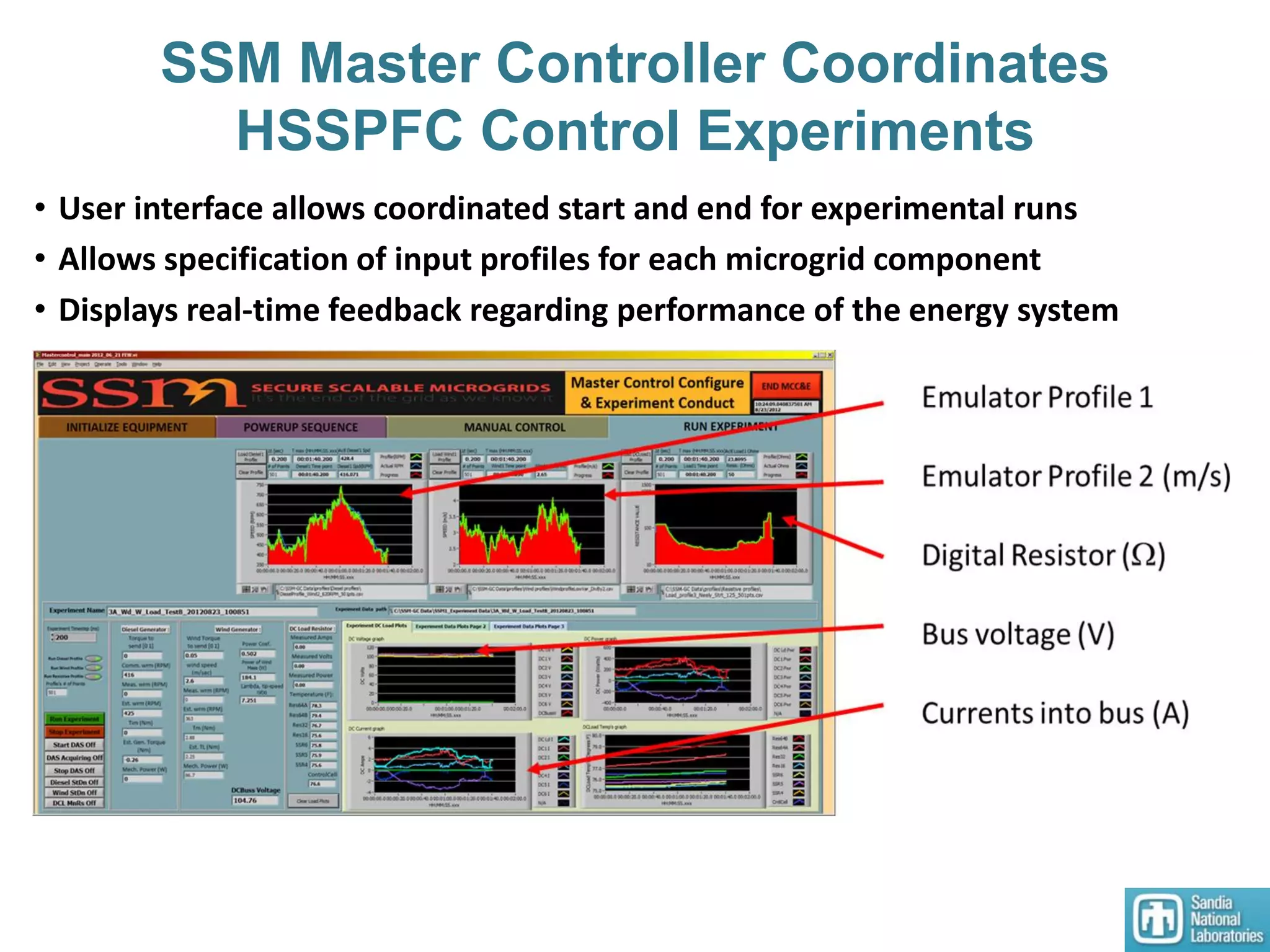
SSM Master Controller Coordinates
HSSPFC Control Experiments
• User interface allows coordinated start and end for experimental runs
• Allows specification of input profiles for each microgrid component
• Displays real-time feedback regarding performance of the energy system
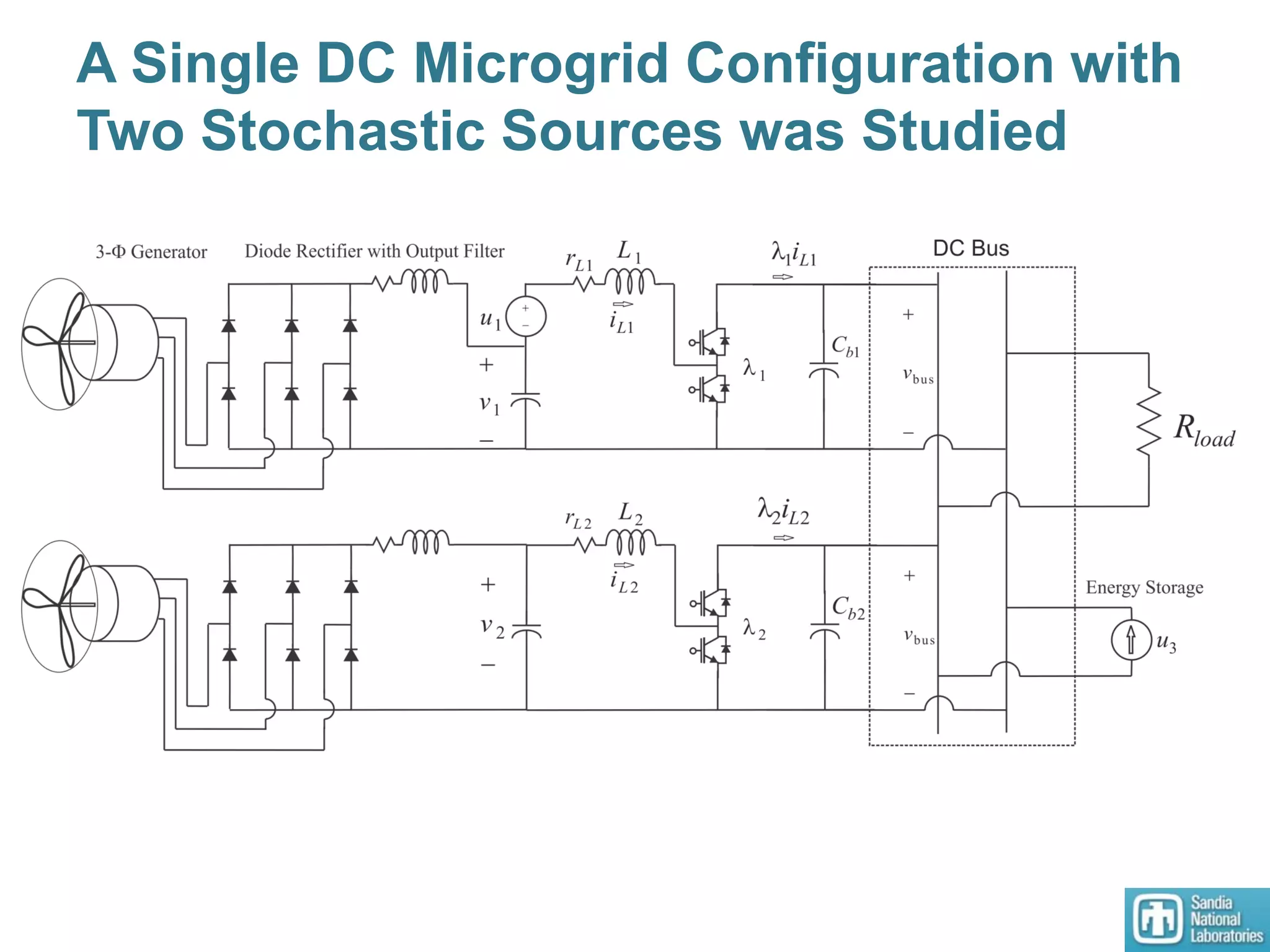
A Single DC Microgrid Configuration with
Two Stochastic Sources was Studied
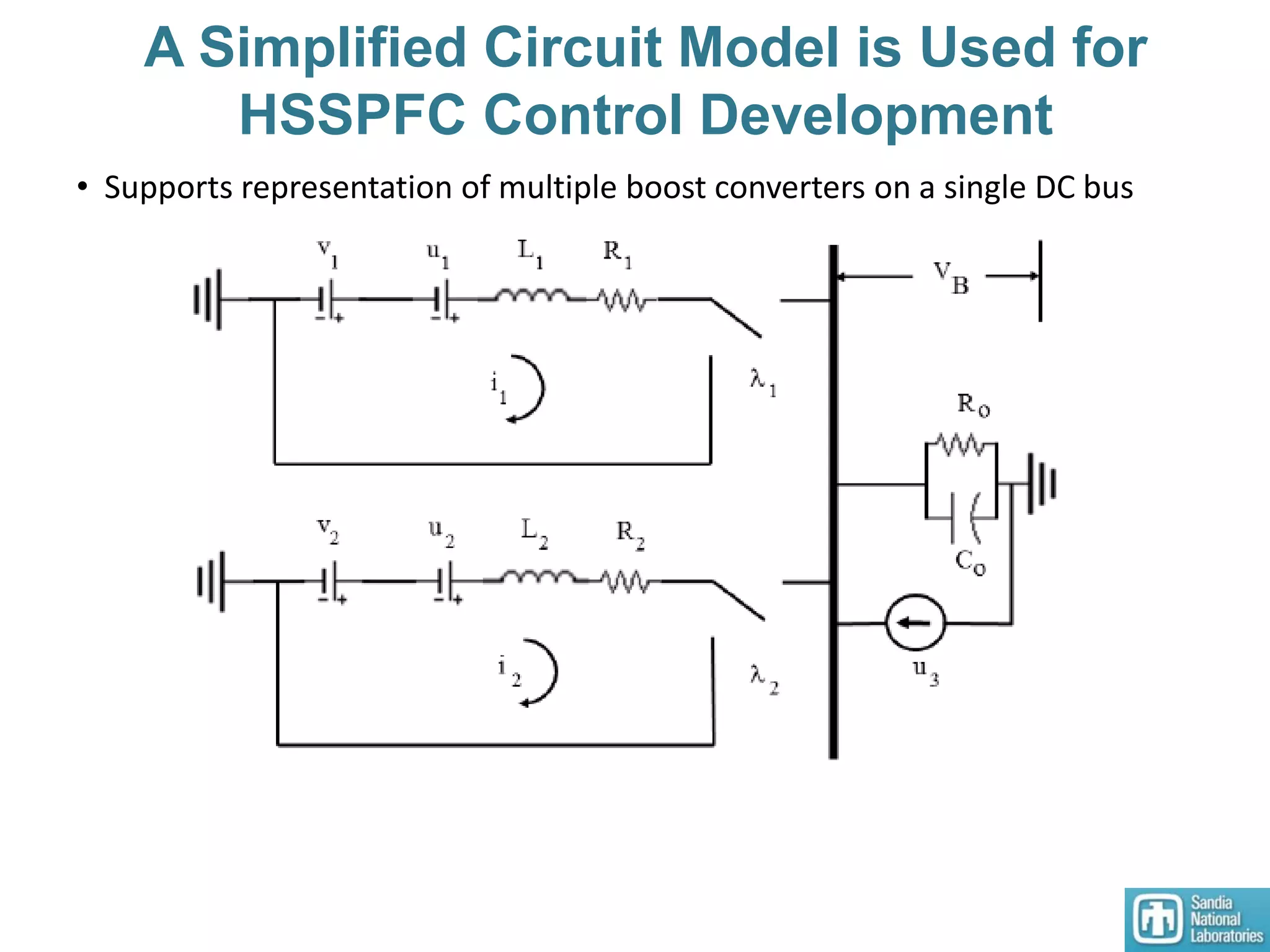
A Simplified Circuit Model is Used for
HSSPFC Control Development
• Supports representation of multiple boost converters on a single DC bus
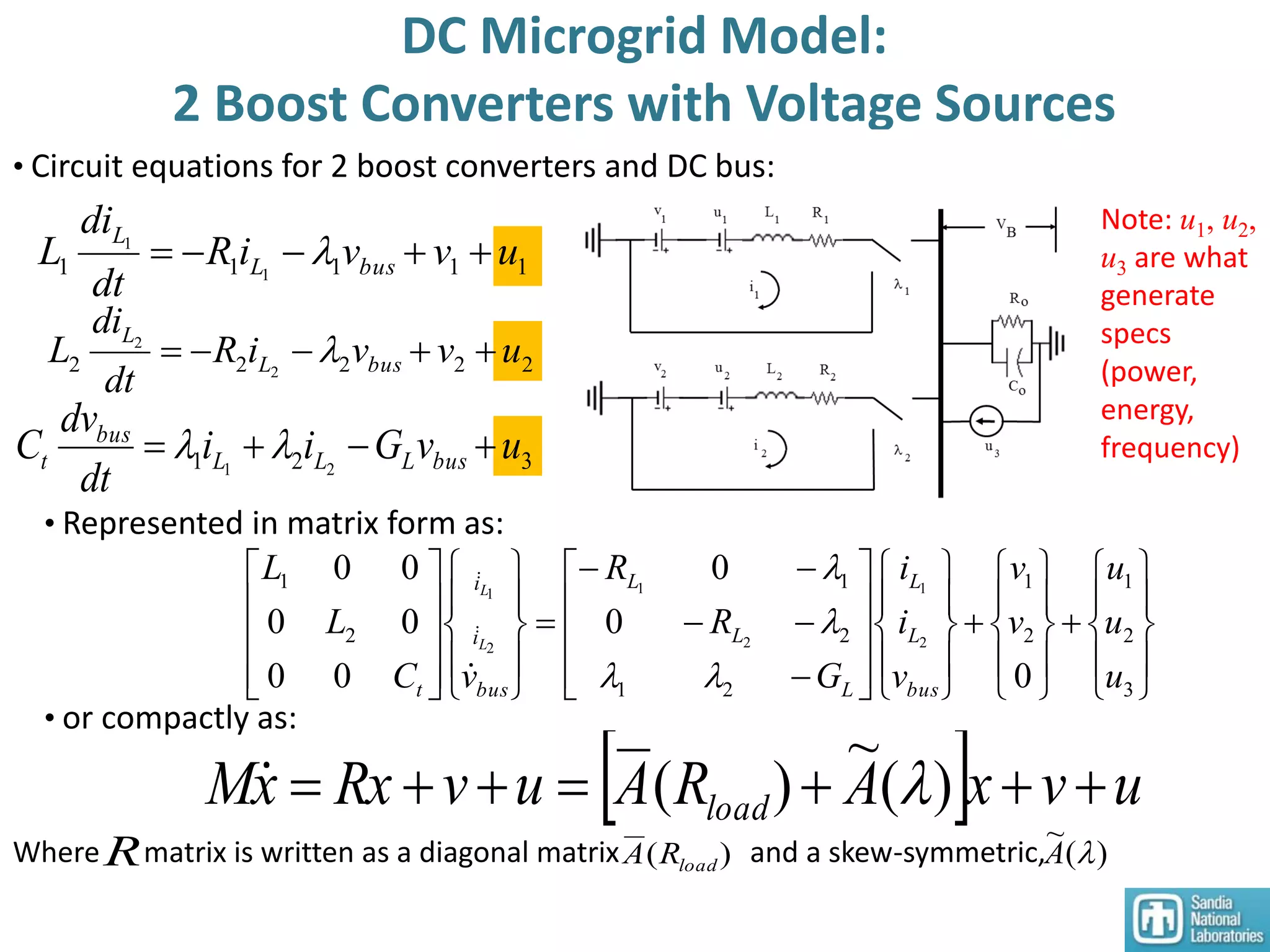
DC Microgrid Model:
2 Boost Converters with Voltage Sources
11111 1
1
uvviR
dt
di
L busL
L
 
22222 2
2
uvviR
dt
di
L busL
L
 
321 21
uvGii
dt
dv
C busLLL
bus
t  
• Circuit equations for 2 boost converters and DC bus:
Note: u1, u2,
u3 are what
generate
specs
(power,
energy,
frequency)
• Represented in matrix form as:
• or compactly as:


































































3
2
1
2
1
21
2
1
2
1
0
0
0
00
00
00
2
1
2
1
2
1
u
u
u
v
v
v
i
i
G
R
R
vC
L
L
bus
L
L
L
L
L
bus
i
i
t
L
L






  uvxARAuvRxxM load  )(
~
)( 
Where matrix is written as a diagonal matrix and a skew-symmetric,R )( loadRA )(
~
A
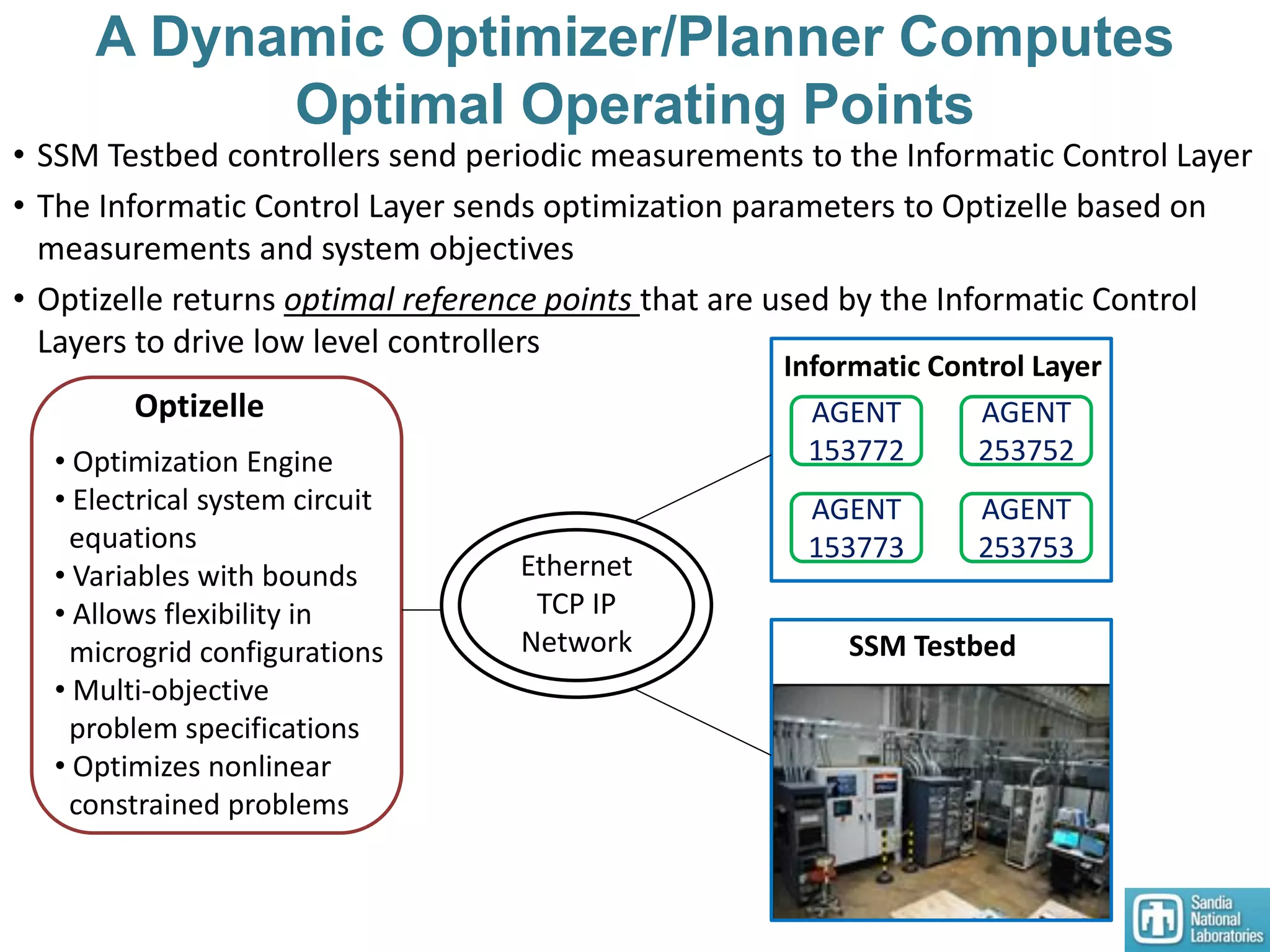
A Dynamic Optimizer/Planner Computes
Optimal Operating Points
AGENT
153773
AGENT
153772
AGENT
253752
AGENT
253753
Informatic Control Layer
Ethernet
TCP IP
Network SSM Testbed
Optizelle
• Optimization Engine
• Electrical system circuit
equations
• Variables with bounds
• Allows flexibility in
microgrid configurations
• Multi-objective
problem specifications
• Optimizes nonlinear
constrained problems
• SSM Testbed controllers send periodic measurements to the Informatic Control Layer
• The Informatic Control Layer sends optimization parameters to Optizelle based on
measurements and system objectives
• Optizelle returns optimal reference points that are used by the Informatic Control
Layers to drive low level controllers
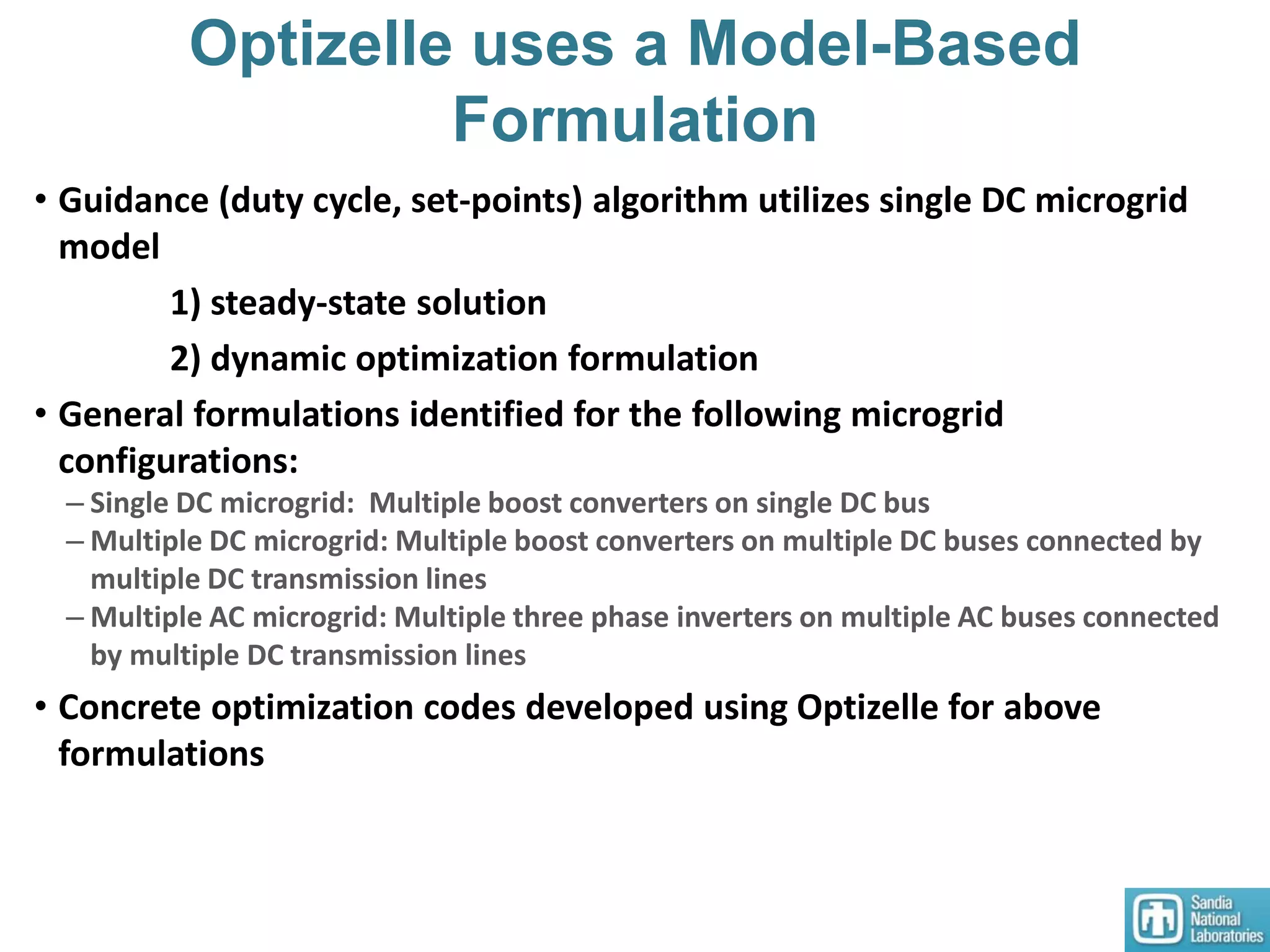
Optizelle uses a Model-Based
Formulation
• Guidance (duty cycle, set-points) algorithm utilizes single DC microgrid
model
1) steady-state solution
2) dynamic optimization formulation
• General formulations identified for the following microgrid
configurations:
– Single DC microgrid: Multiple boost converters on single DC bus
– Multiple DC microgrid: Multiple boost converters on multiple DC buses connected by
multiple DC transmission lines
– Multiple AC microgrid: Multiple three phase inverters on multiple AC buses connected
by multiple DC transmission lines
• Concrete optimization codes developed using Optizelle for above
formulations
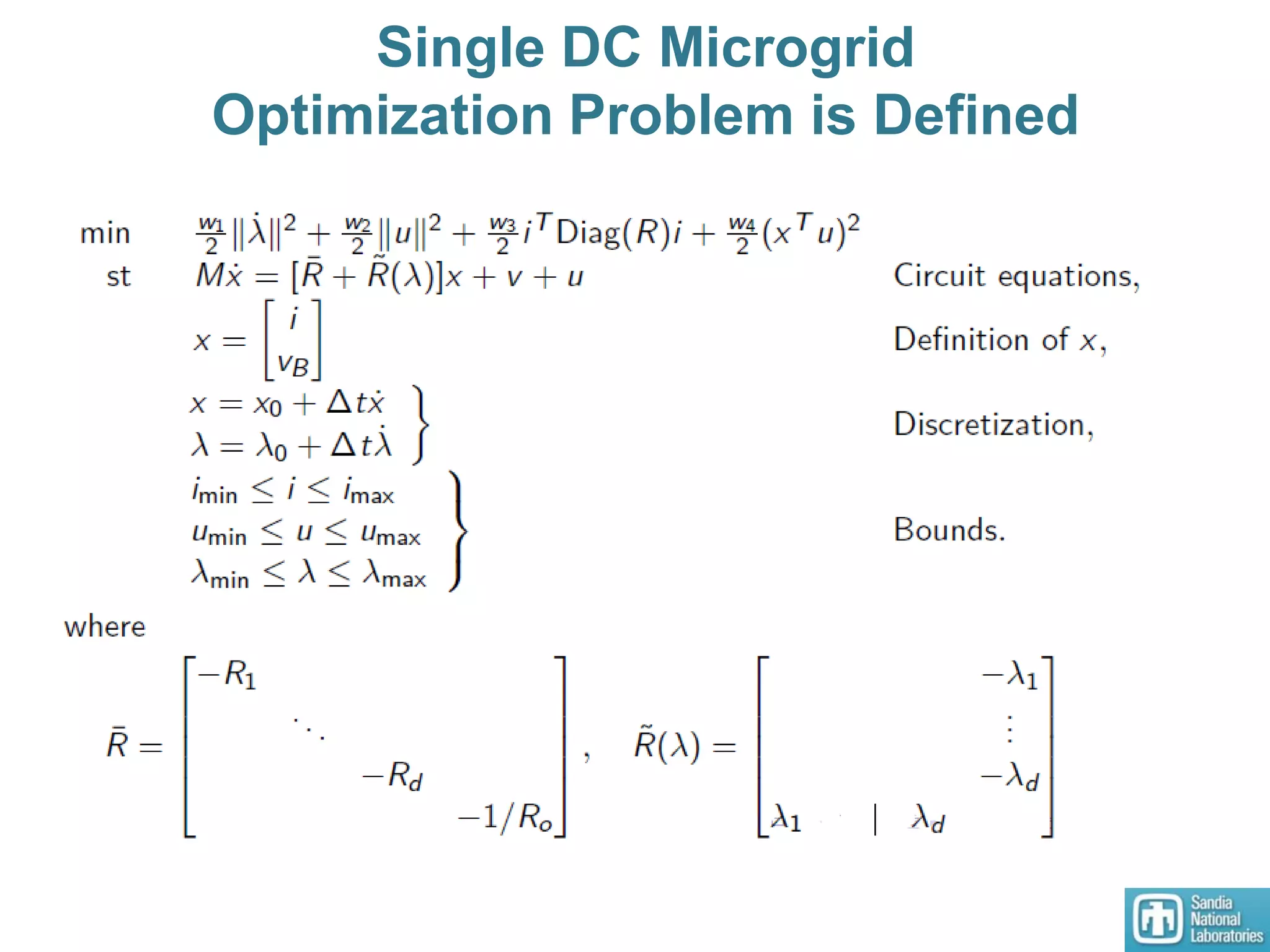
Single DC Microgrid
Optimization Problem is Defined
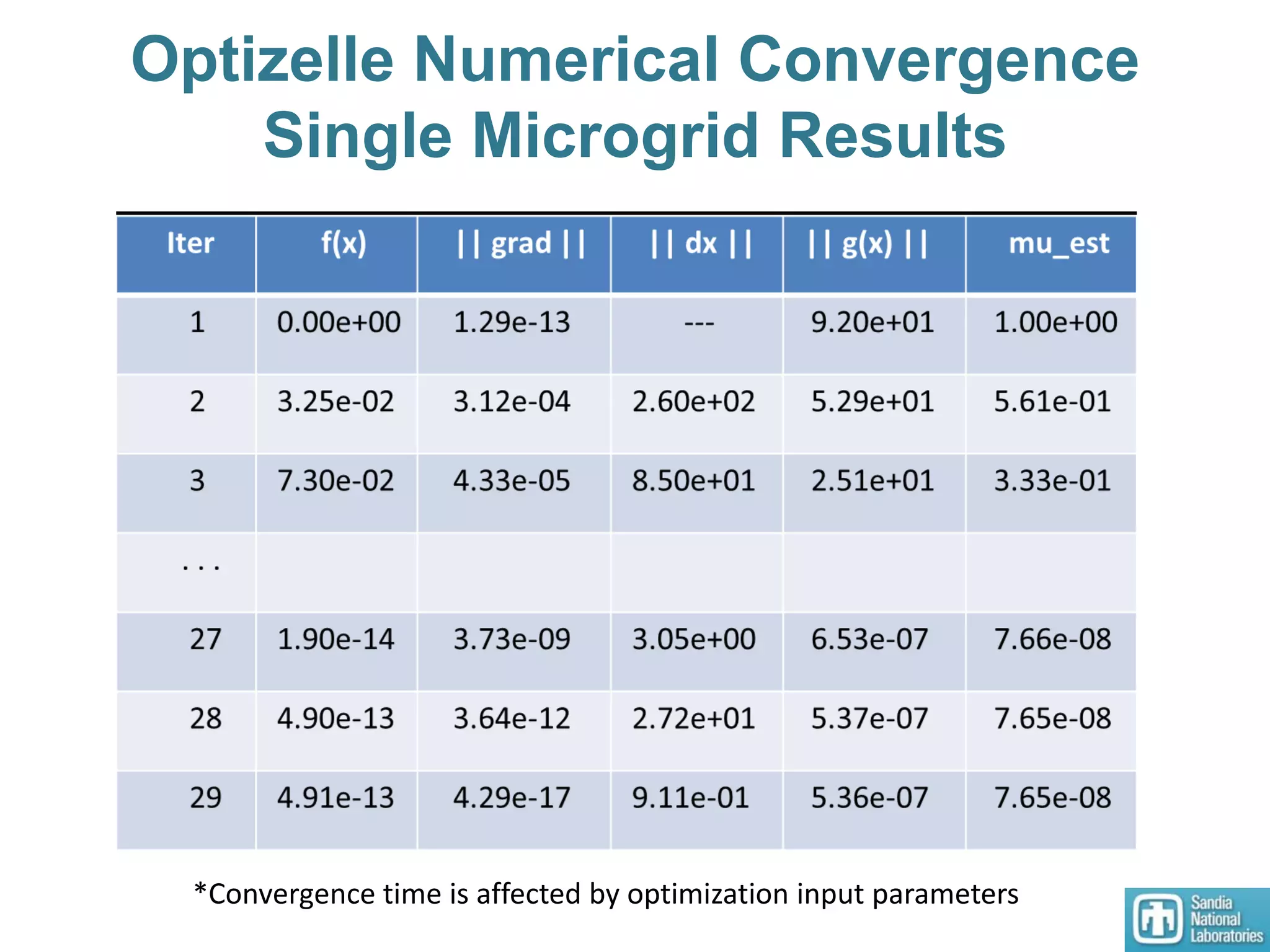
Optizelle Numerical Convergence
Single Microgrid Results
*Convergence time is affected by optimization input parameters
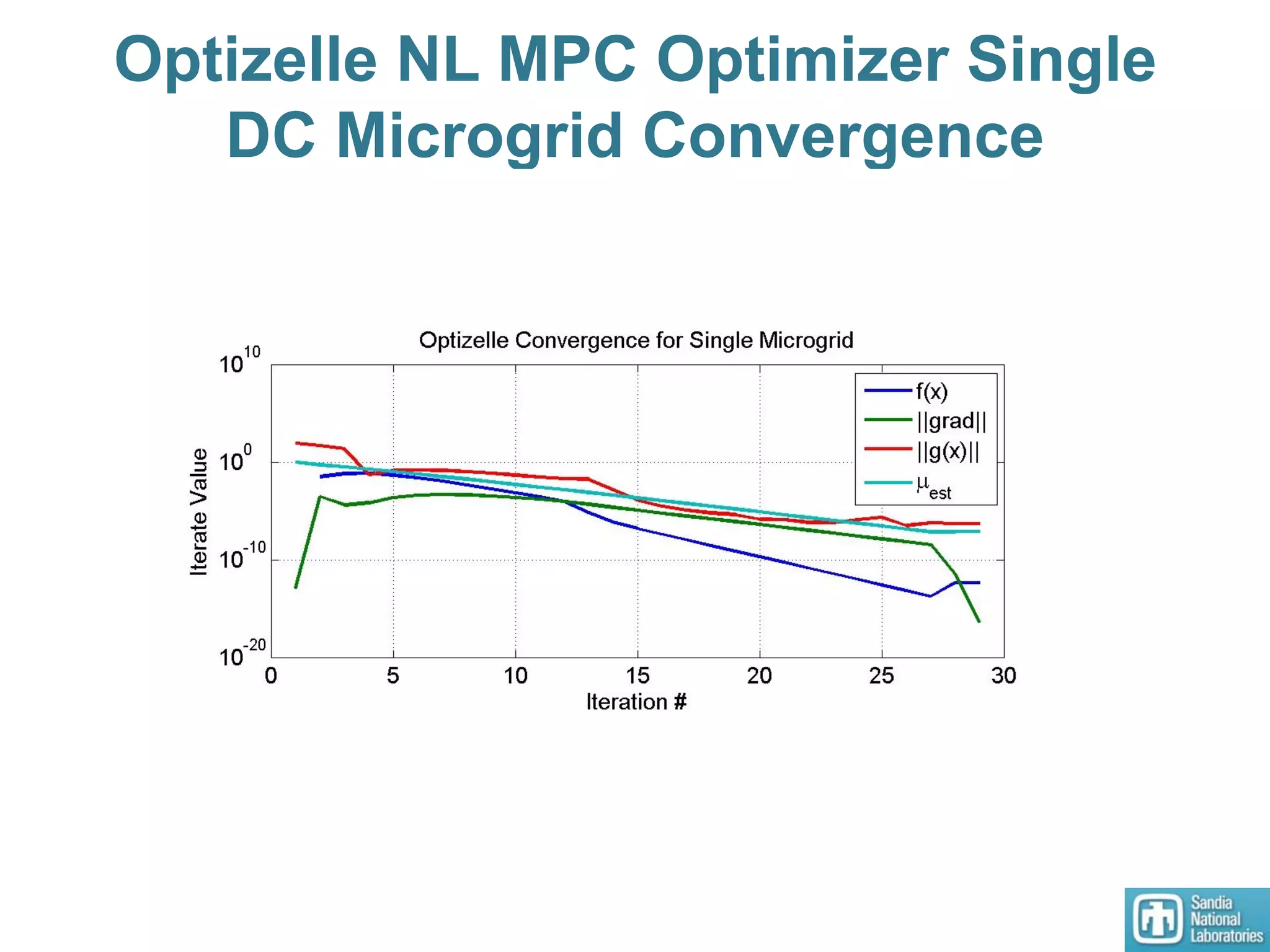
Optizelle NL MPC Optimizer Single
DC Microgrid Convergence
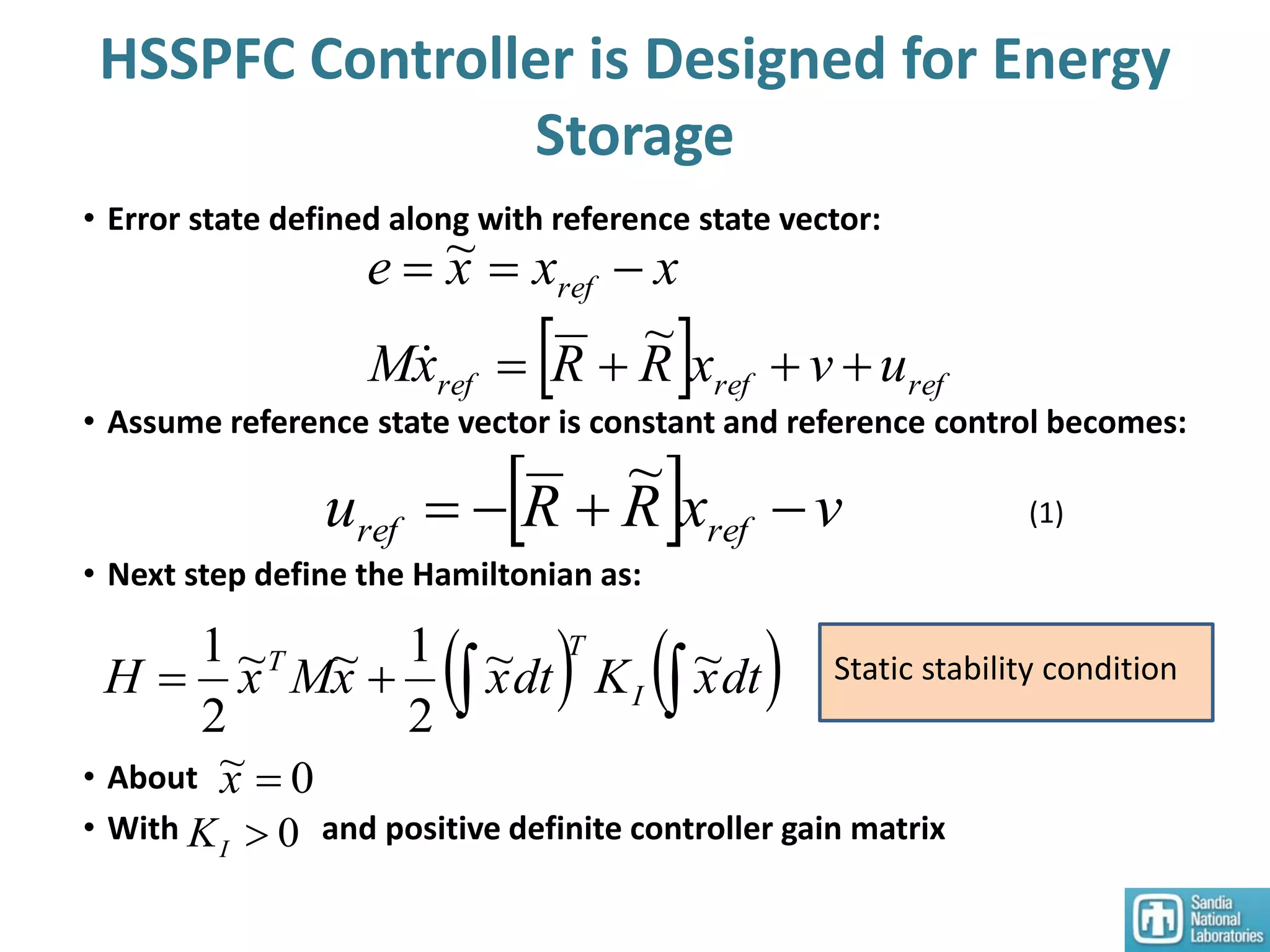
• Error state defined along with reference state vector:
• Assume reference state vector is constant and reference control becomes:
• Next step define the Hamiltonian as:
• About
• With and positive definite controller gain matrix
  vxRRu refref 
~
  refrefref
ref
uvxRRxM
xxxe


~
~

    dtxKdtxxMxH I
T
T ~~
2
1~~
2
1 Static stability condition
0~ x
(1)
0IK
HSSPFC Controller is Designed for Energy
Storage
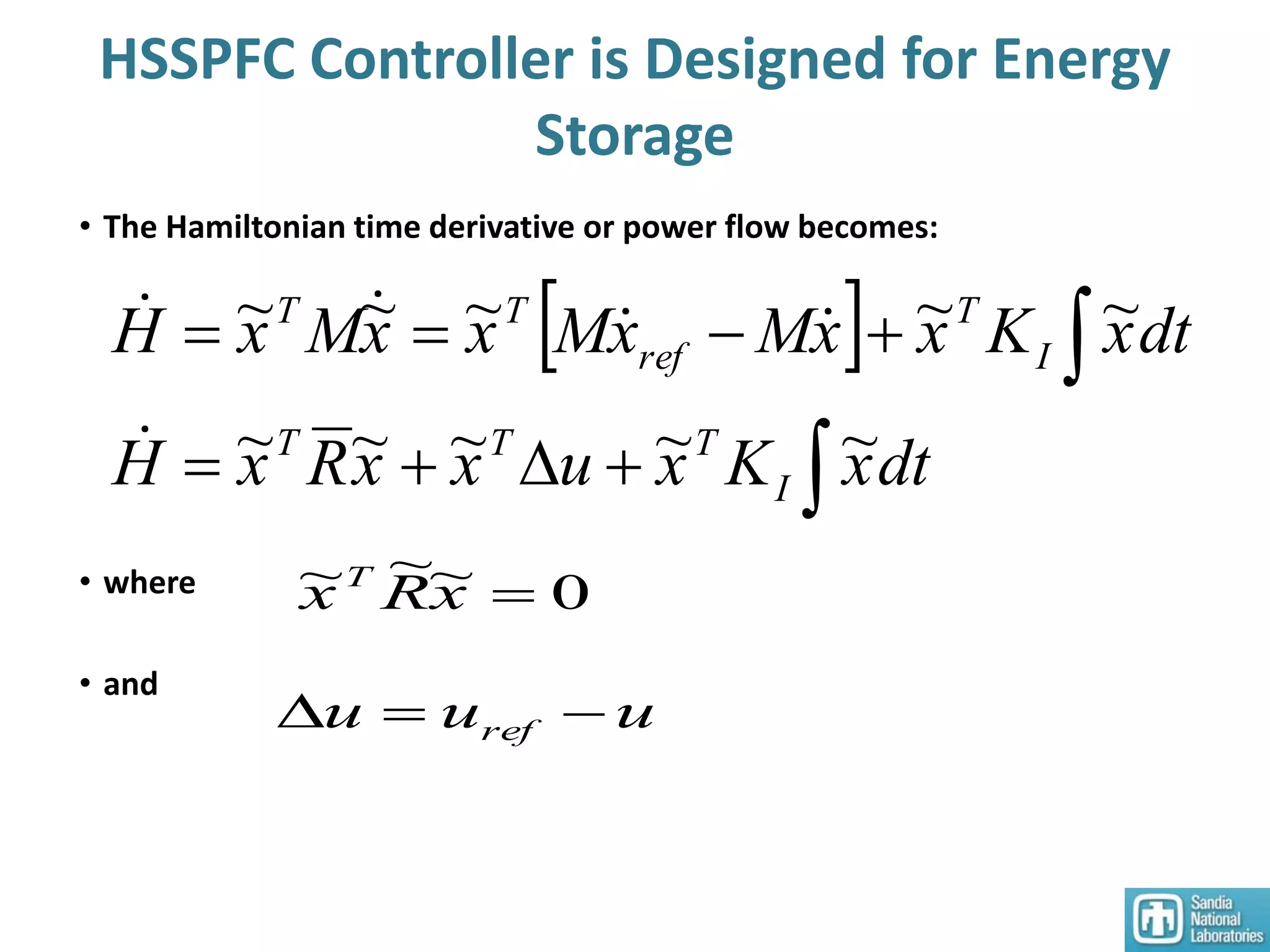
• The Hamiltonian time derivative or power flow becomes:
• where
• and
 




dtxKxuxxRxH
dtxKxxMxMxxMxH
I
TTT
I
T
ref
TT
~~~~~
~~~~~


0~~~ xRx T
uuu ref 
HSSPFC Controller is Designed for Energy
Storage
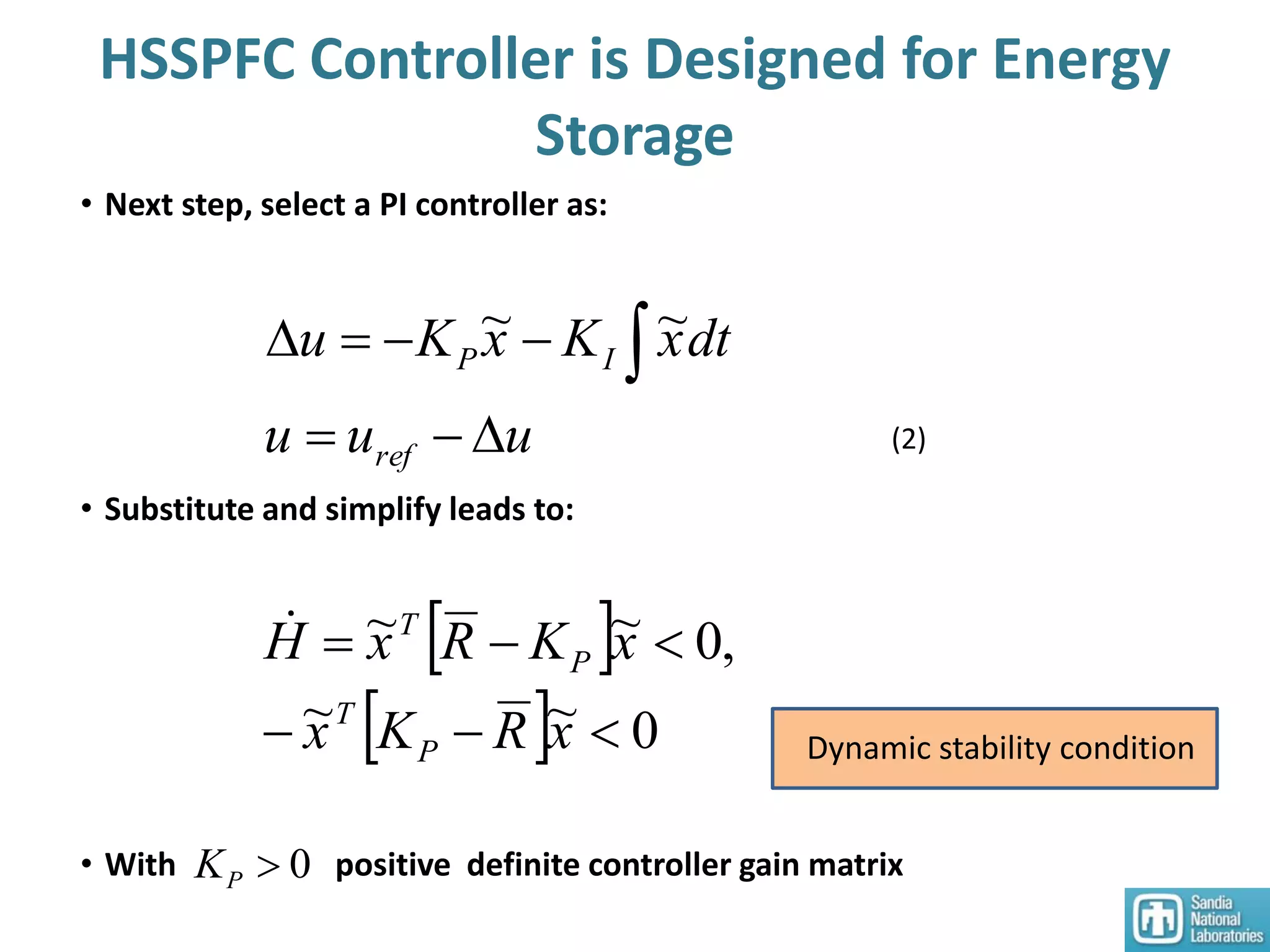
• Next step, select a PI controller as:
• Substitute and simplify leads to:
• With positive definite controller gain matrix
uuu
dtxKxKu
ref
IP

 
~~
 
  0~~
,0~~


xRKx
xKRxH
P
T
P
T
Dynamic stability condition
(2)
0PK
HSSPFC Controller is Designed for Energy
Storage
Trade-off between Information Flow and
Energy Storage was Investigated
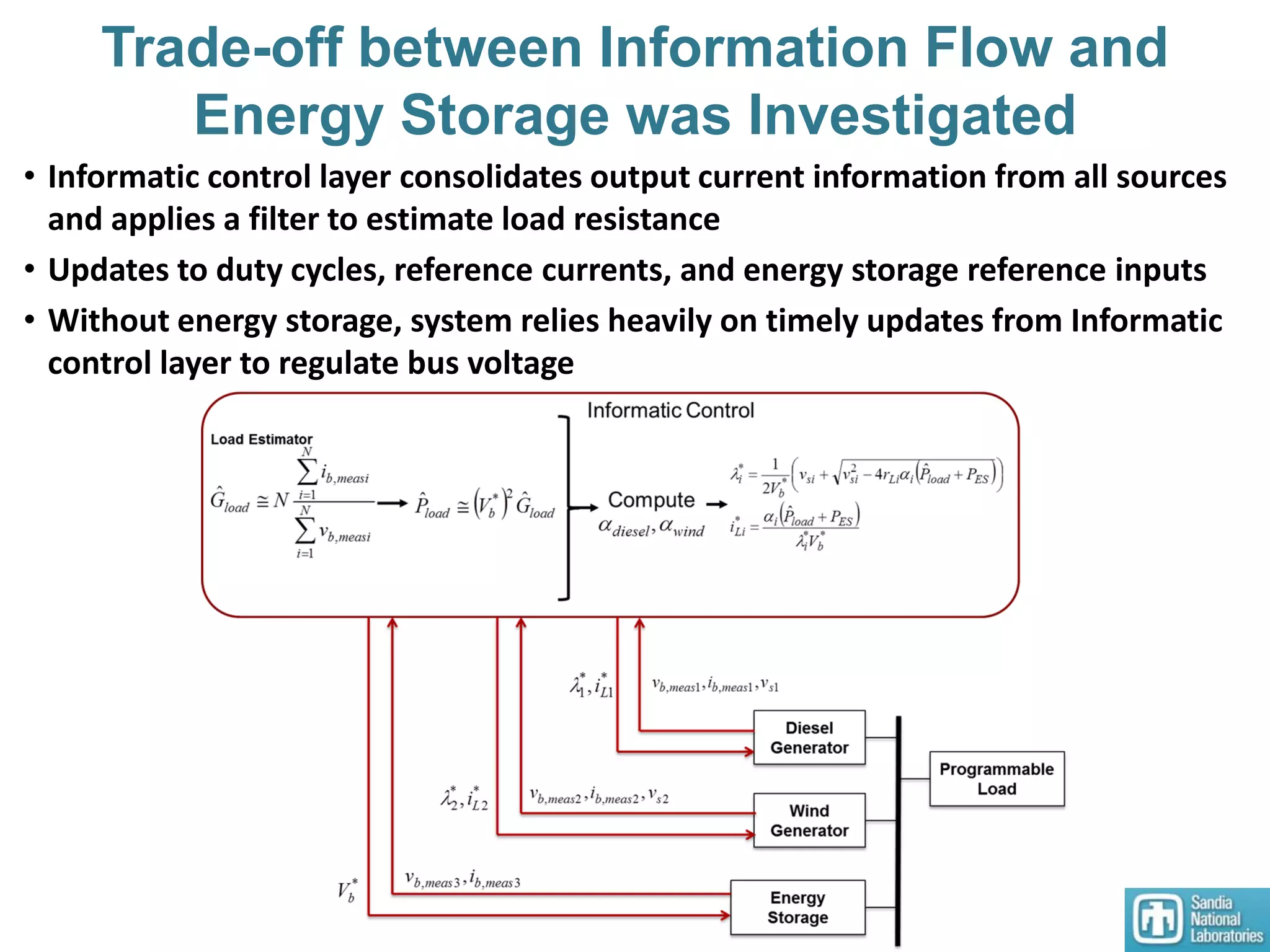
• Informatic control layer consolidates output current information from all sources
and applies a filter to estimate load resistance
• Updates to duty cycles, reference currents, and energy storage reference inputs
• Without energy storage, system relies heavily on timely updates from Informatic
control layer to regulate bus voltage
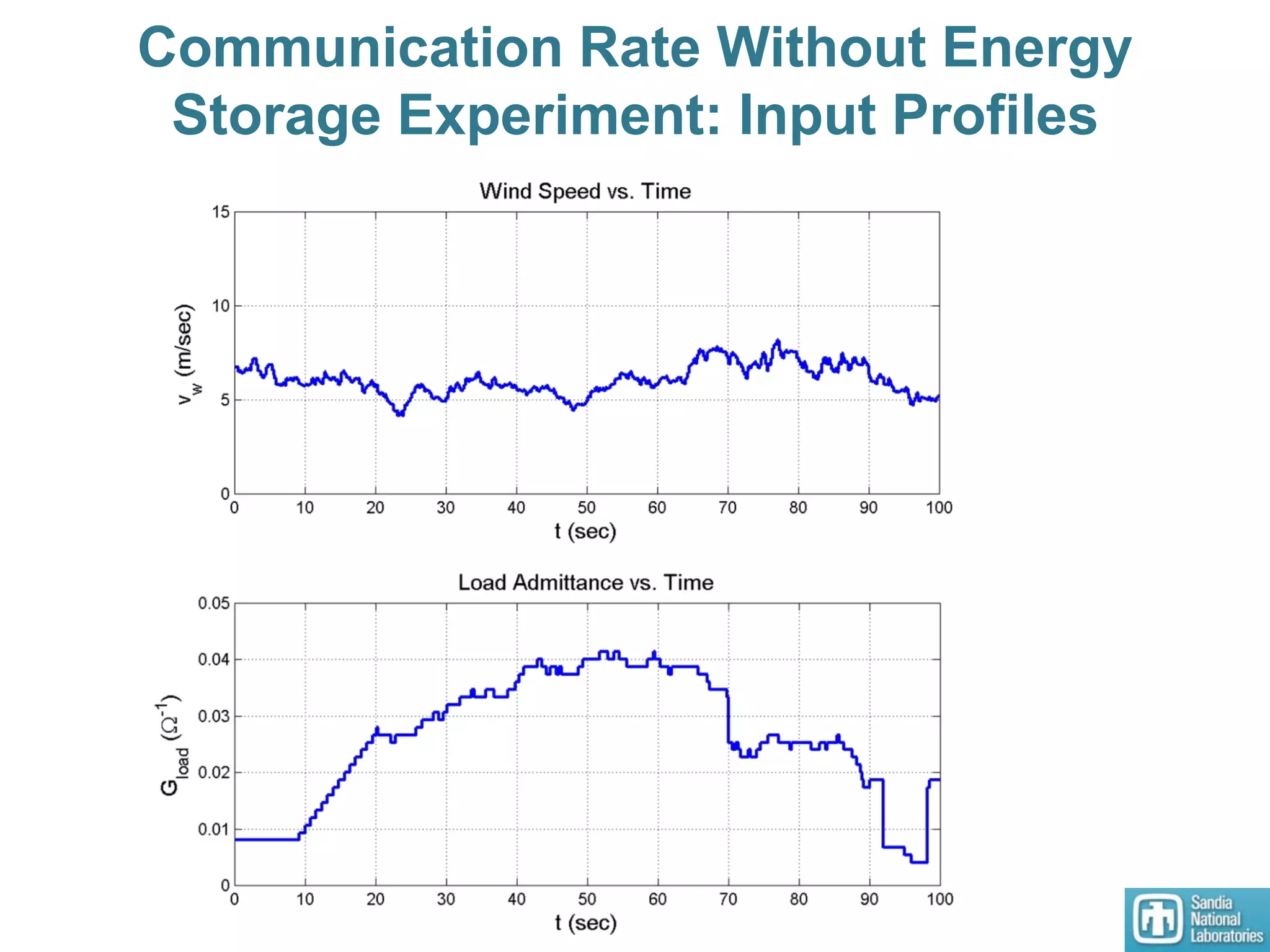
Communication Rate Without Energy
Storage Experiment: Input Profiles
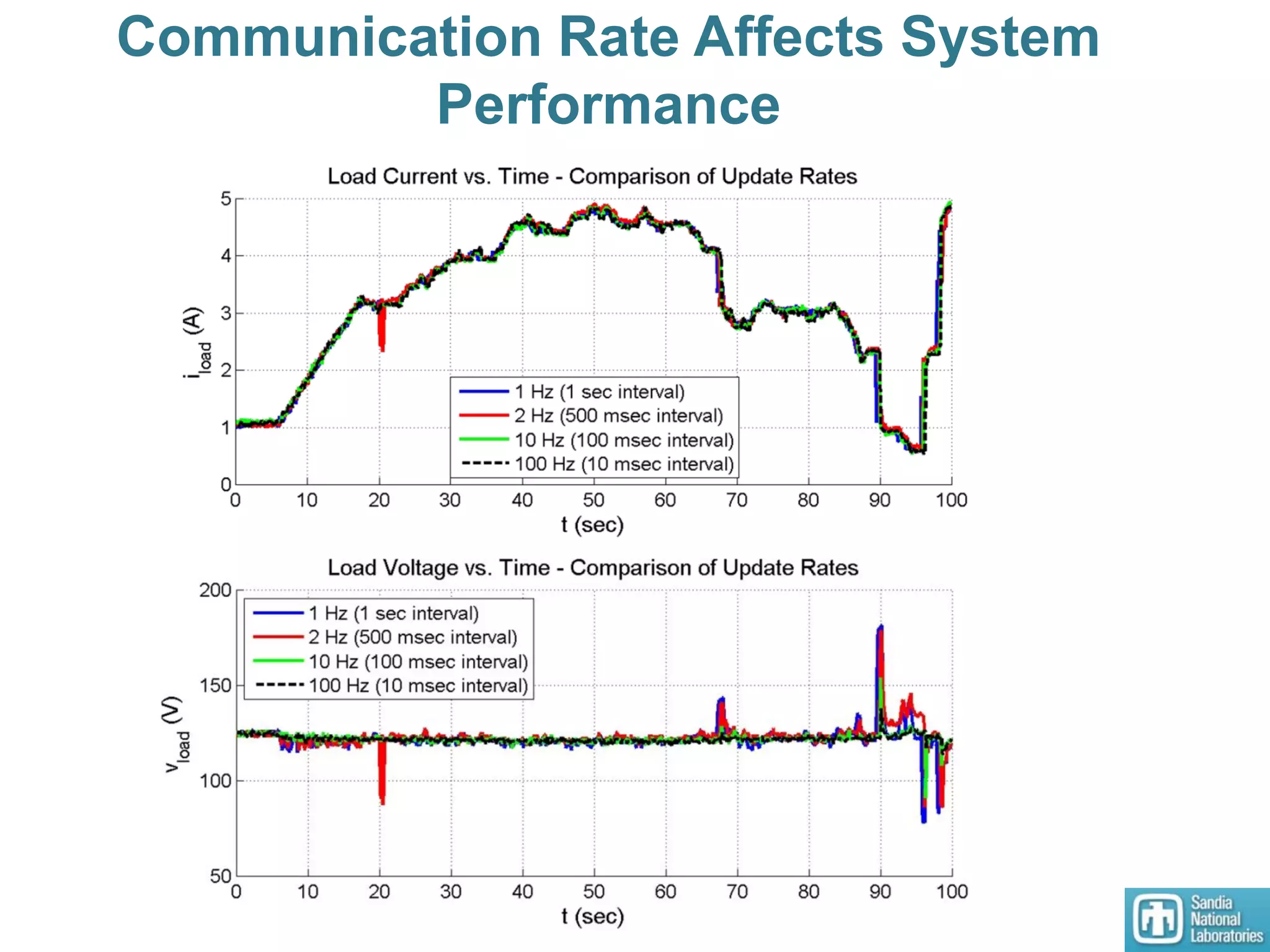
Communication Rate Affects System
Performance
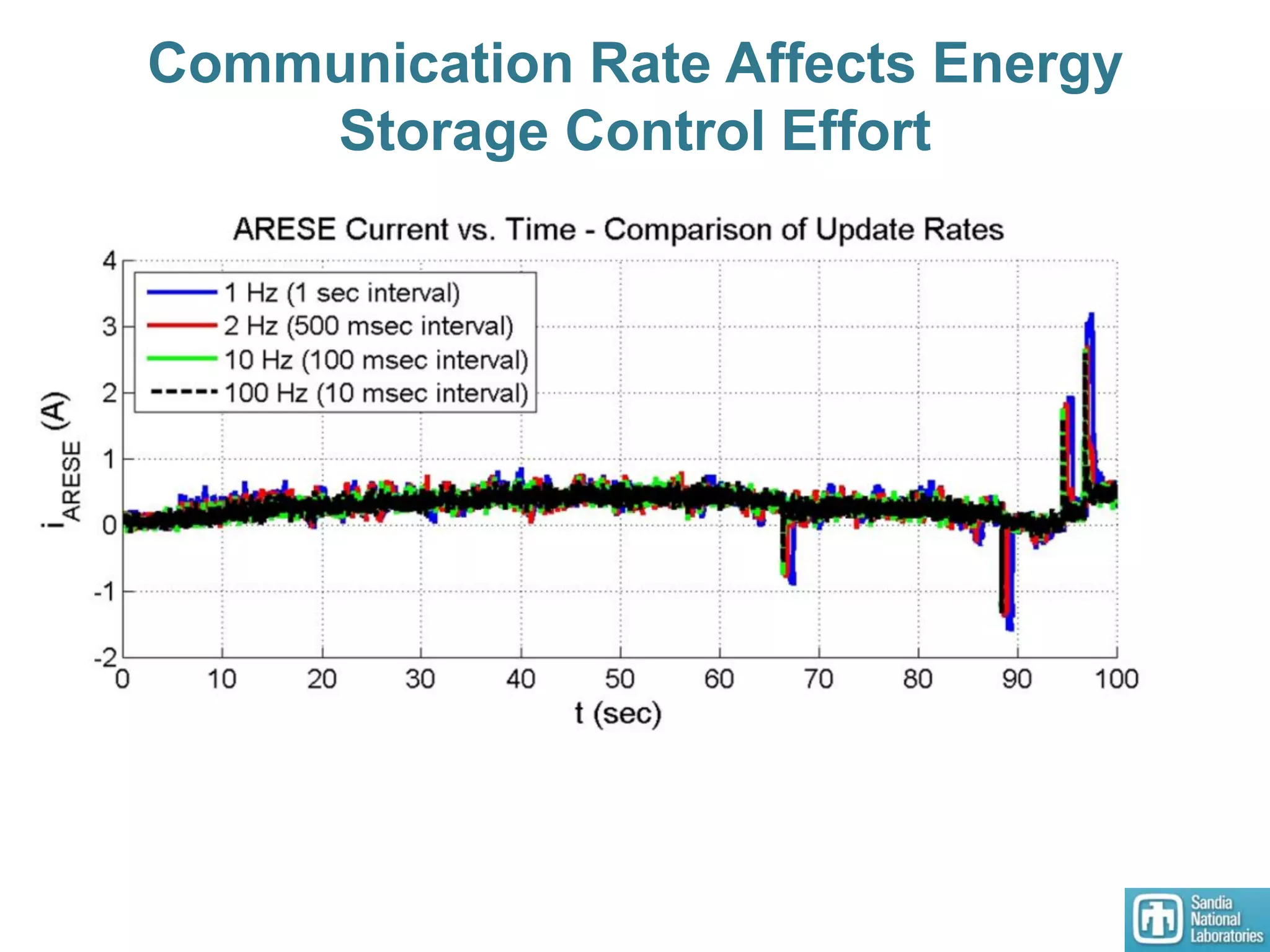
Communication Rate Affects Energy
Storage Control Effort
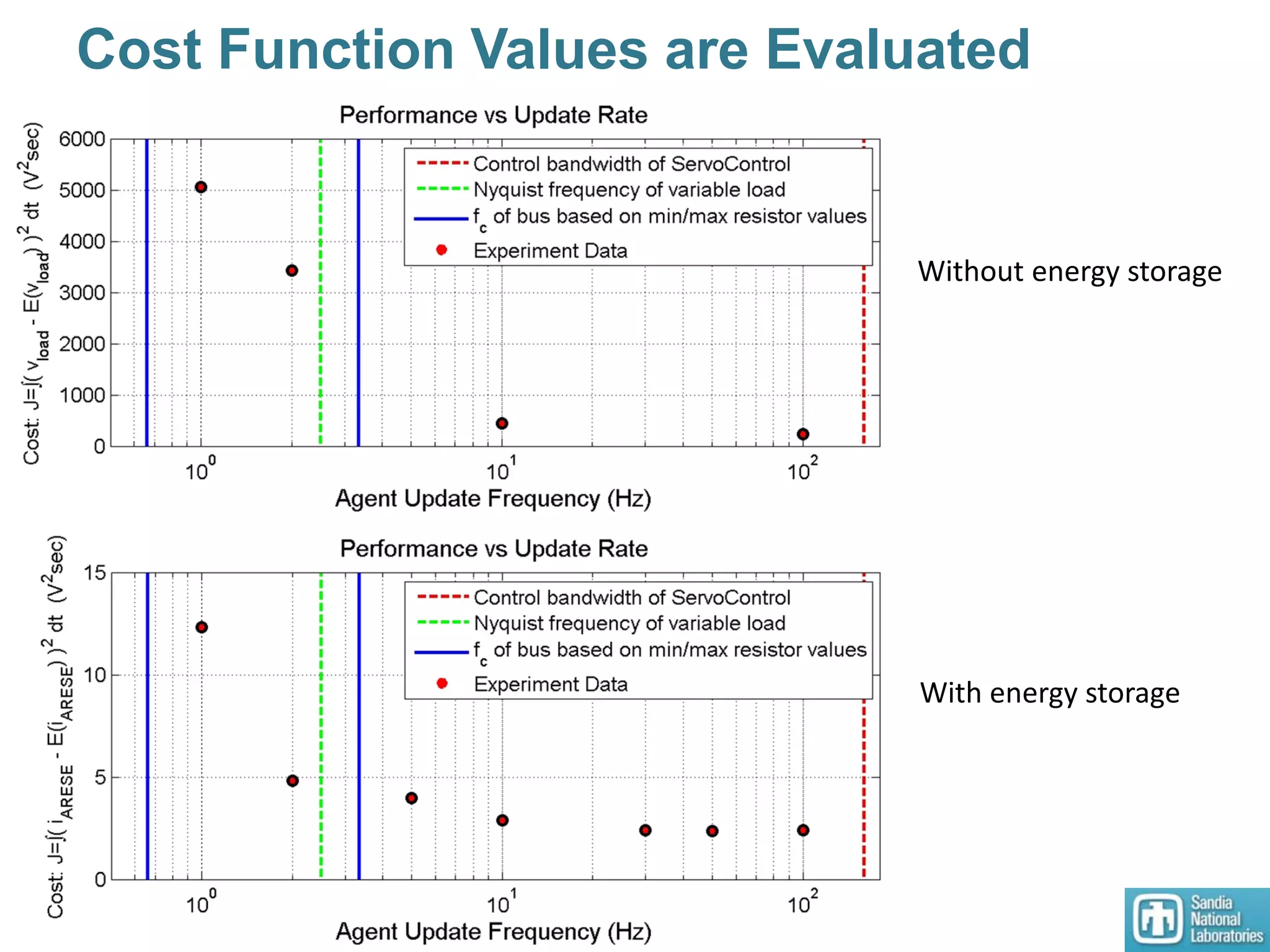
Cost Function Values are Evaluated
Without energy storage
With energy storage
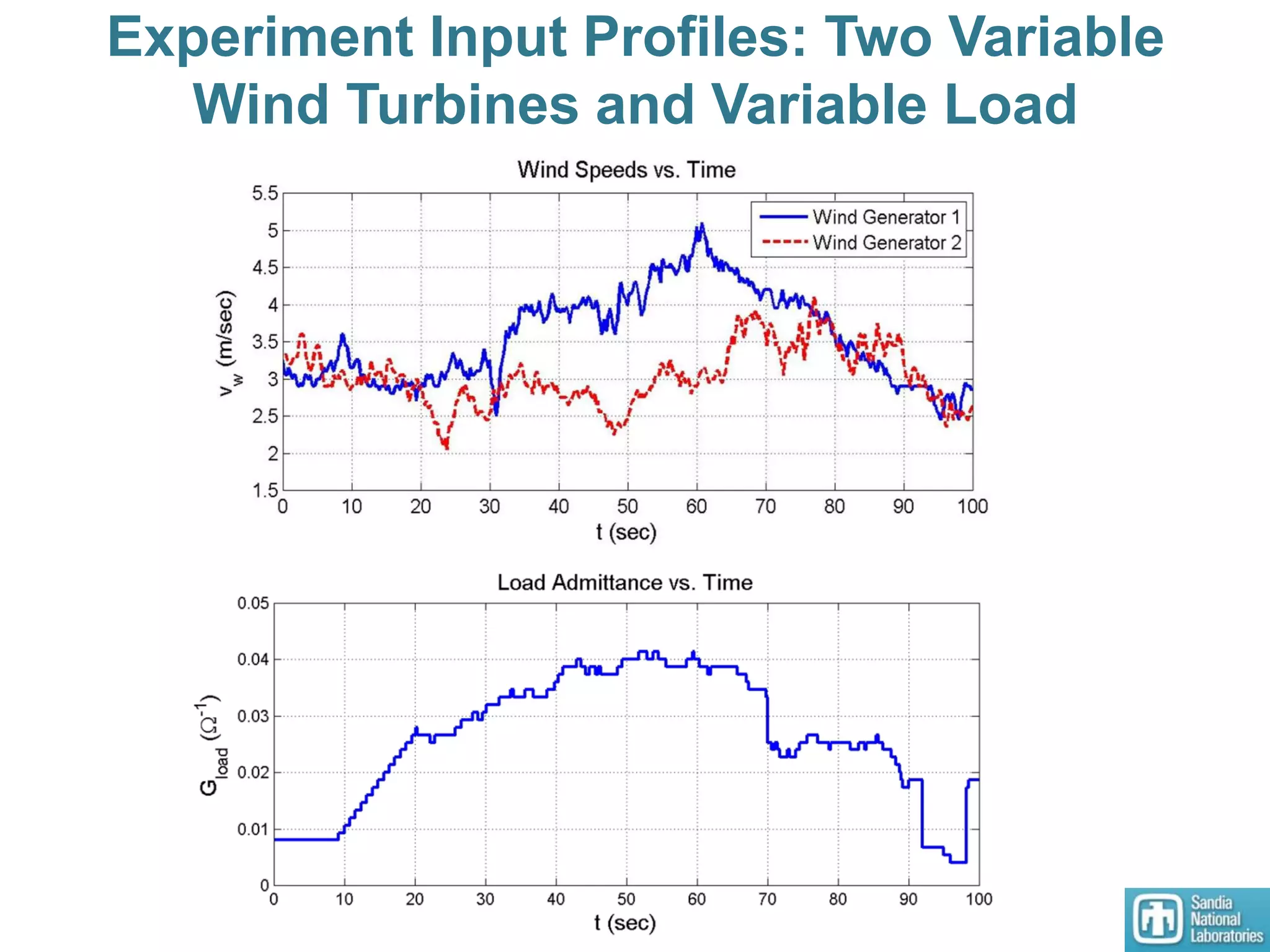
Experiment Input Profiles: Two Variable
Wind Turbines and Variable Load
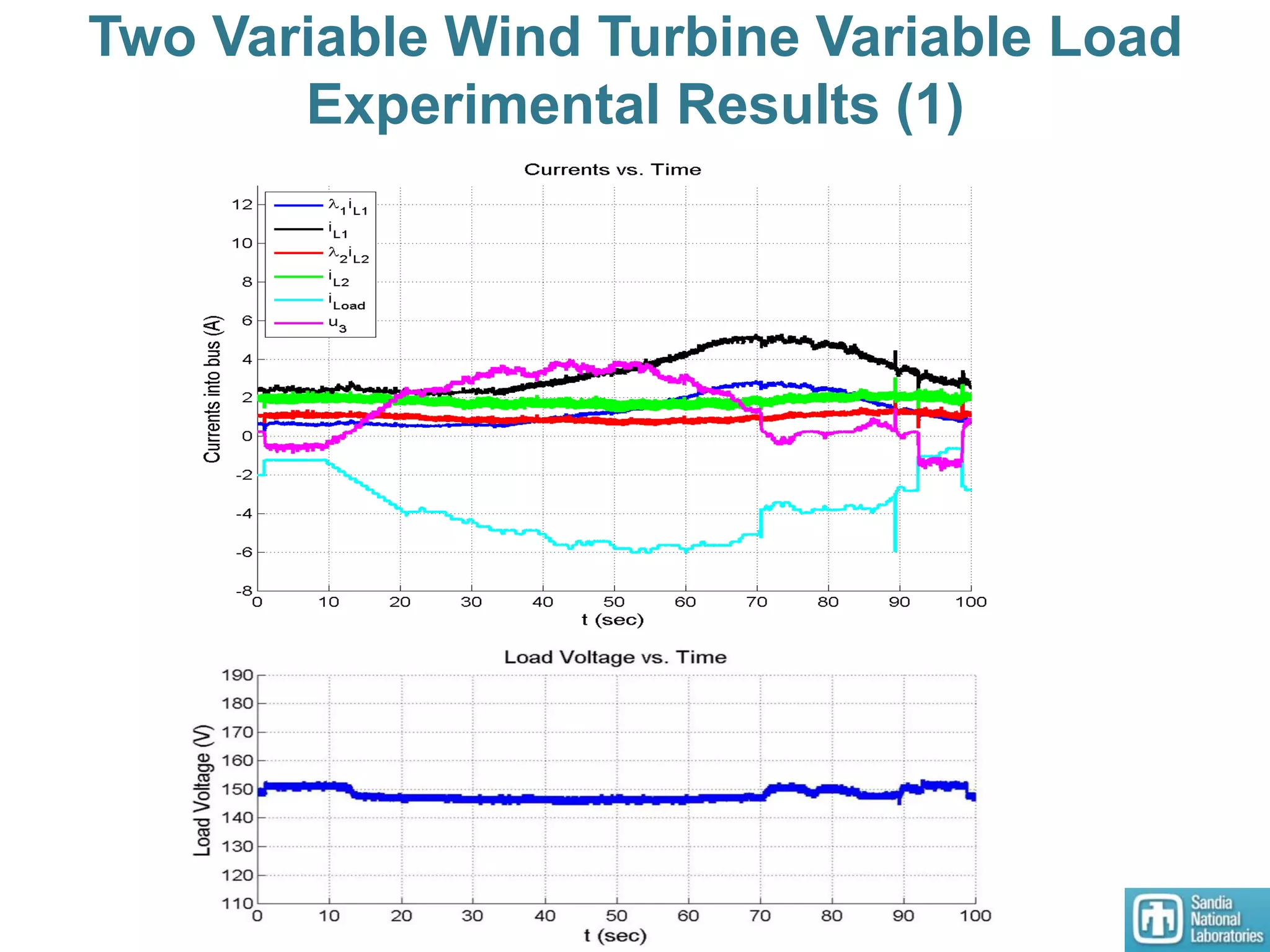
Two Variable Wind Turbine Variable Load
Experimental Results (1)
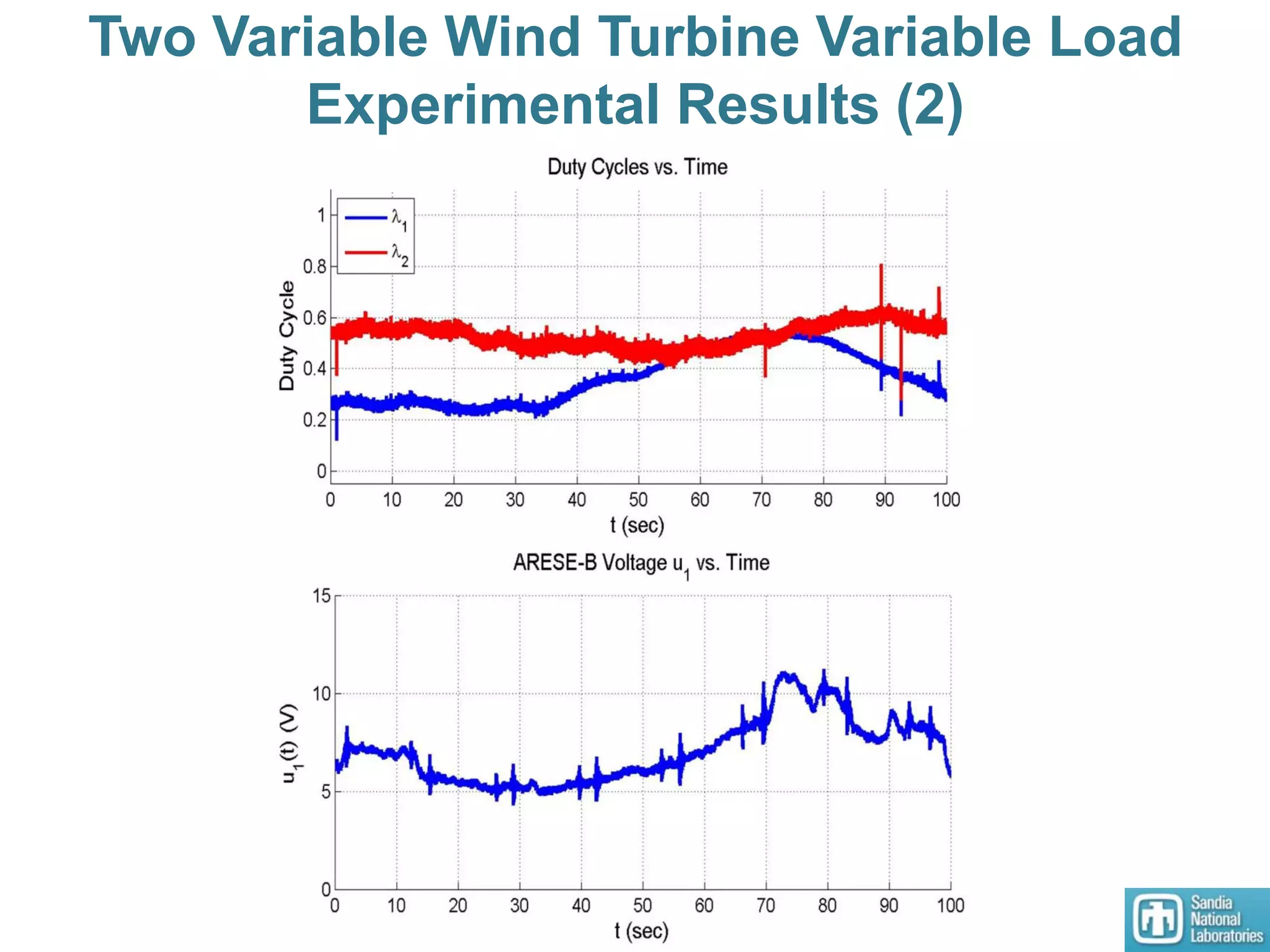
Two Variable Wind Turbine Variable Load
Experimental Results (2)
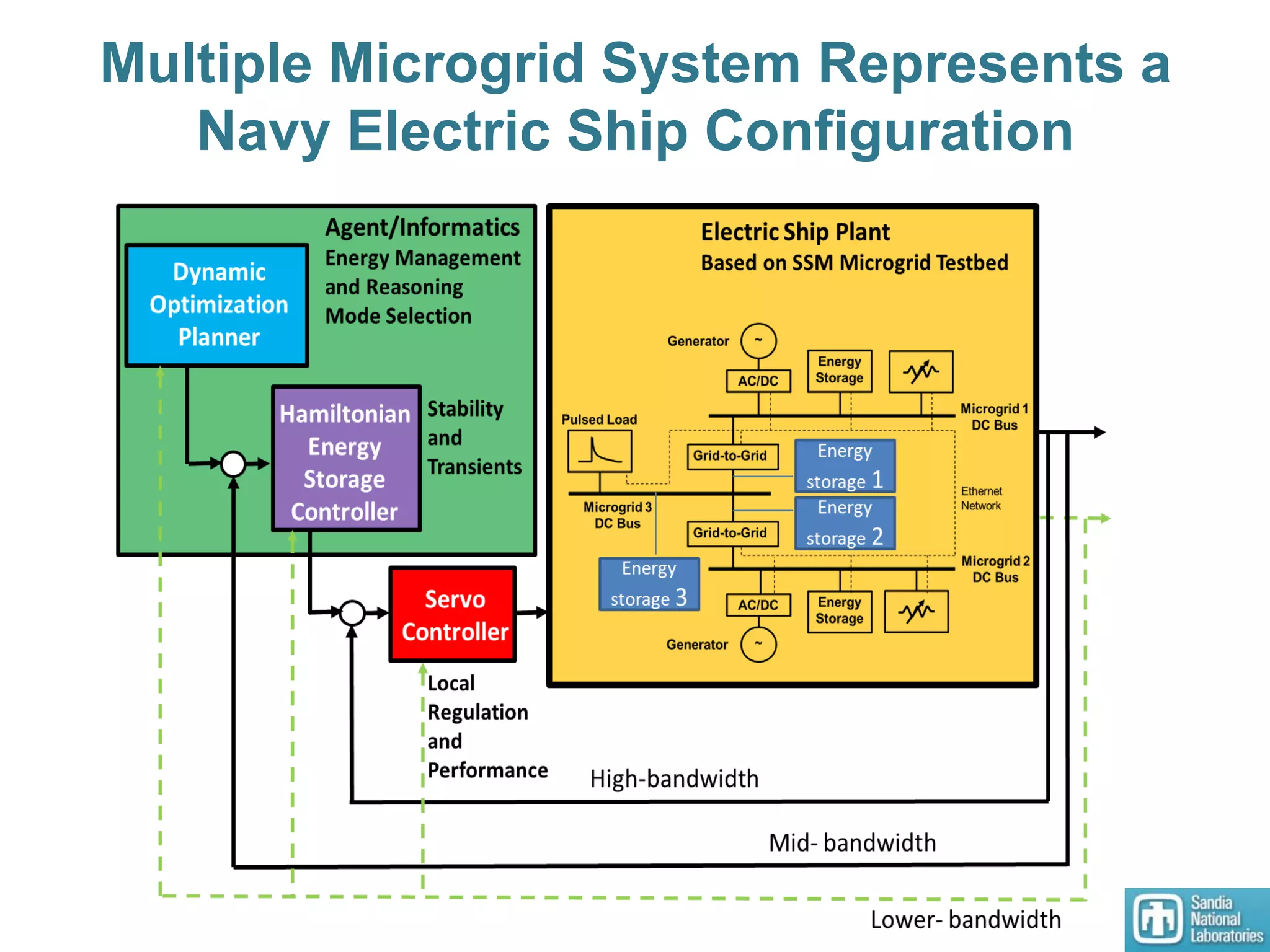
Multiple Microgrid System Represents a
Navy Electric Ship Configuration
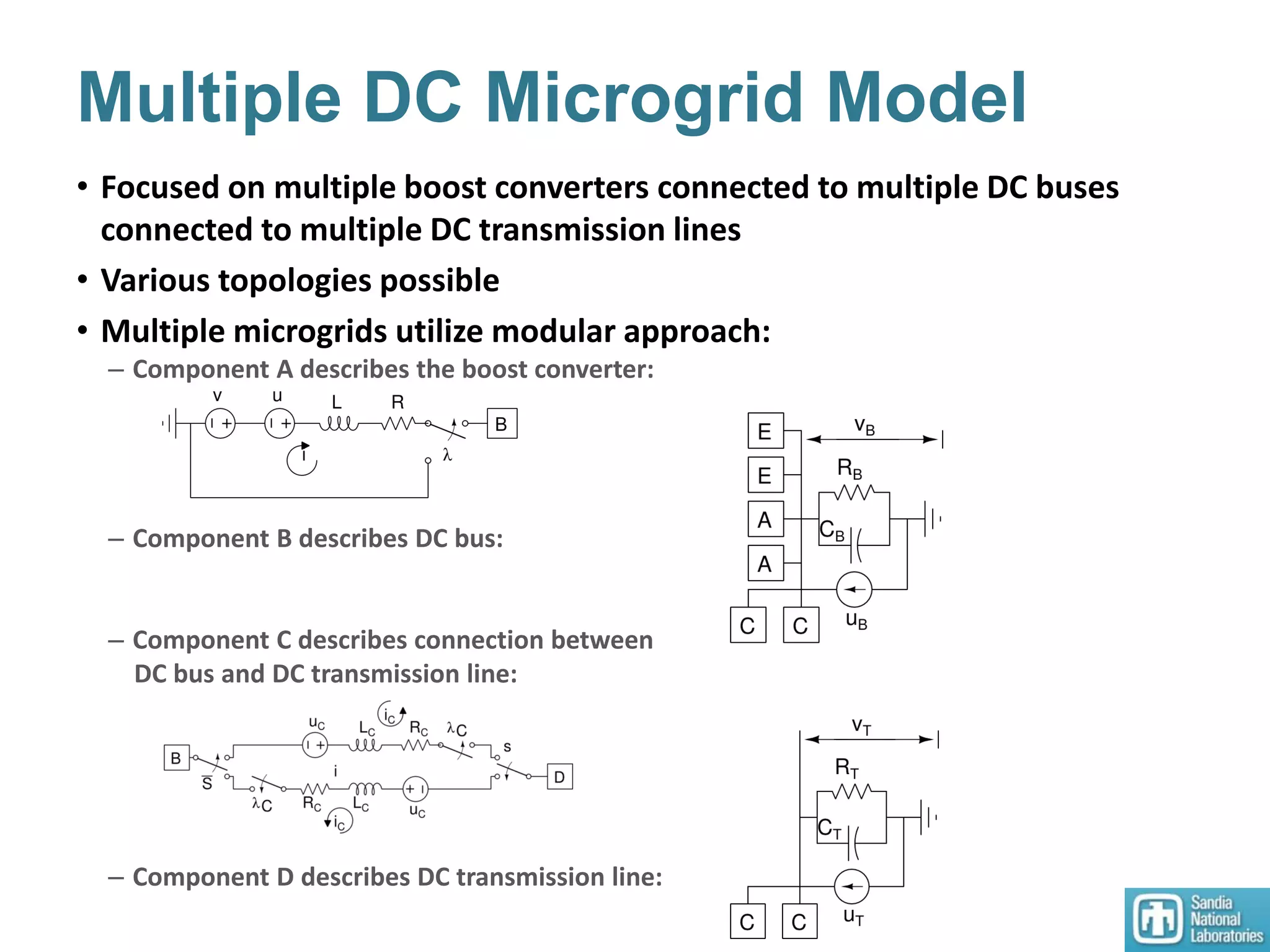
Multiple DC Microgrid Model
• Focused on multiple boost converters connected to multiple DC buses
connected to multiple DC transmission lines
• Various topologies possible
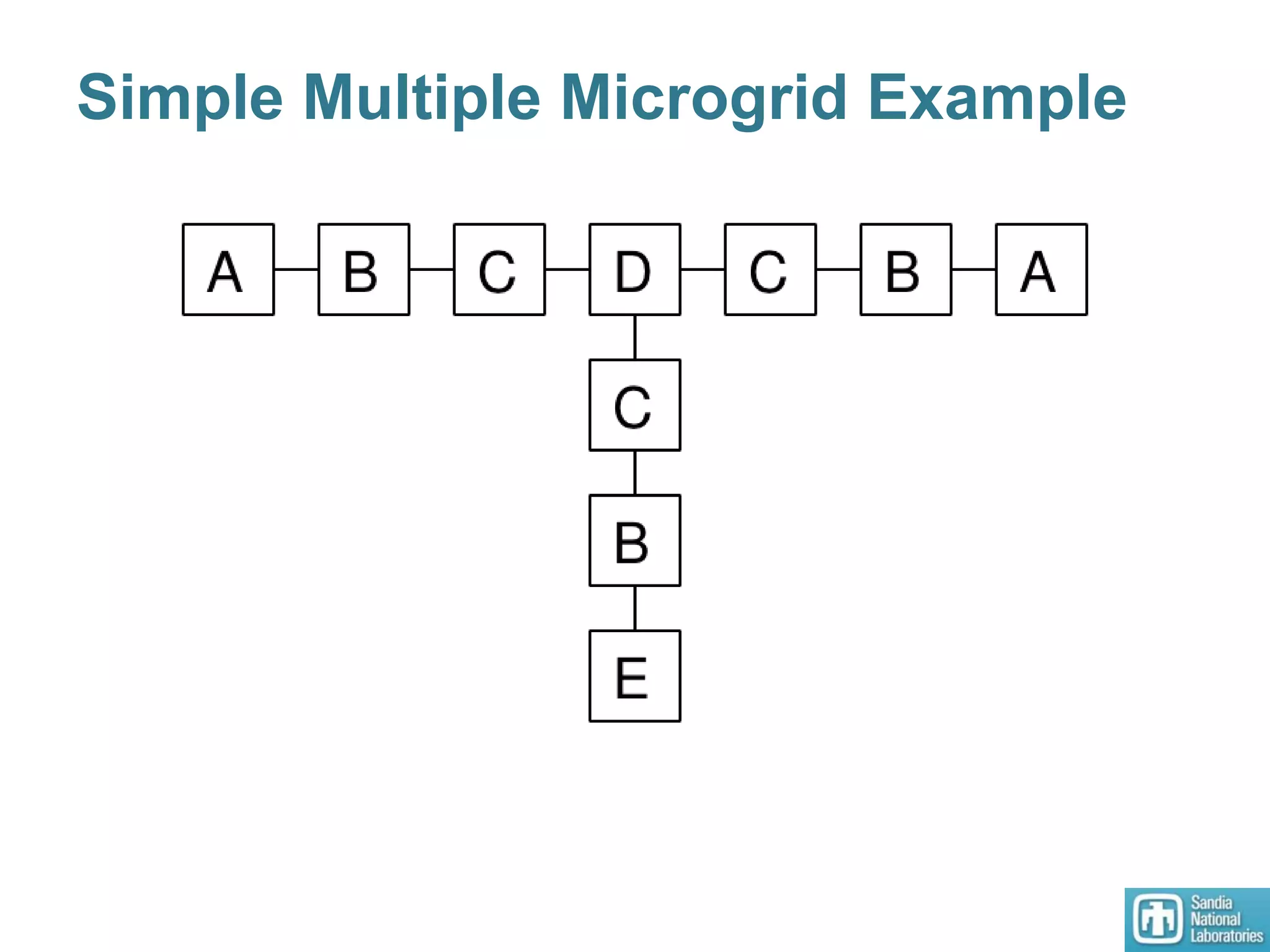
• Multiple microgrids utilize modular approach:
– Component A describes the boost converter:
– Component B describes DC bus:
– Component C describes connection between
DC bus and DC transmission line:
– Component D describes DC transmission line:
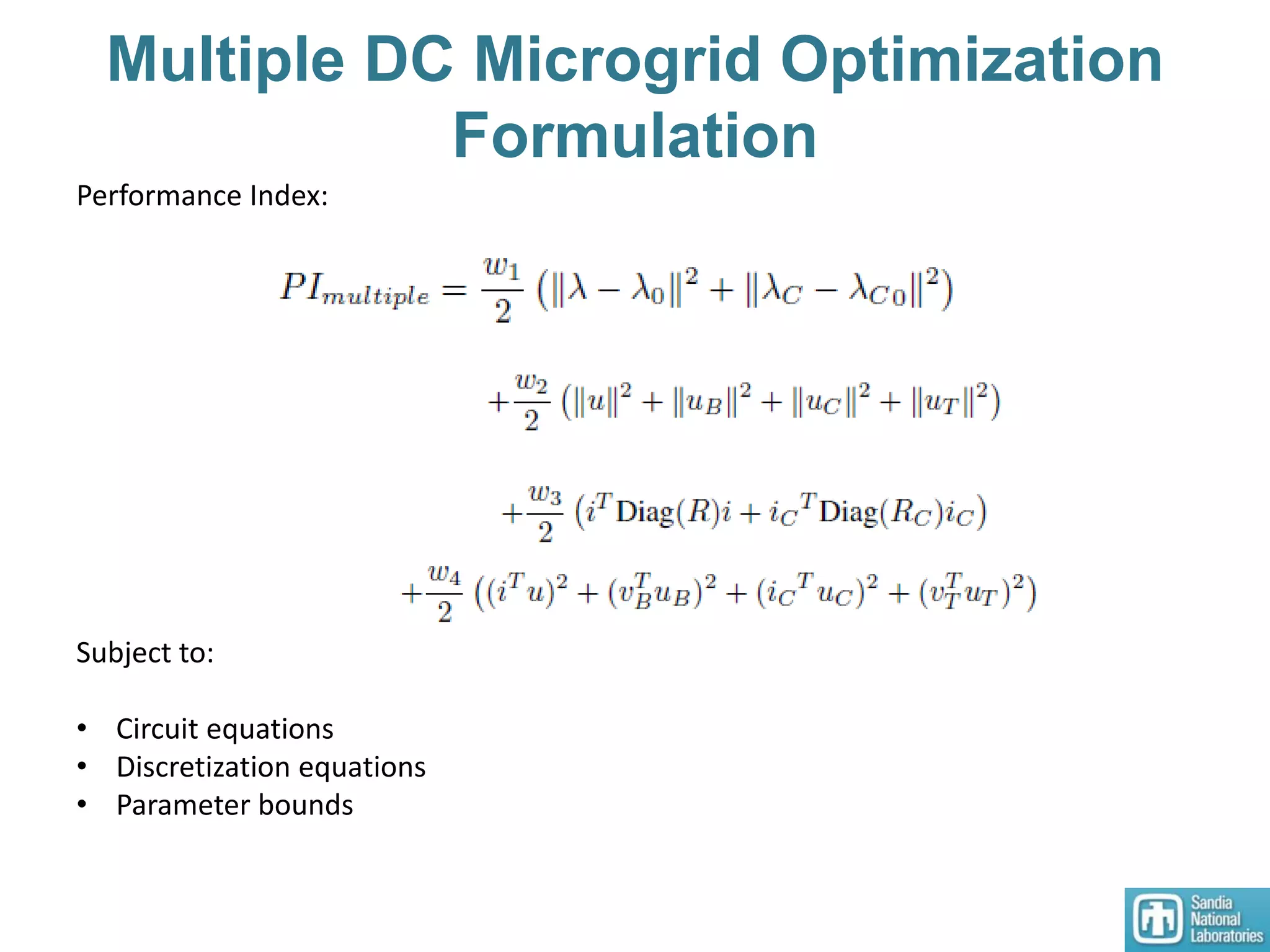
Multiple DC Microgrid Optimization
Formulation
Performance Index:
Subject to:
• Circuit equations
• Discretization equations
• Parameter bounds
Simple Multiple Microgrid Example
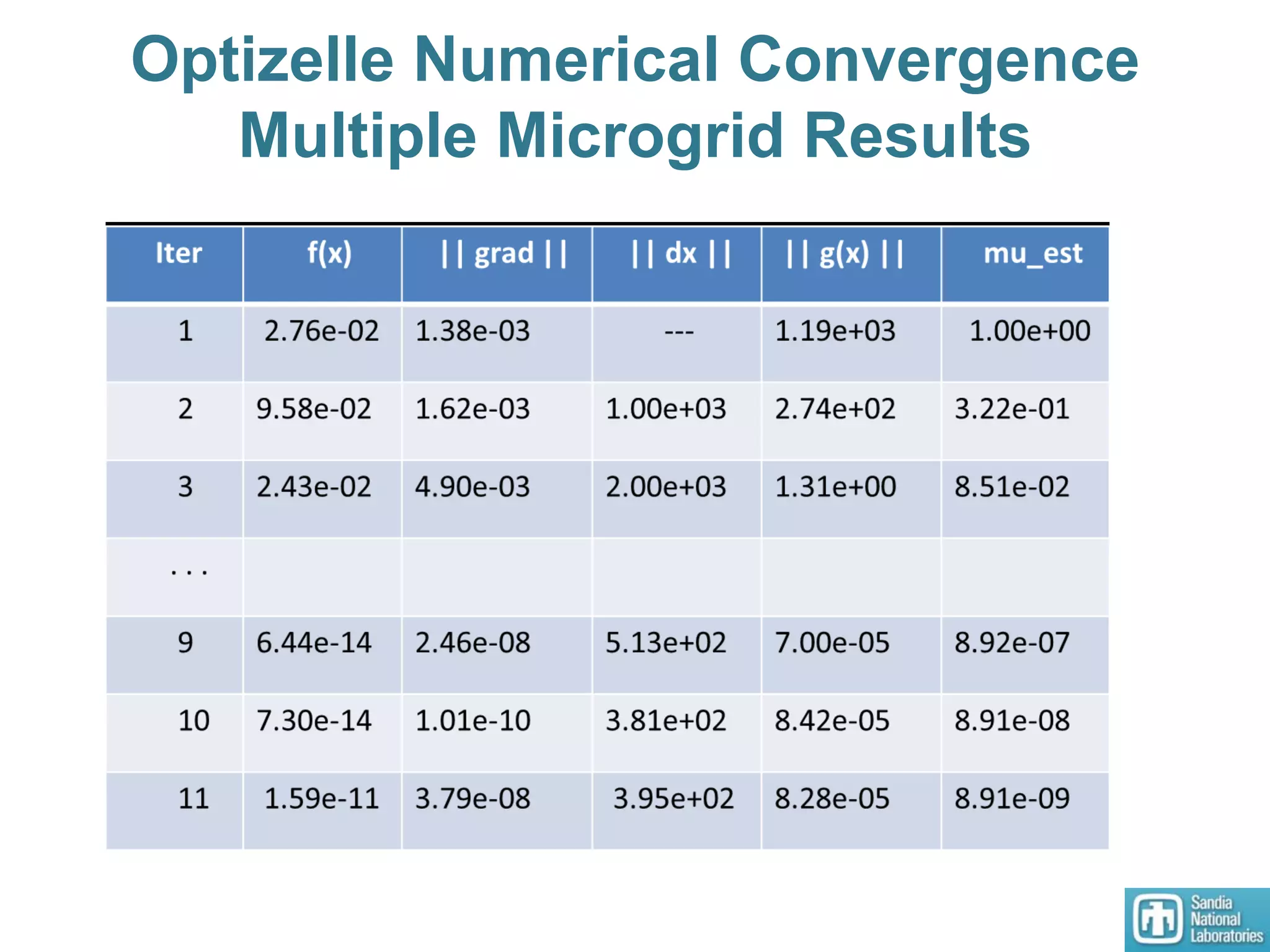
Optizelle Numerical Convergence
Multiple Microgrid Results
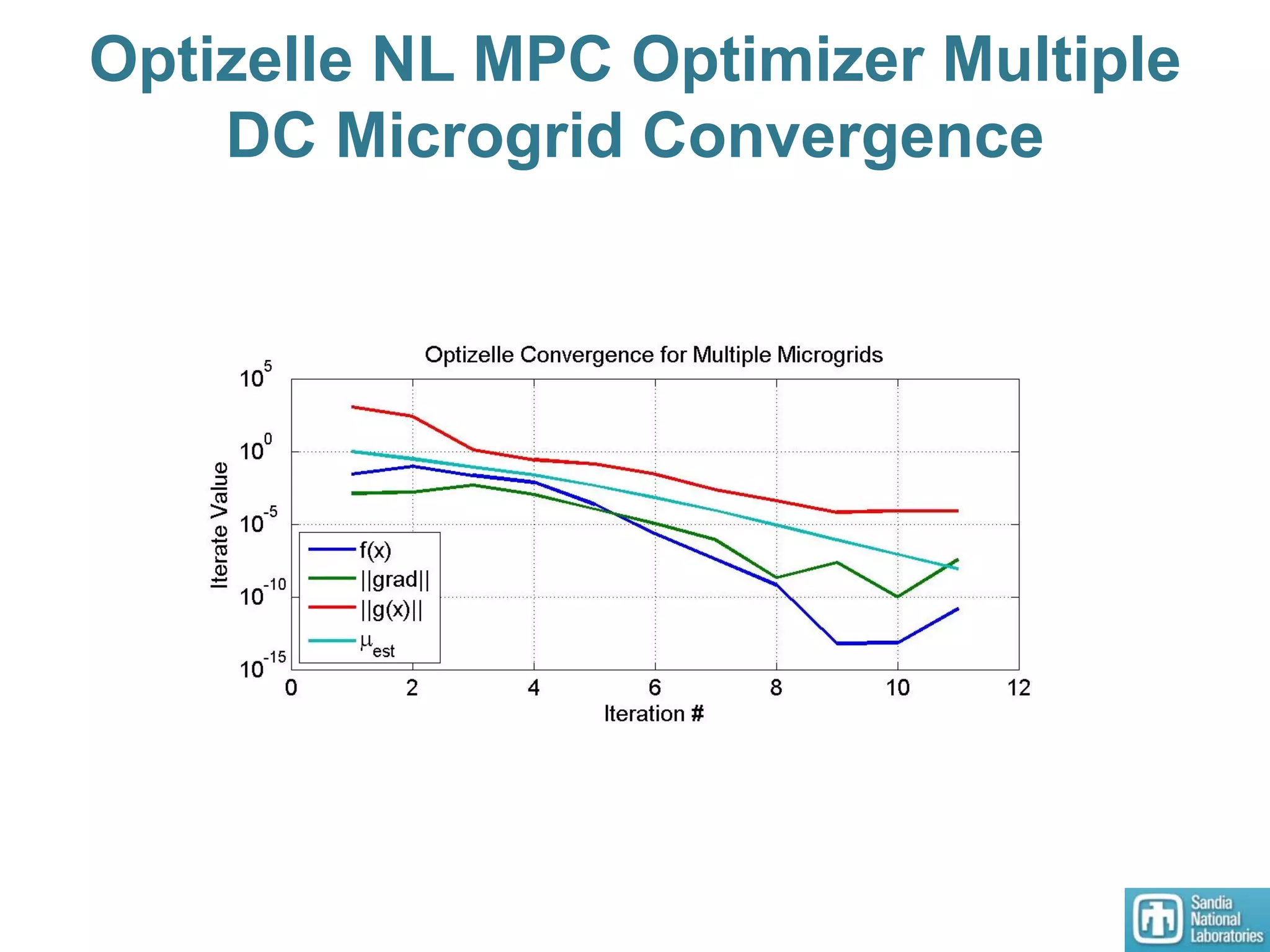
Optizelle NL MPC Optimizer Multiple
DC Microgrid Convergence
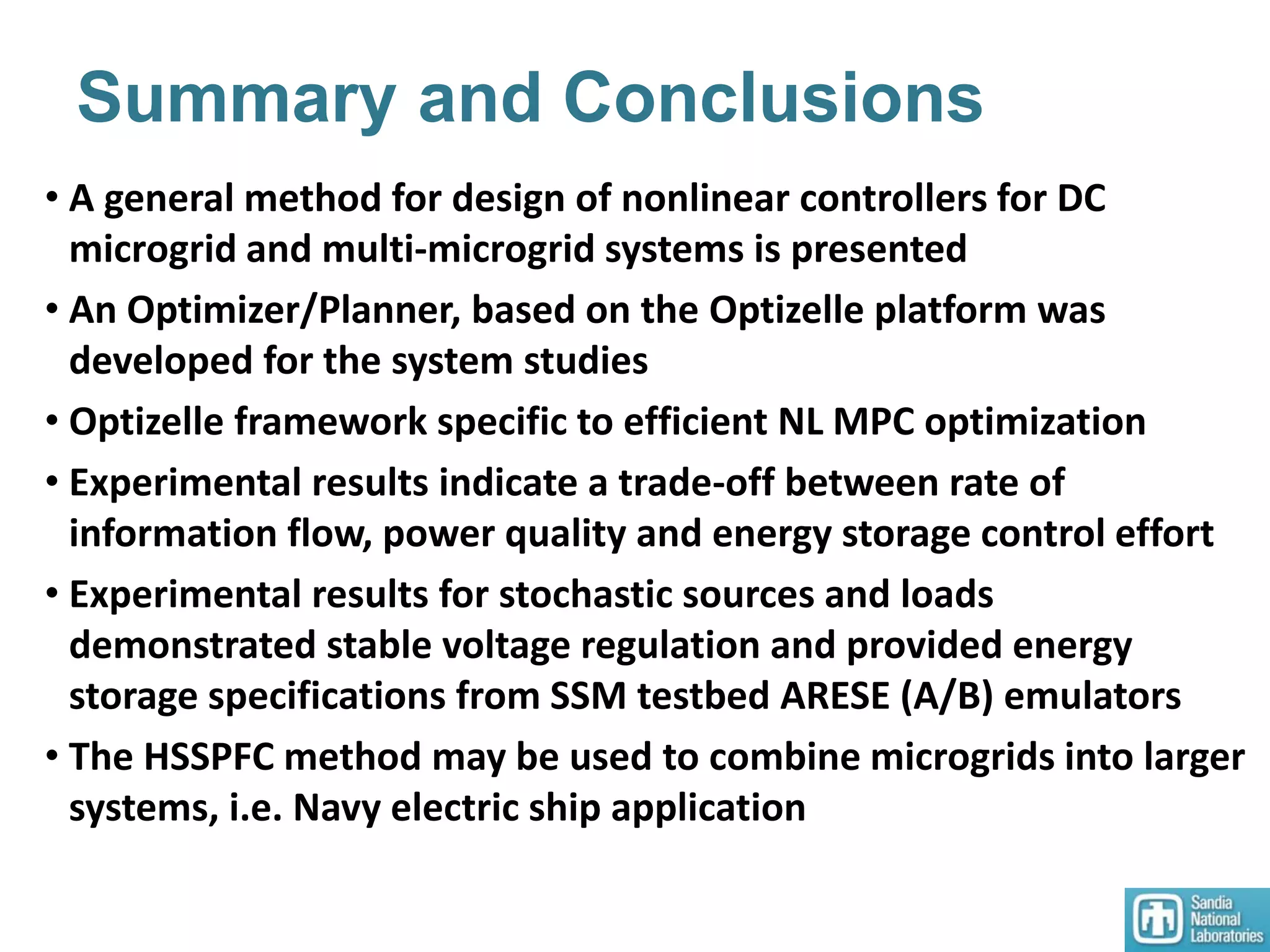
Summary and Conclusions
• A general method for design of nonlinear controllers for DC
microgrid and multi-microgrid systems is presented
• An Optimizer/Planner, based on the Optizelle platform was
developed for the system studies
• Optizelle framework specific to efficient NL MPC optimization
• Experimental results indicate a trade-off between rate of
information flow, power quality and energy storage control effort
• Experimental results for stochastic sources and loads
demonstrated stable voltage regulation and provided energy
storage specifications from SSM testbed ARESE (A/B) emulators
• The HSSPFC method may be used to combine microgrids into larger
systems, i.e. Navy electric ship application
Acknowledgments
•Sandia National Laboratories is a multiprogram
laboratory operated by Sandia Corporation, a
Lockheed Martin Company, for the U.S. Department
of Energy’s National Nuclear Security Administration
under contract DE-AC04- 94AL85000.
•SNL GC/LDRD SSM Microgrid Work
•NAVSEA Naval Power Systems, Electric Ship PMS 320
Program
•Michigan Technological University
–Professor Gordon Parker (Optimization)
–Research Professor Steve Goldsmith (Agents/Informatics Framework)
Backup Slides
A Path From Today’s Grid To The
Future (Smart) Grid
• Large spinning machines → Large inertia (matrix); dispatchable
supply with storage
• Constant operating conditions → well-ordered state
• Well-known load profiles → excellent forecasting
[I]ẋ=f(x,u,t) ; [I]-1 ~ [0] → ẋ=[I]-1 f(x,u,t) ~ 0 ; x(t)=x0
G-L>0 vt
Today’s Grid
Retain Today’s Grid: Replace lost storage with
serial or parallel additional energy storage
A Path From Today’s Grid To The
Future (Smart) Grid (cont.)
Future Grid:
1. High penetration of renewables: loss of storage
 Loss of large spinning machines
 Loss of dispatchable supplies
2. Variable operating conditions → variable state x(t)=?
3. Stochastic load profiles → renewables as negative loads
[IF] ẋ = fF(x,u,t) → ẋF(t) = [IF]-1 fF(x,u,t)
G-L<0 much of the time
4. Problem Restated: How do we regain
a) Well-ordered state → x(t) ?
b) Well-known load profiles?
c) Dispatchable supply with energy storage?
d) Stability and performance?
e) An optimal grid?
A Path From Today’s Grid To The
Future (Smart) Grid (cont.)
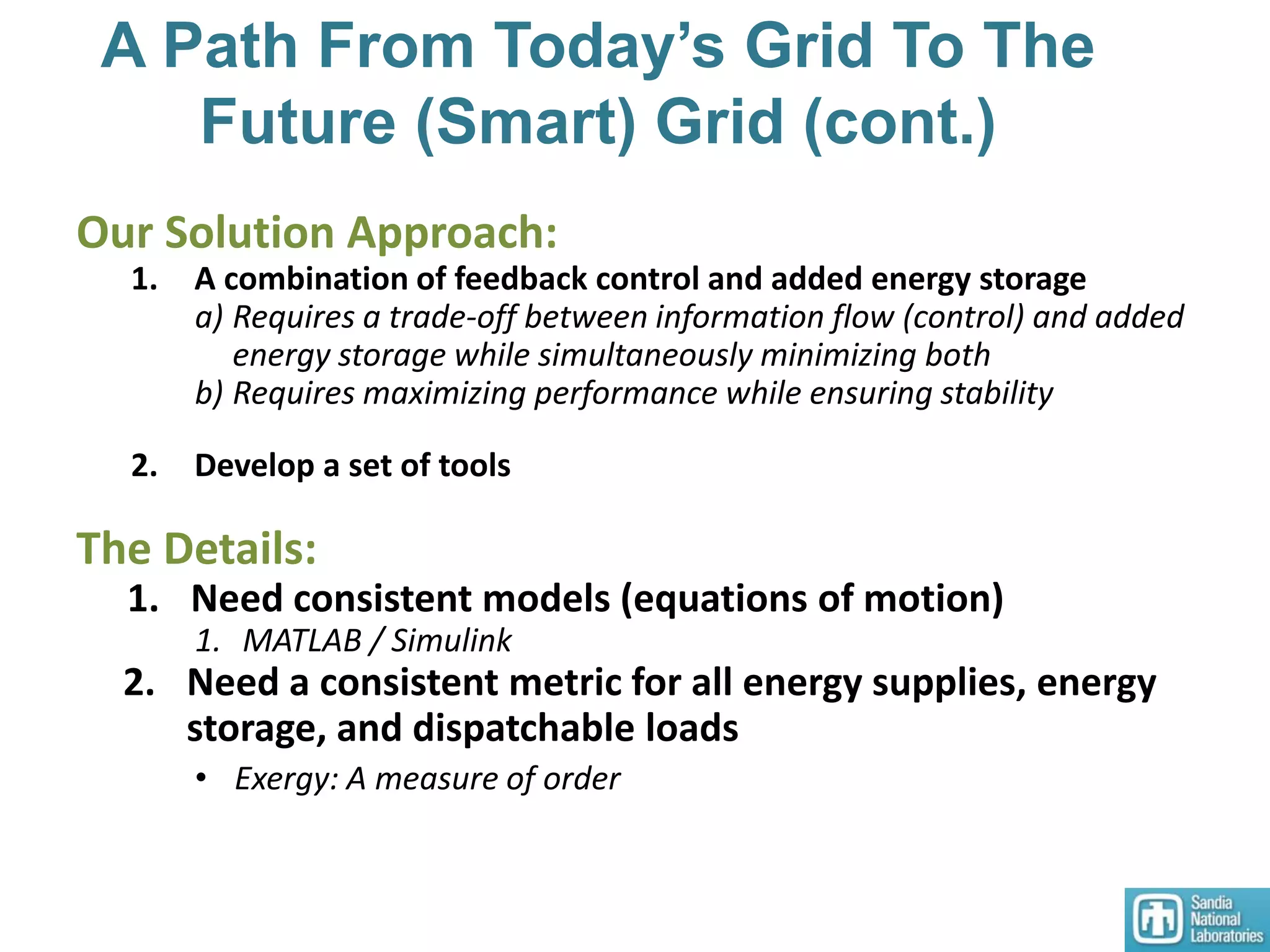
Our Solution Approach:
1. A combination of feedback control and added energy storage
a) Requires a trade-off between information flow (control) and added
energy storage while simultaneously minimizing both
b) Requires maximizing performance while ensuring stability
2. Develop a set of tools
The Details:
1. Need consistent models (equations of motion)
1. MATLAB / Simulink
2. Need a consistent metric for all energy supplies, energy
storage, and dispatchable loads
• Exergy: A measure of order
A Path From Today’s Grid To The
Future (Smart) Grid (cont.)
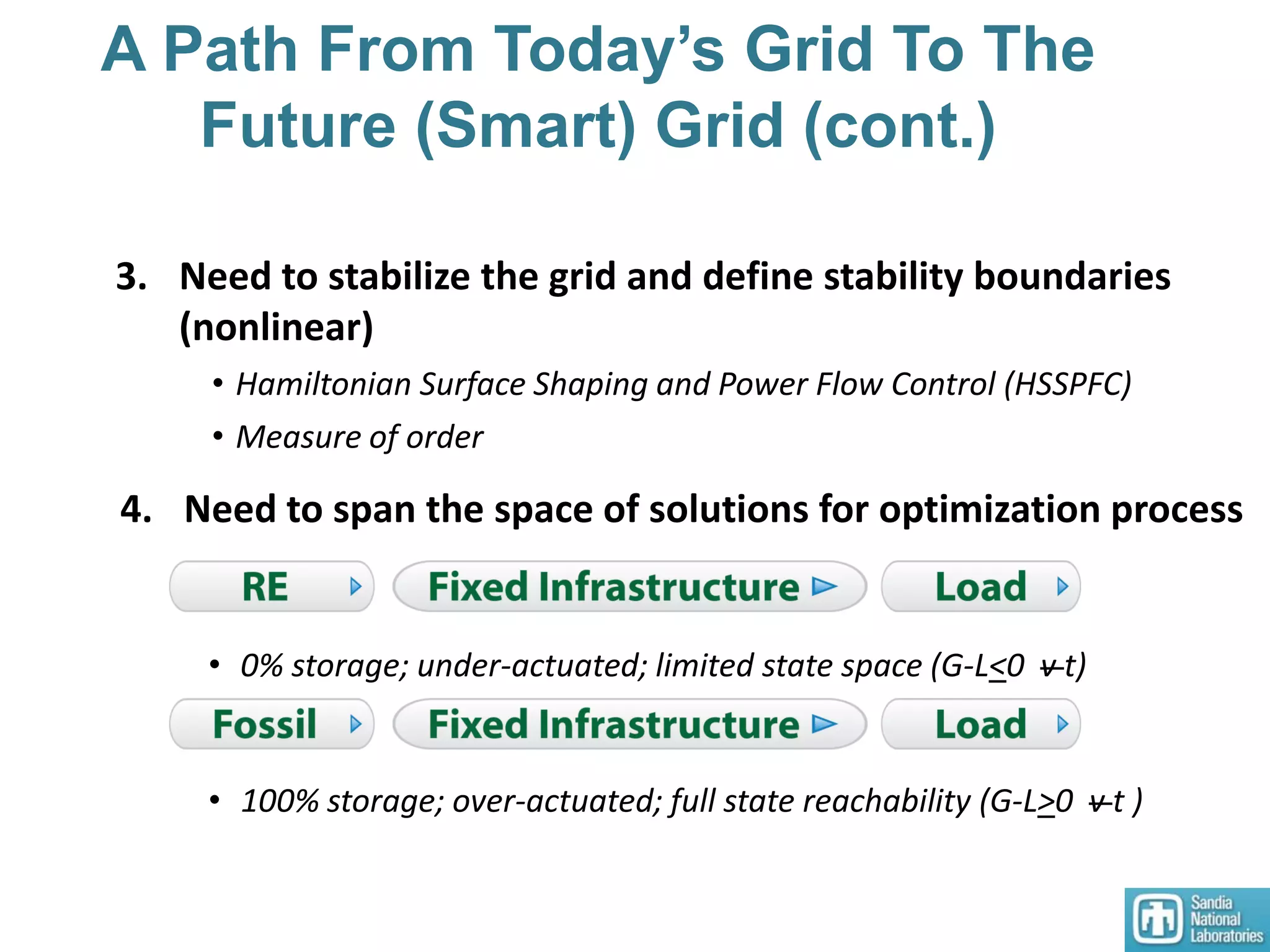
3. Need to stabilize the grid and define stability boundaries
(nonlinear)
• Hamiltonian Surface Shaping and Power Flow Control (HSSPFC)
• Measure of order
4. Need to span the space of solutions for optimization process
• 0% storage; under-actuated; limited state space (G-L<0 v t)
• 100% storage; over-actuated; full state reachability (G-L>0 v t )
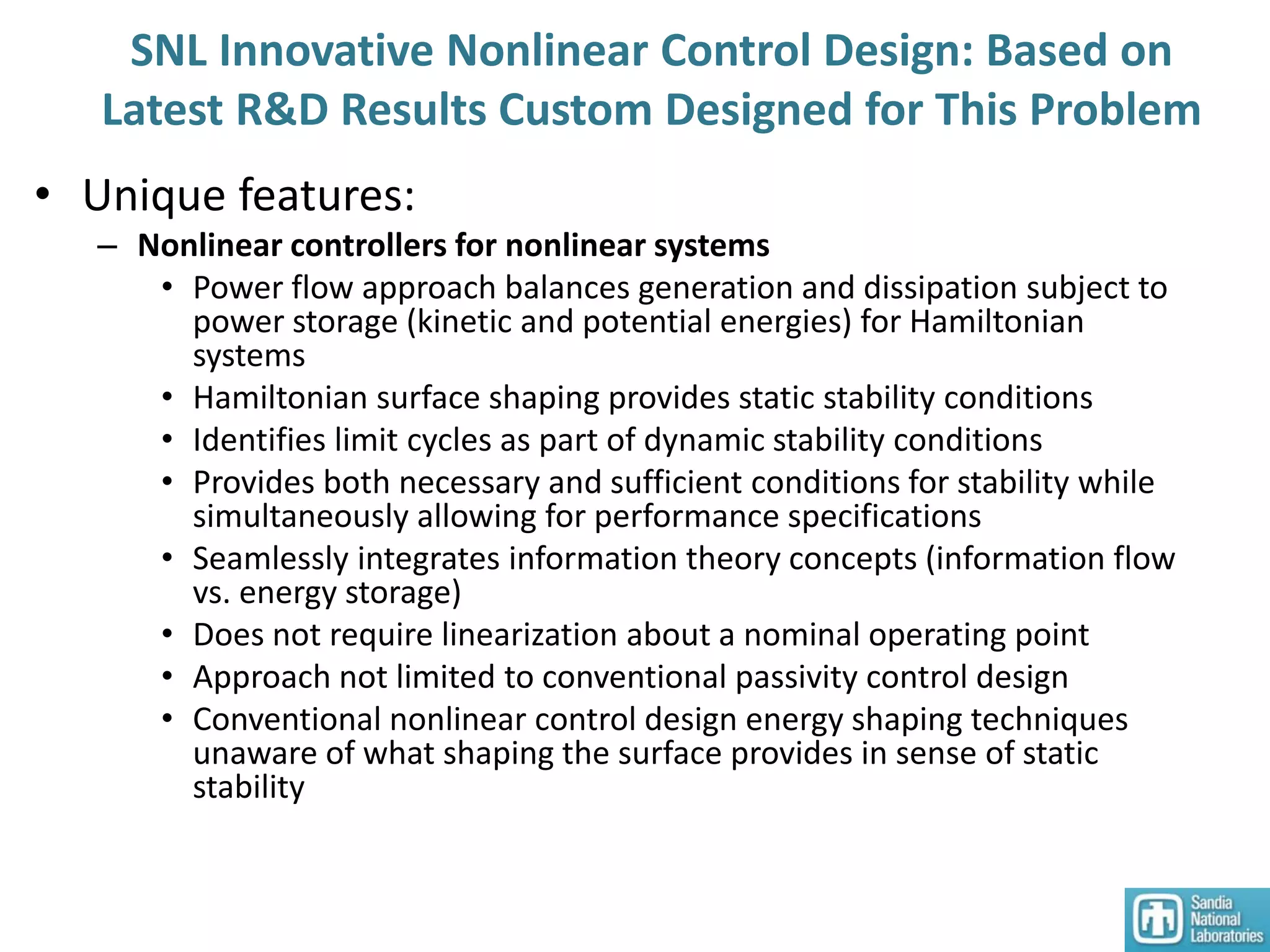
SNL Innovative Nonlinear Control Design: Based on
Latest R&D Results Custom Designed for This Problem
• Unique features:
– Nonlinear controllers for nonlinear systems
• Power flow approach balances generation and dissipation subject to
power storage (kinetic and potential energies) for Hamiltonian
systems
• Hamiltonian surface shaping provides static stability conditions
• Identifies limit cycles as part of dynamic stability conditions
• Provides both necessary and sufficient conditions for stability while
simultaneously allowing for performance specifications
• Seamlessly integrates information theory concepts (information flow
vs. energy storage)
• Does not require linearization about a nominal operating point
• Approach not limited to conventional passivity control design
• Conventional nonlinear control design energy shaping techniques
unaware of what shaping the surface provides in sense of static
stability
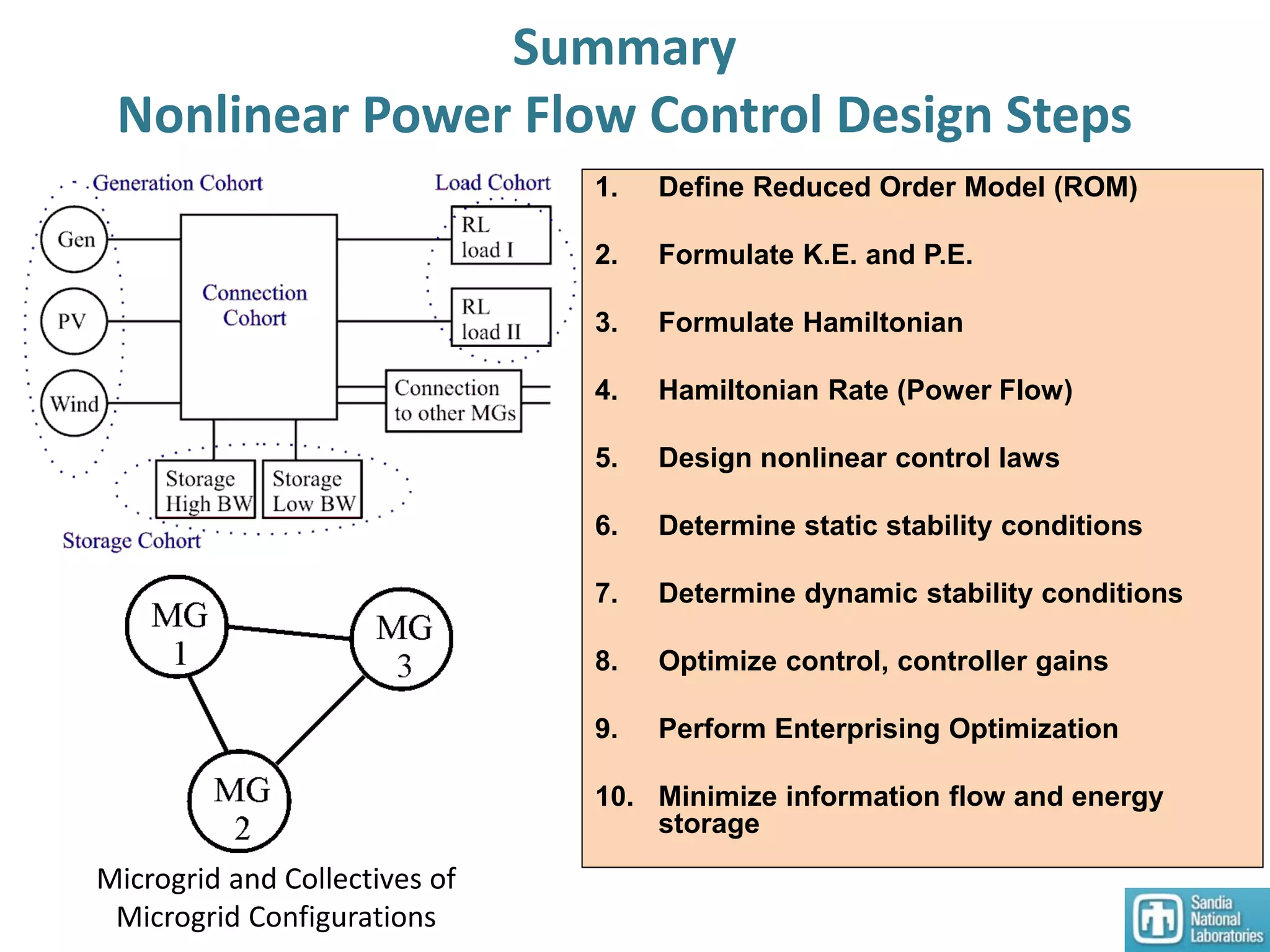
Summary
Nonlinear Power Flow Control Design Steps
1. Define Reduced Order Model (ROM)
2. Formulate K.E. and P.E.
3. Formulate Hamiltonian
4. Hamiltonian Rate (Power Flow)
5. Design nonlinear control laws
6. Determine static stability conditions
7. Determine dynamic stability conditions
8. Optimize control, controller gains
9. Perform Enterprising Optimization
10. Minimize information flow and energy
storage
Microgrid and Collectives of
Microgrid Configurations
Nonlinear Control Design
HSSPFC Energy Storage
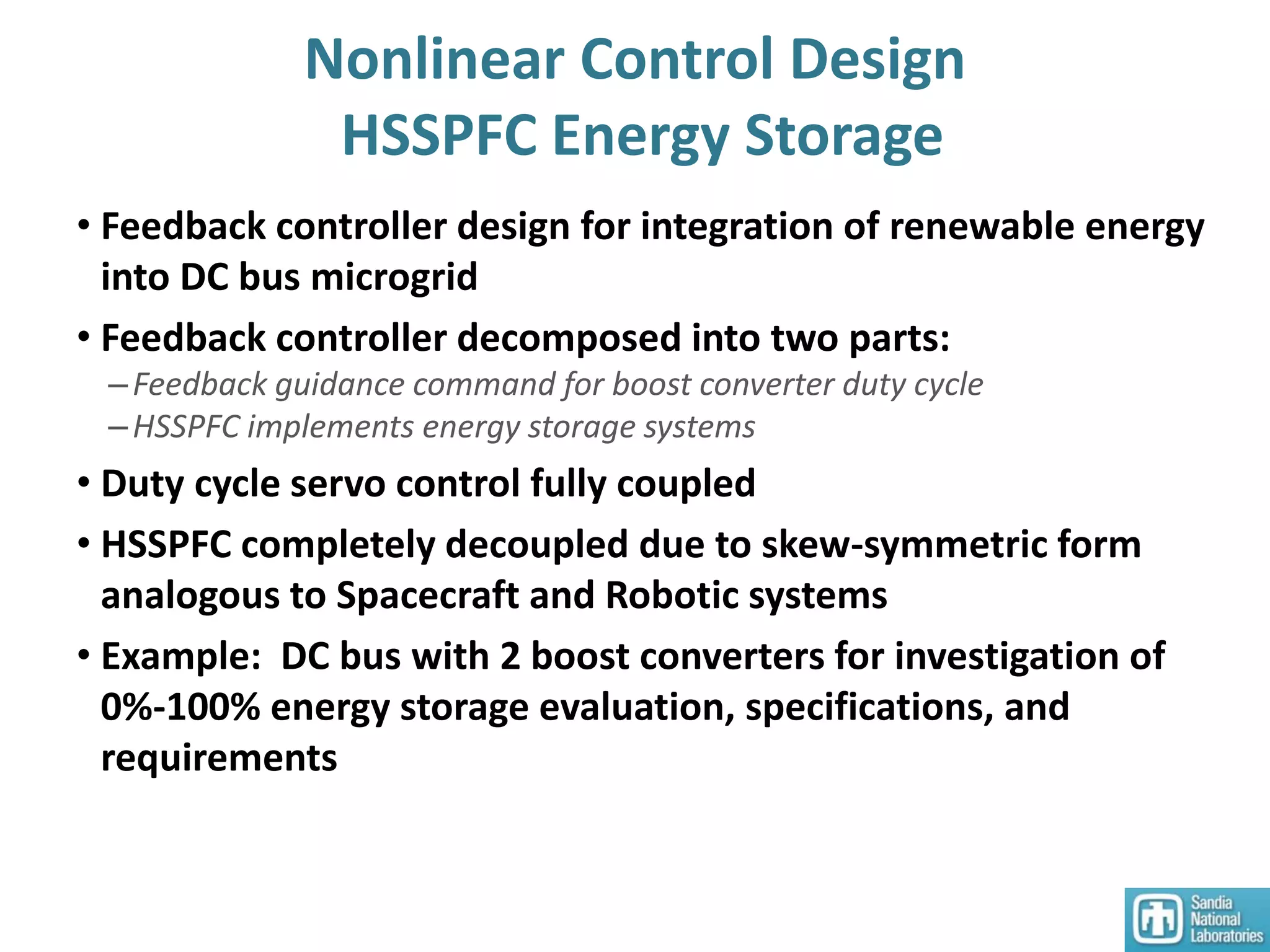
• Feedback controller design for integration of renewable energy
into DC bus microgrid
• Feedback controller decomposed into two parts:
–Feedback guidance command for boost converter duty cycle
–HSSPFC implements energy storage systems
• Duty cycle servo control fully coupled
• HSSPFC completely decoupled due to skew-symmetric form
analogous to Spacecraft and Robotic systems
• Example: DC bus with 2 boost converters for investigation of
0%-100% energy storage evaluation, specifications, and
requirements
Duty Cycle Commands
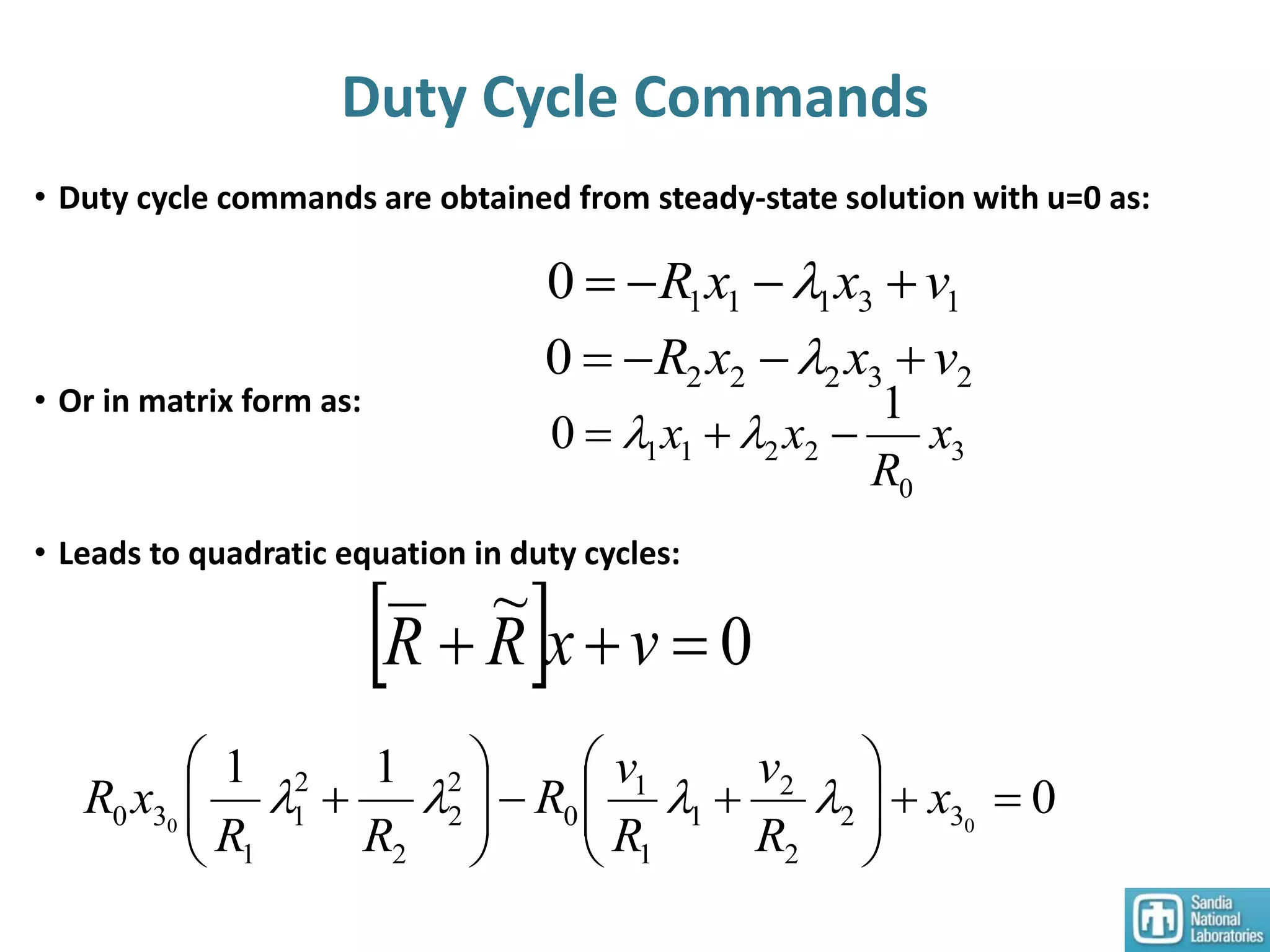
• Duty cycle commands are obtained from steady-state solution with u=0 as:
• Or in matrix form as:
• Leads to quadratic equation in duty cycles:
131110 vxxR  
232220 vxxR  
3
0
2211
1
0 x
R
xx  
0
11
00 32
2
2
1
1
1
0
2
2
2
2
1
1
30 











 x
R
v
R
v
R
RR
xR 
  0
~
 vxRR
HSSPFC for Energy Storage Design
Observations
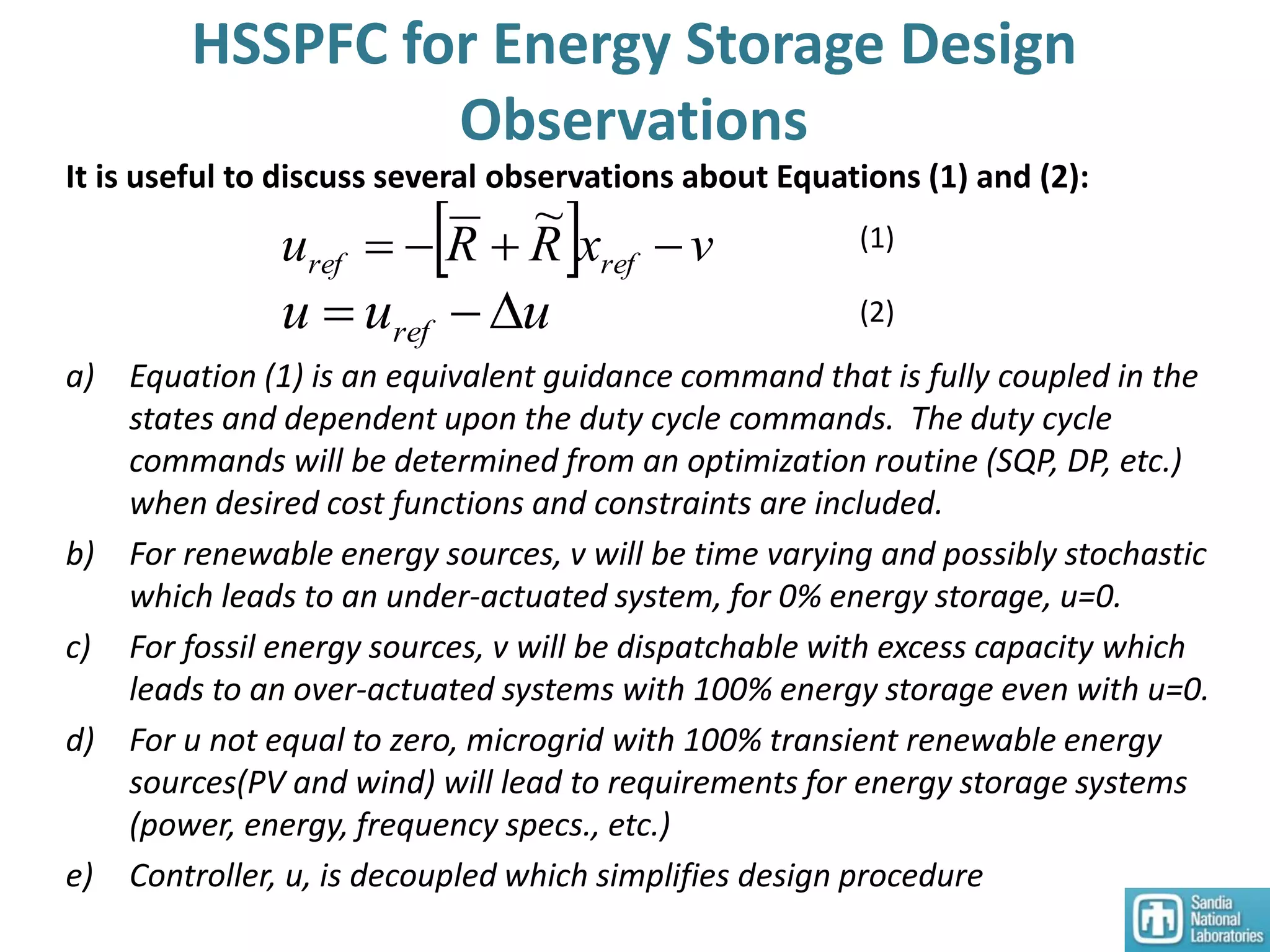
a) Equation (1) is an equivalent guidance command that is fully coupled in the
states and dependent upon the duty cycle commands. The duty cycle
commands will be determined from an optimization routine (SQP, DP, etc.)
when desired cost functions and constraints are included.
b) For renewable energy sources, v will be time varying and possibly stochastic
which leads to an under-actuated system, for 0% energy storage, u=0.
c) For fossil energy sources, v will be dispatchable with excess capacity which
leads to an over-actuated systems with 100% energy storage even with u=0.
d) For u not equal to zero, microgrid with 100% transient renewable energy
sources(PV and wind) will lead to requirements for energy storage systems
(power, energy, frequency specs., etc.)
e) Controller, u, is decoupled which simplifies design procedure
It is useful to discuss several observations about Equations (1) and (2):
  vxRRu refref 
~
uuu ref  (2)
(1)
Energy Storage
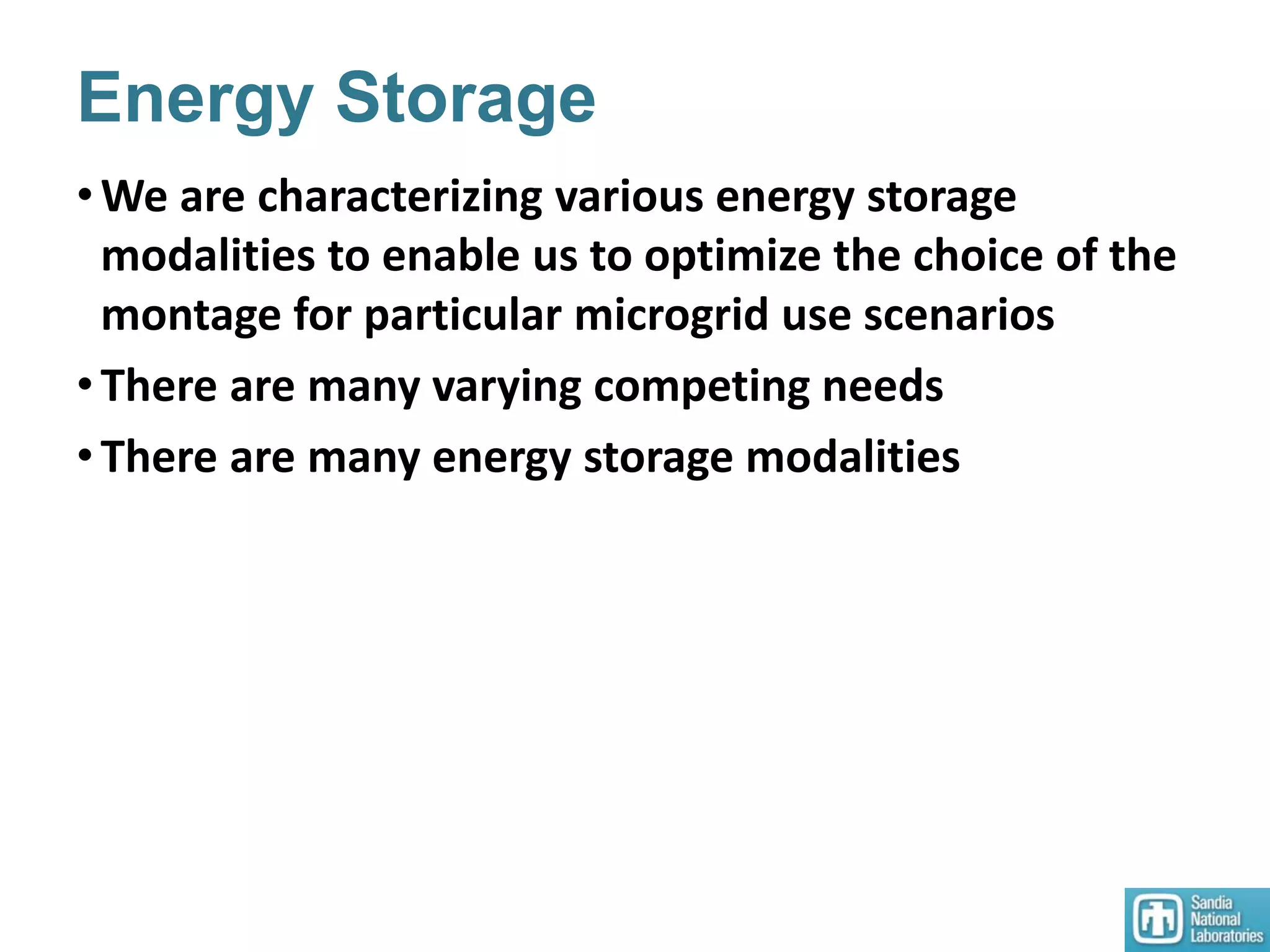
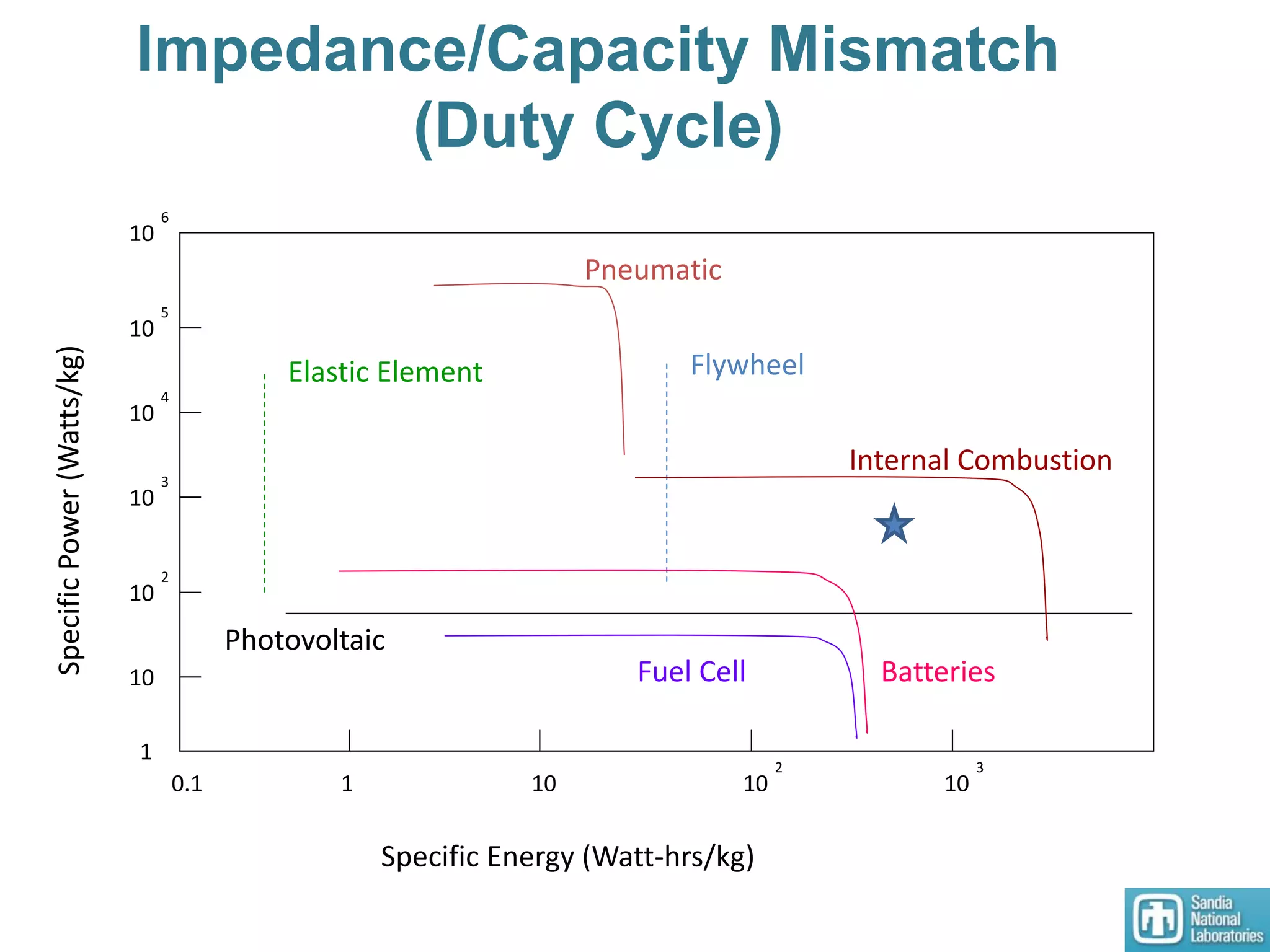
•We are characterizing various energy storage
modalities to enable us to optimize the choice of the
montage for particular microgrid use scenarios
•There are many varying competing needs
•There are many energy storage modalities
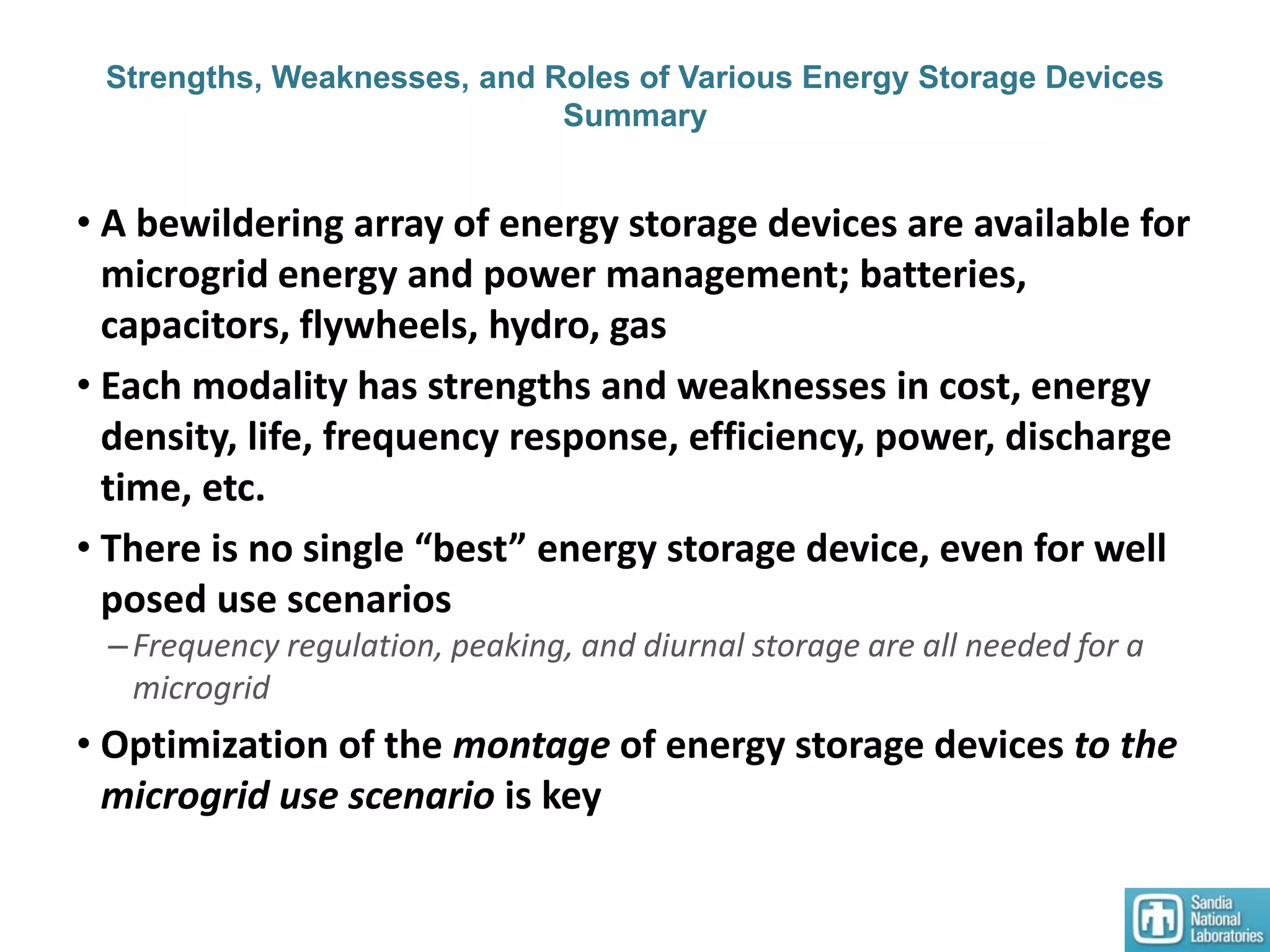
Strengths, Weaknesses, and Roles of Various Energy Storage Devices
Summary
• A bewildering array of energy storage devices are available for
microgrid energy and power management; batteries,
capacitors, flywheels, hydro, gas
• Each modality has strengths and weaknesses in cost, energy
density, life, frequency response, efficiency, power, discharge
time, etc.
• There is no single “best” energy storage device, even for well
posed use scenarios
–Frequency regulation, peaking, and diurnal storage are all needed for a
microgrid
• Optimization of the montage of energy storage devices to the
microgrid use scenario is key
1
10
10
10
10
10
10
101 10 10 100.1
2
3
4
5
6
2 3 4
Specific Energy (Watt-hrs/kg)
Elastic Element
Pneumatic
Flywheel
Photovoltaic
Batteries
Internal Combustion
Fuel Cell
Impedance/Capacity Mismatch
(Duty Cycle)
Summary and Future Work
• Present design of feedback controllers for integration of
renewable energy into DC bus microgrid system
• HSSPFC used to determine both static stability and dynamic
stability conditions
• Model used to produce energy storage requirements
• Power/energy transients
• Peak values
• Frequency response specifications
Future work:
• Include detailed component/subcomponent models
• Further refinement of specific scenarios that demonstrate larger
penetration of variable generation (stability/performance)
• AC microgrid systems
• Demonstrate that HSSPFC control technique is self-similar and
scales to a collective of microgrids (both DC and AC)

RT15 Berkeley | Optimized Power Flow Control in Microgrids - Sandia Laboratory

  • 1.
    Sandia National Laboratoriesis a multi program laboratory managed and operated by Sandia Corporation, a wholly owned subsidiary of Lockheed Martin Corporation, for the U.S. Department of Energy's National Nuclear Security Administration under contract DE-AC04-94AL85000. SAND2011-6823C Hamiltonian Control Design for DC Microgrids with Stochastic Sources and Loads with Applications D.G. Wilson J.C. Neely M.A. Cook S.F. Glover J. Young R.D. Robinett III SPEEDAM 2014 Ischia, Italy 22nd Edition June 18-20, 2014 SAND2014-15152PE
  • 2.
    Outline •Secure Scalable MicrogridTestbed •Microgrid Configuration and Modeling •Dynamic Optimization/Planner •Nonlinear Distributed Controller Design (HSSPFC) •Single DC Microgrid Experimental Results •Multiple Microgrid System Navy Electric Ship •Conclusions
  • 3.
    Secure Scalable Microgrid(SSM) Testbed Enables Hardware Testing of HSSPFC Multiple Microgrid Testbed Mechanical Source Emulators Energy Storage Emulators High Power Digital Resistor – Load Bank
  • 4.
    SSM Master ControllerCoordinates HSSPFC Control Experiments • User interface allows coordinated start and end for experimental runs • Allows specification of input profiles for each microgrid component • Displays real-time feedback regarding performance of the energy system
  • 5.
    A Single DCMicrogrid Configuration with Two Stochastic Sources was Studied
  • 6.
    A Simplified CircuitModel is Used for HSSPFC Control Development • Supports representation of multiple boost converters on a single DC bus
  • 7.
    DC Microgrid Model: 2Boost Converters with Voltage Sources 11111 1 1 uvviR dt di L busL L   22222 2 2 uvviR dt di L busL L   321 21 uvGii dt dv C busLLL bus t   • Circuit equations for 2 boost converters and DC bus: Note: u1, u2, u3 are what generate specs (power, energy, frequency) • Represented in matrix form as: • or compactly as:                                                                   3 2 1 2 1 21 2 1 2 1 0 0 0 00 00 00 2 1 2 1 2 1 u u u v v v i i G R R vC L L bus L L L L L bus i i t L L         uvxARAuvRxxM load  )( ~ )(  Where matrix is written as a diagonal matrix and a skew-symmetric,R )( loadRA )( ~ A
  • 8.
    A Dynamic Optimizer/PlannerComputes Optimal Operating Points AGENT 153773 AGENT 153772 AGENT 253752 AGENT 253753 Informatic Control Layer Ethernet TCP IP Network SSM Testbed Optizelle • Optimization Engine • Electrical system circuit equations • Variables with bounds • Allows flexibility in microgrid configurations • Multi-objective problem specifications • Optimizes nonlinear constrained problems • SSM Testbed controllers send periodic measurements to the Informatic Control Layer • The Informatic Control Layer sends optimization parameters to Optizelle based on measurements and system objectives • Optizelle returns optimal reference points that are used by the Informatic Control Layers to drive low level controllers
  • 9.
    Optizelle uses aModel-Based Formulation • Guidance (duty cycle, set-points) algorithm utilizes single DC microgrid model 1) steady-state solution 2) dynamic optimization formulation • General formulations identified for the following microgrid configurations: – Single DC microgrid: Multiple boost converters on single DC bus – Multiple DC microgrid: Multiple boost converters on multiple DC buses connected by multiple DC transmission lines – Multiple AC microgrid: Multiple three phase inverters on multiple AC buses connected by multiple DC transmission lines • Concrete optimization codes developed using Optizelle for above formulations
  • 10.
  • 11.
    Optizelle Numerical Convergence SingleMicrogrid Results *Convergence time is affected by optimization input parameters
  • 12.
    Optizelle NL MPCOptimizer Single DC Microgrid Convergence
  • 13.
    • Error statedefined along with reference state vector: • Assume reference state vector is constant and reference control becomes: • Next step define the Hamiltonian as: • About • With and positive definite controller gain matrix   vxRRu refref  ~   refrefref ref uvxRRxM xxxe   ~ ~      dtxKdtxxMxH I T T ~~ 2 1~~ 2 1 Static stability condition 0~ x (1) 0IK HSSPFC Controller is Designed for Energy Storage
  • 14.
    • The Hamiltoniantime derivative or power flow becomes: • where • and       dtxKxuxxRxH dtxKxxMxMxxMxH I TTT I T ref TT ~~~~~ ~~~~~   0~~~ xRx T uuu ref  HSSPFC Controller is Designed for Energy Storage
  • 15.
    • Next step,select a PI controller as: • Substitute and simplify leads to: • With positive definite controller gain matrix uuu dtxKxKu ref IP    ~~     0~~ ,0~~   xRKx xKRxH P T P T Dynamic stability condition (2) 0PK HSSPFC Controller is Designed for Energy Storage
  • 16.
    Trade-off between InformationFlow and Energy Storage was Investigated • Informatic control layer consolidates output current information from all sources and applies a filter to estimate load resistance • Updates to duty cycles, reference currents, and energy storage reference inputs • Without energy storage, system relies heavily on timely updates from Informatic control layer to regulate bus voltage
  • 17.
    Communication Rate WithoutEnergy Storage Experiment: Input Profiles
  • 18.
    Communication Rate AffectsSystem Performance
  • 19.
    Communication Rate AffectsEnergy Storage Control Effort
  • 20.
    Cost Function Valuesare Evaluated Without energy storage With energy storage
  • 21.
    Experiment Input Profiles:Two Variable Wind Turbines and Variable Load
  • 22.
    Two Variable WindTurbine Variable Load Experimental Results (1)
  • 23.
    Two Variable WindTurbine Variable Load Experimental Results (2)
  • 24.
    Multiple Microgrid SystemRepresents a Navy Electric Ship Configuration
  • 25.
    Multiple DC MicrogridModel • Focused on multiple boost converters connected to multiple DC buses connected to multiple DC transmission lines • Various topologies possible • Multiple microgrids utilize modular approach: – Component A describes the boost converter: – Component B describes DC bus: – Component C describes connection between DC bus and DC transmission line: – Component D describes DC transmission line:
  • 26.
    Multiple DC MicrogridOptimization Formulation Performance Index: Subject to: • Circuit equations • Discretization equations • Parameter bounds
  • 27.
  • 28.
  • 29.
    Optizelle NL MPCOptimizer Multiple DC Microgrid Convergence
  • 30.
    Summary and Conclusions •A general method for design of nonlinear controllers for DC microgrid and multi-microgrid systems is presented • An Optimizer/Planner, based on the Optizelle platform was developed for the system studies • Optizelle framework specific to efficient NL MPC optimization • Experimental results indicate a trade-off between rate of information flow, power quality and energy storage control effort • Experimental results for stochastic sources and loads demonstrated stable voltage regulation and provided energy storage specifications from SSM testbed ARESE (A/B) emulators • The HSSPFC method may be used to combine microgrids into larger systems, i.e. Navy electric ship application
  • 31.
    Acknowledgments •Sandia National Laboratoriesis a multiprogram laboratory operated by Sandia Corporation, a Lockheed Martin Company, for the U.S. Department of Energy’s National Nuclear Security Administration under contract DE-AC04- 94AL85000. •SNL GC/LDRD SSM Microgrid Work •NAVSEA Naval Power Systems, Electric Ship PMS 320 Program •Michigan Technological University –Professor Gordon Parker (Optimization) –Research Professor Steve Goldsmith (Agents/Informatics Framework)
  • 32.
  • 33.
    A Path FromToday’s Grid To The Future (Smart) Grid • Large spinning machines → Large inertia (matrix); dispatchable supply with storage • Constant operating conditions → well-ordered state • Well-known load profiles → excellent forecasting [I]ẋ=f(x,u,t) ; [I]-1 ~ [0] → ẋ=[I]-1 f(x,u,t) ~ 0 ; x(t)=x0 G-L>0 vt Today’s Grid Retain Today’s Grid: Replace lost storage with serial or parallel additional energy storage
  • 34.
    A Path FromToday’s Grid To The Future (Smart) Grid (cont.) Future Grid: 1. High penetration of renewables: loss of storage  Loss of large spinning machines  Loss of dispatchable supplies 2. Variable operating conditions → variable state x(t)=? 3. Stochastic load profiles → renewables as negative loads [IF] ẋ = fF(x,u,t) → ẋF(t) = [IF]-1 fF(x,u,t) G-L<0 much of the time 4. Problem Restated: How do we regain a) Well-ordered state → x(t) ? b) Well-known load profiles? c) Dispatchable supply with energy storage? d) Stability and performance? e) An optimal grid?
  • 35.
    A Path FromToday’s Grid To The Future (Smart) Grid (cont.) Our Solution Approach: 1. A combination of feedback control and added energy storage a) Requires a trade-off between information flow (control) and added energy storage while simultaneously minimizing both b) Requires maximizing performance while ensuring stability 2. Develop a set of tools The Details: 1. Need consistent models (equations of motion) 1. MATLAB / Simulink 2. Need a consistent metric for all energy supplies, energy storage, and dispatchable loads • Exergy: A measure of order
  • 36.
    A Path FromToday’s Grid To The Future (Smart) Grid (cont.) 3. Need to stabilize the grid and define stability boundaries (nonlinear) • Hamiltonian Surface Shaping and Power Flow Control (HSSPFC) • Measure of order 4. Need to span the space of solutions for optimization process • 0% storage; under-actuated; limited state space (G-L<0 v t) • 100% storage; over-actuated; full state reachability (G-L>0 v t )
  • 37.
    SNL Innovative NonlinearControl Design: Based on Latest R&D Results Custom Designed for This Problem • Unique features: – Nonlinear controllers for nonlinear systems • Power flow approach balances generation and dissipation subject to power storage (kinetic and potential energies) for Hamiltonian systems • Hamiltonian surface shaping provides static stability conditions • Identifies limit cycles as part of dynamic stability conditions • Provides both necessary and sufficient conditions for stability while simultaneously allowing for performance specifications • Seamlessly integrates information theory concepts (information flow vs. energy storage) • Does not require linearization about a nominal operating point • Approach not limited to conventional passivity control design • Conventional nonlinear control design energy shaping techniques unaware of what shaping the surface provides in sense of static stability
  • 38.
    Summary Nonlinear Power FlowControl Design Steps 1. Define Reduced Order Model (ROM) 2. Formulate K.E. and P.E. 3. Formulate Hamiltonian 4. Hamiltonian Rate (Power Flow) 5. Design nonlinear control laws 6. Determine static stability conditions 7. Determine dynamic stability conditions 8. Optimize control, controller gains 9. Perform Enterprising Optimization 10. Minimize information flow and energy storage Microgrid and Collectives of Microgrid Configurations
  • 39.
    Nonlinear Control Design HSSPFCEnergy Storage • Feedback controller design for integration of renewable energy into DC bus microgrid • Feedback controller decomposed into two parts: –Feedback guidance command for boost converter duty cycle –HSSPFC implements energy storage systems • Duty cycle servo control fully coupled • HSSPFC completely decoupled due to skew-symmetric form analogous to Spacecraft and Robotic systems • Example: DC bus with 2 boost converters for investigation of 0%-100% energy storage evaluation, specifications, and requirements
  • 40.
    Duty Cycle Commands •Duty cycle commands are obtained from steady-state solution with u=0 as: • Or in matrix form as: • Leads to quadratic equation in duty cycles: 131110 vxxR   232220 vxxR   3 0 2211 1 0 x R xx   0 11 00 32 2 2 1 1 1 0 2 2 2 2 1 1 30              x R v R v R RR xR    0 ~  vxRR
  • 41.
    HSSPFC for EnergyStorage Design Observations a) Equation (1) is an equivalent guidance command that is fully coupled in the states and dependent upon the duty cycle commands. The duty cycle commands will be determined from an optimization routine (SQP, DP, etc.) when desired cost functions and constraints are included. b) For renewable energy sources, v will be time varying and possibly stochastic which leads to an under-actuated system, for 0% energy storage, u=0. c) For fossil energy sources, v will be dispatchable with excess capacity which leads to an over-actuated systems with 100% energy storage even with u=0. d) For u not equal to zero, microgrid with 100% transient renewable energy sources(PV and wind) will lead to requirements for energy storage systems (power, energy, frequency specs., etc.) e) Controller, u, is decoupled which simplifies design procedure It is useful to discuss several observations about Equations (1) and (2):   vxRRu refref  ~ uuu ref  (2) (1)
  • 42.
    Energy Storage •We arecharacterizing various energy storage modalities to enable us to optimize the choice of the montage for particular microgrid use scenarios •There are many varying competing needs •There are many energy storage modalities
  • 43.
    Strengths, Weaknesses, andRoles of Various Energy Storage Devices Summary • A bewildering array of energy storage devices are available for microgrid energy and power management; batteries, capacitors, flywheels, hydro, gas • Each modality has strengths and weaknesses in cost, energy density, life, frequency response, efficiency, power, discharge time, etc. • There is no single “best” energy storage device, even for well posed use scenarios –Frequency regulation, peaking, and diurnal storage are all needed for a microgrid • Optimization of the montage of energy storage devices to the microgrid use scenario is key
  • 44.
    1 10 10 10 10 10 10 101 10 10100.1 2 3 4 5 6 2 3 4 Specific Energy (Watt-hrs/kg) Elastic Element Pneumatic Flywheel Photovoltaic Batteries Internal Combustion Fuel Cell Impedance/Capacity Mismatch (Duty Cycle)
  • 45.
    Summary and FutureWork • Present design of feedback controllers for integration of renewable energy into DC bus microgrid system • HSSPFC used to determine both static stability and dynamic stability conditions • Model used to produce energy storage requirements • Power/energy transients • Peak values • Frequency response specifications Future work: • Include detailed component/subcomponent models • Further refinement of specific scenarios that demonstrate larger penetration of variable generation (stability/performance) • AC microgrid systems • Demonstrate that HSSPFC control technique is self-similar and scales to a collective of microgrids (both DC and AC)