Antibody (Immunoglobulins) Structures and its Classification:-
Definition:
 Antibodies are immunoglobulin’s (Igs) which are produced in the body in response to
the antigen or foreign bodies.
 Thus all antibodies are immunoglobulin’s but all immunoglobulin’s are not
antibodies.
Location and Formation:
 The antibodies may be bound to a cell membrane or they may remain free.
 Antibodies are produced by В lymphocytes and plasma cells.
 In fact B-lymphocytes get transformed into plasma cells.
 The mature plasma cell produces antibodies at an extremely rapid rate— about 2000
molecules per second.
 Antibodies direct the antibody- mediated immunity (= humoral immunity).
Structure of Antibody (Immunoglobulins)
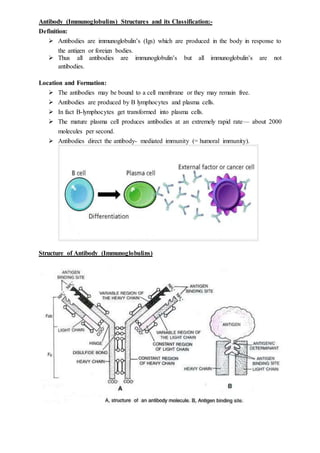
 Antibodies are heavy (~150 kDa) globular plasma proteins. The basic structure of all
antibodies are same.
 There are four polypeptide chains:
 two identical heavy chains and
 two identical light chains connected by disulfide
bonds.
 Light Chain (L) consists polypeptides of about 22,000 Da and
 Heavy Chain (H) consists larger polypeptides of around 50,000 Da or more.
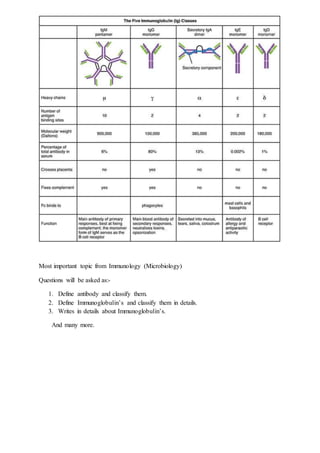
 There are five types of Ig(Means Immunoglobulins) heavy chain (in mammal)
denoted by the Greek letters: α, δ, ε, γ, and μ.
 There are two types of Ig light chain (in mammal), which are called lambda (λ) and
kappa (κ).
An antibody is made up of a variable region and a constant region, and the region that
changes to various structures depending on differences in antigens is called the variable
region, and the region that has a constant structure is called the constant region.
Classes/Types of Antibody
 Serum containing antigen-specific antibodies is called antiserum.
 The 5 types – IgG, IgM, IgA, IgD, IgE – (isotypes) are classified according to the type
of heavy chain constant region, and are distributed and function differently in the
body
Most important topic from Immunology (Microbiology)
Questions will be asked as:-
1. Define antibody and classify them.
2. Define Immunoglobulin’s and classify them in details.
3. Writes in details about Immunoglobulin’s.
And many more.

Immunoglobulins

  • 1.
    Antibody (Immunoglobulins) Structuresand its Classification:- Definition:  Antibodies are immunoglobulin’s (Igs) which are produced in the body in response to the antigen or foreign bodies.  Thus all antibodies are immunoglobulin’s but all immunoglobulin’s are not antibodies. Location and Formation:  The antibodies may be bound to a cell membrane or they may remain free.  Antibodies are produced by В lymphocytes and plasma cells.  In fact B-lymphocytes get transformed into plasma cells.  The mature plasma cell produces antibodies at an extremely rapid rate— about 2000 molecules per second.  Antibodies direct the antibody- mediated immunity (= humoral immunity). Structure of Antibody (Immunoglobulins)
  • 2.
     Antibodies areheavy (~150 kDa) globular plasma proteins. The basic structure of all antibodies are same.  There are four polypeptide chains:  two identical heavy chains and  two identical light chains connected by disulfide bonds.  Light Chain (L) consists polypeptides of about 22,000 Da and  Heavy Chain (H) consists larger polypeptides of around 50,000 Da or more.  There are five types of Ig(Means Immunoglobulins) heavy chain (in mammal) denoted by the Greek letters: α, δ, ε, γ, and μ.  There are two types of Ig light chain (in mammal), which are called lambda (λ) and kappa (κ). An antibody is made up of a variable region and a constant region, and the region that changes to various structures depending on differences in antigens is called the variable region, and the region that has a constant structure is called the constant region. Classes/Types of Antibody  Serum containing antigen-specific antibodies is called antiserum.  The 5 types – IgG, IgM, IgA, IgD, IgE – (isotypes) are classified according to the type of heavy chain constant region, and are distributed and function differently in the body
  • 3.
    Most important topicfrom Immunology (Microbiology) Questions will be asked as:- 1. Define antibody and classify them. 2. Define Immunoglobulin’s and classify them in details. 3. Writes in details about Immunoglobulin’s. And many more.