A
Presentation
On
“Quality Assurance & Validation”
By
Mr. Krushnakant K. Wable
Under the Guidance of
Dr. Sonali Mahaparale
Dr. D. Y. Patil college of Pharmacy,
Department of Quality Assurance Technique,
(Semester-II)
Akurdi, district- Pune
Maharashtra
2017-2018
Contents-
Quality Assurance:
 Introduction
 Definition
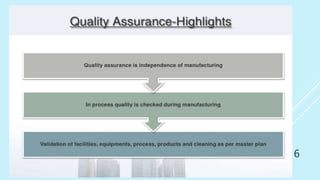
 QA Highlights
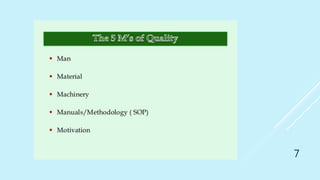
 The 5 M’s of Quality
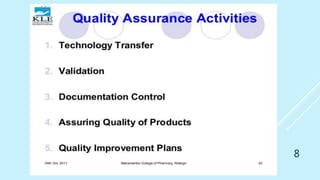
 QAActivities
Validation:
 Introduction
 Need of validation
 Scope
 Documentation
 Types of validation 2
3
Definition of Quality Assurance by WHO:
"Quality Assurance is a wide-ranging concept covering all matters that
individually or collectively influence the quality of a product. It is the
totality of the arrangement made with the object of ensuring that
pharmaceutical products are of the quality required for their intended use,
Quality Assurance therefore incorporates GMP and other factors,
including those outside the scope of this guide, such as product design and
development".
4
5
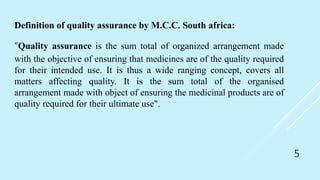
Definition of quality assurance by M.C.C. South africa:
"Quality assurance is the sum total of organized arrangement made
with the objective of ensuring that medicines are of the quality required
for their intended use. It is thus a wide ranging concept, covers all
matters affecting quality. It is the sum total of the organised
arrangement made with object of ensuring the medicinal products are of
quality required for their ultimate use".
6
7
8
9
10
11
VALIDATION
Introduction:
 The concept of validation was proposed by FDA officials Ted Byers & Bud
Loftus in 1970s to improve quality of pharmaceuticals.
 Validation is “Establishing documented evidence that provide high degree of
assurance that specific process will consistently produce a product meet its
predetermined specification and quality attributes.
 This is to maintain and assure a higher degree of quality of food and drug
product.
12
Need of validation:
 Customer satisfaction
 Product liability
 Control production cost
 Development of next generation
 Safety
13
Scope of Validation:
 Analytical test methods
 Instrument calibration
Process utility service
Raw material
Equipment
Facilities
Product Design
Cleaning
14
Documentation of validation:
The validation activity cannot be completed without proper documentation of
each and every minute activity with utmost details.
There are different types of validation documentation such as:
 Validation Master Plan (VMP)
 Validation Protocol (VP)
 Validation Report (VR)
 Standard Operating Procedure (SOP)
15
V.M.P includes..
 Premises
 Processes
 Products
 Format for protocol and other documentation
 List of relevant SOPs
 Planning and scheduling
 Location
 Estimation of staffing requirements
 A time plan of the project
16
Guidelines on Preparing V.M.P.
 V.M.P write on A4 paper.
 File in a presentable form.
 Have a sufficient explanatory drawing.
 Clearly divide the V.M.P in different form.
 It must be dated and signed by authorized persons.
17
Types of validation:
 Cleaning validation
 Equipment validation
 Validation of analytical methods
 Process validation
18
Conclusion:
 Validation has been proven assurance for the process efficiency
and sturdiness and it is also full fledged quality attributing tool for
the pharmaceutical industries.
 Validation is commonest word in area of drug development,
manufacturing and specification of finished product.
 Apart from all the consistency and reliability of a validated
process to produce to produce a quality product is very important
for an industry.
19
References:
 M.A.Potdar; Pharmaceutical Quality Assurance; Nirali Prakashan; December
2007; Pg.no.5.1-5.58
 Ramesh Sawant & Sandip Hapse; Fundamental of quality assurance
techniques , first edition Dec 2011, Career Publication.
 S.S.Chitlange, P.D.Chaudhari, A.E.Shirsat, J.N.Sangshetti; Pharmaceutical
Validation; Suyog Publication; First edition April 2014; Pg no.1.1-1.6
20
Thank
You…!!!

Quality assurance and validation

  • 1.
    A Presentation On “Quality Assurance &Validation” By Mr. Krushnakant K. Wable Under the Guidance of Dr. Sonali Mahaparale Dr. D. Y. Patil college of Pharmacy, Department of Quality Assurance Technique, (Semester-II) Akurdi, district- Pune Maharashtra 2017-2018
  • 2.
    Contents- Quality Assurance:  Introduction Definition  QA Highlights  The 5 M’s of Quality  QAActivities Validation:  Introduction  Need of validation  Scope  Documentation  Types of validation 2
  • 3.
  • 4.
    Definition of QualityAssurance by WHO: "Quality Assurance is a wide-ranging concept covering all matters that individually or collectively influence the quality of a product. It is the totality of the arrangement made with the object of ensuring that pharmaceutical products are of the quality required for their intended use, Quality Assurance therefore incorporates GMP and other factors, including those outside the scope of this guide, such as product design and development". 4
  • 5.
    5 Definition of qualityassurance by M.C.C. South africa: "Quality assurance is the sum total of organized arrangement made with the objective of ensuring that medicines are of the quality required for their intended use. It is thus a wide ranging concept, covers all matters affecting quality. It is the sum total of the organised arrangement made with object of ensuring the medicinal products are of quality required for their ultimate use".
  • 6.
  • 7.
  • 8.
  • 9.
  • 10.
  • 11.
    11 VALIDATION Introduction:  The conceptof validation was proposed by FDA officials Ted Byers & Bud Loftus in 1970s to improve quality of pharmaceuticals.  Validation is “Establishing documented evidence that provide high degree of assurance that specific process will consistently produce a product meet its predetermined specification and quality attributes.  This is to maintain and assure a higher degree of quality of food and drug product.
  • 12.
    12 Need of validation: Customer satisfaction  Product liability  Control production cost  Development of next generation  Safety
  • 13.
    13 Scope of Validation: Analytical test methods  Instrument calibration Process utility service Raw material Equipment Facilities Product Design Cleaning
  • 14.
    14 Documentation of validation: Thevalidation activity cannot be completed without proper documentation of each and every minute activity with utmost details. There are different types of validation documentation such as:  Validation Master Plan (VMP)  Validation Protocol (VP)  Validation Report (VR)  Standard Operating Procedure (SOP)
  • 15.
    15 V.M.P includes..  Premises Processes  Products  Format for protocol and other documentation  List of relevant SOPs  Planning and scheduling  Location  Estimation of staffing requirements  A time plan of the project
  • 16.
    16 Guidelines on PreparingV.M.P.  V.M.P write on A4 paper.  File in a presentable form.  Have a sufficient explanatory drawing.  Clearly divide the V.M.P in different form.  It must be dated and signed by authorized persons.
  • 17.
    17 Types of validation: Cleaning validation  Equipment validation  Validation of analytical methods  Process validation
  • 18.
    18 Conclusion:  Validation hasbeen proven assurance for the process efficiency and sturdiness and it is also full fledged quality attributing tool for the pharmaceutical industries.  Validation is commonest word in area of drug development, manufacturing and specification of finished product.  Apart from all the consistency and reliability of a validated process to produce to produce a quality product is very important for an industry.
  • 19.
    19 References:  M.A.Potdar; PharmaceuticalQuality Assurance; Nirali Prakashan; December 2007; Pg.no.5.1-5.58  Ramesh Sawant & Sandip Hapse; Fundamental of quality assurance techniques , first edition Dec 2011, Career Publication.  S.S.Chitlange, P.D.Chaudhari, A.E.Shirsat, J.N.Sangshetti; Pharmaceutical Validation; Suyog Publication; First edition April 2014; Pg no.1.1-1.6
  • 20.