Routing Simulator
Guided by: Karthick Submitted By
Arun Prakash F
Santhosh Kumar L
Siva Balan
CONTENT
 SYSTEM ANALYSIS
 Abstract
 Existing System
 Drawbacks of Existing System
 Proposed System
 Benefits of Proposed System
 Methods
 SYSTEM SPECIFICATION
 Hardware Configuration
 Software Configuration
ABSTRACT
 A simple definition of routing is "learning how to get from here to
there."
 the term routing is used in a very strict sense to refer only to the
process of obtaining and distributing information
 the functions performed by OSI end systems and intermediate
systems.
 Routing is the act of moving information across an inter network
from a source to a destination
 at least one intermediate node typically is encountered.
 Routing is the process of finding a path from a source to every
destination in the network.
 By using this Project we can able to find best path, cost and
efficiency.
 Goal: Effiecient end-to-end Packet delivery.
The various concepts for discussion are:
 Design goals of Routing Algorithm
 Factors that decide the best Path
 Choices in Routing
Routing Algorithms
 Flooding
 Distance Vector (Bellman-Ford)
 Link state
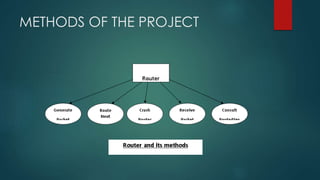
METHODS OF THE PROJECT
EXISTING SYSTEM
 One has to select better routing technique among the several
techniques available.
 So far no routing algorithm is reported to be outright choice for all
possible cases.
 Provides better result for a given configuration of the subnet in real
time.
 The main objective of our project is to maximize the efficiency
routing process by suggesting the potential user a better algorithm
DRAWBACKS OF EXISTING SYSTEM
» One routing technique are Available to get the Information
» less efficiency of the routing process
PROPOSED SYSTE
» The topology of the subnet should be displayed with routers designated with
computer images and links with lines.

» Various Statistics for the router like efficiency, average packet size are to be
displayed when required.

» A router should show an outline when a router is crashed.

» When a link is down, it should be highlighted. This gives an idea of how the
routing goes when a link is down.

» The statistics for the router and the link are to be calculated for every 500
m/sec.
» It redrawing the congestion table and network is to be provided.

» The routing should be controlled by a speed controller.
BENEFITS OF PROPOSED SYSTEM
 Optimality
select the best route, which depends on the metrics and metric weightings
used to make the calculation.
» Simplicity and low overhead
Functionality efficiently, with a minimum of software and utilization overhead.
The routing algorithm must run on a computer with limited physical resources.
» Robustness and stability
It has capacity to perform in some situation such as hardware failures, high load
conditions, and incorrect implementations
» Rapid convergence
Convergence is the process of agreement.
When a network go down or become available, routers distribute routing update
messages.
» Flexibility
They should quickly and accurately adapt to a variety of network.
programmed to adapt to changes in network bandwidth, router queue size, and
network delay, among other variables.
Software Used
Java Development Kit 1.3
The JDK 1.3 is a development environment for writing GUI and applications that confirm to
the Java core API. Its compiler and other tools are run from a shell and have no GUI interface.
Java Tools:
Java Compiler (javac)
Compiles programs written in Java programming Language into byte codes.
Java Interpreter (java)
It executes java byte codes. In other words it runs programs written in the Java programming
language.
Java run-time Interpreter (jre)
It is similar to Java interpreter, but intended for end users who do not enquire all the development-
related options available with the java tool.
Thank You

Routing simulator

  • 1.
    Routing Simulator Guided by:Karthick Submitted By Arun Prakash F Santhosh Kumar L Siva Balan
  • 2.
    CONTENT  SYSTEM ANALYSIS Abstract  Existing System  Drawbacks of Existing System  Proposed System  Benefits of Proposed System  Methods  SYSTEM SPECIFICATION  Hardware Configuration  Software Configuration
  • 3.
    ABSTRACT  A simpledefinition of routing is "learning how to get from here to there."  the term routing is used in a very strict sense to refer only to the process of obtaining and distributing information  the functions performed by OSI end systems and intermediate systems.  Routing is the act of moving information across an inter network from a source to a destination  at least one intermediate node typically is encountered.  Routing is the process of finding a path from a source to every destination in the network.  By using this Project we can able to find best path, cost and efficiency.  Goal: Effiecient end-to-end Packet delivery.
  • 4.
    The various conceptsfor discussion are:  Design goals of Routing Algorithm  Factors that decide the best Path  Choices in Routing
  • 5.
    Routing Algorithms  Flooding Distance Vector (Bellman-Ford)  Link state
  • 6.
  • 7.
    EXISTING SYSTEM  Onehas to select better routing technique among the several techniques available.  So far no routing algorithm is reported to be outright choice for all possible cases.  Provides better result for a given configuration of the subnet in real time.  The main objective of our project is to maximize the efficiency routing process by suggesting the potential user a better algorithm
  • 8.
    DRAWBACKS OF EXISTINGSYSTEM » One routing technique are Available to get the Information » less efficiency of the routing process
  • 9.
    PROPOSED SYSTE » Thetopology of the subnet should be displayed with routers designated with computer images and links with lines.  » Various Statistics for the router like efficiency, average packet size are to be displayed when required.  » A router should show an outline when a router is crashed.  » When a link is down, it should be highlighted. This gives an idea of how the routing goes when a link is down.  » The statistics for the router and the link are to be calculated for every 500 m/sec. » It redrawing the congestion table and network is to be provided.  » The routing should be controlled by a speed controller.
  • 10.
    BENEFITS OF PROPOSEDSYSTEM  Optimality select the best route, which depends on the metrics and metric weightings used to make the calculation. » Simplicity and low overhead Functionality efficiently, with a minimum of software and utilization overhead. The routing algorithm must run on a computer with limited physical resources. » Robustness and stability It has capacity to perform in some situation such as hardware failures, high load conditions, and incorrect implementations » Rapid convergence Convergence is the process of agreement. When a network go down or become available, routers distribute routing update messages. » Flexibility They should quickly and accurately adapt to a variety of network. programmed to adapt to changes in network bandwidth, router queue size, and network delay, among other variables.
  • 11.
    Software Used Java DevelopmentKit 1.3 The JDK 1.3 is a development environment for writing GUI and applications that confirm to the Java core API. Its compiler and other tools are run from a shell and have no GUI interface. Java Tools: Java Compiler (javac) Compiles programs written in Java programming Language into byte codes. Java Interpreter (java) It executes java byte codes. In other words it runs programs written in the Java programming language. Java run-time Interpreter (jre) It is similar to Java interpreter, but intended for end users who do not enquire all the development- related options available with the java tool.
  • 12.