ROOF
Roof Construction
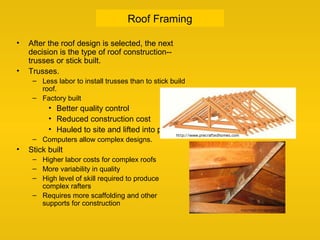
Roof Framing
• After the roof design is selected, the next
decision is the type of roof construction--
trusses or stick built.
• Trusses.
– Less labor to install trusses than to stick build
roof.
– Factory built
• Better quality control
• Reduced construction cost
• Hauled to site and lifted into place
– Computers allow complex designs.
• Stick built
– Higher labor costs for complex roofs
– More variability in quality
– High level of skill required to produce
complex rafters
– Requires more scaffolding and other
supports for construction
Roof--Truss
• Different types of trusses can be used for roofs.
• The type used will be determined by the use of the building, size of
the building and/or the owners preferences.
• Most trusses are custom built for the building.
• Trusses can be wood or metal
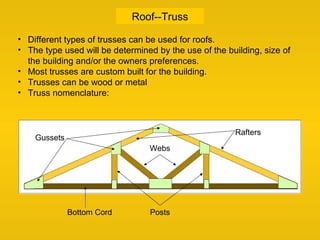
• Truss nomenclature:
Bottom Cord
Webs
Posts
Gussets
Rafters
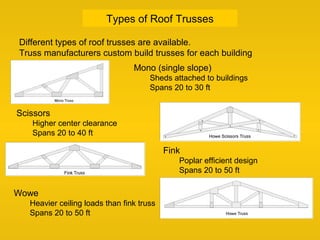
Types of Roof Trusses
Scissors
Higher center clearance
Spans 20 to 40 ft
Mono (single slope)
Sheds attached to buildings
Spans 20 to 30 ft
Fink
Poplar efficient design
Spans 20 to 50 ft
Wowe
Heavier ceiling loads than fink truss
Spans 20 to 50 ft
Different types of roof trusses are available.
Truss manufacturers custom build trusses for each building
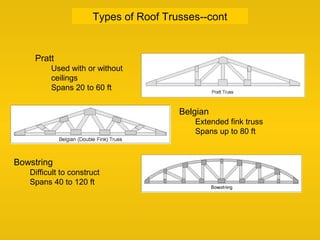
Types of Roof Trusses--cont
Pratt
Used with or without
ceilings
Spans 20 to 60 ft
Belgian
Extended fink truss
Spans up to 80 ft
Bowstring
Difficult to construct
Spans 40 to 120 ft
Roof Pitch
Roof Framing-cont.
Pitch
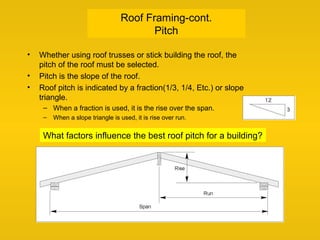
• Whether using roof trusses or stick building the roof, the
pitch of the roof must be selected.
• Pitch is the slope of the roof.
• Roof pitch is indicated by a fraction(1/3, 1/4, Etc.) or slope
triangle.
– When a fraction is used, it is the rise over the span.
– When a slope triangle is used, it is rise over run.
What factors influence the best roof pitch for a building?
Roof Framing-cont.
Pitch Problem
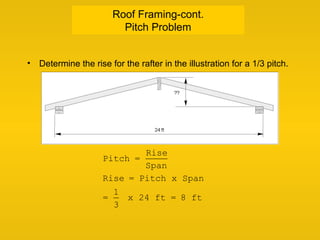
• Determine the rise for the rafter in the illustration for a 1/3 pitch.
Pitch =
Rise
Span
Rise = Pitch x Span
=
1
3
x 24 ft = 8 ft
Roof Framing-cont.
Slope Triangle
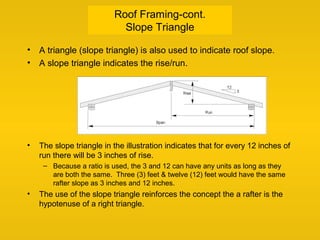
• A triangle (slope triangle) is also used to indicate roof slope.
• A slope triangle indicates the rise/run.
• The slope triangle in the illustration indicates that for every 12 inches of
run there will be 3 inches of rise.
– Because a ratio is used, the 3 and 12 can have any units as long as they
are both the same. Three (3) feet & twelve (12) feet would have the same
rafter slope as 3 inches and 12 inches.
• The use of the slope triangle reinforces the concept the a rafter is the
hypotenuse of a right triangle.
Roof Framing-cont.
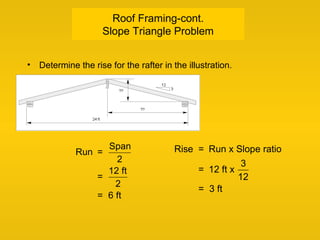
Slope Triangle Problem
• Determine the rise for the rafter in the illustration.
Rise = Run x Slope ratio
= 12 ft x
3
12
= 3 ft
Run =
Span
2
=
12 ft
2
= 6 ft
Stick Build Rafters
Stick Built Rafter
Terms
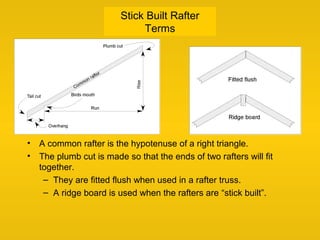
• A common rafter is the hypotenuse of a right triangle.
• The plumb cut is made so that the ends of two rafters will fit
together.
– They are fitted flush when used in a rafter truss.
– A ridge board is used when the rafters are “stick built”.
Stick Built Rafter Terms-cont.
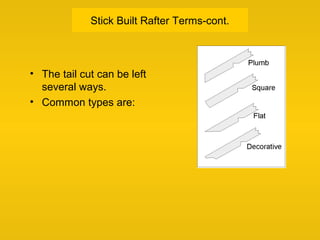
• The tail cut can be left
several ways.
• Common types are:
Stick Built Rafter Terms-cont.
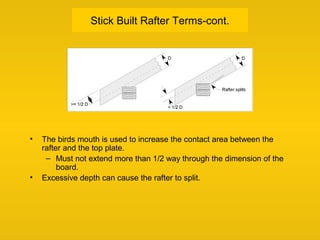
• The birds mouth is used to increase the contact area between the
rafter and the top plate.
– Must not extend more than 1/2 way through the dimension of the
board.
• Excessive depth can cause the rafter to split.
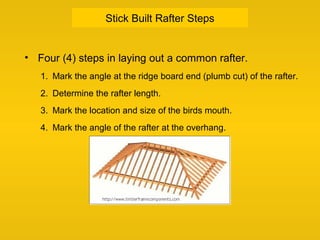
Stick Built Rafter Steps
• Four (4) steps in laying out a common rafter.
1. Mark the angle at the ridge board end (plumb cut) of the rafter.
2. Determine the rafter length.
3. Mark the location and size of the birds mouth.
4. Mark the angle of the rafter at the overhang.
Stick Built Rafter
Step 1-Plumb cut
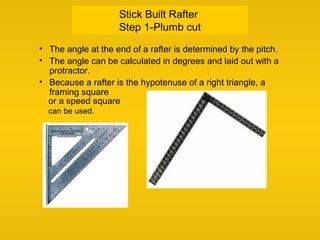
or a speed square
can be used.
• The angle at the end of a rafter is determined by the pitch.
• The angle can be calculated in degrees and laid out with a
protractor.
• Because a rafter is the hypotenuse of a right triangle, a
framing square
Stick Built Rafter Steps.
Step One - Plumb Cut cont.
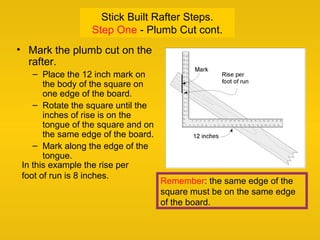
• Mark the plumb cut on the
rafter.
– Place the 12 inch mark on
the body of the square on
one edge of the board.
– Rotate the square until the
inches of rise is on the
tongue of the square and on
the same edge of the board.
– Mark along the edge of the
tongue.
Remember: the same edge of the
square must be on the same edge
of the board.
In this example the rise per
foot of run is 8 inches.
Stick Built Rafter Steps.
Square Use
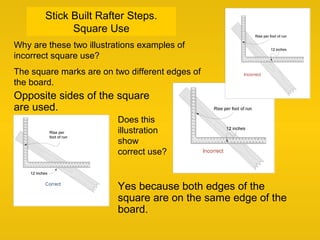
Opposite sides of the square
are used.
Yes because both edges of the
square are on the same edge of the
board.
The square marks are on two different edges of
the board.
Why are these two illustrations examples of
incorrect square use?
Does this
illustration
show
correct use?
Stick Built Rafter Steps.
Step Two - Determine the length
a2
= b2
+ c2
a = b2
+ c2
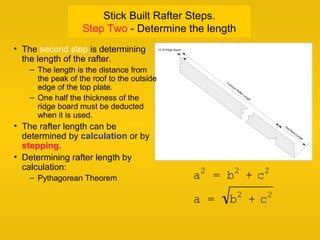
• The second step is determining
the length of the rafter.
– The length is the distance from
the peak of the roof to the outside
edge of the top plate.
– One half the thickness of the
ridge board must be deducted
when it is used.
• The rafter length can be
determined by calculation or by
stepping.
• Determining rafter length by
calculation:
– Pythagorean Theorem
Stick Built Rafter Steps.
Example of Length by Calculation
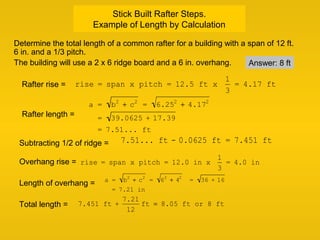
Determine the total length of a common rafter for a building with a span of 12 ft.
6 in. and a 1/3 pitch.
The building will use a 2 x 6 ridge board and a 6 in. overhang.
rise = span x pitch = 12.5 ft x
1
3
= 4.17 ft
a = b2
+ c2
= 6.252
+ 4.172
= 39.0625 + 17.39
= 7.51... ft
7.51... ft - 0.0625 ft = 7.451 ft
a = b2
+ c2
= 62
+ 42
= 36 + 16
= 7.21 in
7.451 ft +
7.21
12
ft = 8.05 ft or 8 ft
Rafter length =
Subtracting 1/2 of ridge =
Length of overhang =
Total length =
Overhang rise = rise = span x pitch = 12.0 in x
1
3
= 4.0 in
Rafter rise =
Answer: 8 ft
Stepping A Rafter
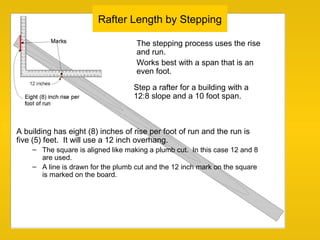
Rafter Length by Stepping
The stepping process uses the rise
and run.
Works best with a span that is an
even foot.
A building has eight (8) inches of rise per foot of run and the run is
five (5) feet. It will use a 12 inch overhang.
– The square is aligned like making a plumb cut. In this case 12 and 8
are used.
– A line is drawn for the plumb cut and the 12 inch mark on the square
is marked on the board.
Step a rafter for a building with a
12:8 slope and a 10 foot span.
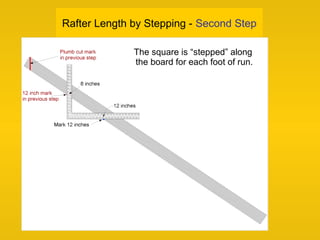
Rafter Length by Stepping - Second Step
The square is “stepped” along
the board for each foot of run.
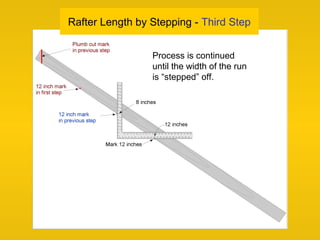
Rafter Length by Stepping - Third Step
Process is continued
until the width of the run
is “stepped” off.
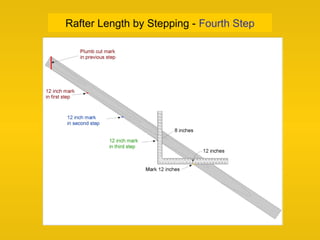
Rafter Length by Stepping - Fourth Step
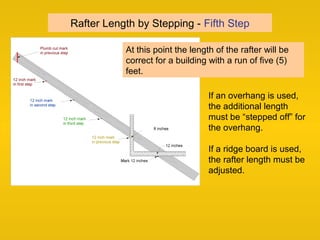
At this point the length of the rafter will be
correct for a building with a run of five (5)
feet.
If an overhang is used,
the additional length
must be “stepped off” for
the overhang.
If a ridge board is used,
the rafter length must be
adjusted.
Rafter Length by Stepping - Fifth Step
Stick Built Rafter Steps.
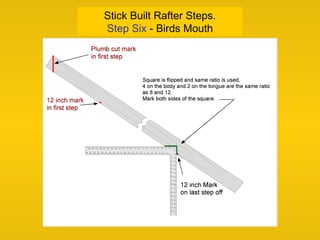
Step Six - Birds Mouth
Stick Built Rafter Steps.
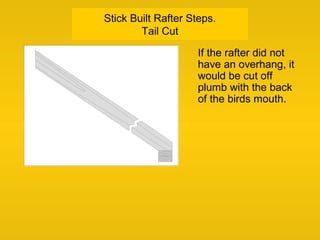
Tail Cut
If the rafter did not
have an overhang, it
would be cut off
plumb with the back
of the birds mouth.
Stick Built Rafter
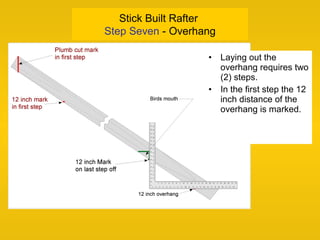
Step Seven - Overhang
• Laying out the
overhang requires two
(2) steps.
• In the first step the 12
inch distance of the
overhang is marked.
Stick Built Rafter
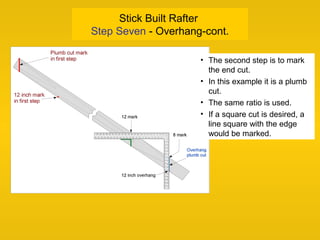
Step Seven - Overhang-cont.
• The second step is to mark
the end cut.
• In this example it is a plumb
cut.
• The same ratio is used.
• If a square cut is desired, a
line square with the edge
would be marked.
Questions

Roof framing

  • 1.
  • 2.
  • 3.
    Roof Framing • Afterthe roof design is selected, the next decision is the type of roof construction-- trusses or stick built. • Trusses. – Less labor to install trusses than to stick build roof. – Factory built • Better quality control • Reduced construction cost • Hauled to site and lifted into place – Computers allow complex designs. • Stick built – Higher labor costs for complex roofs – More variability in quality – High level of skill required to produce complex rafters – Requires more scaffolding and other supports for construction
  • 4.
    Roof--Truss • Different typesof trusses can be used for roofs. • The type used will be determined by the use of the building, size of the building and/or the owners preferences. • Most trusses are custom built for the building. • Trusses can be wood or metal • Truss nomenclature: Bottom Cord Webs Posts Gussets Rafters
  • 5.
    Types of RoofTrusses Scissors Higher center clearance Spans 20 to 40 ft Mono (single slope) Sheds attached to buildings Spans 20 to 30 ft Fink Poplar efficient design Spans 20 to 50 ft Wowe Heavier ceiling loads than fink truss Spans 20 to 50 ft Different types of roof trusses are available. Truss manufacturers custom build trusses for each building
  • 6.
    Types of RoofTrusses--cont Pratt Used with or without ceilings Spans 20 to 60 ft Belgian Extended fink truss Spans up to 80 ft Bowstring Difficult to construct Spans 40 to 120 ft
  • 7.
  • 8.
    Roof Framing-cont. Pitch • Whetherusing roof trusses or stick building the roof, the pitch of the roof must be selected. • Pitch is the slope of the roof. • Roof pitch is indicated by a fraction(1/3, 1/4, Etc.) or slope triangle. – When a fraction is used, it is the rise over the span. – When a slope triangle is used, it is rise over run. What factors influence the best roof pitch for a building?
  • 9.
    Roof Framing-cont. Pitch Problem •Determine the rise for the rafter in the illustration for a 1/3 pitch. Pitch = Rise Span Rise = Pitch x Span = 1 3 x 24 ft = 8 ft
  • 10.
    Roof Framing-cont. Slope Triangle •A triangle (slope triangle) is also used to indicate roof slope. • A slope triangle indicates the rise/run. • The slope triangle in the illustration indicates that for every 12 inches of run there will be 3 inches of rise. – Because a ratio is used, the 3 and 12 can have any units as long as they are both the same. Three (3) feet & twelve (12) feet would have the same rafter slope as 3 inches and 12 inches. • The use of the slope triangle reinforces the concept the a rafter is the hypotenuse of a right triangle.
  • 11.
    Roof Framing-cont. Slope TriangleProblem • Determine the rise for the rafter in the illustration. Rise = Run x Slope ratio = 12 ft x 3 12 = 3 ft Run = Span 2 = 12 ft 2 = 6 ft
  • 12.
  • 13.
    Stick Built Rafter Terms •A common rafter is the hypotenuse of a right triangle. • The plumb cut is made so that the ends of two rafters will fit together. – They are fitted flush when used in a rafter truss. – A ridge board is used when the rafters are “stick built”.
  • 14.
    Stick Built RafterTerms-cont. • The tail cut can be left several ways. • Common types are:
  • 15.
    Stick Built RafterTerms-cont. • The birds mouth is used to increase the contact area between the rafter and the top plate. – Must not extend more than 1/2 way through the dimension of the board. • Excessive depth can cause the rafter to split.
  • 16.
    Stick Built RafterSteps • Four (4) steps in laying out a common rafter. 1. Mark the angle at the ridge board end (plumb cut) of the rafter. 2. Determine the rafter length. 3. Mark the location and size of the birds mouth. 4. Mark the angle of the rafter at the overhang.
  • 17.
    Stick Built Rafter Step1-Plumb cut or a speed square can be used. • The angle at the end of a rafter is determined by the pitch. • The angle can be calculated in degrees and laid out with a protractor. • Because a rafter is the hypotenuse of a right triangle, a framing square
  • 18.
    Stick Built RafterSteps. Step One - Plumb Cut cont. • Mark the plumb cut on the rafter. – Place the 12 inch mark on the body of the square on one edge of the board. – Rotate the square until the inches of rise is on the tongue of the square and on the same edge of the board. – Mark along the edge of the tongue. Remember: the same edge of the square must be on the same edge of the board. In this example the rise per foot of run is 8 inches.
  • 19.
    Stick Built RafterSteps. Square Use Opposite sides of the square are used. Yes because both edges of the square are on the same edge of the board. The square marks are on two different edges of the board. Why are these two illustrations examples of incorrect square use? Does this illustration show correct use?
  • 20.
    Stick Built RafterSteps. Step Two - Determine the length a2 = b2 + c2 a = b2 + c2 • The second step is determining the length of the rafter. – The length is the distance from the peak of the roof to the outside edge of the top plate. – One half the thickness of the ridge board must be deducted when it is used. • The rafter length can be determined by calculation or by stepping. • Determining rafter length by calculation: – Pythagorean Theorem
  • 21.
    Stick Built RafterSteps. Example of Length by Calculation Determine the total length of a common rafter for a building with a span of 12 ft. 6 in. and a 1/3 pitch. The building will use a 2 x 6 ridge board and a 6 in. overhang. rise = span x pitch = 12.5 ft x 1 3 = 4.17 ft a = b2 + c2 = 6.252 + 4.172 = 39.0625 + 17.39 = 7.51... ft 7.51... ft - 0.0625 ft = 7.451 ft a = b2 + c2 = 62 + 42 = 36 + 16 = 7.21 in 7.451 ft + 7.21 12 ft = 8.05 ft or 8 ft Rafter length = Subtracting 1/2 of ridge = Length of overhang = Total length = Overhang rise = rise = span x pitch = 12.0 in x 1 3 = 4.0 in Rafter rise = Answer: 8 ft
  • 22.
  • 23.
    Rafter Length byStepping The stepping process uses the rise and run. Works best with a span that is an even foot. A building has eight (8) inches of rise per foot of run and the run is five (5) feet. It will use a 12 inch overhang. – The square is aligned like making a plumb cut. In this case 12 and 8 are used. – A line is drawn for the plumb cut and the 12 inch mark on the square is marked on the board. Step a rafter for a building with a 12:8 slope and a 10 foot span.
  • 24.
    Rafter Length byStepping - Second Step The square is “stepped” along the board for each foot of run.
  • 25.
    Rafter Length byStepping - Third Step Process is continued until the width of the run is “stepped” off.
  • 26.
    Rafter Length byStepping - Fourth Step
  • 27.
    At this pointthe length of the rafter will be correct for a building with a run of five (5) feet. If an overhang is used, the additional length must be “stepped off” for the overhang. If a ridge board is used, the rafter length must be adjusted. Rafter Length by Stepping - Fifth Step
  • 28.
    Stick Built RafterSteps. Step Six - Birds Mouth
  • 29.
    Stick Built RafterSteps. Tail Cut If the rafter did not have an overhang, it would be cut off plumb with the back of the birds mouth.
  • 30.
    Stick Built Rafter StepSeven - Overhang • Laying out the overhang requires two (2) steps. • In the first step the 12 inch distance of the overhang is marked.
  • 31.
    Stick Built Rafter StepSeven - Overhang-cont. • The second step is to mark the end cut. • In this example it is a plumb cut. • The same ratio is used. • If a square cut is desired, a line square with the edge would be marked.
  • 32.