BACHELOR OF QUANTITY SURVEYING
(HONS)
BLD 60104 CONSTRUCTION TECHNOLOGY 1
By Azrina Md Yaakob
Azrina.MdYaakob@taylors.edu.my
CHAPTER 5
ROOFING
1.1 FUNCTION
•  To keep out rain, wind, snow & dust
•  To prevent excessive heat loss in winter
•  To keep the interior building cool in summer
•  Designed to accommodate all stresses encountered
•  Designed to accept movement due to changes in
temperature & moisture content
•  To provide lateral restraint & stability to adjacent walls
•  To resist penetration of fire & spread of flame from external
sources
1.2 TYPES OF ROOF
TYPES
Pitched
Flat
Gambrel
&
Mansard
Shed
Gable/
Hip
1.2.1 FACTORS THAT INFLUENCE
THE TYPE OF ROOF CHOSEN
a) Size and shape of buildings
•  Simple shape: pitched roof
•  Irregular shaped: flat roof
•  Clear span
b) Appearance
•  Small: pitched roof
•  Large: flat roof
c) Economics
•  Capital & maintenance cost
d) Others
•  Services accommodated
•  weatherproofing
1.2.2 PITCHED ROOF
•  Any roof whose angle of slope to the horizontal lies between 10 and
70 degree
•  Pitch is determined by the covering that is to be placed over the
timber carcass, governed by the load & span
•  Higher cost than flat roof
•  Create a useful void for locating cold water storage system
•  Material : Timber : structural softwood; members joined together with
nails
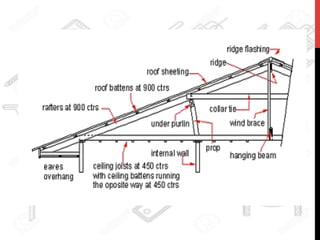
1.2.2.1 PITCHED ROOF MEMBERS
Ridge
•  Spine of a roof
•  Pitching plate for the rafters that are nailed to
each other through the ridge board
Hipped end
•  The roof slope is continued around the end
of a building, where the wall is carried up to
the underside of the roof at a gable end
Rafters
•  Splay cut / bevelled & nailed to ridge board
at upper ends & birth-mouthed nailed to wall
plate at lower ends
Hip rafters
•  Frame the external angles at
the intersection of roof slopes
Valley rafters
•  Used at internal angles
Jack rafters
•  The shortened rafters running
from hip rafters to plate & from
ridge to valley rafters
Common rafters
•  Main load-bearing
members of a roof
•  Span between a wall plate
at eaves & ridge
•  Notched over & nailed to
wall plate situated on top of
a load-bearing wall
Wall plates
•  Provide the bearing &
fixing medium for various
roof members
•  Distribute the loads evenly
over the supporting walls
•  Bedded in cement mortar
on top of load-bearing wall
Eaves
•  Bottom portion of the roof
overhanging the wall
Verge
•  Roof covering overhangs the
gable end
Purlin
•  Horizontal roof members which
give intermediate support to
rafters
•  Act as beam, reducing the span
of rafters & enabling economic
section to be used
1.2.3 FLAT ROOF
•  For large / complicated shaped building
•  Low-pitched roof, 10 degree or less
•  Simplest form: timber flat covered with impervious material to
prevent rain penetration
•  Suitable for spans up to 4000mm
•  Spacing of roof joists is controlled by the width of decking material /
ceiling board
•  To fall in 1 direction towards a gutter / outlet by fixing fittings to the
top of the joist
Advantages of Flat Roof
•  Less material is being used than in a sloped roof
•  The rooftop is potentially useful as a terrace or sleeping porch
•  Potentially pleasing appearance
•  Easier to build than a sloped roof
Disadvantages of Flat Roof
•  Limited capacity for insulation
•  Contrast in style with other buildings in the vicinity
•  Pools of water will collect on the surface unless it is properly
designed & constructed
•  Little / no space to accommodate services
1.3 MATERIALS FOR ROOFING
Pitched
Roof
Tiles
Slates
Shingles
(Wood
tiling)
Sheet
Coverings
Flat Roof
Asphalt
Aluminium
Sheeting
Zinc
Sheeting
Copper
Sheeting
1.3.1 TILING
•  Clay & concrete to wide range of design & colour
•  Pitches from 15 to45 degree
•  Pitch of a tile always less than pitch of the rafters
•  Laid in overlapping course
•  Water is shed off the surface of 1tile on to the exposed surface of
the tile in the next course
•  Two types:
A)  Plain Tiling
B)  Single Lap Tiles
1.3.1.1 PLAIN TILES
•  Double-lap principle
•  Size: 265x165x12mm
•  Under-eaves & top-course tiles: 215mm long
•  Tile-and-a-half tiles for verges: 248mm wide
•  Each tile has 2nibs for hanging over battens & 2 holes for nails
near its head
•  Nailed with 38mm nails of Al alloy, copper/ c/c every 4th/5th course
& at eaves, top course & verges
•  Can be handmade/ machine-pressed clay
•  Handmade: wide variation in colour,texture & shape; should not be
laid on a roof of <45 degree
•  Machine-pressed: harder, denser more uniform in shape; can be
laid to a min. pitch of 35 degree
1.3.1.2 SINGLE LAP TILE
•  Laid with overlapping side joints toa min. pitch of 35 degree
•  Each tile overlaps the head of the tile in the course below
•  Side lap’s dimension is fixed by the design of tiles
•  Common types: Italian, Spanish, double Roman & pantiles
•  Adv: Lighter & permit a flatter slope of roof as they are in larger
sizes & the actual inclination of the tiles is greater
•  Disadv: difficult to replace
Italian Tiles
Spanish Tiles
Double Roman Tiles
Pantiles
1.3.2 SLATES
•  Naturally dense material, split into thin sheets
•  Every slate should be nailed twice
•  Laid to a min pitch of 25 degree
•  Centre nailing is used to overcome the problem of vibration caused
by wind & tending to snap the slate at the fixing if nailed at the head
1.3.3 ASPHALT FLAT ROOF
•  Consists of an aggregate with a bituminous binder, which is cast into
blocks ready for reheating on site
•  Thickness & number of coats depend on surface type &
substructure
•  Laying to
a.  horizontal surface: up to 10 degree pitch
b.  Sloping surface:10 to45 degree pitch
c.  Vertical surface: over 45 degree pitch
•  Horizontal surface should have 2 coats, breaking the joint & build-up
to a min total thickness of 20mm
•  Vertical & sloping surface requires 3 coats, build up to a 20mm total
thickness
•  Can be laid to falls so that the run-off of water is rapid & efficient
1.3.4 ZINC SHEETING
•  A cheaper alternative to lead but has a shorter life
•  Not suitable for use in heavy industrial area
•  Does not creep, light &ductile
•  Normally 2500x1000mm with a min thickness of 0.80mm
•  Batten rolls to provide joints running with the fall of roof, about
985mm centres
1.3.5 ALUMINIUM SHEETING
•  Thickness is often 0.80mm
•  Method of fixing is using batten rolls
•  Strength of aluminium is increased by the addition of alloy
•  Does not require protective treatment
•  Alternative is stainless steel sheeting
1.4 ROOF SUPPORT
Single
Roof
Collar
Roof
Couple
Roof
Double
Roof
Trussed
Roof
King Post
Queen
Post
Mansard
Truss
1.4.1 SINGLE ROOFS
•  Rafters are supported at the
ends only
•  Simplest form: lean-to roof
•  1 wall is carried up to a higher
level than the other & rafters
bridge the space between
•  Suitable for outbuildings &
garages with span x< 2.50m
•  Upper ends of rafter supported
by a ridge board plug to wall /
plate
1.4.1.1 COUPLE ROOF
•  Rafter supported by a ridge board & wall plates
•  No tie; rafters exert an outward thrust on the walls
•  Not be used for spans exceeding 5.00m
•  Improvement: couple close roof -nail ceiling joist to each pair of
rafters; span increased up to 4.00m
1.4.1.2 COLLAR ROOF
•  For span up to 5.00m
•  Each pair of rafters is framed up with a horizontal collar (collar tie),
which should not be placed higher than of the vertical height from
wall plate to ridge
•  Valuable when additional headroom is needed
1.4.2 DOUBLE ROOF
•  When span exceeds 5.00m
•  Purlins are used at about 3.00m centre to give intermediate support
to rafters
•  Purlins supported by struts
•  Collar is provided at each 4thpair of rafter
•  For larger span, hangers at every 4thrafter with connections to purlin
& ceiling binder, which is nailed to ceiling joists
•  Sizes of ceiling joists, binders, rafters & purlins depends on dead load
to be carried, strength of timber, span & spacing of members
1.4.3 TRUSSED ROOF
•  Used over large span: > 6.00m
•  Trusses are structurally designed frames based on triangle
principle, serve to carry purlins
•  Trusses are spaced at 1800mm centre with the space between
being filled by common rafters
1.4.3.1 KING POST TRUSS
•  For spans of 6.00 –9.00m
•  A triangular frame which support the ridge & purlins, spanned from
truss to truss & carried common rafter & roof covering
•  Roof load transmitted through principal rafters to wall below
•  Principal rafters were bolted to a tie beam to prevent them spreading
under load
•  Strut to prevent sagging
1.4.3.2 QUEEN POST TRUSS
•  Spans from 9.00 –12.75m
•  Similar to king post but it has 2 vertical post, strutted apart at their
heads by a straining beam
•  Principal rafters are supported by 2 purlins
•  Feet of queen post are held in position by tenons, straps & staining
sill
1.4.3.3 MANSARD TRUSS
•  Incorporate king & queen post truss
•  Enable accommodation to be provided in roof space
•  Members of roof trusses are arranged so that their centre lines
intersected joints
TUTORIAL 5
• Sketch the typical construction terminology of a pitched
roof together with its functions.
Requirements:
You should sketch the roof in an A4 paper and write its function
beside the labels of the roof. (Individual)

Chapter 5

  • 1.
    BACHELOR OF QUANTITYSURVEYING (HONS) BLD 60104 CONSTRUCTION TECHNOLOGY 1 By Azrina Md Yaakob Azrina.MdYaakob@taylors.edu.my CHAPTER 5 ROOFING
  • 2.
    1.1 FUNCTION •  Tokeep out rain, wind, snow & dust •  To prevent excessive heat loss in winter •  To keep the interior building cool in summer •  Designed to accommodate all stresses encountered •  Designed to accept movement due to changes in temperature & moisture content •  To provide lateral restraint & stability to adjacent walls •  To resist penetration of fire & spread of flame from external sources
  • 3.
    1.2 TYPES OFROOF TYPES Pitched Flat Gambrel & Mansard Shed Gable/ Hip
  • 4.
    1.2.1 FACTORS THATINFLUENCE THE TYPE OF ROOF CHOSEN a) Size and shape of buildings •  Simple shape: pitched roof •  Irregular shaped: flat roof •  Clear span b) Appearance •  Small: pitched roof •  Large: flat roof c) Economics •  Capital & maintenance cost d) Others •  Services accommodated •  weatherproofing
  • 5.
    1.2.2 PITCHED ROOF • Any roof whose angle of slope to the horizontal lies between 10 and 70 degree •  Pitch is determined by the covering that is to be placed over the timber carcass, governed by the load & span •  Higher cost than flat roof •  Create a useful void for locating cold water storage system •  Material : Timber : structural softwood; members joined together with nails
  • 10.
    1.2.2.1 PITCHED ROOFMEMBERS Ridge •  Spine of a roof •  Pitching plate for the rafters that are nailed to each other through the ridge board Hipped end •  The roof slope is continued around the end of a building, where the wall is carried up to the underside of the roof at a gable end Rafters •  Splay cut / bevelled & nailed to ridge board at upper ends & birth-mouthed nailed to wall plate at lower ends
  • 11.
    Hip rafters •  Framethe external angles at the intersection of roof slopes Valley rafters •  Used at internal angles Jack rafters •  The shortened rafters running from hip rafters to plate & from ridge to valley rafters
  • 12.
    Common rafters •  Mainload-bearing members of a roof •  Span between a wall plate at eaves & ridge •  Notched over & nailed to wall plate situated on top of a load-bearing wall Wall plates •  Provide the bearing & fixing medium for various roof members •  Distribute the loads evenly over the supporting walls •  Bedded in cement mortar on top of load-bearing wall
  • 13.
    Eaves •  Bottom portionof the roof overhanging the wall Verge •  Roof covering overhangs the gable end Purlin •  Horizontal roof members which give intermediate support to rafters •  Act as beam, reducing the span of rafters & enabling economic section to be used
  • 15.
    1.2.3 FLAT ROOF • For large / complicated shaped building •  Low-pitched roof, 10 degree or less •  Simplest form: timber flat covered with impervious material to prevent rain penetration •  Suitable for spans up to 4000mm •  Spacing of roof joists is controlled by the width of decking material / ceiling board •  To fall in 1 direction towards a gutter / outlet by fixing fittings to the top of the joist
  • 17.
    Advantages of FlatRoof •  Less material is being used than in a sloped roof •  The rooftop is potentially useful as a terrace or sleeping porch •  Potentially pleasing appearance •  Easier to build than a sloped roof Disadvantages of Flat Roof •  Limited capacity for insulation •  Contrast in style with other buildings in the vicinity •  Pools of water will collect on the surface unless it is properly designed & constructed •  Little / no space to accommodate services
  • 19.
    1.3 MATERIALS FORROOFING Pitched Roof Tiles Slates Shingles (Wood tiling) Sheet Coverings Flat Roof Asphalt Aluminium Sheeting Zinc Sheeting Copper Sheeting
  • 20.
    1.3.1 TILING •  Clay& concrete to wide range of design & colour •  Pitches from 15 to45 degree •  Pitch of a tile always less than pitch of the rafters •  Laid in overlapping course •  Water is shed off the surface of 1tile on to the exposed surface of the tile in the next course •  Two types: A)  Plain Tiling B)  Single Lap Tiles
  • 22.
    1.3.1.1 PLAIN TILES • Double-lap principle •  Size: 265x165x12mm •  Under-eaves & top-course tiles: 215mm long •  Tile-and-a-half tiles for verges: 248mm wide •  Each tile has 2nibs for hanging over battens & 2 holes for nails near its head •  Nailed with 38mm nails of Al alloy, copper/ c/c every 4th/5th course & at eaves, top course & verges •  Can be handmade/ machine-pressed clay •  Handmade: wide variation in colour,texture & shape; should not be laid on a roof of <45 degree •  Machine-pressed: harder, denser more uniform in shape; can be laid to a min. pitch of 35 degree
  • 25.
    1.3.1.2 SINGLE LAPTILE •  Laid with overlapping side joints toa min. pitch of 35 degree •  Each tile overlaps the head of the tile in the course below •  Side lap’s dimension is fixed by the design of tiles •  Common types: Italian, Spanish, double Roman & pantiles •  Adv: Lighter & permit a flatter slope of roof as they are in larger sizes & the actual inclination of the tiles is greater •  Disadv: difficult to replace
  • 26.
  • 27.
  • 28.
    1.3.2 SLATES •  Naturallydense material, split into thin sheets •  Every slate should be nailed twice •  Laid to a min pitch of 25 degree •  Centre nailing is used to overcome the problem of vibration caused by wind & tending to snap the slate at the fixing if nailed at the head
  • 31.
    1.3.3 ASPHALT FLATROOF •  Consists of an aggregate with a bituminous binder, which is cast into blocks ready for reheating on site •  Thickness & number of coats depend on surface type & substructure •  Laying to a.  horizontal surface: up to 10 degree pitch b.  Sloping surface:10 to45 degree pitch c.  Vertical surface: over 45 degree pitch •  Horizontal surface should have 2 coats, breaking the joint & build-up to a min total thickness of 20mm •  Vertical & sloping surface requires 3 coats, build up to a 20mm total thickness •  Can be laid to falls so that the run-off of water is rapid & efficient
  • 35.
    1.3.4 ZINC SHEETING • A cheaper alternative to lead but has a shorter life •  Not suitable for use in heavy industrial area •  Does not creep, light &ductile •  Normally 2500x1000mm with a min thickness of 0.80mm •  Batten rolls to provide joints running with the fall of roof, about 985mm centres
  • 37.
    1.3.5 ALUMINIUM SHEETING • Thickness is often 0.80mm •  Method of fixing is using batten rolls •  Strength of aluminium is increased by the addition of alloy •  Does not require protective treatment •  Alternative is stainless steel sheeting
  • 38.
  • 39.
    1.4.1 SINGLE ROOFS • Rafters are supported at the ends only •  Simplest form: lean-to roof •  1 wall is carried up to a higher level than the other & rafters bridge the space between •  Suitable for outbuildings & garages with span x< 2.50m •  Upper ends of rafter supported by a ridge board plug to wall / plate
  • 40.
    1.4.1.1 COUPLE ROOF • Rafter supported by a ridge board & wall plates •  No tie; rafters exert an outward thrust on the walls •  Not be used for spans exceeding 5.00m •  Improvement: couple close roof -nail ceiling joist to each pair of rafters; span increased up to 4.00m
  • 41.
    1.4.1.2 COLLAR ROOF • For span up to 5.00m •  Each pair of rafters is framed up with a horizontal collar (collar tie), which should not be placed higher than of the vertical height from wall plate to ridge •  Valuable when additional headroom is needed
  • 43.
    1.4.2 DOUBLE ROOF • When span exceeds 5.00m •  Purlins are used at about 3.00m centre to give intermediate support to rafters •  Purlins supported by struts •  Collar is provided at each 4thpair of rafter •  For larger span, hangers at every 4thrafter with connections to purlin & ceiling binder, which is nailed to ceiling joists •  Sizes of ceiling joists, binders, rafters & purlins depends on dead load to be carried, strength of timber, span & spacing of members
  • 45.
    1.4.3 TRUSSED ROOF • Used over large span: > 6.00m •  Trusses are structurally designed frames based on triangle principle, serve to carry purlins •  Trusses are spaced at 1800mm centre with the space between being filled by common rafters
  • 46.
    1.4.3.1 KING POSTTRUSS •  For spans of 6.00 –9.00m •  A triangular frame which support the ridge & purlins, spanned from truss to truss & carried common rafter & roof covering •  Roof load transmitted through principal rafters to wall below •  Principal rafters were bolted to a tie beam to prevent them spreading under load •  Strut to prevent sagging
  • 48.
    1.4.3.2 QUEEN POSTTRUSS •  Spans from 9.00 –12.75m •  Similar to king post but it has 2 vertical post, strutted apart at their heads by a straining beam •  Principal rafters are supported by 2 purlins •  Feet of queen post are held in position by tenons, straps & staining sill
  • 50.
    1.4.3.3 MANSARD TRUSS • Incorporate king & queen post truss •  Enable accommodation to be provided in roof space •  Members of roof trusses are arranged so that their centre lines intersected joints
  • 52.
    TUTORIAL 5 • Sketch thetypical construction terminology of a pitched roof together with its functions. Requirements: You should sketch the roof in an A4 paper and write its function beside the labels of the roof. (Individual)