Welcome
to this Class in the
Department of English
Uttara University
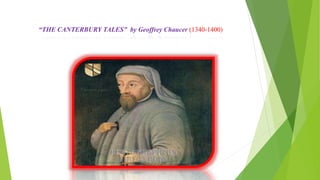
“THE CANTERBURY TALES” by Geoffrey Chaucer (1340-1400)
* About Geoffrey Chaucer . . .
 Father of English poetry, greatest English poet of the
medieval ages.
 First poet of national importance.
 Author, poet, philosopher and alchemist.
 Chaucer also maintained an active career in the civil
service as a bureaucrat, courtier and diplomat.
 Traveled in Flanders, France, Spain and Italy where he
observed various types of men, manners and fashions.
Which highly influenced him for his literary creations. 3
* Chaucer’s Life . . .
 Born in London around 1343.
 precise date and location of his birth remain unknown.
 Son of wealthy London vintner (wine merchant).
 Educated in St Paul’s Cathedral School, and later at
Inner Temple where he studied law.
 In 1357, he became a courtier, diplomat and civil
servant.
 In 1368-78, he was sent to France, Genoa and
Florence.
 Where he influenced by the works of authors like
Dante, Boccaccio and Froissart.
4
* Chaucer’s Works . . .
5
 Early period ( up to c.1370)
-- Translation of ‘Roman de la Rose’
-- The Book of the Duchess
 Middle period (up to c.1387)
-- The House of Fame
-- The Parliament of Flows
-- Translation of ‘Consolation of Philosophy’
-- Troilus and Criseyde
-- The Legend of Good Women
 Last period (after 1387)
-- The Canterbury Tales
6
Features of Chaucer’s Works
 Gift of story telling and descriptive power
 Use of musical element
 Personal touches; charming, humorous
 Rarely philosophized
 softness in narration
 Perennial interest in humanity
 Happy world (as there is pain and perplexity, but no
agony or rebellion)
7
“The Canterbury Tales” - (c.1387)
( Most remarkable work of Chaucer )
 Chaucer’s Canterbury Tales influenced by Boccaccio’s
‘Decameron’.
 29 pilgrims meet at Tabard Inn.
 23 of them tell stories.
 In Canterbury Tales there are 24 stories.
 Chaucer tells two stories – Tale of Thopas and Tale of
Melibeus.
 The Canterbury Tales begins with Knight’s Tale and
ends with Parsons Tale.
 It ends with “Retraction”, Chaucer’s apology for the
vulgar and unworthy parts of this book. 8
Pilgrims meet at Tabard Inn --
9
Upper
Class
Middle Class
Upper
Lower
Lower Class
Virtuous
Immoral
Knight Merchant Cook Yeoman Miller
Squire Clerk of
Shipman
Oxford
Parson
Manciple
Prioress Man of Law Doctor of
Physique
Plowman Reeve
Monk Frankline Wife of
Bath Summoner
Friar Five Guildsmen
Pardoner
10
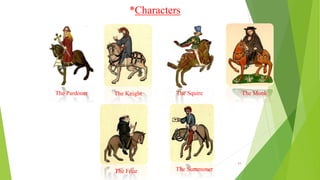
*Characters
The Pardoner The Knight The Squire The Monk
The Friar The Summoner
11
The Parson The Nun’s Priest The Second Nun The Prioress
The Merchant The Clerk of Oxford 12
The Wife of Bath The Man of Law The Shipman The Physician
The Reeve The Franklin 13
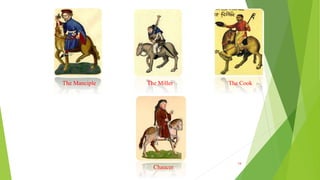
The Manciple The Miller The Cook
Chaucer
14
The Knight –
 Member of the Household Group
 Represents ideals of truth, honour, generosity,
courtesy, modesty and gentleness.
 First to arrive Tabard Inn after Chaucer.
 Wildly travelled and prudent.
 Tells first tale ‘Knight’s Tale’.
The Squire –
 Son of the Knight.
 Was “as fresh as the month of may”
 Fought battles for winning his ladyloves.
 He is humble and modest.
 Tells an ‘Oriental Tale’. 15
The Prioress –
 Her name was Eglantyne.
 Beautiful, romantic and amiable.
 She had fine table manners.
 loves small dogs more than human
beings.
The Monk –
 Compared to the Prioress in religious
affection.
 A robust and masculine man, the Monk
travels with the Prioress and Second Nun.
16
The Friar –
 Supposed to live a poor life by
begging but is more interested in love
affairs of young people.
 Good singer
The Pardoner –
 Chaucer’s masterpiece in character
drawing.
 Good story-teller; sing hymns
beautifully.
17
The Summoner –
 Pardoner’s companion
 Lecherous and dishonest
 Children are afraid of his fiery red face
full of pimples and scary eye brows.
He loves garlic, onion, leeks and wine.
 Spout of few Latin Phrases he knows.
The Parson –
 Ideal parish priest.
Thought only holy thoughts and did
only good deeds.
 He is very gentle and diligent.
18
The Clerk of Oxford –
 A Neutral portrayal
 Devoted to the study of philosophy
 Eager to learn and teach
 Prayed for the souls of those who helped
him
 He is polite and speaks only when
necessary
 He speaks about morality
 His tale is a reply to the tale of wife of bath
it is about the patient Wife Griselda.
19
The Merchant –
 Wealthy businessman
 He wore rich and multicolored clothes
and hat from Holland.
 Carries himself so well that no one
realizes he is heavily in debt
 Newly and unhappily married
The Man of Law –
 Wise and slightly suspicious of
everything
 He had vast knowledge of law
 often appointed by the king as a judge
of the court of assizes
 Wealthy land-buyer
20
The Franklin –
 Companion of Man of Law
 A wealthy gentleman who like to have wine
in the morning
 Because he loves pleasure, he is called “Son
of Epicurus”
 At Country meetings he is representative and
chairman
 ‘ The Franklin’s Tale’is story set in Brittany
* The Five Guildsmen –
 They are artisans and are newly rich represents urban
middle class
 They are – Haberdasher, a Carpenter, a Weaver, a Dryer and
a Tapestry Maker 21
The Wife of Bath –
 Bath is famous for cloth-making and she
was herself an expert in weaving/ embroidery.
 Lived an honourable life
 Wildly travelled in Italy, Spain and
Jerusalem
 Loved to tell romantic tales and to gossip
The Physician –
 Extremely good at his profession and
astronomy
 Knew of every disease and where it came
from and gives cure immediately
 Eats a simple diet which is healthy
 He saved gold, because of his love of gold
22
The Reeve –
 Slender (thin and graceful) man named
Oswald
 In charge of his master’s sheep, cattle, dairy,
swine (pig), horses, stock and poultry.
 He could observe seasons, weather and
foretell harvest
 Also a good carpenter, a trade which he had
learnt in youth 23
The Shipman –
 Live din the west country and comes from
Dartmouth
 Bold and prudent
 Wildly travelled
 Expert in matters regarding the position of
the moon, the tides, the currents and the
perils of the sea
 His ship was called The Magdalen
* The Yeoman –
 Knew all techniques of carpentry and carried a
sword, guard and a shield and a dagger
 He is a woodsman compared to Robin Hood
24
The Manciple –
 Worked at a college of lawyers.
 An attendant who purchases provisions for a
college and an inn of court
 He serves food to the lawyers and students at
the temple
 Despite his lack of education, this Manciple
is smarter than the thirty lawyers he feeds.
The Cook –
 His name is Roger.
 He was employed by the Guildsmen.
 Perfect in cooking food
 His masterpiece is minced chicken in
white sauce.
25
The Miller –
 His name is Robyn.
 Found of telling indecent tales
 He tells the tale of a bawdy fabliau.
 Wore white coat and blue hood.
 Expert in grinding corn and stole corn by pushing the
scales with his thumb, for which narrator swears he had a
“golden thumb”. 26
The pilgrims delivering tales 27
*Chaucer’s Contribution to Literature
 Creator of English Language and Poetry –
-- First metrical artist, humorist and humanist
-- First national poet of England
-- He gave reformed and reshaped language as a powerful
instrument of expression
-- Informed musical sweetness and liquidity to language
-- First man to use “Naked Words”
 First Great Realist –
-- Believe that poetry is the free secular spirit
-- Portrayed comprehensive picture of contemporary life
-- Realistically presented the social, economic and religious
condition of age
-- Keen observer of men and manners
28
 Characterization of Chaucer –
-- First great character painter
-- Portrayed real life characters
-- Characters are drawn from keen observation of man and
women
-- First writer to bring atmosphere of romantic interest about
men and women
 First great narrative poet in English –
-- Father of English Novel
-- “Troilus and Criseyde” first novel written in verse
-- It has plot, dialogue, humour, irony, realism, conflict,
dramatic elements etc.
-- Character Criseyde is the first true psychological study of
complex woman
-- Pandarus is the first comic character in English 29
*Chesterton humorously remarks –
“If Chaucer is the father of poetry, he is
grandfather of English fiction”
*Albert Calls Chaucer –
“The earliest of the great moderns”
30
*References –
1. ‘Ages, movements and Literary Forms’, Dr. Satish
Kumar, Lakshmi Narain Agarawal, Agra.
2. TES Notes, Kalyani Vallath.
31
32

Chaucer presentation

  • 1.
    Welcome to this Classin the Department of English Uttara University
  • 2.
    “THE CANTERBURY TALES”by Geoffrey Chaucer (1340-1400)
  • 3.
    * About GeoffreyChaucer . . .  Father of English poetry, greatest English poet of the medieval ages.  First poet of national importance.  Author, poet, philosopher and alchemist.  Chaucer also maintained an active career in the civil service as a bureaucrat, courtier and diplomat.  Traveled in Flanders, France, Spain and Italy where he observed various types of men, manners and fashions. Which highly influenced him for his literary creations. 3
  • 4.
    * Chaucer’s Life. . .  Born in London around 1343.  precise date and location of his birth remain unknown.  Son of wealthy London vintner (wine merchant).  Educated in St Paul’s Cathedral School, and later at Inner Temple where he studied law.  In 1357, he became a courtier, diplomat and civil servant.  In 1368-78, he was sent to France, Genoa and Florence.  Where he influenced by the works of authors like Dante, Boccaccio and Froissart. 4
  • 5.
  • 6.
     Early period( up to c.1370) -- Translation of ‘Roman de la Rose’ -- The Book of the Duchess  Middle period (up to c.1387) -- The House of Fame -- The Parliament of Flows -- Translation of ‘Consolation of Philosophy’ -- Troilus and Criseyde -- The Legend of Good Women  Last period (after 1387) -- The Canterbury Tales 6
  • 7.
    Features of Chaucer’sWorks  Gift of story telling and descriptive power  Use of musical element  Personal touches; charming, humorous  Rarely philosophized  softness in narration  Perennial interest in humanity  Happy world (as there is pain and perplexity, but no agony or rebellion) 7
  • 8.
    “The Canterbury Tales”- (c.1387) ( Most remarkable work of Chaucer )  Chaucer’s Canterbury Tales influenced by Boccaccio’s ‘Decameron’.  29 pilgrims meet at Tabard Inn.  23 of them tell stories.  In Canterbury Tales there are 24 stories.  Chaucer tells two stories – Tale of Thopas and Tale of Melibeus.  The Canterbury Tales begins with Knight’s Tale and ends with Parsons Tale.  It ends with “Retraction”, Chaucer’s apology for the vulgar and unworthy parts of this book. 8
  • 9.
    Pilgrims meet atTabard Inn -- 9
  • 10.
    Upper Class Middle Class Upper Lower Lower Class Virtuous Immoral KnightMerchant Cook Yeoman Miller Squire Clerk of Shipman Oxford Parson Manciple Prioress Man of Law Doctor of Physique Plowman Reeve Monk Frankline Wife of Bath Summoner Friar Five Guildsmen Pardoner 10
  • 11.
    *Characters The Pardoner TheKnight The Squire The Monk The Friar The Summoner 11
  • 12.
    The Parson TheNun’s Priest The Second Nun The Prioress The Merchant The Clerk of Oxford 12
  • 13.
    The Wife ofBath The Man of Law The Shipman The Physician The Reeve The Franklin 13
  • 14.
    The Manciple TheMiller The Cook Chaucer 14
  • 15.
    The Knight – Member of the Household Group  Represents ideals of truth, honour, generosity, courtesy, modesty and gentleness.  First to arrive Tabard Inn after Chaucer.  Wildly travelled and prudent.  Tells first tale ‘Knight’s Tale’. The Squire –  Son of the Knight.  Was “as fresh as the month of may”  Fought battles for winning his ladyloves.  He is humble and modest.  Tells an ‘Oriental Tale’. 15
  • 16.
    The Prioress – Her name was Eglantyne.  Beautiful, romantic and amiable.  She had fine table manners.  loves small dogs more than human beings. The Monk –  Compared to the Prioress in religious affection.  A robust and masculine man, the Monk travels with the Prioress and Second Nun. 16
  • 17.
    The Friar – Supposed to live a poor life by begging but is more interested in love affairs of young people.  Good singer The Pardoner –  Chaucer’s masterpiece in character drawing.  Good story-teller; sing hymns beautifully. 17
  • 18.
    The Summoner – Pardoner’s companion  Lecherous and dishonest  Children are afraid of his fiery red face full of pimples and scary eye brows. He loves garlic, onion, leeks and wine.  Spout of few Latin Phrases he knows. The Parson –  Ideal parish priest. Thought only holy thoughts and did only good deeds.  He is very gentle and diligent. 18
  • 19.
    The Clerk ofOxford –  A Neutral portrayal  Devoted to the study of philosophy  Eager to learn and teach  Prayed for the souls of those who helped him  He is polite and speaks only when necessary  He speaks about morality  His tale is a reply to the tale of wife of bath it is about the patient Wife Griselda. 19
  • 20.
    The Merchant – Wealthy businessman  He wore rich and multicolored clothes and hat from Holland.  Carries himself so well that no one realizes he is heavily in debt  Newly and unhappily married The Man of Law –  Wise and slightly suspicious of everything  He had vast knowledge of law  often appointed by the king as a judge of the court of assizes  Wealthy land-buyer 20
  • 21.
    The Franklin – Companion of Man of Law  A wealthy gentleman who like to have wine in the morning  Because he loves pleasure, he is called “Son of Epicurus”  At Country meetings he is representative and chairman  ‘ The Franklin’s Tale’is story set in Brittany * The Five Guildsmen –  They are artisans and are newly rich represents urban middle class  They are – Haberdasher, a Carpenter, a Weaver, a Dryer and a Tapestry Maker 21
  • 22.
    The Wife ofBath –  Bath is famous for cloth-making and she was herself an expert in weaving/ embroidery.  Lived an honourable life  Wildly travelled in Italy, Spain and Jerusalem  Loved to tell romantic tales and to gossip The Physician –  Extremely good at his profession and astronomy  Knew of every disease and where it came from and gives cure immediately  Eats a simple diet which is healthy  He saved gold, because of his love of gold 22
  • 23.
    The Reeve – Slender (thin and graceful) man named Oswald  In charge of his master’s sheep, cattle, dairy, swine (pig), horses, stock and poultry.  He could observe seasons, weather and foretell harvest  Also a good carpenter, a trade which he had learnt in youth 23
  • 24.
    The Shipman – Live din the west country and comes from Dartmouth  Bold and prudent  Wildly travelled  Expert in matters regarding the position of the moon, the tides, the currents and the perils of the sea  His ship was called The Magdalen * The Yeoman –  Knew all techniques of carpentry and carried a sword, guard and a shield and a dagger  He is a woodsman compared to Robin Hood 24
  • 25.
    The Manciple – Worked at a college of lawyers.  An attendant who purchases provisions for a college and an inn of court  He serves food to the lawyers and students at the temple  Despite his lack of education, this Manciple is smarter than the thirty lawyers he feeds. The Cook –  His name is Roger.  He was employed by the Guildsmen.  Perfect in cooking food  His masterpiece is minced chicken in white sauce. 25
  • 26.
    The Miller – His name is Robyn.  Found of telling indecent tales  He tells the tale of a bawdy fabliau.  Wore white coat and blue hood.  Expert in grinding corn and stole corn by pushing the scales with his thumb, for which narrator swears he had a “golden thumb”. 26
  • 27.
  • 28.
    *Chaucer’s Contribution toLiterature  Creator of English Language and Poetry – -- First metrical artist, humorist and humanist -- First national poet of England -- He gave reformed and reshaped language as a powerful instrument of expression -- Informed musical sweetness and liquidity to language -- First man to use “Naked Words”  First Great Realist – -- Believe that poetry is the free secular spirit -- Portrayed comprehensive picture of contemporary life -- Realistically presented the social, economic and religious condition of age -- Keen observer of men and manners 28
  • 29.
     Characterization ofChaucer – -- First great character painter -- Portrayed real life characters -- Characters are drawn from keen observation of man and women -- First writer to bring atmosphere of romantic interest about men and women  First great narrative poet in English – -- Father of English Novel -- “Troilus and Criseyde” first novel written in verse -- It has plot, dialogue, humour, irony, realism, conflict, dramatic elements etc. -- Character Criseyde is the first true psychological study of complex woman -- Pandarus is the first comic character in English 29
  • 30.
    *Chesterton humorously remarks– “If Chaucer is the father of poetry, he is grandfather of English fiction” *Albert Calls Chaucer – “The earliest of the great moderns” 30
  • 31.
    *References – 1. ‘Ages,movements and Literary Forms’, Dr. Satish Kumar, Lakshmi Narain Agarawal, Agra. 2. TES Notes, Kalyani Vallath. 31
  • 32.