Imagism:
Capturing a Moment in Time
ENG 531
What is Imagism?
 A poetic movement established in1912
by American and English poets Ezra
Pound, Hilda Doolittle, Richard Aldington,
and F. S. Flint
 Inspired by the critical views of T.E.
Hulme, in response to the careless
thought and Romantic optimism he saw
prevailing in the literary arena.
…continued
 Led by Ezra Pound, this poetic movement
was part of a poetic insurgence against
genteel poetry, which was overly
sentimental and emotionally dishonest.
 Imagist poets believed that Romantic art
was oveexcessively subjective, and
argued for a renewed emphasis on the
object-like nature of the art-work.
 Imagists penned concise verses with dry
piercing clarity, exacting visual images and
imagery.
Key Works
Imagist publications
Des Imagistes, 1914;
Some Imagists, 1915, 1916, 1917
The magazines Poetry (from 1912) and
The Egoist (from 1914)
Influences on Imagism
Imagist poems were influenced by
Japanese haiku poems of seventeen
syllables which usually present only
two juxtaposed images.
This poetry strives to suggests more
than its literal meaning, yet avoids
overt figurative devices like allegories
and metaphors.
Influences on Imagism
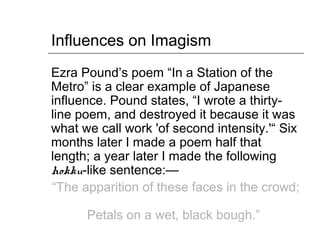
Ezra Pound’s poem “In a Station of the
Metro” is a clear example of Japanese
influence. Pound states, “I wrote a thirty-
line poem, and destroyed it because it was
what we call work 'of second intensity.'“ Six
months later I made a poem half that
length; a year later I made the following
hokku-like sentence:—
“The apparition of these faces in the crowd;
Petals on a wet, black bough.”
Influences on Imagism
According to the modernist principle of
"making it new," Pound does not copy
haiku, but adapts it to the modern world.
Other ancient short forms were "made
new" by the imagists, most notably the
four-line Chinese lyric and the short poems
and fragments from ancient Greece
collected in the Greek Anthology.
From “A Retrospect” by Ezra
Pound
1. Direct treatment of the ‘thing,’ whether
subjective or objective.
2. To use absolutely no word that did not
contribute to the presentation.
3. As regarding rhythm: to compose in
sequence of the musical phrase, not in
sequence of the metronome.
Ezra Pound on Imagism
4. An 'Image' is that which presents an
intellectual and emotional complex in
an instant of time.
5. It is better to present one Image in a
lifetime than to produce voluminous
works.
6. Use no superfluous word, no
adjective which does not reveal
something.
Pound continued
7. Do not intertwine an abstraction with the
concrete. This mistake comes from the
writer not realizing that the natural
object is always the adequate symbol.
8. Do not retell in mediocre verse what has
already been done in good prose.
9. Don't be descriptive; remember that the
painter can describe a landscape much
better than you can, and that he has to
know a good deal more about it.
Amy Lowell: Imagism is
presentation not representation.
“Imagism, then, is a particular
school, springing up within a larger,
more comprehensive movement, the
[Modern American Poetry]
Movement. We can safely claim it to
be a ‘renaissance,’ a re-birth of the
spirit of truth and beauty. It means a
re-discovery of beauty in our modern
world, and the originality and
honesty to affirm that beauty in
whatever manner is native to the
poet.”
Amy Lowell on Imagism
 To use the language of common speech, but to
employ always the exact word, not the nearly-
exact, nor the merely decorative word.
 To create new rhythms -as the expression of new
moods -- and not to copy old rhythms, which
merely echo old moods. The individuality of a poet
may often be better expressed in free-verse than
in conventional forms. In poetry a new cadence
means a new idea.
 To allow absolute freedom in the choice of
subject.
 To present an image (hence the name: "Imagist").
Poetry should render particulars exactly and not
deal in vague generalities, however magnificent
and sonorous.
 To produce poetry that is hard and clear, never

Imagism overview

  • 1.
  • 2.
    What is Imagism? A poetic movement established in1912 by American and English poets Ezra Pound, Hilda Doolittle, Richard Aldington, and F. S. Flint  Inspired by the critical views of T.E. Hulme, in response to the careless thought and Romantic optimism he saw prevailing in the literary arena.
  • 3.
    …continued  Led byEzra Pound, this poetic movement was part of a poetic insurgence against genteel poetry, which was overly sentimental and emotionally dishonest.  Imagist poets believed that Romantic art was oveexcessively subjective, and argued for a renewed emphasis on the object-like nature of the art-work.  Imagists penned concise verses with dry piercing clarity, exacting visual images and imagery.
  • 4.
    Key Works Imagist publications DesImagistes, 1914; Some Imagists, 1915, 1916, 1917 The magazines Poetry (from 1912) and The Egoist (from 1914)
  • 5.
    Influences on Imagism Imagistpoems were influenced by Japanese haiku poems of seventeen syllables which usually present only two juxtaposed images. This poetry strives to suggests more than its literal meaning, yet avoids overt figurative devices like allegories and metaphors.
  • 6.
    Influences on Imagism EzraPound’s poem “In a Station of the Metro” is a clear example of Japanese influence. Pound states, “I wrote a thirty- line poem, and destroyed it because it was what we call work 'of second intensity.'“ Six months later I made a poem half that length; a year later I made the following hokku-like sentence:— “The apparition of these faces in the crowd; Petals on a wet, black bough.”
  • 7.
    Influences on Imagism Accordingto the modernist principle of "making it new," Pound does not copy haiku, but adapts it to the modern world. Other ancient short forms were "made new" by the imagists, most notably the four-line Chinese lyric and the short poems and fragments from ancient Greece collected in the Greek Anthology.
  • 8.
    From “A Retrospect”by Ezra Pound 1. Direct treatment of the ‘thing,’ whether subjective or objective. 2. To use absolutely no word that did not contribute to the presentation. 3. As regarding rhythm: to compose in sequence of the musical phrase, not in sequence of the metronome.
  • 9.
    Ezra Pound onImagism 4. An 'Image' is that which presents an intellectual and emotional complex in an instant of time. 5. It is better to present one Image in a lifetime than to produce voluminous works. 6. Use no superfluous word, no adjective which does not reveal something.
  • 10.
    Pound continued 7. Donot intertwine an abstraction with the concrete. This mistake comes from the writer not realizing that the natural object is always the adequate symbol. 8. Do not retell in mediocre verse what has already been done in good prose. 9. Don't be descriptive; remember that the painter can describe a landscape much better than you can, and that he has to know a good deal more about it.
  • 11.
    Amy Lowell: Imagismis presentation not representation. “Imagism, then, is a particular school, springing up within a larger, more comprehensive movement, the [Modern American Poetry] Movement. We can safely claim it to be a ‘renaissance,’ a re-birth of the spirit of truth and beauty. It means a re-discovery of beauty in our modern world, and the originality and honesty to affirm that beauty in whatever manner is native to the poet.”
  • 12.
    Amy Lowell onImagism  To use the language of common speech, but to employ always the exact word, not the nearly- exact, nor the merely decorative word.  To create new rhythms -as the expression of new moods -- and not to copy old rhythms, which merely echo old moods. The individuality of a poet may often be better expressed in free-verse than in conventional forms. In poetry a new cadence means a new idea.  To allow absolute freedom in the choice of subject.  To present an image (hence the name: "Imagist"). Poetry should render particulars exactly and not deal in vague generalities, however magnificent and sonorous.  To produce poetry that is hard and clear, never