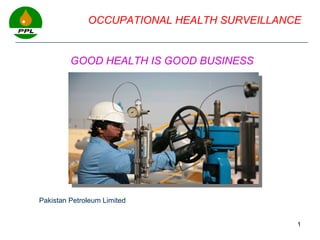
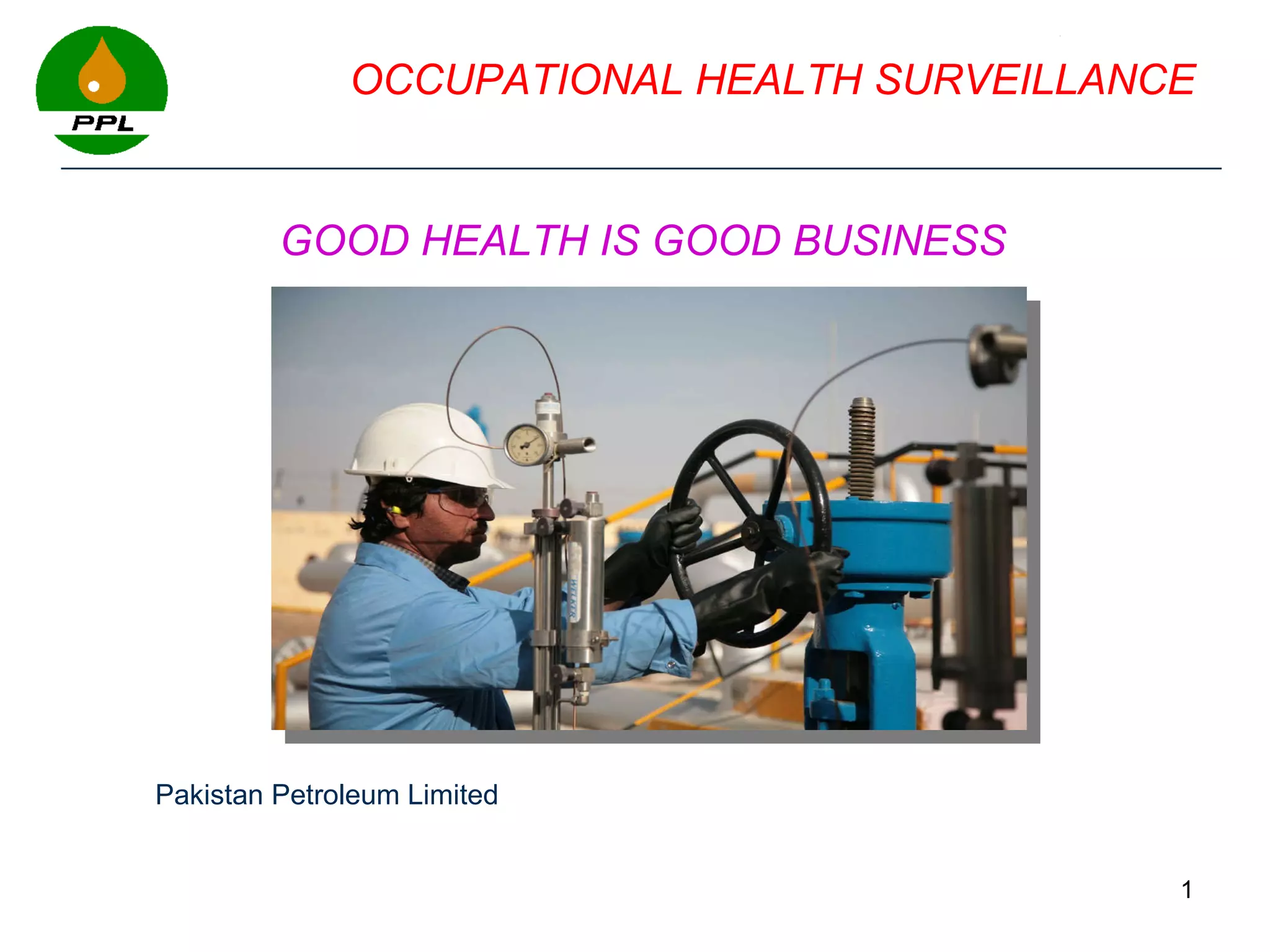
page  OCCUPATIONAL HEALTH SURVEILLANCE  GOOD HEALTH IS GOOD BUSINESS Pakistan Petroleum Limited
OVER VIEW What is an Occupational Health  ? Importance of Occupational Health Fitness to work Health Surveillance of Staff at risk. First aid. Fatigue Management. Food / kitchen hygiene. Use of drugs & alcohol at workplace. Blood borne pathogens.  General housekeeping of residence blocks, dining halls (messes) & sanitation
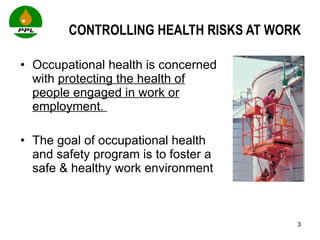
CONTROLLING HEALTH RISKS AT WORK Occupational health is concerned with  protecting the health of people engaged in work or employment.  The goal of occupational health and safety program is to foster a safe & healthy work environment
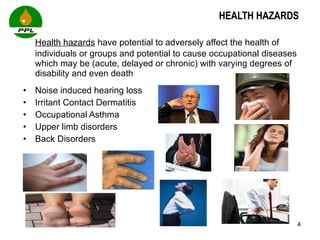
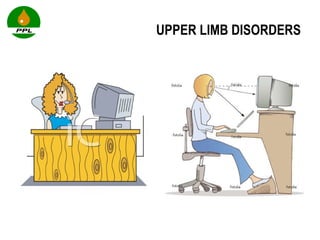
HEALTH HAZARDS  Health hazards  have potential to adversely affect the health of individuals or groups and potential to cause occupational diseases which may be (acute, delayed or chronic) with varying degrees of disability and even death Noise induced hearing loss Irritant Contact Dermatitis Occupational Asthma Upper limb disorders Back Disorders
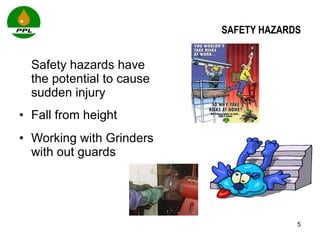
SAFETY HAZARDS Safety hazards have the potential to cause sudden injury Fall from height Working with Grinders with out guards
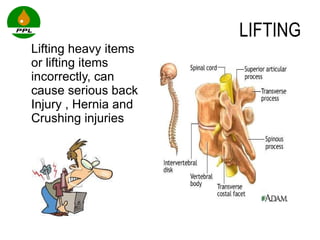
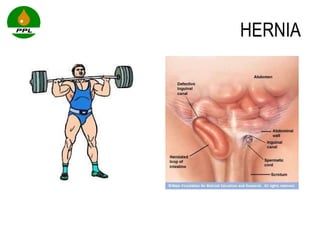
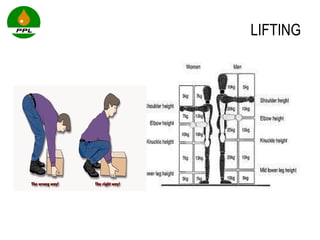
LIFTING Lifting heavy items or lifting items incorrectly, can cause serious back Injury , Hernia and Crushing injuries
HERNIA
LIFTING
UPPER LIMB DISORDERS
WHO AND OCCUPATIONAL HEALTH “ It is the fundamental right of each worker to get higher attainable standard of health and occupational health services should be ensured for all workers”.  “ When work is fully adapted to human goals, capacities, and limitations, and occupational health hazards are under control, work often plays a role in promoting both physical and mental health”.
270 million occupational accidents and 160 million work-related diseases occur annually world wide. 6,000 (on an average) people die as a result of work-related  accidents or diseases, making it 2.2 million fatalities annually: 1.7 million deaths due to work related diseases 0.35 million fatalities due to workplace accidents 0.15 million fatalities due to accidents during commuting 4% (approximately) of the world’s gross domestic product is lost with the cost of injury, death and disease through absence from work, sickness treatment, disability and survivor benefits. ILO STATISTICS  OCCUPATIONAL HEALTH AND SAFETY
ILO OCCUPATIONAL HEALTH AND  SAFETY COVENTION C155 (1981) Sets out broad requirements for member states to follow to ensure health and safety requirements are set into national laws. The employers are responsible  so far as reasonably practicable , the workplaces, machinery equipment and process under their control are  safe and without risk to health  and  Appropriate  measures of protection  are taken. The employers must also provide  measures to deal with emergencies and accidents.
ILO OCCUPATIONAL HEALTH SERVICES  CONVENTION (C.161) 1985 Each member state shall formulate implement and periodically review national policy on occupational Health services Each member state undertakes to develop progressively occupational health services for all workers including those in the public sector The provision made should be adequate and appropriate to the specific risks of undertaking
LAGISLATION REGARDING  OCCUPATIONAL HEALTH  AND SAFETY  IN PAKISTAN Mines Act 1923 Factories Act 1934 Ordinance 2001 Docks Labours Act 1934 Petroleum Rules 1937 West Pakistan Hazardous Operations Rules 1963 Workman's Compensation act 1923 and Rules 1961 Provincial Employees social Security Regulations 1967 The Oil and Gas (safety in drilling and production) Regulations 1974  Hazardous Substances Rule 2003 OHSAS 18001  Standards
BENEFITS OF OCCUPATIONAL HEALTH PROGRAMME Prevents cost of absence and ill-health redundancy Reduction in re-training and recruitment costs.  Helps in retention of staff and build employee loyalty Increased productivity leading to increased profits Compliance with Legislation Decrease employer liability Less insurance premiums Reduced risk and cost of litigation Rise in public profile of the company  Helps to prevent occupational diseases like deafness, cancers, asthma, etc Protection of both physical and economic well being of employees Corporate social responsibility
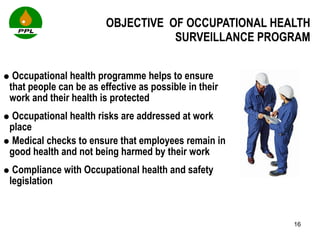
OBJECTIVE  OF OCCUPATIONAL HEALTH SURVEILLANCE PROGRAM Occupational health programme helps to ensure that people can be as effective as possible in their work and their health is protected Occupational health risks are addressed at work place Medical checks to ensure that employees remain in good health and not being harmed by their work Compliance with Occupational health and safety legislation
HEALTH SURVEILLANCE PROGRAMME  INCLUDES Identifying the occupational injury / illness Assessment of Occupational health hazards Implementation of controls to eliminate root causes of health hazards Managing treatment in systematic manner Managing Sickness absence Optimizing business performance and reputation
SCOPE OF OCCUPATIONAL HEALTH PROGRAMME deals with following areas of Occupational Health: Health Surveillance of Staff at risk. First aid. Fatigue Management. Food / kitchen hygiene. Use of drugs & alcohol at workplace. Fumigation & pest control. Blood borne pathogens.  General housekeeping of residence blocks, dining halls (messes) & sanitation etc.
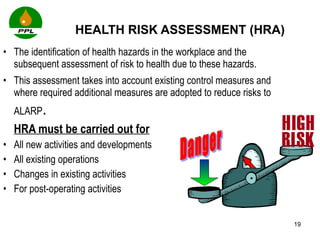
HEALTH RISK ASSESSMENT (HRA) The identification of health hazards in the workplace and the subsequent assessment of risk to health due to these hazards.  This assessment takes into account existing control measures and where required additional measures are adopted to reduce risks to ALARP .  HRA must be carried out for All new activities and developments All existing operations Changes in existing activities For post-operating activities Danger
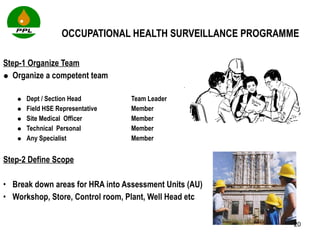
OCCUPATIONAL HEALTH SURVEILLANCE PROGRAMME Step-1 Organize Team Organize a competent team Dept / Section Head Team Leader Field HSE Representative Member Site Medical  Officer Member Technical  Personal Member Any Specialist Member Step-2 Define Scope Break down areas for HRA into Assessment Units (AU)  Workshop, Store, Control room, Plant, Well Head etc
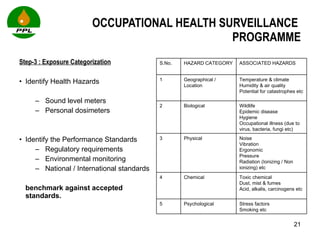
OCCUPATIONAL HEALTH SURVEILLANCE  PROGRAMME Step-3 : Exposure Categorization Identify Health Hazards Sound level meters  Personal dosimeters Identify the Performance Standards  Regulatory requirements Environmental monitoring National / International standards benchmark against accepted standards.  S.No. HAZARD CATEGORY ASSOCIATED HAZARDS 1 Geographical / Location Temperature & climate Humidity & air quality Potential for catastrophes etc 2 Biological Wildlife Epidemic disease Hygiene Occupational illness (due to virus, bacteria, fungi etc) 3 Physical Noise Vibration Ergonomic Pressure Radiation (Ionizing / Non ionizing) etc 4 Chemical  Toxic chemical Dust, mist & fumes Acid, alkalis, carcinogens etc 5 Psychological Stress factors Smoking etc
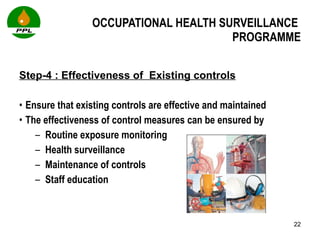
OCCUPATIONAL HEALTH SURVEILLANCE  PROGRAMME Step-4 : Effectiveness of  Existing controls Ensure that existing controls are effective and maintained  The effectiveness of control measures can be ensured by Routine exposure monitoring Health surveillance Maintenance of controls  Staff education
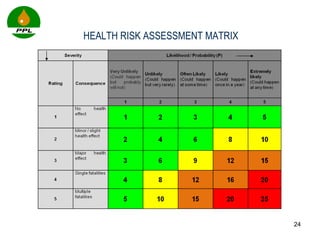
Step-5: Health Risk Assessment: A health risk is generally defined as the likelihood that exposure to a hazard will result in occupational illness, disability or death (Severity).  The risk is obtained by combining the probability with severity Risk (R) = Probability / Likelihood (P)  X Severity (S) RAM Categorizes Health hazards as Very High, High, Medium, low
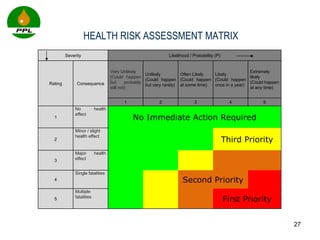
HEALTH RISK ASSESSMENT MATRIX
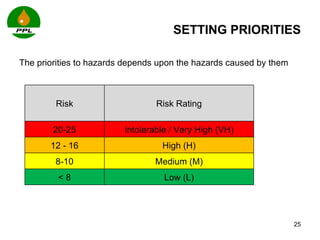
SETTING PRIORITIES The priorities to hazards depends upon the hazards caused by them Risk Risk Rating 20-25 Intolerable / Very High (VH) 12 - 16 High (H) 8-10 Medium (M) < 8 Low (L)
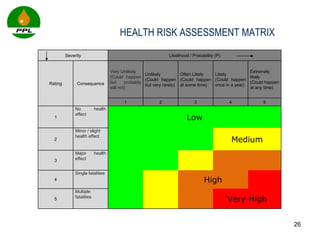
HEALTH RISK ASSESSMENT MATRIX Severity Likelihood / Probability (P) Rating Consequence Very Unlikely (Could happen but probably will not) Unlikely (Could happen but very rarely) Often Likely (Could happen at some time) Likely (Could happen once in a year) Extremely likely (Could happen at any time) 1 2 3 4 5 1 No health effect Low 2 Minor / slight  health effect Medium 3 Major health effect 4 Single fatalities High 5 Multiple fatalities Very High
HEALTH RISK ASSESSMENT MATRIX Severity Likelihood / Probability (P) Rating Consequence Very Unlikely (Could happen but probably will not) Unlikely (Could happen but very rarely) Often Likely (Could happen at some time) Likely (Could happen once in a year) Extremely likely (Could happen at any time) 1 2 3 4 5 1 No health effect No Immediate Action Required 2 Minor / slight  health effect Third Priority 3 Major health effect 4 Single fatalities Second Priority 5 Multiple fatalities First Priority
OCCUPATIONAL HEALTH SURVEILLANCE  PROGRAMME Step-7 Determine the additional control measures If Control Measures are not enough to control Risks Identify the additional controls to limit risk to ALARP Compare the additional controls with existing controls and identify gaps Identify and agree remedial actions to address the   identified gaps
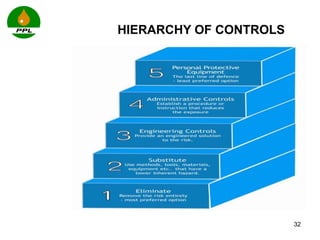
PRIORITOIES TO CONTROL HAZARDS Action – First Priority Stop the exposure  Notify management immediately Identify all sources Implement immediate control improvements, e.g. introduce use of Personal Protective Equipment as a short term measure until other more robust controls are in place Consider need for exposure measurement Identify and implement work practice and control improvements - consider hierarchy of controls Review HRA, including measurements, after improvements are made
PRIORITOIES TO CONTROL HAZARDS Action – Second Priority Reduce exposure to below NEQS Introduce use of Personal Protective Equipment as a short term measure until other more robust controls are in place Identify and implement work practice and control improvements - consider hierarchy of controls Consider need for exposure measurement Review HRA, including measurements, after improvements are made
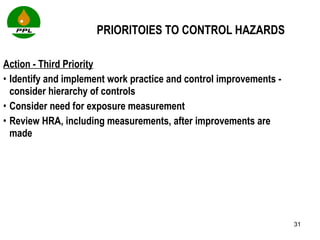
PRIORITOIES TO CONTROL HAZARDS Action - Third Priority   Identify and implement work practice and control improvements - consider hierarchy of controls Consider need for exposure measurement Review HRA, including measurements, after improvements are made
HIERARCHY OF CONTROLS
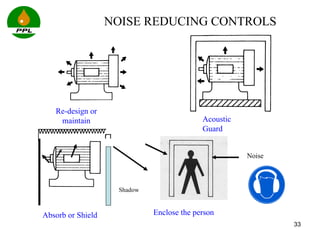
NOISE REDUCING CONTROLS Re-design or maintain Acoustic Guard Absorb or Shield Enclose the person Shadow Noise
OCCUPATIONAL HEALTH SURVIELLANCE  PROGRAMME Step 8: Remedial Action Plan   Remedial action Plan should state the Additional control and recovery measures.  Remedial action plan should be SMART.  S------Specific M-----Measurable A-----Achievable R-----Realistic T-----Time bound This plan should include priorities, responsible person and target dates for actions.
OCCUPATIONAL HEALTH SURVEILLANCE  PROGRAMME Step-9: Documenting Health Risk Assessments The record of HRA is kept and retrievable for Audits and periodic reviews. For chronic health risks records should be kept for long period to allow the evaluation of individual health effects.  Include exposure monitoring and health surveillance  record It  may act as insurance against possible future liabilities. Findings of HRAs should be communicated  to relevant staff
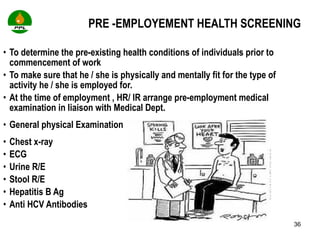
PRE -EMPLOYEMENT HEALTH SCREENING To determine the pre-existing health conditions of individuals prior to commencement of work  To make sure that he / she is physically and mentally fit for the type of activity he / she is employed for. At the time of employment , HR/ IR arrange pre-employment medical  examination in liaison with Medical Dept.  General physical Examination  Chest x-ray  ECG  Urine R/E  Stool R/E  Hepatitis B Ag  Anti HCV Antibodies
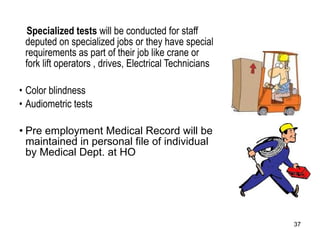
Specialized tests  will be conducted for staff deputed on specialized jobs or they have special requirements as part of their job like crane or fork lift operators , drives, Electrical Technicians Color blindness  Audiometric tests Pre employment Medical Record will be maintained in personal file of individual by Medical Dept. at HO
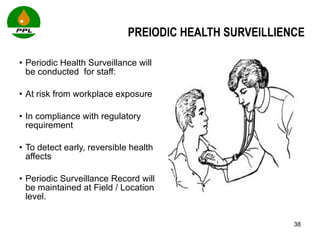
PREIODIC HEALTH SURVEILLIENCE Periodic Health Surveillance will be conducted  for staff: At risk from workplace exposure In compliance with regulatory requirement To detect early, reversible health affects Periodic Surveillance Record will be maintained at Field / Location level.
OCCUPATIONAL HEALTH SURVEILLANCE PROGRAM At initial stages the Occupational Health Surveillance Program is focused on Electrical Technicians Drivers Fork Lift and crane operators Kitchen staff Janitorial staff Fire man Radiology  Exposed to High noise  Any case identified by Dept. Head / Field Incharge
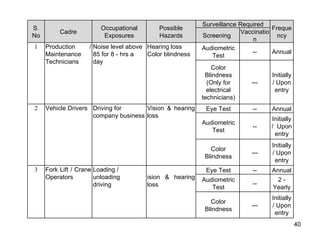
S. No Cadre Occupational Exposures Possible Hazards Surveillance Required Frequency Screening  Vaccination 1 Production  / Maintenance Technicians  Noise level above 85 for 8 - hrs a day Hearing loss Color blindness Audiometric Test -- Annual Color Blindness (Only for electrical technicians) --- Initially / Upon entry 2 Vehicle Drivers Driving for company business Vision & hearing loss Eye Test -- Annual Audiometric Test -- Initially /  Upon entry Color Blindness --- Initially / Upon entry 3 Fork Lift / Crane Operators Loading / unloading driving Vision & hearing loss Eye Test -- Annual Audiometric Test -- 2 - Yearly Color Blindness --- Initially / Upon entry
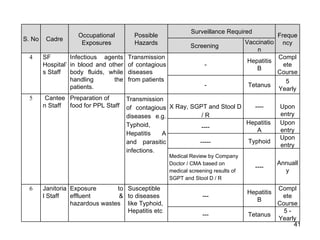
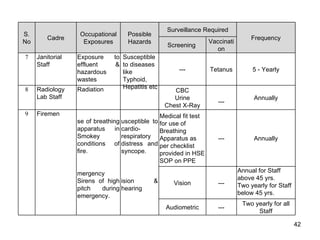
S. No Cadre Occupational Exposures Possible Hazards Surveillance Required Frequency Screening  Vaccination 4 SF Hospital’s Staff Infectious agents in blood and other body fluids, while handling the patients.  Transmission of contagious diseases from patients - Hepatitis B Complete Course - Tetanus 5 Yearly 5 Canteen Staff Preparation of food for PPL Staff Transmission of contagious diseases e.g. Typhoid, Hepatitis A and parasitic infections. X Ray, SGPT and Stool D / R ---- Upon entry ---- Hepatitis  A Upon entry ----- Typhoid Upon entry Medical Review by Company Doctor / CMA based on medical screening results of SGPT and Stool D / R ---- Annually 6 Janitorial Staff Exposure to effluent & hazardous wastes Susceptible to diseases like Typhoid, Hepatitis etc  --- Hepatitis B Complete Course --- Tetanus 5 - Yearly
S. No Cadre Occupational Exposures Possible Hazards Surveillance Required Frequency Screening  Vaccination 7 Janitorial Staff Exposure to effluent & hazardous wastes Susceptible to diseases like Typhoid, Hepatitis etc  --- Tetanus 5 - Yearly 8 Radiology Lab Staff Radiation CBC Urine Chest X-Ray --- Annually 9 Firemen Use of breathing apparatus in Smokey conditions of fire. Emergency Sirens of high pitch during emergency. Susceptible to cardio-respiratory distress and syncope.  Vision & hearing  Medical fit test for use of Breathing Apparatus as per checklist provided in HSE SOP on PPE --- Annually Vision --- Annual for Staff above 45 yrs. Two yearly for Staff below 45 yrs. Audiometric --- Two yearly for all Staff
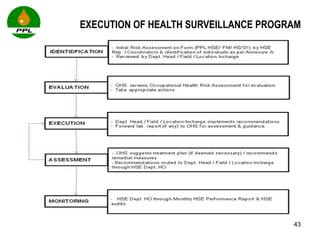
EXECUTION OF HEALTH SURVEILLANCE PROGRAM
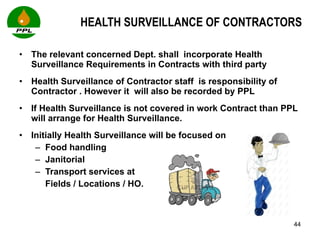
HEALTH SURVEILLANCE OF CONTRACTORS The relevant concerned Dept. shall  incorporate Health Surveillance Requirements in Contracts with third party Health Surveillance of Contractor staff  is responsibility of Contractor . However it  will also be recorded by PPL If Health Surveillance is not covered in work Contract than PPL will arrange for Health Surveillance.  Initially Health Surveillance will be focused on  Food handling  Janitorial  Transport services at  Fields / Locations / HO.
HEALTH SURVEILLANCE OF CONTRACTORS Admin. Dept. HO shall incorporate the Health Surveillance requirements into the Contract Document with the Catering / Janitorial Service / Transport Contractors and extend necessary coordination with Medical & HSE Dept.at HO for monitoring implementation by these contractors.  The actions taken by Field Management in response to recommendations of OHS for the implementation of additional control measures are recorded in template (PPL – HSE / FM / HS / 02 & 03).  Dept. Head / Field  Incharge will acquire record(s) of vaccination and health surveillance of contractor’s Staff and forward to Medical Dept. for necessary review and recommendations.  Any new entry into the record shall be maintained at contract executing Dept.'s end.
DISEASE STATISTICS At Fields Site Company Medical Advisor (CMA) in coordination with Field HSE Representative develops and forwards the Disease Analysis Record Sheet (PPL - HSE / FM / HS / 04) on monthly basis to OHS with copy to HSE Dept. HO through respective Field / Location Incharge for their record and onward maintaining statistical data.  At Sui the sickness and illnesses data of PPL Staff is centrally consolidated and forwarded through Sui Hospital. At HO the same is developed and maintained by Medical Dept. For any contagious diseases, immediate actions may be taken on CMA's recommendations. However, the detailed guidelines may be obtained from OHS.
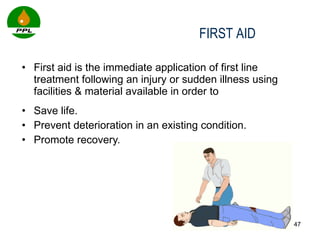
First aid is the immediate application of first line treatment following an injury or sudden illness using facilities & material available in order to Save life. Prevent deterioration in an existing condition. Promote recovery. FIRST AID
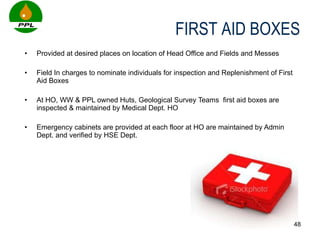
Provided at desired places on location of Head Office and Fields and Messes Field In charges to nominate individuals for inspection and Replenishment of First Aid Boxes At HO, WW & PPL owned Huts, Geological Survey Teams  first aid boxes are inspected & maintained by Medical Dept. HO  Emergency cabinets are provided at each floor at HO are maintained by Admin Dept. and verified by HSE Dept. FIRST AID BOXES
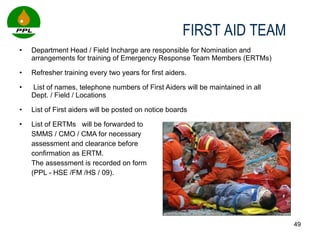
Department Head / Field Incharge are responsible for Nomination and arrangements for training of Emergency Response Team Members (ERTMs) Refresher training every two years for first aiders.  List of names, telephone numbers of First Aiders will be maintained in all Dept. / Field / Locations  List of First aiders will be posted on notice boards List of ERTMs  will be forwarded to  SMMS / CMO / CMA for necessary  assessment and clearance before  confirmation as ERTM.  The assessment is recorded on form  (PPL - HSE /FM /HS / 09).  FIRST AID TEAM
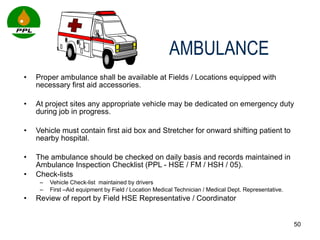
Proper ambulance shall be available at Fields / Locations equipped with necessary first aid accessories. At project sites any appropriate vehicle may be dedicated on emergency duty during job in progress.  Vehicle must contain first aid box and Stretcher for onward shifting patient to nearby hospital. The ambulance should be checked on daily basis and records maintained in Ambulance Inspection Checklist (PPL - HSE / FM / HSH / 05).  Check-lists  Vehicle Check-list  maintained by drivers  First –Aid equipment by Field / Location Medical Technician / Medical Dept. Representative. Review of report by Field HSE Representative / Coordinator   AMBULANCE
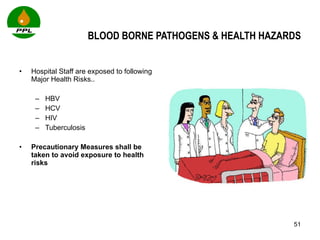
BLOOD BORNE PATHOGENS & HEALTH HAZARDS Hospital Staff are exposed to following Major Health Risks..  HBV HCV HIV Tuberculosis Precautionary Measures shall be taken to avoid exposure to health risks
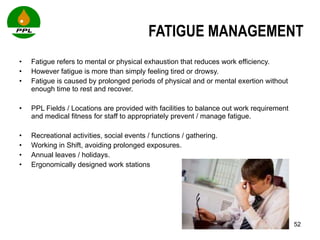
FATIGUE MANAGEMENT Fatigue refers to mental or physical exhaustion that reduces work efficiency.  However fatigue is more than simply feeling tired or drowsy.   Fatigue is caused by prolonged periods of physical and or mental exertion without enough time to rest and recover.    PPL Fields / Locations are provided with facilities to balance out work requirement and medical fitness for staff to appropriately prevent / manage fatigue.  Recreational activities, social events / functions / gathering. Working in Shift, avoiding prolonged exposures. Annual leaves / holidays. Ergonomically designed work stations
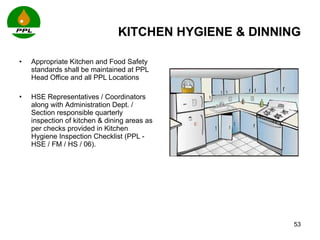
KITCHEN HYGIENE & DINNING Appropriate Kitchen and Food Safety standards shall be maintained at PPL Head Office and all PPL Locations HSE Representatives / Coordinators along with  Administration Dept. / Section responsible quarterly inspection of kitchen & dining areas as per checks provided in Kitchen Hygiene Inspection Checklist (PPL - HSE / FM / HS / 06).
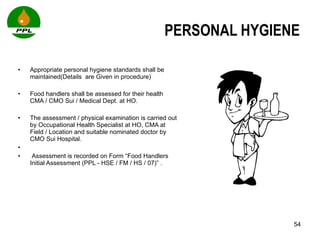
PERSONAL HYGIENE  Appropriate personal hygiene standards shall be maintained(Details  are Given in procedure)  Food handlers shall be assessed for their health  CMA / CMO Sui / Medical Dept. at HO.  The assessment / physical examination is carried out by Occupational Health Specialist at HO, CMA at Field / Location and suitable nominated doctor by CMO Sui Hospital.  Assessment is recorded on Form “Food Handlers Initial Assessment (PPL - HSE / FM / HS / 07)” .
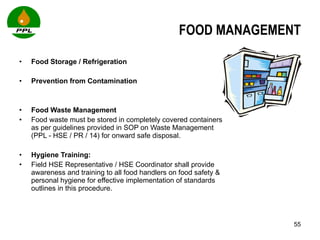
FOOD MANAGEMENT Food Storage / Refrigeration Prevention from Contamination Food Waste Management Food waste must be stored in completely covered containers as per guidelines provided in SOP on Waste Management (PPL - HSE / PR / 14) for onward safe disposal.  Hygiene Training:  Field HSE Representative / HSE Coordinator shall provide awareness and training to all food handlers on food safety & personal hygiene for effective implementation of standards outlines in this procedure.
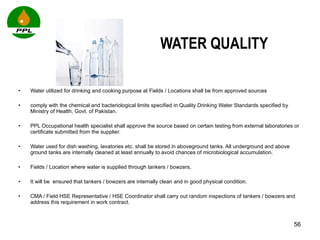
WATER QUALITY Water utilized for drinking and cooking purpose at Fields / Locations shall be from approved sources  comply with the chemical and bacteriological limits specified in Quality Drinking Water Standards specified by Ministry of Health, Govt. of Pakistan.  PPL Occupational health specialist shall approve the source based on certain testing from external laboratories or certificate submitted from the supplier.  Water used for dish washing, lavatories etc. shall be stored in aboveground tanks. All underground and above ground tanks are internally cleaned at least annually to avoid chances of microbiological accumulation. Fields / Location where water is supplied through tankers / bowzers,  It will be  ensured that tankers / bowzers are internally clean and in good physical condition.  CMA / Field HSE Representative / HSE Coordinator shall carry out random inspections of tankers / bowzers and address this requirement in work contract.
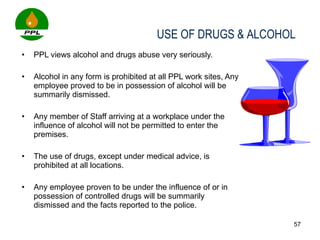
PPL views alcohol and drugs abuse very seriously.    Alcohol in any form is prohibited at all PPL work sites, Any employee proved to be in possession of alcohol will be summarily dismissed.  Any member of Staff arriving at a workplace under the influence of alcohol will not be permitted to enter the premises.  The use of drugs, except under medical advice, is prohibited at all locations.  Any employee proven to be under the influence of or in possession of controlled drugs will be summarily dismissed and the facts reported to the police.   USE OF DRUGS & ALCOHOL
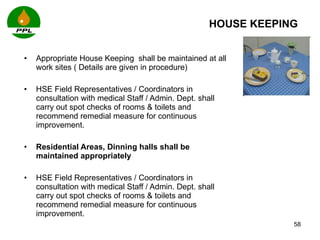
HOUSE KEEPING  Appropriate House Keeping  shall be maintained at all work sites ( Details are given in procedure) HSE Field Representatives / Coordinators in consultation with  medical Staff / Admin. Dept. shall carry out spot checks of rooms & toilets and recommend remedial measure for continuous improvement.  Residential Areas, Dinning halls shall be maintained appropriately  HSE Field Representatives / Coordinators in consultation with  medical Staff / Admin. Dept. shall carry out spot checks of rooms & toilets and recommend remedial measure for continuous improvement.   
MONITORING AND RECORD KEEPING The overall performance of this program is monitored by HSE Dept. HO through HSE Internal Audits and relevant record is maintained at Field / Location / Admin. Dept. at HO. PROGRAM EVALUATION HSE & Medical Dept. will evaluate the overall performance of this procedure on annual basis. TRAINING   Field HSE Representative / Coordinator shall identify the training need as per TNA in coordination with Occupational Health Specialist.
RESPONSIBILITIES HSE Dept. HO Overall Co-ordination of managing Health Surveillance Program Monitoring of implementation Recommend preventive measures to  Departmental Head / Field Incharges  in close liaison with Occupational Health Specialist Review on annual basis and update Medical Dept. HO Implement Health Surveillance Program across PPL. Carry out Assessment of nature, severity, extend of injury / illness. Recommends  treatment of individual and preventive measures to avoid re-occurrence. Seek all budgetary approval required for execution of this program.  Nominate Occupational Health Specialist (OHS) for execution of this program.
RESPONSIBILITIES . Occupational Health Specialist  Carrying out assessment, suggest treatment plans & recommend actions for prevention of occupational injury / illness and follow up through periodic checks. Provide training to Field HSE Representatives / Coordinators for the identification & preliminary assessment of occupational injuries and illnesses.  
RESPONSIBILITIES Dept. Head / Field / Location Incharge Ultimately responsible for implementation of Occupational Health Procedure on his location Reporting occupational injuries / illnesses to Medical Dept. HO along with initial findings of risk assessment for onward action. Implementing the recommendation of Medical & HSE Depts. HO.  Regularly monitoring the compliance of recommendations. Inspection and maintenance  good housekeeping and hygiene standards. Nominating and training designated ERTMs on First Aid. Updating all First Aid boxes  Report incidents to HSE Dept. HO  Arranging  hygienic inspection of kitchen on quarterly basis.  Ensuring compliance of local regulations pertaining to fumigation activity by the contractor. Providing vehicle at project sites for shifting  injured person to nearby identified hospital.
RESPONSIBILITIES HSE Representative / Coordinator    Carrying out initial risk assessment  Identification of persons at risk Carrying out inspection of Kitchen along with Admin. Dept. / Section Rep. Extending necessary assistance to Field / Location Incharge in implementing requirements of procedure   HR / IR Dept.  Coordinating medical screening of newly appointed Staff through Medical Dept. at HO and / or Field / Location.  It will be ensured that Electrical Technicians, Fork Lift / Crane Operators and Vehicle Drivers are assessed for color blindness and audiometric in addition to other specified routine pre employment test.
ATTACHMENTS Basic Occupational Health Surveillance Program Annexure A Occupational Health Risk Assessment Guidelines  Annexure B List of First Aid Box Inventory  Annexure C Ambulance Inspection Guidelines Annexure D Occupational Health Risk Assessment PPL - HSE / FM / HS / 01 Occupational Health Surveillance Record  PPL - HSE / FM / HS / 02 Occupation Health Surveillance Record - Contractor PPL - HSE / FM / HS / 03 Disease Analysis – Record Sheet PPL - HSE / FM / HS / 04 Ambulance Inspection Checklist PPL - HSE / FM / HS / 05 Kitchen Hygiene Inspection Checklist PPL - HSE / FM / HS / 06 Food Handler Initial Health Assessment Form  PPL - HSE / FM / HS / 07 List of First Aid Boxes \PPL - HSE / FM / HS / 08 Nomination Form for ERTM PPL - HSE / FM / HS / 09
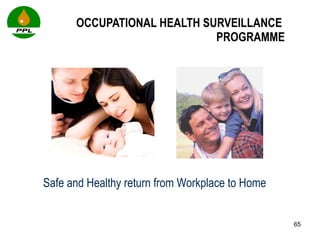
OCCUPATIONAL HEALTH SURVEILLANCE  PROGRAMME Safe and Healthy return from Workplace to Home
OCCUPATIONAL HEALTH SURVIELLANCE  PROGRAMME We must be the change we wish to see in the world
OCCUPATIONAL HEALTH SURVIELLANCE  PROGRAMME Thank You

Occupational Health Surveillance

  • 1.
    page OCCUPATIONALHEALTH SURVEILLANCE GOOD HEALTH IS GOOD BUSINESS Pakistan Petroleum Limited
  • 2.
    OVER VIEW Whatis an Occupational Health ? Importance of Occupational Health Fitness to work Health Surveillance of Staff at risk. First aid. Fatigue Management. Food / kitchen hygiene. Use of drugs & alcohol at workplace. Blood borne pathogens. General housekeeping of residence blocks, dining halls (messes) & sanitation
  • 3.
    CONTROLLING HEALTH RISKSAT WORK Occupational health is concerned with protecting the health of people engaged in work or employment. The goal of occupational health and safety program is to foster a safe & healthy work environment
  • 4.
    HEALTH HAZARDS Health hazards have potential to adversely affect the health of individuals or groups and potential to cause occupational diseases which may be (acute, delayed or chronic) with varying degrees of disability and even death Noise induced hearing loss Irritant Contact Dermatitis Occupational Asthma Upper limb disorders Back Disorders
  • 5.
    SAFETY HAZARDS Safetyhazards have the potential to cause sudden injury Fall from height Working with Grinders with out guards
  • 6.
    LIFTING Lifting heavyitems or lifting items incorrectly, can cause serious back Injury , Hernia and Crushing injuries
  • 7.
  • 8.
  • 9.
  • 10.
    WHO AND OCCUPATIONALHEALTH “ It is the fundamental right of each worker to get higher attainable standard of health and occupational health services should be ensured for all workers”. “ When work is fully adapted to human goals, capacities, and limitations, and occupational health hazards are under control, work often plays a role in promoting both physical and mental health”.
  • 11.
    270 million occupationalaccidents and 160 million work-related diseases occur annually world wide. 6,000 (on an average) people die as a result of work-related accidents or diseases, making it 2.2 million fatalities annually: 1.7 million deaths due to work related diseases 0.35 million fatalities due to workplace accidents 0.15 million fatalities due to accidents during commuting 4% (approximately) of the world’s gross domestic product is lost with the cost of injury, death and disease through absence from work, sickness treatment, disability and survivor benefits. ILO STATISTICS OCCUPATIONAL HEALTH AND SAFETY
  • 12.
    ILO OCCUPATIONAL HEALTHAND SAFETY COVENTION C155 (1981) Sets out broad requirements for member states to follow to ensure health and safety requirements are set into national laws. The employers are responsible so far as reasonably practicable , the workplaces, machinery equipment and process under their control are safe and without risk to health and Appropriate measures of protection are taken. The employers must also provide measures to deal with emergencies and accidents.
  • 13.
    ILO OCCUPATIONAL HEALTHSERVICES CONVENTION (C.161) 1985 Each member state shall formulate implement and periodically review national policy on occupational Health services Each member state undertakes to develop progressively occupational health services for all workers including those in the public sector The provision made should be adequate and appropriate to the specific risks of undertaking
  • 14.
    LAGISLATION REGARDING OCCUPATIONAL HEALTH AND SAFETY IN PAKISTAN Mines Act 1923 Factories Act 1934 Ordinance 2001 Docks Labours Act 1934 Petroleum Rules 1937 West Pakistan Hazardous Operations Rules 1963 Workman's Compensation act 1923 and Rules 1961 Provincial Employees social Security Regulations 1967 The Oil and Gas (safety in drilling and production) Regulations 1974 Hazardous Substances Rule 2003 OHSAS 18001 Standards
  • 15.
    BENEFITS OF OCCUPATIONALHEALTH PROGRAMME Prevents cost of absence and ill-health redundancy Reduction in re-training and recruitment costs. Helps in retention of staff and build employee loyalty Increased productivity leading to increased profits Compliance with Legislation Decrease employer liability Less insurance premiums Reduced risk and cost of litigation Rise in public profile of the company Helps to prevent occupational diseases like deafness, cancers, asthma, etc Protection of both physical and economic well being of employees Corporate social responsibility
  • 16.
    OBJECTIVE OFOCCUPATIONAL HEALTH SURVEILLANCE PROGRAM Occupational health programme helps to ensure that people can be as effective as possible in their work and their health is protected Occupational health risks are addressed at work place Medical checks to ensure that employees remain in good health and not being harmed by their work Compliance with Occupational health and safety legislation
  • 17.
    HEALTH SURVEILLANCE PROGRAMME INCLUDES Identifying the occupational injury / illness Assessment of Occupational health hazards Implementation of controls to eliminate root causes of health hazards Managing treatment in systematic manner Managing Sickness absence Optimizing business performance and reputation
  • 18.
    SCOPE OF OCCUPATIONALHEALTH PROGRAMME deals with following areas of Occupational Health: Health Surveillance of Staff at risk. First aid. Fatigue Management. Food / kitchen hygiene. Use of drugs & alcohol at workplace. Fumigation & pest control. Blood borne pathogens. General housekeeping of residence blocks, dining halls (messes) & sanitation etc.
  • 19.
    HEALTH RISK ASSESSMENT(HRA) The identification of health hazards in the workplace and the subsequent assessment of risk to health due to these hazards. This assessment takes into account existing control measures and where required additional measures are adopted to reduce risks to ALARP . HRA must be carried out for All new activities and developments All existing operations Changes in existing activities For post-operating activities Danger
  • 20.
    OCCUPATIONAL HEALTH SURVEILLANCEPROGRAMME Step-1 Organize Team Organize a competent team Dept / Section Head Team Leader Field HSE Representative Member Site Medical Officer Member Technical Personal Member Any Specialist Member Step-2 Define Scope Break down areas for HRA into Assessment Units (AU) Workshop, Store, Control room, Plant, Well Head etc
  • 21.
    OCCUPATIONAL HEALTH SURVEILLANCE PROGRAMME Step-3 : Exposure Categorization Identify Health Hazards Sound level meters Personal dosimeters Identify the Performance Standards Regulatory requirements Environmental monitoring National / International standards benchmark against accepted standards. S.No. HAZARD CATEGORY ASSOCIATED HAZARDS 1 Geographical / Location Temperature & climate Humidity & air quality Potential for catastrophes etc 2 Biological Wildlife Epidemic disease Hygiene Occupational illness (due to virus, bacteria, fungi etc) 3 Physical Noise Vibration Ergonomic Pressure Radiation (Ionizing / Non ionizing) etc 4 Chemical Toxic chemical Dust, mist & fumes Acid, alkalis, carcinogens etc 5 Psychological Stress factors Smoking etc
  • 22.
    OCCUPATIONAL HEALTH SURVEILLANCE PROGRAMME Step-4 : Effectiveness of Existing controls Ensure that existing controls are effective and maintained The effectiveness of control measures can be ensured by Routine exposure monitoring Health surveillance Maintenance of controls Staff education
  • 23.
    Step-5: Health RiskAssessment: A health risk is generally defined as the likelihood that exposure to a hazard will result in occupational illness, disability or death (Severity). The risk is obtained by combining the probability with severity Risk (R) = Probability / Likelihood (P) X Severity (S) RAM Categorizes Health hazards as Very High, High, Medium, low
  • 24.
  • 25.
    SETTING PRIORITIES Thepriorities to hazards depends upon the hazards caused by them Risk Risk Rating 20-25 Intolerable / Very High (VH) 12 - 16 High (H) 8-10 Medium (M) < 8 Low (L)
  • 26.
    HEALTH RISK ASSESSMENTMATRIX Severity Likelihood / Probability (P) Rating Consequence Very Unlikely (Could happen but probably will not) Unlikely (Could happen but very rarely) Often Likely (Could happen at some time) Likely (Could happen once in a year) Extremely likely (Could happen at any time) 1 2 3 4 5 1 No health effect Low 2 Minor / slight health effect Medium 3 Major health effect 4 Single fatalities High 5 Multiple fatalities Very High
  • 27.
    HEALTH RISK ASSESSMENTMATRIX Severity Likelihood / Probability (P) Rating Consequence Very Unlikely (Could happen but probably will not) Unlikely (Could happen but very rarely) Often Likely (Could happen at some time) Likely (Could happen once in a year) Extremely likely (Could happen at any time) 1 2 3 4 5 1 No health effect No Immediate Action Required 2 Minor / slight health effect Third Priority 3 Major health effect 4 Single fatalities Second Priority 5 Multiple fatalities First Priority
  • 28.
    OCCUPATIONAL HEALTH SURVEILLANCE PROGRAMME Step-7 Determine the additional control measures If Control Measures are not enough to control Risks Identify the additional controls to limit risk to ALARP Compare the additional controls with existing controls and identify gaps Identify and agree remedial actions to address the identified gaps
  • 29.
    PRIORITOIES TO CONTROLHAZARDS Action – First Priority Stop the exposure Notify management immediately Identify all sources Implement immediate control improvements, e.g. introduce use of Personal Protective Equipment as a short term measure until other more robust controls are in place Consider need for exposure measurement Identify and implement work practice and control improvements - consider hierarchy of controls Review HRA, including measurements, after improvements are made
  • 30.
    PRIORITOIES TO CONTROLHAZARDS Action – Second Priority Reduce exposure to below NEQS Introduce use of Personal Protective Equipment as a short term measure until other more robust controls are in place Identify and implement work practice and control improvements - consider hierarchy of controls Consider need for exposure measurement Review HRA, including measurements, after improvements are made
  • 31.
    PRIORITOIES TO CONTROLHAZARDS Action - Third Priority Identify and implement work practice and control improvements - consider hierarchy of controls Consider need for exposure measurement Review HRA, including measurements, after improvements are made
  • 32.
  • 33.
    NOISE REDUCING CONTROLSRe-design or maintain Acoustic Guard Absorb or Shield Enclose the person Shadow Noise
  • 34.
    OCCUPATIONAL HEALTH SURVIELLANCE PROGRAMME Step 8: Remedial Action Plan Remedial action Plan should state the Additional control and recovery measures. Remedial action plan should be SMART. S------Specific M-----Measurable A-----Achievable R-----Realistic T-----Time bound This plan should include priorities, responsible person and target dates for actions.
  • 35.
    OCCUPATIONAL HEALTH SURVEILLANCE PROGRAMME Step-9: Documenting Health Risk Assessments The record of HRA is kept and retrievable for Audits and periodic reviews. For chronic health risks records should be kept for long period to allow the evaluation of individual health effects. Include exposure monitoring and health surveillance record It may act as insurance against possible future liabilities. Findings of HRAs should be communicated to relevant staff
  • 36.
    PRE -EMPLOYEMENT HEALTHSCREENING To determine the pre-existing health conditions of individuals prior to commencement of work To make sure that he / she is physically and mentally fit for the type of activity he / she is employed for. At the time of employment , HR/ IR arrange pre-employment medical examination in liaison with Medical Dept. General physical Examination Chest x-ray ECG Urine R/E Stool R/E Hepatitis B Ag Anti HCV Antibodies
  • 37.
    Specialized tests will be conducted for staff deputed on specialized jobs or they have special requirements as part of their job like crane or fork lift operators , drives, Electrical Technicians Color blindness Audiometric tests Pre employment Medical Record will be maintained in personal file of individual by Medical Dept. at HO
  • 38.
    PREIODIC HEALTH SURVEILLIENCEPeriodic Health Surveillance will be conducted for staff: At risk from workplace exposure In compliance with regulatory requirement To detect early, reversible health affects Periodic Surveillance Record will be maintained at Field / Location level.
  • 39.
    OCCUPATIONAL HEALTH SURVEILLANCEPROGRAM At initial stages the Occupational Health Surveillance Program is focused on Electrical Technicians Drivers Fork Lift and crane operators Kitchen staff Janitorial staff Fire man Radiology Exposed to High noise Any case identified by Dept. Head / Field Incharge
  • 40.
    S. No CadreOccupational Exposures Possible Hazards Surveillance Required Frequency Screening Vaccination 1 Production / Maintenance Technicians Noise level above 85 for 8 - hrs a day Hearing loss Color blindness Audiometric Test -- Annual Color Blindness (Only for electrical technicians) --- Initially / Upon entry 2 Vehicle Drivers Driving for company business Vision & hearing loss Eye Test -- Annual Audiometric Test -- Initially / Upon entry Color Blindness --- Initially / Upon entry 3 Fork Lift / Crane Operators Loading / unloading driving Vision & hearing loss Eye Test -- Annual Audiometric Test -- 2 - Yearly Color Blindness --- Initially / Upon entry
  • 41.
    S. No CadreOccupational Exposures Possible Hazards Surveillance Required Frequency Screening Vaccination 4 SF Hospital’s Staff Infectious agents in blood and other body fluids, while handling the patients. Transmission of contagious diseases from patients - Hepatitis B Complete Course - Tetanus 5 Yearly 5 Canteen Staff Preparation of food for PPL Staff Transmission of contagious diseases e.g. Typhoid, Hepatitis A and parasitic infections. X Ray, SGPT and Stool D / R ---- Upon entry ---- Hepatitis A Upon entry ----- Typhoid Upon entry Medical Review by Company Doctor / CMA based on medical screening results of SGPT and Stool D / R ---- Annually 6 Janitorial Staff Exposure to effluent & hazardous wastes Susceptible to diseases like Typhoid, Hepatitis etc --- Hepatitis B Complete Course --- Tetanus 5 - Yearly
  • 42.
    S. No CadreOccupational Exposures Possible Hazards Surveillance Required Frequency Screening Vaccination 7 Janitorial Staff Exposure to effluent & hazardous wastes Susceptible to diseases like Typhoid, Hepatitis etc --- Tetanus 5 - Yearly 8 Radiology Lab Staff Radiation CBC Urine Chest X-Ray --- Annually 9 Firemen Use of breathing apparatus in Smokey conditions of fire. Emergency Sirens of high pitch during emergency. Susceptible to cardio-respiratory distress and syncope. Vision & hearing Medical fit test for use of Breathing Apparatus as per checklist provided in HSE SOP on PPE --- Annually Vision --- Annual for Staff above 45 yrs. Two yearly for Staff below 45 yrs. Audiometric --- Two yearly for all Staff
  • 43.
    EXECUTION OF HEALTHSURVEILLANCE PROGRAM
  • 44.
    HEALTH SURVEILLANCE OFCONTRACTORS The relevant concerned Dept. shall incorporate Health Surveillance Requirements in Contracts with third party Health Surveillance of Contractor staff is responsibility of Contractor . However it will also be recorded by PPL If Health Surveillance is not covered in work Contract than PPL will arrange for Health Surveillance. Initially Health Surveillance will be focused on Food handling Janitorial Transport services at Fields / Locations / HO.
  • 45.
    HEALTH SURVEILLANCE OFCONTRACTORS Admin. Dept. HO shall incorporate the Health Surveillance requirements into the Contract Document with the Catering / Janitorial Service / Transport Contractors and extend necessary coordination with Medical & HSE Dept.at HO for monitoring implementation by these contractors. The actions taken by Field Management in response to recommendations of OHS for the implementation of additional control measures are recorded in template (PPL – HSE / FM / HS / 02 & 03). Dept. Head / Field Incharge will acquire record(s) of vaccination and health surveillance of contractor’s Staff and forward to Medical Dept. for necessary review and recommendations. Any new entry into the record shall be maintained at contract executing Dept.'s end.
  • 46.
    DISEASE STATISTICS AtFields Site Company Medical Advisor (CMA) in coordination with Field HSE Representative develops and forwards the Disease Analysis Record Sheet (PPL - HSE / FM / HS / 04) on monthly basis to OHS with copy to HSE Dept. HO through respective Field / Location Incharge for their record and onward maintaining statistical data. At Sui the sickness and illnesses data of PPL Staff is centrally consolidated and forwarded through Sui Hospital. At HO the same is developed and maintained by Medical Dept. For any contagious diseases, immediate actions may be taken on CMA's recommendations. However, the detailed guidelines may be obtained from OHS.
  • 47.
    First aid isthe immediate application of first line treatment following an injury or sudden illness using facilities & material available in order to Save life. Prevent deterioration in an existing condition. Promote recovery. FIRST AID
  • 48.
    Provided at desiredplaces on location of Head Office and Fields and Messes Field In charges to nominate individuals for inspection and Replenishment of First Aid Boxes At HO, WW & PPL owned Huts, Geological Survey Teams first aid boxes are inspected & maintained by Medical Dept. HO Emergency cabinets are provided at each floor at HO are maintained by Admin Dept. and verified by HSE Dept. FIRST AID BOXES
  • 49.
    Department Head /Field Incharge are responsible for Nomination and arrangements for training of Emergency Response Team Members (ERTMs) Refresher training every two years for first aiders. List of names, telephone numbers of First Aiders will be maintained in all Dept. / Field / Locations List of First aiders will be posted on notice boards List of ERTMs will be forwarded to SMMS / CMO / CMA for necessary assessment and clearance before confirmation as ERTM. The assessment is recorded on form (PPL - HSE /FM /HS / 09). FIRST AID TEAM
  • 50.
    Proper ambulance shallbe available at Fields / Locations equipped with necessary first aid accessories. At project sites any appropriate vehicle may be dedicated on emergency duty during job in progress. Vehicle must contain first aid box and Stretcher for onward shifting patient to nearby hospital. The ambulance should be checked on daily basis and records maintained in Ambulance Inspection Checklist (PPL - HSE / FM / HSH / 05). Check-lists Vehicle Check-list maintained by drivers First –Aid equipment by Field / Location Medical Technician / Medical Dept. Representative. Review of report by Field HSE Representative / Coordinator   AMBULANCE
  • 51.
    BLOOD BORNE PATHOGENS& HEALTH HAZARDS Hospital Staff are exposed to following Major Health Risks.. HBV HCV HIV Tuberculosis Precautionary Measures shall be taken to avoid exposure to health risks
  • 52.
    FATIGUE MANAGEMENT Fatigue refersto mental or physical exhaustion that reduces work efficiency. However fatigue is more than simply feeling tired or drowsy.  Fatigue is caused by prolonged periods of physical and or mental exertion without enough time to rest and recover.   PPL Fields / Locations are provided with facilities to balance out work requirement and medical fitness for staff to appropriately prevent / manage fatigue. Recreational activities, social events / functions / gathering. Working in Shift, avoiding prolonged exposures. Annual leaves / holidays. Ergonomically designed work stations
  • 53.
    KITCHEN HYGIENE &DINNING Appropriate Kitchen and Food Safety standards shall be maintained at PPL Head Office and all PPL Locations HSE Representatives / Coordinators along with Administration Dept. / Section responsible quarterly inspection of kitchen & dining areas as per checks provided in Kitchen Hygiene Inspection Checklist (PPL - HSE / FM / HS / 06).
  • 54.
    PERSONAL HYGIENE Appropriate personal hygiene standards shall be maintained(Details are Given in procedure) Food handlers shall be assessed for their health CMA / CMO Sui / Medical Dept. at HO. The assessment / physical examination is carried out by Occupational Health Specialist at HO, CMA at Field / Location and suitable nominated doctor by CMO Sui Hospital. Assessment is recorded on Form “Food Handlers Initial Assessment (PPL - HSE / FM / HS / 07)” .
  • 55.
    FOOD MANAGEMENT FoodStorage / Refrigeration Prevention from Contamination Food Waste Management Food waste must be stored in completely covered containers as per guidelines provided in SOP on Waste Management (PPL - HSE / PR / 14) for onward safe disposal. Hygiene Training: Field HSE Representative / HSE Coordinator shall provide awareness and training to all food handlers on food safety & personal hygiene for effective implementation of standards outlines in this procedure.
  • 56.
    WATER QUALITY Waterutilized for drinking and cooking purpose at Fields / Locations shall be from approved sources comply with the chemical and bacteriological limits specified in Quality Drinking Water Standards specified by Ministry of Health, Govt. of Pakistan. PPL Occupational health specialist shall approve the source based on certain testing from external laboratories or certificate submitted from the supplier. Water used for dish washing, lavatories etc. shall be stored in aboveground tanks. All underground and above ground tanks are internally cleaned at least annually to avoid chances of microbiological accumulation. Fields / Location where water is supplied through tankers / bowzers, It will be ensured that tankers / bowzers are internally clean and in good physical condition. CMA / Field HSE Representative / HSE Coordinator shall carry out random inspections of tankers / bowzers and address this requirement in work contract.
  • 57.
    PPL views alcoholand drugs abuse very seriously.   Alcohol in any form is prohibited at all PPL work sites, Any employee proved to be in possession of alcohol will be summarily dismissed. Any member of Staff arriving at a workplace under the influence of alcohol will not be permitted to enter the premises. The use of drugs, except under medical advice, is prohibited at all locations. Any employee proven to be under the influence of or in possession of controlled drugs will be summarily dismissed and the facts reported to the police.   USE OF DRUGS & ALCOHOL
  • 58.
    HOUSE KEEPING Appropriate House Keeping shall be maintained at all work sites ( Details are given in procedure) HSE Field Representatives / Coordinators in consultation with medical Staff / Admin. Dept. shall carry out spot checks of rooms & toilets and recommend remedial measure for continuous improvement. Residential Areas, Dinning halls shall be maintained appropriately HSE Field Representatives / Coordinators in consultation with medical Staff / Admin. Dept. shall carry out spot checks of rooms & toilets and recommend remedial measure for continuous improvement.  
  • 59.
    MONITORING AND RECORDKEEPING The overall performance of this program is monitored by HSE Dept. HO through HSE Internal Audits and relevant record is maintained at Field / Location / Admin. Dept. at HO. PROGRAM EVALUATION HSE & Medical Dept. will evaluate the overall performance of this procedure on annual basis. TRAINING   Field HSE Representative / Coordinator shall identify the training need as per TNA in coordination with Occupational Health Specialist.
  • 60.
    RESPONSIBILITIES HSE Dept.HO Overall Co-ordination of managing Health Surveillance Program Monitoring of implementation Recommend preventive measures to Departmental Head / Field Incharges in close liaison with Occupational Health Specialist Review on annual basis and update Medical Dept. HO Implement Health Surveillance Program across PPL. Carry out Assessment of nature, severity, extend of injury / illness. Recommends treatment of individual and preventive measures to avoid re-occurrence. Seek all budgetary approval required for execution of this program. Nominate Occupational Health Specialist (OHS) for execution of this program.
  • 61.
    RESPONSIBILITIES . OccupationalHealth Specialist Carrying out assessment, suggest treatment plans & recommend actions for prevention of occupational injury / illness and follow up through periodic checks. Provide training to Field HSE Representatives / Coordinators for the identification & preliminary assessment of occupational injuries and illnesses.  
  • 62.
    RESPONSIBILITIES Dept. Head/ Field / Location Incharge Ultimately responsible for implementation of Occupational Health Procedure on his location Reporting occupational injuries / illnesses to Medical Dept. HO along with initial findings of risk assessment for onward action. Implementing the recommendation of Medical & HSE Depts. HO. Regularly monitoring the compliance of recommendations. Inspection and maintenance good housekeeping and hygiene standards. Nominating and training designated ERTMs on First Aid. Updating all First Aid boxes Report incidents to HSE Dept. HO Arranging hygienic inspection of kitchen on quarterly basis. Ensuring compliance of local regulations pertaining to fumigation activity by the contractor. Providing vehicle at project sites for shifting injured person to nearby identified hospital.
  • 63.
    RESPONSIBILITIES HSE Representative/ Coordinator   Carrying out initial risk assessment Identification of persons at risk Carrying out inspection of Kitchen along with Admin. Dept. / Section Rep. Extending necessary assistance to Field / Location Incharge in implementing requirements of procedure   HR / IR Dept. Coordinating medical screening of newly appointed Staff through Medical Dept. at HO and / or Field / Location. It will be ensured that Electrical Technicians, Fork Lift / Crane Operators and Vehicle Drivers are assessed for color blindness and audiometric in addition to other specified routine pre employment test.
  • 64.
    ATTACHMENTS Basic OccupationalHealth Surveillance Program Annexure A Occupational Health Risk Assessment Guidelines Annexure B List of First Aid Box Inventory Annexure C Ambulance Inspection Guidelines Annexure D Occupational Health Risk Assessment PPL - HSE / FM / HS / 01 Occupational Health Surveillance Record PPL - HSE / FM / HS / 02 Occupation Health Surveillance Record - Contractor PPL - HSE / FM / HS / 03 Disease Analysis – Record Sheet PPL - HSE / FM / HS / 04 Ambulance Inspection Checklist PPL - HSE / FM / HS / 05 Kitchen Hygiene Inspection Checklist PPL - HSE / FM / HS / 06 Food Handler Initial Health Assessment Form PPL - HSE / FM / HS / 07 List of First Aid Boxes \PPL - HSE / FM / HS / 08 Nomination Form for ERTM PPL - HSE / FM / HS / 09
  • 65.
    OCCUPATIONAL HEALTH SURVEILLANCE PROGRAMME Safe and Healthy return from Workplace to Home
  • 66.
    OCCUPATIONAL HEALTH SURVIELLANCE PROGRAMME We must be the change we wish to see in the world
  • 67.