SILICATE MINERALS
       Prepared by Dr. F. Clark,
  Department of Earth and Atmospheric
     Sciences, University of Alberta
                                   Sept. 05
ISOLATED SILICATES [Nesosilicates]

In this group, silicon tetrahedra share no oxygen anions
   with other tetrahedra, and so have an excess negative
   charge of 4-. In the mineral olivine, this is balanced by
   the insertion of a pair of divalent cations in the crystal
   structure, either or both of Mg2+ and Fe2+. The chemical
   formula for olivine is written (Mg,Fe)2SiO4, which tells us
   that for every silicon, there are four oxygen and two
   cations, either or both of Mg and Fe. This option, which
   illustrates ionic substitution, is indicated by separating
   these elements by a comma within the parentheses. We
   have variation within fixed limits, those limits being 100%
   Mg and 100% Fe, or any proportion in between.
OLIVINE
These three
specimens are
of an igneous
rock consisting
almost
exclusively of
crystals of
olivine that are
approximately
1mm across.
Olivine exhibits its classic glassy, olive green appearance in these
specimens, as well as its common granular [somewhat like sugar]
habit. There is no cleavage, only conchoidal fracture, so that there are
no plane surfaces reflecting light.
SINGLE CHAIN SILICATES
               [Inosilicates]
In the single chain silicates, each silicon tetrahedron shares
   two oxygen anions, one with one neighbouring
   tetrahedron, and one with another, to produce long,
   strongly bonded chains. Each shared oxygen accounts
   for only 1- rather than the usual 2-, so that for each
   silicon tetrahedron, the excess negative charge is now
   only 2-, which still requires insertion of cations in the
   crystal structure. These cations are bonded to, and serve
   to link, the chains, but these bonds are weaker than
   those within the chains. The single chain silicates thus
   cleave parallel to the chains, along two planes that meet
   at approximately 90 degrees.
Pyroxene [e.g. augite]
In these three views of two specimens, the upper face and left side
vertical face meet at right angles, a common characteristic of the single
chain silicates. Note how irregular the faces are on the two images on
the right, yet how these small steps are parallel to each other. The
hardness, around 5 ½ to 6, white streak, and typical dark colour make
this otherwise very similar to amphibole, a double chain silicate. The
square cross-sections of pyroxene crystals distinguishes them from
amphiboles.
DOUBLE CHAIN SILICATES
             [Inosilicates]
As with single chain silicates, chains are constructed by
  sharing of two oxygen for each silicon tetrahedron. The
  double chains are constructed by having every second
  silicon along the chain share a third oxygen with a silicon
  from the facing chain. The net result is that on average,
  each silicon shares 2 ½ oxygen, so the excess negative
  charge per silicon is reduced to 1 ½. Cations serve to
  balance charge and link the strongly constructed double
  chains, whose extra width causes the cleavage planes to
  change orientation and meet at approximately 60 and
  120 degrees, producing hexagonal cross sections.
Amphibole [e.g. hornblende]


In the double chain silicates, the extra width of the double chain skews
the intersection angle between cleavage faces, so that they meet to
form hexagonal cross sections to the crystals, as highlighted by the
yellow lines in the right-hand image. In this case, we are sighting along
the length of the chains. Other major properties are as for pyroxene.
SHEET SILICATES [Phyllosilicates]

In this group, each silicon tetrahedron shares three oxygen
   anions with neighbouring tetrahedra, so that the net
   negative charge per silicon is now 1-. This produces a
   kind of hexagonal honeycomb sheet, in which all
   tetrahedra point in the same direction. This enables
   these layers to bond with layers of cations at the centres
   of octahedra with oxygen as the apices. There is great
   variety in the combinations that are possible. However,
   there is an asymmetry to the charge distribution which
   leads to net surface charges on the sheets, which are
   then weakly bonded to each other by cations. This leads
   to the characteristic property of this group – one perfect
   cleavage, parallel to the sheets.
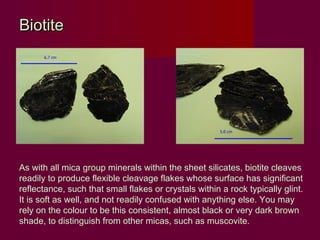
Biotite


As with all mica group minerals within the sheet silicates, biotite cleaves
readily to produce flexible cleavage flakes whose surface has significant
reflectance, such that small flakes or crystals within a rock typically glint.
It is soft as well, and not readily confused with anything else. You may
rely on the colour to be this consistent, almost black or very dark brown
shade, to distinguish from other micas, such as muscovite.
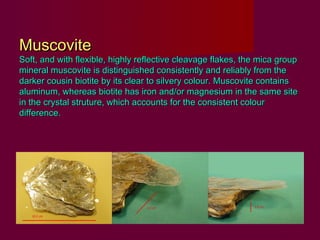
Muscovite
Soft, and with flexible, highly reflective cleavage flakes, the mica group
mineral muscovite is distinguished consistently and reliably from the
darker cousin biotite by its clear to silvery colour. Muscovite contains
aluminum, whereas biotite has iron and/or magnesium in the same site
in the crystal struture, which accounts for the consistent colour
difference.
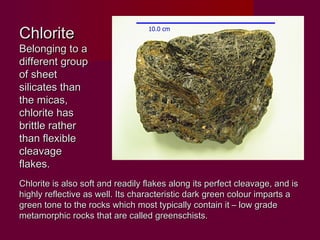
Chlorite
Belonging to a
different group
of sheet
silicates than
the micas,
chlorite has
brittle rather
than flexible
cleavage
flakes.
Chlorite is also soft and readily flakes along its perfect cleavage, and is
highly reflective as well. Its characteristic dark green colour imparts a
green tone to the rocks which most typically contain it – low grade
metamorphic rocks that are called greenschists.
FRAMEWORK SILICATES
             [Tectosilicates]
Finally, all four oxygen are shared, each one with a
   different silicon tetrahedron, which eliminates the excess
   negative charge, given the basic formula SiO2 (the two
   oxygen are in effect four ½ oxygen, each being shared).
   One might therefore expect the framework silicates to be
   the simplest group to deal with, but complexity is
   introduced in the feldspar group, as we shall soon see.
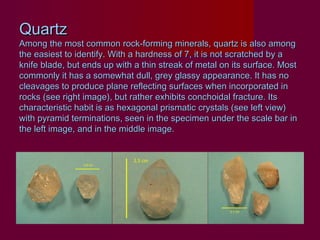
Quartz
Among the most common rock-forming minerals, quartz is also among
the easiest to identify. With a hardness of 7, it is not scratched by a
knife blade, but ends up with a thin streak of metal on its surface. Most
commonly it has a somewhat dull, grey glassy appearance. It has no
cleavages to produce plane reflecting surfaces when incorporated in
rocks (see right image), but rather exhibits conchoidal fracture. Its
characteristic habit is as hexagonal prismatic crystals (see left view)
with pyramid terminations, seen in the specimen under the scale bar in
the left image, and in the middle image.
Feldspar Group – Potassium Feldspar

In the feldspars, we see coupled ionic substitution, rather
   than the simple substitution exhibited by olivine. By
   virtue of its size, Al3+ fits between the oxygen anions of
   the tetrahedra in place of Si4+. Of course, this introduces
   a positive charge deficiency. Statistically, either one out
   of every four tetrahedra, or two out of every four
   tetrahedra, may have a silicon cation replaced by
   aluminum (any more than that cannot be accommodated
   by the crystal structure). In the case of potassium
   feldspar, one out of every four tetrahedra has aluminum,
   and the charge deficiency is balanced by insertion of a
   potassium (K+) cation.
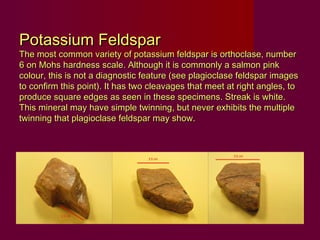
Potassium Feldspar
The most common variety of potassium feldspar is orthoclase, number
6 on Mohs hardness scale. Although it is commonly a salmon pink
colour, this is not a diagnostic feature (see plagioclase feldspar images
to confirm this point). It has two cleavages that meet at right angles, to
produce square edges as seen in these specimens. Streak is white.
This mineral may have simple twinning, but never exhibits the multiple
twinning that plagioclase feldspar may show.
Potassium Feldspar


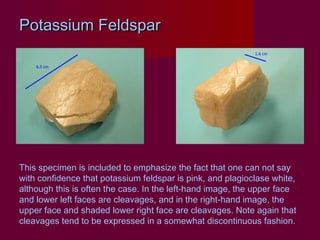
This specimen is included to emphasize the fact that one can not say
with confidence that potassium feldspar is pink, and plagioclase white,
although this is often the case. In the left-hand image, the upper face
and lower left faces are cleavages, and in the right-hand image, the
upper face and shaded lower right face are cleavages. Note again that
cleavages tend to be expressed in a somewhat discontinuous fashion.
Feldspar Group – Plagioclase Feldspar

Explanation of the plagioclase feldspars carries on from
  potassium feldspar. The substitution of one Al3+ for Si4+
  could also be balanced by Na+. This is albite, the sodium
  plagioclase feldspar. If we substitute two Al for Si out of
  every four Si, the charge deficiency of 2+ is balanced by
  Ca2+, and we have anorthite. The ionic radii of Na+ and
  Ca2+ are almost identical, so the two freely substitute,
  along with Al3+ for Si4+, to produce the plagioclase feldspar
  solid solution series. One might expect there to be free
  substitution between albite and potassium feldspar, but
  because the ionic radius of potassium is approximately
  40% larger than that of sodium, such substitution is
  limited to elevated temperatures.
Plagioclase
Feldspar
This mineral
has many
properties in
common with
potassium
feldspar, which
we emphasize
on this slide.

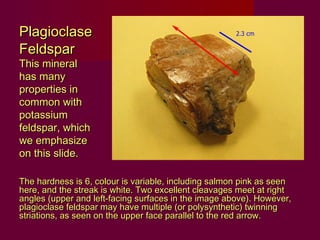
The hardness is 6, colour is variable, including salmon pink as seen
here, and the streak is white. Two excellent cleavages meet at right
angles (upper and left-facing surfaces in the image above). However,
plagioclase feldspar may have multiple (or polysynthetic) twinning
striations, as seen on the upper face parallel to the red arrow.
Plagioclase Feldspar


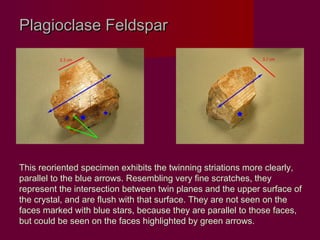
This reoriented specimen exhibits the twinning striations more clearly,
parallel to the blue arrows. Resembling very fine scratches, they
represent the intersection between twin planes and the upper surface of
the crystal, and are flush with that surface. They are not seen on the
faces marked with blue stars, because they are parallel to those faces,
but could be seen on the faces highlighted by green arrows.
Plagioclase Feldspar


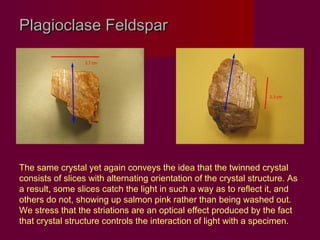
The same crystal yet again conveys the idea that the twinned crystal
consists of slices with alternating orientation of the crystal structure. As
a result, some slices catch the light in such a way as to reflect it, and
others do not, showing up salmon pink rather than being washed out.
We stress that the striations are an optical effect produced by the fact
that crystal structure controls the interaction of light with a specimen.
Plagioclase Feldspar


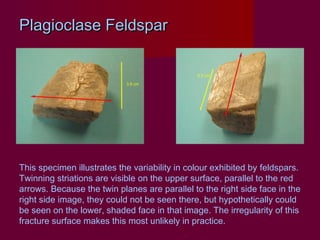
This specimen illustrates the variability in colour exhibited by feldspars.
Twinning striations are visible on the upper surface, parallel to the red
arrows. Because the twin planes are parallel to the right side face in the
right side image, they could not be seen there, but hypothetically could
be seen on the lower, shaded face in that image. The irregularity of this
fracture surface makes this most unlikely in practice.
Plagioclase Feldspar


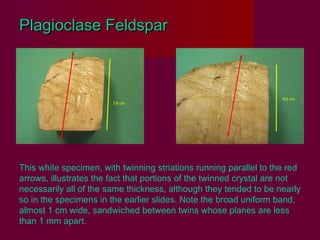
This white specimen, with twinning striations running parallel to the red
arrows, illustrates the fact that portions of the twinned crystal are not
necessarily all of the same thickness, although they tended to be nearly
so in the specimens in the earlier slides. Note the broad uniform band,
almost 1 cm wide, sandwiched between twins whose planes are less
than 1 mm apart.

Silicate minerals

  • 1.
    SILICATE MINERALS Prepared by Dr. F. Clark, Department of Earth and Atmospheric Sciences, University of Alberta Sept. 05
  • 2.
    ISOLATED SILICATES [Nesosilicates] Inthis group, silicon tetrahedra share no oxygen anions with other tetrahedra, and so have an excess negative charge of 4-. In the mineral olivine, this is balanced by the insertion of a pair of divalent cations in the crystal structure, either or both of Mg2+ and Fe2+. The chemical formula for olivine is written (Mg,Fe)2SiO4, which tells us that for every silicon, there are four oxygen and two cations, either or both of Mg and Fe. This option, which illustrates ionic substitution, is indicated by separating these elements by a comma within the parentheses. We have variation within fixed limits, those limits being 100% Mg and 100% Fe, or any proportion in between.
  • 3.
    OLIVINE These three specimens are ofan igneous rock consisting almost exclusively of crystals of olivine that are approximately 1mm across. Olivine exhibits its classic glassy, olive green appearance in these specimens, as well as its common granular [somewhat like sugar] habit. There is no cleavage, only conchoidal fracture, so that there are no plane surfaces reflecting light.
  • 4.
    SINGLE CHAIN SILICATES [Inosilicates] In the single chain silicates, each silicon tetrahedron shares two oxygen anions, one with one neighbouring tetrahedron, and one with another, to produce long, strongly bonded chains. Each shared oxygen accounts for only 1- rather than the usual 2-, so that for each silicon tetrahedron, the excess negative charge is now only 2-, which still requires insertion of cations in the crystal structure. These cations are bonded to, and serve to link, the chains, but these bonds are weaker than those within the chains. The single chain silicates thus cleave parallel to the chains, along two planes that meet at approximately 90 degrees.
  • 5.
    Pyroxene [e.g. augite] Inthese three views of two specimens, the upper face and left side vertical face meet at right angles, a common characteristic of the single chain silicates. Note how irregular the faces are on the two images on the right, yet how these small steps are parallel to each other. The hardness, around 5 ½ to 6, white streak, and typical dark colour make this otherwise very similar to amphibole, a double chain silicate. The square cross-sections of pyroxene crystals distinguishes them from amphiboles.
  • 6.
    DOUBLE CHAIN SILICATES [Inosilicates] As with single chain silicates, chains are constructed by sharing of two oxygen for each silicon tetrahedron. The double chains are constructed by having every second silicon along the chain share a third oxygen with a silicon from the facing chain. The net result is that on average, each silicon shares 2 ½ oxygen, so the excess negative charge per silicon is reduced to 1 ½. Cations serve to balance charge and link the strongly constructed double chains, whose extra width causes the cleavage planes to change orientation and meet at approximately 60 and 120 degrees, producing hexagonal cross sections.
  • 7.
    Amphibole [e.g. hornblende] Inthe double chain silicates, the extra width of the double chain skews the intersection angle between cleavage faces, so that they meet to form hexagonal cross sections to the crystals, as highlighted by the yellow lines in the right-hand image. In this case, we are sighting along the length of the chains. Other major properties are as for pyroxene.
  • 8.
    SHEET SILICATES [Phyllosilicates] Inthis group, each silicon tetrahedron shares three oxygen anions with neighbouring tetrahedra, so that the net negative charge per silicon is now 1-. This produces a kind of hexagonal honeycomb sheet, in which all tetrahedra point in the same direction. This enables these layers to bond with layers of cations at the centres of octahedra with oxygen as the apices. There is great variety in the combinations that are possible. However, there is an asymmetry to the charge distribution which leads to net surface charges on the sheets, which are then weakly bonded to each other by cations. This leads to the characteristic property of this group – one perfect cleavage, parallel to the sheets.
  • 9.
    Biotite As with allmica group minerals within the sheet silicates, biotite cleaves readily to produce flexible cleavage flakes whose surface has significant reflectance, such that small flakes or crystals within a rock typically glint. It is soft as well, and not readily confused with anything else. You may rely on the colour to be this consistent, almost black or very dark brown shade, to distinguish from other micas, such as muscovite.
  • 10.
    Muscovite Soft, and withflexible, highly reflective cleavage flakes, the mica group mineral muscovite is distinguished consistently and reliably from the darker cousin biotite by its clear to silvery colour. Muscovite contains aluminum, whereas biotite has iron and/or magnesium in the same site in the crystal struture, which accounts for the consistent colour difference.
  • 11.
    Chlorite Belonging to a differentgroup of sheet silicates than the micas, chlorite has brittle rather than flexible cleavage flakes. Chlorite is also soft and readily flakes along its perfect cleavage, and is highly reflective as well. Its characteristic dark green colour imparts a green tone to the rocks which most typically contain it – low grade metamorphic rocks that are called greenschists.
  • 12.
    FRAMEWORK SILICATES [Tectosilicates] Finally, all four oxygen are shared, each one with a different silicon tetrahedron, which eliminates the excess negative charge, given the basic formula SiO2 (the two oxygen are in effect four ½ oxygen, each being shared). One might therefore expect the framework silicates to be the simplest group to deal with, but complexity is introduced in the feldspar group, as we shall soon see.
  • 13.
    Quartz Among the mostcommon rock-forming minerals, quartz is also among the easiest to identify. With a hardness of 7, it is not scratched by a knife blade, but ends up with a thin streak of metal on its surface. Most commonly it has a somewhat dull, grey glassy appearance. It has no cleavages to produce plane reflecting surfaces when incorporated in rocks (see right image), but rather exhibits conchoidal fracture. Its characteristic habit is as hexagonal prismatic crystals (see left view) with pyramid terminations, seen in the specimen under the scale bar in the left image, and in the middle image.
  • 14.
    Feldspar Group –Potassium Feldspar In the feldspars, we see coupled ionic substitution, rather than the simple substitution exhibited by olivine. By virtue of its size, Al3+ fits between the oxygen anions of the tetrahedra in place of Si4+. Of course, this introduces a positive charge deficiency. Statistically, either one out of every four tetrahedra, or two out of every four tetrahedra, may have a silicon cation replaced by aluminum (any more than that cannot be accommodated by the crystal structure). In the case of potassium feldspar, one out of every four tetrahedra has aluminum, and the charge deficiency is balanced by insertion of a potassium (K+) cation.
  • 15.
    Potassium Feldspar The mostcommon variety of potassium feldspar is orthoclase, number 6 on Mohs hardness scale. Although it is commonly a salmon pink colour, this is not a diagnostic feature (see plagioclase feldspar images to confirm this point). It has two cleavages that meet at right angles, to produce square edges as seen in these specimens. Streak is white. This mineral may have simple twinning, but never exhibits the multiple twinning that plagioclase feldspar may show.
  • 16.
    Potassium Feldspar This specimenis included to emphasize the fact that one can not say with confidence that potassium feldspar is pink, and plagioclase white, although this is often the case. In the left-hand image, the upper face and lower left faces are cleavages, and in the right-hand image, the upper face and shaded lower right face are cleavages. Note again that cleavages tend to be expressed in a somewhat discontinuous fashion.
  • 17.
    Feldspar Group –Plagioclase Feldspar Explanation of the plagioclase feldspars carries on from potassium feldspar. The substitution of one Al3+ for Si4+ could also be balanced by Na+. This is albite, the sodium plagioclase feldspar. If we substitute two Al for Si out of every four Si, the charge deficiency of 2+ is balanced by Ca2+, and we have anorthite. The ionic radii of Na+ and Ca2+ are almost identical, so the two freely substitute, along with Al3+ for Si4+, to produce the plagioclase feldspar solid solution series. One might expect there to be free substitution between albite and potassium feldspar, but because the ionic radius of potassium is approximately 40% larger than that of sodium, such substitution is limited to elevated temperatures.
  • 18.
    Plagioclase Feldspar This mineral has many propertiesin common with potassium feldspar, which we emphasize on this slide. The hardness is 6, colour is variable, including salmon pink as seen here, and the streak is white. Two excellent cleavages meet at right angles (upper and left-facing surfaces in the image above). However, plagioclase feldspar may have multiple (or polysynthetic) twinning striations, as seen on the upper face parallel to the red arrow.
  • 19.
    Plagioclase Feldspar This reorientedspecimen exhibits the twinning striations more clearly, parallel to the blue arrows. Resembling very fine scratches, they represent the intersection between twin planes and the upper surface of the crystal, and are flush with that surface. They are not seen on the faces marked with blue stars, because they are parallel to those faces, but could be seen on the faces highlighted by green arrows.
  • 20.
    Plagioclase Feldspar The samecrystal yet again conveys the idea that the twinned crystal consists of slices with alternating orientation of the crystal structure. As a result, some slices catch the light in such a way as to reflect it, and others do not, showing up salmon pink rather than being washed out. We stress that the striations are an optical effect produced by the fact that crystal structure controls the interaction of light with a specimen.
  • 21.
    Plagioclase Feldspar This specimenillustrates the variability in colour exhibited by feldspars. Twinning striations are visible on the upper surface, parallel to the red arrows. Because the twin planes are parallel to the right side face in the right side image, they could not be seen there, but hypothetically could be seen on the lower, shaded face in that image. The irregularity of this fracture surface makes this most unlikely in practice.
  • 22.
    Plagioclase Feldspar This whitespecimen, with twinning striations running parallel to the red arrows, illustrates the fact that portions of the twinned crystal are not necessarily all of the same thickness, although they tended to be nearly so in the specimens in the earlier slides. Note the broad uniform band, almost 1 cm wide, sandwiched between twins whose planes are less than 1 mm apart.