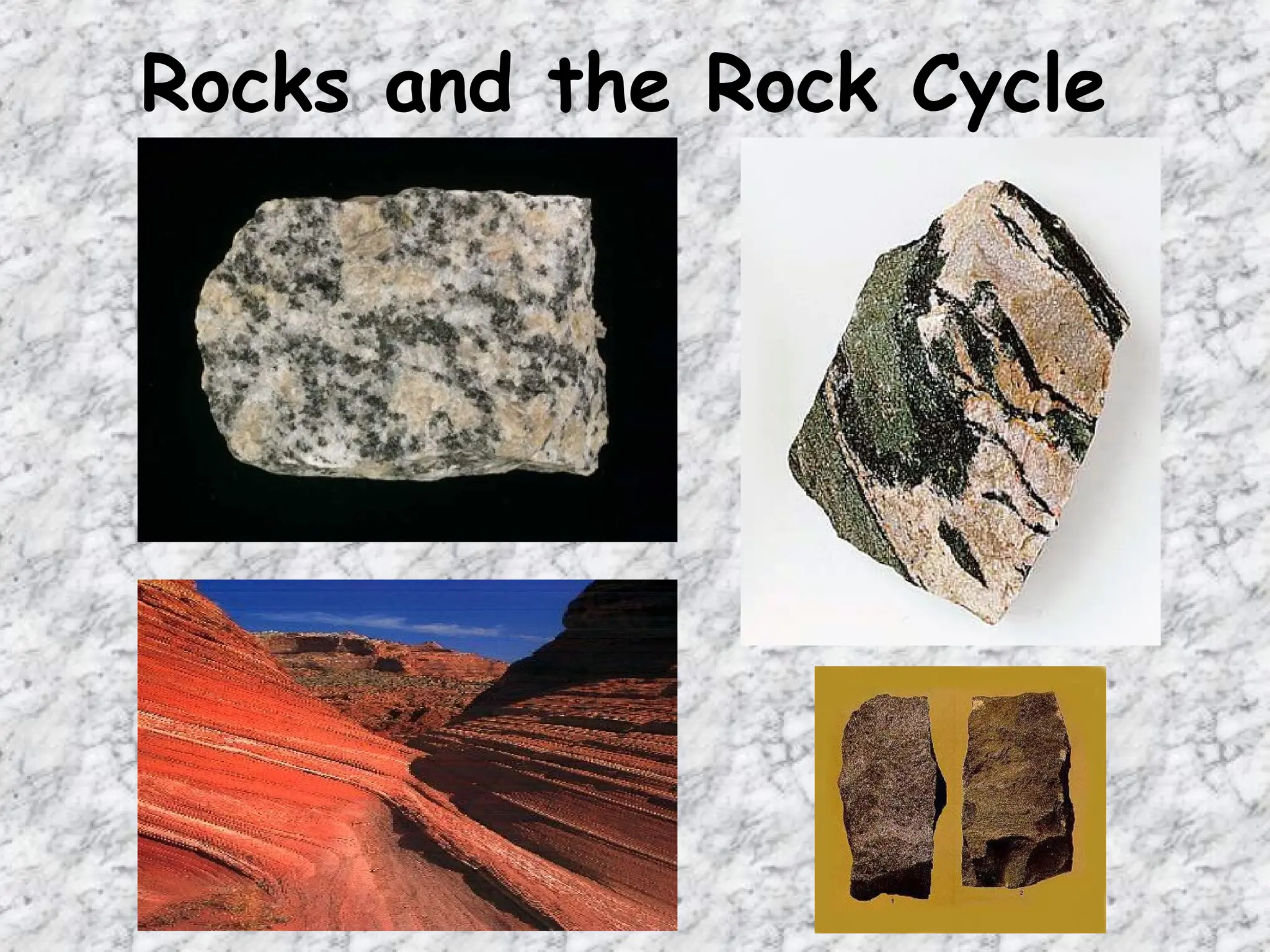
Rocks and the Rock Cycle
Three Types of Rocks
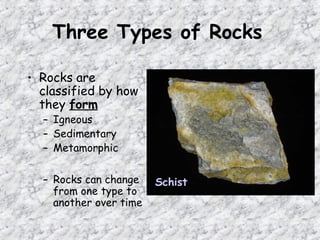
• Rocks are
classified by how
they form
– Igneous
– Sedimentary
– Metamorphic
– Rocks can change
from one type to
another over time
Schist
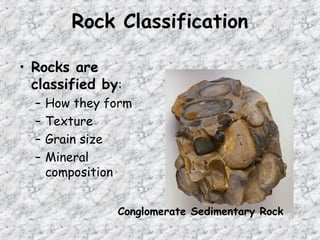
Rock Classification
• Rocks are
classified by:
– How they form
– Texture
– Grain size
– Mineral
composition
Conglomerate Sedimentary Rock
Igneous Rocks
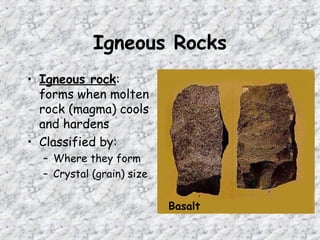
• Igneous rock:
forms when molten
rock (magma) cools
and hardens
• Classified by:
– Where they form
– Crystal (grain) size
Basalt
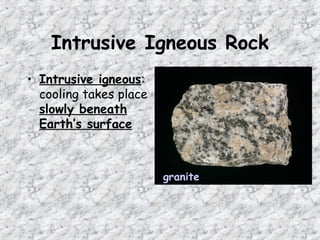
Intrusive Igneous Rock
• Intrusive igneous:
cooling takes place
slowly beneath
Earth’s surface
granite
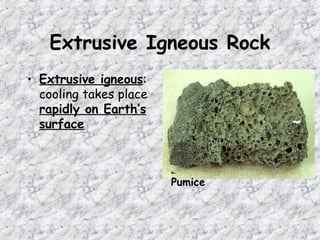
Extrusive Igneous Rock
• Extrusive igneous:
cooling takes place
rapidly on Earth’s
surface
Pumice
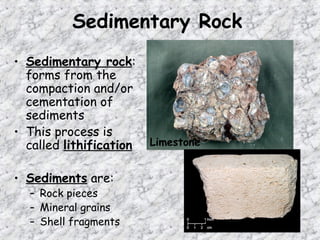
Sedimentary Rock
• Sedimentary rock:
forms from the
compaction and/or
cementation of
sediments
• This process is
called lithification
• Sediments are:
– Rock pieces
– Mineral grains
– Shell fragments
Limestone
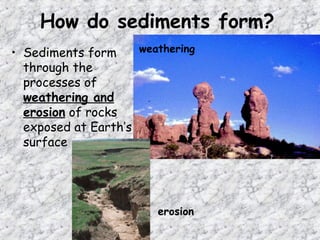
How do sediments form?
• Sediments form
through the
processes of
weathering and
erosion of rocks
exposed at Earth’s
surface
weathering
erosion
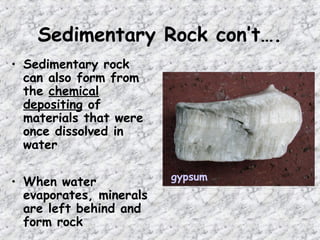
Sedimentary Rock con’t….
• Sedimentary rock
can also form from
the chemical
depositing of
materials that were
once dissolved in
water
• When water
evaporates, minerals
are left behind and
form rock
gypsum
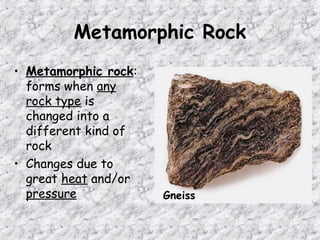
Metamorphic Rock
• Metamorphic rock:
forms when any
rock type is
changed into a
different kind of
rock
• Changes due to
great heat and/or
pressure Gneiss
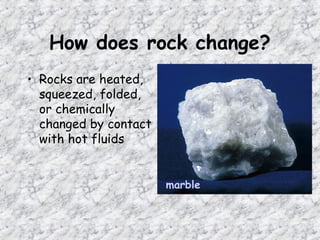
How does rock change?
• Rocks are heated,
squeezed, folded,
or chemically
changed by contact
with hot fluids
marble
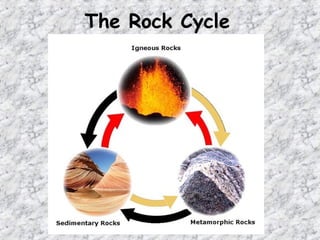
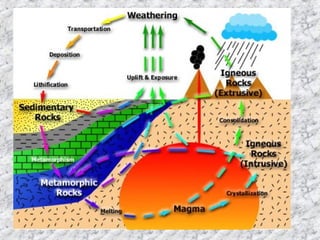
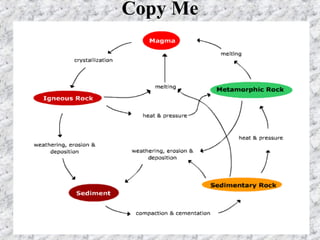
The Rock Cycle
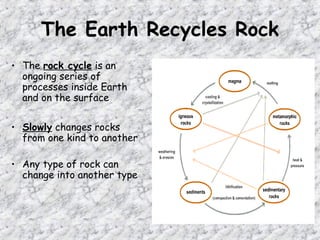
The Earth Recycles Rock
• The rock cycle is an
ongoing series of
processes inside Earth
and on the surface
• Slowly changes rocks
from one kind to another
• Any type of rock can
change into another type
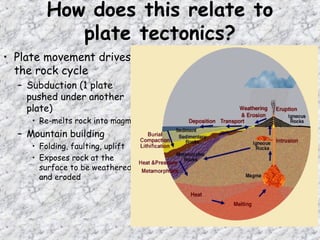
How does this relate to
plate tectonics?
• Plate movement drives
the rock cycle
– Subduction (1 plate
pushed under another
plate)
• Re-melts rock into magma
– Mountain building
• Folding, faulting, uplift
• Exposes rock at the
surface to be weathered
and eroded
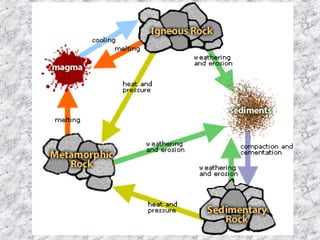
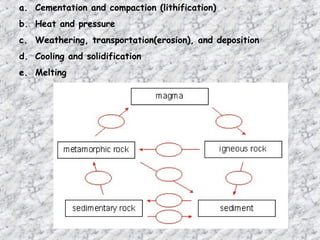
a. Cementation and compaction (lithification)
b. Heat and pressure
c. Weathering, transportation(erosion), and deposition
d. Cooling and solidification
e. Melting
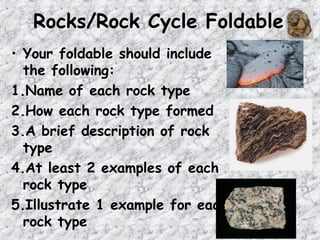
Rocks/Rock Cycle Foldable
• Your foldable should include
the following:
1.Name of each rock type
2.How each rock type formed
3.A brief description of rock
type
4.At least 2 examples of each
rock type
5.Illustrate 1 example for each
rock type
Copy Me
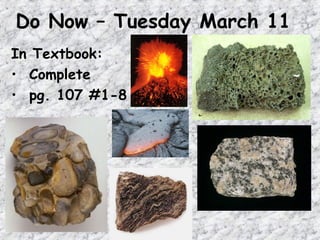
Do Now – Tuesday March 11
In Textbook:
• Complete
• pg. 107 #1-8
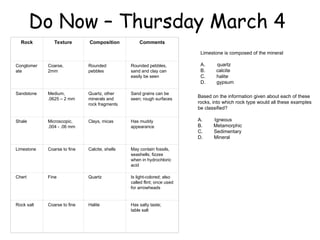
Do Now – Thursday March 4
Rock Texture Composition Comments
Conglomer
ate
Coarse,
2mm
Rounded
pebbles
Rounded pebbles,
sand and clay can
easily be seen
Sandstone Medium,
.0625 – 2 mm
Quartz, other
minerals and
rock fragments
Sand grains can be
seen; rough surfaces
Shale Microscopic,
.004 - .06 mm
Clays, micas Has muddy
appearance
Limestone Coarse to fine Calcite, shells May contain fossils,
seashells; fizzes
when in hydrochloric
acid
Chert Fine Quartz Is light-colored; also
called flint; once used
for arrowheads
Rock salt Coarse to fine Halite Has salty taste;
table salt
Limestone is composed of the mineral
A. quartz
B. calcite
C. halite
D. gypsum
Based on the information given about each of these
rocks, into which rock type would all these examples
be classified?
A. Igneous
B. Metamorphic
C. Sedimentary
D. Mineral
Gypsum
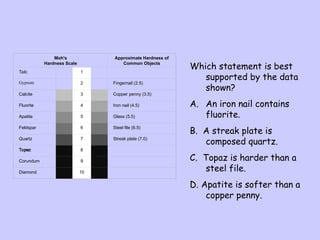
Moh's
Hardness Scale
Approximate Hardness of
Common Objects
Talc
Gypsum
1
2 Fingernail (2.5)
Calcite 3 Copper penny (3.5)
Fluorite 4 Iron nail (4.5)
Apatite 5 Glass (5.5)
Feldspar 6 Steel file (6.5)
Quartz
Topaz
7 Streak plate (7.0)
Topaz 8
Corundum 9
Diamond 10
Which statement is best
supported by the data
shown?
A. An iron nail contains
fluorite.
B. A streak plate is
composed quartz.
C. Topaz is harder than a
steel file.
D. Apatite is softer than a
copper penny.
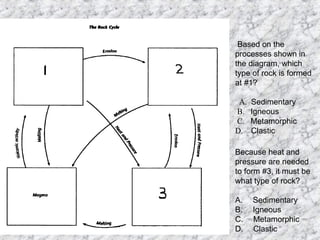
Based on the
processes shown in
the diagram, which
type of rock is formed
at #1?
A. Sedimentary
B. Igneous
C. Metamorphic
D. Clastic
Because heat and
pressure are needed
to form #3, it must be
what type of rock?
A. Sedimentary
B. Igneous
C. Metamorphic
D. Clastic

rocks_and_the_rock_cycledsfasdfadfasdf.ppt

  • 1.
    Rocks and theRock Cycle
  • 2.
    Three Types ofRocks • Rocks are classified by how they form – Igneous – Sedimentary – Metamorphic – Rocks can change from one type to another over time Schist
  • 3.
    Rock Classification • Rocksare classified by: – How they form – Texture – Grain size – Mineral composition Conglomerate Sedimentary Rock
  • 4.
    Igneous Rocks • Igneousrock: forms when molten rock (magma) cools and hardens • Classified by: – Where they form – Crystal (grain) size Basalt
  • 5.
    Intrusive Igneous Rock •Intrusive igneous: cooling takes place slowly beneath Earth’s surface granite
  • 6.
    Extrusive Igneous Rock •Extrusive igneous: cooling takes place rapidly on Earth’s surface Pumice
  • 7.
    Sedimentary Rock • Sedimentaryrock: forms from the compaction and/or cementation of sediments • This process is called lithification • Sediments are: – Rock pieces – Mineral grains – Shell fragments Limestone
  • 8.
    How do sedimentsform? • Sediments form through the processes of weathering and erosion of rocks exposed at Earth’s surface weathering erosion
  • 9.
    Sedimentary Rock con’t…. •Sedimentary rock can also form from the chemical depositing of materials that were once dissolved in water • When water evaporates, minerals are left behind and form rock gypsum
  • 10.
    Metamorphic Rock • Metamorphicrock: forms when any rock type is changed into a different kind of rock • Changes due to great heat and/or pressure Gneiss
  • 11.
    How does rockchange? • Rocks are heated, squeezed, folded, or chemically changed by contact with hot fluids marble
  • 12.
  • 13.
    The Earth RecyclesRock • The rock cycle is an ongoing series of processes inside Earth and on the surface • Slowly changes rocks from one kind to another • Any type of rock can change into another type
  • 14.
    How does thisrelate to plate tectonics? • Plate movement drives the rock cycle – Subduction (1 plate pushed under another plate) • Re-melts rock into magma – Mountain building • Folding, faulting, uplift • Exposes rock at the surface to be weathered and eroded
  • 20.
    a. Cementation andcompaction (lithification) b. Heat and pressure c. Weathering, transportation(erosion), and deposition d. Cooling and solidification e. Melting
  • 21.
    Rocks/Rock Cycle Foldable •Your foldable should include the following: 1.Name of each rock type 2.How each rock type formed 3.A brief description of rock type 4.At least 2 examples of each rock type 5.Illustrate 1 example for each rock type
  • 22.
  • 23.
    Do Now –Tuesday March 11 In Textbook: • Complete • pg. 107 #1-8
  • 24.
    Do Now –Thursday March 4 Rock Texture Composition Comments Conglomer ate Coarse, 2mm Rounded pebbles Rounded pebbles, sand and clay can easily be seen Sandstone Medium, .0625 – 2 mm Quartz, other minerals and rock fragments Sand grains can be seen; rough surfaces Shale Microscopic, .004 - .06 mm Clays, micas Has muddy appearance Limestone Coarse to fine Calcite, shells May contain fossils, seashells; fizzes when in hydrochloric acid Chert Fine Quartz Is light-colored; also called flint; once used for arrowheads Rock salt Coarse to fine Halite Has salty taste; table salt Limestone is composed of the mineral A. quartz B. calcite C. halite D. gypsum Based on the information given about each of these rocks, into which rock type would all these examples be classified? A. Igneous B. Metamorphic C. Sedimentary D. Mineral
  • 25.
    Gypsum Moh's Hardness Scale Approximate Hardnessof Common Objects Talc Gypsum 1 2 Fingernail (2.5) Calcite 3 Copper penny (3.5) Fluorite 4 Iron nail (4.5) Apatite 5 Glass (5.5) Feldspar 6 Steel file (6.5) Quartz Topaz 7 Streak plate (7.0) Topaz 8 Corundum 9 Diamond 10 Which statement is best supported by the data shown? A. An iron nail contains fluorite. B. A streak plate is composed quartz. C. Topaz is harder than a steel file. D. Apatite is softer than a copper penny.
  • 26.
    Based on the processesshown in the diagram, which type of rock is formed at #1? A. Sedimentary B. Igneous C. Metamorphic D. Clastic Because heat and pressure are needed to form #3, it must be what type of rock? A. Sedimentary B. Igneous C. Metamorphic D. Clastic