The Evolution of
Robots
By: Mike Dunn
The First Robot Ever
http://www.todayifoundout.com/index.php/2010/10/the-first-known-robot-was-created-around-400-bc-and-was-a-mechanical-bird/

•
•
•
•

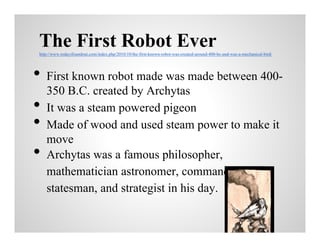
First known robot made was made between 400350 B.C. created by Archytas
It was a steam powered pigeon
Made of wood and used steam power to make it
move
Archytas was a famous philosopher,
mathematician astronomer, commander,
statesman, and strategist in his day.
Working Robot
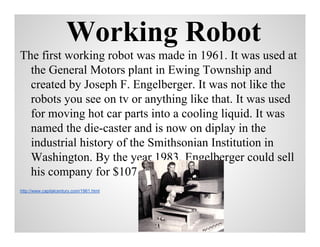
The first working robot was made in 1961. It was used at
the General Motors plant in Ewing Township and
created by Joseph F. Engelberger. It was not like the
robots you see on tv or anything like that. It was used
for moving hot car parts into a cooling liquid. It was
named the die-caster and is now on diplay in the
industrial history of the Smithsonian Institution in
Washington. By the year 1983, Engelberger could sell
his company for $107 million.
http://www.capitalcentury.com/1961.html
First Robotic Arm
http://inventors.about.com/od/roboticsrobots/a/RoboTimeline.htm

•
•
•
•

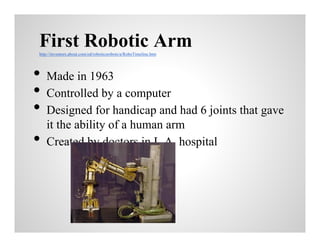
Made in 1963
Controlled by a computer
Designed for handicap and had 6 joints that gave
it the ability of a human arm
Created by doctors in L.A. hospital
Real Robots
•
•
•

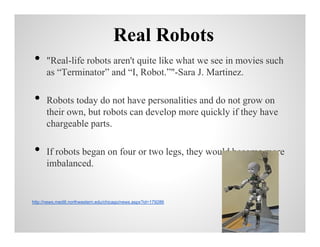
"Real-life robots aren't quite like what we see in movies such
as “Terminator” and “I, Robot.”"-Sara J. Martinez.
Robots today do not have personalities and do not grow on
their own, but robots can develop more quickly if they have
chargeable parts.
If robots began on four or two legs, they would become more
imbalanced.

http://news.medill.northwestern.edu/chicago/news.aspx?id=179286
Manny

•
•
•
•

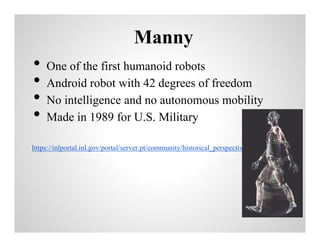
One of the first humanoid robots
Android robot with 42 degrees of freedom
No intelligence and no autonomous mobility
Made in 1989 for U.S. Military

https://inlportal.inl.gov/portal/server.pt/community/historical_perspectives/537
Industrial Revolution
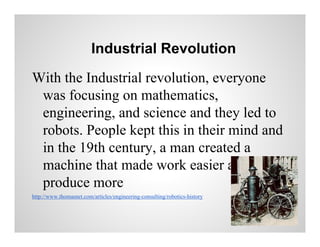
With the Industrial revolution, everyone
was focusing on mathematics,
engineering, and science and they led to
robots. People kept this in their mind and
in the 19th century, a man created a
machine that made work easier and could
produce more
http://www.thomasnet.com/articles/engineering-consulting/robotics-history
MERTZ
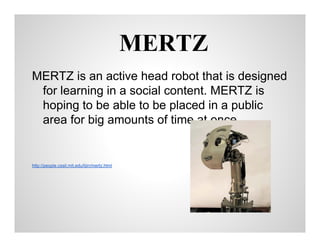
MERTZ is an active head robot that is designed
for learning in a social content. MERTZ is
hoping to be able to be placed in a public
area for big amounts of time at once

http://people.csail.mit.edu/lijin/mertz.html
Robonaut 2

•
•
•

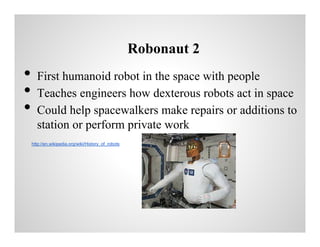
First humanoid robot in the space with people
Teaches engineers how dexterous robots act in space
Could help spacewalkers make repairs or additions to
station or perform private work
http://en.wikipedia.org/wiki/History_of_robots
The evolution of robots

The evolution of robots

  • 1.
  • 2.
    The First RobotEver http://www.todayifoundout.com/index.php/2010/10/the-first-known-robot-was-created-around-400-bc-and-was-a-mechanical-bird/ • • • • First known robot made was made between 400350 B.C. created by Archytas It was a steam powered pigeon Made of wood and used steam power to make it move Archytas was a famous philosopher, mathematician astronomer, commander, statesman, and strategist in his day.
  • 3.
    Working Robot The firstworking robot was made in 1961. It was used at the General Motors plant in Ewing Township and created by Joseph F. Engelberger. It was not like the robots you see on tv or anything like that. It was used for moving hot car parts into a cooling liquid. It was named the die-caster and is now on diplay in the industrial history of the Smithsonian Institution in Washington. By the year 1983, Engelberger could sell his company for $107 million. http://www.capitalcentury.com/1961.html
  • 4.
    First Robotic Arm http://inventors.about.com/od/roboticsrobots/a/RoboTimeline.htm • • • • Madein 1963 Controlled by a computer Designed for handicap and had 6 joints that gave it the ability of a human arm Created by doctors in L.A. hospital
  • 5.
    Real Robots • • • "Real-life robotsaren't quite like what we see in movies such as “Terminator” and “I, Robot.”"-Sara J. Martinez. Robots today do not have personalities and do not grow on their own, but robots can develop more quickly if they have chargeable parts. If robots began on four or two legs, they would become more imbalanced. http://news.medill.northwestern.edu/chicago/news.aspx?id=179286
  • 6.
    Manny • • • • One of thefirst humanoid robots Android robot with 42 degrees of freedom No intelligence and no autonomous mobility Made in 1989 for U.S. Military https://inlportal.inl.gov/portal/server.pt/community/historical_perspectives/537
  • 7.
    Industrial Revolution With theIndustrial revolution, everyone was focusing on mathematics, engineering, and science and they led to robots. People kept this in their mind and in the 19th century, a man created a machine that made work easier and could produce more http://www.thomasnet.com/articles/engineering-consulting/robotics-history
  • 8.
    MERTZ MERTZ is anactive head robot that is designed for learning in a social content. MERTZ is hoping to be able to be placed in a public area for big amounts of time at once http://people.csail.mit.edu/lijin/mertz.html
  • 9.
    Robonaut 2 • • • First humanoidrobot in the space with people Teaches engineers how dexterous robots act in space Could help spacewalkers make repairs or additions to station or perform private work http://en.wikipedia.org/wiki/History_of_robots