SUBMITTED BY :- HARSHAL AWALE
ROLL NO :- 11031M02017
1
The term "robot" was first used in
1920 in a play called "R.U.R." Or
"Rossum's universal robots" by the
Czech writer Karel Capek.
The word “Robot”comes from the
word “Robota”,meaning,in
Czech”,forced labour,drudgery.
HISTORY
2
Robotics Terminology
3
Robot - Mechanical device that performs
human tasks, either automatically or by remote
control.
Robotics - Study and application of robot
technology.
Telerobotics - Robot that is operated remotely.
What is the Definition of a Robot?
A reprogrammable multifunctional
manipulator designed to move material,
parts, tools or specialized devices through
various programmed motions for the
performance of a variety of Tasks.
Robot Institute of America.
4
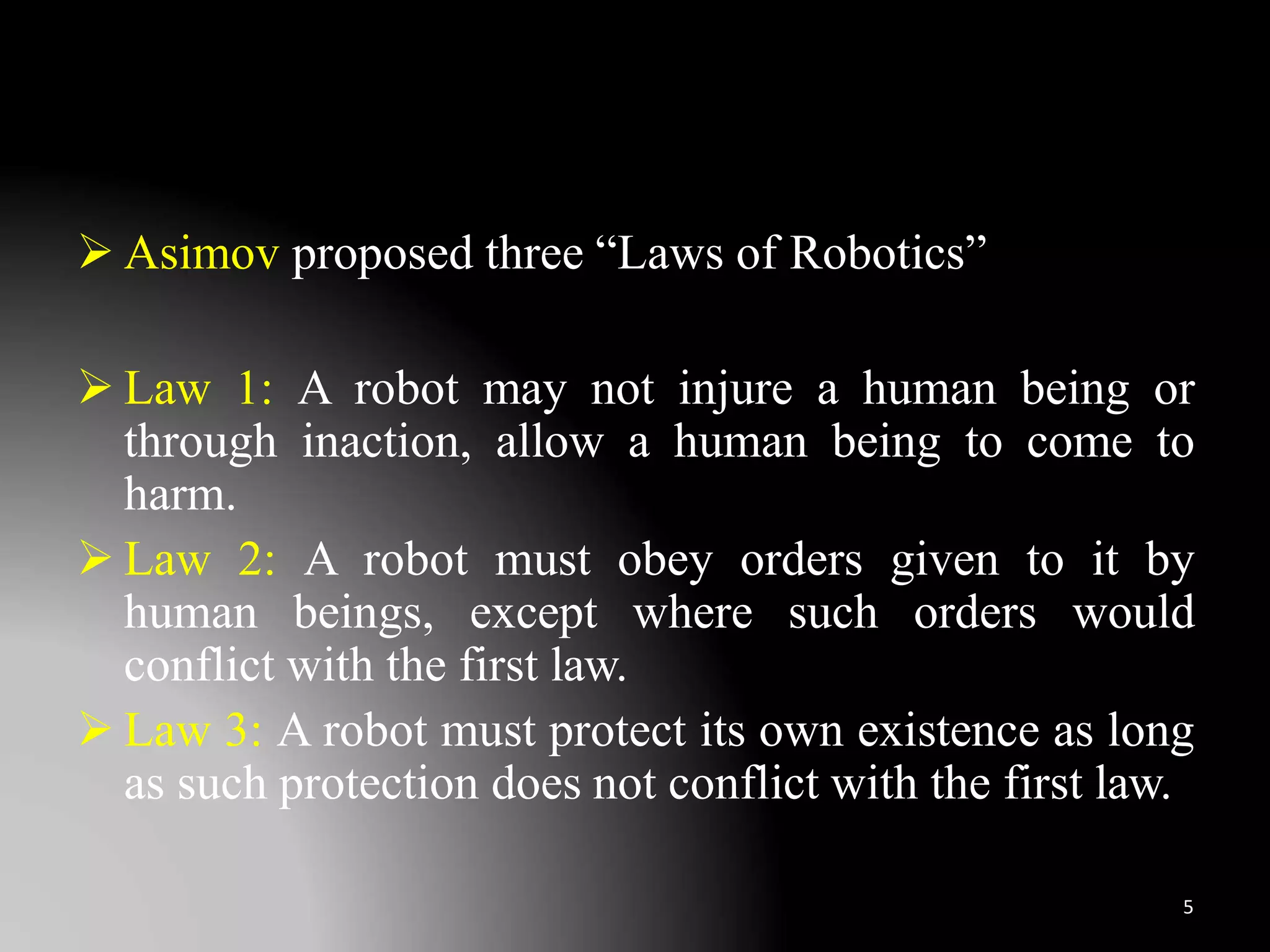
 Asimov proposed three “Laws of Robotics”
 Law 1: A robot may not injure a human being or
through inaction, allow a human being to come to
harm.
 Law 2: A robot must obey orders given to it by
human beings, except where such orders would
conflict with the first law.
 Law 3: A robot must protect its own existence as long
as such protection does not conflict with the first law.
5
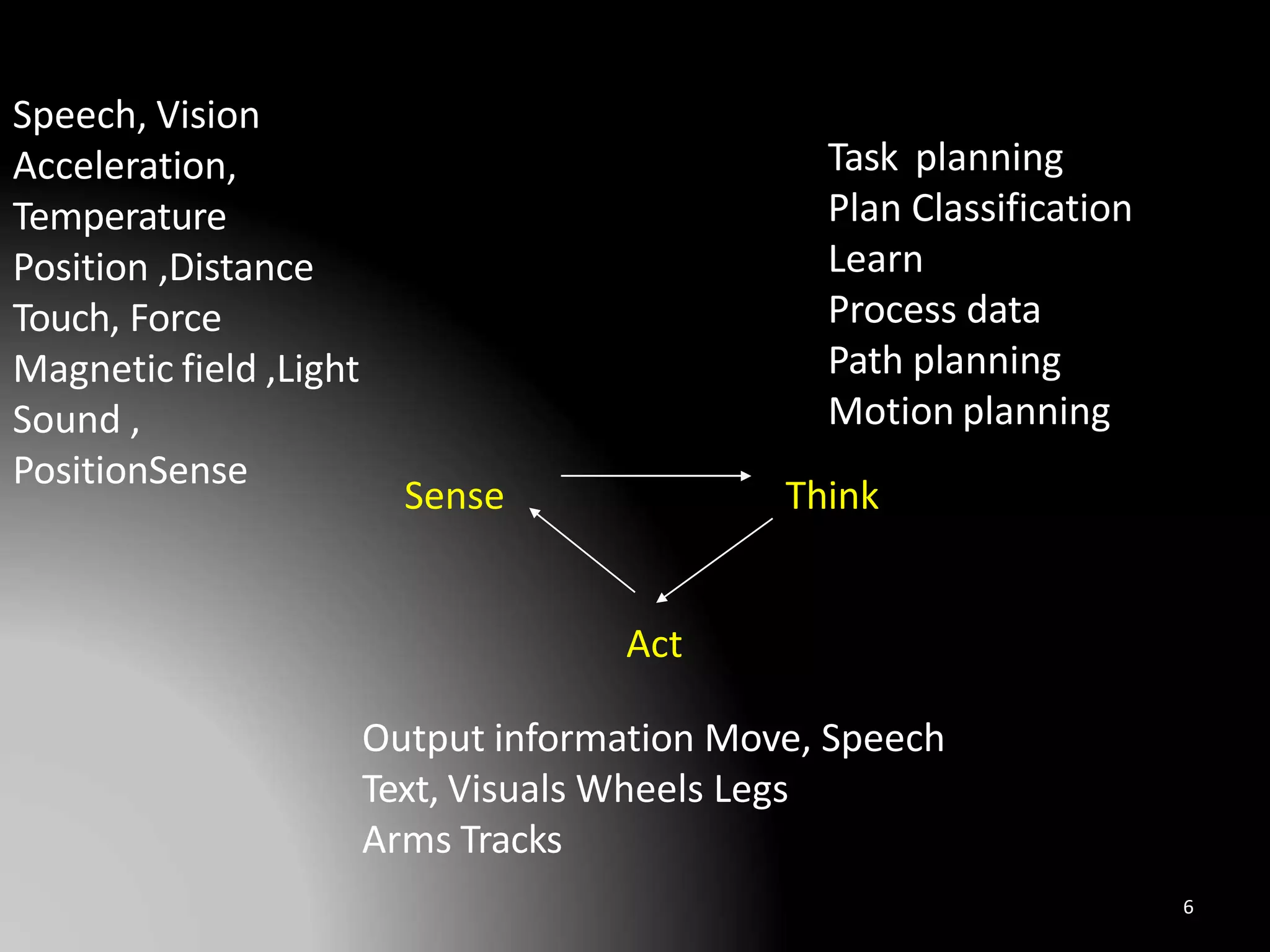
Speech, Vision
Acceleration,
Temperature
Position ,Distance
Touch, Force
Magnetic field ,Light
Sound ,
PositionSense
Task planning
Plan Classification
Learn
Process data
Path planning
Motion planning
Think
6
Sense
Act
Output information Move, Speech
Text, Visuals Wheels Legs
Arms Tracks
Artificial intelligence is the intelligence exhibited by
machines or software, and the branch of computer
science that develops machines and software with
intelligence. Major AI researchers and textbooks define
the field as "the study and design of intelligent
agents",[where an intelligent agent is a system that
perceives its environment and takes actions that maximize
its chances of success. John McCarthy, who coined the
term in 1955,defines it as "the science and engineering of
making intelligent machines.
7
A robot is any moving machine that can be
programmed to perform tasks and gather
information from its surroundings. Robots
work from a central microprocessor that
controls their movements, they also have
sensors for examining the environment and
power sources.
8
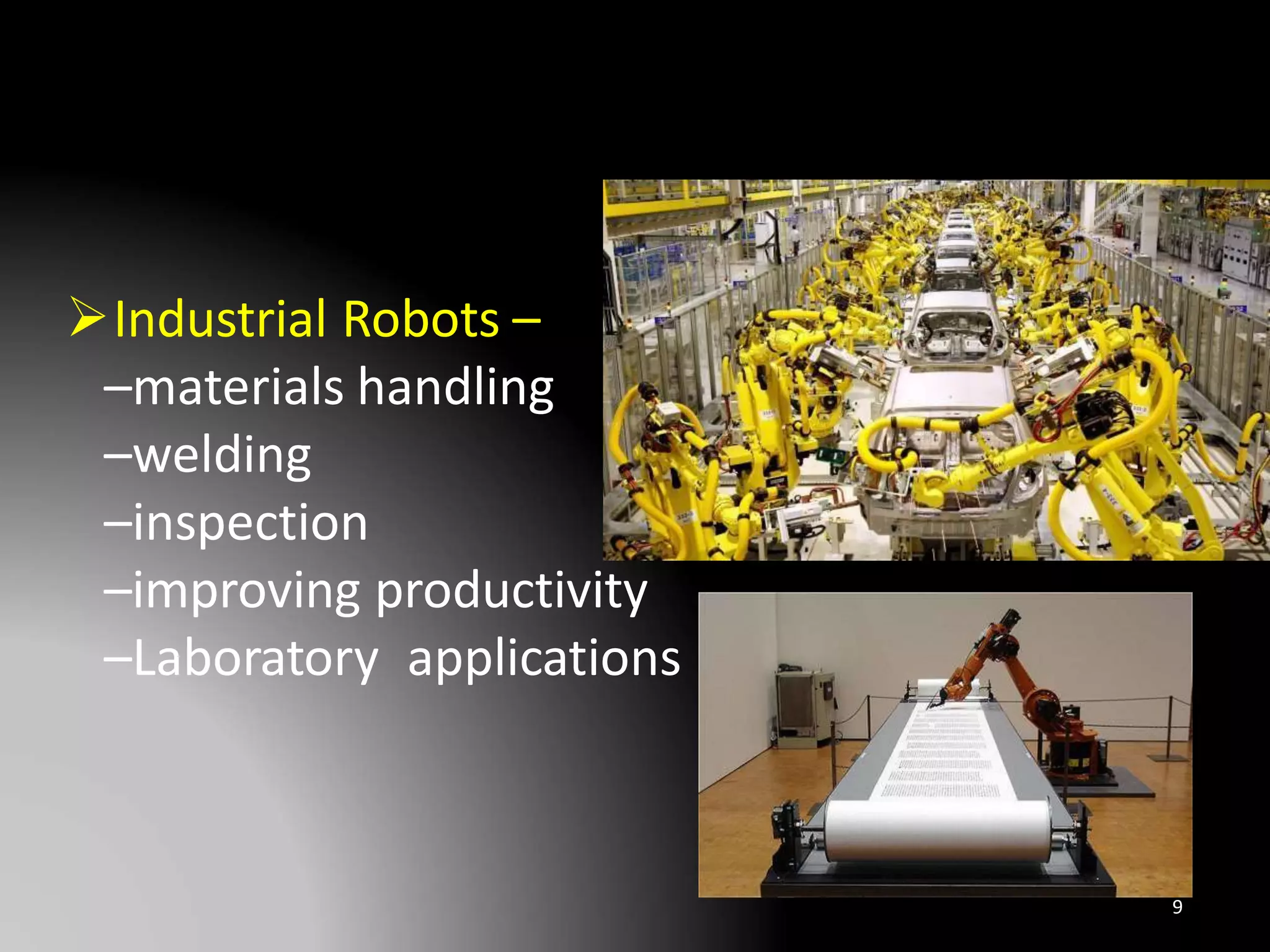
Industrial Robots –
–materials handling
–welding
–inspection
–improving productivity
–Laboratory applications
9
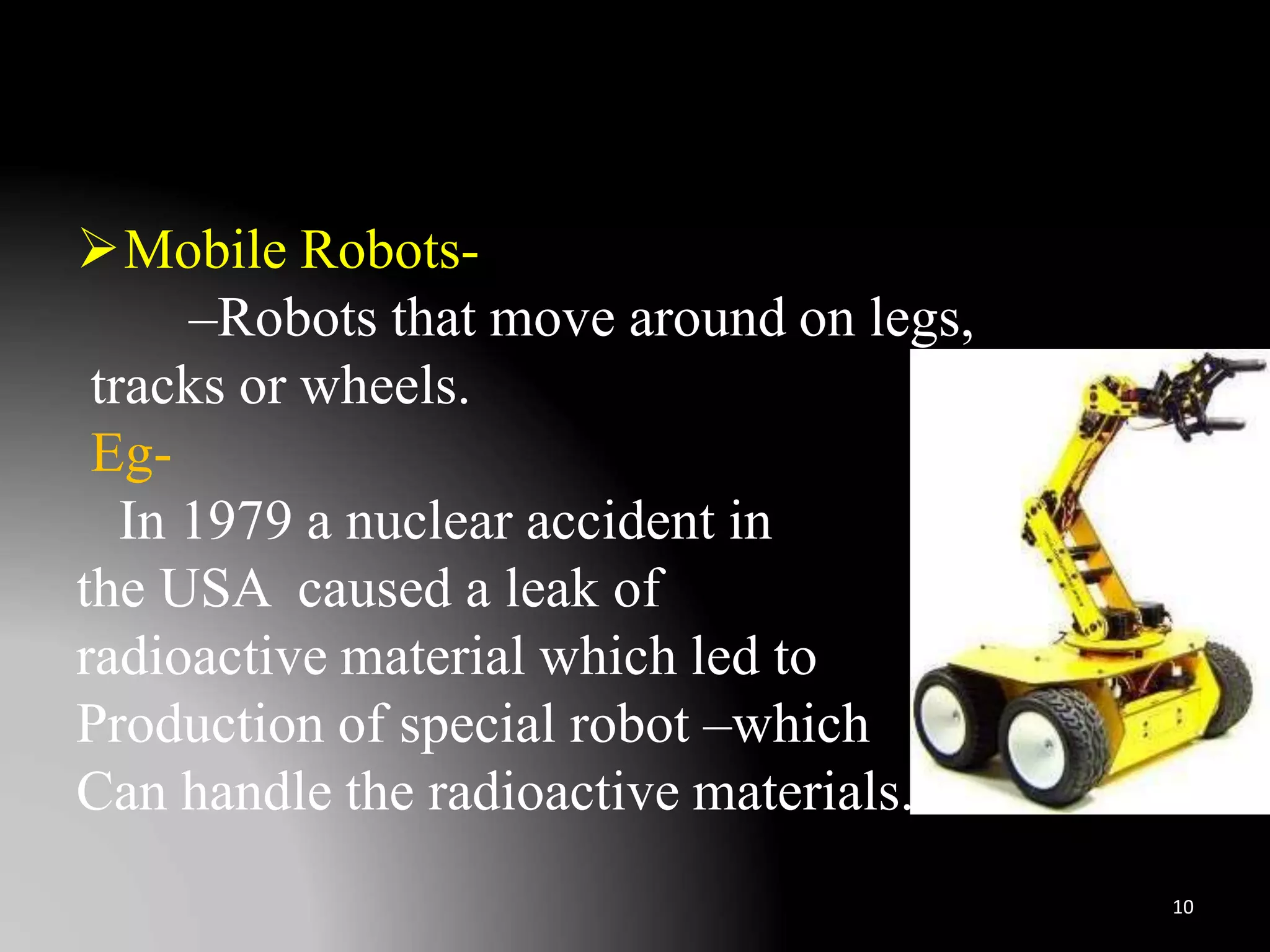
Mobile Robots-
–Robots that move around on legs,
tracks or wheels.
Eg-
In 1979 a nuclear accident in
the USA caused a leak of
radioactive material which led to
Production of special robot –which
Can handle the radioactive materials.
10
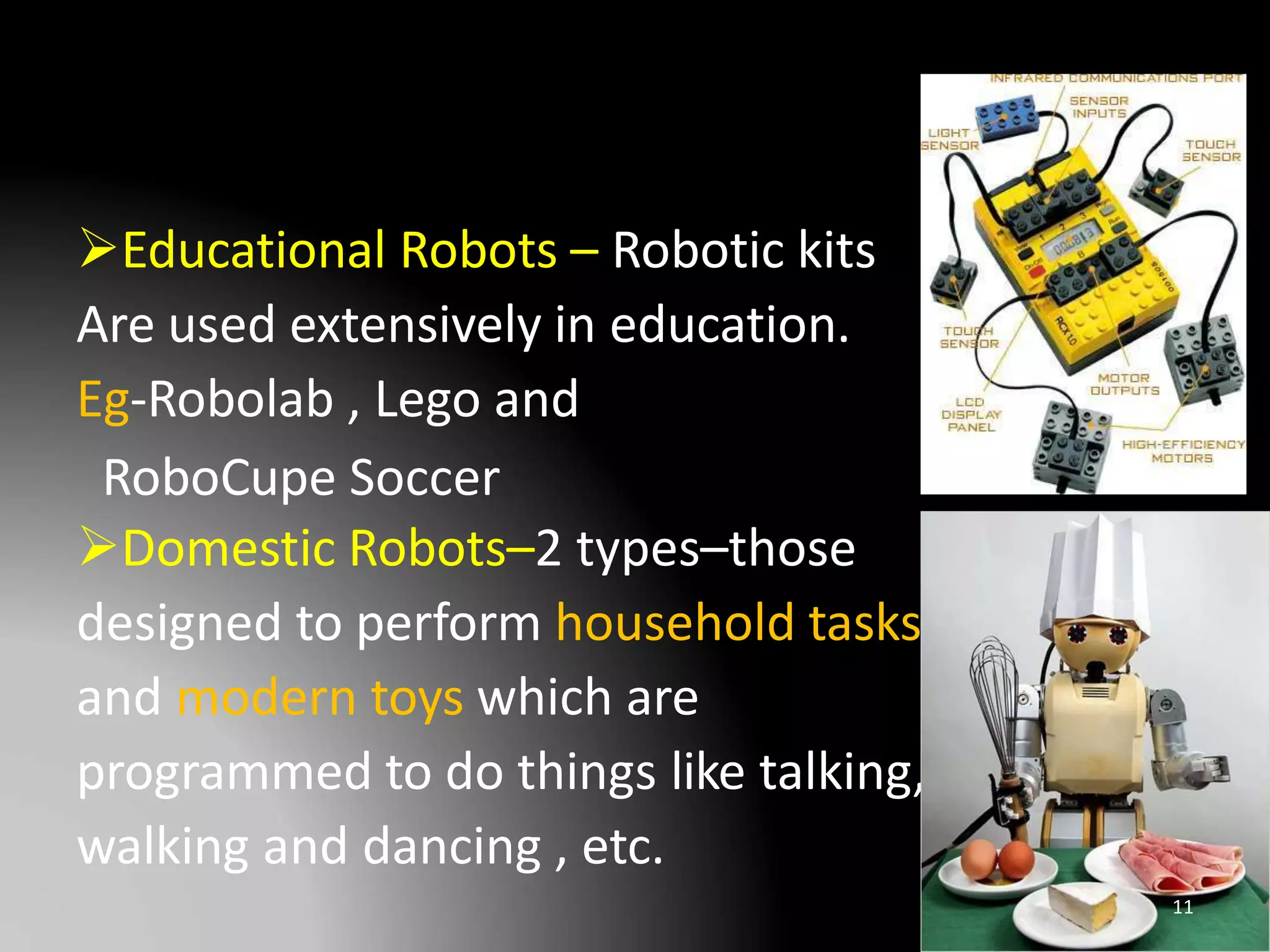
Educational Robots – Robotic kits
Are used extensively in education.
Eg-Robolab , Lego and
RoboCupe Soccer
Domestic Robots–2 types–those
designed to perform household tasks
and modern toys which are
programmed to do things like talking,
walking and dancing , etc.
11
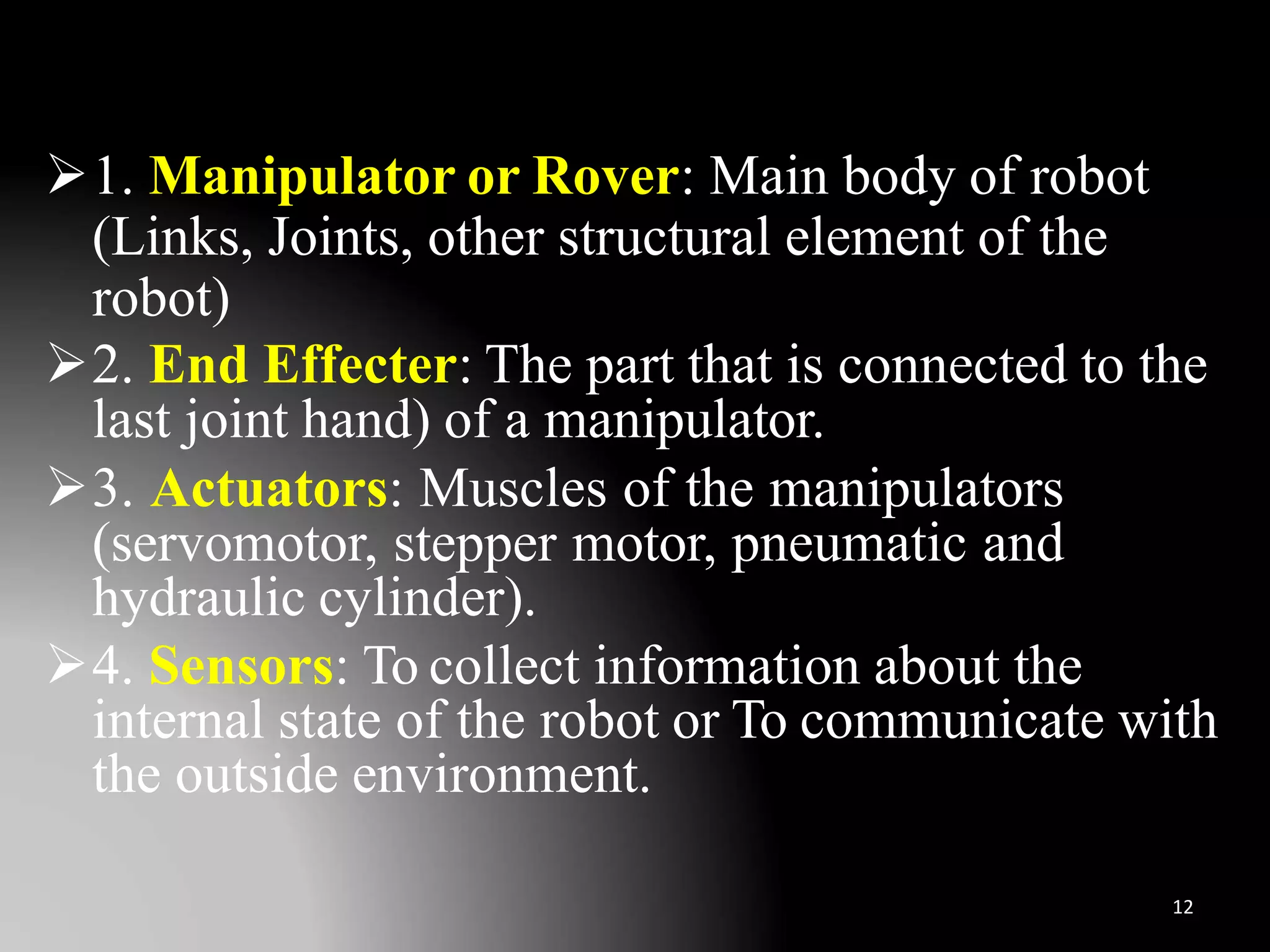
1. Manipulator or Rover: Main body of robot
(Links, Joints, other structural element of the
robot)
2. End Effecter: The part that is connected to the
last joint hand) of a manipulator.
3. Actuators: Muscles of the manipulators
(servomotor, stepper motor, pneumatic and
hydraulic cylinder).
4. Sensors: To collect information about the
internal state of the robot or To communicate with
the outside environment.
12
5. Controller: Similar to cerebellum. It controls
and coordinates the motion of the actuators.
6. Processor: The brain of the robot. It
calculates the motions and the velocity of the
robot’s joints, etc.
7. Software: Operating system, robotic
software and the collection of routines.
13
n
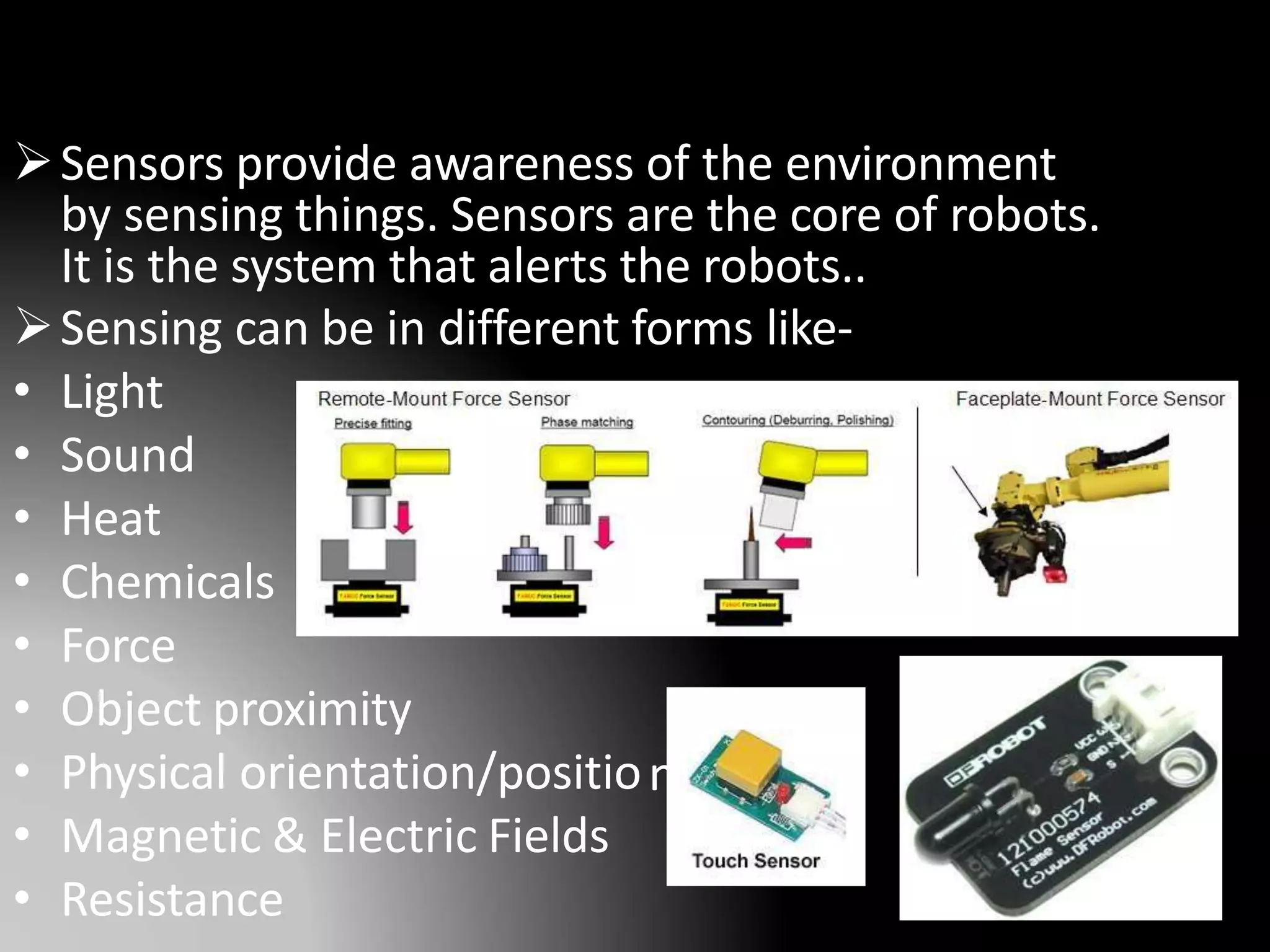
Sensors provide awareness of the environment
by sensing things. Sensors are the core of robots.
It is the system that alerts the robots..
Sensing can be in different forms like-
• Light
• Sound
• Heat
• Chemicals
• Force
• Object proximity
• Physical orientation/positio
• Magnetic & Electric Fields
• Resistance 14
Locomotion
Manipulation
15
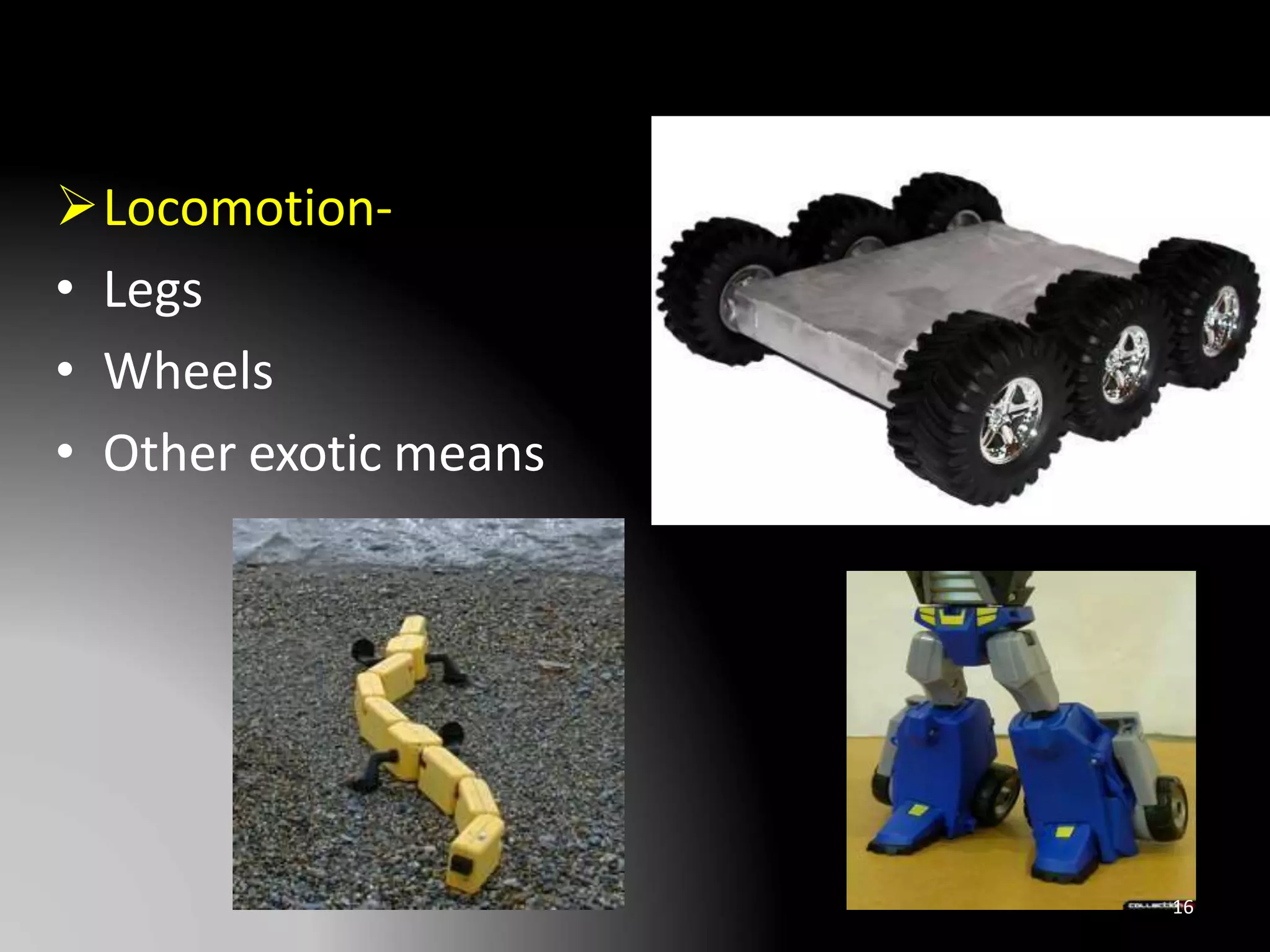
Locomotion-
• Legs
• Wheels
• Other exotic means
16
 Manipulations-
• Degrees of freedom
– independently controllable components of motion
• Arms
– convenient method to allow full movement in 3D
– more often used in fixed robots due to power & weight
– even more difficult to control!
• due to extra degrees of freedom
• Grippers
– may be very simple (two rigid arms) to pick up objects
– may be complex device with fingers on end of an arm
– probably need feedback to control grip force
17
In robotics, an end effectors is the device at
the end of a robotic arm, designed to interact
with the environment.
End effectors may consist of a gripper or a
tool. The gripper can be of two fingers, three
fingers or even five fingers.
18
Each plane in which a robot can maneuver.
• ROTATE BASE OF ARM
• PIVOT BASE OF ARM
• BEND ELBOW
• WRIST UPAND DOWN
• WRIST LEFT AND RIGHT
• ROTATE WRIST
19
Robots are also used for the following tasks:
• Dirty Tasks
• Repetitive tasks
• Dangerous tasks
• Impossible tasks
• Robots assisting the handicapped
• Can operate equipments at much higher
precision than humans.
• Cheaper on a long term basis. 20
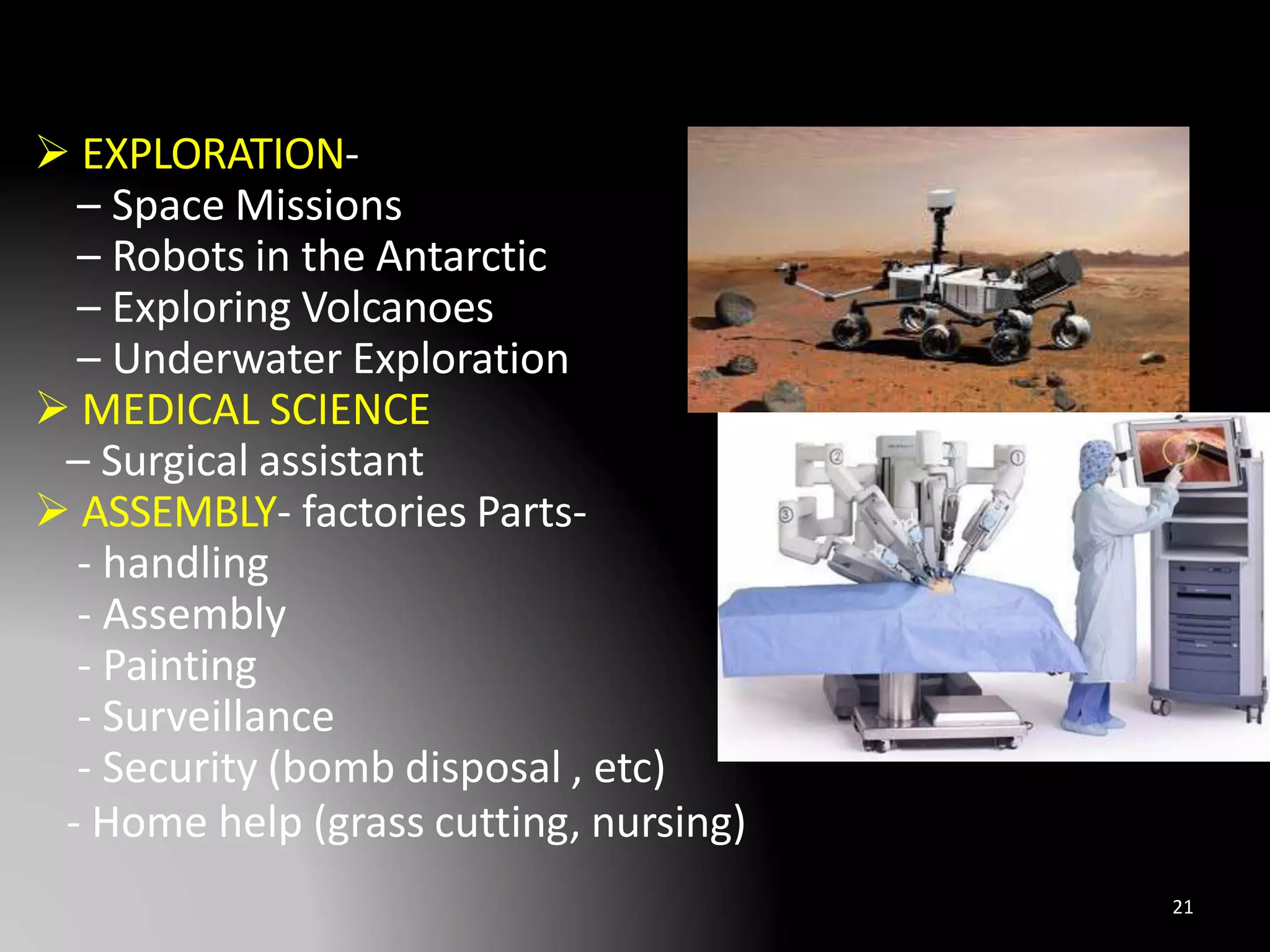
 EXPLORATION-
– Space Missions
– Robots in the Antarctic
– Exploring Volcanoes
– Underwater Exploration
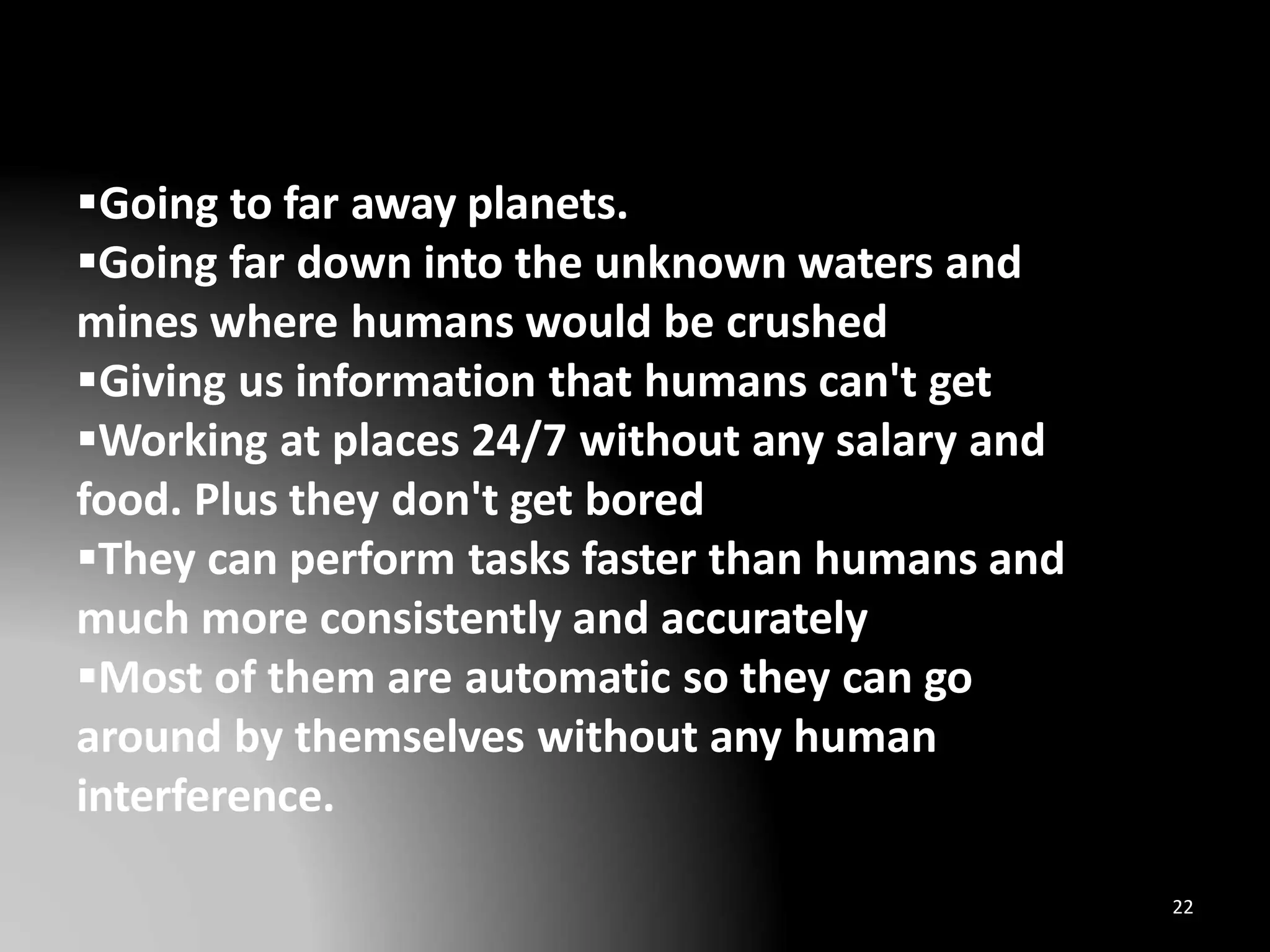
 MEDICAL SCIENCE
– Surgical assistant
 ASSEMBLY- factories Parts-
- handling
- Assembly
- Painting
- Surveillance
- Security (bomb disposal , etc)
- Home help (grass cutting, nursing)
21
Going to far away planets.
Going far down into the unknown waters and
mines where humans would be crushed
Giving us information that humans can't get
Working at places 24/7 without any salary and
food. Plus they don't get bored
They can perform tasks faster than humans and
much more consistently and accurately
Most of them are automatic so they can go
around by themselves without any human
interference.
22
 People can lose jobs in factories
 It needs a supply of power
It needs maintenance to keep it running .
It costs money to make or buy a robot
23
• Scientists say that it is possible that a robot brain
will exist by 2019 .
• Vernor Vinge has suggested that a moment may
come when computers and robots are smarter than
humans.
• In 2009, some robots acquired various forms of
semi-autonomy, including being able to find power
sources on their own.
• The Association for the Advancement of
Artificial Intelligence has researched on this
problem.
24
25

Robots.pptx

  • 1.
    SUBMITTED BY :-HARSHAL AWALE ROLL NO :- 11031M02017 1
  • 2.
    The term "robot"was first used in 1920 in a play called "R.U.R." Or "Rossum's universal robots" by the Czech writer Karel Capek. The word “Robot”comes from the word “Robota”,meaning,in Czech”,forced labour,drudgery. HISTORY 2
  • 3.
    Robotics Terminology 3 Robot -Mechanical device that performs human tasks, either automatically or by remote control. Robotics - Study and application of robot technology. Telerobotics - Robot that is operated remotely.
  • 4.
    What is theDefinition of a Robot? A reprogrammable multifunctional manipulator designed to move material, parts, tools or specialized devices through various programmed motions for the performance of a variety of Tasks. Robot Institute of America. 4
  • 5.
     Asimov proposedthree “Laws of Robotics”  Law 1: A robot may not injure a human being or through inaction, allow a human being to come to harm.  Law 2: A robot must obey orders given to it by human beings, except where such orders would conflict with the first law.  Law 3: A robot must protect its own existence as long as such protection does not conflict with the first law. 5
  • 6.
    Speech, Vision Acceleration, Temperature Position ,Distance Touch,Force Magnetic field ,Light Sound , PositionSense Task planning Plan Classification Learn Process data Path planning Motion planning Think 6 Sense Act Output information Move, Speech Text, Visuals Wheels Legs Arms Tracks
  • 7.
    Artificial intelligence isthe intelligence exhibited by machines or software, and the branch of computer science that develops machines and software with intelligence. Major AI researchers and textbooks define the field as "the study and design of intelligent agents",[where an intelligent agent is a system that perceives its environment and takes actions that maximize its chances of success. John McCarthy, who coined the term in 1955,defines it as "the science and engineering of making intelligent machines. 7
  • 8.
    A robot isany moving machine that can be programmed to perform tasks and gather information from its surroundings. Robots work from a central microprocessor that controls their movements, they also have sensors for examining the environment and power sources. 8
  • 9.
    Industrial Robots – –materialshandling –welding –inspection –improving productivity –Laboratory applications 9
  • 10.
    Mobile Robots- –Robots thatmove around on legs, tracks or wheels. Eg- In 1979 a nuclear accident in the USA caused a leak of radioactive material which led to Production of special robot –which Can handle the radioactive materials. 10
  • 11.
    Educational Robots –Robotic kits Are used extensively in education. Eg-Robolab , Lego and RoboCupe Soccer Domestic Robots–2 types–those designed to perform household tasks and modern toys which are programmed to do things like talking, walking and dancing , etc. 11
  • 12.
    1. Manipulator orRover: Main body of robot (Links, Joints, other structural element of the robot) 2. End Effecter: The part that is connected to the last joint hand) of a manipulator. 3. Actuators: Muscles of the manipulators (servomotor, stepper motor, pneumatic and hydraulic cylinder). 4. Sensors: To collect information about the internal state of the robot or To communicate with the outside environment. 12
  • 13.
    5. Controller: Similarto cerebellum. It controls and coordinates the motion of the actuators. 6. Processor: The brain of the robot. It calculates the motions and the velocity of the robot’s joints, etc. 7. Software: Operating system, robotic software and the collection of routines. 13
  • 14.
    n Sensors provide awarenessof the environment by sensing things. Sensors are the core of robots. It is the system that alerts the robots.. Sensing can be in different forms like- • Light • Sound • Heat • Chemicals • Force • Object proximity • Physical orientation/positio • Magnetic & Electric Fields • Resistance 14
  • 15.
  • 16.
  • 17.
     Manipulations- • Degreesof freedom – independently controllable components of motion • Arms – convenient method to allow full movement in 3D – more often used in fixed robots due to power & weight – even more difficult to control! • due to extra degrees of freedom • Grippers – may be very simple (two rigid arms) to pick up objects – may be complex device with fingers on end of an arm – probably need feedback to control grip force 17
  • 18.
    In robotics, anend effectors is the device at the end of a robotic arm, designed to interact with the environment. End effectors may consist of a gripper or a tool. The gripper can be of two fingers, three fingers or even five fingers. 18
  • 19.
    Each plane inwhich a robot can maneuver. • ROTATE BASE OF ARM • PIVOT BASE OF ARM • BEND ELBOW • WRIST UPAND DOWN • WRIST LEFT AND RIGHT • ROTATE WRIST 19
  • 20.
    Robots are alsoused for the following tasks: • Dirty Tasks • Repetitive tasks • Dangerous tasks • Impossible tasks • Robots assisting the handicapped • Can operate equipments at much higher precision than humans. • Cheaper on a long term basis. 20
  • 21.
     EXPLORATION- – SpaceMissions – Robots in the Antarctic – Exploring Volcanoes – Underwater Exploration  MEDICAL SCIENCE – Surgical assistant  ASSEMBLY- factories Parts- - handling - Assembly - Painting - Surveillance - Security (bomb disposal , etc) - Home help (grass cutting, nursing) 21
  • 22.
    Going to faraway planets. Going far down into the unknown waters and mines where humans would be crushed Giving us information that humans can't get Working at places 24/7 without any salary and food. Plus they don't get bored They can perform tasks faster than humans and much more consistently and accurately Most of them are automatic so they can go around by themselves without any human interference. 22
  • 23.
     People canlose jobs in factories  It needs a supply of power It needs maintenance to keep it running . It costs money to make or buy a robot 23
  • 24.
    • Scientists saythat it is possible that a robot brain will exist by 2019 . • Vernor Vinge has suggested that a moment may come when computers and robots are smarter than humans. • In 2009, some robots acquired various forms of semi-autonomy, including being able to find power sources on their own. • The Association for the Advancement of Artificial Intelligence has researched on this problem. 24
  • 25.