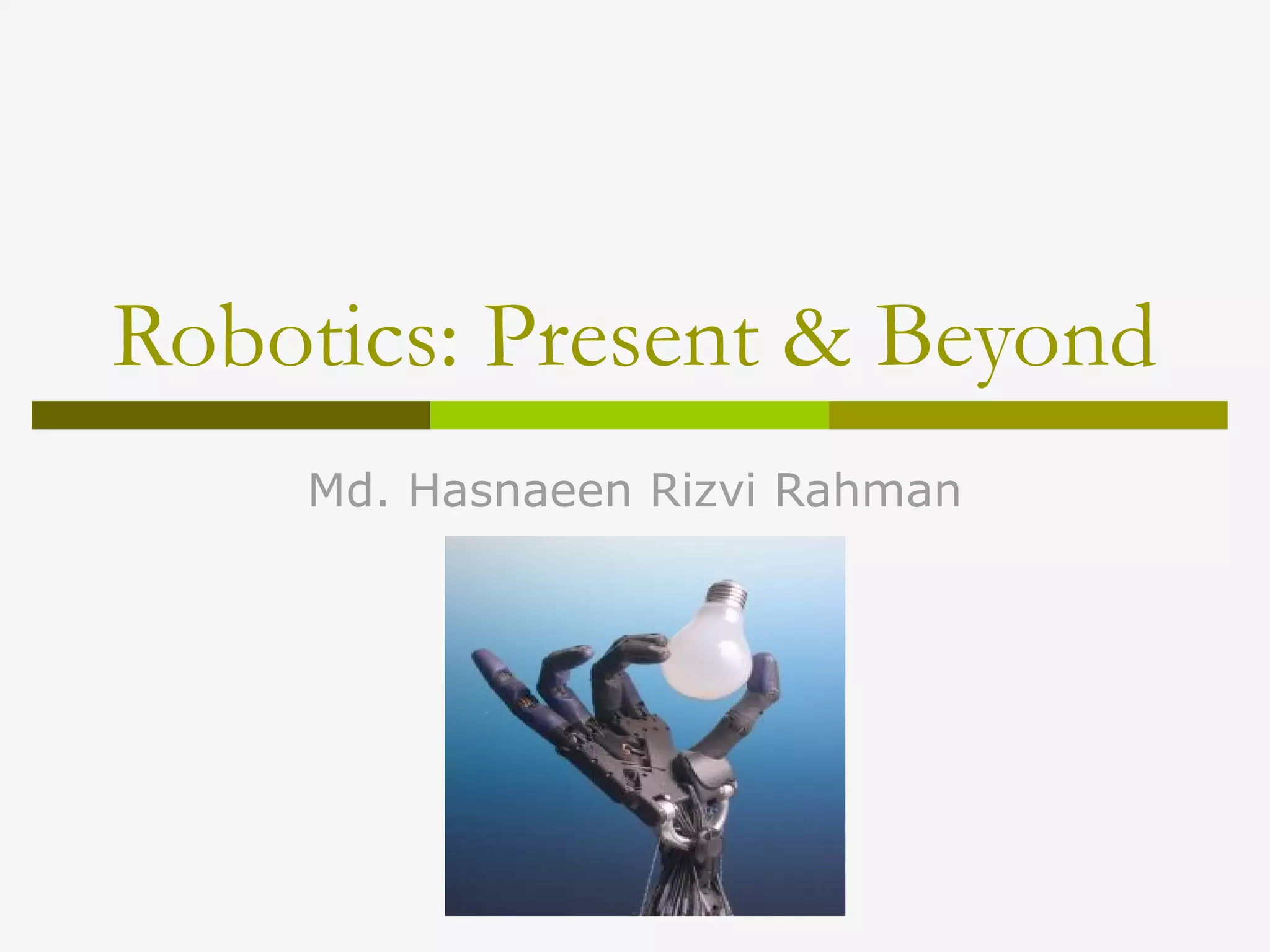
Robotics: Present & Beyond
Md. Hasnaeen Rizvi Rahman
Overview
 Robotics - the science and
technology of robots, their
design, manufacture, and
application.
 Requires a working
knowledge of electronics,
mechanics and software
accompanied by a large
working knowledge of
many subjects.
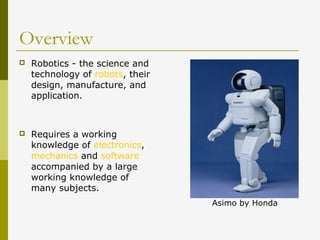
Asimo by Honda
History
 "Robot" coined by science fiction
author Karel Čapek, a Nobel
Prize nominee, in his 1920
theater play R.U.R. (Rossum's
Universal Robots)
 Robota meaning "self labor" or
"hard work" in Czech
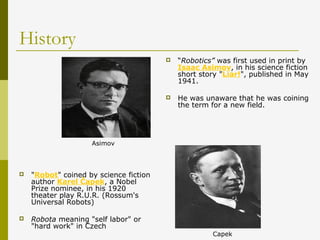
 “Robotics” was first used in print by
Isaac Asimov, in his science fiction
short story "Liar!", published in May
1941.
 He was unaware that he was coining
the term for a new field.
Asimov
Capek
History continued
 In the Iliad, the god Hephaestus made talking handmaidens out of gold.
 Archytas of Tarentum is credited with creating a mechanical Pigeon in 400 BC.
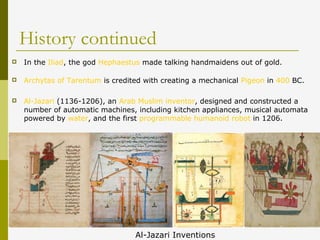
 Al-Jazari (1136-1206), an Arab Muslim inventor, designed and constructed a
number of automatic machines, including kitchen appliances, musical automata
powered by water, and the first programmable humanoid robot in 1206.
Al-Jazari Inventions
History continued
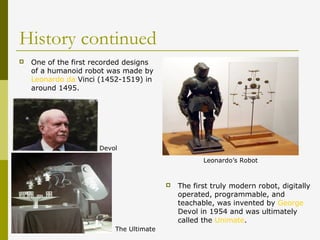
 One of the first recorded designs
of a humanoid robot was made by
Leonardo da Vinci (1452-1519) in
around 1495.
 The first truly modern robot, digitally
operated, programmable, and
teachable, was invented by George
Devol in 1954 and was ultimately
called the Unimate.
Leonardo’s Robot
Devol
The Ultimate
Definition
 A robot is a mechanical or virtual, artificial agent.
 It is usually a system, which, by its appearance or movements, conveys a
sense that it has intent or agency of its own.
 The word robot can refer to both physical robots and virtual
software agents, but the latter are usually referred to as bots to
differentiate.
 A typical robot will have several, though not necessarily all of the following
properties:
 is not 'natural' i.e. artificially created
 can sense its environment, and manipulate or interact with things in it
 has some ability to make choices based on the environment, often using
automatic control or a preprogrammed sequence
 is programmable
Definition continued
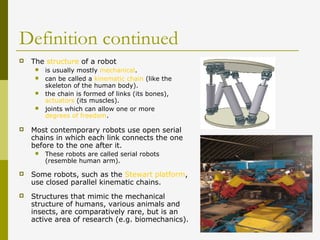
 The structure of a robot
 is usually mostly mechanical.
 can be called a kinematic chain (like the
skeleton of the human body).
 the chain is formed of links (its bones),
actuators (its muscles).
 joints which can allow one or more
degrees of freedom.
 Most contemporary robots use open serial
chains in which each link connects the one
before to the one after it.
 These robots are called serial robots
(resemble human arm).
 Some robots, such as the Stewart platform,
use closed parallel kinematic chains.
 Structures that mimic the mechanical
structure of humans, various animals and
insects, are comparatively rare, but is an
active area of research (e.g. biomechanics).
Components of robots - Actuation
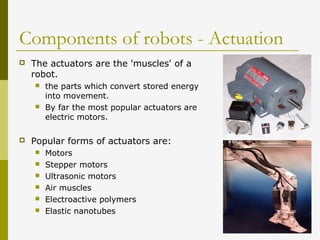
 The actuators are the 'muscles' of a
robot.
 the parts which convert stored energy
into movement.
 By far the most popular actuators are
electric motors.
 Popular forms of actuators are:
 Motors
 Stepper motors
 Ultrasonic motors
 Air muscles
 Electroactive polymers
 Elastic nanotubes
Components of robots - Manipulation
 This is the process of manipulating objects in
the external environment
 pick up, modify, destroy or otherwise have an
effect.
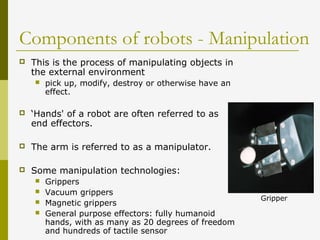
 ‘Hands' of a robot are often referred to as
end effectors.
 The arm is referred to as a manipulator.
 Some manipulation technologies:
 Grippers
 Vacuum grippers
 Magnetic grippers
 General purpose effectors: fully humanoid
hands, with as many as 20 degrees of freedom
and hundreds of tactile sensor
Gripper
Components of robots - Locomotion
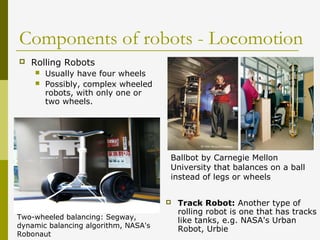
 Rolling Robots
 Usually have four wheels
 Possibly, complex wheeled
robots, with only one or
two wheels.
 Track Robot: Another type of
rolling robot is one that has tracks
like tanks, e.g. NASA's Urban
Robot, Urbie
Two-wheeled balancing: Segway,
dynamic balancing algorithm, NASA's
Robonaut
Ballbot by Carnegie Mellon
University that balances on a ball
instead of legs or wheels
Components of robots - Locomotion
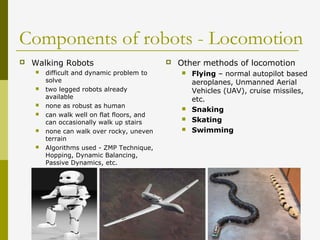
 Walking Robots
 difficult and dynamic problem to
solve
 two legged robots already
available
 none as robust as human
 can walk well on flat floors, and
can occasionally walk up stairs
 none can walk over rocky, uneven
terrain
 Algorithms used - ZMP Technique,
Hopping, Dynamic Balancing,
Passive Dynamics, etc.
 Other methods of locomotion
 Flying – normal autopilot based
aeroplanes, Unmanned Aerial
Vehicles (UAV), cruise missiles,
etc.
 Snaking
 Skating
 Swimming
Components of robots - Human interaction
 Speech recognition – difficult
task for a computer, mostly
because of the great variability of
speech.
 Gestures – e.g. human hand
gestures
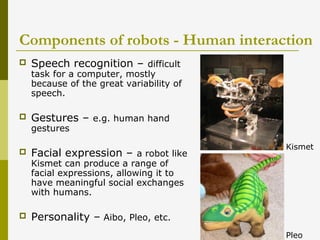
 Facial expression – a robot like
Kismet can produce a range of
facial expressions, allowing it to
have meaningful social exchanges
with humans.
 Personality – Aibo, Pleo, etc.
Kismet
Pleo
Contemporary uses
 Robots are used in industrial,
military, exploration, home making,
and academic and research
applications.
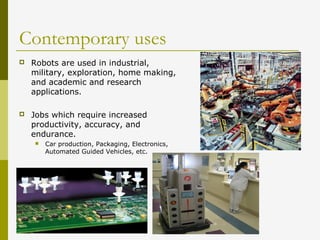
 Jobs which require increased
productivity, accuracy, and
endurance.
 Car production, Packaging, Electronics,
Automated Guided Vehicles, etc.
Contemporary uses
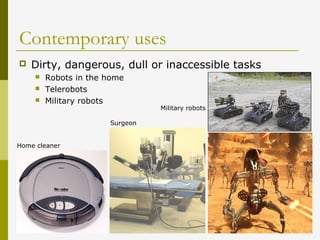
 Dirty, dangerous, dull or inaccessible tasks
 Robots in the home
 Telerobots
 Military robots
Home cleaner
Surgeon
Military robots
Contemporary uses
 Unconventional robots
 Nanorobots
 Soft robots
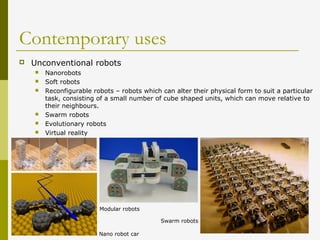
 Reconfigurable robots – robots which can alter their physical form to suit a particular
task, consisting of a small number of cube shaped units, which can move relative to
their neighbours.
 Swarm robots
 Evolutionary robots
 Virtual reality
Modular robots
Nano robot car
Swarm robots
Contemporary uses
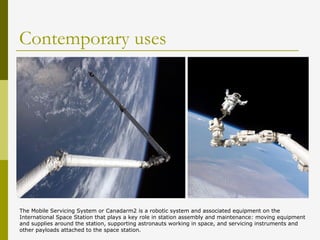
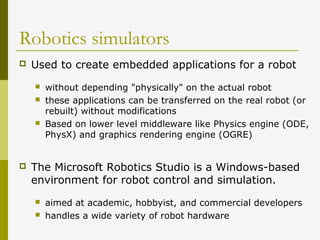
The Mobile Servicing System or Canadarm2 is a robotic system and associated equipment on the
International Space Station that plays a key role in station assembly and maintenance: moving equipment
and supplies around the station, supporting astronauts working in space, and servicing instruments and
other payloads attached to the space station.
Robotics simulators
 Used to create embedded applications for a robot
 without depending "physically" on the actual robot
 these applications can be transferred on the real robot (or
rebuilt) without modifications
 Based on lower level middleware like Physics engine (ODE,
PhysX) and graphics rendering engine (OGRE)
 The Microsoft Robotics Studio is a Windows-based
environment for robot control and simulation.
 aimed at academic, hobbyist, and commercial developers
 handles a wide variety of robot hardware
Robotics simulators
 Features include:
 a visual programming tool, Microsoft Visual Programming Language, for creating and
debugging robot applications
 web-based and windows-based interfaces
 3D simulation (including hardware acceleration)
 a lightweight services-oriented runtime
 easy access to a robot's sensors and actuators via a .NET-based concurrent library
implementation
 support for a number of languages including C# and Visual Basic .NET, JScript, and
IronPython
 Location technologies including GPS
 Speech technologies including text to speech and speech recognition
 Vision technologies including color tracking, line tracking, and simplified face and
hand gesture detection
Dangers and fears
 Current robots don’t pose any threat
or danger to society.
 Fears and concerns about robots have
been repeatedly expressed in a wide
range of books and films.
 The principal theme is the robots'
intelligence and ability to act could
exceed that of humans
 they could develop a conscience and a
motivation to take over or destroy the
human race
 Robots could be dangerous if
 programmed to kill
 programmed to be so smart that they
make their own software
 build their own hardware to upgrade
themselves
 change their own source code
 Robot Fatalities - The first human to
be killed by a robot was Robert
Williams who died at a casting plant in
Flat Rock, MI (January 25, 1979).
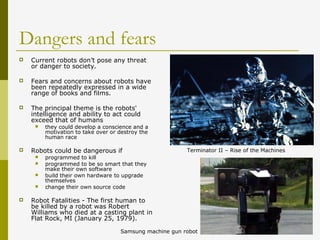
Terminator II – Rise of the Machines
Samsung machine gun robot
Literature
 Three Laws of Robotics
 a set of three rules written by Isaac Asimov in his 1942 short story
"Runaround“.
 First law: A robot may not injure a human being or, through inaction,
allow a human being to come to harm.
 Second law: A robot must obey orders given to it by human beings,
except where such orders would conflict with the First Law.
 Third law: A robot must protect its own existence as long as such
protection does not conflict with the First or Second Law.
 Two more laws introduced later by other writers.
 Fourth law: A robot must establish its identity as a robot in all cases.
 Fifth law: A robot must know it is a robot.
 Roboticists sometimes see the these laws as a future ideal.
Future of robotics
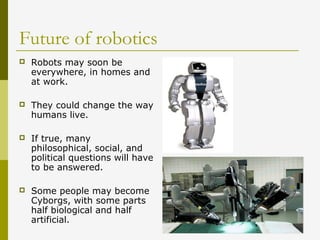
 Robots may soon be
everywhere, in homes and
at work.
 They could change the way
humans live.
 If true, many
philosophical, social, and
political questions will have
to be answered.
 Some people may become
Cyborgs, with some parts
half biological and half
artificial.
Future of robotics
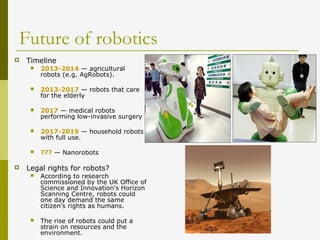
 Timeline
 2013-2014 — agricultural
robots (e.g. AgRobots).
 2013-2017 — robots that care
for the elderly
 2017 — medical robots
performing low-invasive surgery
 2017-2019 — household robots
with full use.
 ??? — Nanorobots
 Legal rights for robots?
 According to research
commissioned by the UK Office of
Science and Innovation's Horizon
Scanning Centre, robots could
one day demand the same
citizen's rights as humans.
 The rise of robots could put a
strain on resources and the
environment.
Robotics in 2020 and beyond
 Home, factories, agriculture, building &
construction, undersea, space, mining,
hospitals and streets; for repair,
construction, maintenance, security,
entertainment, companionship, care.
 Only our imagination is the limit.
 Robot civilization is coming. Stay tuned.
Copotronic
Thank you

Robotics

  • 1.
    Robotics: Present &Beyond Md. Hasnaeen Rizvi Rahman
  • 2.
    Overview  Robotics -the science and technology of robots, their design, manufacture, and application.  Requires a working knowledge of electronics, mechanics and software accompanied by a large working knowledge of many subjects. Asimo by Honda
  • 3.
    History  "Robot" coinedby science fiction author Karel Čapek, a Nobel Prize nominee, in his 1920 theater play R.U.R. (Rossum's Universal Robots)  Robota meaning "self labor" or "hard work" in Czech  “Robotics” was first used in print by Isaac Asimov, in his science fiction short story "Liar!", published in May 1941.  He was unaware that he was coining the term for a new field. Asimov Capek
  • 4.
    History continued  Inthe Iliad, the god Hephaestus made talking handmaidens out of gold.  Archytas of Tarentum is credited with creating a mechanical Pigeon in 400 BC.  Al-Jazari (1136-1206), an Arab Muslim inventor, designed and constructed a number of automatic machines, including kitchen appliances, musical automata powered by water, and the first programmable humanoid robot in 1206. Al-Jazari Inventions
  • 5.
    History continued  Oneof the first recorded designs of a humanoid robot was made by Leonardo da Vinci (1452-1519) in around 1495.  The first truly modern robot, digitally operated, programmable, and teachable, was invented by George Devol in 1954 and was ultimately called the Unimate. Leonardo’s Robot Devol The Ultimate
  • 6.
    Definition  A robotis a mechanical or virtual, artificial agent.  It is usually a system, which, by its appearance or movements, conveys a sense that it has intent or agency of its own.  The word robot can refer to both physical robots and virtual software agents, but the latter are usually referred to as bots to differentiate.  A typical robot will have several, though not necessarily all of the following properties:  is not 'natural' i.e. artificially created  can sense its environment, and manipulate or interact with things in it  has some ability to make choices based on the environment, often using automatic control or a preprogrammed sequence  is programmable
  • 7.
    Definition continued  Thestructure of a robot  is usually mostly mechanical.  can be called a kinematic chain (like the skeleton of the human body).  the chain is formed of links (its bones), actuators (its muscles).  joints which can allow one or more degrees of freedom.  Most contemporary robots use open serial chains in which each link connects the one before to the one after it.  These robots are called serial robots (resemble human arm).  Some robots, such as the Stewart platform, use closed parallel kinematic chains.  Structures that mimic the mechanical structure of humans, various animals and insects, are comparatively rare, but is an active area of research (e.g. biomechanics).
  • 8.
    Components of robots- Actuation  The actuators are the 'muscles' of a robot.  the parts which convert stored energy into movement.  By far the most popular actuators are electric motors.  Popular forms of actuators are:  Motors  Stepper motors  Ultrasonic motors  Air muscles  Electroactive polymers  Elastic nanotubes
  • 9.
    Components of robots- Manipulation  This is the process of manipulating objects in the external environment  pick up, modify, destroy or otherwise have an effect.  ‘Hands' of a robot are often referred to as end effectors.  The arm is referred to as a manipulator.  Some manipulation technologies:  Grippers  Vacuum grippers  Magnetic grippers  General purpose effectors: fully humanoid hands, with as many as 20 degrees of freedom and hundreds of tactile sensor Gripper
  • 10.
    Components of robots- Locomotion  Rolling Robots  Usually have four wheels  Possibly, complex wheeled robots, with only one or two wheels.  Track Robot: Another type of rolling robot is one that has tracks like tanks, e.g. NASA's Urban Robot, Urbie Two-wheeled balancing: Segway, dynamic balancing algorithm, NASA's Robonaut Ballbot by Carnegie Mellon University that balances on a ball instead of legs or wheels
  • 11.
    Components of robots- Locomotion  Walking Robots  difficult and dynamic problem to solve  two legged robots already available  none as robust as human  can walk well on flat floors, and can occasionally walk up stairs  none can walk over rocky, uneven terrain  Algorithms used - ZMP Technique, Hopping, Dynamic Balancing, Passive Dynamics, etc.  Other methods of locomotion  Flying – normal autopilot based aeroplanes, Unmanned Aerial Vehicles (UAV), cruise missiles, etc.  Snaking  Skating  Swimming
  • 12.
    Components of robots- Human interaction  Speech recognition – difficult task for a computer, mostly because of the great variability of speech.  Gestures – e.g. human hand gestures  Facial expression – a robot like Kismet can produce a range of facial expressions, allowing it to have meaningful social exchanges with humans.  Personality – Aibo, Pleo, etc. Kismet Pleo
  • 13.
    Contemporary uses  Robotsare used in industrial, military, exploration, home making, and academic and research applications.  Jobs which require increased productivity, accuracy, and endurance.  Car production, Packaging, Electronics, Automated Guided Vehicles, etc.
  • 14.
    Contemporary uses  Dirty,dangerous, dull or inaccessible tasks  Robots in the home  Telerobots  Military robots Home cleaner Surgeon Military robots
  • 15.
    Contemporary uses  Unconventionalrobots  Nanorobots  Soft robots  Reconfigurable robots – robots which can alter their physical form to suit a particular task, consisting of a small number of cube shaped units, which can move relative to their neighbours.  Swarm robots  Evolutionary robots  Virtual reality Modular robots Nano robot car Swarm robots
  • 16.
    Contemporary uses The MobileServicing System or Canadarm2 is a robotic system and associated equipment on the International Space Station that plays a key role in station assembly and maintenance: moving equipment and supplies around the station, supporting astronauts working in space, and servicing instruments and other payloads attached to the space station.
  • 17.
    Robotics simulators  Usedto create embedded applications for a robot  without depending "physically" on the actual robot  these applications can be transferred on the real robot (or rebuilt) without modifications  Based on lower level middleware like Physics engine (ODE, PhysX) and graphics rendering engine (OGRE)  The Microsoft Robotics Studio is a Windows-based environment for robot control and simulation.  aimed at academic, hobbyist, and commercial developers  handles a wide variety of robot hardware
  • 18.
    Robotics simulators  Featuresinclude:  a visual programming tool, Microsoft Visual Programming Language, for creating and debugging robot applications  web-based and windows-based interfaces  3D simulation (including hardware acceleration)  a lightweight services-oriented runtime  easy access to a robot's sensors and actuators via a .NET-based concurrent library implementation  support for a number of languages including C# and Visual Basic .NET, JScript, and IronPython  Location technologies including GPS  Speech technologies including text to speech and speech recognition  Vision technologies including color tracking, line tracking, and simplified face and hand gesture detection
  • 19.
    Dangers and fears Current robots don’t pose any threat or danger to society.  Fears and concerns about robots have been repeatedly expressed in a wide range of books and films.  The principal theme is the robots' intelligence and ability to act could exceed that of humans  they could develop a conscience and a motivation to take over or destroy the human race  Robots could be dangerous if  programmed to kill  programmed to be so smart that they make their own software  build their own hardware to upgrade themselves  change their own source code  Robot Fatalities - The first human to be killed by a robot was Robert Williams who died at a casting plant in Flat Rock, MI (January 25, 1979). Terminator II – Rise of the Machines Samsung machine gun robot
  • 20.
    Literature  Three Lawsof Robotics  a set of three rules written by Isaac Asimov in his 1942 short story "Runaround“.  First law: A robot may not injure a human being or, through inaction, allow a human being to come to harm.  Second law: A robot must obey orders given to it by human beings, except where such orders would conflict with the First Law.  Third law: A robot must protect its own existence as long as such protection does not conflict with the First or Second Law.  Two more laws introduced later by other writers.  Fourth law: A robot must establish its identity as a robot in all cases.  Fifth law: A robot must know it is a robot.  Roboticists sometimes see the these laws as a future ideal.
  • 21.
    Future of robotics Robots may soon be everywhere, in homes and at work.  They could change the way humans live.  If true, many philosophical, social, and political questions will have to be answered.  Some people may become Cyborgs, with some parts half biological and half artificial.
  • 22.
    Future of robotics Timeline  2013-2014 — agricultural robots (e.g. AgRobots).  2013-2017 — robots that care for the elderly  2017 — medical robots performing low-invasive surgery  2017-2019 — household robots with full use.  ??? — Nanorobots  Legal rights for robots?  According to research commissioned by the UK Office of Science and Innovation's Horizon Scanning Centre, robots could one day demand the same citizen's rights as humans.  The rise of robots could put a strain on resources and the environment.
  • 23.
    Robotics in 2020and beyond  Home, factories, agriculture, building & construction, undersea, space, mining, hospitals and streets; for repair, construction, maintenance, security, entertainment, companionship, care.  Only our imagination is the limit.  Robot civilization is coming. Stay tuned.
  • 24.