Robotic Welding
R.SRIDHAR
15MC010 M.E.MECHATRONICS
THIYAGARAJAR COLLEGE OF ENGINERING
Outline
1. Robot Technology State of the Art
2. Robot environment and Driving Forces to Automation
3. Difficulties in Automation
4. Improvements needed in the near future.
5. Welding Application - Overview
6. Software architecture
7. Remote Services
8. Adding equipment
9. Conclusions
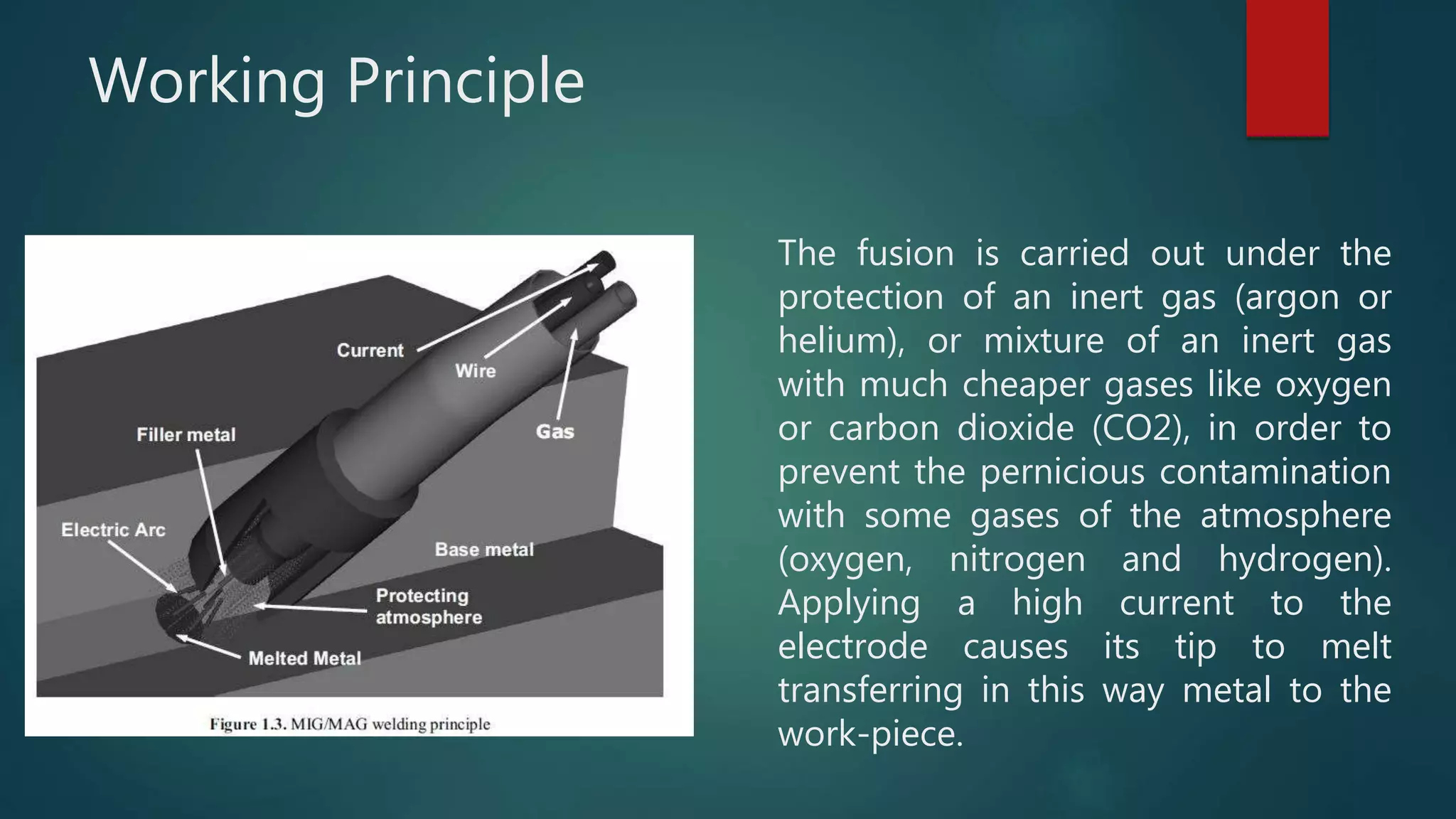
Working Principle
The fusion is carried out under the
protection of an inert gas (argon or
helium), or mixture of an inert gas
with much cheaper gases like oxygen
or carbon dioxide (CO2), in order to
prevent the pernicious contamination
with some gases of the atmosphere
(oxygen, nitrogen and hydrogen).
Applying a high current to the
electrode causes its tip to melt
transferring in this way metal to the
work-piece.
Contn..
 The experienced and skilled manual welder is able to select the
welding process parameters based on similar cases previously
encountered. In particular, he is able to:
1. Select the type of shielding gas, the
2.type and diameter of wire to use,
3.and the initial current and voltage settings more suitable
for the case in hand.
4. Adjust continuously the process variables by looking to
the molten pool or by listening to the sound produced by the arc.
5. Maintain the torch in the correct position with precision
and stability, which is fundamental for a good and constant weld.
Welding Technology
 Gas Tungsten Arc Welding / TIG Welding
-welding process where the arc is created between a non consumable
electrode and the work metal.
 Gas Metal Arc Welding /MIG Welding
-welding process, uses the heat of the electric arc to melt the
consumable electrode wire and the metallic components to be welded.
 Laser Beam Welding
 Resistor Spot Welding
 Friction Stir Welding
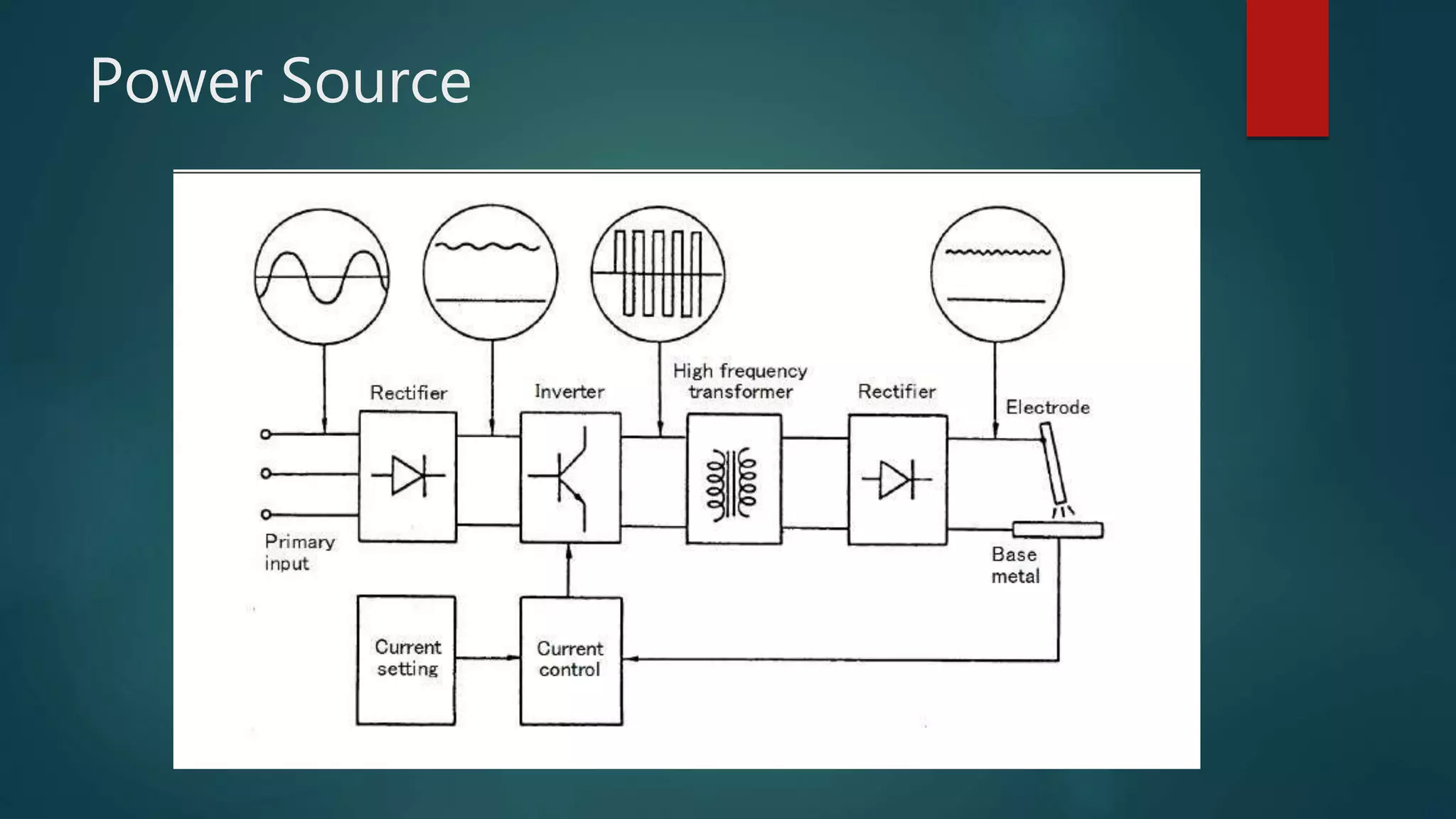
Power Source
Considering Parameters
 The input data is generally the
Type of weld
-butt weld or
-fillet weld
The welding position
-flat,
-horizontal
-vertical or
-overhead
 The output data is usually the welding parameters namely
-current
-voltage
-welding speed and number of weld beads/layers
Common Welding Joints
What is Robotics
 And how do we define robotics then? Is it a science? Is it a
technique or collection of techniques? If the reader takes a
robotics book then something like this appears:
“A robot is a re-programmable multi-functional manipulator
designed to move materials, parts, tools, or specialized devices,
through variable programmed motions for the performance of a
variety of tasks”, from the book Robotics – Control, Sensing,
Vision and Intelligence, Fu, Gonzalez, Lee, MacGraw Hill, 1987.”
Why to Automate Welding?
 Actually robot manipulators are interesting machines in terms of flexibility,
programmability and precision.
 perform industrial tasks in a human-like manner with at least comparable
quality for longer periods of time.
 Robots manipulators present the best rate between “production cost” and
“production volume” for small/medium production volumes
 are unique flexible machines (mainly due to programmability) that can be
adapted to perform very different tasks. Consequently
Manufacture of Welding Robots
1. Yaskawa / Motomam
2. FUNUC
3. ABB
4. KUKA
5. KAWASAKI
6. COMAU
7. PANASONIC,COOLS,NACHI
Robot Manipulator And Parameters
A T-pipe representing a type of work-piece
that should benefit from a seam
tracker which can compensate for both
position and orientation changes
Features of Robot Manipulators
 Programmable control system, using powerful programming languages and environments.
 It is possible to define positions/orientations, define reference systems, parameterize
trajectories and other actions, and play that continuously with high precision and
repeatability.
 Advanced PLC capabilities are also available, namely, IO control and data acquisition, and
several communication interfaces and protocols. These functionalities enable robots to
coordinate actions with other equipment's and sensors, and being integrated with other
computers and manufacturing systems existing in the setup.
Sensors for Welding Robots
 1. Sensors for Technological Parameters
Arc Voltage
Welding Current
Hall Effect Sensor
Current Shunt
 Sensors for Geometrical Parameters
Optical Sensors
Through-arc Sensing
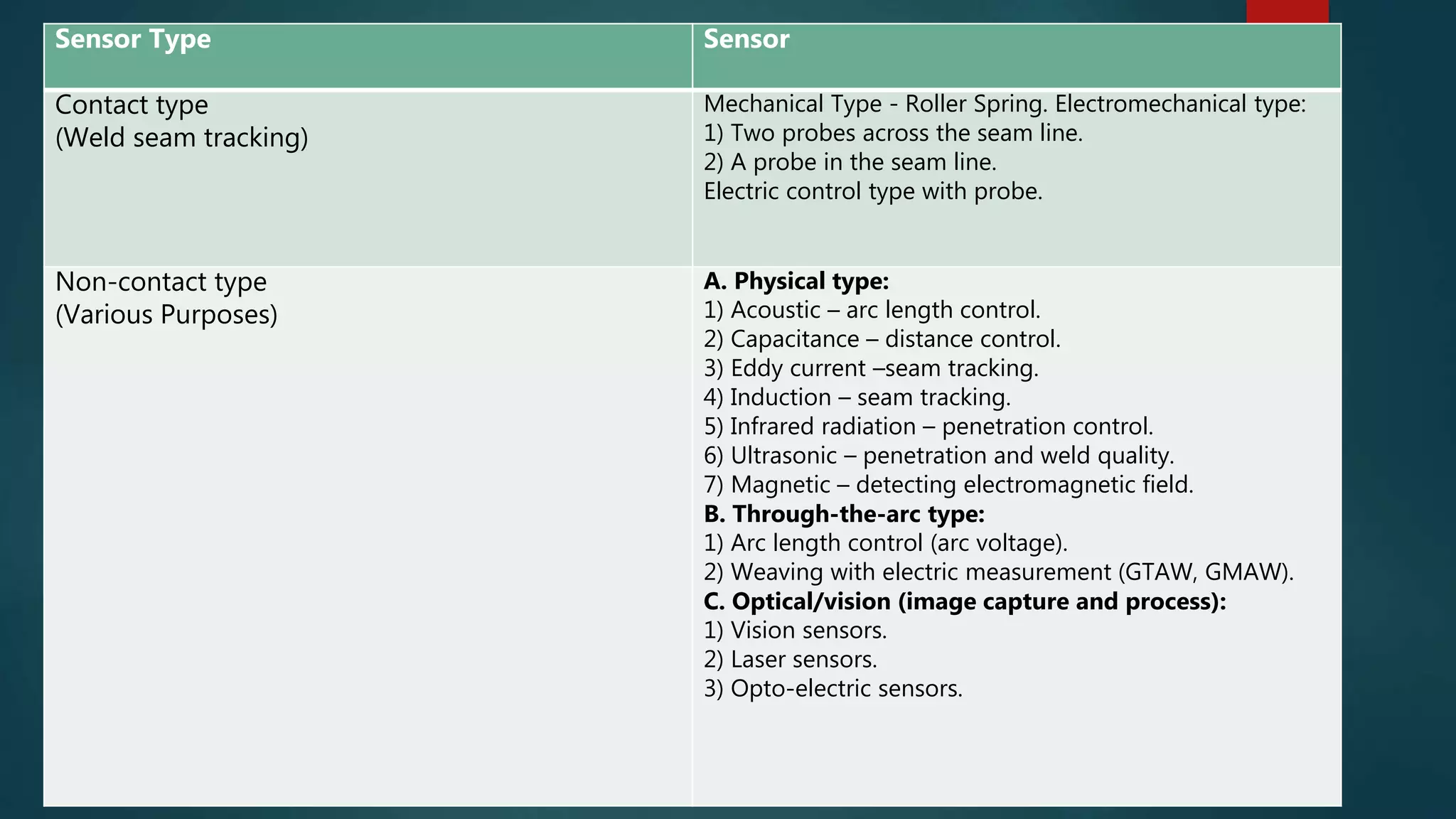
Sensor Type Sensor
Contact type
(Weld seam tracking)
Mechanical Type - Roller Spring. Electromechanical type:
1) Two probes across the seam line.
2) A probe in the seam line.
Electric control type with probe.
Non-contact type
(Various Purposes)
A. Physical type:
1) Acoustic – arc length control.
2) Capacitance – distance control.
3) Eddy current –seam tracking.
4) Induction – seam tracking.
5) Infrared radiation – penetration control.
6) Ultrasonic – penetration and weld quality.
7) Magnetic – detecting electromagnetic field.
B. Through-the-arc type:
1) Arc length control (arc voltage).
2) Weaving with electric measurement (GTAW, GMAW).
C. Optical/vision (image capture and process):
1) Vision sensors.
2) Laser sensors.
3) Opto-electric sensors.
Fault Detection Using Monitoring
 Parameters in GMAW which affect the weld penetration and bead
geometry are for example:
Welding current
Arc voltage
Welding speed
Wire feed rate
Electrode extension
Electrode composition and diameter
Shielded gas composition and flow rate
Robotic Welding: System Issues
 Preparation phase: where the welding operator sets up the parts to be
welded, the welding apparatus (power source, robot, robot program,
etc.) and the welding parameters. The type of gas and the type of wire
are also selected in this phase
 Welding Phase the system should be able to maintain the torch
orientation while following the desired trajectory (that may be different
from the 106 Welding Robots planned one), perform seam tracking and
change welding parameters in real-time.
 Analysis Phase When advance sensors are used, like laser 3D cameras,
this phase can be executed on-line during the welding phase. This is
particularly interesting since evaluation of welding quality on-line may
influence the ongoing welding process.
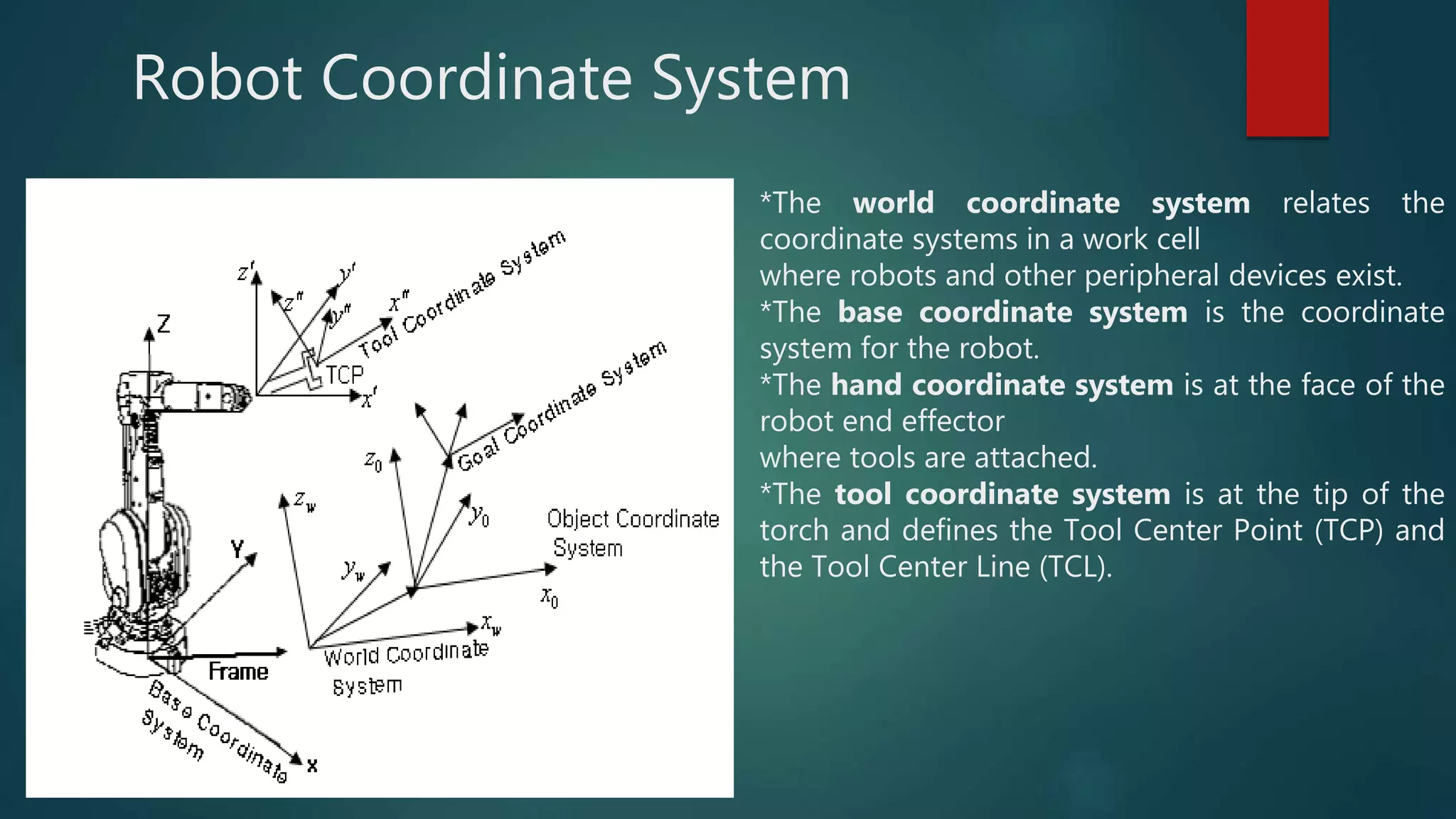
Robot Coordinate System
*The world coordinate system relates the
coordinate systems in a work cell
where robots and other peripheral devices exist.
*The base coordinate system is the coordinate
system for the robot.
*The hand coordinate system is at the face of the
robot end effector
where tools are attached.
*The tool coordinate system is at the tip of the
torch and defines the Tool Center Point (TCP) and
the Tool Center Line (TCL).
Trends in Welding Automation
Technologies in Actual Fabrication
 Unmanned Robot Welding System
 Narrow Gap Welding of Heavy Plates
 Field Girth Welding of Gas Pipelines
 Rail Welding Technologies
THANK YOU

Robotic welding

  • 1.
  • 2.
    Outline 1. Robot TechnologyState of the Art 2. Robot environment and Driving Forces to Automation 3. Difficulties in Automation 4. Improvements needed in the near future. 5. Welding Application - Overview 6. Software architecture 7. Remote Services 8. Adding equipment 9. Conclusions
  • 3.
    Working Principle The fusionis carried out under the protection of an inert gas (argon or helium), or mixture of an inert gas with much cheaper gases like oxygen or carbon dioxide (CO2), in order to prevent the pernicious contamination with some gases of the atmosphere (oxygen, nitrogen and hydrogen). Applying a high current to the electrode causes its tip to melt transferring in this way metal to the work-piece.
  • 4.
    Contn..  The experiencedand skilled manual welder is able to select the welding process parameters based on similar cases previously encountered. In particular, he is able to: 1. Select the type of shielding gas, the 2.type and diameter of wire to use, 3.and the initial current and voltage settings more suitable for the case in hand. 4. Adjust continuously the process variables by looking to the molten pool or by listening to the sound produced by the arc. 5. Maintain the torch in the correct position with precision and stability, which is fundamental for a good and constant weld.
  • 5.
    Welding Technology  GasTungsten Arc Welding / TIG Welding -welding process where the arc is created between a non consumable electrode and the work metal.  Gas Metal Arc Welding /MIG Welding -welding process, uses the heat of the electric arc to melt the consumable electrode wire and the metallic components to be welded.  Laser Beam Welding  Resistor Spot Welding  Friction Stir Welding
  • 7.
  • 8.
    Considering Parameters  Theinput data is generally the Type of weld -butt weld or -fillet weld The welding position -flat, -horizontal -vertical or -overhead  The output data is usually the welding parameters namely -current -voltage -welding speed and number of weld beads/layers
  • 9.
  • 10.
    What is Robotics And how do we define robotics then? Is it a science? Is it a technique or collection of techniques? If the reader takes a robotics book then something like this appears: “A robot is a re-programmable multi-functional manipulator designed to move materials, parts, tools, or specialized devices, through variable programmed motions for the performance of a variety of tasks”, from the book Robotics – Control, Sensing, Vision and Intelligence, Fu, Gonzalez, Lee, MacGraw Hill, 1987.”
  • 11.
    Why to AutomateWelding?  Actually robot manipulators are interesting machines in terms of flexibility, programmability and precision.  perform industrial tasks in a human-like manner with at least comparable quality for longer periods of time.  Robots manipulators present the best rate between “production cost” and “production volume” for small/medium production volumes  are unique flexible machines (mainly due to programmability) that can be adapted to perform very different tasks. Consequently
  • 12.
    Manufacture of WeldingRobots 1. Yaskawa / Motomam 2. FUNUC 3. ABB 4. KUKA 5. KAWASAKI 6. COMAU 7. PANASONIC,COOLS,NACHI
  • 13.
    Robot Manipulator AndParameters A T-pipe representing a type of work-piece that should benefit from a seam tracker which can compensate for both position and orientation changes
  • 14.
    Features of RobotManipulators  Programmable control system, using powerful programming languages and environments.  It is possible to define positions/orientations, define reference systems, parameterize trajectories and other actions, and play that continuously with high precision and repeatability.  Advanced PLC capabilities are also available, namely, IO control and data acquisition, and several communication interfaces and protocols. These functionalities enable robots to coordinate actions with other equipment's and sensors, and being integrated with other computers and manufacturing systems existing in the setup.
  • 15.
    Sensors for WeldingRobots  1. Sensors for Technological Parameters Arc Voltage Welding Current Hall Effect Sensor Current Shunt  Sensors for Geometrical Parameters Optical Sensors Through-arc Sensing
  • 16.
    Sensor Type Sensor Contacttype (Weld seam tracking) Mechanical Type - Roller Spring. Electromechanical type: 1) Two probes across the seam line. 2) A probe in the seam line. Electric control type with probe. Non-contact type (Various Purposes) A. Physical type: 1) Acoustic – arc length control. 2) Capacitance – distance control. 3) Eddy current –seam tracking. 4) Induction – seam tracking. 5) Infrared radiation – penetration control. 6) Ultrasonic – penetration and weld quality. 7) Magnetic – detecting electromagnetic field. B. Through-the-arc type: 1) Arc length control (arc voltage). 2) Weaving with electric measurement (GTAW, GMAW). C. Optical/vision (image capture and process): 1) Vision sensors. 2) Laser sensors. 3) Opto-electric sensors.
  • 17.
    Fault Detection UsingMonitoring  Parameters in GMAW which affect the weld penetration and bead geometry are for example: Welding current Arc voltage Welding speed Wire feed rate Electrode extension Electrode composition and diameter Shielded gas composition and flow rate
  • 18.
    Robotic Welding: SystemIssues  Preparation phase: where the welding operator sets up the parts to be welded, the welding apparatus (power source, robot, robot program, etc.) and the welding parameters. The type of gas and the type of wire are also selected in this phase  Welding Phase the system should be able to maintain the torch orientation while following the desired trajectory (that may be different from the 106 Welding Robots planned one), perform seam tracking and change welding parameters in real-time.  Analysis Phase When advance sensors are used, like laser 3D cameras, this phase can be executed on-line during the welding phase. This is particularly interesting since evaluation of welding quality on-line may influence the ongoing welding process.
  • 19.
    Robot Coordinate System *Theworld coordinate system relates the coordinate systems in a work cell where robots and other peripheral devices exist. *The base coordinate system is the coordinate system for the robot. *The hand coordinate system is at the face of the robot end effector where tools are attached. *The tool coordinate system is at the tip of the torch and defines the Tool Center Point (TCP) and the Tool Center Line (TCL).
  • 20.
    Trends in WeldingAutomation Technologies in Actual Fabrication  Unmanned Robot Welding System  Narrow Gap Welding of Heavy Plates  Field Girth Welding of Gas Pipelines  Rail Welding Technologies
  • 21.