vicky power point presentation robotic surgery.pptx
1.
Self Introduction
NAME :VIKAS
PIN NO : 23020-M-101
YEAR/SEM: 4TH
SEM D M E
TOPIC : ROBOTIC SURGERY
2.
Table of contents
Introduction
What is robotic surgery
Benefits of Robotic surgery
Robotic surgery systems
Applications of robotic surgery
Advantages and disadvantages
Limitations of robotic surgery
Future technology
Conclusion
3.
What is roboticsurgery
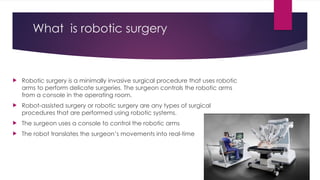
Robotic surgery is a minimally invasive surgical procedure that uses robotic
arms to perform delicate surgeries. The surgeon controls the robotic arms
from a console in the operating room.
Robot-assisted surgery or robotic surgery are any types of surgical
procedures that are performed using robotic systems.
The surgeon uses a console to control the robotic arms
The robot translates the surgeon’s movements into real-time
4.
Benefits of roboticsurgery
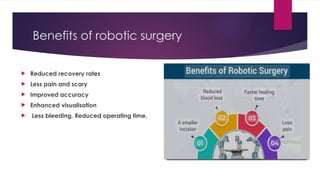
Reduced recovery rates
Less pain and scary
Improved accuracy
Enhanced visualisation
Less bleeding, Reduced operating time,
5.
Robotic surgery systems
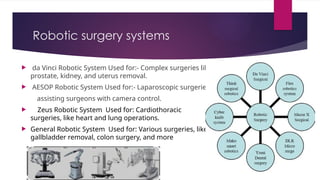
da Vinci Robotic System Used for:- Complex surgeries like
prostate, kidney, and uterus removal.
AESOP Robotic System Used for:- Laparoscopic surgeries,
assisting surgeons with camera control.
Zeus Robotic System Used for: Cardiothoracic
surgeries, like heart and lung operations.
General Robotic System Used for: Various surgeries, like
gallbladder removal, colon surgery, and more
6.
How does itworks
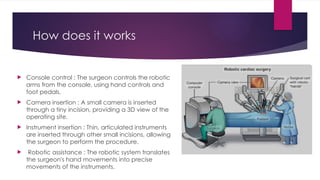
Console control : The surgeon controls the robotic
arms from the console, using hand controls and
foot pedals.
Camera insertion : A small camera is inserted
through a tiny incision, providing a 3D view of the
operating site.
Instrument insertion : Thin, articulated instruments
are inserted through other small incisions, allowing
the surgeon to perform the procedure.
Robotic assistance : The robotic system translates
the surgeon's hand movements into precise
movements of the instruments.
7.
Applications of roboticsurgery systems
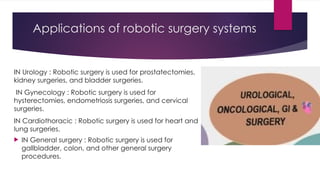
IN Urology : Robotic surgery is used for prostatectomies,
kidney surgeries, and bladder surgeries.
IN Gynecology : Robotic surgery is used for
hysterectomies, endometriosis surgeries, and cervical
surgeries.
IN Cardiothoracic : Robotic surgery is used for heart and
lung surgeries.
IN General surgery : Robotic surgery is used for
gallbladder, colon, and other general surgery
procedures.
8.
Advantages and disadvantages
Advantages:
1.Reduced blood loss
2. Faster recovery rate
3. Shorter hospital stay
Disadvantages:
4. High cost
5. Limited availability of trained surgeons
6. Technical issues and malfunctions
9.
Limitations of roboticsurgery
Steep learning curve for surgeons
Limited haptic feedback
Potential for robotic malfunction
Limited availability of robotic systems
10.
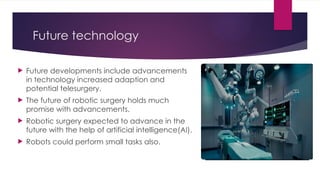
Future technology
Futuredevelopments include advancements
in technology increased adaption and
potential telesurgery.
The future of robotic surgery holds much
promise with advancements.
Robotic surgery expected to advance in the
future with the help of artificial intelligence(AI).
Robots could perform small tasks also.
11.
Conclusion
Robotic surgery isa revolutionary technology that has
transformed the field of surgery. With its many benefits,
including reduced recovery time, less pain and scarring,
improved accuracy and precision, and enhanced
visualization, robotic surgery has become a preferred
option for many patients and surgeons.