COMPUTER AUTOMATED SURGEON
Santhosh,Goku Raja ,venkatasen
Electronics and communication department
mailsandy02@gmail.com
gokulanddravid@gmail.com
clashofclans66669999@gmail.com
Abstract : Robotic surgery is a new and exciting emerging technology that is taking the surgical profession by storm. Up to
this point, however, the race to acquire and incorporate this emerging technology has primarily been driven by the market.
In addition, surgical robots have become the entry fee for centres wanting to be known for excellence in minimally invasive
surgery despite the current lack of practical applications. Therefore, robotic devices seem to have more of a marketing role
than a practical role. Whether or not robotic devices will grow into a more practical role remains to be seen.
Keywords: CNC,robotic surgery, laser treatment,autonomus
1. INTRODUCTION
The invention relates to a computer-aided surgery apparatus. More specifically, the invention relates to such an
apparatus which aids a surgeon in accurately positioning surgical instruments for performing surgical procedures on a
patient. The invention also relates to a linkage mechanism for connecting a fixed point on a portion of interest of a
patient (for example, a fixed point on a leg or arm of a patient) with a fixed point on the apparatus, and for maintaining
a fixed separation between the fixed points, whereby, to maintain a fixed relationship between the portion of interest of
the patient and the apparatus even when the portion of interest of the patient is being moved. Many surgical procedures,
particularly in the fields of orthopaedic surgery and neurosurgery, involve the careful placement and manipulation of
probes, cutting tools, drills and saws amongst a variety of surgical instruments .There are available mechanical
apparatus which are used for different surgical procedures to help the surgeon guide the surgical instruments to ensure
proper alignment. These alignment mechanisms must be referenced to certain anatomical landmarks and the set-up time
for the various alignment jigs can represent a significant portion of the total surgical duration. When surgical procedures
are required on, for example, unexposed tumours or the like, fluoroscopy is used to indicate to the surgeon the position
and orientation of the surgical procedure. This has the disadvantage of exposing a patient and physician to radiation. In
addition, the accuracy is less than adequate for precision requirements of the surgery. In addition, in procedures relating
to the cutting of bogey parts for the purposes of joint replacement, fracture repair or deformity correction, among others,
there is the problem of tool orientation such as drilling from point to point, sawing, locating planes in specific
orientations with other planes of specific orientations, etc. The problems of 3-dimensional control of the surgical
instruments becomes formidable. As above mentioned, some jigs exist for the performance of limited procedures
permitting safe and reproducible orientation of tools. However, these have the disadvantage of being less than adaptable
to variations that occur during surgical procedures. In addition, the limits of inaccuracy permissible for satisfactory
results during surgery leave many of the currently accepted techniques for surgical instrument control unacceptable.
Although the field of 3-dimensional imaging as represented in the techniques of MRI (magnetic resinence imaging) and
CAT scans (computer aided tomography) provide an abundance of 3-dimensional information concerning the locations
of, for example, unexposed tumours’, there is presently no interface between this information and the surgical processes
which provide remedies. Required is an apparatus which can transpose the information of the 3-dimensional imaging
systems from the reference system of the 3-dimensional imaging systems to a reference system of the apparatus.
'
A. Summary of Invention
It is therefore an object of the invention to provide a computer-aided surgery apparatus which provides
significant improvements over present technologies for aiding a surgeon in accurately positioning surgical instruments
for performing surgical procedures on a patient such as hole drilling, bone sawing, distance measurement and site
location (e.g. point to point distance, blind hole location), and stereotaxic aiming and locating. It is a more specific
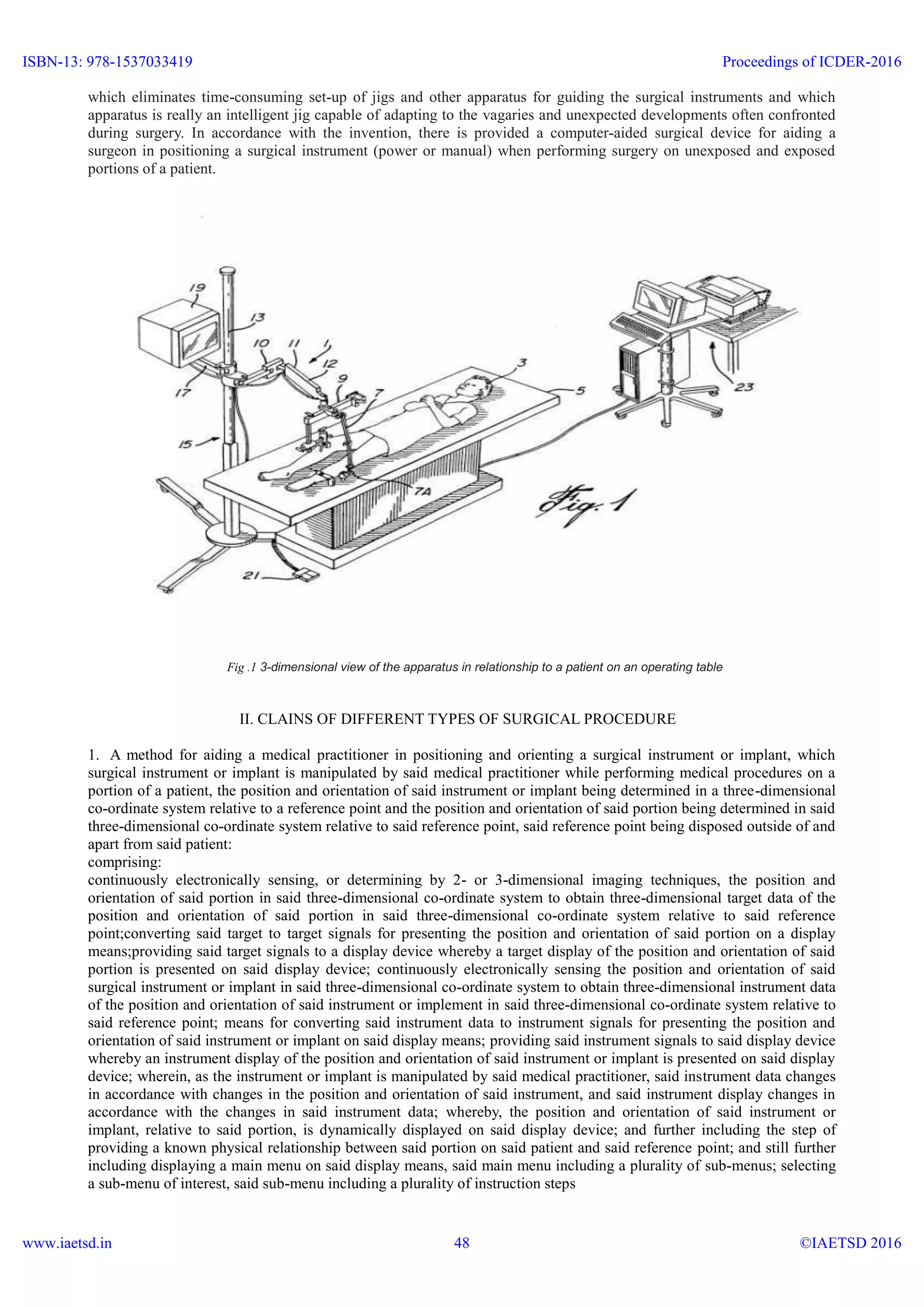
object of the invention to provide such an apparatus which includes a computer driven precision instrumented linkage
attached to a surgical instrument and providing the surgeon with instantaneous and continuous feedback on 3-
dimensional orientation of the tool. It is a still further object of the invention to provide such a linkage which can also
be used as an independent anatomical point digitizer so that important reference landmarks can be located and
subsequently used as points of reference for surgery. It is a still further object of the invention to provide an apparatus
ISBN-13: 978-1537033419
www.iaetsd.in
Proceedings of ICDER-2016
©IAETSD 201647
which eliminates time-consuming set-up of jigs and other apparatus for guiding the surgical instruments and which
apparatus is really an intelligent jig capable of adapting to the vagaries and unexpected developments often confronted
during surgery. In accordance with the invention, there is provided a computer-aided surgical device for aiding a
surgeon in positioning a surgical instrument (power or manual) when performing surgery on unexposed and exposed
portions of a patient.
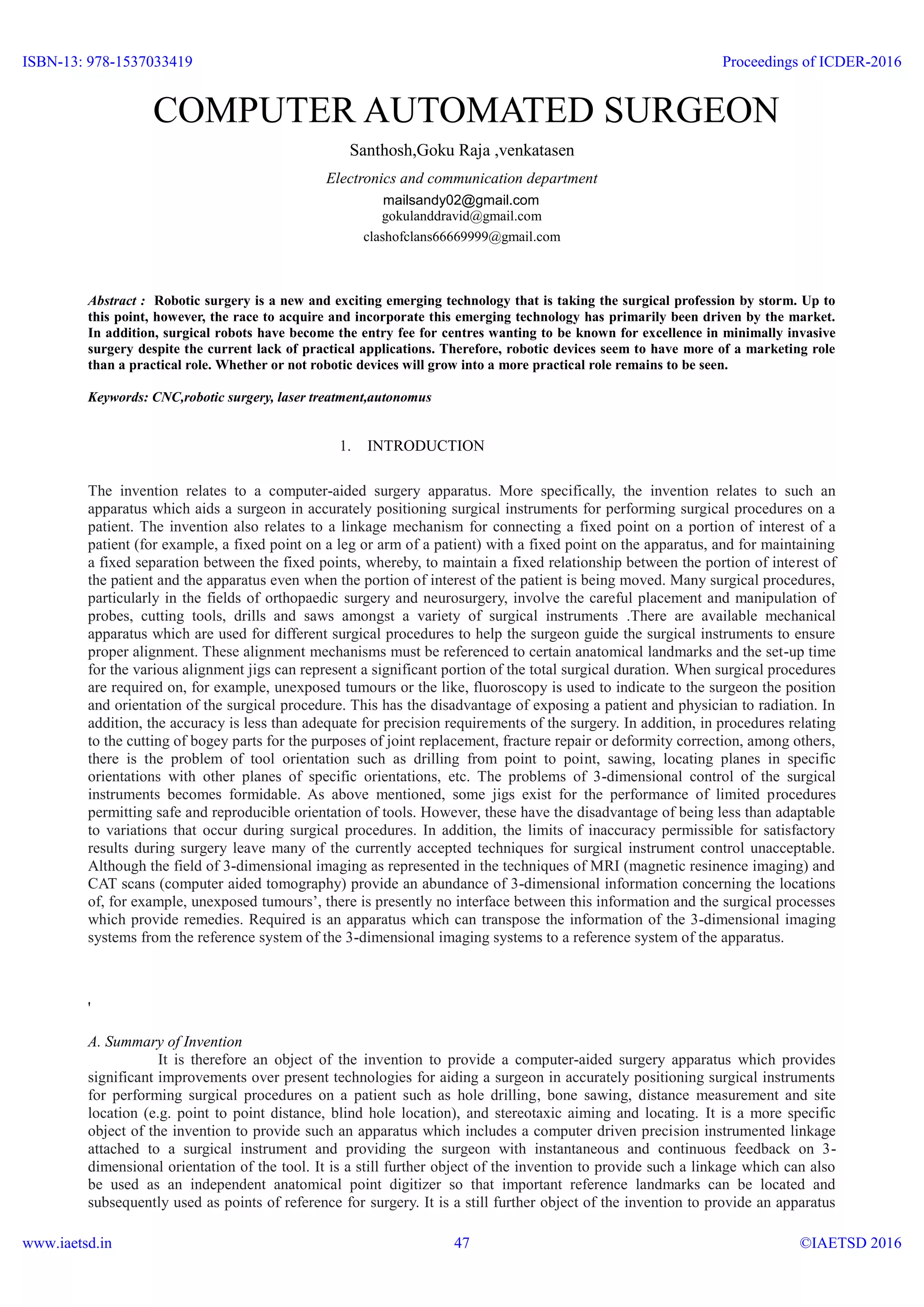
Fig .1 3-dimensional view of the apparatus in relationship to a patient on an operating table
II. CLAINS OF DIFFERENT TYPES OF SURGICAL PROCEDURE
1. A method for aiding a medical practitioner in positioning and orienting a surgical instrument or implant, which
surgical instrument or implant is manipulated by said medical practitioner while performing medical procedures on a
portion of a patient, the position and orientation of said instrument or implant being determined in a three-dimensional
co-ordinate system relative to a reference point and the position and orientation of said portion being determined in said
three-dimensional co-ordinate system relative to said reference point, said reference point being disposed outside of and
apart from said patient:
comprising:
continuously electronically sensing, or determining by 2- or 3-dimensional imaging techniques, the position and
orientation of said portion in said three-dimensional co-ordinate system to obtain three-dimensional target data of the
position and orientation of said portion in said three-dimensional co-ordinate system relative to said reference
point;converting said target to target signals for presenting the position and orientation of said portion on a display
means;providing said target signals to a display device whereby a target display of the position and orientation of said
portion is presented on said display device; continuously electronically sensing the position and orientation of said
surgical instrument or implant in said three-dimensional co-ordinate system to obtain three-dimensional instrument data
of the position and orientation of said instrument or implement in said three-dimensional co-ordinate system relative to
said reference point; means for converting said instrument data to instrument signals for presenting the position and
orientation of said instrument or implant on said display means; providing said instrument signals to said display device
whereby an instrument display of the position and orientation of said instrument or implant is presented on said display
device; wherein, as the instrument or implant is manipulated by said medical practitioner, said instrument data changes
in accordance with changes in the position and orientation of said instrument, and said instrument display changes in
accordance with the changes in said instrument data; whereby, the position and orientation of said instrument or
implant, relative to said portion, is dynamically displayed on said display device; and further including the step of
providing a known physical relationship between said portion on said patient and said reference point; and still further
including displaying a main menu on said display means, said main menu including a plurality of sub-menus; selecting
a sub-menu of interest, said sub-menu including a plurality of instruction steps
ISBN-13: 978-1537033419
www.iaetsd.in
Proceedings of ICDER-2016
©IAETSD 201648
2. A method as defined in claim 1 for performing a drilling operation, said surgical instrument comprising a drill, said
sub-menu comprising a Drill Menu, said method comprising:
digitizing entry and exit points;
installing drill bit in said drill; and
drilling a hole from said entry to said exit points.
3 . A method as defined in claim 1, for performing a sawing operation, said sub-menu comprising a Sawing Menu, said
method comprising:
digitizing a plane periphery;
digitizing a perpendicular to said plane;
installing the saw and saw blade on said manipulating means;
sawing through said plane.
4. A method as defined in claim 1, for performing a measurement operation, said sub-menu comprising a Measurement
Menu, said method comprising selecting a sub-sub-menu of said Measurement Menu.
5. A method as defined in claim 4 for performing the operation of measuring the distance from a first point to a second
point, said sub-menu comprising a Point-to-Point Distance Menu, said method comprising:
Digitizing one of said points;
Digitizing the other one of said points; and
Calculating said distance.
6. A method as defined in claim 4 for performing a spinal curvature measurement operation, said sub-sub-menu
comprising a Spinal Curvature Menu, said method comprising:
displaying the starting and finishing vertebrae of the patient's spine on said display means and performing a scan along
the patient's spine of predetermined length as determined by the selection of the starting and finishing vertebrae on said
display means;
Presenting graphics on the screen of a generic spine with the curvature calculated as per the digitized points.
REFFERENCE
1. John T. McElveen, Jr., MD, Division of Otolaryngology, Duke University Medical Center, Durham, NC 27710.
2. Graham Hextell, Area Project Officer, PEPEN S. Sutherland-Fraser, Area CNC, Perioperative Practice
Development
CONCLUSIONS
Robotic surgery is still in its infancy and its niche has not yet been well defined. Its current practical uses are
mostly confined to smaller surgical procedures.
ISBN-13: 978-1537033419
www.iaetsd.in
Proceedings of ICDER-2016
©IAETSD 201649

iaetsd Computer automated surgeon

  • 1.
    COMPUTER AUTOMATED SURGEON Santhosh,GokuRaja ,venkatasen Electronics and communication department mailsandy02@gmail.com gokulanddravid@gmail.com clashofclans66669999@gmail.com Abstract : Robotic surgery is a new and exciting emerging technology that is taking the surgical profession by storm. Up to this point, however, the race to acquire and incorporate this emerging technology has primarily been driven by the market. In addition, surgical robots have become the entry fee for centres wanting to be known for excellence in minimally invasive surgery despite the current lack of practical applications. Therefore, robotic devices seem to have more of a marketing role than a practical role. Whether or not robotic devices will grow into a more practical role remains to be seen. Keywords: CNC,robotic surgery, laser treatment,autonomus 1. INTRODUCTION The invention relates to a computer-aided surgery apparatus. More specifically, the invention relates to such an apparatus which aids a surgeon in accurately positioning surgical instruments for performing surgical procedures on a patient. The invention also relates to a linkage mechanism for connecting a fixed point on a portion of interest of a patient (for example, a fixed point on a leg or arm of a patient) with a fixed point on the apparatus, and for maintaining a fixed separation between the fixed points, whereby, to maintain a fixed relationship between the portion of interest of the patient and the apparatus even when the portion of interest of the patient is being moved. Many surgical procedures, particularly in the fields of orthopaedic surgery and neurosurgery, involve the careful placement and manipulation of probes, cutting tools, drills and saws amongst a variety of surgical instruments .There are available mechanical apparatus which are used for different surgical procedures to help the surgeon guide the surgical instruments to ensure proper alignment. These alignment mechanisms must be referenced to certain anatomical landmarks and the set-up time for the various alignment jigs can represent a significant portion of the total surgical duration. When surgical procedures are required on, for example, unexposed tumours or the like, fluoroscopy is used to indicate to the surgeon the position and orientation of the surgical procedure. This has the disadvantage of exposing a patient and physician to radiation. In addition, the accuracy is less than adequate for precision requirements of the surgery. In addition, in procedures relating to the cutting of bogey parts for the purposes of joint replacement, fracture repair or deformity correction, among others, there is the problem of tool orientation such as drilling from point to point, sawing, locating planes in specific orientations with other planes of specific orientations, etc. The problems of 3-dimensional control of the surgical instruments becomes formidable. As above mentioned, some jigs exist for the performance of limited procedures permitting safe and reproducible orientation of tools. However, these have the disadvantage of being less than adaptable to variations that occur during surgical procedures. In addition, the limits of inaccuracy permissible for satisfactory results during surgery leave many of the currently accepted techniques for surgical instrument control unacceptable. Although the field of 3-dimensional imaging as represented in the techniques of MRI (magnetic resinence imaging) and CAT scans (computer aided tomography) provide an abundance of 3-dimensional information concerning the locations of, for example, unexposed tumours’, there is presently no interface between this information and the surgical processes which provide remedies. Required is an apparatus which can transpose the information of the 3-dimensional imaging systems from the reference system of the 3-dimensional imaging systems to a reference system of the apparatus. ' A. Summary of Invention It is therefore an object of the invention to provide a computer-aided surgery apparatus which provides significant improvements over present technologies for aiding a surgeon in accurately positioning surgical instruments for performing surgical procedures on a patient such as hole drilling, bone sawing, distance measurement and site location (e.g. point to point distance, blind hole location), and stereotaxic aiming and locating. It is a more specific object of the invention to provide such an apparatus which includes a computer driven precision instrumented linkage attached to a surgical instrument and providing the surgeon with instantaneous and continuous feedback on 3- dimensional orientation of the tool. It is a still further object of the invention to provide such a linkage which can also be used as an independent anatomical point digitizer so that important reference landmarks can be located and subsequently used as points of reference for surgery. It is a still further object of the invention to provide an apparatus ISBN-13: 978-1537033419 www.iaetsd.in Proceedings of ICDER-2016 ©IAETSD 201647
  • 2.
    which eliminates time-consumingset-up of jigs and other apparatus for guiding the surgical instruments and which apparatus is really an intelligent jig capable of adapting to the vagaries and unexpected developments often confronted during surgery. In accordance with the invention, there is provided a computer-aided surgical device for aiding a surgeon in positioning a surgical instrument (power or manual) when performing surgery on unexposed and exposed portions of a patient. Fig .1 3-dimensional view of the apparatus in relationship to a patient on an operating table II. CLAINS OF DIFFERENT TYPES OF SURGICAL PROCEDURE 1. A method for aiding a medical practitioner in positioning and orienting a surgical instrument or implant, which surgical instrument or implant is manipulated by said medical practitioner while performing medical procedures on a portion of a patient, the position and orientation of said instrument or implant being determined in a three-dimensional co-ordinate system relative to a reference point and the position and orientation of said portion being determined in said three-dimensional co-ordinate system relative to said reference point, said reference point being disposed outside of and apart from said patient: comprising: continuously electronically sensing, or determining by 2- or 3-dimensional imaging techniques, the position and orientation of said portion in said three-dimensional co-ordinate system to obtain three-dimensional target data of the position and orientation of said portion in said three-dimensional co-ordinate system relative to said reference point;converting said target to target signals for presenting the position and orientation of said portion on a display means;providing said target signals to a display device whereby a target display of the position and orientation of said portion is presented on said display device; continuously electronically sensing the position and orientation of said surgical instrument or implant in said three-dimensional co-ordinate system to obtain three-dimensional instrument data of the position and orientation of said instrument or implement in said three-dimensional co-ordinate system relative to said reference point; means for converting said instrument data to instrument signals for presenting the position and orientation of said instrument or implant on said display means; providing said instrument signals to said display device whereby an instrument display of the position and orientation of said instrument or implant is presented on said display device; wherein, as the instrument or implant is manipulated by said medical practitioner, said instrument data changes in accordance with changes in the position and orientation of said instrument, and said instrument display changes in accordance with the changes in said instrument data; whereby, the position and orientation of said instrument or implant, relative to said portion, is dynamically displayed on said display device; and further including the step of providing a known physical relationship between said portion on said patient and said reference point; and still further including displaying a main menu on said display means, said main menu including a plurality of sub-menus; selecting a sub-menu of interest, said sub-menu including a plurality of instruction steps ISBN-13: 978-1537033419 www.iaetsd.in Proceedings of ICDER-2016 ©IAETSD 201648
  • 3.
    2. A methodas defined in claim 1 for performing a drilling operation, said surgical instrument comprising a drill, said sub-menu comprising a Drill Menu, said method comprising: digitizing entry and exit points; installing drill bit in said drill; and drilling a hole from said entry to said exit points. 3 . A method as defined in claim 1, for performing a sawing operation, said sub-menu comprising a Sawing Menu, said method comprising: digitizing a plane periphery; digitizing a perpendicular to said plane; installing the saw and saw blade on said manipulating means; sawing through said plane. 4. A method as defined in claim 1, for performing a measurement operation, said sub-menu comprising a Measurement Menu, said method comprising selecting a sub-sub-menu of said Measurement Menu. 5. A method as defined in claim 4 for performing the operation of measuring the distance from a first point to a second point, said sub-menu comprising a Point-to-Point Distance Menu, said method comprising: Digitizing one of said points; Digitizing the other one of said points; and Calculating said distance. 6. A method as defined in claim 4 for performing a spinal curvature measurement operation, said sub-sub-menu comprising a Spinal Curvature Menu, said method comprising: displaying the starting and finishing vertebrae of the patient's spine on said display means and performing a scan along the patient's spine of predetermined length as determined by the selection of the starting and finishing vertebrae on said display means; Presenting graphics on the screen of a generic spine with the curvature calculated as per the digitized points. REFFERENCE 1. John T. McElveen, Jr., MD, Division of Otolaryngology, Duke University Medical Center, Durham, NC 27710. 2. Graham Hextell, Area Project Officer, PEPEN S. Sutherland-Fraser, Area CNC, Perioperative Practice Development CONCLUSIONS Robotic surgery is still in its infancy and its niche has not yet been well defined. Its current practical uses are mostly confined to smaller surgical procedures. ISBN-13: 978-1537033419 www.iaetsd.in Proceedings of ICDER-2016 ©IAETSD 201649