Principles of Robotic Surgery
- Abhishek Pandey
Introduction
• Robot – Programmable device doing complex actions
automatically with speed & precision.
• Robotic Surgery → Robot Assisted Surgery – Surgeon
in control.
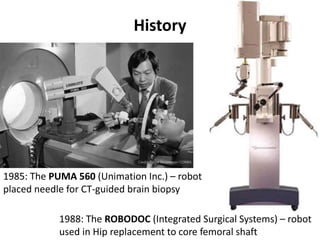
History
1985: The PUMA 560 (Unimation Inc.) – robot
placed needle for CT-guided brain biopsy
1988: The ROBODOC (Integrated Surgical Systems) – robot
used in Hip replacement to core femoral shaft
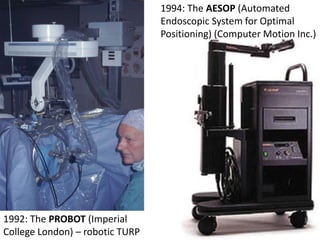
1992: The PROBOT (Imperial
College London) – robotic TURP
1994: The AESOP (Automated
Endoscopic System for Optimal
Positioning) (Computer Motion Inc.)
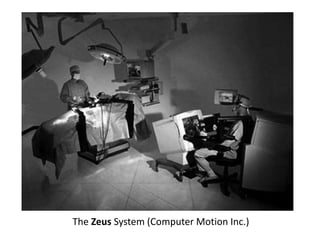
The Zeus System (Computer Motion Inc.)
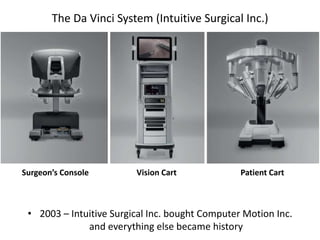
The Da Vinci System (Intuitive Surgical Inc.)
• 2003 – Intuitive Surgical Inc. bought Computer Motion Inc.
and everything else became history
Surgeon’s Console Vision Cart Patient Cart
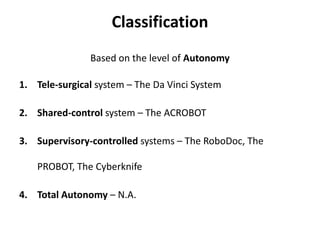
Classification
Based on the level of Autonomy
1. Tele-surgical system – The Da Vinci System
2. Shared-control system – The ACROBOT
3. Supervisory-controlled systems – The RoboDoc, The
PROBOT, The Cyberknife
4. Total Autonomy – N.A.
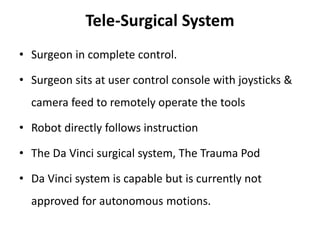
Tele-Surgical System
• Surgeon in complete control.
• Surgeon sits at user control console with joysticks &
camera feed to remotely operate the tools
• Robot directly follows instruction
• The Da Vinci surgical system, The Trauma Pod
• Da Vinci system is capable but is currently not
approved for autonomous motions.
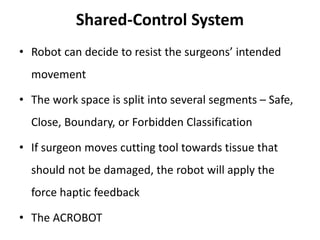
Shared-Control System
• Robot can decide to resist the surgeons’ intended
movement
• The work space is split into several segments – Safe,
Close, Boundary, or Forbidden Classification
• If surgeon moves cutting tool towards tissue that
should not be damaged, the robot will apply the
force haptic feedback
• The ACROBOT
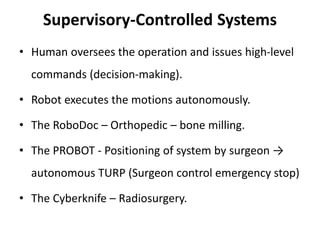
Supervisory-Controlled Systems
• Human oversees the operation and issues high-level
commands (decision-making).
• Robot executes the motions autonomously.
• The RoboDoc – Orthopedic – bone milling.
• The PROBOT - Positioning of system by surgeon →
autonomous TURP (Surgeon control emergency stop)
• The Cyberknife – Radiosurgery.
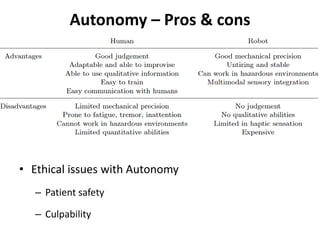
Autonomy – Pros & cons
• Ethical issues with Autonomy
– Patient safety
– Culpability
Approaches to Automation
• Predefining Motions or Constraints – execution of
steps without ability to adapt to environment will fail
in real surgical situations if there is movement.
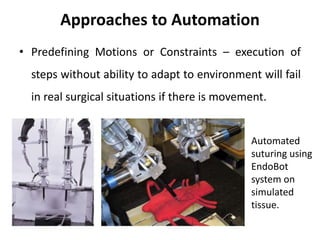
Automated
suturing using
EndoBot
system on
simulated
tissue.
• Visual Tracking and Servoing –
– Visual servoing – use of images in a feedback loop to
automate the robotic system.
– autonomous endoscopic camera movement – tracking
surgeon’s intent via instrument/eye movements
• Learning by observation (LBO)
The Da Vinci Surgical System
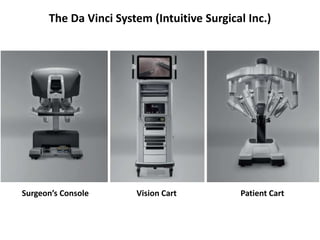
1. The Patient-side Cart – Four patient-side
manipulators or arms
2. The Surgeon Console – High resolution stereo-
viewer – 3D vision & Joystick control
3. The Vision Cart – Computerized Control system –
relay of Input and Output with Processing
The Da Vinci System (Intuitive Surgical Inc.)
Surgeon’s Console Vision Cart Patient Cart
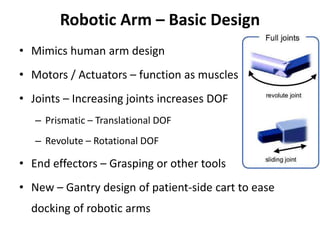
Robotic Arm – Basic Design
• Mimics human arm design
• Motors / Actuators – function as muscles
• Joints – Increasing joints increases DOF
– Prismatic – Translational DOF
– Revolute – Rotational DOF
• End effectors – Grasping or other tools
• New – Gantry design of patient-side cart to ease
docking of robotic arms
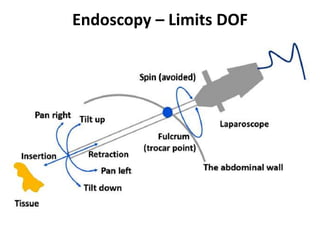
Endoscopy – Limits DOF
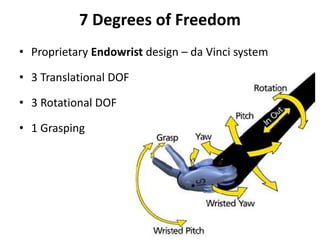
7 Degrees of Freedom
• Proprietary Endowrist design – da Vinci system
• 3 Translational DOF
• 3 Rotational DOF
• 1 Grasping
Processing
• Movement scaled down
• Tremors filtered
• Image Magnified with 3D effect
• Crosschecking and Spatial correlation between
surgeon’s movement & end effector movement.
• Gravity compensation – the actuator power required
to resist joint torque caused by weight of robot
SOP
• Preparing & Draping system
• Roll-up – Positioning patient-cart next to patient bed
• Deployment – adjusting angles of robotic arms to
ensure clearance between arms & patient
• Docking – Securing connection b/w arm & patient
• Undocking → Undraping → Cleaning
• Stowing arms to minimize storage space required
Challenges
• Ethical Issues
• Learning Curve
• Cost
• Tele-Surgical Latencies
• Full autonomy far-fetched
• Superiority could not be demonstrated
Current Benefits
• Better accuracy, precision, dexterity
• Tremor corrections
• Scaled motion
• Haptic corrective feedback.
• End-effectors much smaller
• Tele-Surgery
THANK YOU

Robotic surgery - Principles

  • 1.
    Principles of RoboticSurgery - Abhishek Pandey
  • 2.
    Introduction • Robot –Programmable device doing complex actions automatically with speed & precision. • Robotic Surgery → Robot Assisted Surgery – Surgeon in control.
  • 3.
    History 1985: The PUMA560 (Unimation Inc.) – robot placed needle for CT-guided brain biopsy 1988: The ROBODOC (Integrated Surgical Systems) – robot used in Hip replacement to core femoral shaft
  • 4.
    1992: The PROBOT(Imperial College London) – robotic TURP 1994: The AESOP (Automated Endoscopic System for Optimal Positioning) (Computer Motion Inc.)
  • 5.
    The Zeus System(Computer Motion Inc.)
  • 6.
    The Da VinciSystem (Intuitive Surgical Inc.) • 2003 – Intuitive Surgical Inc. bought Computer Motion Inc. and everything else became history Surgeon’s Console Vision Cart Patient Cart
  • 7.
    Classification Based on thelevel of Autonomy 1. Tele-surgical system – The Da Vinci System 2. Shared-control system – The ACROBOT 3. Supervisory-controlled systems – The RoboDoc, The PROBOT, The Cyberknife 4. Total Autonomy – N.A.
  • 8.
    Tele-Surgical System • Surgeonin complete control. • Surgeon sits at user control console with joysticks & camera feed to remotely operate the tools • Robot directly follows instruction • The Da Vinci surgical system, The Trauma Pod • Da Vinci system is capable but is currently not approved for autonomous motions.
  • 9.
    Shared-Control System • Robotcan decide to resist the surgeons’ intended movement • The work space is split into several segments – Safe, Close, Boundary, or Forbidden Classification • If surgeon moves cutting tool towards tissue that should not be damaged, the robot will apply the force haptic feedback • The ACROBOT
  • 10.
    Supervisory-Controlled Systems • Humanoversees the operation and issues high-level commands (decision-making). • Robot executes the motions autonomously. • The RoboDoc – Orthopedic – bone milling. • The PROBOT - Positioning of system by surgeon → autonomous TURP (Surgeon control emergency stop) • The Cyberknife – Radiosurgery.
  • 11.
    Autonomy – Pros& cons • Ethical issues with Autonomy – Patient safety – Culpability
  • 12.
    Approaches to Automation •Predefining Motions or Constraints – execution of steps without ability to adapt to environment will fail in real surgical situations if there is movement. Automated suturing using EndoBot system on simulated tissue.
  • 13.
    • Visual Trackingand Servoing – – Visual servoing – use of images in a feedback loop to automate the robotic system. – autonomous endoscopic camera movement – tracking surgeon’s intent via instrument/eye movements • Learning by observation (LBO)
  • 14.
    The Da VinciSurgical System 1. The Patient-side Cart – Four patient-side manipulators or arms 2. The Surgeon Console – High resolution stereo- viewer – 3D vision & Joystick control 3. The Vision Cart – Computerized Control system – relay of Input and Output with Processing
  • 15.
    The Da VinciSystem (Intuitive Surgical Inc.) Surgeon’s Console Vision Cart Patient Cart
  • 16.
    Robotic Arm –Basic Design • Mimics human arm design • Motors / Actuators – function as muscles • Joints – Increasing joints increases DOF – Prismatic – Translational DOF – Revolute – Rotational DOF • End effectors – Grasping or other tools • New – Gantry design of patient-side cart to ease docking of robotic arms
  • 18.
  • 19.
    7 Degrees ofFreedom • Proprietary Endowrist design – da Vinci system • 3 Translational DOF • 3 Rotational DOF • 1 Grasping
  • 20.
    Processing • Movement scaleddown • Tremors filtered • Image Magnified with 3D effect • Crosschecking and Spatial correlation between surgeon’s movement & end effector movement. • Gravity compensation – the actuator power required to resist joint torque caused by weight of robot
  • 21.
    SOP • Preparing &Draping system • Roll-up – Positioning patient-cart next to patient bed • Deployment – adjusting angles of robotic arms to ensure clearance between arms & patient • Docking – Securing connection b/w arm & patient • Undocking → Undraping → Cleaning • Stowing arms to minimize storage space required
  • 22.
    Challenges • Ethical Issues •Learning Curve • Cost • Tele-Surgical Latencies • Full autonomy far-fetched • Superiority could not be demonstrated
  • 23.
    Current Benefits • Betteraccuracy, precision, dexterity • Tremor corrections • Scaled motion • Haptic corrective feedback. • End-effectors much smaller • Tele-Surgery
  • 24.