Probabilistic Algorithms for
Mobile Robot Mapping

Presented by: Noha Quan Ravi
Based on the paper

A Real-Time Algorithm for Mobile Robot Mapping
With Applications to Multi-Robot and 3D Mapping
Best paper award at 2000 IEEE International
Conference on Robotics and Automation (~1,100
submissions)
By: Sebastian Thrun et. al.

2
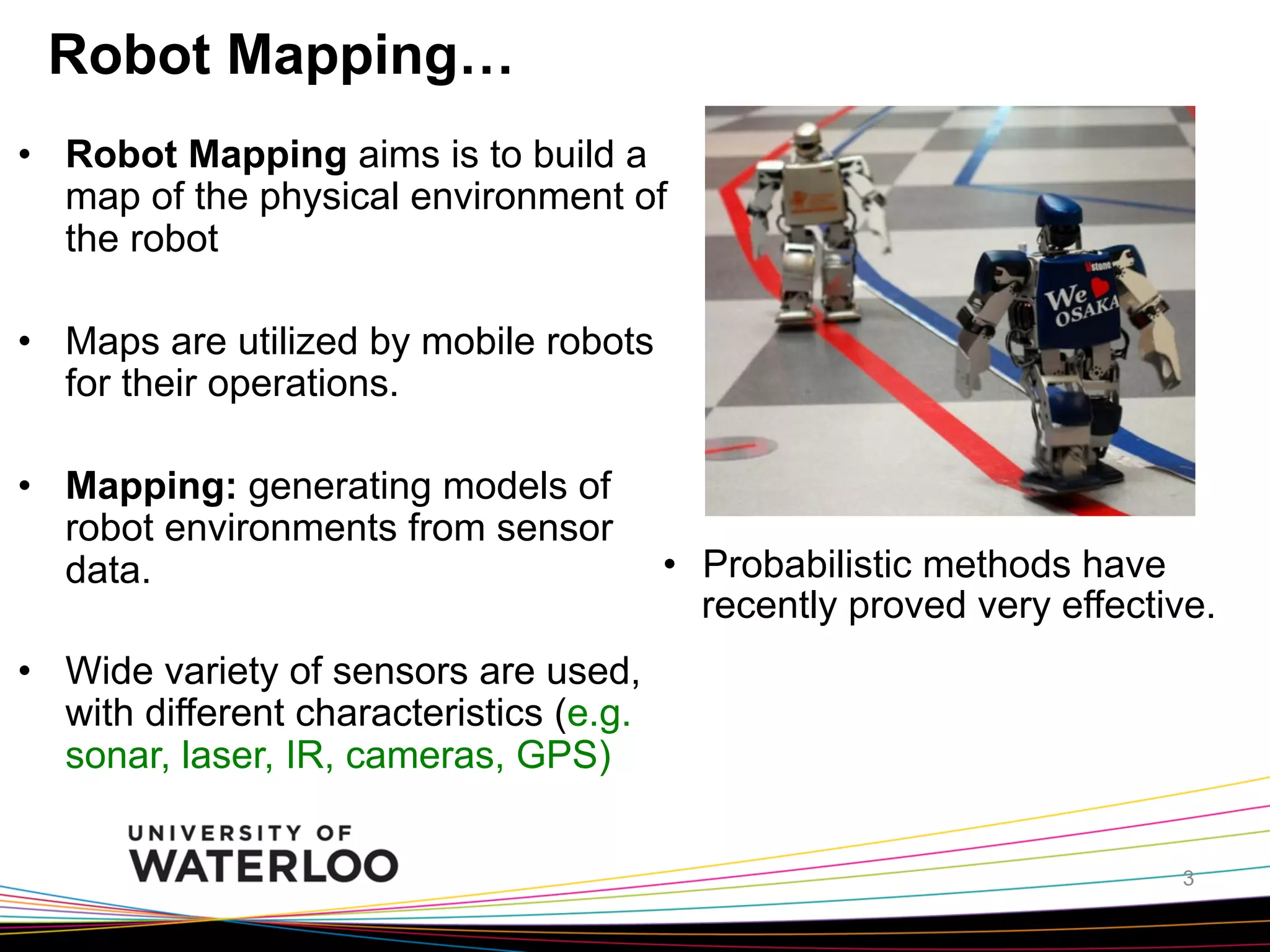
Robot Mapping…
•  Robot Mapping aims is to build a
map of the physical environment of
the robot
•  Maps are utilized by mobile robots
for their operations.
•  Mapping: generating models of
robot environments from sensor
data.

•  Probabilistic methods have
recently proved very effective.

•  Wide variety of sensors are used,
with different characteristics (e.g.
sonar, laser, IR, cameras, GPS)
3
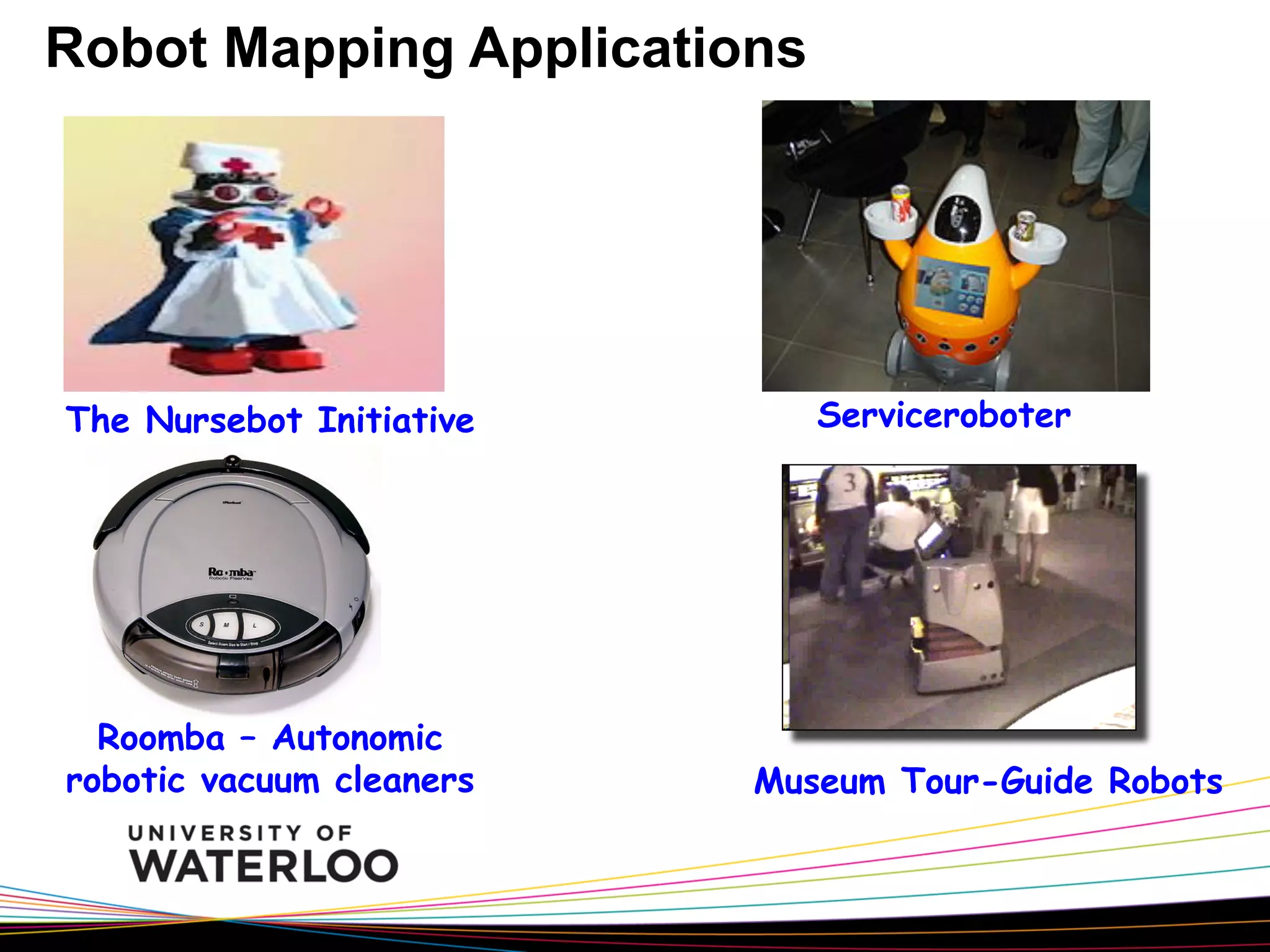
Robot Mapping Applications

The Nursebot Initiative

Roomba – Autonomic
robotic vacuum cleaners

Serviceroboter

Museum Tour-Guide Robots
video

5
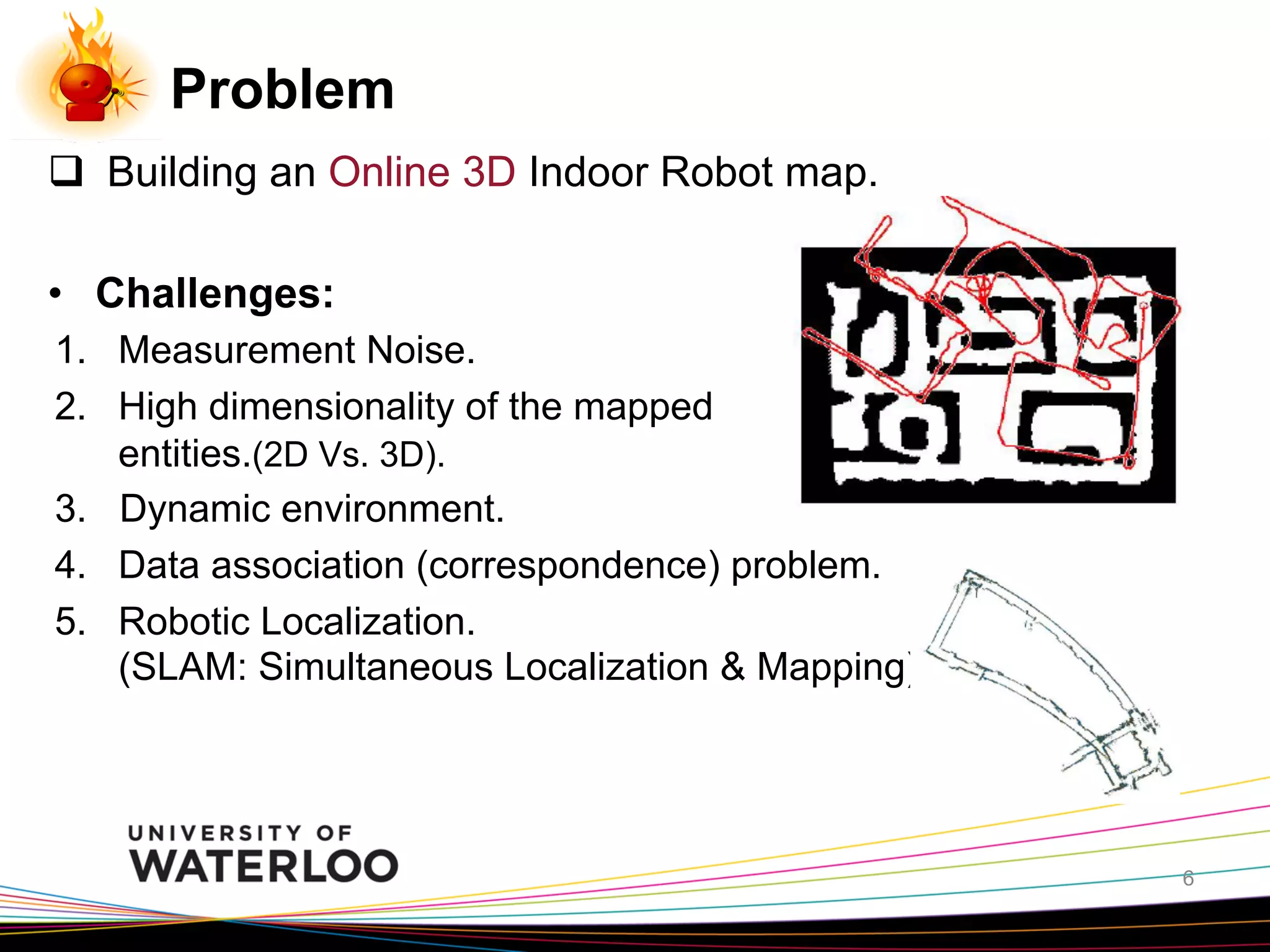
Problem
q  Building an Online 3D Indoor Robot map.
•  Challenges:
1.  Measurement Noise.
2.  High dimensionality of the mapped
entities.(2D Vs. 3D).
3. Dynamic environment.
4.  Data association (correspondence) problem.
5.  Robotic Localization.
(SLAM: Simultaneous Localization & Mapping)

6
Related Work
Ø  Focused on building maps in 2D from sensor
measurements.
-  Line extraction from a single scan.
Ø  3D system models proposed by Roth* doesn’t
consider uncertainty of individual measurements
when generating the 3D model.

* G. Roth and R. Wibowo, “A fast algorithm for making mesh-models
from multiple-view range data,” in Proceedings of the DND/CSA
Robotics and Knowledge Based Systems Workshop, 1995.

7
Methodology
•  Propose an algorithm “Online EM” for 3D models for indoor
mappings that works in real time.
•  Measurements are captured using laser range finder and
panoramic camera.
•  Evaluation of the proposed algorithm via real-time
implementation in several different buildings.
•  Assumptions:
Ø  prior knowledge : the shape of basic building elements.
Ø  Robot pose is given.
8
Agenda

9
Generative Probability Model
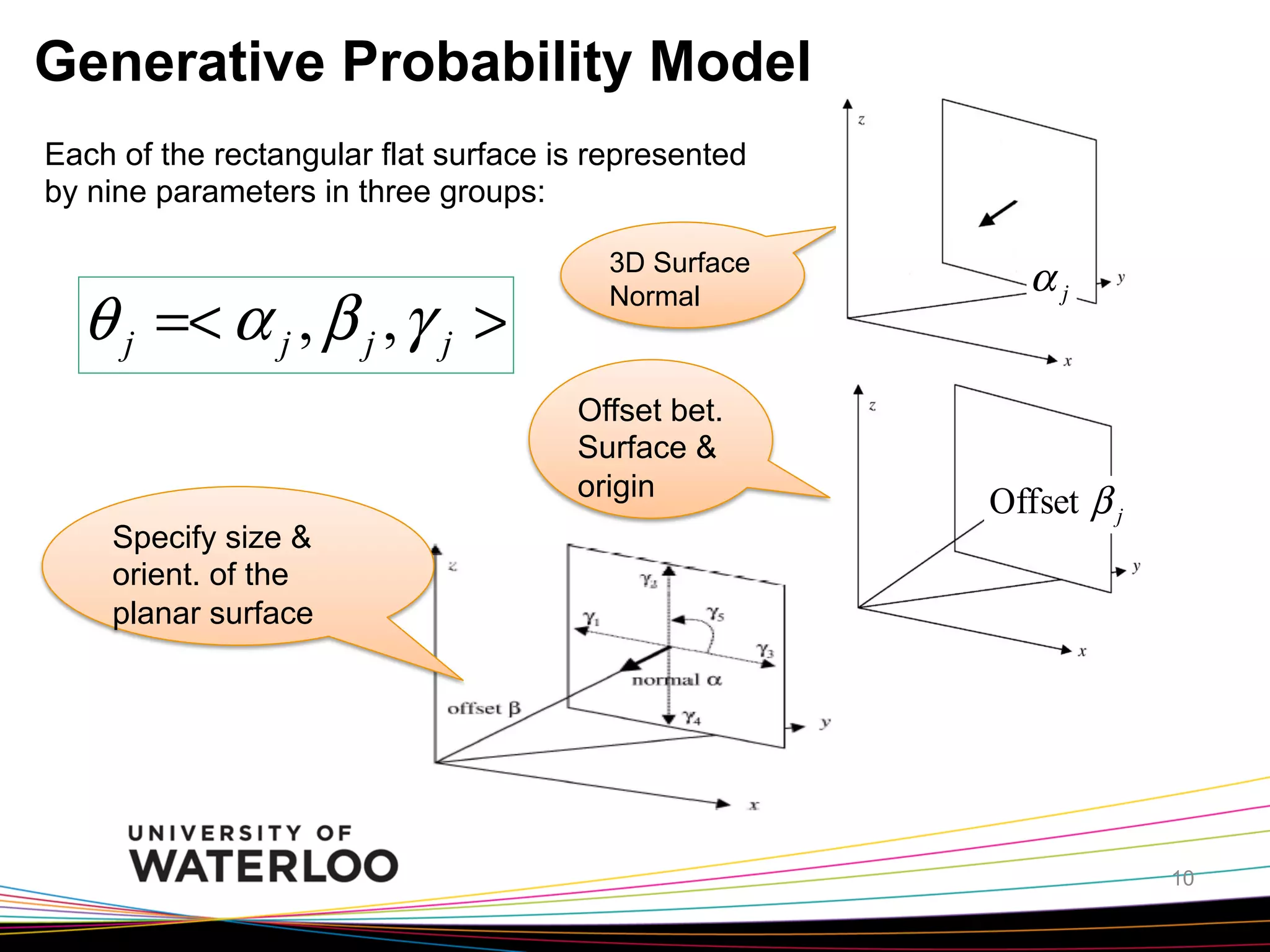
Each of the rectangular flat surface is represented
by nine parameters in three groups:

θ j =< α j , β j , γ j >

3D Surface
Normal

Offset bet.
Surface &
origin
Specify size &
orient. of the
planar surface

!j

Offset β j

10
Generative Probability Model: World Model
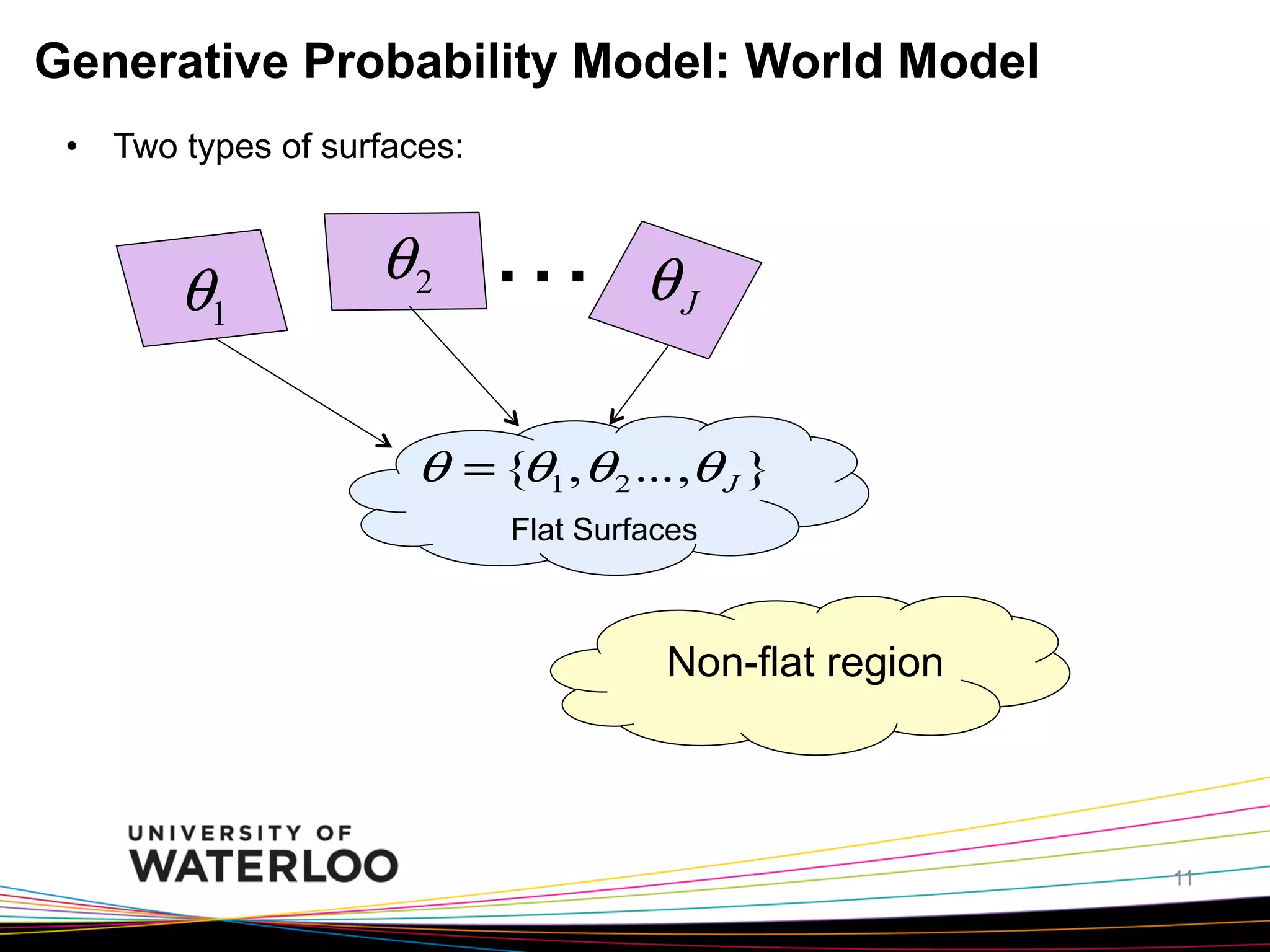
•  Two types of surfaces:

θ1

θ2

…

θJ

θ = {θ1 ,θ 2 ...,θ J }
Flat Surfaces

Non-flat region

11
Generative Probability Model: Measurements
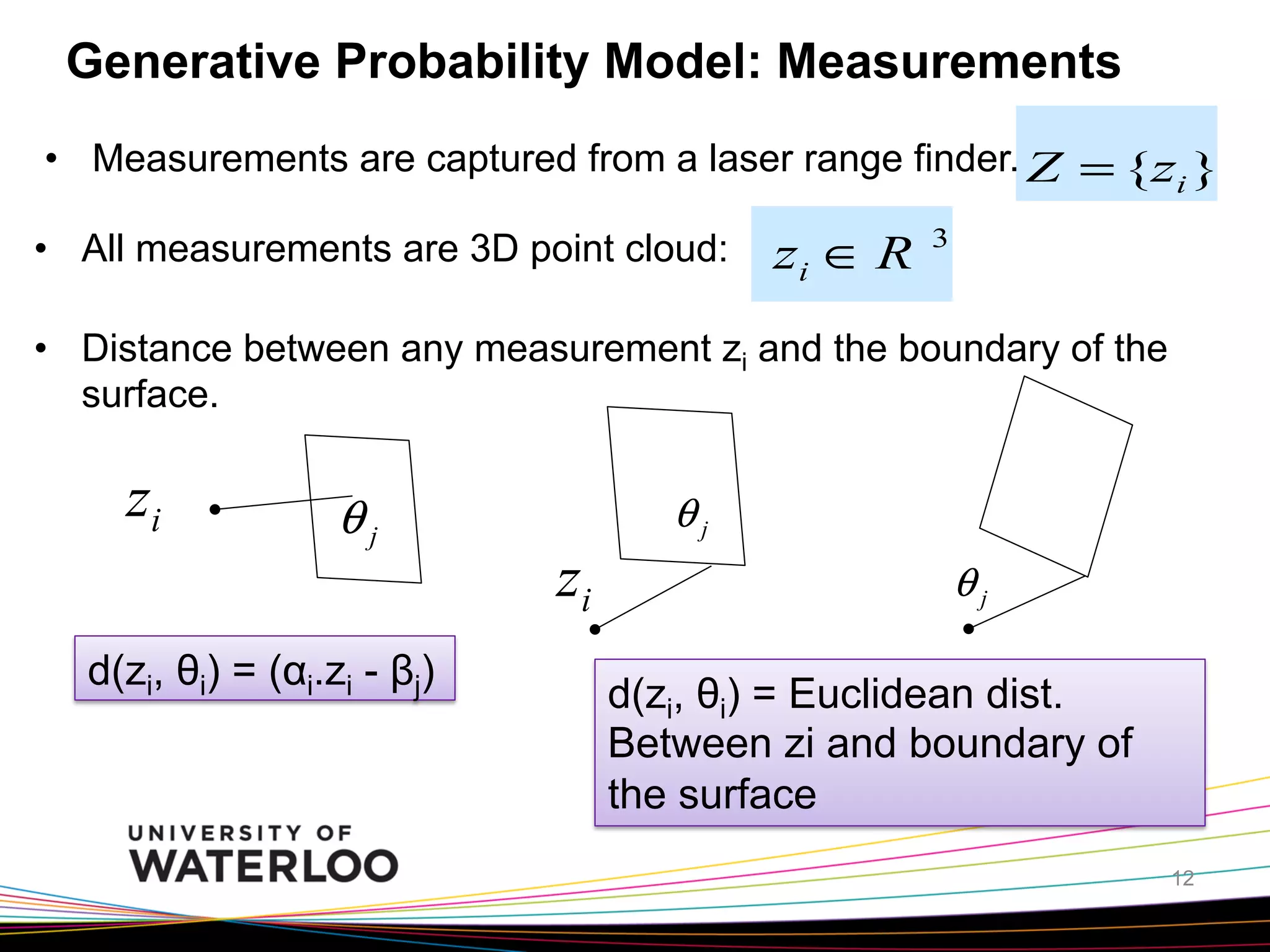
•  Measurements are captured from a laser range finder. Z = {z }
i
•  All measurements are 3D point cloud:

zi ∈ R

3

•  Distance between any measurement zi and the boundary of the
surface.

zi

θj

d(zi, θi) = (αi.zi - βj)

θj

zi

θj
d(zi, θi) = Euclidean dist.
zi
Between zi and boundary of
the surface
12
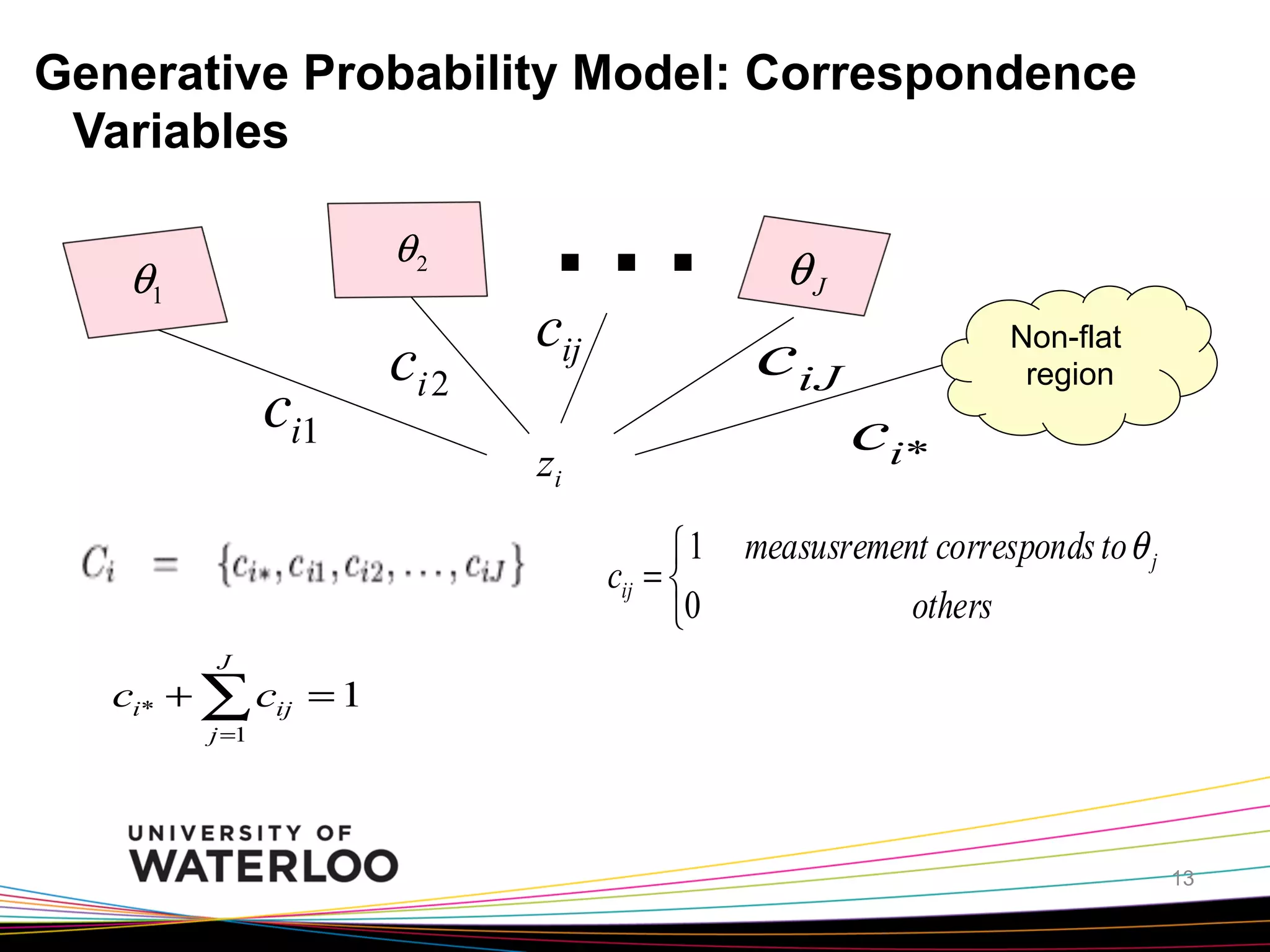
Generative Probability Model: Correspondence
Variables
θ2

θ1

ci1

ci 2

…

cij

θJ

ciJ

zi
⎧1
cij = ⎨
⎩0

Non-flat
region

ci*

measusrement corresponds to θ j
others

J

ci* + ∑ cij = 1
j =1

13
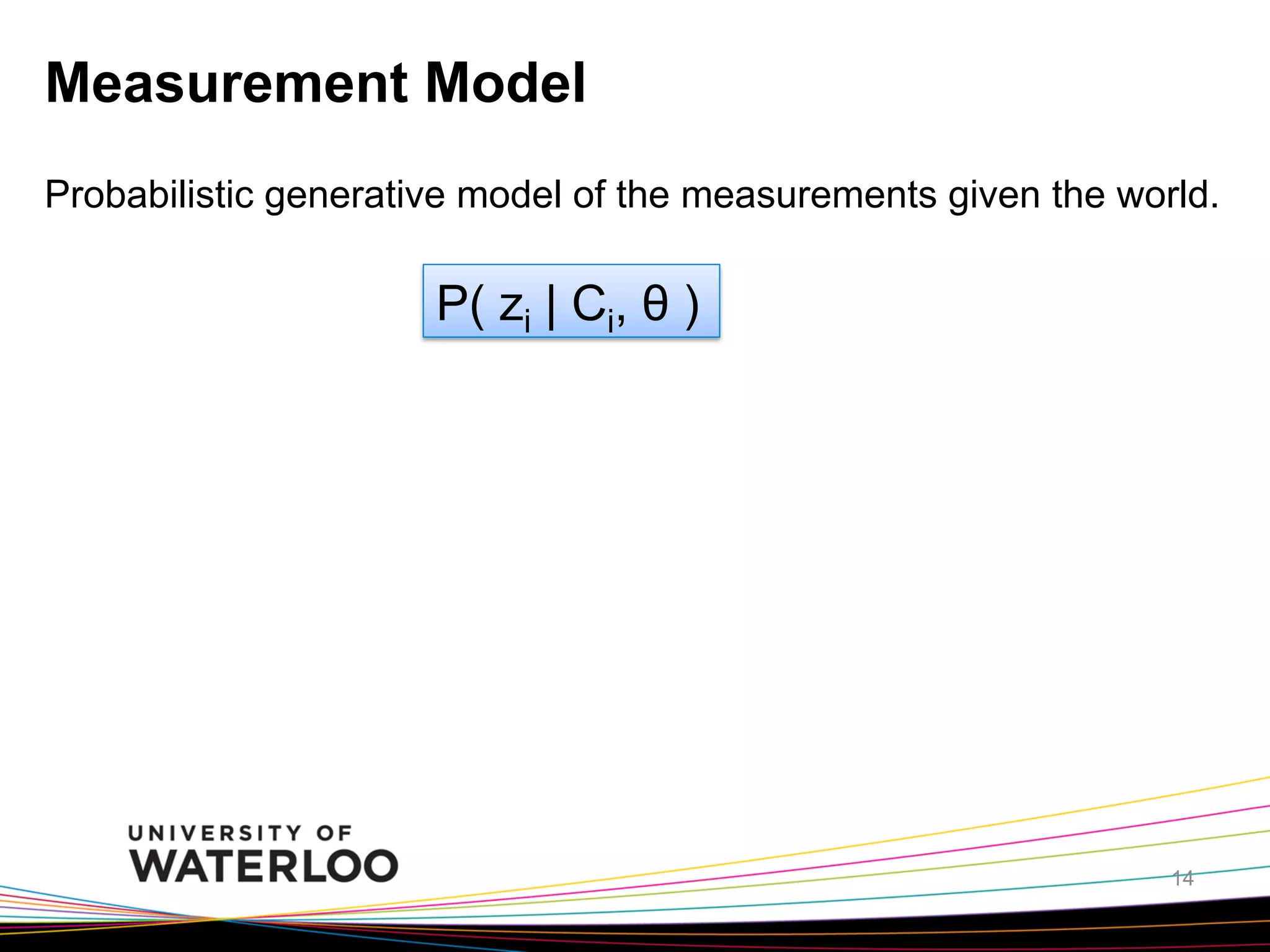
Measurement Model
Probabilistic generative model of the measurements given the world.

P( zi | Ci, θ )

14
Agenda

15
Error Distribution
A. For flat surfaces (Normal distribution)

p( zi | cij = 1,θ ) =

1
2πσ

2

e

2
1 d ( zi ,θ j )
−
2
σ2

B. For non-flat surfaces (Uniform distribution)

⎧1 / z max ,
p( zi | cij = 1, θ ) = ⎨
⎩ 0,
1
z max

=

1
2πσ

2

e

if 0 ≤ zi ≤ z max
otherwise

1
z 2 max
− log
2
2πσ 2

16
The Log-Likelihood Function
•  Sensor Model: Conditional probability

p( zi | Ci ,θ ) =

1
2πσ 2

e

1
z 2 ma x
− [ ci* log
+
2
2
2πσ

∑ j cij

d 2 ( zi ,θ j )

σ

2

]

•  Sensor Model: Joint probability

p( zi , Ci | θ ) =

1
( J + 1) 2πσ 2

e

1
z 2 max
− [ ci* log
+
2
2
2πσ

∑ j cij

d 2 ( zi ,θ j )

σ

2

]

17
The Expectation of the log likelihood
•  Assuming independence in measurement noise:

p( Z , C | θ )
=∏
i

1
( J + 1) 2πσ

2

e

1
z 2 max
− [ ci* log
+
2
2πσ 2

∑ j cij

d 2 ( zi ,θ j )

σ2

]

•  EM: take the log likelihood (take the log of the above equation)

EC = [log p ( Z , C | θ ) | Z , θ ]
⎡
1
1
z 2 max
∑ ⎢log ( J + 1) 2πσ 2 − 2 E[ci* | zi ,θ ] log 2πσ 2
i ⎢
⎣
d 2 ( zi , θ j ) ⎤
1
− ∑ j E[cij | zi , θ ]
⎥
2
σ2 ⎥
⎦
18
Agenda

19
EM Algorithm: offline
•  A popular method for optimization
•  Uses hill climbing in likelihood space.
•  Used for problems with latent variables.

z

•  Input: measurement i,
the 3D points
1
•  Output:
[ n +1]
< α [ n+1] , β [ n+1] , γ [ n+1] >
A map θ
which maximize the expectation log likelihood
over correspondences C
•  EM is an iterative process. Each iteration
includes two steps: E-step and M-step.

θ

...

θ2

θJ
Non-flat
region
EM Algorithm: offline
A. The E-Step
-  Initialize θ [0] = A random map
-  Calculate the expectations of the unknown
correspondences for the current map θ [n] .
[
eijn ] = E[cij | zi ,θ [ n ] ] = p(cij | zi ,θ [ n ] )

p( zi | cij ,θ ) p(cij | θ )
[n]

=

[n]

p ( zi | θ [ n ] )
e

=
e

2
z max
2

1
− log
2 2πσ

2
1 d ( zi |θ j )
−
2 σ2

+ ∑k e

−

2

1 d ( zi |θ k )
2 σ2

ei[*n ] = E[ci* | zi ,θ [ n ] ] = p(cij | zi ,θ [ n ] )
p( zi | ci* ,θ [ n ] ) p(ci* | θ [ n ] )
=
p ( zi | θ [ n ] )
e

=
e

2
z max
1
− log
2 2πσ 2

z2
1
− log max2
2 2πσ

+ ∑k e

1 d 2 ( zi |θ k )
−
2 σ2

21
EM Algorithm: offline (cont.)
B. The M-Step

•  Goal: Maximize the expectation of the log likelihood where
the expectation is taken over all the correspondences C.
EC = [log p(Z , C | θ ) | Z ,θ ]
⎡
1
1
z 2 max
∑ ⎢log ( J + 1) 2πσ 2 − 2 E[ci* | zi ,θ ] log 2πσ 2
i ⎢
⎣
d 2 ( zi , θ j ) ⎤
1
− ∑ j E[cij | zi ,θ ]
⎥
2
σ2 ⎥
⎦

The quadratic optimization problem is solved via Lagrange multipliers.

22
Agenda

23
Online EM	
•  Offline EM Limitations
•  1. Require all the measurements Z as input
•  2. Access every measurement zi and every
θ j per iteration d 2 ( zi ,θ j )
model
•  3. Computation grows as dataset grows

•  Solution: Online EM	
24
Online EM	
•  Key idea:
•  Each time interval, constant number of new
range measurements arrive

•  Advantages:
•  1. Acquire compact 3-D models in real time
•  2. Limited number of measurements as input
•  3. Constant time per iteration
25
Online EM (Online E-Step)	
•  Constant number of measurements
•  1.New arrival measurements
•  2. Old measurements
–  At the boundary of two surface models
–  Unexplained by any existing surface models

•  Counter
•  1. Record E-step calculation times
•  2. Freeze when achieve a threshold

	
26
Online EM (Online M-Step)	
•  Goal:
•  Re-estimate the parameters of flat surface model
in constant time

•  Control:
•  The number of flat surfaces
•  The number of measurements

	
27
Online EM (Online M-Step)	
•  Control the number of flat surfaces :
•  Active flat surface model only

•  Definition of “active”:
•  A surface is active at time i if the E-step
executed at that time changed the ML
correspondence to or away from the surface for
any of the updated measurement.	
28
Online EM

(Model Selection)	

q Add new models
Ø  New measurements not “explained” by existing surface
models
Ø  “explained”:
likelihood > threshold
Ø  not “explained”: seed for new surface

q Remove models
Ø  The surface model is not supported by sufficient
measurements	

29
Agenda

30
Experimental Results
•  Two stages
–  Offline EM algorithm.
168,120 range measurements
3,270 camera images,
extracted 3,220,950 pixels
Two minutes

–  Real time online version of our approach
•  Different buildings
•  Three examples in paper (One presented here)

31
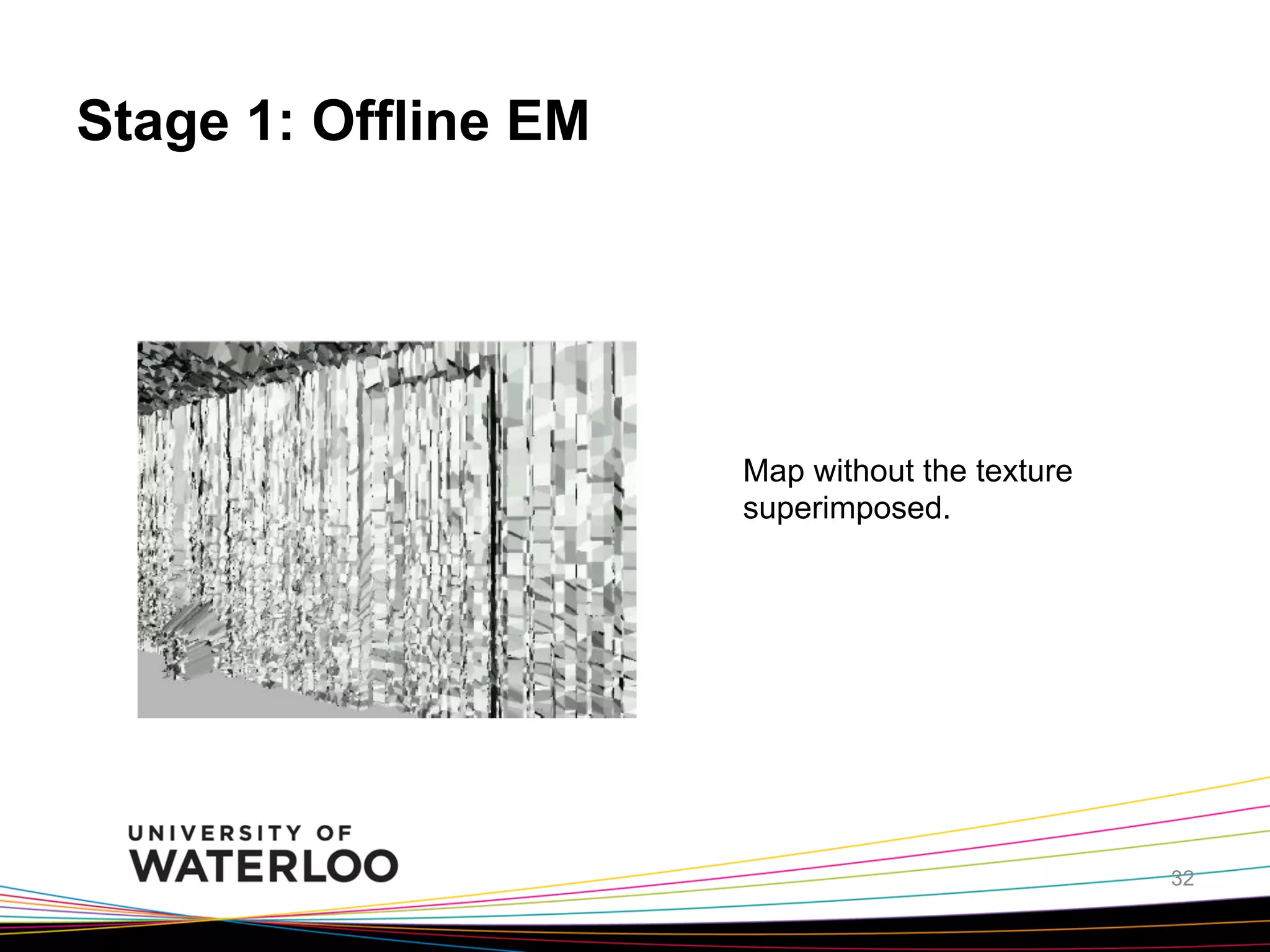
Stage 1: Offline EM

Map without the texture
superimposed.

32
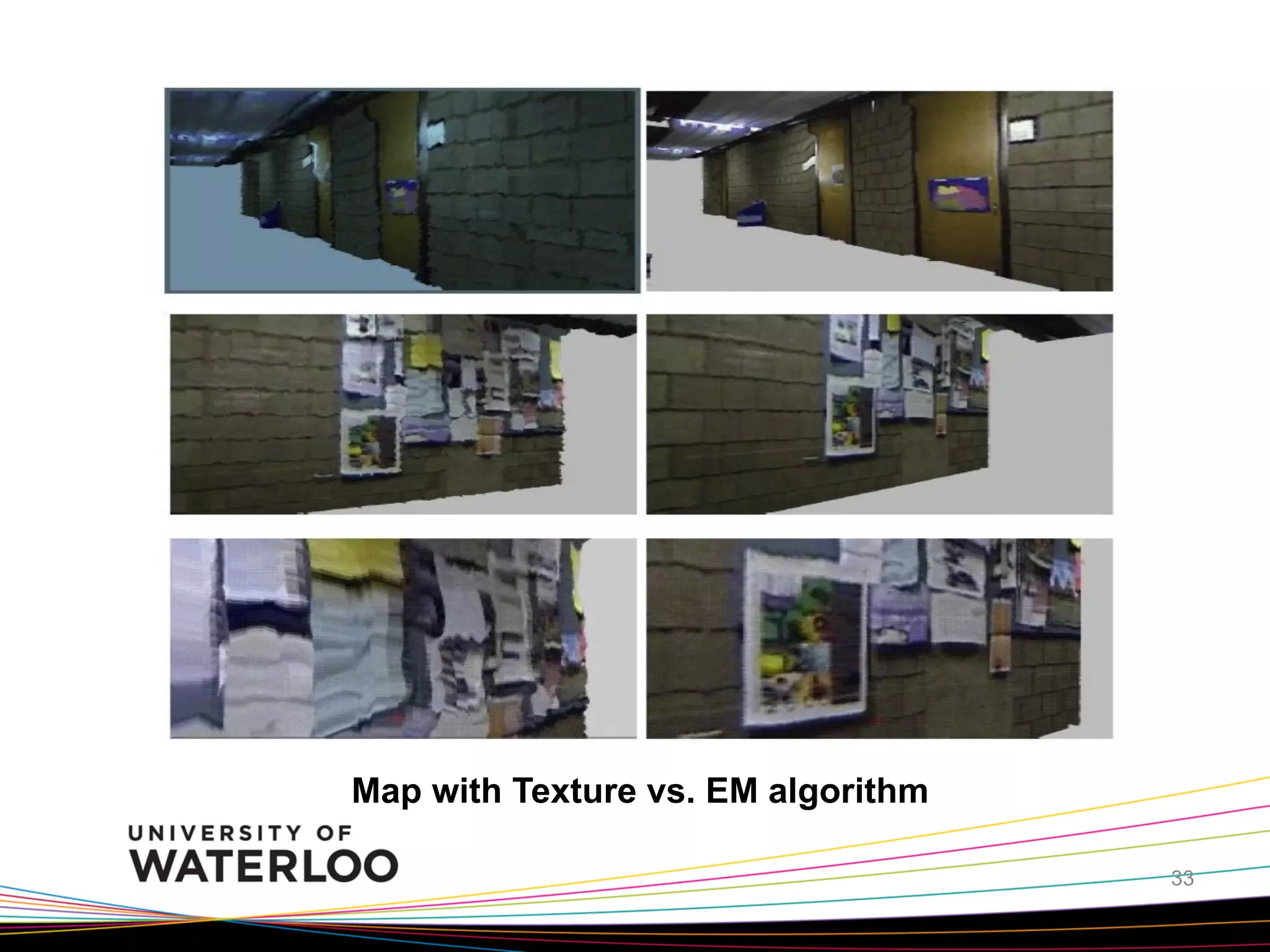
Map with Texture vs. EM algorithm
33
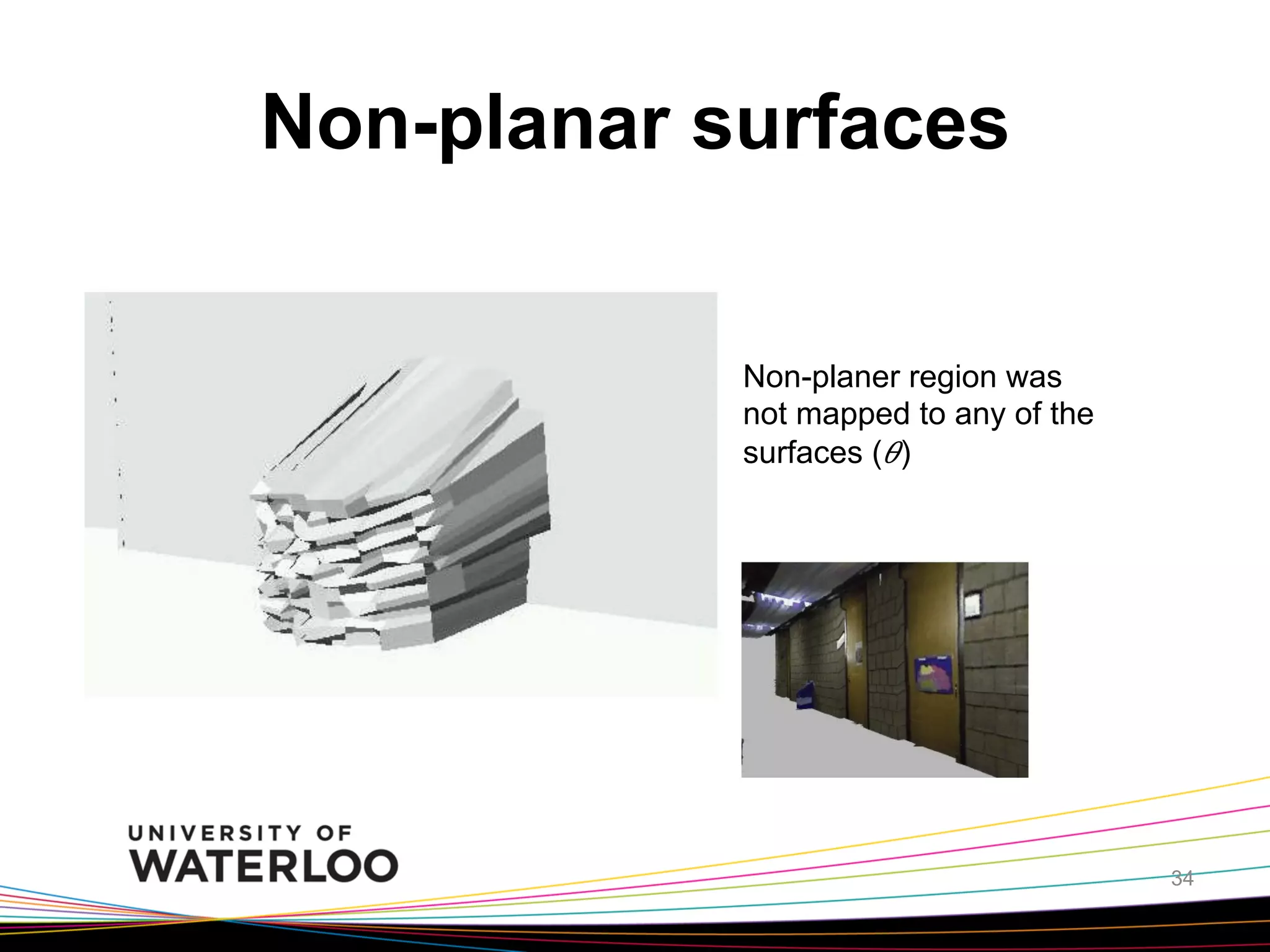
Non-planar surfaces
Non-planer region was
not mapped to any of the
surfaces (!)

34
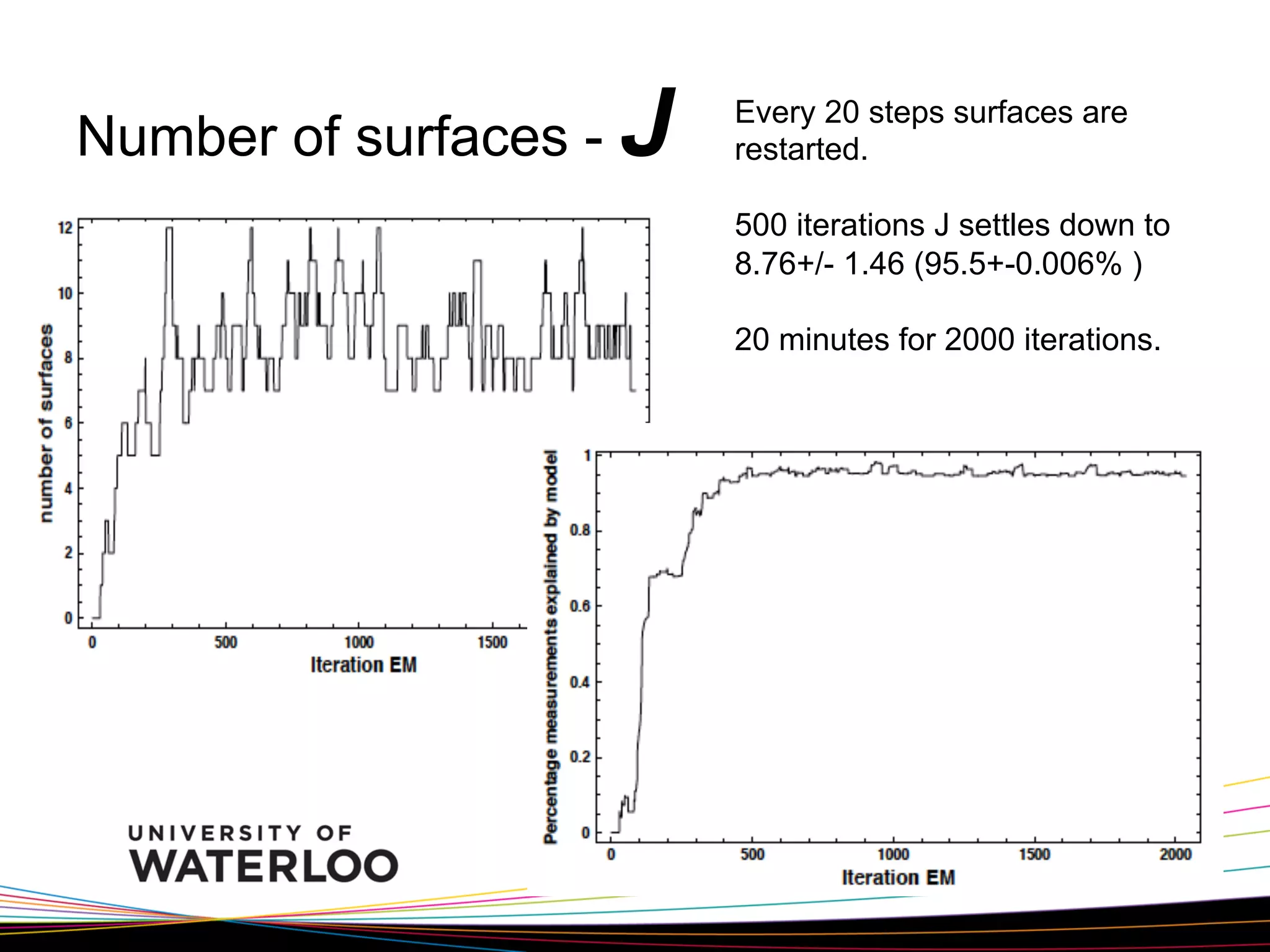
Number of surfaces -

J

Every 20 steps surfaces are
restarted.
500 iterations J settles down to
8.76+/- 1.46 (95.5+-0.006% )
20 minutes for 2000 iterations.

35
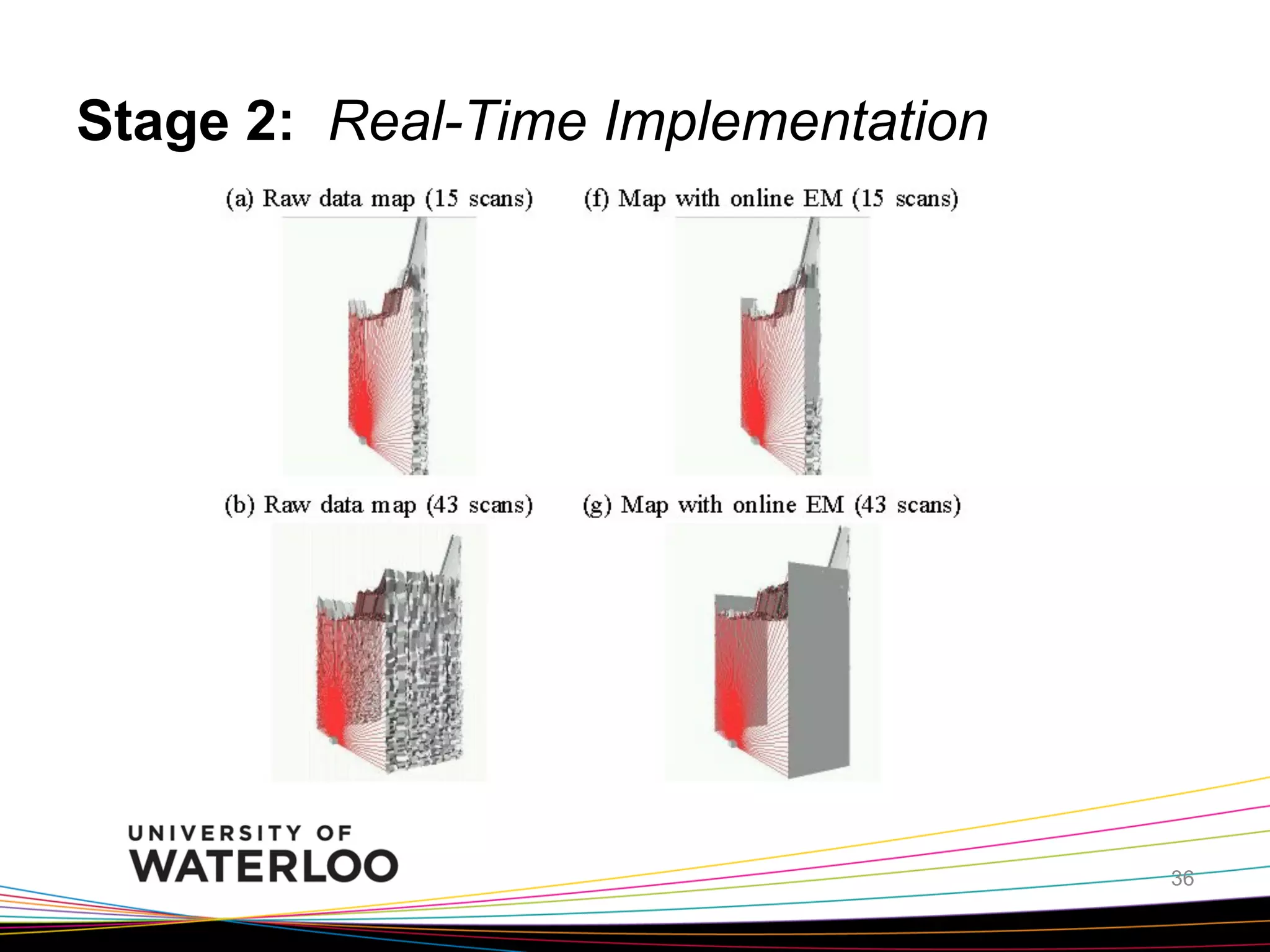
Stage 2: Real-Time Implementation

36
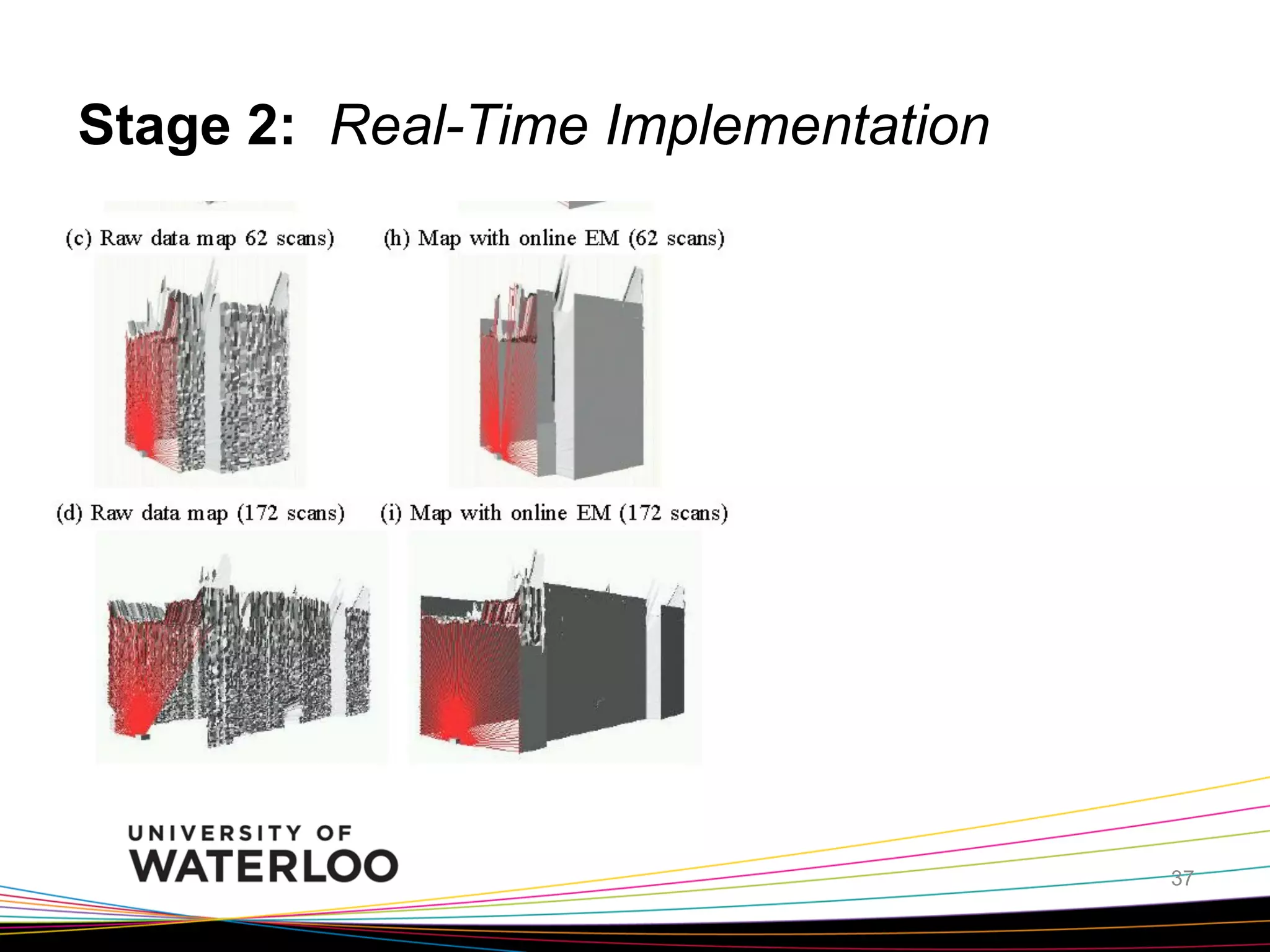
Stage 2: Real-Time Implementation

37
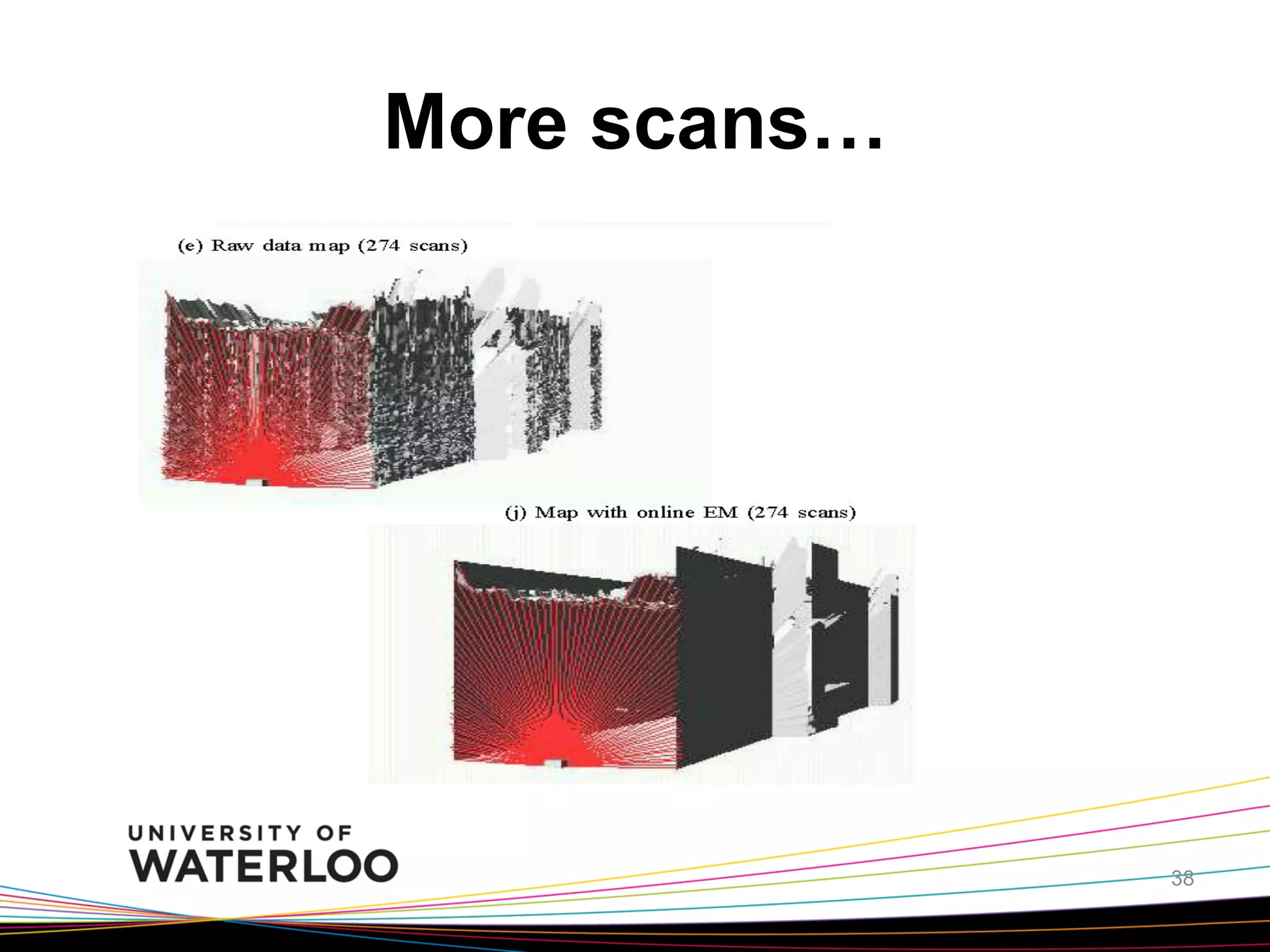
More scans…

38
Agenda

39
Conclusion - Main Contributions
•  Convert EM from offline to online
•  Compact & accurate computations.
•  3D mapping instead of 2D mapping
•  Handles surfaces in arbitrary orientations.

40
Conclusion - Critical Analysis
•  Models are visually realistic but not geometrically
accurate.
•  Not best in occluded/unstructured environments.
•  Test data has hallways with no furniture/occlusions.
•  Starts with Assumption that surfaces as flat.
•  Quality of images is not good enough for eye-inhand. just suffices robot movement.

41
Future Work
•  Can be used for representing more complex
models.
•  Outdoor mapping
•  Use EM to perform SLAM.

42
Questions ?

43

Robot maptalk

  • 1.
    Probabilistic Algorithms for MobileRobot Mapping Presented by: Noha Quan Ravi
  • 2.
    Based on thepaper A Real-Time Algorithm for Mobile Robot Mapping With Applications to Multi-Robot and 3D Mapping Best paper award at 2000 IEEE International Conference on Robotics and Automation (~1,100 submissions) By: Sebastian Thrun et. al. 2
  • 3.
    Robot Mapping… •  RobotMapping aims is to build a map of the physical environment of the robot •  Maps are utilized by mobile robots for their operations. •  Mapping: generating models of robot environments from sensor data. •  Probabilistic methods have recently proved very effective. •  Wide variety of sensors are used, with different characteristics (e.g. sonar, laser, IR, cameras, GPS) 3
  • 4.
    Robot Mapping Applications TheNursebot Initiative Roomba – Autonomic robotic vacuum cleaners Serviceroboter Museum Tour-Guide Robots
  • 5.
  • 6.
    Problem q  Building anOnline 3D Indoor Robot map. •  Challenges: 1.  Measurement Noise. 2.  High dimensionality of the mapped entities.(2D Vs. 3D). 3. Dynamic environment. 4.  Data association (correspondence) problem. 5.  Robotic Localization. (SLAM: Simultaneous Localization & Mapping) 6
  • 7.
    Related Work Ø  Focusedon building maps in 2D from sensor measurements. -  Line extraction from a single scan. Ø  3D system models proposed by Roth* doesn’t consider uncertainty of individual measurements when generating the 3D model. * G. Roth and R. Wibowo, “A fast algorithm for making mesh-models from multiple-view range data,” in Proceedings of the DND/CSA Robotics and Knowledge Based Systems Workshop, 1995. 7
  • 8.
    Methodology •  Propose analgorithm “Online EM” for 3D models for indoor mappings that works in real time. •  Measurements are captured using laser range finder and panoramic camera. •  Evaluation of the proposed algorithm via real-time implementation in several different buildings. •  Assumptions: Ø  prior knowledge : the shape of basic building elements. Ø  Robot pose is given. 8
  • 9.
  • 10.
    Generative Probability Model Eachof the rectangular flat surface is represented by nine parameters in three groups: θ j =< α j , β j , γ j > 3D Surface Normal Offset bet. Surface & origin Specify size & orient. of the planar surface !j Offset β j 10
  • 11.
    Generative Probability Model:World Model •  Two types of surfaces: θ1 θ2 … θJ θ = {θ1 ,θ 2 ...,θ J } Flat Surfaces Non-flat region 11
  • 12.
    Generative Probability Model:Measurements •  Measurements are captured from a laser range finder. Z = {z } i •  All measurements are 3D point cloud: zi ∈ R 3 •  Distance between any measurement zi and the boundary of the surface. zi θj d(zi, θi) = (αi.zi - βj) θj zi θj d(zi, θi) = Euclidean dist. zi Between zi and boundary of the surface 12
  • 13.
    Generative Probability Model:Correspondence Variables θ2 θ1 ci1 ci 2 … cij θJ ciJ zi ⎧1 cij = ⎨ ⎩0 Non-flat region ci* measusrement corresponds to θ j others J ci* + ∑ cij = 1 j =1 13
  • 14.
    Measurement Model Probabilistic generativemodel of the measurements given the world. P( zi | Ci, θ ) 14
  • 15.
  • 16.
    Error Distribution A. Forflat surfaces (Normal distribution) p( zi | cij = 1,θ ) = 1 2πσ 2 e 2 1 d ( zi ,θ j ) − 2 σ2 B. For non-flat surfaces (Uniform distribution) ⎧1 / z max , p( zi | cij = 1, θ ) = ⎨ ⎩ 0, 1 z max = 1 2πσ 2 e if 0 ≤ zi ≤ z max otherwise 1 z 2 max − log 2 2πσ 2 16
  • 17.
    The Log-Likelihood Function • Sensor Model: Conditional probability p( zi | Ci ,θ ) = 1 2πσ 2 e 1 z 2 ma x − [ ci* log + 2 2 2πσ ∑ j cij d 2 ( zi ,θ j ) σ 2 ] •  Sensor Model: Joint probability p( zi , Ci | θ ) = 1 ( J + 1) 2πσ 2 e 1 z 2 max − [ ci* log + 2 2 2πσ ∑ j cij d 2 ( zi ,θ j ) σ 2 ] 17
  • 18.
    The Expectation ofthe log likelihood •  Assuming independence in measurement noise: p( Z , C | θ ) =∏ i 1 ( J + 1) 2πσ 2 e 1 z 2 max − [ ci* log + 2 2πσ 2 ∑ j cij d 2 ( zi ,θ j ) σ2 ] •  EM: take the log likelihood (take the log of the above equation) EC = [log p ( Z , C | θ ) | Z , θ ] ⎡ 1 1 z 2 max ∑ ⎢log ( J + 1) 2πσ 2 − 2 E[ci* | zi ,θ ] log 2πσ 2 i ⎢ ⎣ d 2 ( zi , θ j ) ⎤ 1 − ∑ j E[cij | zi , θ ] ⎥ 2 σ2 ⎥ ⎦ 18
  • 19.
  • 20.
    EM Algorithm: offline • A popular method for optimization •  Uses hill climbing in likelihood space. •  Used for problems with latent variables. z •  Input: measurement i, the 3D points 1 •  Output: [ n +1] < α [ n+1] , β [ n+1] , γ [ n+1] > A map θ which maximize the expectation log likelihood over correspondences C •  EM is an iterative process. Each iteration includes two steps: E-step and M-step. θ ... θ2 θJ Non-flat region
  • 21.
    EM Algorithm: offline A.The E-Step -  Initialize θ [0] = A random map -  Calculate the expectations of the unknown correspondences for the current map θ [n] . [ eijn ] = E[cij | zi ,θ [ n ] ] = p(cij | zi ,θ [ n ] ) p( zi | cij ,θ ) p(cij | θ ) [n] = [n] p ( zi | θ [ n ] ) e = e 2 z max 2 1 − log 2 2πσ 2 1 d ( zi |θ j ) − 2 σ2 + ∑k e − 2 1 d ( zi |θ k ) 2 σ2 ei[*n ] = E[ci* | zi ,θ [ n ] ] = p(cij | zi ,θ [ n ] ) p( zi | ci* ,θ [ n ] ) p(ci* | θ [ n ] ) = p ( zi | θ [ n ] ) e = e 2 z max 1 − log 2 2πσ 2 z2 1 − log max2 2 2πσ + ∑k e 1 d 2 ( zi |θ k ) − 2 σ2 21
  • 22.
    EM Algorithm: offline(cont.) B. The M-Step •  Goal: Maximize the expectation of the log likelihood where the expectation is taken over all the correspondences C. EC = [log p(Z , C | θ ) | Z ,θ ] ⎡ 1 1 z 2 max ∑ ⎢log ( J + 1) 2πσ 2 − 2 E[ci* | zi ,θ ] log 2πσ 2 i ⎢ ⎣ d 2 ( zi , θ j ) ⎤ 1 − ∑ j E[cij | zi ,θ ] ⎥ 2 σ2 ⎥ ⎦ The quadratic optimization problem is solved via Lagrange multipliers. 22
  • 23.
  • 24.
    Online EM •  OfflineEM Limitations •  1. Require all the measurements Z as input •  2. Access every measurement zi and every θ j per iteration d 2 ( zi ,θ j ) model •  3. Computation grows as dataset grows •  Solution: Online EM 24
  • 25.
    Online EM •  Keyidea: •  Each time interval, constant number of new range measurements arrive •  Advantages: •  1. Acquire compact 3-D models in real time •  2. Limited number of measurements as input •  3. Constant time per iteration 25
  • 26.
    Online EM (OnlineE-Step) •  Constant number of measurements •  1.New arrival measurements •  2. Old measurements –  At the boundary of two surface models –  Unexplained by any existing surface models •  Counter •  1. Record E-step calculation times •  2. Freeze when achieve a threshold 26
  • 27.
    Online EM (OnlineM-Step) •  Goal: •  Re-estimate the parameters of flat surface model in constant time •  Control: •  The number of flat surfaces •  The number of measurements 27
  • 28.
    Online EM (OnlineM-Step) •  Control the number of flat surfaces : •  Active flat surface model only •  Definition of “active”: •  A surface is active at time i if the E-step executed at that time changed the ML correspondence to or away from the surface for any of the updated measurement. 28
  • 29.
    Online EM (Model Selection) q Addnew models Ø  New measurements not “explained” by existing surface models Ø  “explained”: likelihood > threshold Ø  not “explained”: seed for new surface q Remove models Ø  The surface model is not supported by sufficient measurements 29
  • 30.
  • 31.
    Experimental Results •  Twostages –  Offline EM algorithm. 168,120 range measurements 3,270 camera images, extracted 3,220,950 pixels Two minutes –  Real time online version of our approach •  Different buildings •  Three examples in paper (One presented here) 31
  • 32.
    Stage 1: OfflineEM Map without the texture superimposed. 32
  • 33.
    Map with Texturevs. EM algorithm 33
  • 34.
    Non-planar surfaces Non-planer regionwas not mapped to any of the surfaces (!) 34
  • 35.
    Number of surfaces- J Every 20 steps surfaces are restarted. 500 iterations J settles down to 8.76+/- 1.46 (95.5+-0.006% ) 20 minutes for 2000 iterations. 35
  • 36.
    Stage 2: Real-TimeImplementation 36
  • 37.
    Stage 2: Real-TimeImplementation 37
  • 38.
  • 39.
  • 40.
    Conclusion - MainContributions •  Convert EM from offline to online •  Compact & accurate computations. •  3D mapping instead of 2D mapping •  Handles surfaces in arbitrary orientations. 40
  • 41.
    Conclusion - CriticalAnalysis •  Models are visually realistic but not geometrically accurate. •  Not best in occluded/unstructured environments. •  Test data has hallways with no furniture/occlusions. •  Starts with Assumption that surfaces as flat. •  Quality of images is not good enough for eye-inhand. just suffices robot movement. 41
  • 42.
    Future Work •  Canbe used for representing more complex models. •  Outdoor mapping •  Use EM to perform SLAM. 42
  • 43.