Adaptive Lab
Talk Series
Electrical and
Computer
Engineering
Outline
Problem
Definition
System Model
Overall Model
Theory of
Planned
Behavior
Cognitive
Dissonance
Theory of
Overjustification
Controller
Design
Assumptions
and Initial
Conditions
Controller
Design: Stage1
Controller
Design: Stage2
Simulation
Results
A Model-Based Feedback-Control Approach to
Behaviour Modification Through
Reward-Induced Attitude Change
J.Ni, D. Kulic, and D. Davison
presented by: Noha El-Prince
April 16, 2013
Electrical and Computer Engineering Adaptive Lab Talk Series
Adaptive Lab
Talk Series
Electrical and
Computer
Engineering
Outline
Problem
Definition
System Model
Overall Model
Theory of
Planned
Behavior
Cognitive
Dissonance
Theory of
Overjustification
Controller
Design
Assumptions
and Initial
Conditions
Controller
Design: Stage1
Controller
Design: Stage2
Simulation
Results
1 Outline
2 Problem Definition
3 System Model
Overall Model
Theory of Planned Behavior
Cognitive Dissonance
Theory of Overjustification
4 Controller Design
Assumptions and Initial Conditions
Controller Design: Stage1
Controller Design: Stage2
5 Simulation Results
6 Conclusion
Electrical and Computer Engineering Adaptive Lab Talk Series
Adaptive Lab
Talk Series
Electrical and
Computer
Engineering
Outline
Problem
Definition
System Model
Overall Model
Theory of
Planned
Behavior
Cognitive
Dissonance
Theory of
Overjustification
Controller
Design
Assumptions
and Initial
Conditions
Controller
Design: Stage1
Controller
Design: Stage2
Simulation
Results
Problem Definition
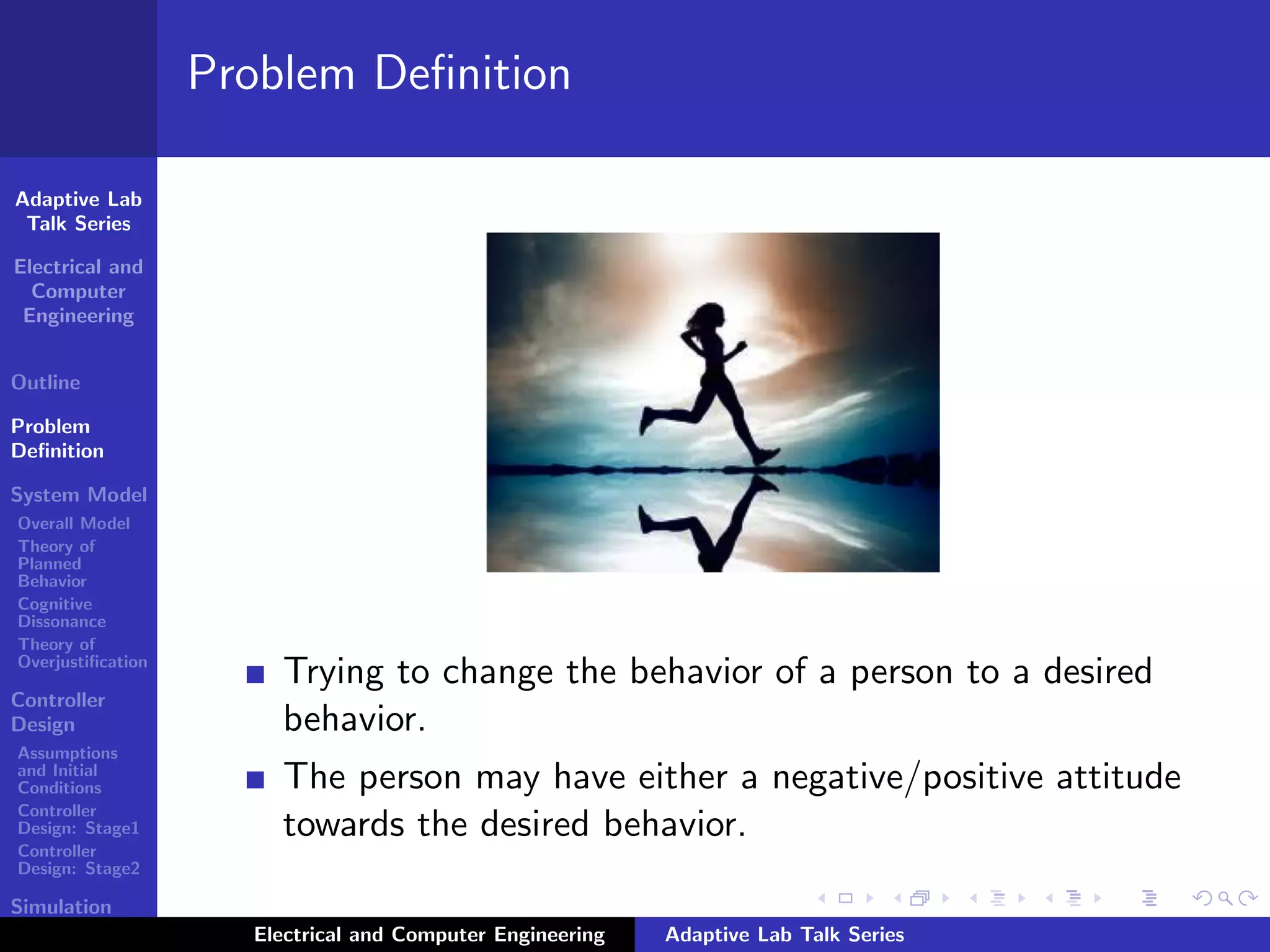
Trying to change the behavior of a person to a desired
behavior.
The person may have either a negative/positive attitude
towards the desired behavior.
Electrical and Computer Engineering Adaptive Lab Talk Series
Adaptive Lab
Talk Series
Electrical and
Computer
Engineering
Outline
Problem
Definition
System Model
Overall Model
Theory of
Planned
Behavior
Cognitive
Dissonance
Theory of
Overjustification
Controller
Design
Assumptions
and Initial
Conditions
Controller
Design: Stage1
Controller
Design: Stage2
Simulation
Results
Methodology
Model the internal cognitive psychological state of a
person.
Design a controller based on the cognitive model.
Goal: Tracking desired behavior via a sequence of
rewards.
Electrical and Computer Engineering Adaptive Lab Talk Series
Adaptive Lab
Talk Series
Electrical and
Computer
Engineering
Outline
Problem
Definition
System Model
Overall Model
Theory of
Planned
Behavior
Cognitive
Dissonance
Theory of
Overjustification
Controller
Design
Assumptions
and Initial
Conditions
Controller
Design: Stage1
Controller
Design: Stage2
Simulation
Results
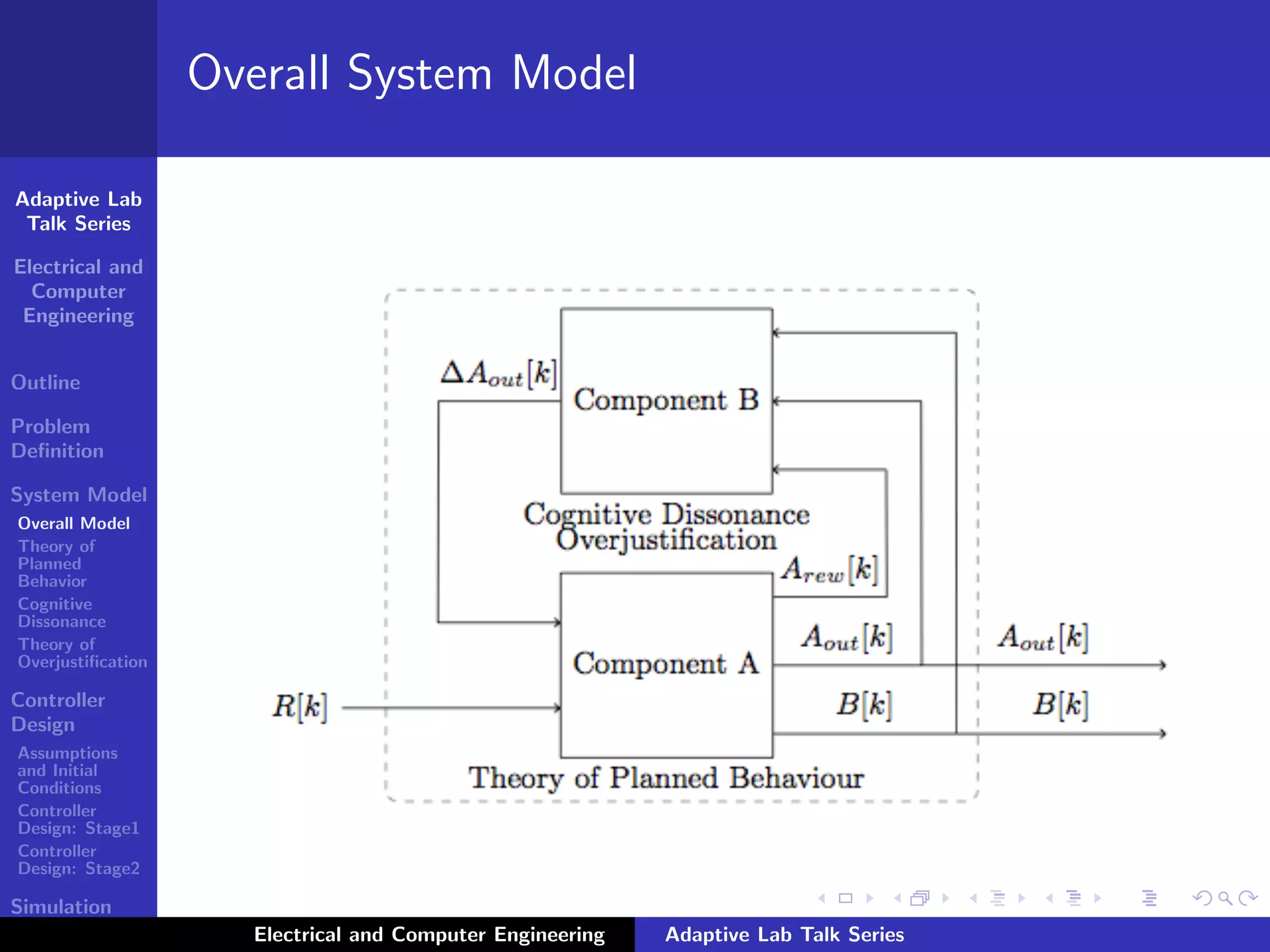
Overall System Model
Electrical and Computer Engineering Adaptive Lab Talk Series
Adaptive Lab
Talk Series
Electrical and
Computer
Engineering
Outline
Problem
Definition
System Model
Overall Model
Theory of
Planned
Behavior
Cognitive
Dissonance
Theory of
Overjustification
Controller
Design
Assumptions
and Initial
Conditions
Controller
Design: Stage1
Controller
Design: Stage2
Simulation
Results
Theory of Planned Behavior
Aout[k] = Aout[k − 1] + ∆Aout[k − 1], (1)
∆Aout[k] = ∆ACD
out [k] + ∆AOJ
out[k], (2)
Arew[k] = r1Arew[k − 1] + µ1(1 − r1)R[k − 1], (3)
BI[k] = Aout[k] + Arew[k], (4)
Electrical and Computer Engineering Adaptive Lab Talk Series
Adaptive Lab
Talk Series
Electrical and
Computer
Engineering
Outline
Problem
Definition
System Model
Overall Model
Theory of
Planned
Behavior
Cognitive
Dissonance
Theory of
Overjustification
Controller
Design
Assumptions
and Initial
Conditions
Controller
Design: Stage1
Controller
Design: Stage2
Simulation
Results
Theory of Planned Behavior
B[k] =



Bd[k] if BI[k] ≥ Bd[k] and Aout[k] ≤ Bd[k]
Aout[k] if (BI[k] < Bd[k] and Aout[k] ≥ 0)
or Aout[k] > Bd[k]
0 otherwise.
(5)
Electrical and Computer Engineering Adaptive Lab Talk Series
Adaptive Lab
Talk Series
Electrical and
Computer
Engineering
Outline
Problem
Definition
System Model
Overall Model
Theory of
Planned
Behavior
Cognitive
Dissonance
Theory of
Overjustification
Controller
Design
Assumptions
and Initial
Conditions
Controller
Design: Stage1
Controller
Design: Stage2
Simulation
Results
Cognitive Dissonance Theory (Block A)
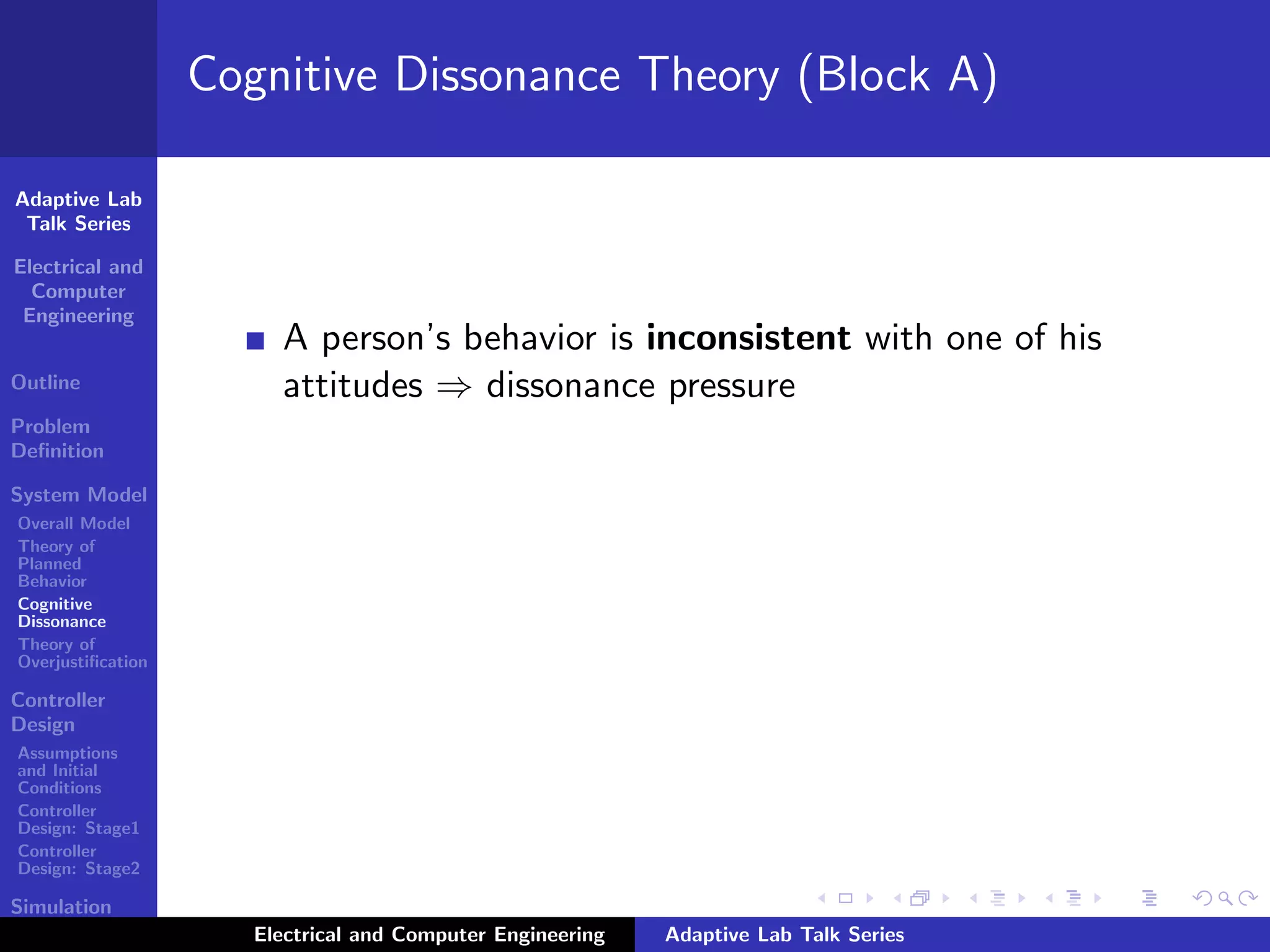
A person’s behavior is inconsistent with one of his
attitudes ⇒ dissonance pressure
Electrical and Computer Engineering Adaptive Lab Talk Series
Adaptive Lab
Talk Series
Electrical and
Computer
Engineering
Outline
Problem
Definition
System Model
Overall Model
Theory of
Planned
Behavior
Cognitive
Dissonance
Theory of
Overjustification
Controller
Design
Assumptions
and Initial
Conditions
Controller
Design: Stage1
Controller
Design: Stage2
Simulation
Results
Cognitive Dissonance Theory (Block A)
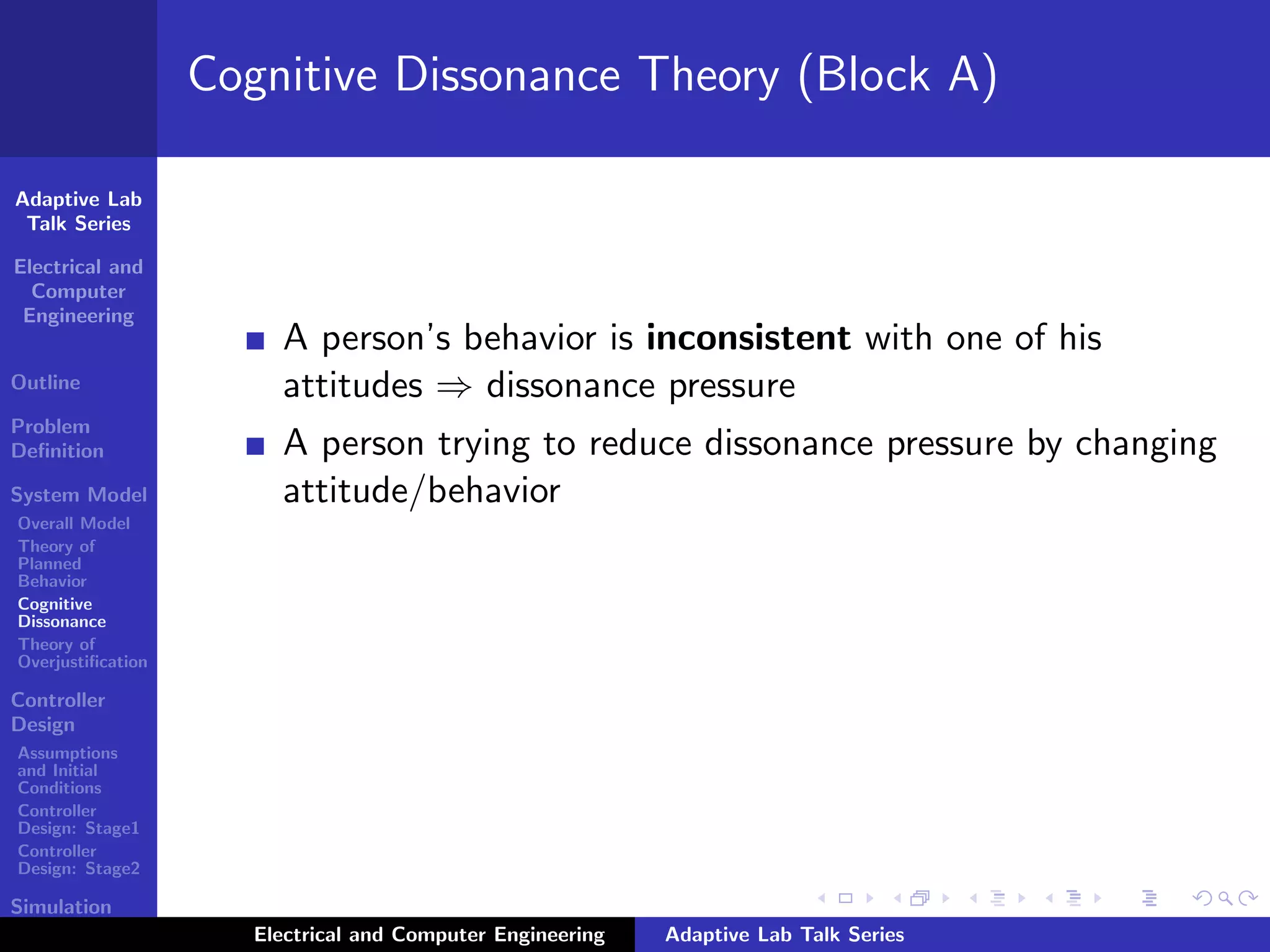
A person’s behavior is inconsistent with one of his
attitudes ⇒ dissonance pressure
A person trying to reduce dissonance pressure by changing
attitude/behavior
Electrical and Computer Engineering Adaptive Lab Talk Series
Adaptive Lab
Talk Series
Electrical and
Computer
Engineering
Outline
Problem
Definition
System Model
Overall Model
Theory of
Planned
Behavior
Cognitive
Dissonance
Theory of
Overjustification
Controller
Design
Assumptions
and Initial
Conditions
Controller
Design: Stage1
Controller
Design: Stage2
Simulation
Results
Cognitive Dissonance Theory (Block A)
A person’s behavior is inconsistent with one of his
attitudes ⇒ dissonance pressure
A person trying to reduce dissonance pressure by changing
attitude/behavior
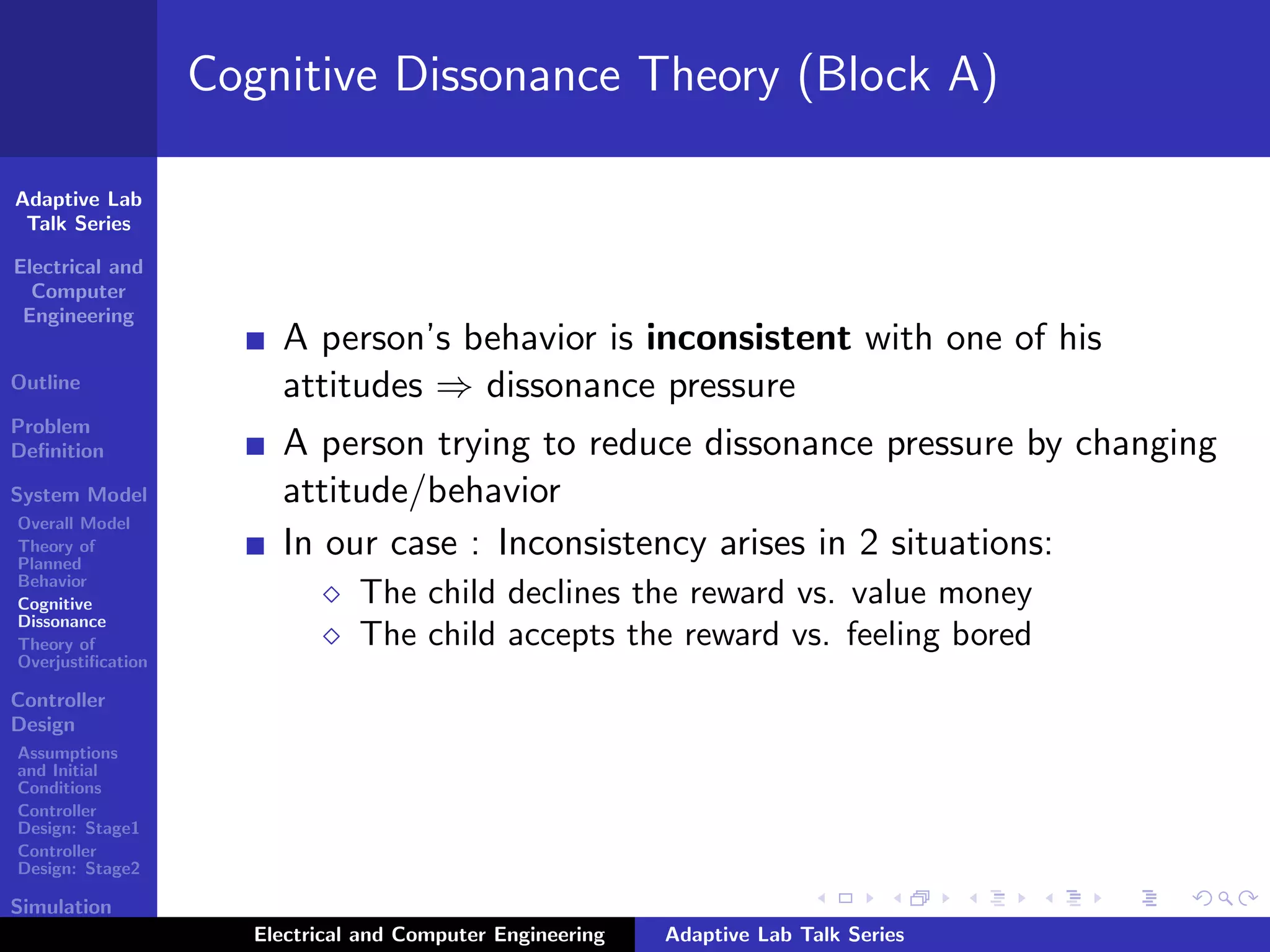
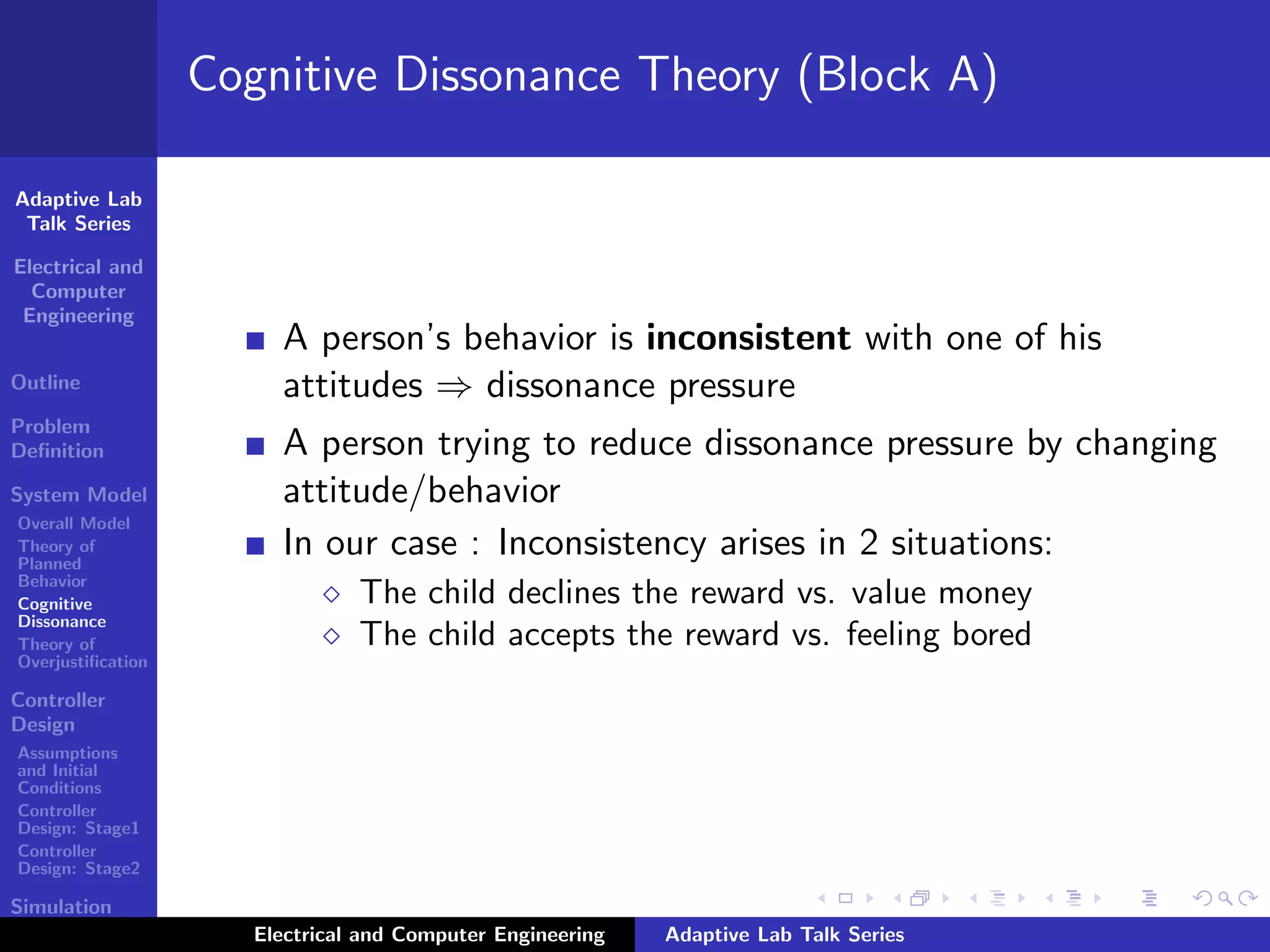
In our case : Inconsistency arises in 2 situations:
The child declines the reward vs. value money
The child accepts the reward vs. feeling bored
Electrical and Computer Engineering Adaptive Lab Talk Series
Adaptive Lab
Talk Series
Electrical and
Computer
Engineering
Outline
Problem
Definition
System Model
Overall Model
Theory of
Planned
Behavior
Cognitive
Dissonance
Theory of
Overjustification
Controller
Design
Assumptions
and Initial
Conditions
Controller
Design: Stage1
Controller
Design: Stage2
Simulation
Results
Cognitive Dissonance Theory (Block A)
A person’s behavior is inconsistent with one of his
attitudes ⇒ dissonance pressure
A person trying to reduce dissonance pressure by changing
attitude/behavior
In our case : Inconsistency arises in 2 situations:
The child declines the reward vs. value money
The child accepts the reward vs. feeling bored
Electrical and Computer Engineering Adaptive Lab Talk Series
Adaptive Lab
Talk Series
Electrical and
Computer
Engineering
Outline
Problem
Definition
System Model
Overall Model
Theory of
Planned
Behavior
Cognitive
Dissonance
Theory of
Overjustification
Controller
Design
Assumptions
and Initial
Conditions
Controller
Design: Stage1
Controller
Design: Stage2
Simulation
Results
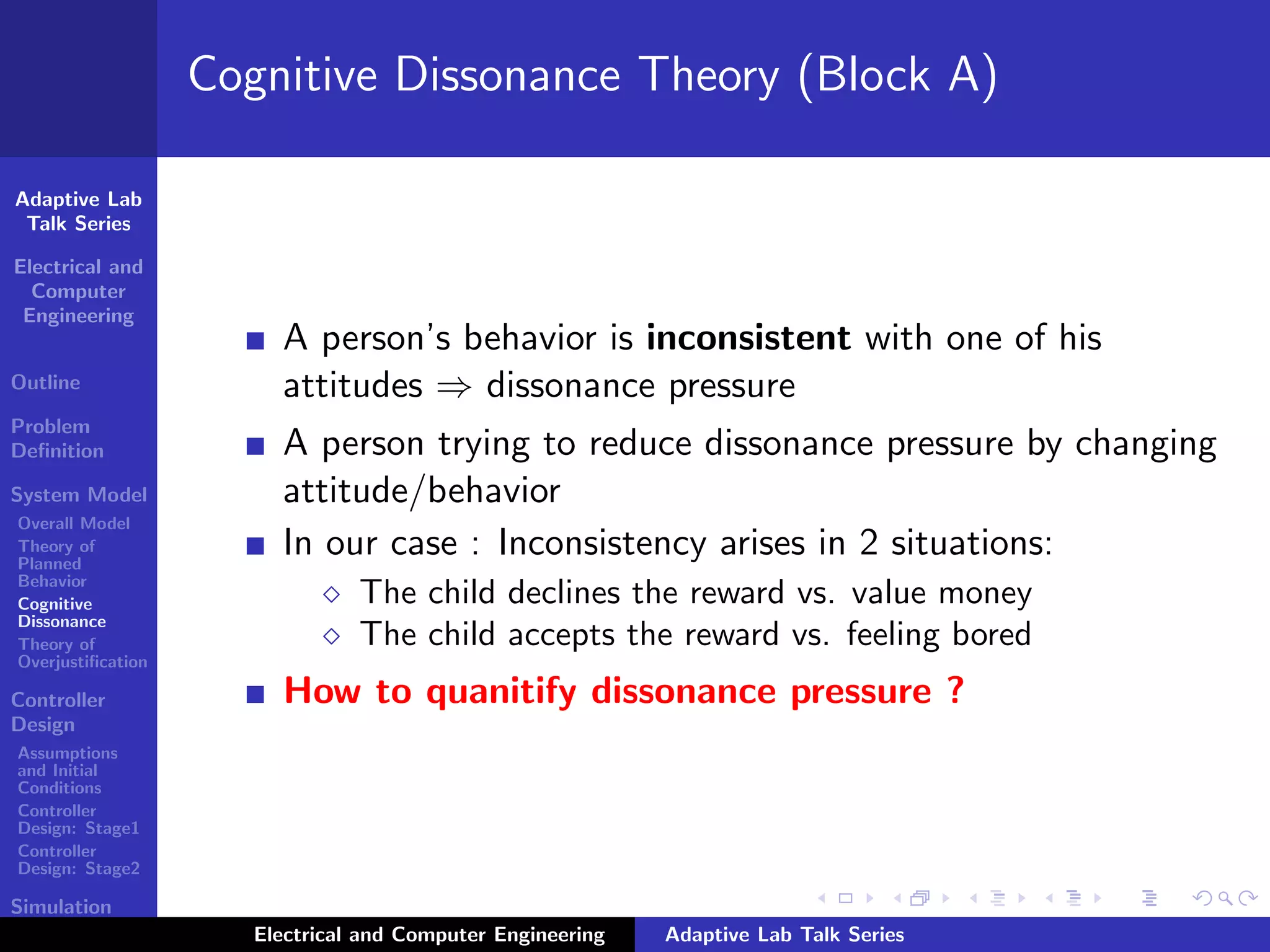
Cognitive Dissonance Theory (Block A)
A person’s behavior is inconsistent with one of his
attitudes ⇒ dissonance pressure
A person trying to reduce dissonance pressure by changing
attitude/behavior
In our case : Inconsistency arises in 2 situations:
The child declines the reward vs. value money
The child accepts the reward vs. feeling bored
How to quanitify dissonance pressure ?
Electrical and Computer Engineering Adaptive Lab Talk Series
Adaptive Lab
Talk Series
Electrical and
Computer
Engineering
Outline
Problem
Definition
System Model
Overall Model
Theory of
Planned
Behavior
Cognitive
Dissonance
Theory of
Overjustification
Controller
Design
Assumptions
and Initial
Conditions
Controller
Design: Stage1
Controller
Design: Stage2
Simulation
Results
Quantifying Dissonance Pressure
Dissonance = ”%” of inconsistent cognitive pairs
PCD
raw[k] =



Bsgn[k] Mincon[k]
Mincon[k]+Mcon[k] if Mincon[k] + Mcon[k] >
0 otherwise.
Bsgn[k] =
+1 if B[k] ≥ Bd[k] or Aout[k] ≥ 0
−1 otherwise.
(7)
Electrical and Computer Engineering Adaptive Lab Talk Series
Adaptive Lab
Talk Series
Electrical and
Computer
Engineering
Outline
Problem
Definition
System Model
Overall Model
Theory of
Planned
Behavior
Cognitive
Dissonance
Theory of
Overjustification
Controller
Design
Assumptions
and Initial
Conditions
Controller
Design: Stage1
Controller
Design: Stage2
Simulation
Results
Quantifying Dissonance Pressure - cont.
M
1
incon[k] =
|Arew[k]| if sgn(Arew[k]) = Brel[k]
0 otherwise,
(8)
M
2
incon[k] =
|Aout[k]| if sgn(Aout[k]) = Bsgn[k]
0 otherwise,
(9)
M
1
con[k] =
|Arew[k]| if sgn(Arew[k]) = Brel[k]
0 otherwise,
(10)
M
2
con[k] =
|Aout[k]| if sgn(Aout[k]) = Bsgn[k]
0 otherwise,
(11)
Mincon[k] =
2
i=1
M
i
incon[k], Mcon[k] =
2
i=1
M
i
con[k], (12)
Brel[k] =
+1 if B[k] ≥ Bd[k]
−1 otherwise.
(13)
Electrical and Computer Engineering Adaptive Lab Talk Series
Adaptive Lab
Talk Series
Electrical and
Computer
Engineering
Outline
Problem
Definition
System Model
Overall Model
Theory of
Planned
Behavior
Cognitive
Dissonance
Theory of
Overjustification
Controller
Design
Assumptions
and Initial
Conditions
Controller
Design: Stage1
Controller
Design: Stage2
Simulation
Results
Special Case: Attitude Reversal
Aout[k] small, R[k] small, Bd[k] is high ⇒ Child declines
the reward
To reduce Diss. pressure: increase Aout OR “give up”
jogging ⇒ Aout[k] <<<
r[k] =



+1 if Bd[k] − BI[k] > αrevAout[k], Aout[k] ≥ 0,
K1PCD
[k] > 2Aout[k], and Arew[k] > 0,
−1 otherwise.
(14)
PCD
[k] =
(1 − r2)PCD
raw[k] if r[k − 1] = 1
r2PCD
[k − 1] + (1 − r2)PCD
raw[k] otherwise.
(15)
P raw
CD
Electrical and Computer Engineering Adaptive Lab Talk Series
Adaptive Lab
Talk Series
Electrical and
Computer
Engineering
Outline
Problem
Definition
System Model
Overall Model
Theory of
Planned
Behavior
Cognitive
Dissonance
Theory of
Overjustification
Controller
Design
Assumptions
and Initial
Conditions
Controller
Design: Stage1
Controller
Design: Stage2
Simulation
Results
Quantifying ∆Aout
Assume the change in Aout[k] is proportional to dissonance
pressure, with proportionality constant K1 > 0:
∆ACD
out [k] =
−K1PCD
[k] if r[k] = 1
+K1PCD
[k] otherwise.
(16)
P CD
Electrical and Computer Engineering Adaptive Lab Talk Series
Adaptive Lab
Talk Series
Electrical and
Computer
Engineering
Outline
Problem
Definition
System Model
Overall Model
Theory of
Planned
Behavior
Cognitive
Dissonance
Theory of
Overjustification
Controller
Design
Assumptions
and Initial
Conditions
Controller
Design: Stage1
Controller
Design: Stage2
Simulation
Results
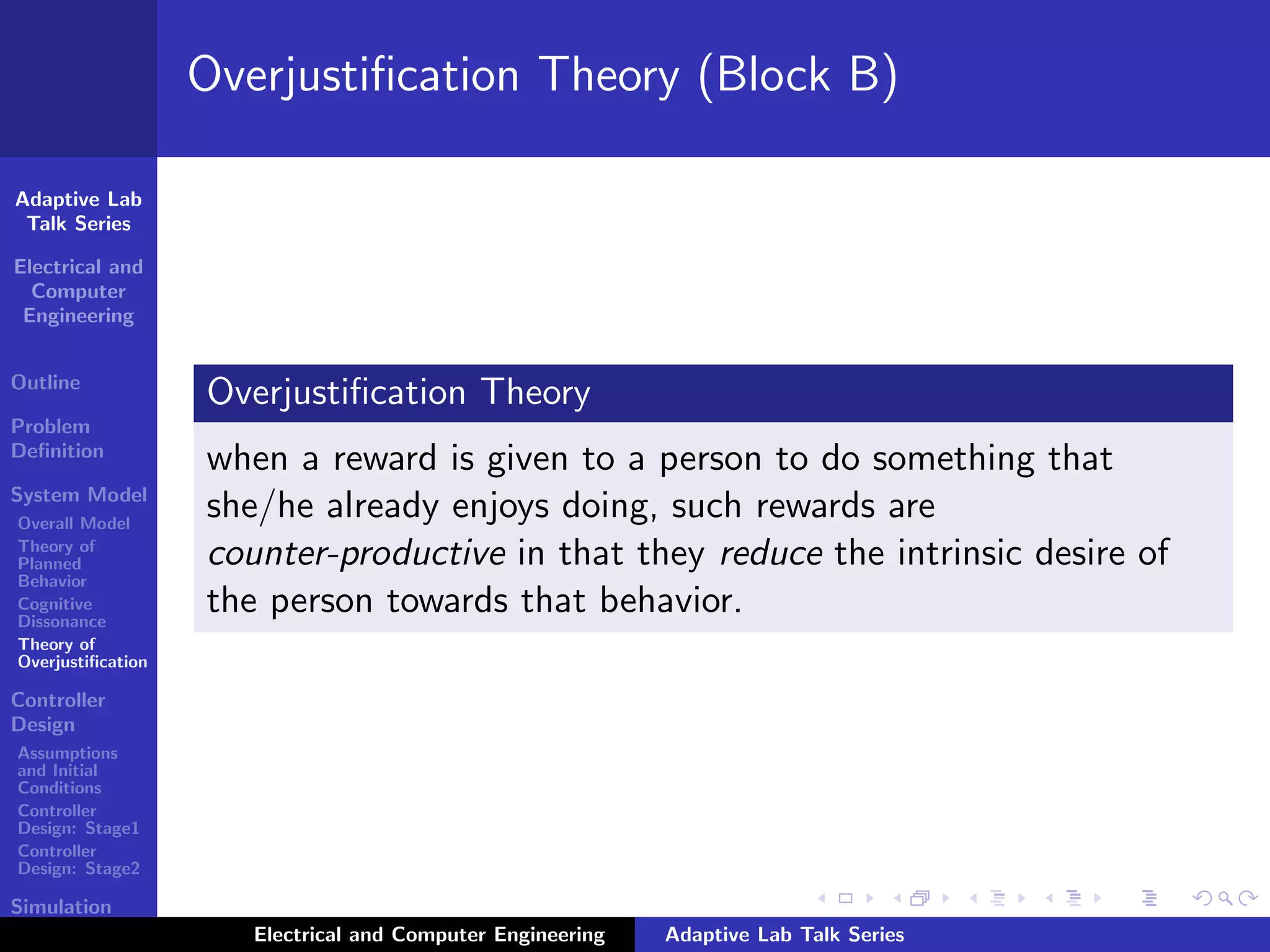
Overjustification Theory (Block B)
Overjustification Theory
when a reward is given to a person to do something that
she/he already enjoys doing, such rewards are
counter-productive in that they reduce the intrinsic desire of
the person towards that behavior.
Electrical and Computer Engineering Adaptive Lab Talk Series
Adaptive Lab
Talk Series
Electrical and
Computer
Engineering
Outline
Problem
Definition
System Model
Overall Model
Theory of
Planned
Behavior
Cognitive
Dissonance
Theory of
Overjustification
Controller
Design
Assumptions
and Initial
Conditions
Controller
Design: Stage1
Controller
Design: Stage2
Simulation
Results
Overjustification Theory - cont.
Let Bt[k] = minimal attitude level to which the
overjustification effect can drive Aout[k].
Assume Bt[k] is a constant fraction of Bd[k], i.e.,
Bt[k] = αBd
· Bd[k], (17)
for some constant 0 < αBd
< 1.
If Bt[k] > Aout[k] ⇒ overjustification pressure does not
decrease Aout, and the reverse is true i.e.
Arel
out[k] = max{0, Aout[k] − Bt[k]}. (18)
where Arel
out[k]: a relative attitude with respect to Bt[k]
Electrical and Computer Engineering Adaptive Lab Talk Series
Adaptive Lab
Talk Series
Electrical and
Computer
Engineering
Outline
Problem
Definition
System Model
Overall Model
Theory of
Planned
Behavior
Cognitive
Dissonance
Theory of
Overjustification
Controller
Design
Assumptions
and Initial
Conditions
Controller
Design: Stage1
Controller
Design: Stage2
Simulation
Results
Overjustification Theory - cont.
Then the raw and filtered overjustification pressures, and the resulting change in intrinsic attitude, are
computed just as in our previous work, but using Arel
out instead of Aout, as follows:
P
OJ
raw[k] =



Arel
out[k]Arew[k] if Arel
out[k] > 0 and Arew[k] > 0
and B[k] ≥ Bd[k]
0 otherwise,
(19)
P
OJ
[k] = r3P
OJ
[k − 1] + (1 − r3)P
OJ
raw[k], (20)
∆A
OJ
out[k] =
−K2P OJ
[k] if K2P OJ
[k] ≤ Arel
out[k]
−Arel
out[k] otherwise.
(21)
Electrical and Computer Engineering Adaptive Lab Talk Series
Adaptive Lab
Talk Series
Electrical and
Computer
Engineering
Outline
Problem
Definition
System Model
Overall Model
Theory of
Planned
Behavior
Cognitive
Dissonance
Theory of
Overjustification
Controller
Design
Assumptions
and Initial
Conditions
Controller
Design: Stage1
Controller
Design: Stage2
Simulation
Results
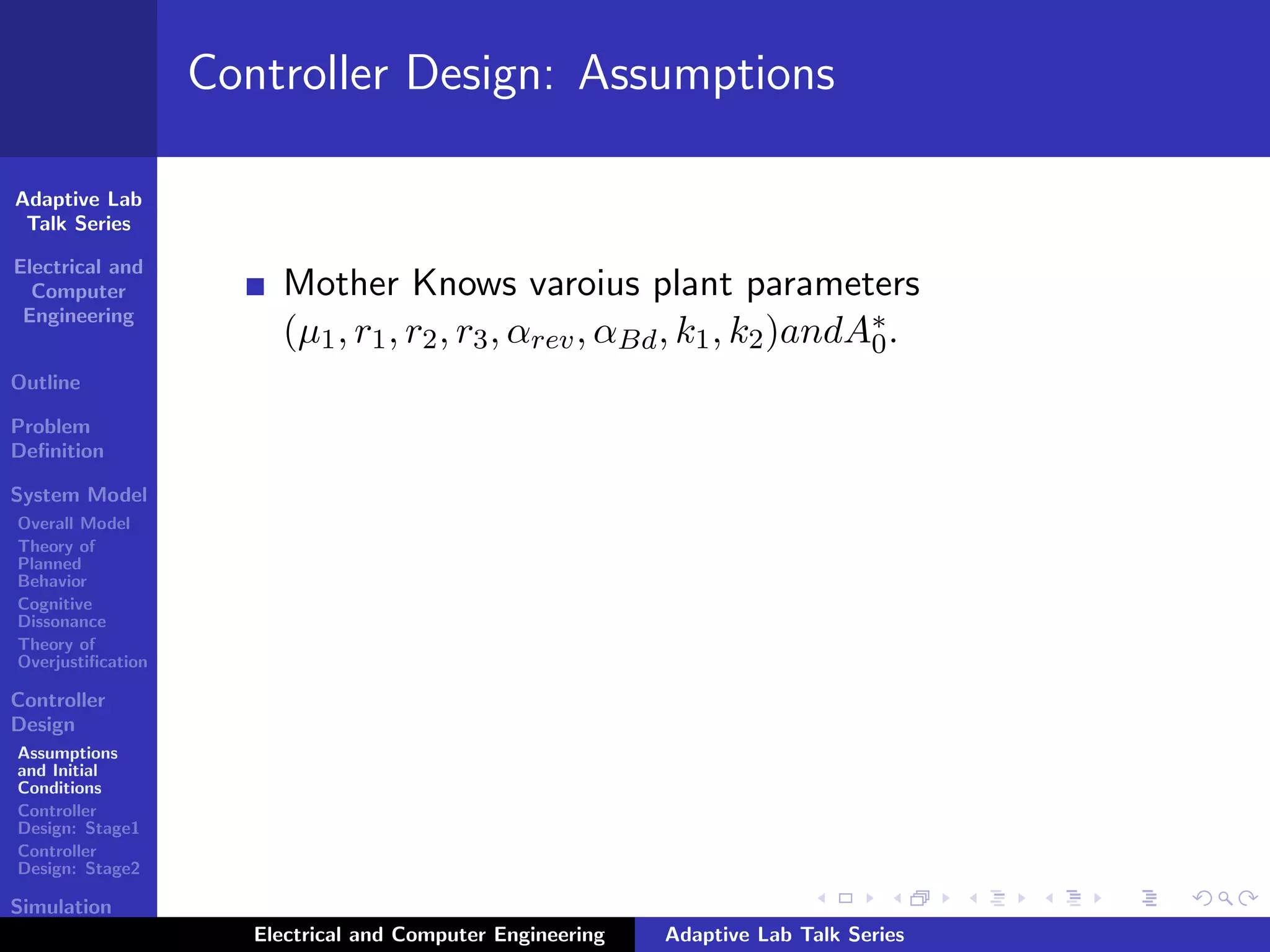
Controller Design: Assumptions
Mother Knows varoius plant parameters
(µ1, r1, r2, r3, αrev, αBd, k1, k2)andA∗
0.
Electrical and Computer Engineering Adaptive Lab Talk Series
Adaptive Lab
Talk Series
Electrical and
Computer
Engineering
Outline
Problem
Definition
System Model
Overall Model
Theory of
Planned
Behavior
Cognitive
Dissonance
Theory of
Overjustification
Controller
Design
Assumptions
and Initial
Conditions
Controller
Design: Stage1
Controller
Design: Stage2
Simulation
Results
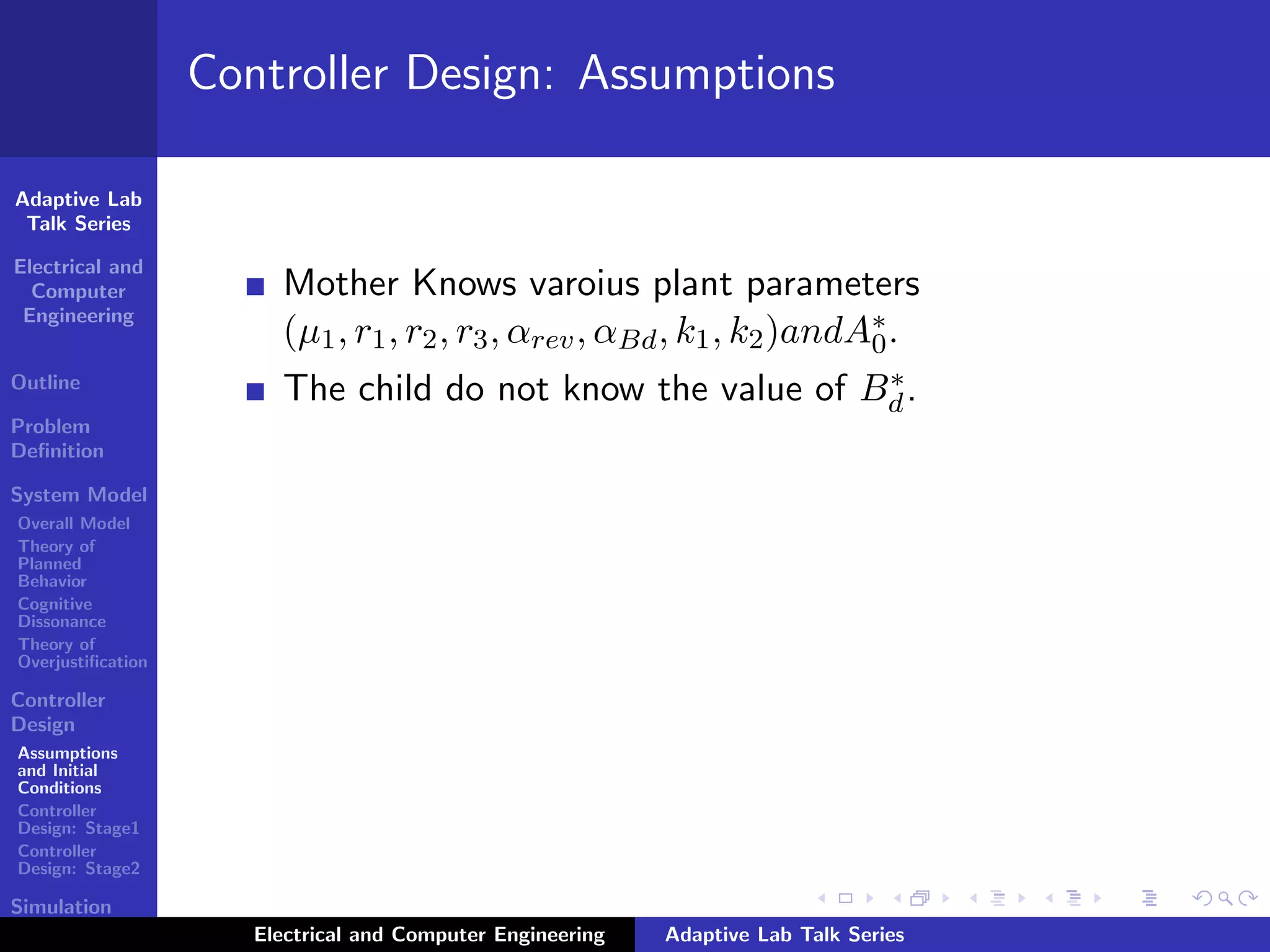
Controller Design: Assumptions
Mother Knows varoius plant parameters
(µ1, r1, r2, r3, αrev, αBd, k1, k2)andA∗
0.
The child do not know the value of B∗
d.
Electrical and Computer Engineering Adaptive Lab Talk Series
Adaptive Lab
Talk Series
Electrical and
Computer
Engineering
Outline
Problem
Definition
System Model
Overall Model
Theory of
Planned
Behavior
Cognitive
Dissonance
Theory of
Overjustification
Controller
Design
Assumptions
and Initial
Conditions
Controller
Design: Stage1
Controller
Design: Stage2
Simulation
Results
Controller Design: Assumptions
Mother Knows varoius plant parameters
(µ1, r1, r2, r3, αrev, αBd, k1, k2)andA∗
0.
The child do not know the value of B∗
d.
Bd[k + 1] is assigned to the child by end of day k.
Electrical and Computer Engineering Adaptive Lab Talk Series
Adaptive Lab
Talk Series
Electrical and
Computer
Engineering
Outline
Problem
Definition
System Model
Overall Model
Theory of
Planned
Behavior
Cognitive
Dissonance
Theory of
Overjustification
Controller
Design
Assumptions
and Initial
Conditions
Controller
Design: Stage1
Controller
Design: Stage2
Simulation
Results
Controller Design: Assumptions
Mother Knows varoius plant parameters
(µ1, r1, r2, r3, αrev, αBd, k1, k2)andA∗
0.
The child do not know the value of B∗
d.
Bd[k + 1] is assigned to the child by end of day k.
i.c: PCD[0] = POJ [0] = Arew[0] = 0, Aout = A∗
0.
Electrical and Computer Engineering Adaptive Lab Talk Series
Adaptive Lab
Talk Series
Electrical and
Computer
Engineering
Outline
Problem
Definition
System Model
Overall Model
Theory of
Planned
Behavior
Cognitive
Dissonance
Theory of
Overjustification
Controller
Design
Assumptions
and Initial
Conditions
Controller
Design: Stage1
Controller
Design: Stage2
Simulation
Results
Controller Design: Assumptions
Mother Knows varoius plant parameters
(µ1, r1, r2, r3, αrev, αBd, k1, k2)andA∗
0.
The child do not know the value of B∗
d.
Bd[k + 1] is assigned to the child by end of day k.
i.c: PCD[0] = POJ [0] = Arew[0] = 0, Aout = A∗
0.
Reward is not given everyday: N= Settling time
Electrical and Computer Engineering Adaptive Lab Talk Series
Adaptive Lab
Talk Series
Electrical and
Computer
Engineering
Outline
Problem
Definition
System Model
Overall Model
Theory of
Planned
Behavior
Cognitive
Dissonance
Theory of
Overjustification
Controller
Design
Assumptions
and Initial
Conditions
Controller
Design: Stage1
Controller
Design: Stage2
Simulation
Results
Controller Design: Assumptions
Mother Knows varoius plant parameters
(µ1, r1, r2, r3, αrev, αBd, k1, k2)andA∗
0.
The child do not know the value of B∗
d.
Bd[k + 1] is assigned to the child by end of day k.
i.c: PCD[0] = POJ [0] = Arew[0] = 0, Aout = A∗
0.
Reward is not given everyday: N= Settling time
If impulsive reward applied at time 0, a transient
(1 − rk−1
2 ) appears.
Electrical and Computer Engineering Adaptive Lab Talk Series
Adaptive Lab
Talk Series
Electrical and
Computer
Engineering
Outline
Problem
Definition
System Model
Overall Model
Theory of
Planned
Behavior
Cognitive
Dissonance
Theory of
Overjustification
Controller
Design
Assumptions
and Initial
Conditions
Controller
Design: Stage1
Controller
Design: Stage2
Simulation
Results
Controller Design: Assumptions
Mother Knows varoius plant parameters
(µ1, r1, r2, r3, αrev, αBd, k1, k2)andA∗
0.
The child do not know the value of B∗
d.
Bd[k + 1] is assigned to the child by end of day k.
i.c: PCD[0] = POJ [0] = Arew[0] = 0, Aout = A∗
0.
Reward is not given everyday: N= Settling time
If impulsive reward applied at time 0, a transient
(1 − rk−1
2 ) appears.
Approach: wait for the transient to settle before applying
the next impulsive reward.
Electrical and Computer Engineering Adaptive Lab Talk Series
Adaptive Lab
Talk Series
Electrical and
Computer
Engineering
Outline
Problem
Definition
System Model
Overall Model
Theory of
Planned
Behavior
Cognitive
Dissonance
Theory of
Overjustification
Controller
Design
Assumptions
and Initial
Conditions
Controller
Design: Stage1
Controller
Design: Stage2
Simulation
Results
Controller Design: Stage1
BI[k + 1] ≥ Bd[k + 1].
⇓
R[k] >>> enough to force B[k + 1] > 0. >>
⇓
Bsgn[k + 1] = +1.
⇓
PCD
raw[k + 1] > 0. >>
⇓
Goal: increase Aout from −ve to +ve.
Electrical and Computer Engineering Adaptive Lab Talk Series
Adaptive Lab
Talk Series
Electrical and
Computer
Engineering
Outline
Problem
Definition
System Model
Overall Model
Theory of
Planned
Behavior
Cognitive
Dissonance
Theory of
Overjustification
Controller
Design
Assumptions
and Initial
Conditions
Controller
Design: Stage1
Controller
Design: Stage2
Simulation
Results
Controller Design: Stage1- cont.
BI[k] = Aout[k] + Arew[k]
= A0 + µ1R[k] ≥ Bd[k + 1]
R[k] =
Bd[k + 1] + |A0|
µ1
(22)
The associated dissonance pressure is:
PCD
raw[k + 1] =
Bsgn[k + 1] · |Aout[k + 1]
|Aout[k + 1]| + Arew[k + 1]
=
|A0|
|A0| + µ1R[k]
.
(23)
Maximizing (23) subject to (22) results in Bd[k + 1] = 0 and
R[k] = |A0|/µ1. For improved robustness:
Bd[k + 1] = 2ε (24)
R[k] =
2Bd[k + 1] + |Aout[k]|
µ1
=
2 + |Aout[k]|
µ1
(25)
Electrical and Computer Engineering Adaptive Lab Talk Series
Adaptive Lab
Talk Series
Electrical and
Computer
Engineering
Outline
Problem
Definition
System Model
Overall Model
Theory of
Planned
Behavior
Cognitive
Dissonance
Theory of
Overjustification
Controller
Design
Assumptions
and Initial
Conditions
Controller
Design: Stage1
Controller
Design: Stage2
Simulation
Results
Controller Design: Stage2
Goal: (0 ≤ Aout[k] ≤ B∗
d) for k = 0, N, 2N, 3N, . . .
Q. What is the appropriate value of R[k] that guarantee
above three conditions satisfied ?
Electrical and Computer Engineering Adaptive Lab Talk Series
Adaptive Lab
Talk Series
Electrical and
Computer
Engineering
Outline
Problem
Definition
System Model
Overall Model
Theory of
Planned
Behavior
Cognitive
Dissonance
Theory of
Overjustification
Controller
Design
Assumptions
and Initial
Conditions
Controller
Design: Stage1
Controller
Design: Stage2
Simulation
Results
Controller Design: Stage2
Goal: (0 ≤ Aout[k] ≤ B∗
d) for k = 0, N, 2N, 3N, . . .
Use sequence of reward impulses, each impulse applied
every N days.
Q. What is the appropriate value of R[k] that guarantee
above three conditions satisfied ?
Electrical and Computer Engineering Adaptive Lab Talk Series
Adaptive Lab
Talk Series
Electrical and
Computer
Engineering
Outline
Problem
Definition
System Model
Overall Model
Theory of
Planned
Behavior
Cognitive
Dissonance
Theory of
Overjustification
Controller
Design
Assumptions
and Initial
Conditions
Controller
Design: Stage1
Controller
Design: Stage2
Simulation
Results
Controller Design: Stage2
Goal: (0 ≤ Aout[k] ≤ B∗
d) for k = 0, N, 2N, 3N, . . .
Use sequence of reward impulses, each impulse applied
every N days.
Inorder to raise Aout[k], give the child R[k]<<< enough
to be :
Rejected by the child ⇒ PCD
< 0 ⇒ Aout ⇑ .
Avoid exciting the OVJ dynamics that makes Aout ⇓ .
Avoid attitude reversal.
Q. What is the appropriate value of R[k] that guarantee
above three conditions satisfied ?
Electrical and Computer Engineering Adaptive Lab Talk Series
Adaptive Lab
Talk Series
Electrical and
Computer
Engineering
Outline
Problem
Definition
System Model
Overall Model
Theory of
Planned
Behavior
Cognitive
Dissonance
Theory of
Overjustification
Controller
Design
Assumptions
and Initial
Conditions
Controller
Design: Stage1
Controller
Design: Stage2
Simulation
Results
Controller Design: Stage2 - cont.
To enforce the child to reject the reward R[k] force:
BI[k + 1] < Bd[k + 1]
Aout[k] + Arew[k] < Bd[k + 1]
Aout[k] + r1Arew[k − 1] + µ1(1 − r1)R[k − 1] < Bd[k + 1]
R[k] <
Bd[k + 1] − r1Arew[k] − Aout[k]
µ1(1 − r1)
R[k] <
Bd[k + 1] − Aout[k]
µ1
(27)
Equation(27) gurantees child reject reward and OJ = 0.
Electrical and Computer Engineering Adaptive Lab Talk Series
Adaptive Lab
Talk Series
Electrical and
Computer
Engineering
Outline
Problem
Definition
System Model
Overall Model
Theory of
Planned
Behavior
Cognitive
Dissonance
Theory of
Overjustification
Controller
Design
Assumptions
and Initial
Conditions
Controller
Design: Stage1
Controller
Design: Stage2
Simulation
Results
Controller Design: Stage2 - cont.
Attitude reversal is avoided on day k+1 if R[k] is chosen s.t :
Bd[k] − BI[k] ≤ αrevAout[k], Aout[k] ≥ 0
Bd[k] + Aout[k] − Arew[k] ≤ αrevAout[k]
Aout[k] + r1Arew[k − 1] + µ1(1 − r1)R[k − 1] ≤ Bd[k + 1]
R[k] ≥
Bd[k + 1] − (αrev + 1)Aout[k]
µ1
(28)
Equation(28) gurantees avoidance of attitude reversal.
Q. How to keep R[k] at a reasonable level ?
Electrical and Computer Engineering Adaptive Lab Talk Series
Adaptive Lab
Talk Series
Electrical and
Computer
Engineering
Outline
Problem
Definition
System Model
Overall Model
Theory of
Planned
Behavior
Cognitive
Dissonance
Theory of
Overjustification
Controller
Design
Assumptions
and Initial
Conditions
Controller
Design: Stage1
Controller
Design: Stage2
Simulation
Results
Controller Design: Stage2 - cont.
By introducing a controller tuning parameter β ∈ (0, 1), the
aggressiveness of attitude increase can be adjusted:
Ad = βAout[k] + (1 − β)(Aout[k] + K1(1 − rN−1
2 )).
R[k] =
Aout[k]
µ1
K1(1 − rN−1
2 )
Aout[k] + K1(1 − rN−1
2 ) − Ad
− 1 . (29)
To avoid driving the attitude higher than needed (i.e., beyond
B∗
d), we add a saturator as follows:
Ad = min{B∗
d, βAout[k] + (1 − β)(Aout[k] + K1(1 − rN−1
2 ))}.
(30)
Electrical and Computer Engineering Adaptive Lab Talk Series
Adaptive Lab
Talk Series
Electrical and
Computer
Engineering
Outline
Problem
Definition
System Model
Overall Model
Theory of
Planned
Behavior
Cognitive
Dissonance
Theory of
Overjustification
Controller
Design
Assumptions
and Initial
Conditions
Controller
Design: Stage1
Controller
Design: Stage2
Simulation
Results
Controller Design: Stage2 - cont.
Get the value of Bd[k + 1] from the formulas of R[k] :
Bdmin[k] = Aout[k](
K1(1 − r2)N−1
Aout[k] + K1(1 − r2)N−1 − Ad
(31)
Bdmax[k] = Aout[k](
K1(1 − r2)N−1
Aout[k] + K1(1 − r2)N−1 − Ad
+ αrev
(32)
Bdmin[k] < Bd[k + 1] ≤ Bdmax[k]. (33)
Bd[k + 1] = γBdmin[k] + (1 − γ)Bdmax[k]. (34)
Electrical and Computer Engineering Adaptive Lab Talk Series
Adaptive Lab
Talk Series
Electrical and
Computer
Engineering
Outline
Problem
Definition
System Model
Overall Model
Theory of
Planned
Behavior
Cognitive
Dissonance
Theory of
Overjustification
Controller
Design
Assumptions
and Initial
Conditions
Controller
Design: Stage1
Controller
Design: Stage2
Simulation
Results
Simulation Results
0 5 10 15 20 25 30 35
0
50
100
150
Day number (k)
Behavior(mins)
Bd
*
B[k]
Bd
[k]
Open−Loop Implementation
0 5 10 15 20 25 30 35
0
50
100
YES
YES
YES
YES NO
NO
NO
Day number (k)
RewardOffered($)
R[k]
0 5 10 15 20 25 30 35
−50
0
50
Day number (k)
Attitude(mins)
Aout
[k]
∆ Aout
CD
[k]
Electrical and Computer Engineering Adaptive Lab Talk Series
Adaptive Lab
Talk Series
Electrical and
Computer
Engineering
Outline
Problem
Definition
System Model
Overall Model
Theory of
Planned
Behavior
Cognitive
Dissonance
Theory of
Overjustification
Controller
Design
Assumptions
and Initial
Conditions
Controller
Design: Stage1
Controller
Design: Stage2
Simulation
Results
Simulation Results
0 5 10 15 20 25 30 35
0
50
100
150
Day number (k)
Behavior(mins)
Bd
*
B[k]
Bd
[k]
Open−Loop Implementation
0 5 10 15 20 25 30 35
0
50
100
YES
YES
YES
YES
NO
NO
NO
NO
Day number (k)
RewardOffered($)
R[k]
0 5 10 15 20 25 30 35
−50
0
50
Day number (k)
Attitude(mins)
Aout
[k]
∆ Aout
CD
[k]
Electrical and Computer Engineering Adaptive Lab Talk Series
Adaptive Lab
Talk Series
Electrical and
Computer
Engineering
Outline
Problem
Definition
System Model
Overall Model
Theory of
Planned
Behavior
Cognitive
Dissonance
Theory of
Overjustification
Controller
Design
Assumptions
and Initial
Conditions
Controller
Design: Stage1
Controller
Design: Stage2
Simulation
Results
Simulation Results
0 5 10 15 20 25 30 35
0
50
100
150
Day number (k)
Behavior(mins)
Bd
*
B[k]
Bd
[k]
Open−Loop Implementation
0 5 10 15 20 25 30 35
0
50
100
YES
YES
YES
YES
NO NO NO NO NO NO
NO
Day number (k)
RewardOffered($)
R[k]
0 5 10 15 20 25 30 35
−50
0
50
Day number (k)
Attitude(mins)
Aout
[k]
∆ Aout
CD
[k]
Electrical and Computer Engineering Adaptive Lab Talk Series
Adaptive Lab
Talk Series
Electrical and
Computer
Engineering
Outline
Problem
Definition
System Model
Overall Model
Theory of
Planned
Behavior
Cognitive
Dissonance
Theory of
Overjustification
Controller
Design
Assumptions
and Initial
Conditions
Controller
Design: Stage1
Controller
Design: Stage2
Simulation
Results
Conclusion and Future Work
A new model-based behavior-modification algorithm have
been developed.
Electrical and Computer Engineering Adaptive Lab Talk Series
Adaptive Lab
Talk Series
Electrical and
Computer
Engineering
Outline
Problem
Definition
System Model
Overall Model
Theory of
Planned
Behavior
Cognitive
Dissonance
Theory of
Overjustification
Controller
Design
Assumptions
and Initial
Conditions
Controller
Design: Stage1
Controller
Design: Stage2
Simulation
Results
Conclusion and Future Work
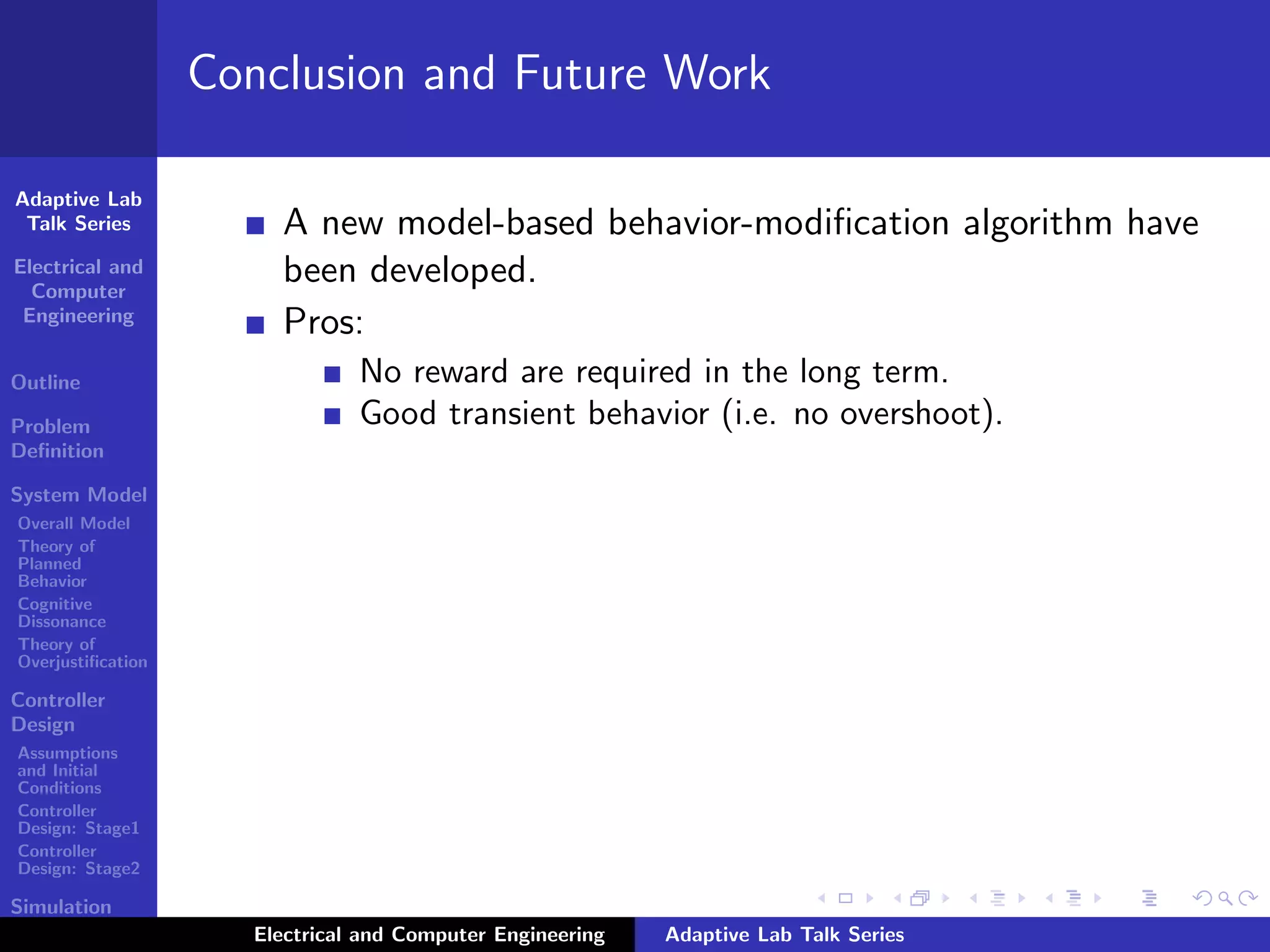
A new model-based behavior-modification algorithm have
been developed.
Pros:
No reward are required in the long term.
Good transient behavior (i.e. no overshoot).
Electrical and Computer Engineering Adaptive Lab Talk Series
Adaptive Lab
Talk Series
Electrical and
Computer
Engineering
Outline
Problem
Definition
System Model
Overall Model
Theory of
Planned
Behavior
Cognitive
Dissonance
Theory of
Overjustification
Controller
Design
Assumptions
and Initial
Conditions
Controller
Design: Stage1
Controller
Design: Stage2
Simulation
Results
Conclusion and Future Work
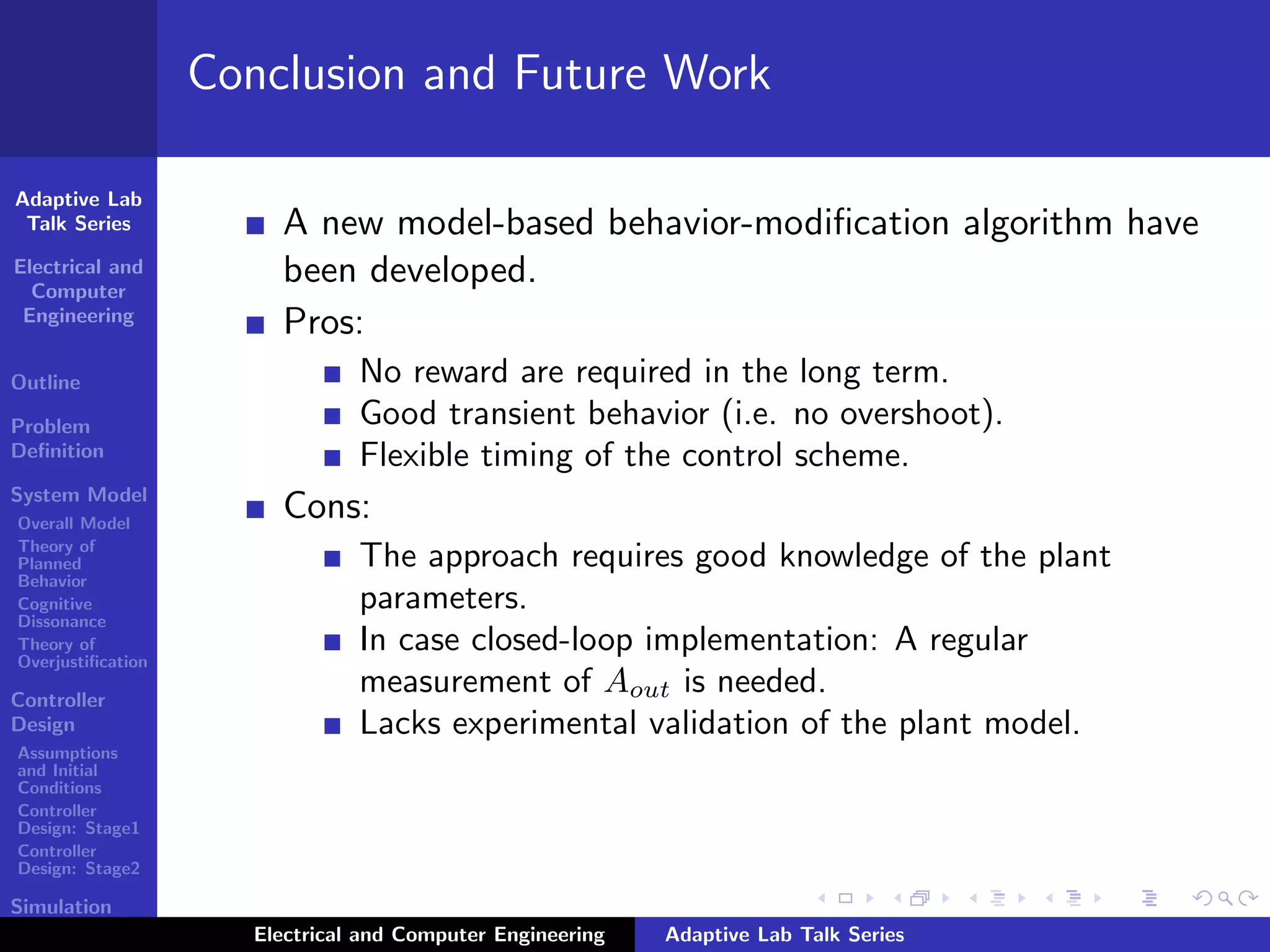
A new model-based behavior-modification algorithm have
been developed.
Pros:
No reward are required in the long term.
Good transient behavior (i.e. no overshoot).
Flexible timing of the control scheme.
Cons:
The approach requires good knowledge of the plant
parameters.
In case closed-loop implementation: A regular
measurement of Aout is needed.
Lacks experimental validation of the plant model.
Electrical and Computer Engineering Adaptive Lab Talk Series
Adaptive Lab
Talk Series
Electrical and
Computer
Engineering
Outline
Problem
Definition
System Model
Overall Model
Theory of
Planned
Behavior
Cognitive
Dissonance
Theory of
Overjustification
Controller
Design
Assumptions
and Initial
Conditions
Controller
Design: Stage1
Controller
Design: Stage2
Simulation
Results
Conclusion and Future Work
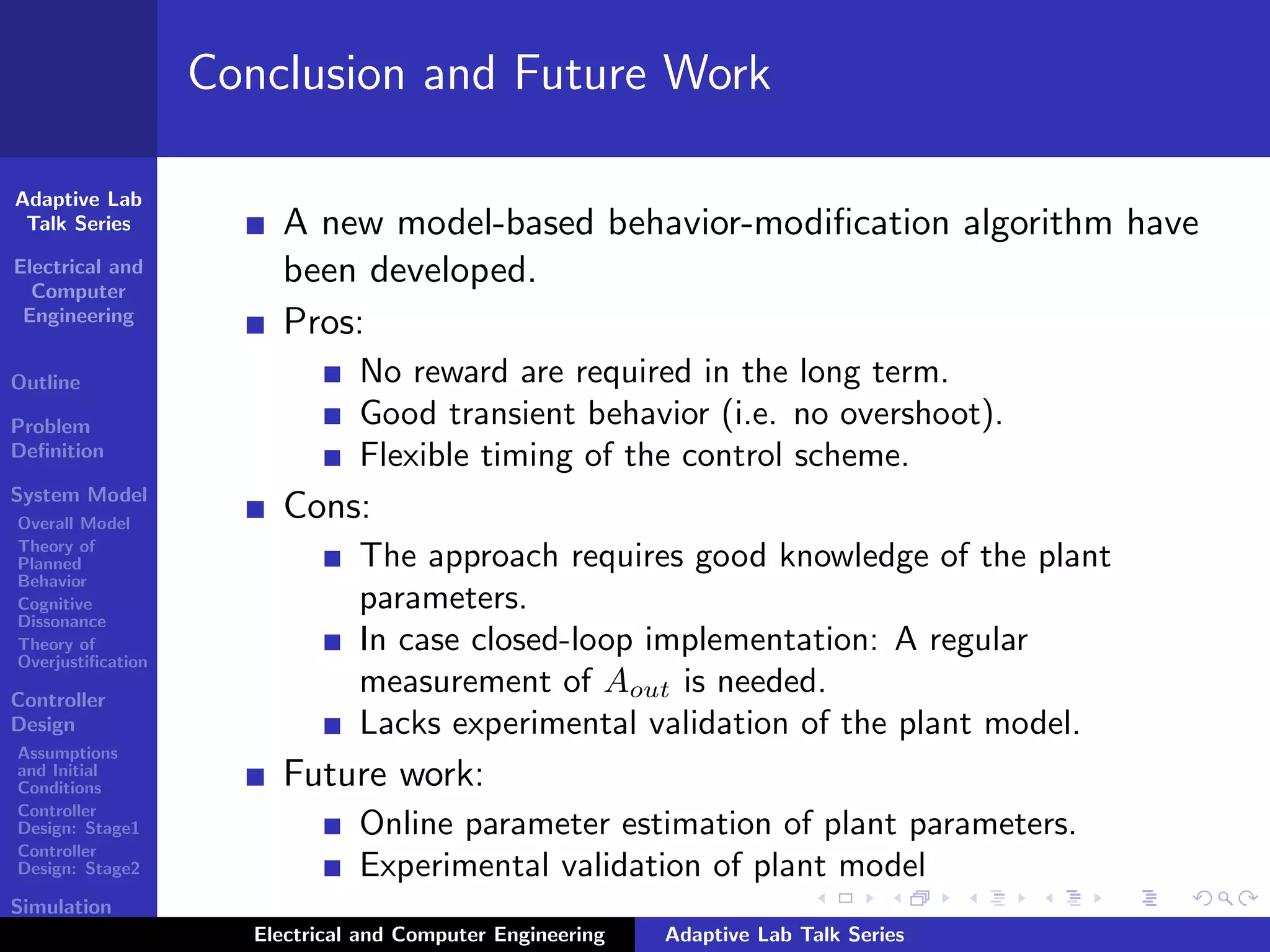
A new model-based behavior-modification algorithm have
been developed.
Pros:
No reward are required in the long term.
Good transient behavior (i.e. no overshoot).
Flexible timing of the control scheme.
Cons:
The approach requires good knowledge of the plant
parameters.
In case closed-loop implementation: A regular
measurement of Aout is needed.
Lacks experimental validation of the plant model.
Future work:
Online parameter estimation of plant parameters.
Experimental validation of plant model
Electrical and Computer Engineering Adaptive Lab Talk Series

AdaptiveLab Talk1

  • 1.
    Adaptive Lab Talk Series Electricaland Computer Engineering Outline Problem Definition System Model Overall Model Theory of Planned Behavior Cognitive Dissonance Theory of Overjustification Controller Design Assumptions and Initial Conditions Controller Design: Stage1 Controller Design: Stage2 Simulation Results A Model-Based Feedback-Control Approach to Behaviour Modification Through Reward-Induced Attitude Change J.Ni, D. Kulic, and D. Davison presented by: Noha El-Prince April 16, 2013 Electrical and Computer Engineering Adaptive Lab Talk Series
  • 2.
    Adaptive Lab Talk Series Electricaland Computer Engineering Outline Problem Definition System Model Overall Model Theory of Planned Behavior Cognitive Dissonance Theory of Overjustification Controller Design Assumptions and Initial Conditions Controller Design: Stage1 Controller Design: Stage2 Simulation Results 1 Outline 2 Problem Definition 3 System Model Overall Model Theory of Planned Behavior Cognitive Dissonance Theory of Overjustification 4 Controller Design Assumptions and Initial Conditions Controller Design: Stage1 Controller Design: Stage2 5 Simulation Results 6 Conclusion Electrical and Computer Engineering Adaptive Lab Talk Series
  • 3.
    Adaptive Lab Talk Series Electricaland Computer Engineering Outline Problem Definition System Model Overall Model Theory of Planned Behavior Cognitive Dissonance Theory of Overjustification Controller Design Assumptions and Initial Conditions Controller Design: Stage1 Controller Design: Stage2 Simulation Results Problem Definition Trying to change the behavior of a person to a desired behavior. The person may have either a negative/positive attitude towards the desired behavior. Electrical and Computer Engineering Adaptive Lab Talk Series
  • 4.
    Adaptive Lab Talk Series Electricaland Computer Engineering Outline Problem Definition System Model Overall Model Theory of Planned Behavior Cognitive Dissonance Theory of Overjustification Controller Design Assumptions and Initial Conditions Controller Design: Stage1 Controller Design: Stage2 Simulation Results Methodology Model the internal cognitive psychological state of a person. Design a controller based on the cognitive model. Goal: Tracking desired behavior via a sequence of rewards. Electrical and Computer Engineering Adaptive Lab Talk Series
  • 5.
    Adaptive Lab Talk Series Electricaland Computer Engineering Outline Problem Definition System Model Overall Model Theory of Planned Behavior Cognitive Dissonance Theory of Overjustification Controller Design Assumptions and Initial Conditions Controller Design: Stage1 Controller Design: Stage2 Simulation Results Overall System Model Electrical and Computer Engineering Adaptive Lab Talk Series
  • 6.
    Adaptive Lab Talk Series Electricaland Computer Engineering Outline Problem Definition System Model Overall Model Theory of Planned Behavior Cognitive Dissonance Theory of Overjustification Controller Design Assumptions and Initial Conditions Controller Design: Stage1 Controller Design: Stage2 Simulation Results Theory of Planned Behavior Aout[k] = Aout[k − 1] + ∆Aout[k − 1], (1) ∆Aout[k] = ∆ACD out [k] + ∆AOJ out[k], (2) Arew[k] = r1Arew[k − 1] + µ1(1 − r1)R[k − 1], (3) BI[k] = Aout[k] + Arew[k], (4) Electrical and Computer Engineering Adaptive Lab Talk Series
  • 7.
    Adaptive Lab Talk Series Electricaland Computer Engineering Outline Problem Definition System Model Overall Model Theory of Planned Behavior Cognitive Dissonance Theory of Overjustification Controller Design Assumptions and Initial Conditions Controller Design: Stage1 Controller Design: Stage2 Simulation Results Theory of Planned Behavior B[k] =    Bd[k] if BI[k] ≥ Bd[k] and Aout[k] ≤ Bd[k] Aout[k] if (BI[k] < Bd[k] and Aout[k] ≥ 0) or Aout[k] > Bd[k] 0 otherwise. (5) Electrical and Computer Engineering Adaptive Lab Talk Series
  • 8.
    Adaptive Lab Talk Series Electricaland Computer Engineering Outline Problem Definition System Model Overall Model Theory of Planned Behavior Cognitive Dissonance Theory of Overjustification Controller Design Assumptions and Initial Conditions Controller Design: Stage1 Controller Design: Stage2 Simulation Results Cognitive Dissonance Theory (Block A) A person’s behavior is inconsistent with one of his attitudes ⇒ dissonance pressure Electrical and Computer Engineering Adaptive Lab Talk Series
  • 9.
    Adaptive Lab Talk Series Electricaland Computer Engineering Outline Problem Definition System Model Overall Model Theory of Planned Behavior Cognitive Dissonance Theory of Overjustification Controller Design Assumptions and Initial Conditions Controller Design: Stage1 Controller Design: Stage2 Simulation Results Cognitive Dissonance Theory (Block A) A person’s behavior is inconsistent with one of his attitudes ⇒ dissonance pressure A person trying to reduce dissonance pressure by changing attitude/behavior Electrical and Computer Engineering Adaptive Lab Talk Series
  • 10.
    Adaptive Lab Talk Series Electricaland Computer Engineering Outline Problem Definition System Model Overall Model Theory of Planned Behavior Cognitive Dissonance Theory of Overjustification Controller Design Assumptions and Initial Conditions Controller Design: Stage1 Controller Design: Stage2 Simulation Results Cognitive Dissonance Theory (Block A) A person’s behavior is inconsistent with one of his attitudes ⇒ dissonance pressure A person trying to reduce dissonance pressure by changing attitude/behavior In our case : Inconsistency arises in 2 situations: The child declines the reward vs. value money The child accepts the reward vs. feeling bored Electrical and Computer Engineering Adaptive Lab Talk Series
  • 11.
    Adaptive Lab Talk Series Electricaland Computer Engineering Outline Problem Definition System Model Overall Model Theory of Planned Behavior Cognitive Dissonance Theory of Overjustification Controller Design Assumptions and Initial Conditions Controller Design: Stage1 Controller Design: Stage2 Simulation Results Cognitive Dissonance Theory (Block A) A person’s behavior is inconsistent with one of his attitudes ⇒ dissonance pressure A person trying to reduce dissonance pressure by changing attitude/behavior In our case : Inconsistency arises in 2 situations: The child declines the reward vs. value money The child accepts the reward vs. feeling bored Electrical and Computer Engineering Adaptive Lab Talk Series
  • 12.
    Adaptive Lab Talk Series Electricaland Computer Engineering Outline Problem Definition System Model Overall Model Theory of Planned Behavior Cognitive Dissonance Theory of Overjustification Controller Design Assumptions and Initial Conditions Controller Design: Stage1 Controller Design: Stage2 Simulation Results Cognitive Dissonance Theory (Block A) A person’s behavior is inconsistent with one of his attitudes ⇒ dissonance pressure A person trying to reduce dissonance pressure by changing attitude/behavior In our case : Inconsistency arises in 2 situations: The child declines the reward vs. value money The child accepts the reward vs. feeling bored How to quanitify dissonance pressure ? Electrical and Computer Engineering Adaptive Lab Talk Series
  • 13.
    Adaptive Lab Talk Series Electricaland Computer Engineering Outline Problem Definition System Model Overall Model Theory of Planned Behavior Cognitive Dissonance Theory of Overjustification Controller Design Assumptions and Initial Conditions Controller Design: Stage1 Controller Design: Stage2 Simulation Results Quantifying Dissonance Pressure Dissonance = ”%” of inconsistent cognitive pairs PCD raw[k] =    Bsgn[k] Mincon[k] Mincon[k]+Mcon[k] if Mincon[k] + Mcon[k] > 0 otherwise. Bsgn[k] = +1 if B[k] ≥ Bd[k] or Aout[k] ≥ 0 −1 otherwise. (7) Electrical and Computer Engineering Adaptive Lab Talk Series
  • 14.
    Adaptive Lab Talk Series Electricaland Computer Engineering Outline Problem Definition System Model Overall Model Theory of Planned Behavior Cognitive Dissonance Theory of Overjustification Controller Design Assumptions and Initial Conditions Controller Design: Stage1 Controller Design: Stage2 Simulation Results Quantifying Dissonance Pressure - cont. M 1 incon[k] = |Arew[k]| if sgn(Arew[k]) = Brel[k] 0 otherwise, (8) M 2 incon[k] = |Aout[k]| if sgn(Aout[k]) = Bsgn[k] 0 otherwise, (9) M 1 con[k] = |Arew[k]| if sgn(Arew[k]) = Brel[k] 0 otherwise, (10) M 2 con[k] = |Aout[k]| if sgn(Aout[k]) = Bsgn[k] 0 otherwise, (11) Mincon[k] = 2 i=1 M i incon[k], Mcon[k] = 2 i=1 M i con[k], (12) Brel[k] = +1 if B[k] ≥ Bd[k] −1 otherwise. (13) Electrical and Computer Engineering Adaptive Lab Talk Series
  • 15.
    Adaptive Lab Talk Series Electricaland Computer Engineering Outline Problem Definition System Model Overall Model Theory of Planned Behavior Cognitive Dissonance Theory of Overjustification Controller Design Assumptions and Initial Conditions Controller Design: Stage1 Controller Design: Stage2 Simulation Results Special Case: Attitude Reversal Aout[k] small, R[k] small, Bd[k] is high ⇒ Child declines the reward To reduce Diss. pressure: increase Aout OR “give up” jogging ⇒ Aout[k] <<< r[k] =    +1 if Bd[k] − BI[k] > αrevAout[k], Aout[k] ≥ 0, K1PCD [k] > 2Aout[k], and Arew[k] > 0, −1 otherwise. (14) PCD [k] = (1 − r2)PCD raw[k] if r[k − 1] = 1 r2PCD [k − 1] + (1 − r2)PCD raw[k] otherwise. (15) P raw CD Electrical and Computer Engineering Adaptive Lab Talk Series
  • 16.
    Adaptive Lab Talk Series Electricaland Computer Engineering Outline Problem Definition System Model Overall Model Theory of Planned Behavior Cognitive Dissonance Theory of Overjustification Controller Design Assumptions and Initial Conditions Controller Design: Stage1 Controller Design: Stage2 Simulation Results Quantifying ∆Aout Assume the change in Aout[k] is proportional to dissonance pressure, with proportionality constant K1 > 0: ∆ACD out [k] = −K1PCD [k] if r[k] = 1 +K1PCD [k] otherwise. (16) P CD Electrical and Computer Engineering Adaptive Lab Talk Series
  • 17.
    Adaptive Lab Talk Series Electricaland Computer Engineering Outline Problem Definition System Model Overall Model Theory of Planned Behavior Cognitive Dissonance Theory of Overjustification Controller Design Assumptions and Initial Conditions Controller Design: Stage1 Controller Design: Stage2 Simulation Results Overjustification Theory (Block B) Overjustification Theory when a reward is given to a person to do something that she/he already enjoys doing, such rewards are counter-productive in that they reduce the intrinsic desire of the person towards that behavior. Electrical and Computer Engineering Adaptive Lab Talk Series
  • 18.
    Adaptive Lab Talk Series Electricaland Computer Engineering Outline Problem Definition System Model Overall Model Theory of Planned Behavior Cognitive Dissonance Theory of Overjustification Controller Design Assumptions and Initial Conditions Controller Design: Stage1 Controller Design: Stage2 Simulation Results Overjustification Theory - cont. Let Bt[k] = minimal attitude level to which the overjustification effect can drive Aout[k]. Assume Bt[k] is a constant fraction of Bd[k], i.e., Bt[k] = αBd · Bd[k], (17) for some constant 0 < αBd < 1. If Bt[k] > Aout[k] ⇒ overjustification pressure does not decrease Aout, and the reverse is true i.e. Arel out[k] = max{0, Aout[k] − Bt[k]}. (18) where Arel out[k]: a relative attitude with respect to Bt[k] Electrical and Computer Engineering Adaptive Lab Talk Series
  • 19.
    Adaptive Lab Talk Series Electricaland Computer Engineering Outline Problem Definition System Model Overall Model Theory of Planned Behavior Cognitive Dissonance Theory of Overjustification Controller Design Assumptions and Initial Conditions Controller Design: Stage1 Controller Design: Stage2 Simulation Results Overjustification Theory - cont. Then the raw and filtered overjustification pressures, and the resulting change in intrinsic attitude, are computed just as in our previous work, but using Arel out instead of Aout, as follows: P OJ raw[k] =    Arel out[k]Arew[k] if Arel out[k] > 0 and Arew[k] > 0 and B[k] ≥ Bd[k] 0 otherwise, (19) P OJ [k] = r3P OJ [k − 1] + (1 − r3)P OJ raw[k], (20) ∆A OJ out[k] = −K2P OJ [k] if K2P OJ [k] ≤ Arel out[k] −Arel out[k] otherwise. (21) Electrical and Computer Engineering Adaptive Lab Talk Series
  • 20.
    Adaptive Lab Talk Series Electricaland Computer Engineering Outline Problem Definition System Model Overall Model Theory of Planned Behavior Cognitive Dissonance Theory of Overjustification Controller Design Assumptions and Initial Conditions Controller Design: Stage1 Controller Design: Stage2 Simulation Results Controller Design: Assumptions Mother Knows varoius plant parameters (µ1, r1, r2, r3, αrev, αBd, k1, k2)andA∗ 0. Electrical and Computer Engineering Adaptive Lab Talk Series
  • 21.
    Adaptive Lab Talk Series Electricaland Computer Engineering Outline Problem Definition System Model Overall Model Theory of Planned Behavior Cognitive Dissonance Theory of Overjustification Controller Design Assumptions and Initial Conditions Controller Design: Stage1 Controller Design: Stage2 Simulation Results Controller Design: Assumptions Mother Knows varoius plant parameters (µ1, r1, r2, r3, αrev, αBd, k1, k2)andA∗ 0. The child do not know the value of B∗ d. Electrical and Computer Engineering Adaptive Lab Talk Series
  • 22.
    Adaptive Lab Talk Series Electricaland Computer Engineering Outline Problem Definition System Model Overall Model Theory of Planned Behavior Cognitive Dissonance Theory of Overjustification Controller Design Assumptions and Initial Conditions Controller Design: Stage1 Controller Design: Stage2 Simulation Results Controller Design: Assumptions Mother Knows varoius plant parameters (µ1, r1, r2, r3, αrev, αBd, k1, k2)andA∗ 0. The child do not know the value of B∗ d. Bd[k + 1] is assigned to the child by end of day k. Electrical and Computer Engineering Adaptive Lab Talk Series
  • 23.
    Adaptive Lab Talk Series Electricaland Computer Engineering Outline Problem Definition System Model Overall Model Theory of Planned Behavior Cognitive Dissonance Theory of Overjustification Controller Design Assumptions and Initial Conditions Controller Design: Stage1 Controller Design: Stage2 Simulation Results Controller Design: Assumptions Mother Knows varoius plant parameters (µ1, r1, r2, r3, αrev, αBd, k1, k2)andA∗ 0. The child do not know the value of B∗ d. Bd[k + 1] is assigned to the child by end of day k. i.c: PCD[0] = POJ [0] = Arew[0] = 0, Aout = A∗ 0. Electrical and Computer Engineering Adaptive Lab Talk Series
  • 24.
    Adaptive Lab Talk Series Electricaland Computer Engineering Outline Problem Definition System Model Overall Model Theory of Planned Behavior Cognitive Dissonance Theory of Overjustification Controller Design Assumptions and Initial Conditions Controller Design: Stage1 Controller Design: Stage2 Simulation Results Controller Design: Assumptions Mother Knows varoius plant parameters (µ1, r1, r2, r3, αrev, αBd, k1, k2)andA∗ 0. The child do not know the value of B∗ d. Bd[k + 1] is assigned to the child by end of day k. i.c: PCD[0] = POJ [0] = Arew[0] = 0, Aout = A∗ 0. Reward is not given everyday: N= Settling time Electrical and Computer Engineering Adaptive Lab Talk Series
  • 25.
    Adaptive Lab Talk Series Electricaland Computer Engineering Outline Problem Definition System Model Overall Model Theory of Planned Behavior Cognitive Dissonance Theory of Overjustification Controller Design Assumptions and Initial Conditions Controller Design: Stage1 Controller Design: Stage2 Simulation Results Controller Design: Assumptions Mother Knows varoius plant parameters (µ1, r1, r2, r3, αrev, αBd, k1, k2)andA∗ 0. The child do not know the value of B∗ d. Bd[k + 1] is assigned to the child by end of day k. i.c: PCD[0] = POJ [0] = Arew[0] = 0, Aout = A∗ 0. Reward is not given everyday: N= Settling time If impulsive reward applied at time 0, a transient (1 − rk−1 2 ) appears. Electrical and Computer Engineering Adaptive Lab Talk Series
  • 26.
    Adaptive Lab Talk Series Electricaland Computer Engineering Outline Problem Definition System Model Overall Model Theory of Planned Behavior Cognitive Dissonance Theory of Overjustification Controller Design Assumptions and Initial Conditions Controller Design: Stage1 Controller Design: Stage2 Simulation Results Controller Design: Assumptions Mother Knows varoius plant parameters (µ1, r1, r2, r3, αrev, αBd, k1, k2)andA∗ 0. The child do not know the value of B∗ d. Bd[k + 1] is assigned to the child by end of day k. i.c: PCD[0] = POJ [0] = Arew[0] = 0, Aout = A∗ 0. Reward is not given everyday: N= Settling time If impulsive reward applied at time 0, a transient (1 − rk−1 2 ) appears. Approach: wait for the transient to settle before applying the next impulsive reward. Electrical and Computer Engineering Adaptive Lab Talk Series
  • 27.
    Adaptive Lab Talk Series Electricaland Computer Engineering Outline Problem Definition System Model Overall Model Theory of Planned Behavior Cognitive Dissonance Theory of Overjustification Controller Design Assumptions and Initial Conditions Controller Design: Stage1 Controller Design: Stage2 Simulation Results Controller Design: Stage1 BI[k + 1] ≥ Bd[k + 1]. ⇓ R[k] >>> enough to force B[k + 1] > 0. >> ⇓ Bsgn[k + 1] = +1. ⇓ PCD raw[k + 1] > 0. >> ⇓ Goal: increase Aout from −ve to +ve. Electrical and Computer Engineering Adaptive Lab Talk Series
  • 28.
    Adaptive Lab Talk Series Electricaland Computer Engineering Outline Problem Definition System Model Overall Model Theory of Planned Behavior Cognitive Dissonance Theory of Overjustification Controller Design Assumptions and Initial Conditions Controller Design: Stage1 Controller Design: Stage2 Simulation Results Controller Design: Stage1- cont. BI[k] = Aout[k] + Arew[k] = A0 + µ1R[k] ≥ Bd[k + 1] R[k] = Bd[k + 1] + |A0| µ1 (22) The associated dissonance pressure is: PCD raw[k + 1] = Bsgn[k + 1] · |Aout[k + 1] |Aout[k + 1]| + Arew[k + 1] = |A0| |A0| + µ1R[k] . (23) Maximizing (23) subject to (22) results in Bd[k + 1] = 0 and R[k] = |A0|/µ1. For improved robustness: Bd[k + 1] = 2ε (24) R[k] = 2Bd[k + 1] + |Aout[k]| µ1 = 2 + |Aout[k]| µ1 (25) Electrical and Computer Engineering Adaptive Lab Talk Series
  • 29.
    Adaptive Lab Talk Series Electricaland Computer Engineering Outline Problem Definition System Model Overall Model Theory of Planned Behavior Cognitive Dissonance Theory of Overjustification Controller Design Assumptions and Initial Conditions Controller Design: Stage1 Controller Design: Stage2 Simulation Results Controller Design: Stage2 Goal: (0 ≤ Aout[k] ≤ B∗ d) for k = 0, N, 2N, 3N, . . . Q. What is the appropriate value of R[k] that guarantee above three conditions satisfied ? Electrical and Computer Engineering Adaptive Lab Talk Series
  • 30.
    Adaptive Lab Talk Series Electricaland Computer Engineering Outline Problem Definition System Model Overall Model Theory of Planned Behavior Cognitive Dissonance Theory of Overjustification Controller Design Assumptions and Initial Conditions Controller Design: Stage1 Controller Design: Stage2 Simulation Results Controller Design: Stage2 Goal: (0 ≤ Aout[k] ≤ B∗ d) for k = 0, N, 2N, 3N, . . . Use sequence of reward impulses, each impulse applied every N days. Q. What is the appropriate value of R[k] that guarantee above three conditions satisfied ? Electrical and Computer Engineering Adaptive Lab Talk Series
  • 31.
    Adaptive Lab Talk Series Electricaland Computer Engineering Outline Problem Definition System Model Overall Model Theory of Planned Behavior Cognitive Dissonance Theory of Overjustification Controller Design Assumptions and Initial Conditions Controller Design: Stage1 Controller Design: Stage2 Simulation Results Controller Design: Stage2 Goal: (0 ≤ Aout[k] ≤ B∗ d) for k = 0, N, 2N, 3N, . . . Use sequence of reward impulses, each impulse applied every N days. Inorder to raise Aout[k], give the child R[k]<<< enough to be : Rejected by the child ⇒ PCD < 0 ⇒ Aout ⇑ . Avoid exciting the OVJ dynamics that makes Aout ⇓ . Avoid attitude reversal. Q. What is the appropriate value of R[k] that guarantee above three conditions satisfied ? Electrical and Computer Engineering Adaptive Lab Talk Series
  • 32.
    Adaptive Lab Talk Series Electricaland Computer Engineering Outline Problem Definition System Model Overall Model Theory of Planned Behavior Cognitive Dissonance Theory of Overjustification Controller Design Assumptions and Initial Conditions Controller Design: Stage1 Controller Design: Stage2 Simulation Results Controller Design: Stage2 - cont. To enforce the child to reject the reward R[k] force: BI[k + 1] < Bd[k + 1] Aout[k] + Arew[k] < Bd[k + 1] Aout[k] + r1Arew[k − 1] + µ1(1 − r1)R[k − 1] < Bd[k + 1] R[k] < Bd[k + 1] − r1Arew[k] − Aout[k] µ1(1 − r1) R[k] < Bd[k + 1] − Aout[k] µ1 (27) Equation(27) gurantees child reject reward and OJ = 0. Electrical and Computer Engineering Adaptive Lab Talk Series
  • 33.
    Adaptive Lab Talk Series Electricaland Computer Engineering Outline Problem Definition System Model Overall Model Theory of Planned Behavior Cognitive Dissonance Theory of Overjustification Controller Design Assumptions and Initial Conditions Controller Design: Stage1 Controller Design: Stage2 Simulation Results Controller Design: Stage2 - cont. Attitude reversal is avoided on day k+1 if R[k] is chosen s.t : Bd[k] − BI[k] ≤ αrevAout[k], Aout[k] ≥ 0 Bd[k] + Aout[k] − Arew[k] ≤ αrevAout[k] Aout[k] + r1Arew[k − 1] + µ1(1 − r1)R[k − 1] ≤ Bd[k + 1] R[k] ≥ Bd[k + 1] − (αrev + 1)Aout[k] µ1 (28) Equation(28) gurantees avoidance of attitude reversal. Q. How to keep R[k] at a reasonable level ? Electrical and Computer Engineering Adaptive Lab Talk Series
  • 34.
    Adaptive Lab Talk Series Electricaland Computer Engineering Outline Problem Definition System Model Overall Model Theory of Planned Behavior Cognitive Dissonance Theory of Overjustification Controller Design Assumptions and Initial Conditions Controller Design: Stage1 Controller Design: Stage2 Simulation Results Controller Design: Stage2 - cont. By introducing a controller tuning parameter β ∈ (0, 1), the aggressiveness of attitude increase can be adjusted: Ad = βAout[k] + (1 − β)(Aout[k] + K1(1 − rN−1 2 )). R[k] = Aout[k] µ1 K1(1 − rN−1 2 ) Aout[k] + K1(1 − rN−1 2 ) − Ad − 1 . (29) To avoid driving the attitude higher than needed (i.e., beyond B∗ d), we add a saturator as follows: Ad = min{B∗ d, βAout[k] + (1 − β)(Aout[k] + K1(1 − rN−1 2 ))}. (30) Electrical and Computer Engineering Adaptive Lab Talk Series
  • 35.
    Adaptive Lab Talk Series Electricaland Computer Engineering Outline Problem Definition System Model Overall Model Theory of Planned Behavior Cognitive Dissonance Theory of Overjustification Controller Design Assumptions and Initial Conditions Controller Design: Stage1 Controller Design: Stage2 Simulation Results Controller Design: Stage2 - cont. Get the value of Bd[k + 1] from the formulas of R[k] : Bdmin[k] = Aout[k]( K1(1 − r2)N−1 Aout[k] + K1(1 − r2)N−1 − Ad (31) Bdmax[k] = Aout[k]( K1(1 − r2)N−1 Aout[k] + K1(1 − r2)N−1 − Ad + αrev (32) Bdmin[k] < Bd[k + 1] ≤ Bdmax[k]. (33) Bd[k + 1] = γBdmin[k] + (1 − γ)Bdmax[k]. (34) Electrical and Computer Engineering Adaptive Lab Talk Series
  • 36.
    Adaptive Lab Talk Series Electricaland Computer Engineering Outline Problem Definition System Model Overall Model Theory of Planned Behavior Cognitive Dissonance Theory of Overjustification Controller Design Assumptions and Initial Conditions Controller Design: Stage1 Controller Design: Stage2 Simulation Results Simulation Results 0 5 10 15 20 25 30 35 0 50 100 150 Day number (k) Behavior(mins) Bd * B[k] Bd [k] Open−Loop Implementation 0 5 10 15 20 25 30 35 0 50 100 YES YES YES YES NO NO NO Day number (k) RewardOffered($) R[k] 0 5 10 15 20 25 30 35 −50 0 50 Day number (k) Attitude(mins) Aout [k] ∆ Aout CD [k] Electrical and Computer Engineering Adaptive Lab Talk Series
  • 37.
    Adaptive Lab Talk Series Electricaland Computer Engineering Outline Problem Definition System Model Overall Model Theory of Planned Behavior Cognitive Dissonance Theory of Overjustification Controller Design Assumptions and Initial Conditions Controller Design: Stage1 Controller Design: Stage2 Simulation Results Simulation Results 0 5 10 15 20 25 30 35 0 50 100 150 Day number (k) Behavior(mins) Bd * B[k] Bd [k] Open−Loop Implementation 0 5 10 15 20 25 30 35 0 50 100 YES YES YES YES NO NO NO NO Day number (k) RewardOffered($) R[k] 0 5 10 15 20 25 30 35 −50 0 50 Day number (k) Attitude(mins) Aout [k] ∆ Aout CD [k] Electrical and Computer Engineering Adaptive Lab Talk Series
  • 38.
    Adaptive Lab Talk Series Electricaland Computer Engineering Outline Problem Definition System Model Overall Model Theory of Planned Behavior Cognitive Dissonance Theory of Overjustification Controller Design Assumptions and Initial Conditions Controller Design: Stage1 Controller Design: Stage2 Simulation Results Simulation Results 0 5 10 15 20 25 30 35 0 50 100 150 Day number (k) Behavior(mins) Bd * B[k] Bd [k] Open−Loop Implementation 0 5 10 15 20 25 30 35 0 50 100 YES YES YES YES NO NO NO NO NO NO NO Day number (k) RewardOffered($) R[k] 0 5 10 15 20 25 30 35 −50 0 50 Day number (k) Attitude(mins) Aout [k] ∆ Aout CD [k] Electrical and Computer Engineering Adaptive Lab Talk Series
  • 39.
    Adaptive Lab Talk Series Electricaland Computer Engineering Outline Problem Definition System Model Overall Model Theory of Planned Behavior Cognitive Dissonance Theory of Overjustification Controller Design Assumptions and Initial Conditions Controller Design: Stage1 Controller Design: Stage2 Simulation Results Conclusion and Future Work A new model-based behavior-modification algorithm have been developed. Electrical and Computer Engineering Adaptive Lab Talk Series
  • 40.
    Adaptive Lab Talk Series Electricaland Computer Engineering Outline Problem Definition System Model Overall Model Theory of Planned Behavior Cognitive Dissonance Theory of Overjustification Controller Design Assumptions and Initial Conditions Controller Design: Stage1 Controller Design: Stage2 Simulation Results Conclusion and Future Work A new model-based behavior-modification algorithm have been developed. Pros: No reward are required in the long term. Good transient behavior (i.e. no overshoot). Electrical and Computer Engineering Adaptive Lab Talk Series
  • 41.
    Adaptive Lab Talk Series Electricaland Computer Engineering Outline Problem Definition System Model Overall Model Theory of Planned Behavior Cognitive Dissonance Theory of Overjustification Controller Design Assumptions and Initial Conditions Controller Design: Stage1 Controller Design: Stage2 Simulation Results Conclusion and Future Work A new model-based behavior-modification algorithm have been developed. Pros: No reward are required in the long term. Good transient behavior (i.e. no overshoot). Flexible timing of the control scheme. Cons: The approach requires good knowledge of the plant parameters. In case closed-loop implementation: A regular measurement of Aout is needed. Lacks experimental validation of the plant model. Electrical and Computer Engineering Adaptive Lab Talk Series
  • 42.
    Adaptive Lab Talk Series Electricaland Computer Engineering Outline Problem Definition System Model Overall Model Theory of Planned Behavior Cognitive Dissonance Theory of Overjustification Controller Design Assumptions and Initial Conditions Controller Design: Stage1 Controller Design: Stage2 Simulation Results Conclusion and Future Work A new model-based behavior-modification algorithm have been developed. Pros: No reward are required in the long term. Good transient behavior (i.e. no overshoot). Flexible timing of the control scheme. Cons: The approach requires good knowledge of the plant parameters. In case closed-loop implementation: A regular measurement of Aout is needed. Lacks experimental validation of the plant model. Future work: Online parameter estimation of plant parameters. Experimental validation of plant model Electrical and Computer Engineering Adaptive Lab Talk Series