A New Algorithm for 3D Isovist

                                        SULEIMAN Wassim1,
                                        JOLIVEAU Thierry1,
                                           FAVIER Eric2

              1ISTHME-ISIG   CNRS/UMR EVS, Université Jean Monnet - Saint-Etienne.
                   2DIPI   EA 3719 École Nationale d'Ingénieurs de Saint-Etienne

                                wassim.suleiman@univ-st-etienne.fr
                                thierry.joliveau@univ-st-etienne.fr
                                        eric.favier@enise.fr


                                                                                             1
15th International Symposium on Spatial Data Handling (SDH) – August 2012 in Bonn, Germany
Isovist
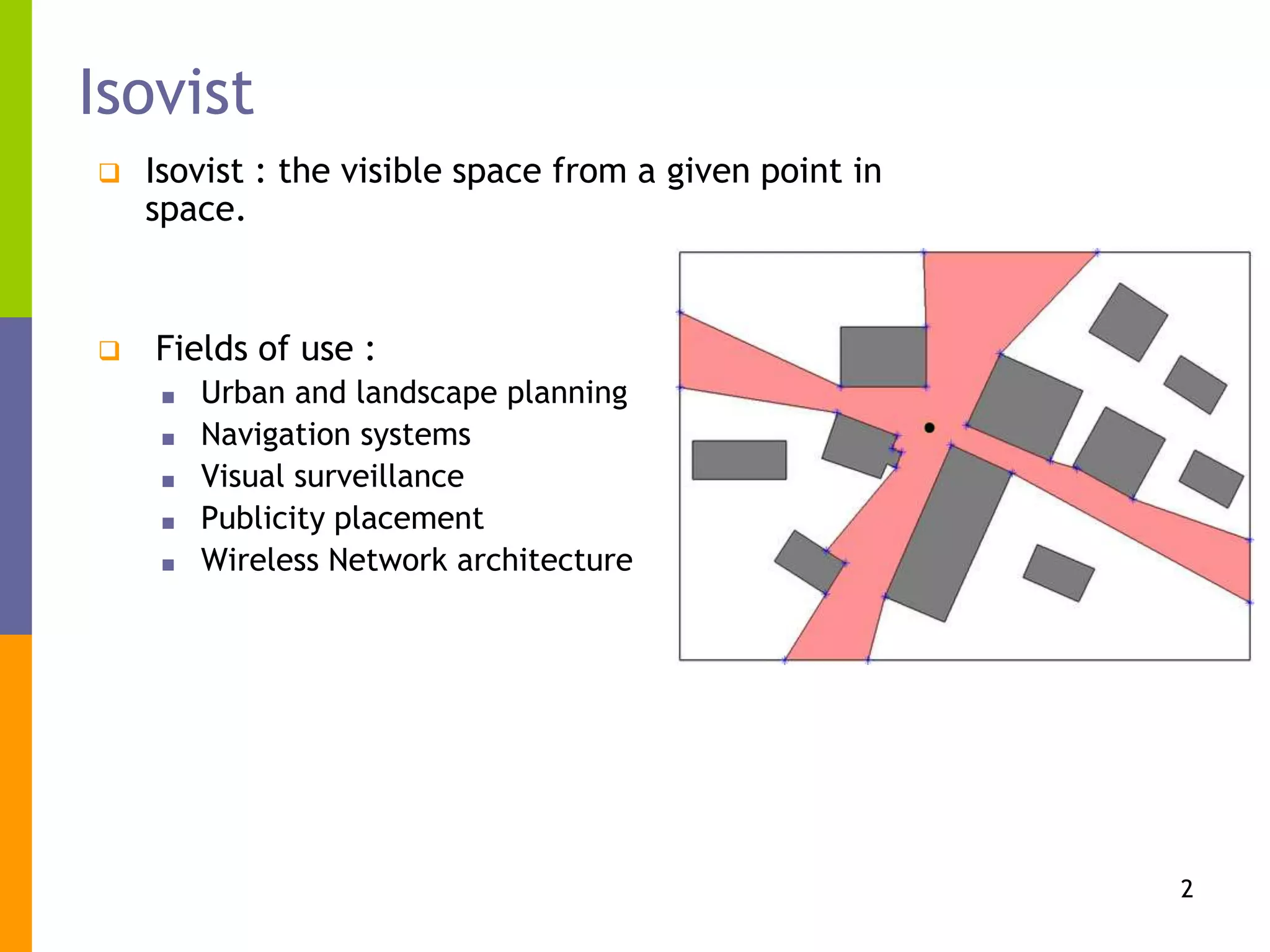
   Isovist : the visible space from a given point in
    space.


   Fields of use :
     ■   Urban and landscape planning
     ■   Navigation systems
     ■   Visual surveillance
     ■   Publicity placement
     ■   Wireless Network architecture


                                                        2
Main technique for computing Isovist :
ray tracing
  2D Vector data       2.5D Raster data


                                         Brossard & Wieber


   Number of rays ?       Resolution ?


                                                       3
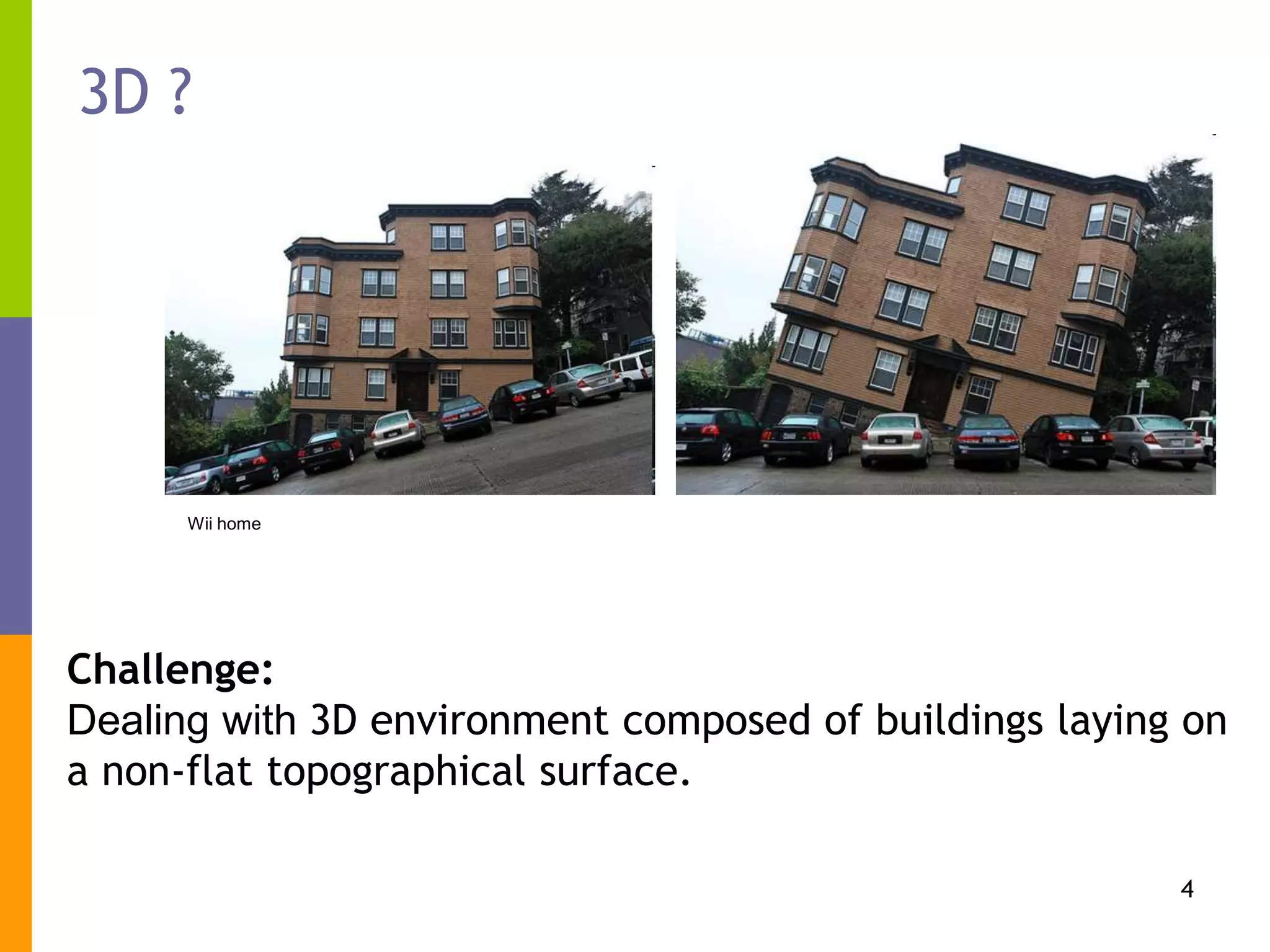
3D ?


      Wii home


Challenge:
Dealing with 3D environment composed of buildings laying on
a non-flat topographical surface.

                                                        4
2.5 and 3D Isovist solutions


         2,5 Raster mode                           Voxel mode
           (Public Eye)           (Pyysalo et al. 2009), (Morello & Ratti 2009)


Limitations ?

• The identity and the individuality of the special entities
  (buildings for example) is lost

• The precision is related to the resolution
                                                                                  5
New algorithms for computing ISOVIST
in 2D and 3D
   The principle is to analyze how the spatial entities
    (buildings) block the line-of-sight.

   The isovist will be considered as a group of vision angle
    associated with spatial entities or free space (if there
    is no building blocking the sight).


                                                                6
New algorithm for 2D ISOVIST
   Assumption
     ■ 2D space is an aggregation of segments.
     ■ We will use the polar coordinates centered at the observer
       point.


                                                                    7
New algorithm for 2D ISOVIST



                               8
New algorithm for 2D ISOVIST
   Definition
     ■ The free segment is a segment whose the two ends are visible
       by the observer.


                                                                      9
New algorithm for 2D ISOVIST
   Definition
     ■ The free vision field is an angle of vision where there is no
       obstacle blocking the line of sight.


                                                                       10
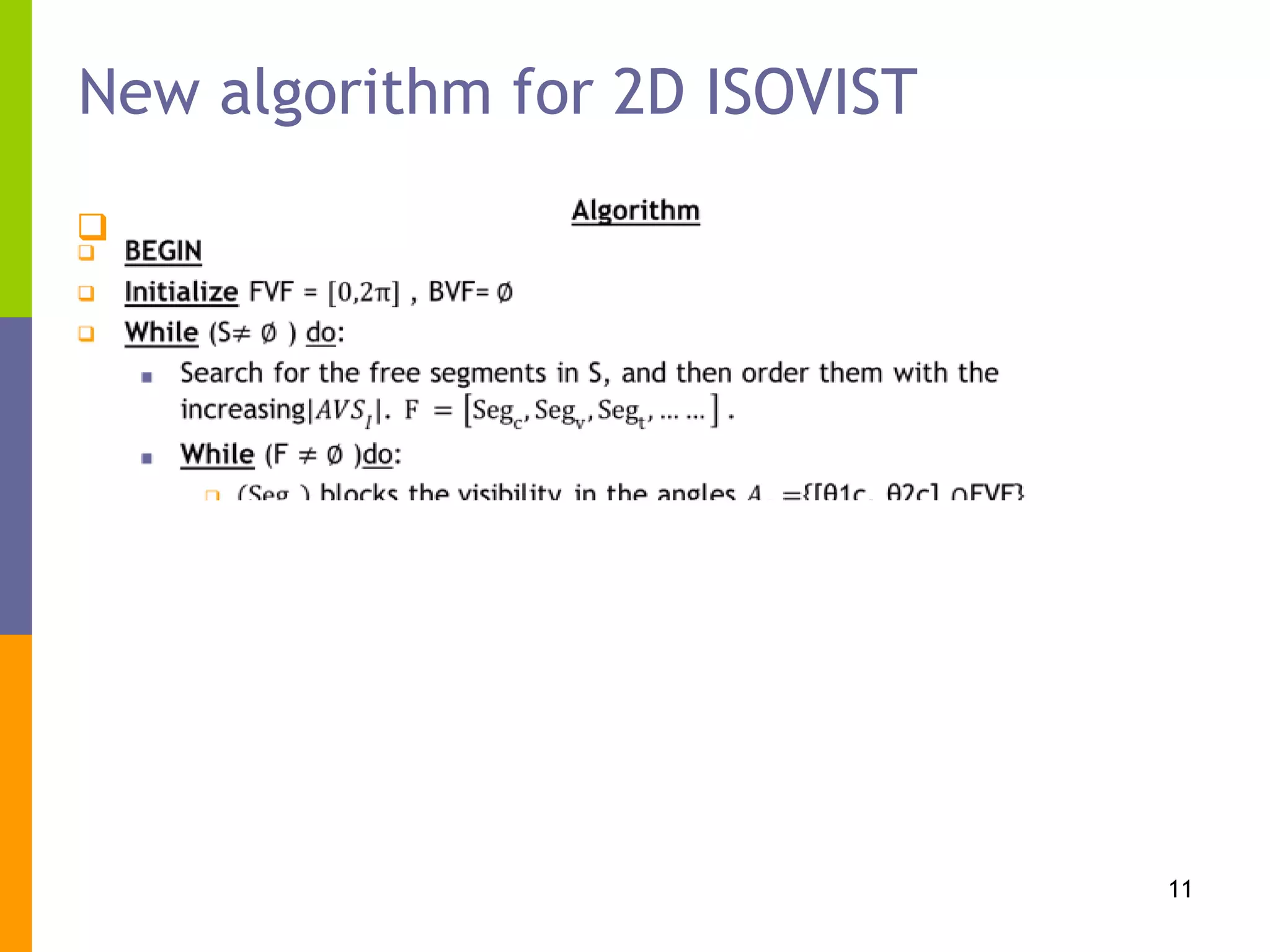
New algorithm for 2D ISOVIST



                               11
New algorithm for 2D ISOVIST
      Implementation : virtual environment on Matlab


                                                       12
New algorithm for 2D ISOVIST
      Implementation : real GIS data on Matlab


                                                 13
New algorithm for 2D ISOVIST
      Application: dominant type of buildings in view


                                                        14
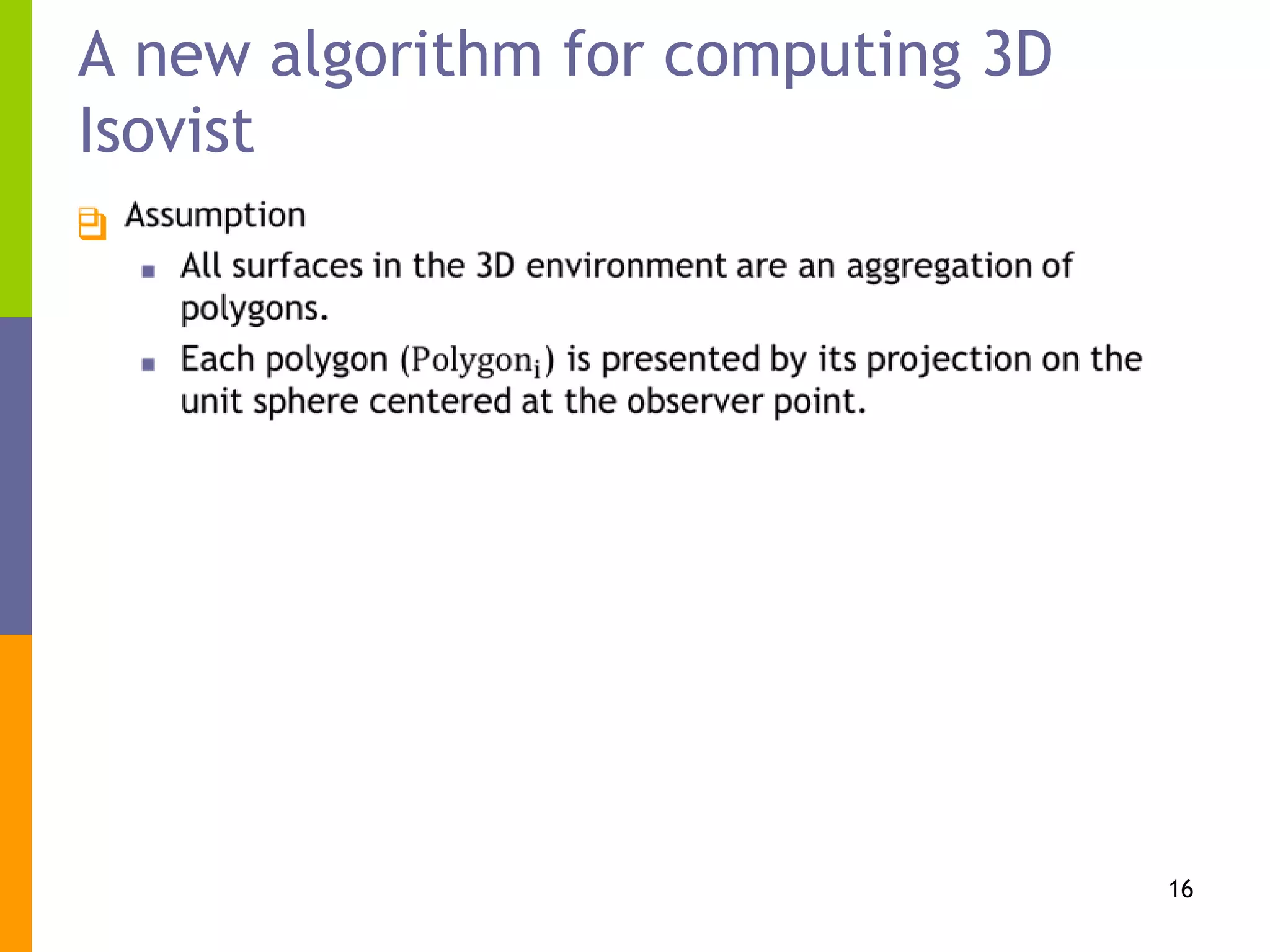
3D data model used for implementing
the 3D Isovist algorithm
   3D environment considered as a constellation of
    polygons
    ■   TIN terrain model +
    ■   2D footprints with
        height extrusion


                 3D polygon plane facets (terrain, building)
                                                               15
A new algorithm for computing 3D
Isovist



                                   16
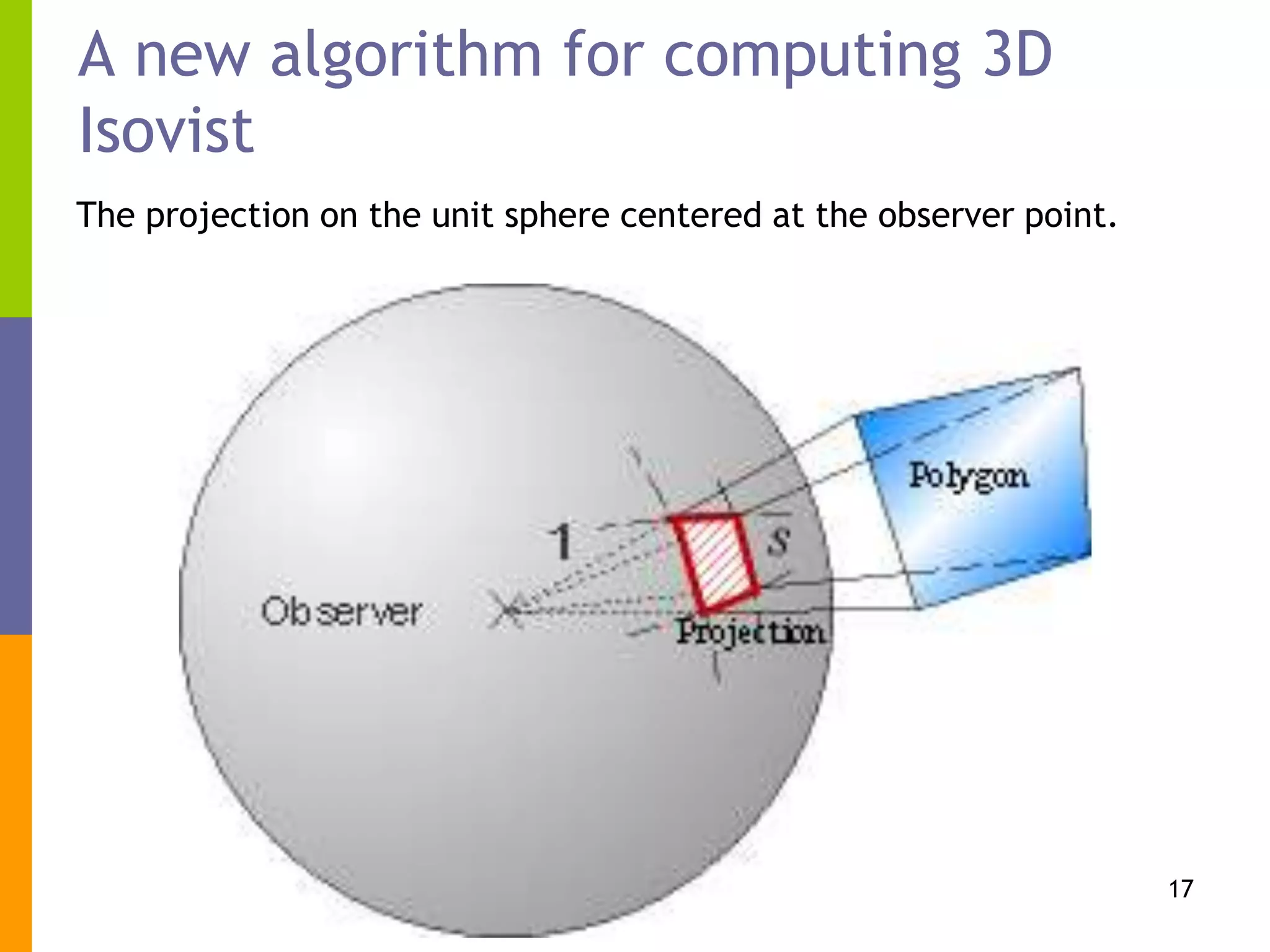
A new algorithm for computing 3D
Isovist
The projection on the unit sphere centered at the observer point.


                   1

                                                  Polygon

             Observer
                          Projection


                                                                    17
A new algorithm for computing 3D
Isovist



                                   18
A new algorithm for computing 3D Isovist

   Definitions

     ■   The free polygon is a polygon whose edges (or the enclosed
         frontier segments) are visible from the observer.


                                                                      19
A new algorithm for computing 3D Isovist

   Definitions

     ■   The free vision field is a solid angle of vision where no obstacle
         is blocking the line of sight.


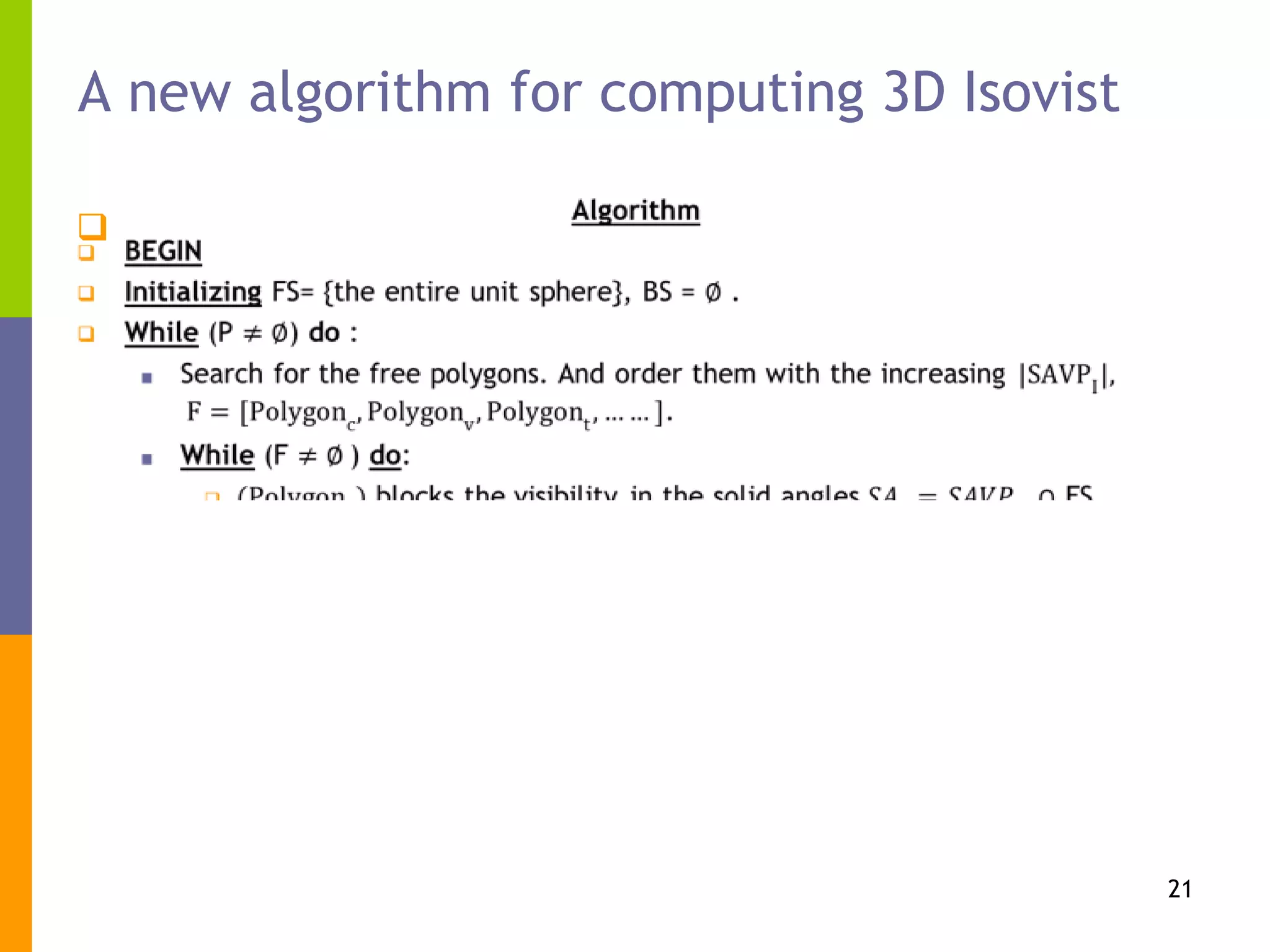
                                                                         20
A new algorithm for computing 3D Isovist




                                           21
A new algorithm for computing 3D Isovist
             Implementation on Matlab


                                           22
A new algorithm for computing 3D Isovist
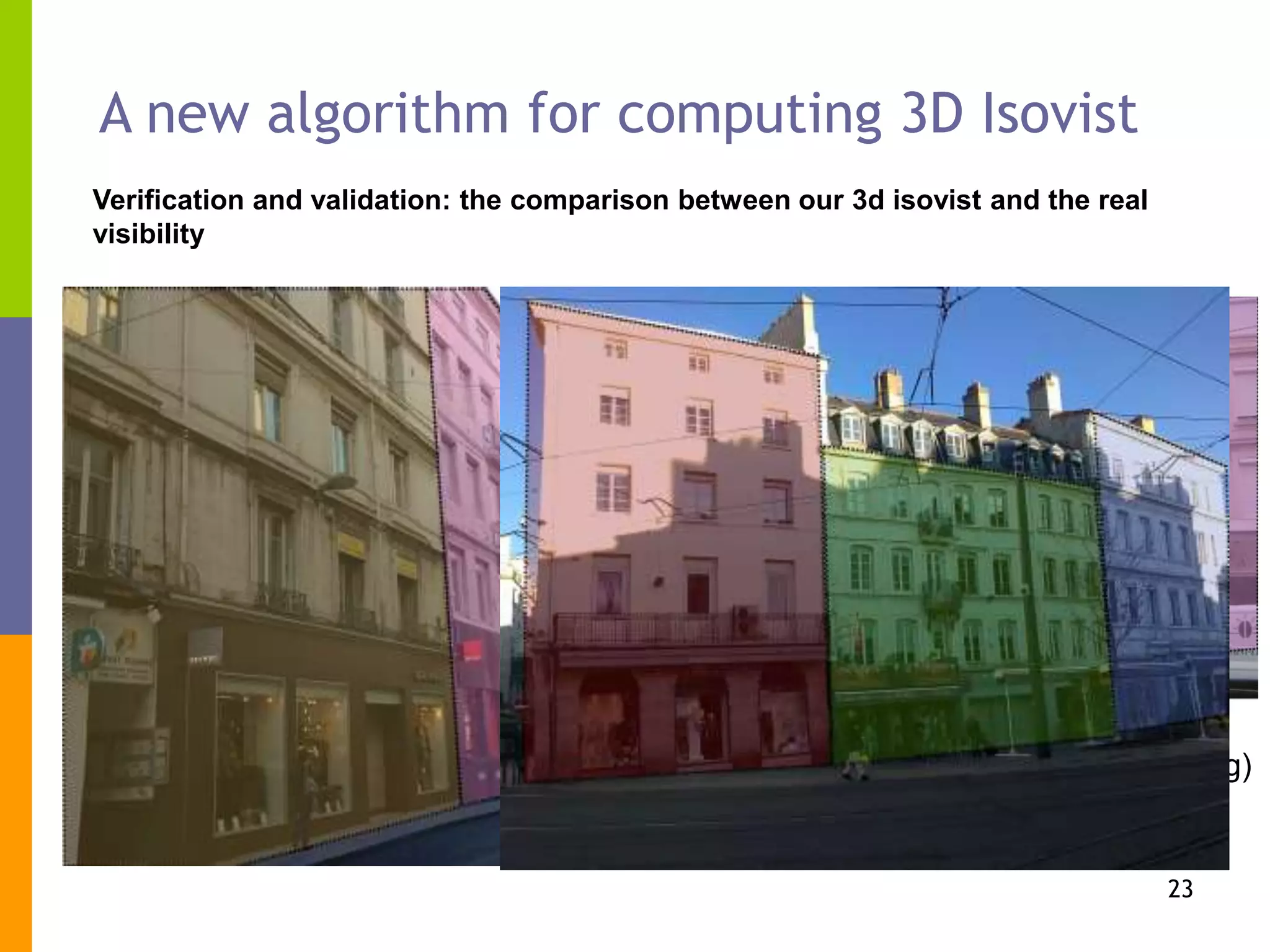
Verification and validation: the comparison between our 3d isovist and the real
visibility


    The image by            The image in
    the 3D isovist          The real world


                                                      2D/3D registration
                                                      (Edges and corners matching)


                                                                                  23
A new algorithm for computing 3D Isovist
Application: Computing visibility indices


Open sky index with IDW interpolation   Visibility of target building with IDW interpolation


                Visibility of target
                building with solid
                angle of vision
                interpolation
                                                                                               24
Conclusion


   We propose a new algorithm for computing Isovist in
    2D and 3D environment with non-flat topographical
    surface

   It permits the calculation of classic visibility indices
    and new ones like the content of the view (e.g. the
    percentage of historic building in a view)


                                                               25
Future work


   Developing a stand alone program to achieve the
    calculation.
   Using parallel processing like using cuda over GPU.
   Implementation in the hardware or in a low level
    programming language.
   Thinking about meaning and definition of 3D Visibility
    indices (vertical and horizontal surfaces).


                                                             26
Thank you
for your attention !


                       27

3D Isovist New algorithm

  • 1.
    A New Algorithmfor 3D Isovist SULEIMAN Wassim1, JOLIVEAU Thierry1, FAVIER Eric2 1ISTHME-ISIG CNRS/UMR EVS, Université Jean Monnet - Saint-Etienne. 2DIPI EA 3719 École Nationale d'Ingénieurs de Saint-Etienne wassim.suleiman@univ-st-etienne.fr thierry.joliveau@univ-st-etienne.fr eric.favier@enise.fr 1 15th International Symposium on Spatial Data Handling (SDH) – August 2012 in Bonn, Germany
  • 2.
    Isovist  Isovist : the visible space from a given point in space.  Fields of use : ■ Urban and landscape planning ■ Navigation systems ■ Visual surveillance ■ Publicity placement ■ Wireless Network architecture 2
  • 3.
    Main technique forcomputing Isovist : ray tracing 2D Vector data 2.5D Raster data Brossard & Wieber Number of rays ? Resolution ? 3
  • 4.
    3D ? Wii home Challenge: Dealing with 3D environment composed of buildings laying on a non-flat topographical surface. 4
  • 5.
    2.5 and 3DIsovist solutions 2,5 Raster mode Voxel mode (Public Eye) (Pyysalo et al. 2009), (Morello & Ratti 2009) Limitations ? • The identity and the individuality of the special entities (buildings for example) is lost • The precision is related to the resolution 5
  • 6.
    New algorithms forcomputing ISOVIST in 2D and 3D  The principle is to analyze how the spatial entities (buildings) block the line-of-sight.  The isovist will be considered as a group of vision angle associated with spatial entities or free space (if there is no building blocking the sight). 6
  • 7.
    New algorithm for2D ISOVIST  Assumption ■ 2D space is an aggregation of segments. ■ We will use the polar coordinates centered at the observer point. 7
  • 8.
    New algorithm for2D ISOVIST  8
  • 9.
    New algorithm for2D ISOVIST  Definition ■ The free segment is a segment whose the two ends are visible by the observer. 9
  • 10.
    New algorithm for2D ISOVIST  Definition ■ The free vision field is an angle of vision where there is no obstacle blocking the line of sight. 10
  • 11.
    New algorithm for2D ISOVIST  11
  • 12.
    New algorithm for2D ISOVIST Implementation : virtual environment on Matlab 12
  • 13.
    New algorithm for2D ISOVIST Implementation : real GIS data on Matlab 13
  • 14.
    New algorithm for2D ISOVIST Application: dominant type of buildings in view 14
  • 15.
    3D data modelused for implementing the 3D Isovist algorithm  3D environment considered as a constellation of polygons ■ TIN terrain model + ■ 2D footprints with height extrusion 3D polygon plane facets (terrain, building) 15
  • 16.
    A new algorithmfor computing 3D Isovist  16
  • 17.
    A new algorithmfor computing 3D Isovist The projection on the unit sphere centered at the observer point. 1 Polygon Observer Projection 17
  • 18.
    A new algorithmfor computing 3D Isovist  18
  • 19.
    A new algorithmfor computing 3D Isovist  Definitions ■ The free polygon is a polygon whose edges (or the enclosed frontier segments) are visible from the observer. 19
  • 20.
    A new algorithmfor computing 3D Isovist  Definitions ■ The free vision field is a solid angle of vision where no obstacle is blocking the line of sight. 20
  • 21.
    A new algorithmfor computing 3D Isovist  21
  • 22.
    A new algorithmfor computing 3D Isovist Implementation on Matlab 22
  • 23.
    A new algorithmfor computing 3D Isovist Verification and validation: the comparison between our 3d isovist and the real visibility The image by The image in the 3D isovist The real world 2D/3D registration (Edges and corners matching) 23
  • 24.
    A new algorithmfor computing 3D Isovist Application: Computing visibility indices Open sky index with IDW interpolation Visibility of target building with IDW interpolation Visibility of target building with solid angle of vision interpolation 24
  • 25.
    Conclusion  We propose a new algorithm for computing Isovist in 2D and 3D environment with non-flat topographical surface  It permits the calculation of classic visibility indices and new ones like the content of the view (e.g. the percentage of historic building in a view) 25
  • 26.
    Future work  Developing a stand alone program to achieve the calculation.  Using parallel processing like using cuda over GPU.  Implementation in the hardware or in a low level programming language.  Thinking about meaning and definition of 3D Visibility indices (vertical and horizontal surfaces). 26
  • 27.
    Thank you for yourattention ! 27