Everything you
need to know
about AutoML!
CMPE 297 – Special Topics
Arpitha Gurumurthy
014642290
Research Paper reference:
AutoML: A Survey of the State-of-the-Art
https://arxiv.org/pdf/1908.00709.pdf
Problem
Statement
Tired of figuring
out which model
to use for your
use case?
Tired of feature
selection and
hyperparameter
tuning?
Well then, welcome
welcome to the
world of AutoML!
What’s stopping DL techniques
from being widely employed?
• DL methods have proven to perform
remarkably well on image
classification, object detection, and
language modeling tasks.
• But the development relies heavily
relies on human expertise.
• AutoML helps in removing the need
for humans in the loop by automating
the entire ML pipeline.
What is AutoML?
AutoML is the process of
automating the construction of
of an ML pipeline on a limited
limited budget by enabling
even infants in the field to
build ML applications.
A complete AutoML system is
is beginner-friendly and helps
helps us build an end-to-end
ML pipeline.
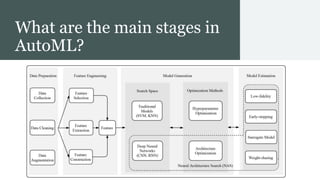
What are the main stages in
AutoML?
Stage 1: Data Preparation
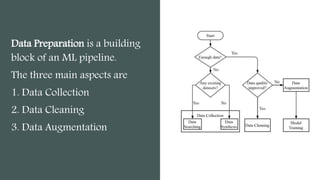
Data Preparation is a building
block of an ML pipeline.
The three main aspects are
1. Data Collection
2. Data Cleaning
3. Data Augmentation
1. Data Collection
 This step involves building or enhancing an existing dataset.
 The most important part of building an ML system is having
the right dataset.
 This is a very challenging task as it would require several
resources.
 To solve this problem, data searching, and data synthesis were
introduced.
1. Data Collection - Continued
Data Searching:
 The most common source of data is web data and searching the
web data is tough given that it is inexhaustible.
 Web data may be unlabeled or incorrectly labeled. To solve for
incorrect labels, active and semi-supervised learning methods can
be employed.
 Dataset imbalance is another problem when it comes to web data.
Symmetric Minority Oversampling Technique (SMOTE) can help
alleviate the imbalance by creating new minority samples.
1. Data Collection - Continued
Data Synthesis:
 Acquiring data or synthesize it is a very expensive affair.
 Data simulators can be used to mimic real-world data during the research phase.
 OpenAI gym is a tool that provides a variety of simulated environments. For example, they
are beneficial for Autonomous driving given the safety hazards.
 With the help of this toolkit, developers can focus their energy on writing the algorithm
instead of worrying about generating data.
 Another very useful technique for generating an image, tabular, and text data is
Generative Adversarial Networks (GANs).
2. Data Cleaning
 Data that is collected from the web or any other source is
bound to have noise, and noise can negatively affect what the
model learns.
 Traditionally this process was carried out through
crowdsourcing and required expert knowledge. This was very
expensive.
 Many methods like BoostClean and AlphaClean were introduced
to automate data cleaning on static data.
 As for dynamic data, meta-learning techniques were applied.
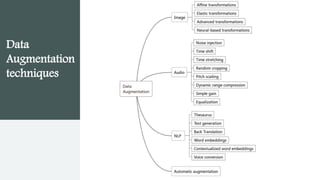
3. Data Augmentation
 This process can be considered as an extension to data
collection as it involves generating new samples based
on existing data.
 Data Augmentation (DA) also helps in generalizing the
model by avoiding overfitting since it essentially focuses
on generating more data for model training.
 This enhances the model robustness and in turn the
performance.
Data
Augmentation
techniques
Stage 2: Feature Engineering
 Feature Engineering is the process of extracting features from raw data that
the models can understand.
 The three main aspects of feature engineering include feature selection,
feature extraction, and feature construction.
 Feature extraction and selection involve reducing the
dimensionality/number of features, while feature construction deals with
increasing this dimensionality.
 Automatic feature engineering involves the combination of these three
What is Feature Engineering?
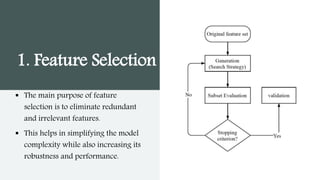
1. Feature Selection
 The main purpose of feature
selection is to eliminate redundant
and irrelevant features.
 This helps in simplifying the model
complexity while also increasing its
robustness and performance.
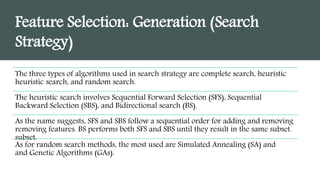
Feature Selection: Generation (Search
Strategy)
The three types of algorithms used in search strategy are complete search, heuristic
heuristic search, and random search.
The heuristic search involves Sequential Forward Selection (SFS), Sequential
Backward Selection (SBS), and Bidirectional search (BS).
As the name suggests, SFS and SBS follow a sequential order for adding and removing
removing features. BS performs both SFS and SBS until they result in the same subset.
subset.
As for random search methods, the most used are Simulated Annealing (SA) and
and Genetic Algorithms (GAs).
2. Feature Construction
• This process involves creating new features from raw data thereby
increasing the number of samples.
• This in turn helps in increasing the model generalizability and
performance.
• Preprocessing transformation is one of the most used methods for
feature construction. This includes standardization, normalization,
and feature discretization.
• Decision tree-based methods, genetic algorithms, annotation-based
approaches are some automated methods for feature construction.
3. Feature Extraction
• The essence of feature extraction is dimensionality
reduction. Unlike feature selection, original features are
allowed to be altered during this process.
• Most popular approaches include to automate this process
are Principal Component Analysis (PCA), Independent
Component Analysis, isomap, non-linear dimensionality
reduction, Linear Discriminant Analysis (LDA), and feed-
forward neural network-based approaches.
Stage 3: Model Generation
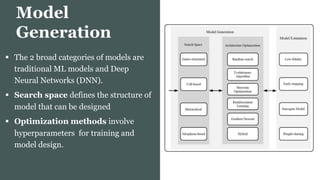
 The 2 broad categories of models are
traditional ML models and Deep
Neural Networks (DNN).
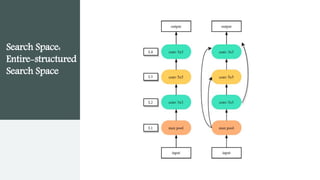
 Search space defines the structure of
model that can be designed
 Optimization methods involve
hyperparameters for training and
model design.
Model
Generation
Search Space:
Entire-structured
Search Space
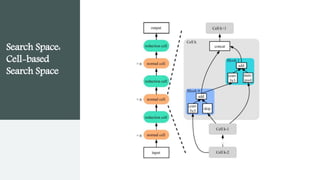
Search Space:
Cell-based
Search Space
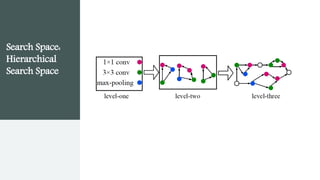
Search Space:
Hierarchical
Search Space
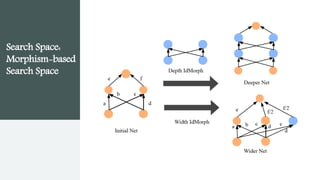
Search Space:
Morphism-based
Search Space
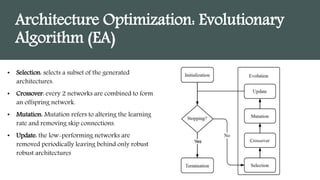
• Selection: selects a subset of the generated
architectures.
• Crossover: every 2 networks are combined to form
an offspring network.
• Mutation: Mutation refers to altering the learning
rate and removing skip connections.
• Update: the low-performing networks are
removed periodically leaving behind only robust
robust architectures
Architecture Optimization: Evolutionary
Algorithm (EA)
Other
Architecture
Optimization
techniques:
Reinforcement Learning
Learning (RL)
Gradient Descent (GD)
Surrogate Model-based
Optimization (SMBO)
Hybrid Optimization
Method
Hyperparameter Optimization
Once we have the most optimal architecture after the AO stage, it becomes essential to finetune this
this network with different values of hyperparameters and find the most suitable values.
1. Grid and Random Search (GS and RS)
2. Bayesian Optimization (BO)
3. Gradient-based Optimization (GO)
Stage 4: Model Evaluation
Model
Evaluation
Approaches that can accelerate the process of model evaluation:
• Low fidelity: Model training time is directly proportional to the size of
its dataset. We can also reduce the model size and compare its
performance.
• Weight Sharing: The core idea is to reuse the knowledge gained by
the previous tasks to ramp up the training time of the current model
design.
• Early stopping: It is very beneficial to accelerate the model evaluation
time by terminating the evaluations when the model starts to perform
poorly on the evaluation data.
After the new model has
been selected, we need to
evaluate its performance
NAS Performance
Comparison
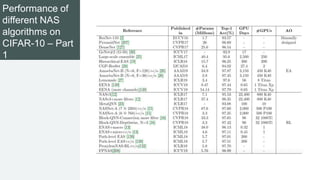
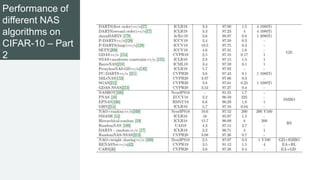
• The early research on EA- and RL-based NAS
methods focused more on high performance
rather than on resource consumption.
• The later research on NAS attempted to improve
search efficiency by not compromising on model
performance.
• EENA utilized the mutation and crossover
operations of EA which reused the learned
information in the evolution process.
• ENAS was the first RL-based NAS approach that
adopted a parameter-sharing strategy, thereby
reducing the number of GPUs.
Performance of
different NAS
algorithms on
CIFAR-10 – Part
1
Performance of
different NAS
algorithms on
CIFAR-10 – Part
2
Open Problems and
Future Directions
The existing search spaces have proven to be efficient
efficient but require some degree of human interference.
interference. This introduces bias.
When it comes to NLP tasks, the NAS community is yet to
yet to produce models that can match up to human-
designed ones. This is surely an area for improvement
improvement and requires more research.
Another important direction for further research is to
to learn how to interpret the results of AutoML
mathematically.
Reproducibility is an ever-challenging problem in ML
ML which is also carried over to AutoML.
The datasets used in AutoML research (CIFAR-10 and
and ImageNet) are mostly labeled and well-structured.
structured. However, data in the real world is almost
chaotic.
Conclusion
We’ve seen various AutoML applications in this article, from data preparation to
to model evaluation.
We’ve also shed some light on the less explored areas which might need some
attention.
With, it is worthy to note that AutoML is a powerful invention that allows even
beginners in the field of ML to build and deploy AI applications.
AutoML marks a huge milestone in taking the world towards self-improving AI.
AI.
THANK YOU!
I would like to thank my Professor Vijay
Eranti for inspiring me to research on
AutoML and understand its benefits.
References
1. https://arxiv.org/pdf/1908.00709.pdf
2. https://careers.edicomgroup.com/what-is-deep-learning-
case-study-in-edicom-part-i/
3. https://searchsoftwarequality.techtarget.com/feature/Analysts
-mixed-on-future-growth-of-MLOps-AutoML-tools
4. https://www.freepik.com/free-vector/cute-monkey-
confused-cartoon-vector-icon-illustration-animal-nature-
icon-concept-isolated-premium-vector-flat-cartoon-
style_16305659.html
5. https://arxiv.org/pdf/1904.11827.pdf
6. https://arxiv.org/pdf/1711.01299.pdf

Everything you need to know about AutoML

  • 1.
    Everything you need toknow about AutoML! CMPE 297 – Special Topics Arpitha Gurumurthy 014642290 Research Paper reference: AutoML: A Survey of the State-of-the-Art https://arxiv.org/pdf/1908.00709.pdf
  • 2.
    Problem Statement Tired of figuring outwhich model to use for your use case? Tired of feature selection and hyperparameter tuning? Well then, welcome welcome to the world of AutoML!
  • 3.
    What’s stopping DLtechniques from being widely employed? • DL methods have proven to perform remarkably well on image classification, object detection, and language modeling tasks. • But the development relies heavily relies on human expertise. • AutoML helps in removing the need for humans in the loop by automating the entire ML pipeline.
  • 4.
    What is AutoML? AutoMLis the process of automating the construction of of an ML pipeline on a limited limited budget by enabling even infants in the field to build ML applications. A complete AutoML system is is beginner-friendly and helps helps us build an end-to-end ML pipeline.
  • 5.
    What are themain stages in AutoML?
  • 6.
    Stage 1: DataPreparation
  • 7.
    Data Preparation isa building block of an ML pipeline. The three main aspects are 1. Data Collection 2. Data Cleaning 3. Data Augmentation
  • 8.
    1. Data Collection This step involves building or enhancing an existing dataset.  The most important part of building an ML system is having the right dataset.  This is a very challenging task as it would require several resources.  To solve this problem, data searching, and data synthesis were introduced.
  • 9.
    1. Data Collection- Continued Data Searching:  The most common source of data is web data and searching the web data is tough given that it is inexhaustible.  Web data may be unlabeled or incorrectly labeled. To solve for incorrect labels, active and semi-supervised learning methods can be employed.  Dataset imbalance is another problem when it comes to web data. Symmetric Minority Oversampling Technique (SMOTE) can help alleviate the imbalance by creating new minority samples.
  • 10.
    1. Data Collection- Continued Data Synthesis:  Acquiring data or synthesize it is a very expensive affair.  Data simulators can be used to mimic real-world data during the research phase.  OpenAI gym is a tool that provides a variety of simulated environments. For example, they are beneficial for Autonomous driving given the safety hazards.  With the help of this toolkit, developers can focus their energy on writing the algorithm instead of worrying about generating data.  Another very useful technique for generating an image, tabular, and text data is Generative Adversarial Networks (GANs).
  • 11.
    2. Data Cleaning Data that is collected from the web or any other source is bound to have noise, and noise can negatively affect what the model learns.  Traditionally this process was carried out through crowdsourcing and required expert knowledge. This was very expensive.  Many methods like BoostClean and AlphaClean were introduced to automate data cleaning on static data.  As for dynamic data, meta-learning techniques were applied.
  • 12.
    3. Data Augmentation This process can be considered as an extension to data collection as it involves generating new samples based on existing data.  Data Augmentation (DA) also helps in generalizing the model by avoiding overfitting since it essentially focuses on generating more data for model training.  This enhances the model robustness and in turn the performance.
  • 13.
  • 14.
    Stage 2: FeatureEngineering
  • 15.
     Feature Engineeringis the process of extracting features from raw data that the models can understand.  The three main aspects of feature engineering include feature selection, feature extraction, and feature construction.  Feature extraction and selection involve reducing the dimensionality/number of features, while feature construction deals with increasing this dimensionality.  Automatic feature engineering involves the combination of these three What is Feature Engineering?
  • 16.
    1. Feature Selection The main purpose of feature selection is to eliminate redundant and irrelevant features.  This helps in simplifying the model complexity while also increasing its robustness and performance.
  • 17.
    Feature Selection: Generation(Search Strategy) The three types of algorithms used in search strategy are complete search, heuristic heuristic search, and random search. The heuristic search involves Sequential Forward Selection (SFS), Sequential Backward Selection (SBS), and Bidirectional search (BS). As the name suggests, SFS and SBS follow a sequential order for adding and removing removing features. BS performs both SFS and SBS until they result in the same subset. subset. As for random search methods, the most used are Simulated Annealing (SA) and and Genetic Algorithms (GAs).
  • 18.
    2. Feature Construction •This process involves creating new features from raw data thereby increasing the number of samples. • This in turn helps in increasing the model generalizability and performance. • Preprocessing transformation is one of the most used methods for feature construction. This includes standardization, normalization, and feature discretization. • Decision tree-based methods, genetic algorithms, annotation-based approaches are some automated methods for feature construction.
  • 19.
    3. Feature Extraction •The essence of feature extraction is dimensionality reduction. Unlike feature selection, original features are allowed to be altered during this process. • Most popular approaches include to automate this process are Principal Component Analysis (PCA), Independent Component Analysis, isomap, non-linear dimensionality reduction, Linear Discriminant Analysis (LDA), and feed- forward neural network-based approaches.
  • 20.
    Stage 3: ModelGeneration
  • 21.
     The 2broad categories of models are traditional ML models and Deep Neural Networks (DNN).  Search space defines the structure of model that can be designed  Optimization methods involve hyperparameters for training and model design. Model Generation
  • 22.
  • 23.
  • 24.
  • 25.
  • 26.
    • Selection: selectsa subset of the generated architectures. • Crossover: every 2 networks are combined to form an offspring network. • Mutation: Mutation refers to altering the learning rate and removing skip connections. • Update: the low-performing networks are removed periodically leaving behind only robust robust architectures Architecture Optimization: Evolutionary Algorithm (EA)
  • 27.
    Other Architecture Optimization techniques: Reinforcement Learning Learning (RL) GradientDescent (GD) Surrogate Model-based Optimization (SMBO) Hybrid Optimization Method
  • 28.
    Hyperparameter Optimization Once wehave the most optimal architecture after the AO stage, it becomes essential to finetune this this network with different values of hyperparameters and find the most suitable values. 1. Grid and Random Search (GS and RS) 2. Bayesian Optimization (BO) 3. Gradient-based Optimization (GO)
  • 29.
    Stage 4: ModelEvaluation
  • 30.
    Model Evaluation Approaches that canaccelerate the process of model evaluation: • Low fidelity: Model training time is directly proportional to the size of its dataset. We can also reduce the model size and compare its performance. • Weight Sharing: The core idea is to reuse the knowledge gained by the previous tasks to ramp up the training time of the current model design. • Early stopping: It is very beneficial to accelerate the model evaluation time by terminating the evaluations when the model starts to perform poorly on the evaluation data. After the new model has been selected, we need to evaluate its performance
  • 31.
    NAS Performance Comparison • Theearly research on EA- and RL-based NAS methods focused more on high performance rather than on resource consumption. • The later research on NAS attempted to improve search efficiency by not compromising on model performance. • EENA utilized the mutation and crossover operations of EA which reused the learned information in the evolution process. • ENAS was the first RL-based NAS approach that adopted a parameter-sharing strategy, thereby reducing the number of GPUs.
  • 32.
  • 33.
  • 34.
    Open Problems and FutureDirections The existing search spaces have proven to be efficient efficient but require some degree of human interference. interference. This introduces bias. When it comes to NLP tasks, the NAS community is yet to yet to produce models that can match up to human- designed ones. This is surely an area for improvement improvement and requires more research. Another important direction for further research is to to learn how to interpret the results of AutoML mathematically. Reproducibility is an ever-challenging problem in ML ML which is also carried over to AutoML. The datasets used in AutoML research (CIFAR-10 and and ImageNet) are mostly labeled and well-structured. structured. However, data in the real world is almost chaotic.

  • 35.
    Conclusion We’ve seen variousAutoML applications in this article, from data preparation to to model evaluation. We’ve also shed some light on the less explored areas which might need some attention. With, it is worthy to note that AutoML is a powerful invention that allows even beginners in the field of ML to build and deploy AI applications. AutoML marks a huge milestone in taking the world towards self-improving AI. AI.
  • 36.
    THANK YOU! I wouldlike to thank my Professor Vijay Eranti for inspiring me to research on AutoML and understand its benefits.
  • 37.
    References 1. https://arxiv.org/pdf/1908.00709.pdf 2. https://careers.edicomgroup.com/what-is-deep-learning- case-study-in-edicom-part-i/ 3.https://searchsoftwarequality.techtarget.com/feature/Analysts -mixed-on-future-growth-of-MLOps-AutoML-tools 4. https://www.freepik.com/free-vector/cute-monkey- confused-cartoon-vector-icon-illustration-animal-nature- icon-concept-isolated-premium-vector-flat-cartoon- style_16305659.html 5. https://arxiv.org/pdf/1904.11827.pdf 6. https://arxiv.org/pdf/1711.01299.pdf