Fuzzy Set Type-2

Theory, Applications and Examples
Mahmoud Alish
Noha El-Prince
Nouf Al Alawi
Agenda
• 

Introduction to type-2 fuzzy set.
o  Interval Type-2 & General Type-2
o  Type-2 Terminologies

• 

Type-2 fuzzy set Theory & Systems
o  Theory & operation
o  Inference System
o  Example (Image Edge Detection)

• 

Application (Computing With Words)
o 
o 
o 
o 
o 

Computing with Words (CWW)
Perceptual Computing (Per-C)
Example of Per-C: Journal Publishing Judgment Advisor (JPJA)
Analysis of Per-C
Conclusion
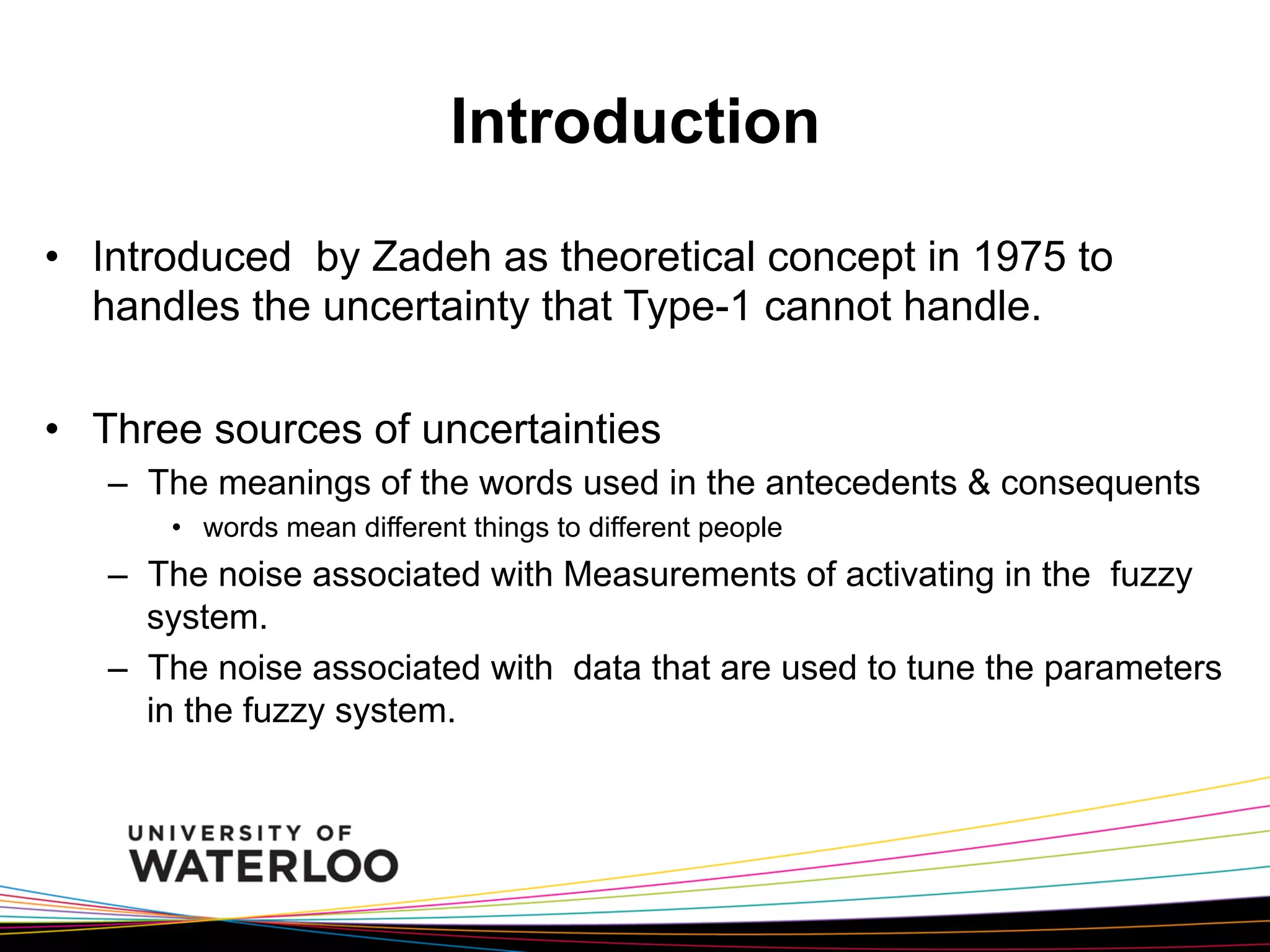
Introduction
•  Introduced by Zadeh as theoretical concept in 1975 to
handles the uncertainty that Type-1 cannot handle.
•  Three sources of uncertainties
–  The meanings of the words used in the antecedents & consequents
•  words mean different things to different people

–  The noise associated with Measurements of activating in the fuzzy
system.
–  The noise associated with data that are used to tune the parameters
in the fuzzy system.
Introduction
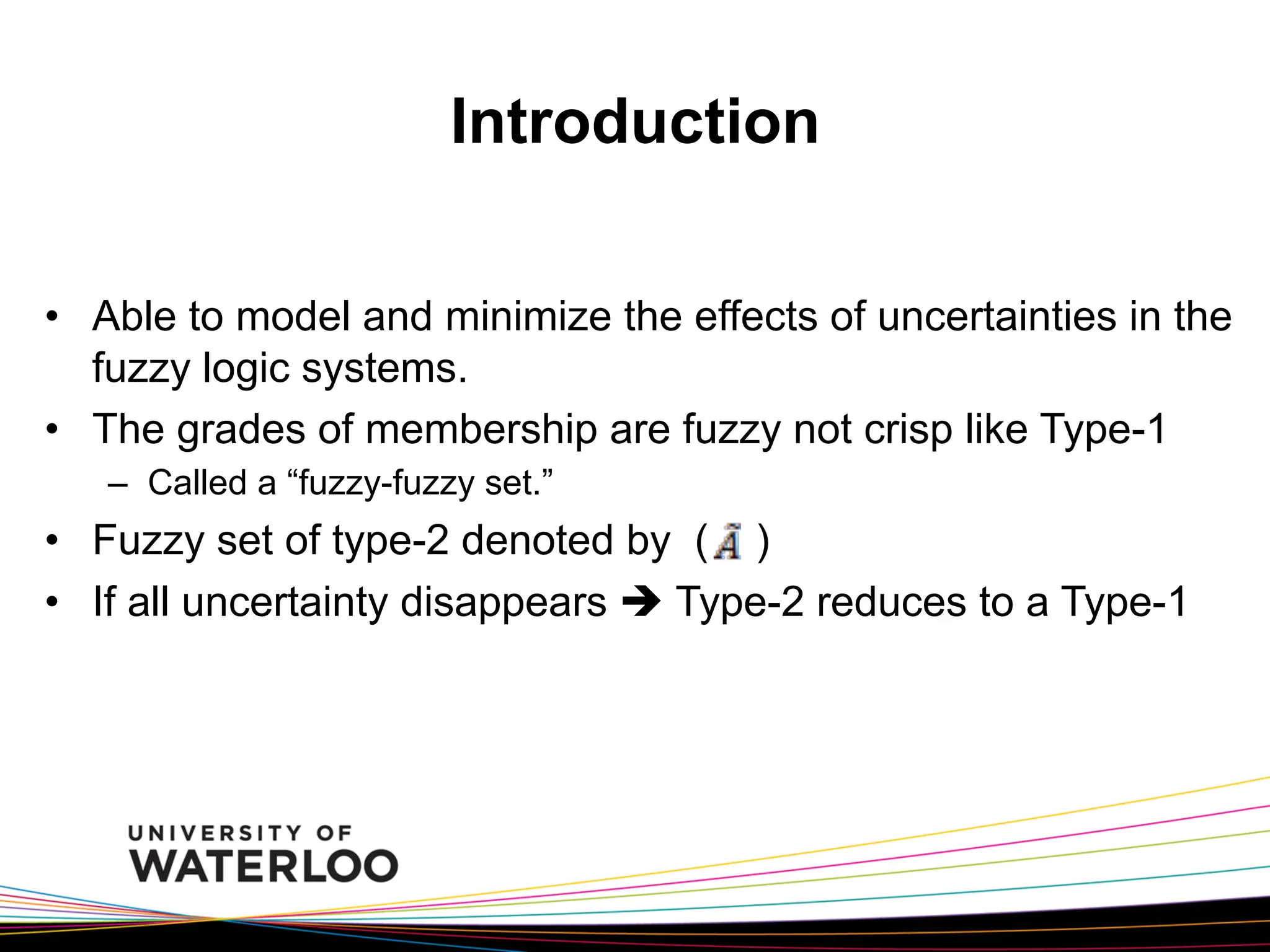
•  Able to model and minimize the effects of uncertainties in the
fuzzy logic systems.
•  The grades of membership are fuzzy not crisp like Type-1
–  Called a “fuzzy-fuzzy set.”

•  Fuzzy set of type-2 denoted by ( )
•  If all uncertainty disappears è Type-2 reduces to a Type-1
Interval & General
Type-2 Fuzzy Set
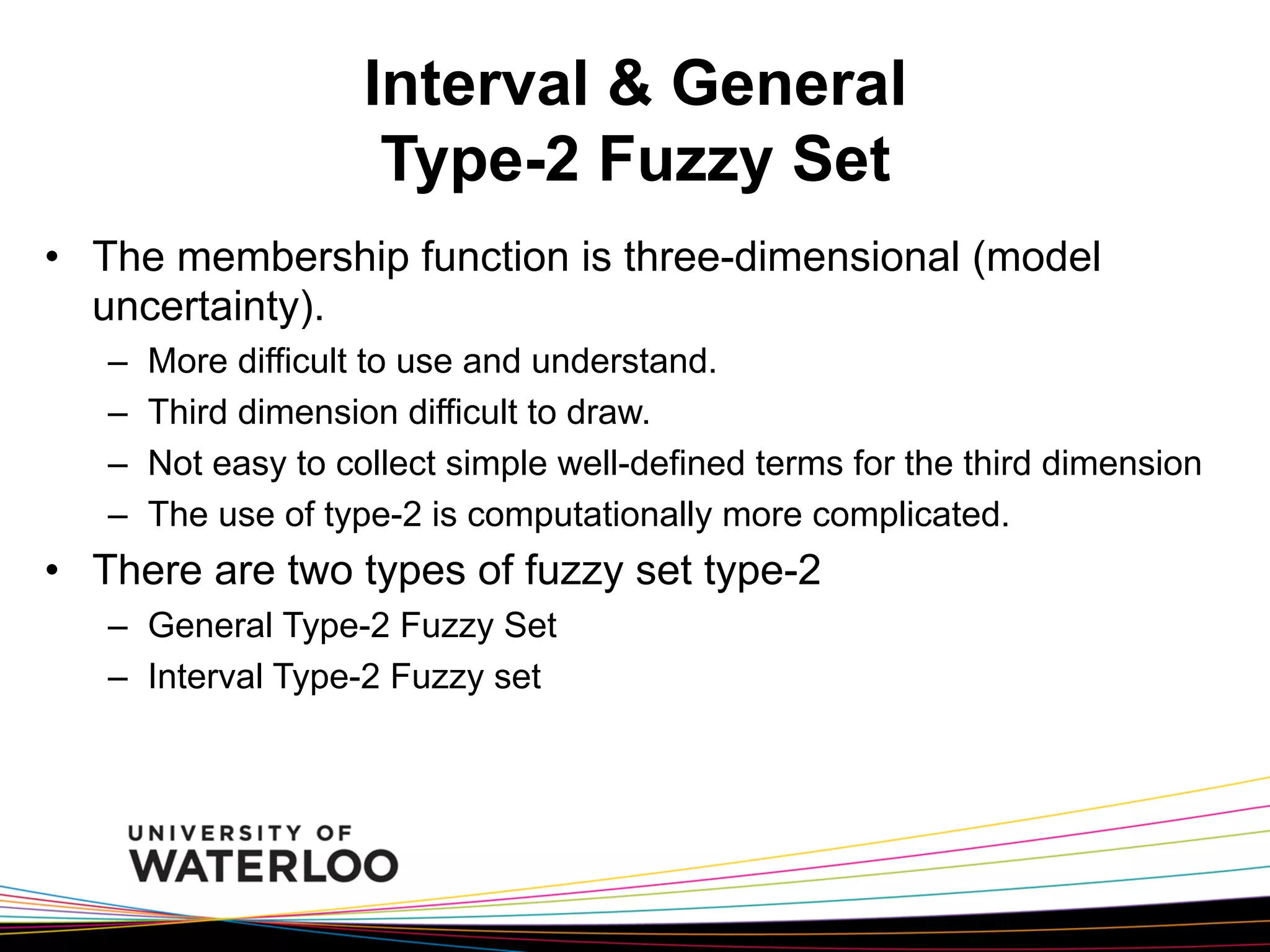
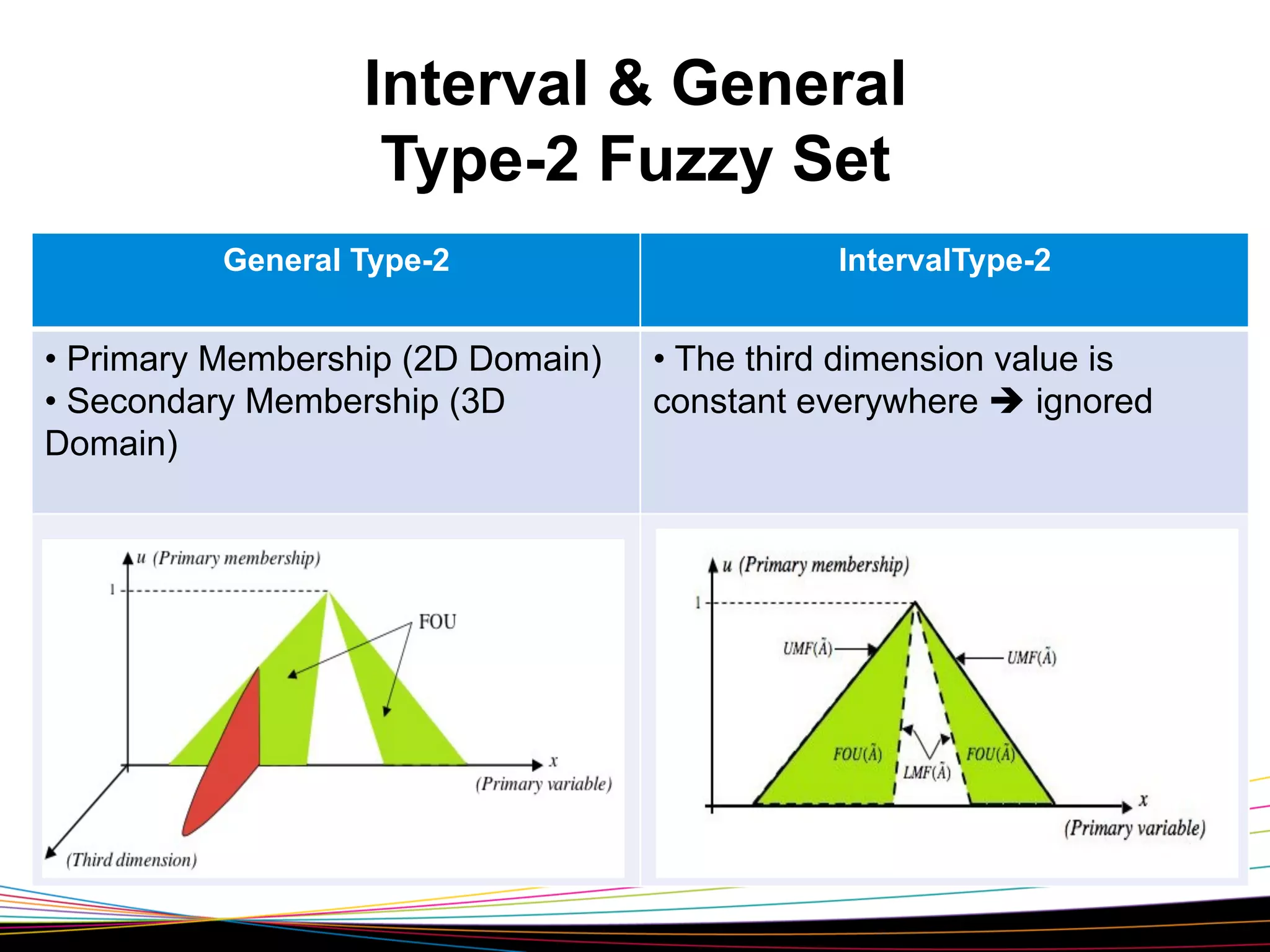
•  The membership function is three-dimensional (model
uncertainty).
– 
– 
– 
– 

More difficult to use and understand.
Third dimension difficult to draw.
Not easy to collect simple well-defined terms for the third dimension
The use of type-2 is computationally more complicated.

•  There are two types of fuzzy set type-2
–  General Type-2 Fuzzy Set
–  Interval Type-2 Fuzzy set
Interval & General
Type-2 Fuzzy Set
General Type-2

•  Primary Membership (2D Domain)
•  Secondary Membership (3D
Domain)

IntervalType-2

•  The third dimension value is
constant everywhere è ignored
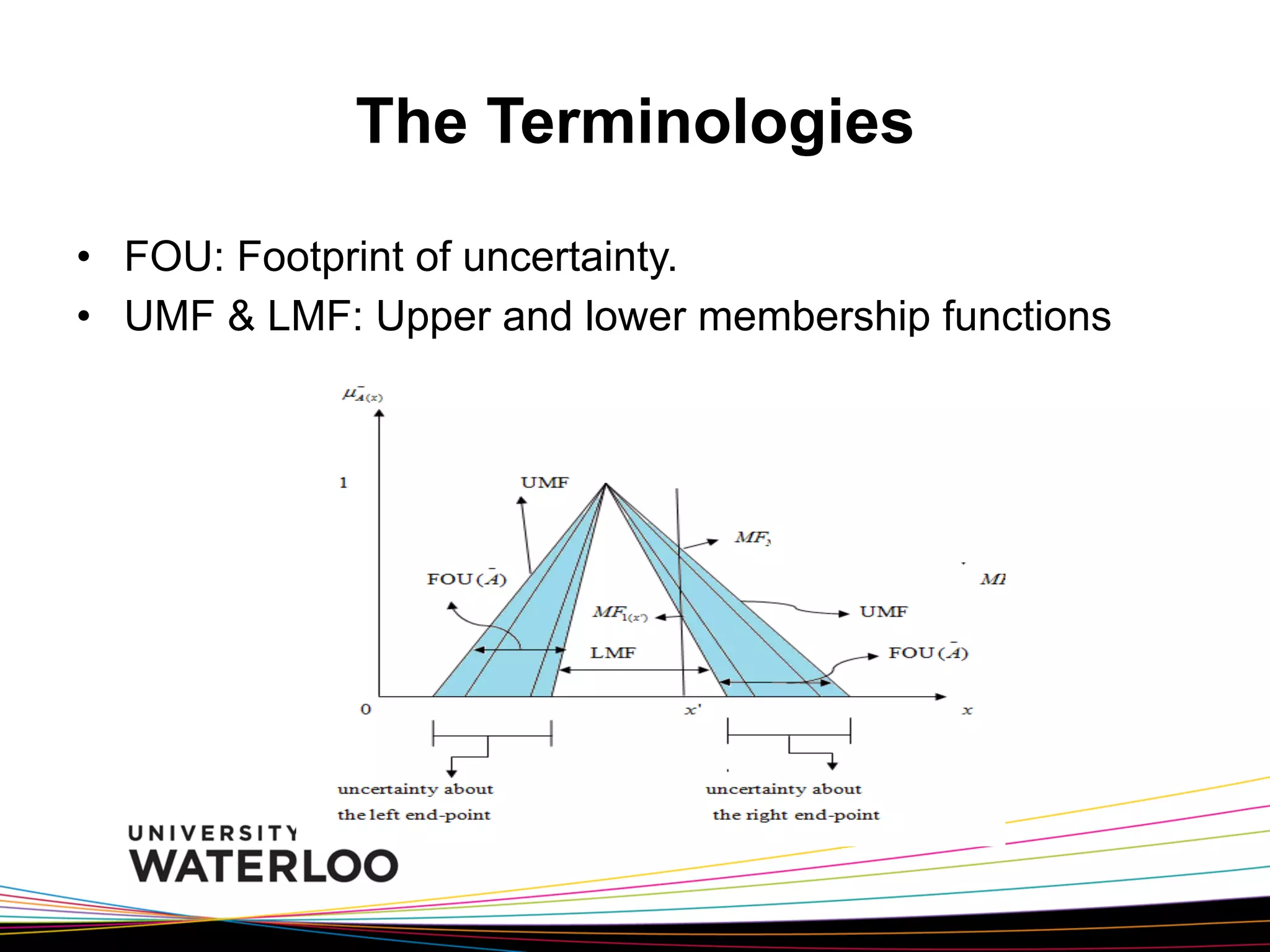
The Terminologies
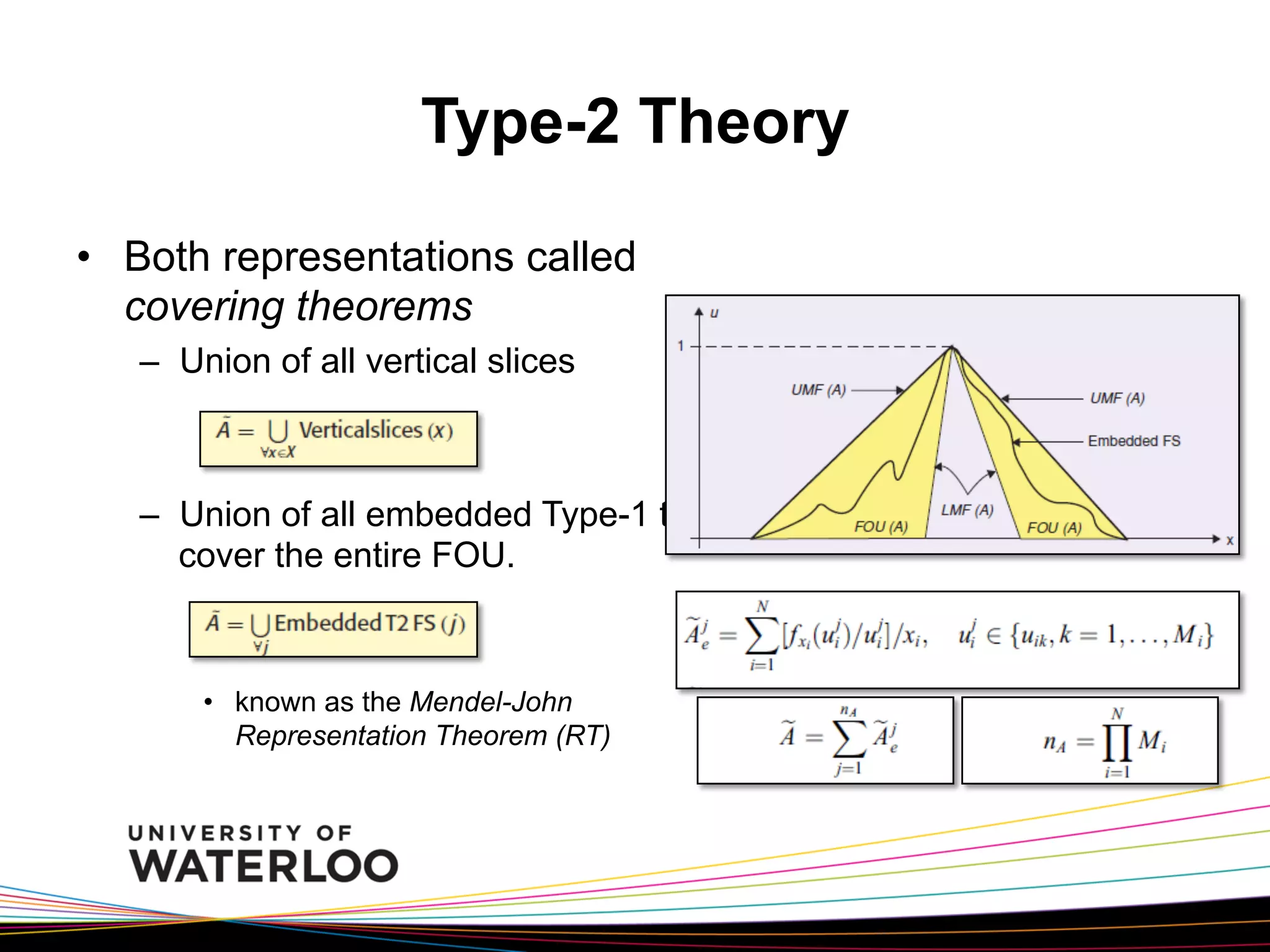
•  FOU: Footprint of uncertainty.
•  UMF & LMF: Upper and lower membership functions
Agenda
• 

Introduction to type-2 fuzzy set.
o  Interval Type-2 & General Type-2
o  Type-2 Terminologies

• 

Type-2 fuzzy set Theory & Systems
o  Theory & operation
o  Inference System
o  Example (Image Edge Detection)

• 

Application (Computing With Words)
o 
o 
o 
o 
o 

Computing with Words (CWW)
Perceptual Computing (Per-C)
Example of Per-C: Journal Publishing Judgment Advisor (JPJA)
Analysis of Per-C
Conclusion
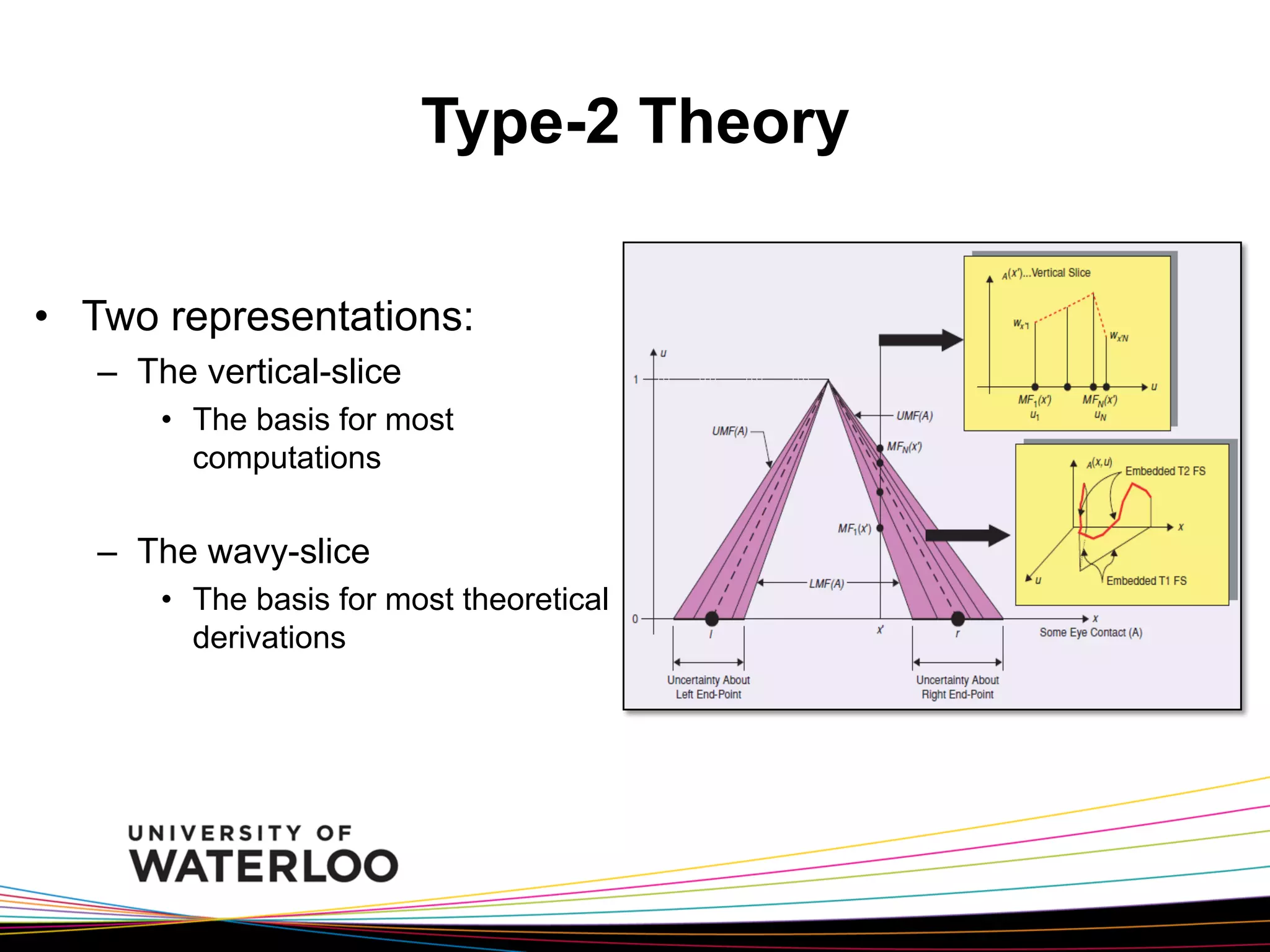
Type-2 Theory
•  Two representations:
–  The vertical-slice
•  The basis for most
computations

–  The wavy-slice
•  The basis for most theoretical
derivations
Type-2 Theory
•  Both representations called
covering theorems
–  Union of all vertical slices

–  Union of all embedded Type-1 that
cover the entire FOU.

•  known as the Mendel-John
Representation Theorem (RT)
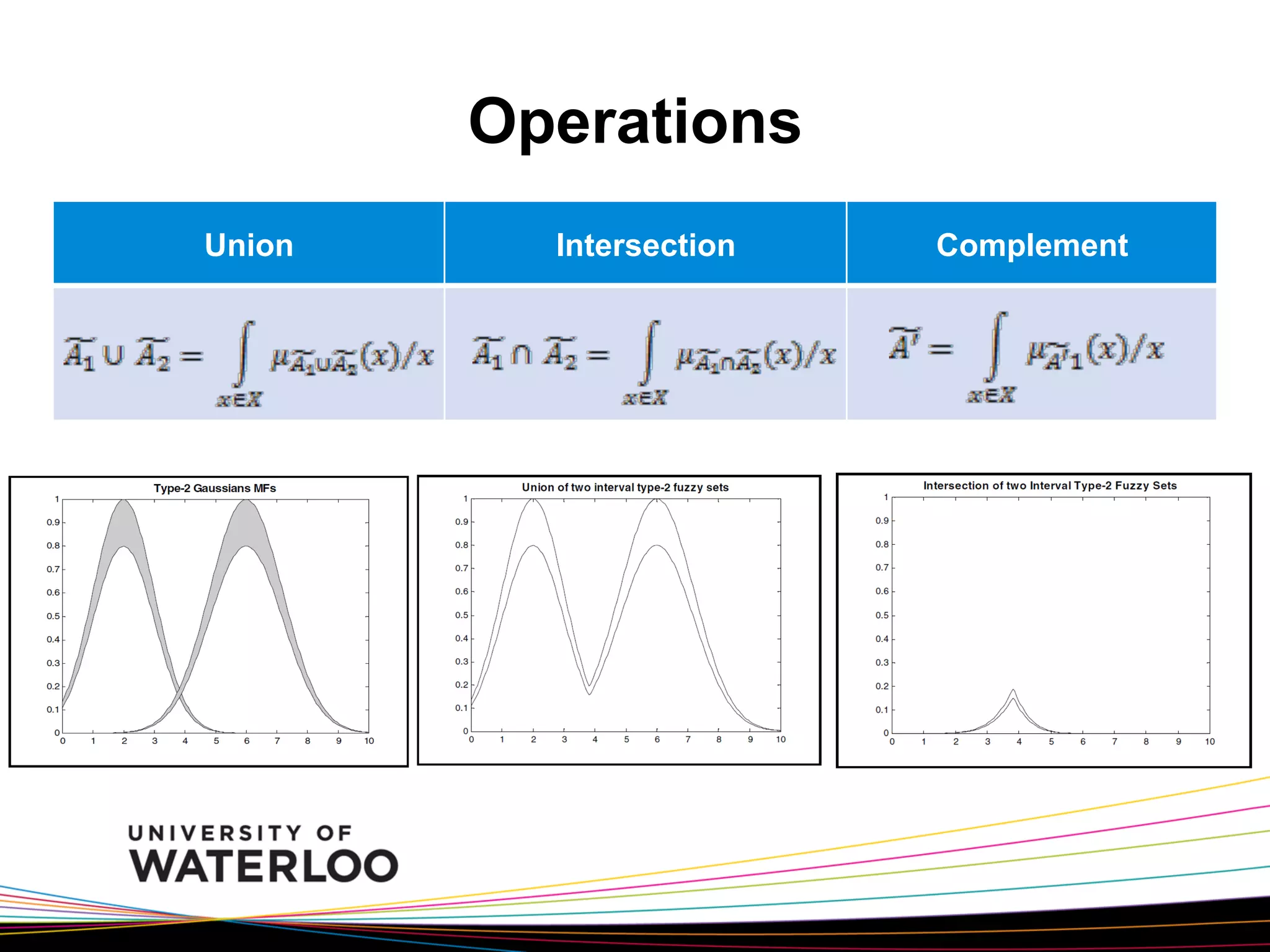
Operations
Union

Intersection

Complement
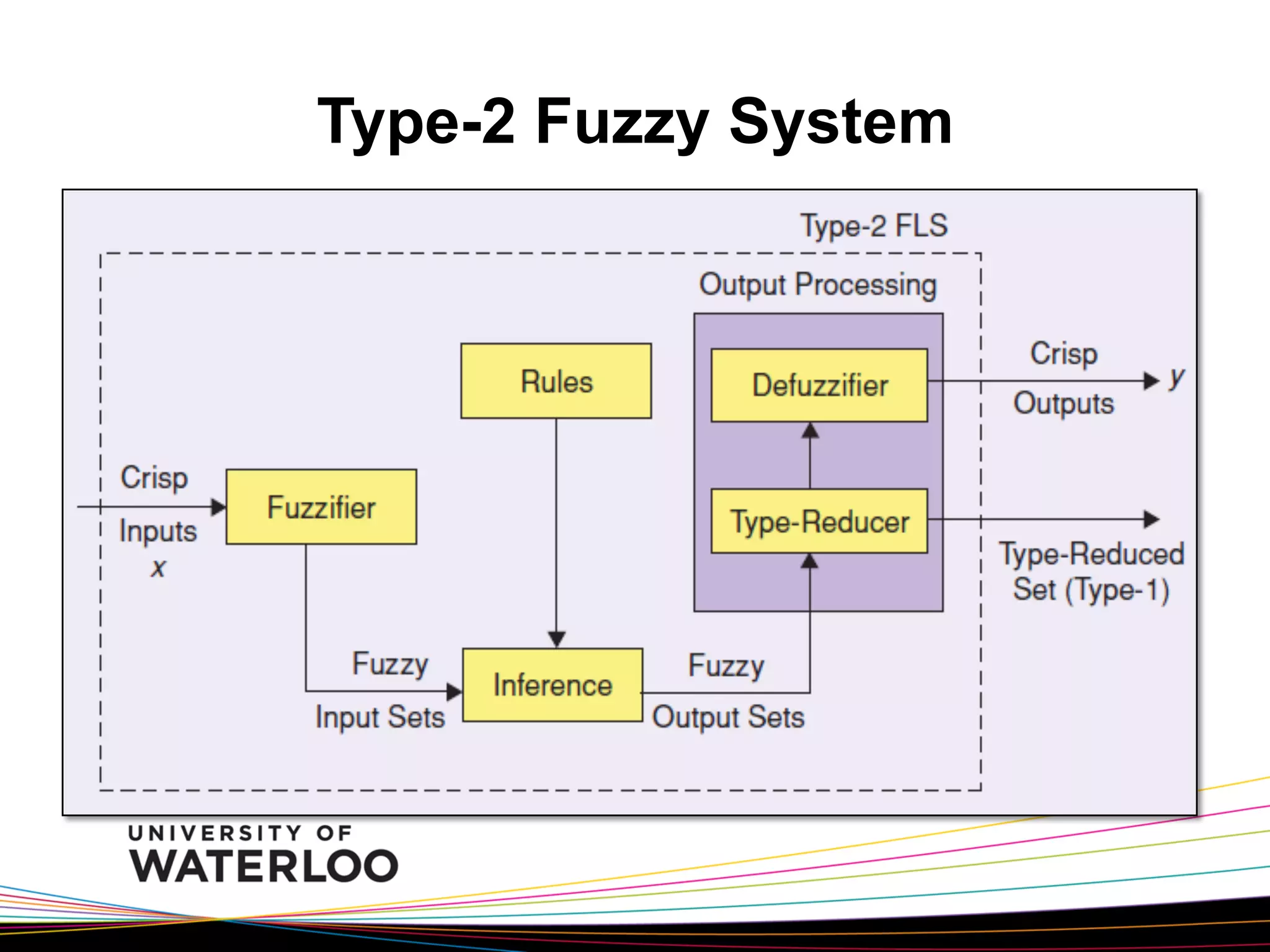
Type-2 Fuzzy System
Type-2 Fuzzy System
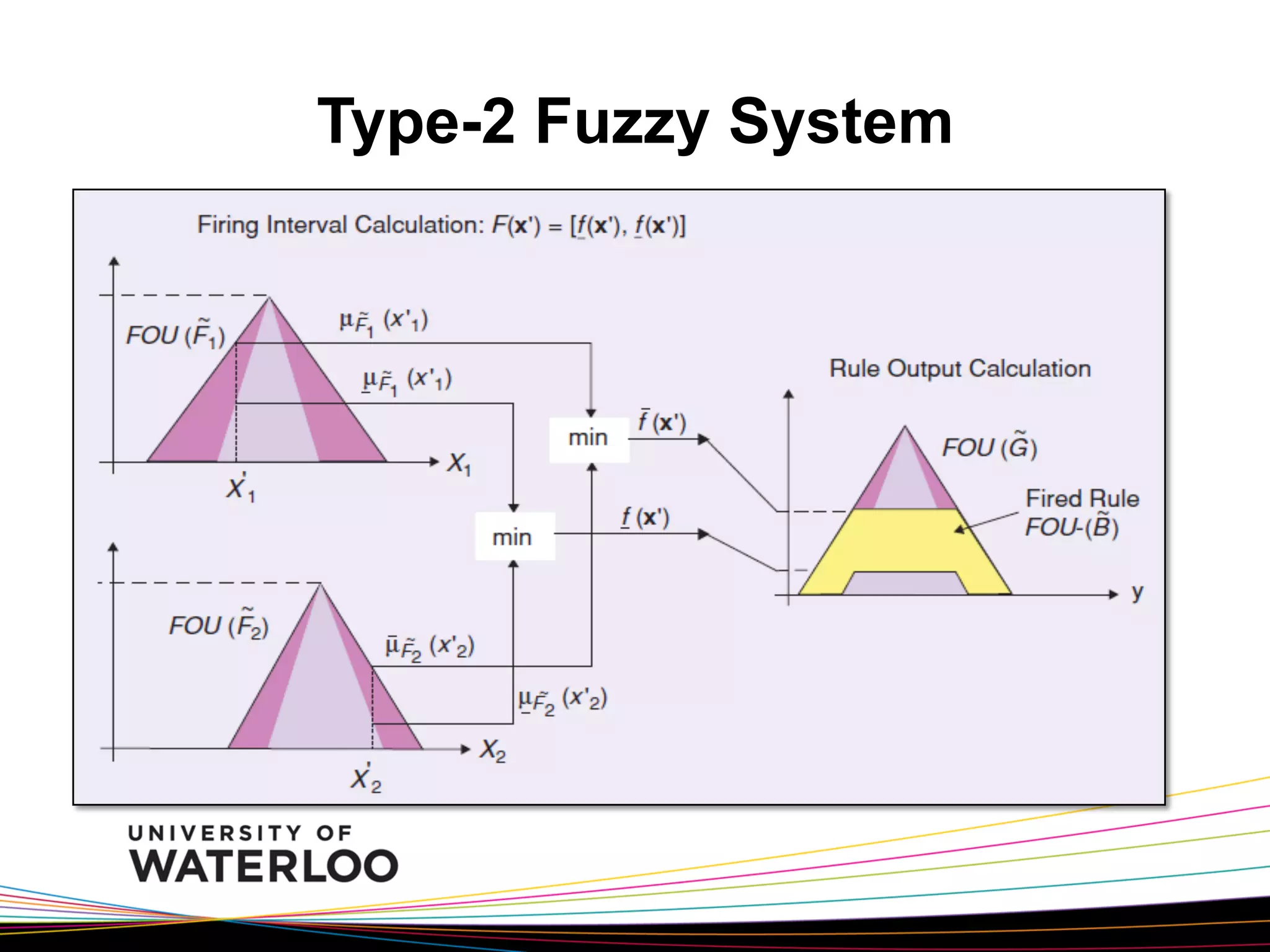
Type-2 Fuzzy System
•  Singleton Type-2 Fuzzy Logic Systems
–  Based on Mandani
–  Uncertainties in the antecedents or consequents

•  Non-singleton Fuzzy Logic Systems
–  Based on Mandani
–  Uncertainties in both the antecedents, consequents and input
measurement
–  More complicated.

•  Sugeno Type-2 Fuzzy Systems
–  Based on Takagi and Sugeno
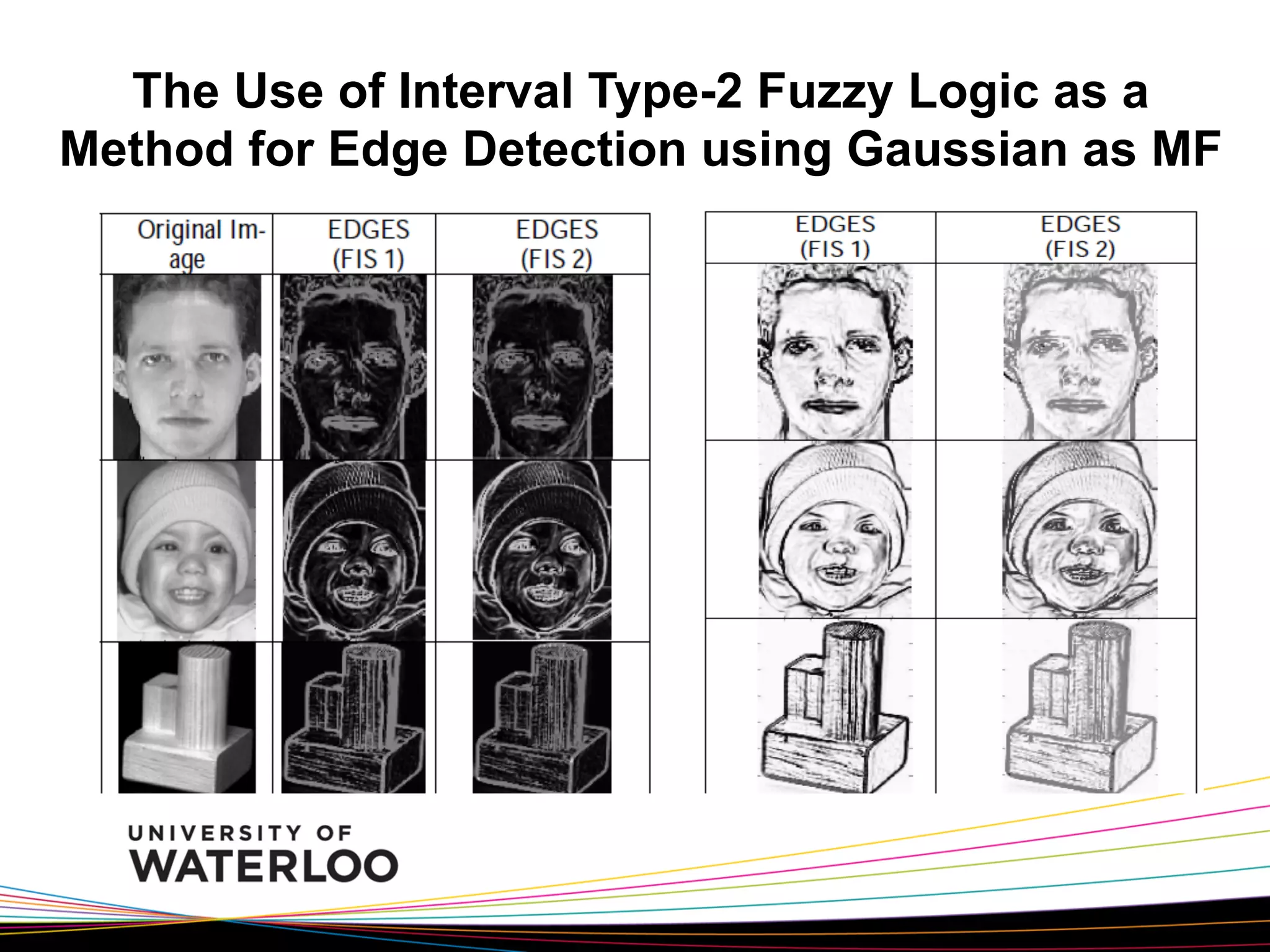
The Use of Interval Type-2 Fuzzy Logic as a
Method for Edge Detection using Gaussian as MF
•  Detecting the edges allows feature extraction & construction of input
vectors for neural networks with aims of image recognition

•  Traditional Methods
–  The gradient methods like Roberts, Prewitt and Sobel for detect edges.
•  Looking for maximum and minimum in first derived

–  The Laplacian methods like Marrs-Hildreth
•  Finding the zeros of second derived
The Use of Interval Type-2 Fuzzy Logic as a
Method for Edge Detection using Gaussian as MF
Inputs
DH:
Derivative
Horizontal
DV:
Derivative
Vertical
HP:
high-pass
filter
M:
low-pass
filter

Inputs equation

Rules
If (DH is LOW) and (DV is LOW) then (EDGES
is LOW)
If (DH is MEDIUM) and (DV is MEDIUM) then
(EDGES is HIGH)
If (DH is HIGH) and (DV is HIGH) then
(EDGES is HIGH)
If (DH is MEDIUM) and (HP is LOW) then
(EDGES is HIGH)
If (DV is MEDIUM) and (HP is LOW) then
(EDGES is HIGH)
If (M is LOW) and (DV is MEDIUM) then
(EDGES is LOW)
If (M is LOW) and (DH is MEDIUM) then
(EDGES is LOW)
The Use of Interval Type-2 Fuzzy Logic as a
Method for Edge Detection using Gaussian as MF
The Use of Interval Type-2 Fuzzy Logic as a
Method for Edge Detection using Gaussian as MF

• 

By using Type-2 fuzzy more than
half of the pixels were cleared
without depreciating the image
–  reduce in drastic form the cost of
training in a neural network.
Agenda
• 

Introduction to type-2 fuzzy set.
o  Interval Type-2 & General Type-2
o  Type-2 Terminologies

• 

Type-2 fuzzy set Theory & Systems
o  Theory & operation
o  Inference System
o  Example (Image Edge Detection)

• 

Application (Computing With Words)
o 
o 
o 
o 
o 

Computing with Words (CWW)
Perceptual Computing (Per-C)
Example of Per-C: Journal Publishing Judgment Advisor (JPJA)
Analysis of Per-C
Conclusion
Computing with Words (CWW)
CWW	
  	
  is	
  :	
  
“A	
  methodology	
  in	
  which	
  words	
  are	
  used	


  in	
  place	
  of	
  numbers	
  for	
  compu7ng	
  and	


  reasoning..”

(Zadeh, 1996- Ref[4])

Distance	
  =	
  
500	
  

Ann	
  lives	
  near	
  
Mary	
  

Example:	
  consider	
  the	
  proposi<ons:	
  
	
  p1	
  =	
  Ann	
  lives	
  near	
  Mary	
  
	
  p2	
  =	
  Mary	
  lives	
  near	
  Clara.	


Query	
  :	
  “How	
  far	
  is	
  Ann	
  from	
  Clara?,”	


  Answer:	
  Ann	
  lives	
  not	
  far	
  from	
  Clara.	
  
Fig. Compute with numbers vs.
compute with words

20
Perceptual Computer (Per-C)
Words
(perceptions)

Encoder

IT2 FS

CWW Engine
(T2 FLS)
Words
(word, rank, class)

Decoder

IT2 FS

Fig. Architecture of a Per-C (Mendel Ref[5],2002)

• 
• 
• 

Words mean different things to different People = uncertainty in words = FL
Uncertainty a person has about the meaning of a word (intra-personal
uncertainty)=> T1 FL
Uncertainties that a group of people have about the meaning of the word
(inter-personal uncertainty) => T2 FL
[Ref 6]
21
Perceptual Computer (Per-C) cont.
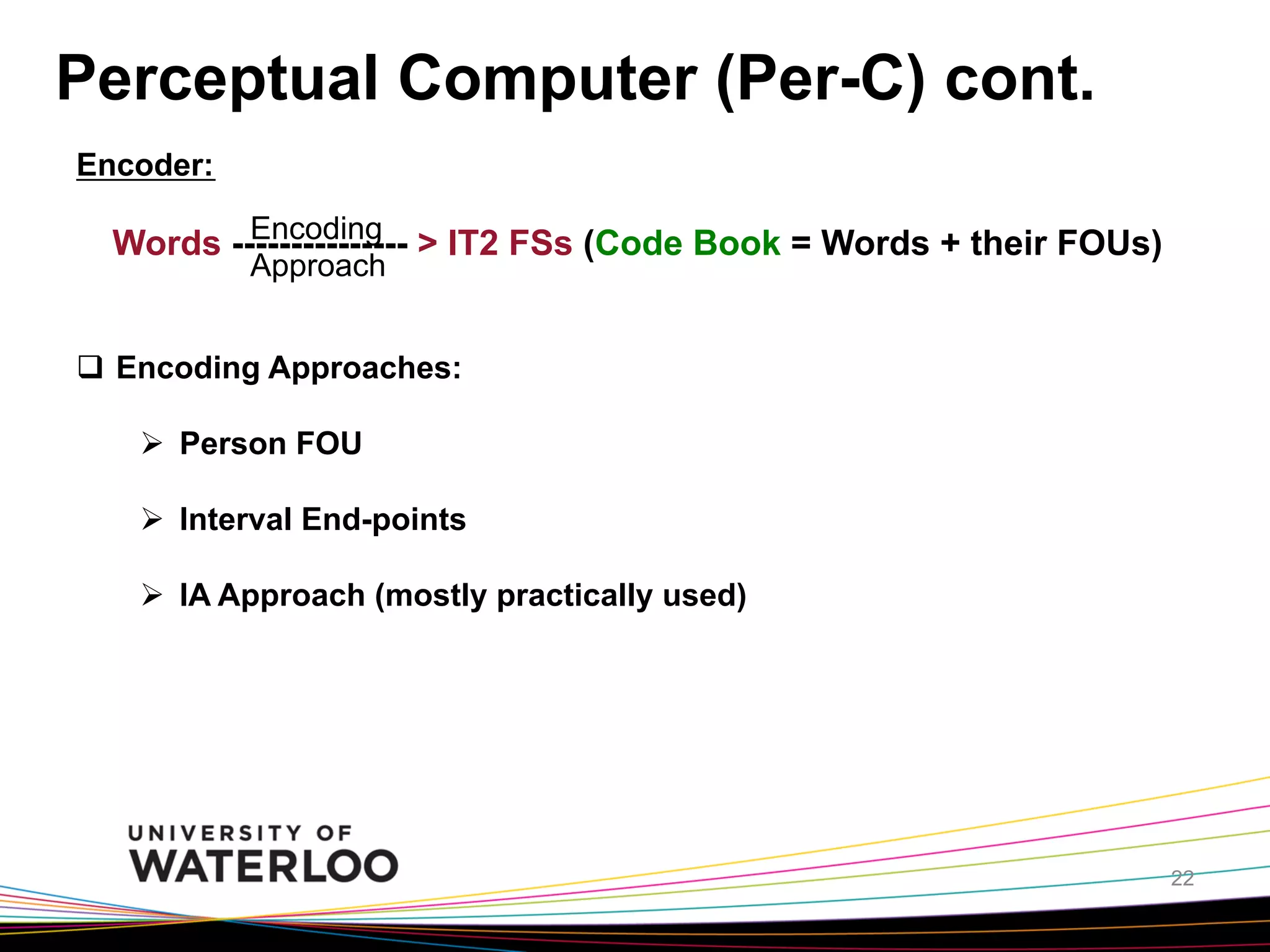
Encoder:
Encoding
Words --------------- > IT2 FSs (Code Book = Words + their FOUs)
Approach

q  Encoding Approaches:
Ø  Person FOU
Ø  Interval End-points
Ø  IA Approach (mostly practically used)

22
Perceptual Computer (Per-C) cont.
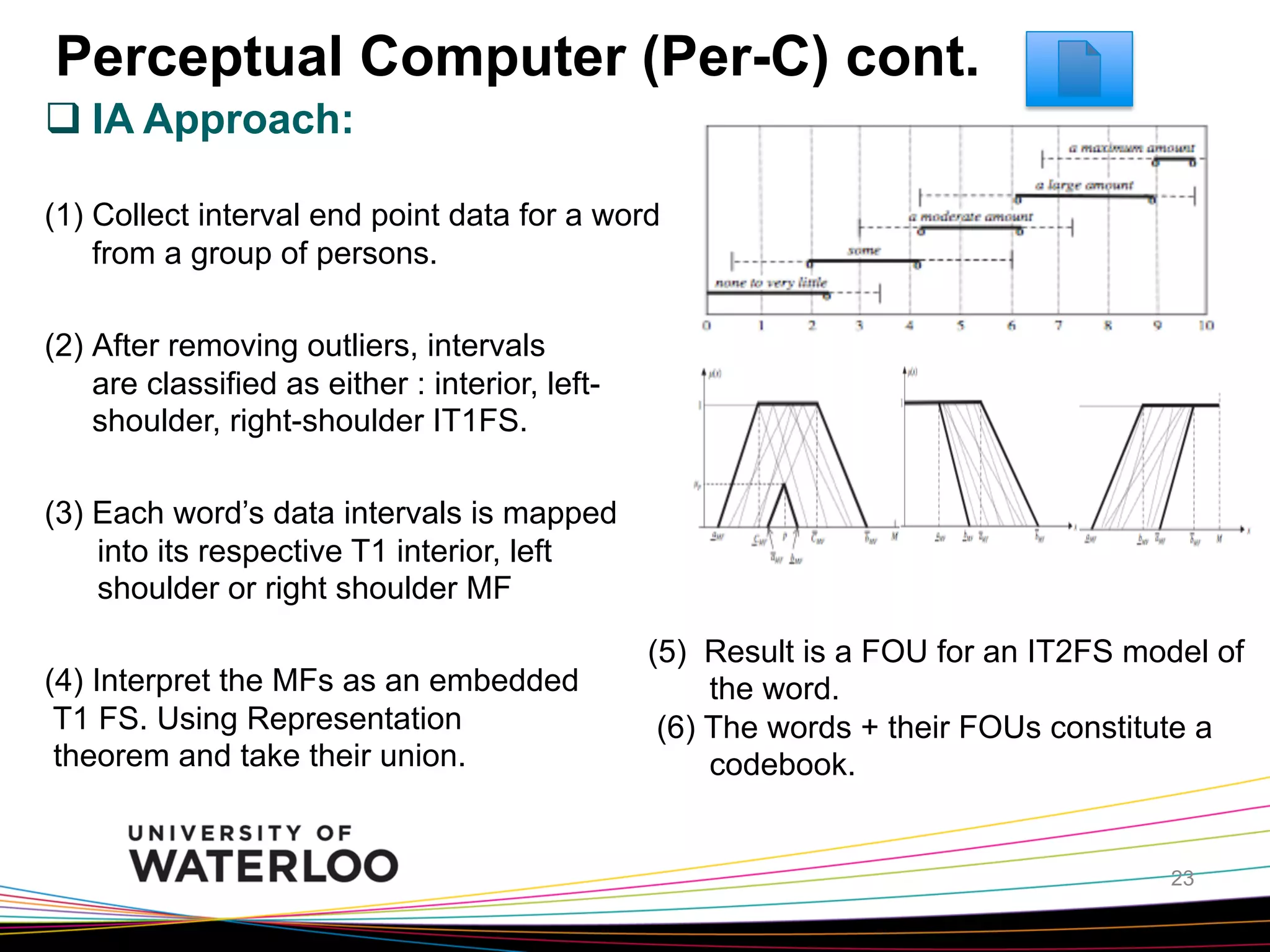
q IA Approach:
(1)  Collect interval end point data for a word
from a group of persons.
(2)  After removing outliers, intervals
are classified as either : interior, leftshoulder, right-shoulder IT1FS.
(3) Each word’s data intervals is mapped
into its respective T1 interior, left
shoulder or right shoulder MF
(4) Interpret the MFs as an embedded
T1 FS. Using Representation
theorem and take their union.

(5) Result is a FOU for an IT2FS model of
the word.
(6) The words + their FOUs constitute a
codebook.

23
Perceptual Computer (Per-C) cont.
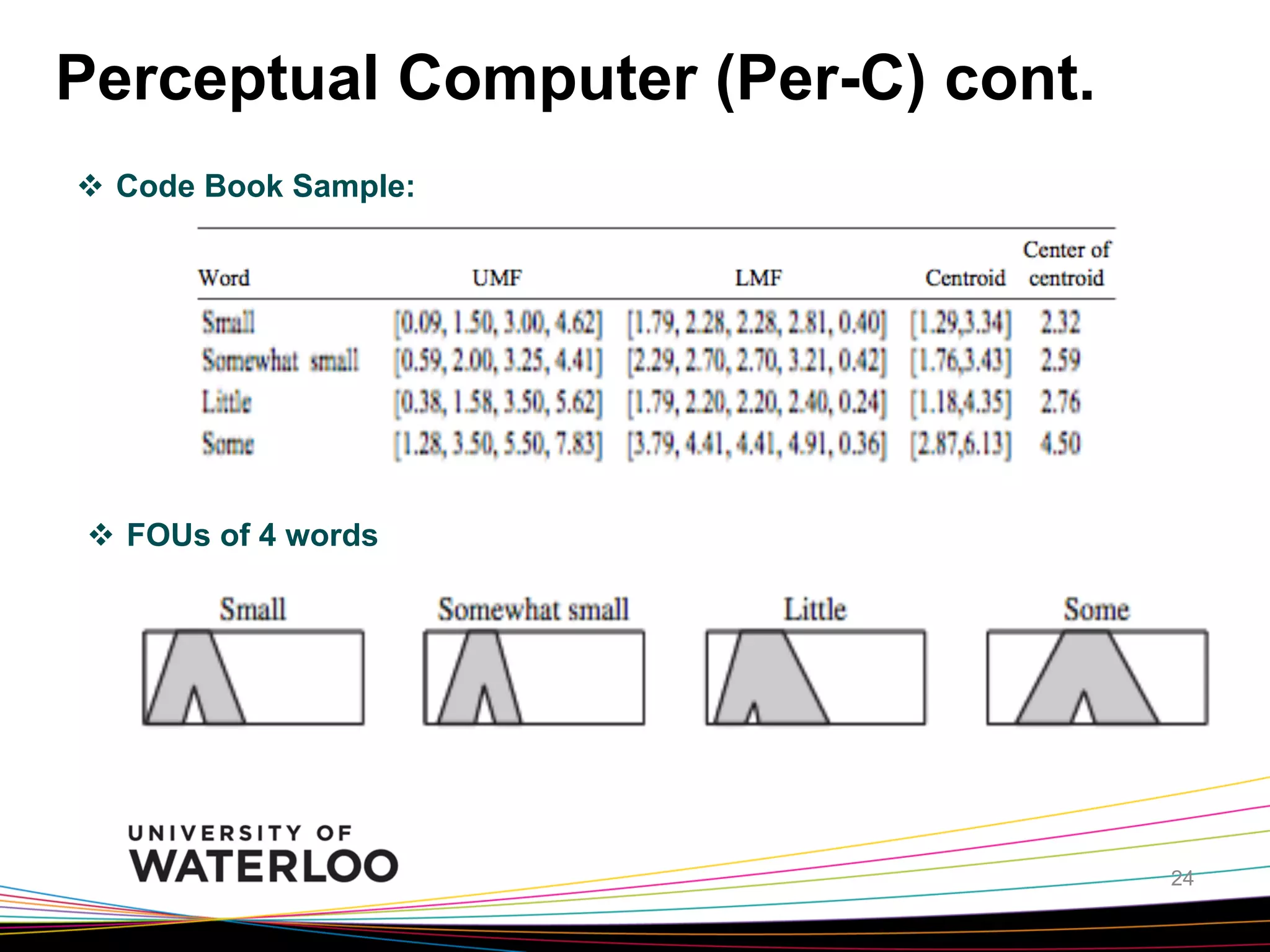
v  Code Book Sample:

v  FOUs of 4 words

24
Perceptual Computer (Per-C) cont.
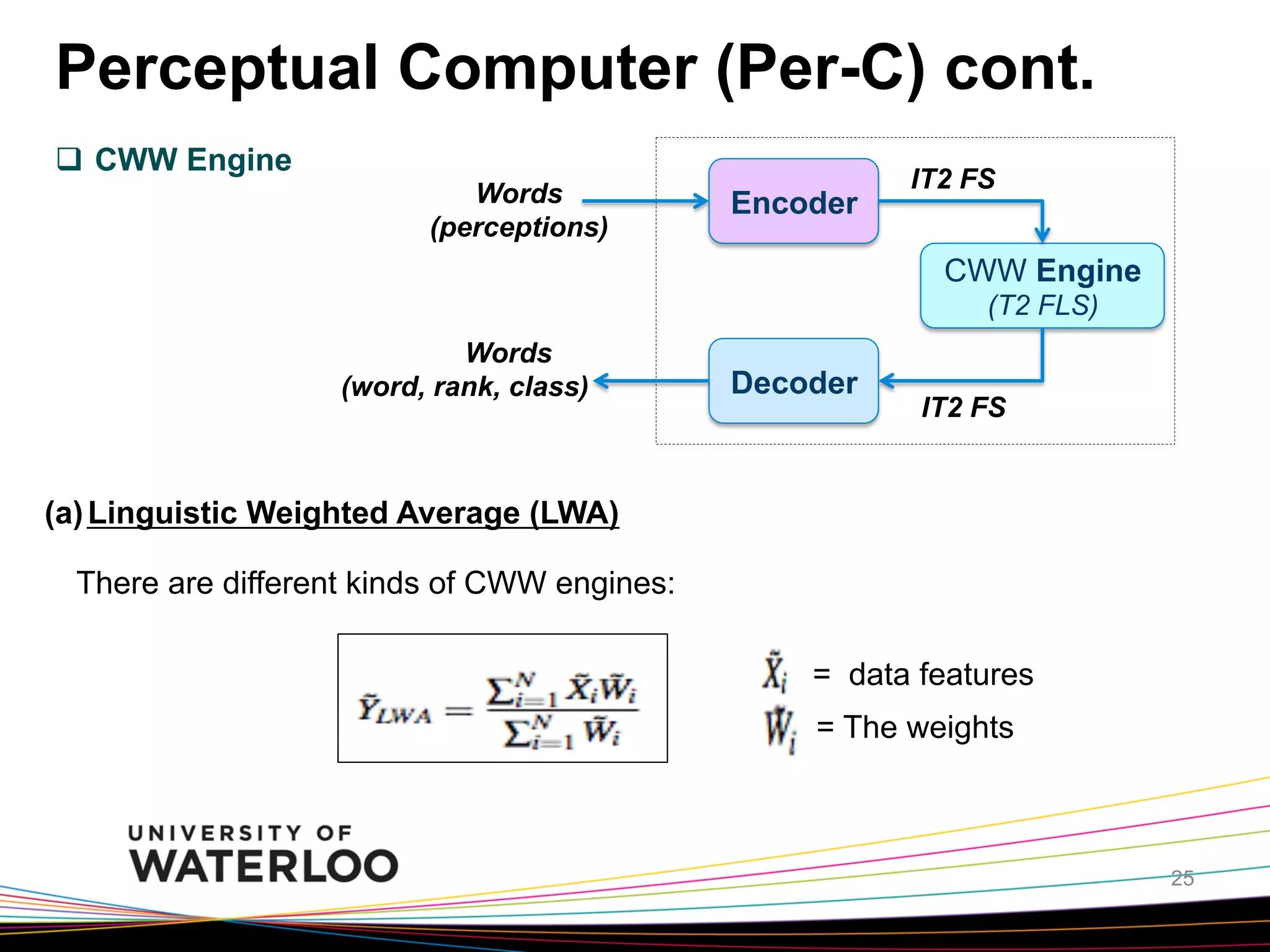
q  CWW Engine
Words
(perceptions)

Encoder

IT2 FS

CWW Engine
(T2 FLS)
Words
(word, rank, class)

Decoder

IT2 FS

(a)  Linguistic Weighted Average (LWA)
There are different kinds of CWW engines:
= data features
= The weights

25
Perceptual Computer (Per-C) cont.
q  CWW Engine
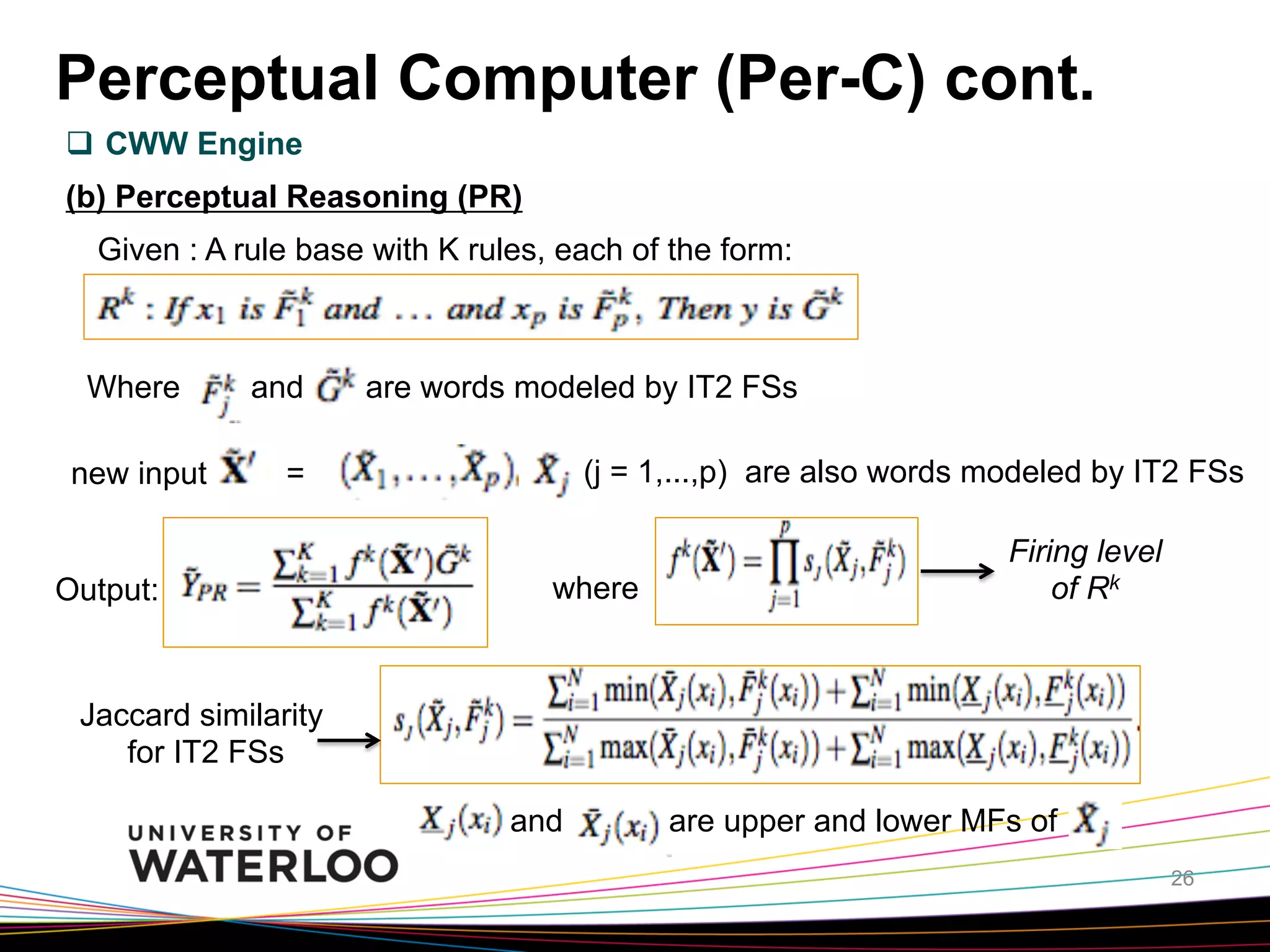
(b) Perceptual Reasoning (PR)
Given : A rule base with K rules, each of the form:

Where
new input

and

are words modeled by IT2 FSs
(j = 1,...,p) are also words modeled by IT2 FSs

=

Output:

where

Firing level
of Rk

Jaccard similarity
for IT2 FSs
and

are upper and lower MFs of
26
Perceptual Computer (Per-C) cont.
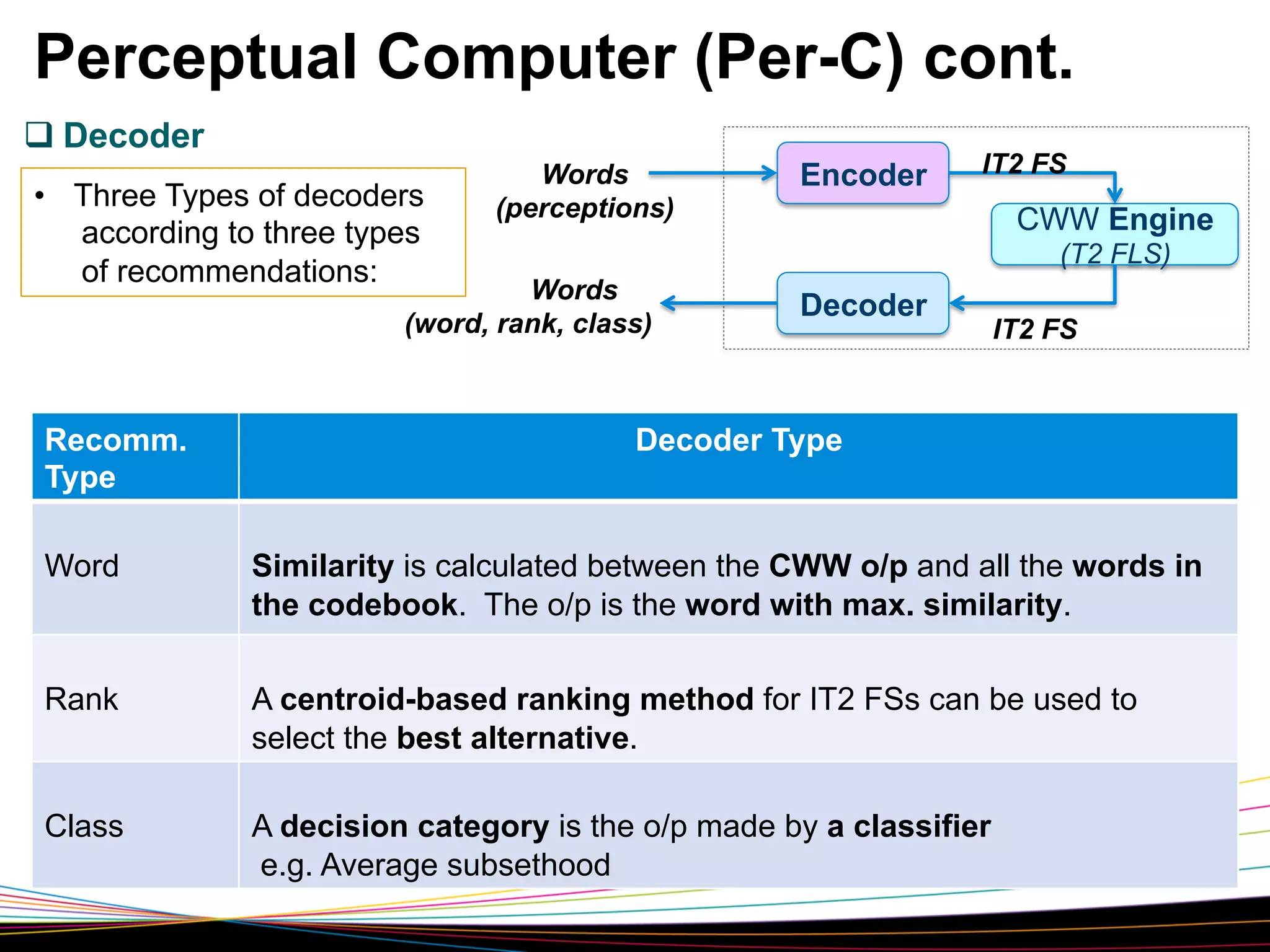
q Decoder
•  Three Types of decoders
according to three types
of recommendations:

Words
(perceptions)

IT2 FS

CWW Engine
(T2 FLS)

Words
(word, rank, class)

Recomm.
Type

Encoder

Decoder

IT2 FS

Decoder Type

Word

Similarity is calculated between the CWW o/p and all the words in
the codebook. The o/p is the word with max. similarity.

Rank

A centroid-based ranking method for IT2 FSs can be used to
select the best alternative.

Class

A decision category is the o/p made by a classifier
e.g. Average subsethood

27
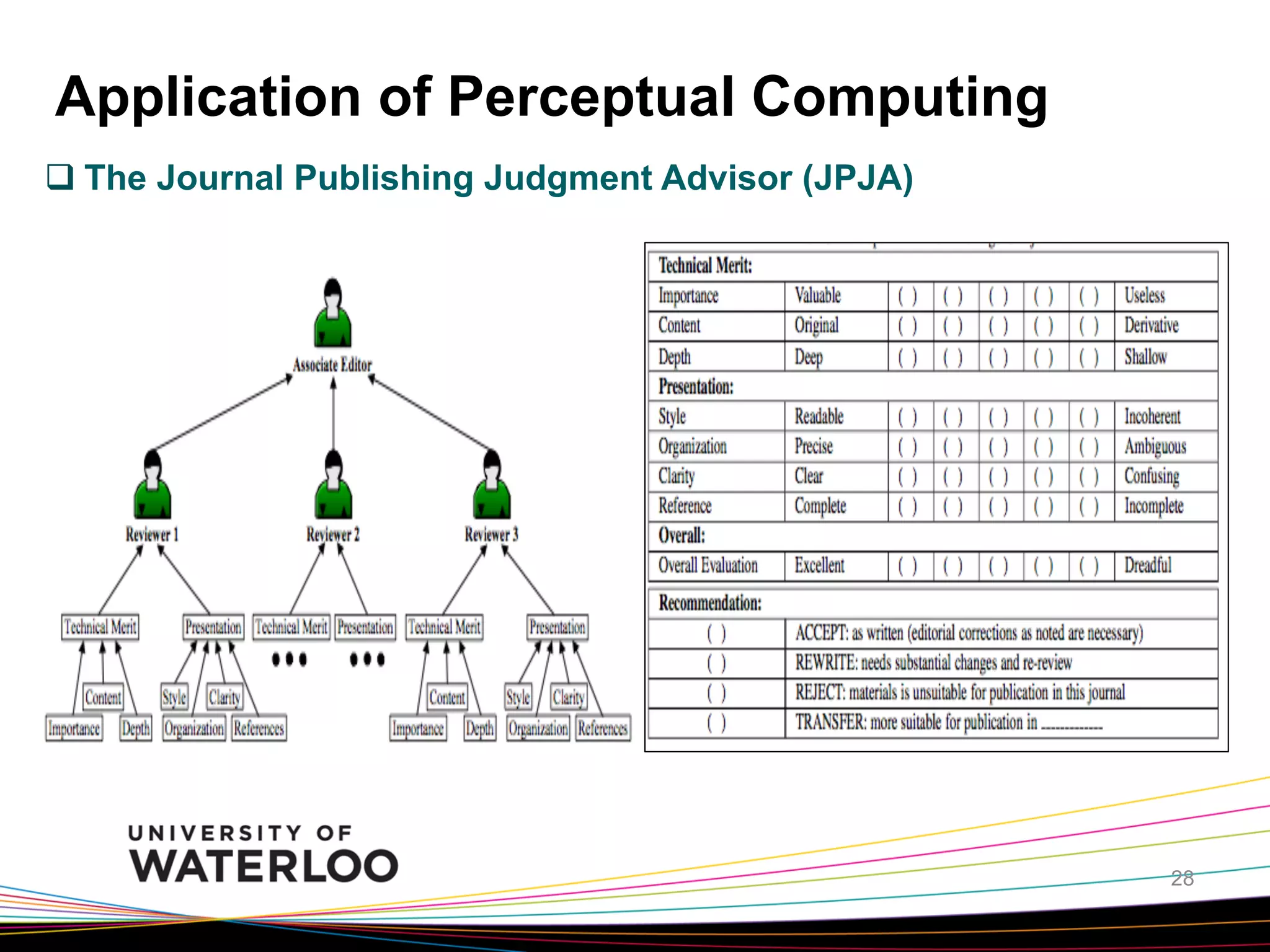
Application of Perceptual Computing
q The Journal Publishing Judgment Advisor (JPJA)

28
Application of Perceptual Computing
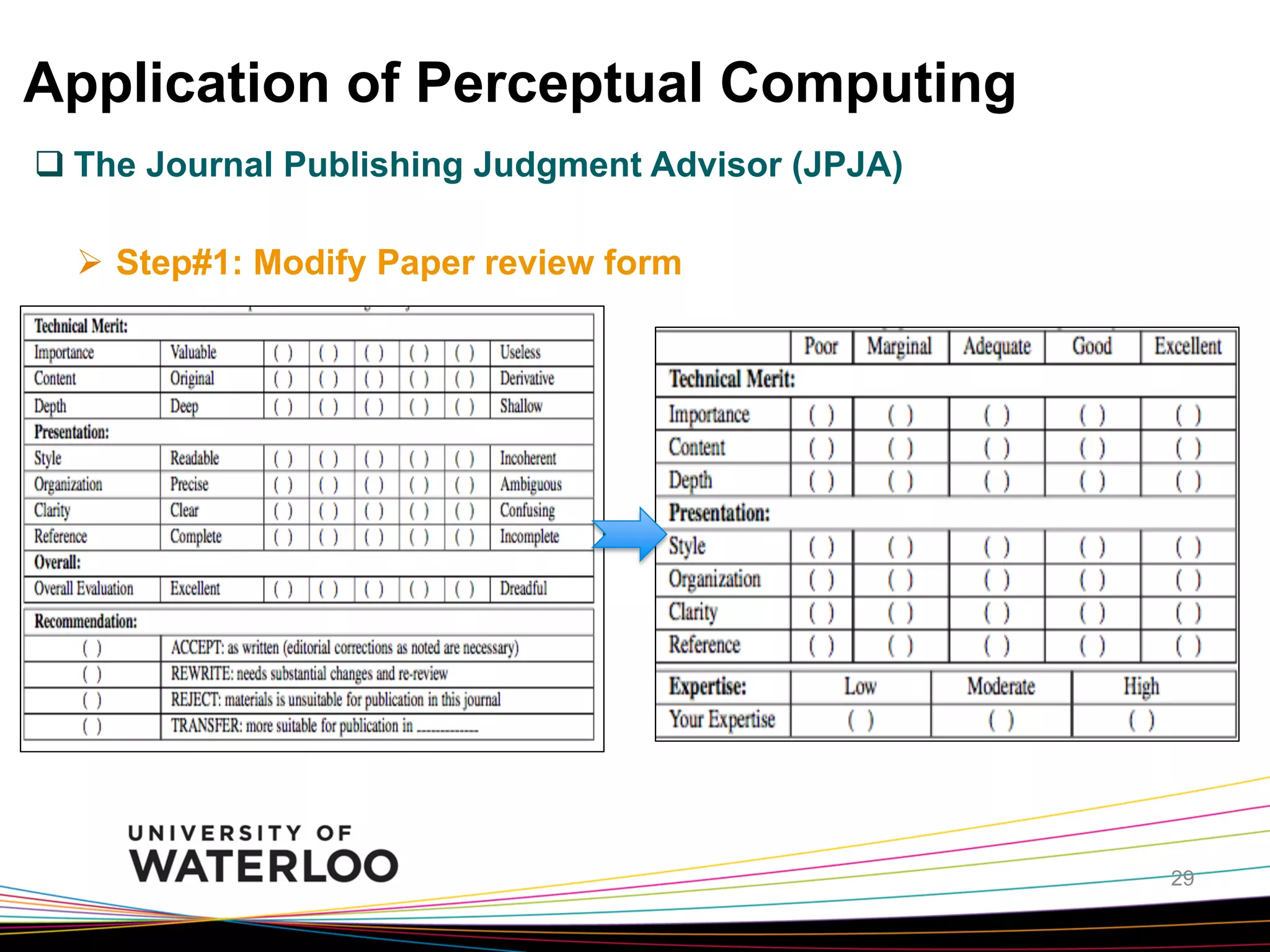
q The Journal Publishing Judgment Advisor (JPJA)
Ø  Step#1: Modify Paper review form

29
Application of Perceptual Computing
q The Journal Publishing Judgment Advisor (JPJA)
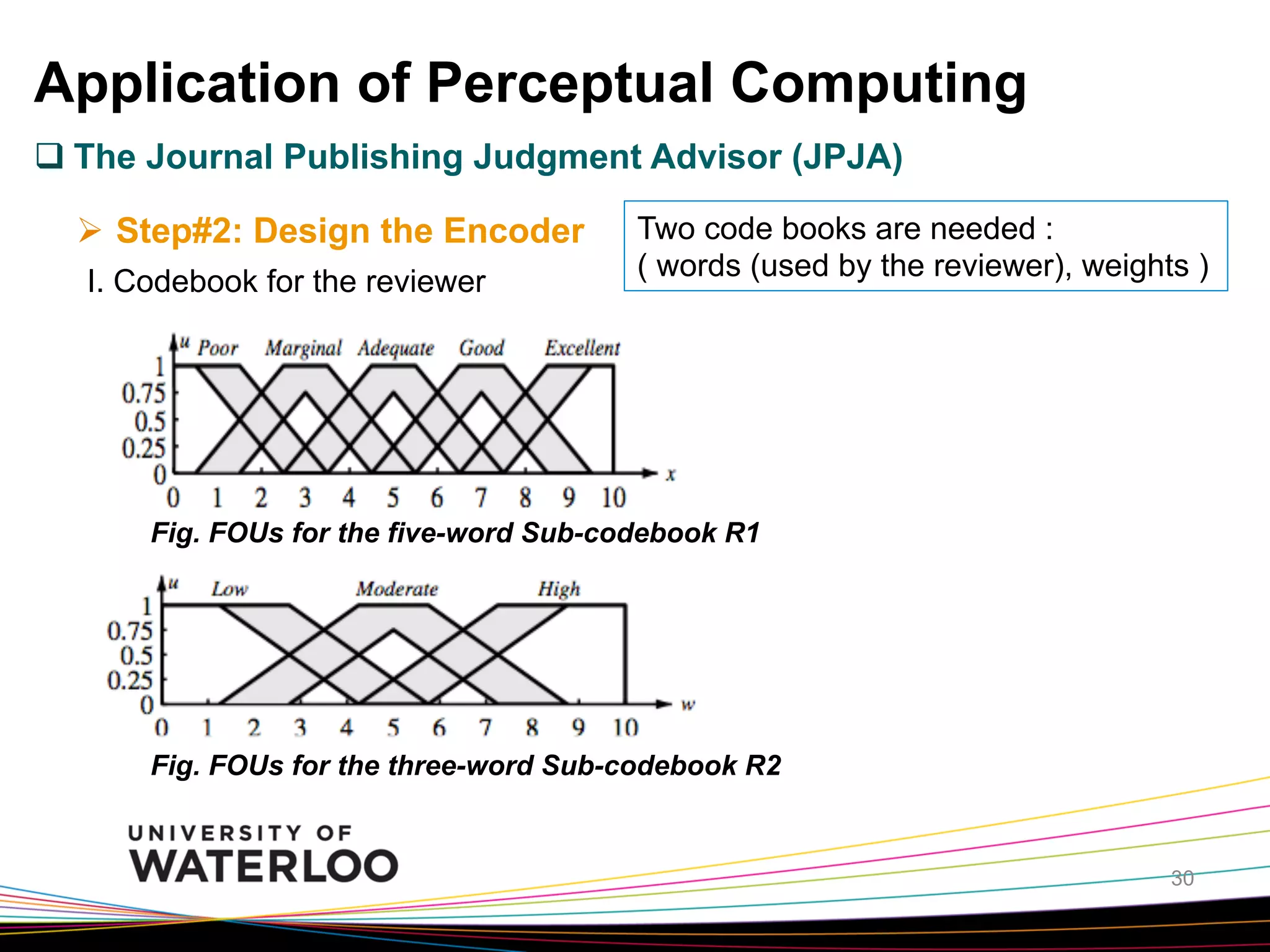
Ø  Step#2: Design the Encoder
I. Codebook for the reviewer

Two code books are needed :
( words (used by the reviewer), weights )

Fig. FOUs for the five-word Sub-codebook R1

Fig. FOUs for the three-word Sub-codebook R2

30
Application of Perceptual Computing
q The Journal Publishing Judgment Advisor (JPJA)
Ø  Step#2: Design the Encoder – cont.
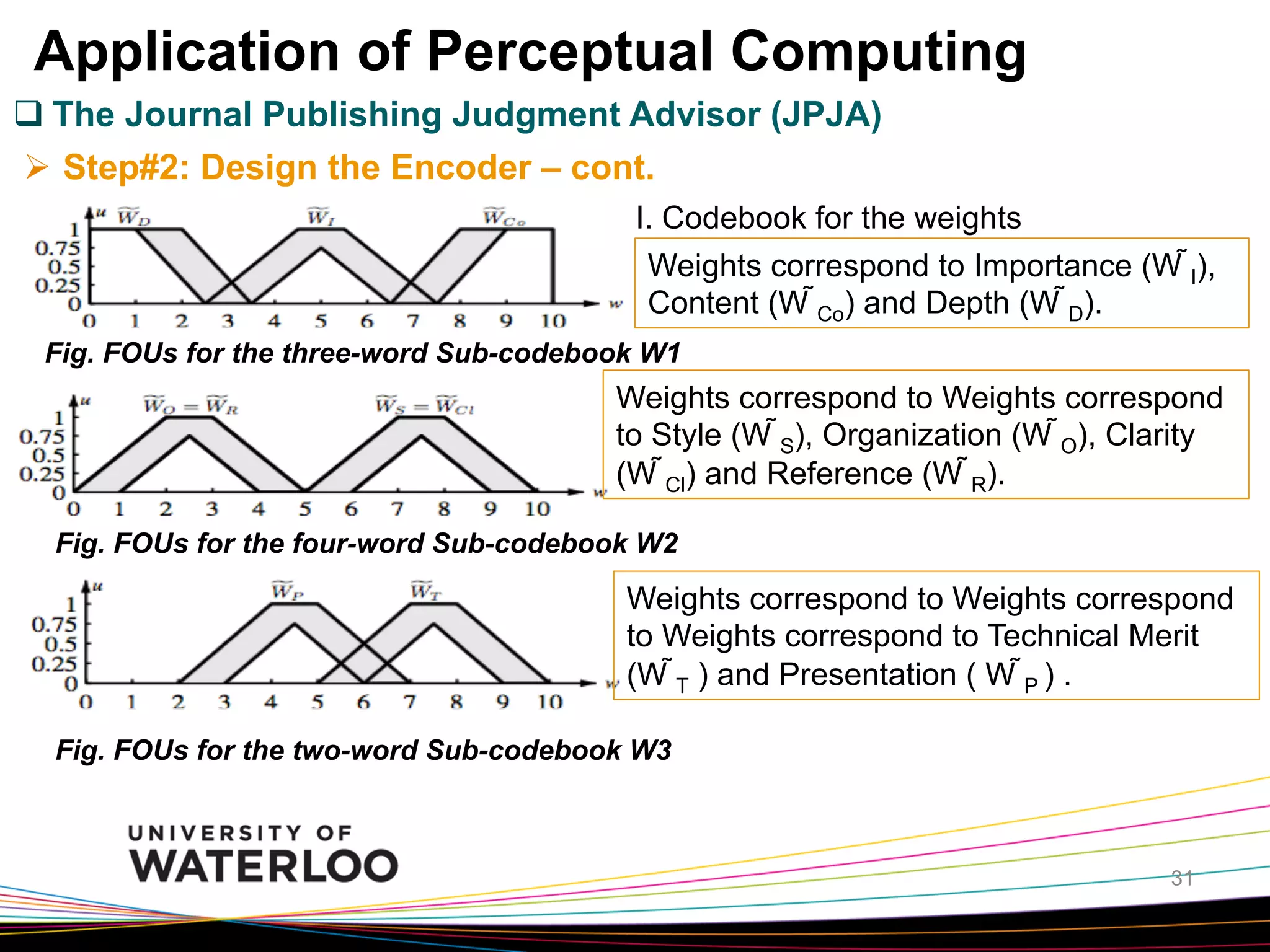
II. Codebook for the weights
Weights correspond to Importance (W Ĩ ),
Content (W Co) and Depth (W D).
̃
̃
Fig. FOUs for the three-word Sub-codebook W1

Weights correspond to Weights correspond
to Style (W ̃S), Organization (W O), Clarity
̃
(W ̃Cl) and Reference (W R).
̃
Fig. FOUs for the four-word Sub-codebook W2

Weights correspond to Weights correspond
to Weights correspond to Technical Merit
(W ̃T ) and Presentation ( W P ) .
̃
Fig. FOUs for the two-word Sub-codebook W3

31
Application of Perceptual Computing
q The Journal Publishing Judgment Advisor (JPJA)
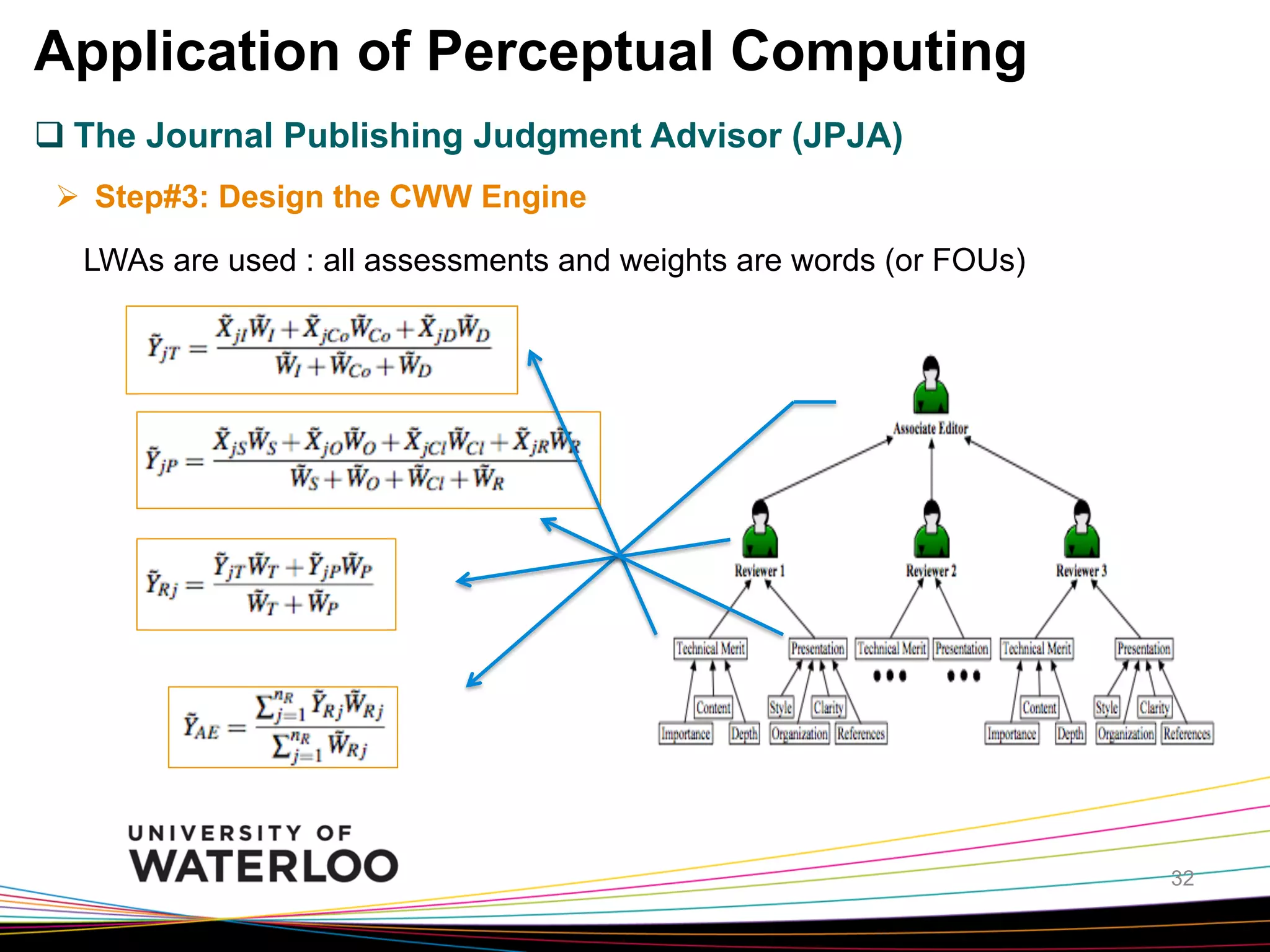
Ø  Step#3: Design the CWW Engine
LWAs are used : all assessments and weights are words (or FOUs)

32
Application of Perceptual Computing
q The Journal Publishing Judgment Advisor (JPJA)
Ø  Step#4: Design the decoder
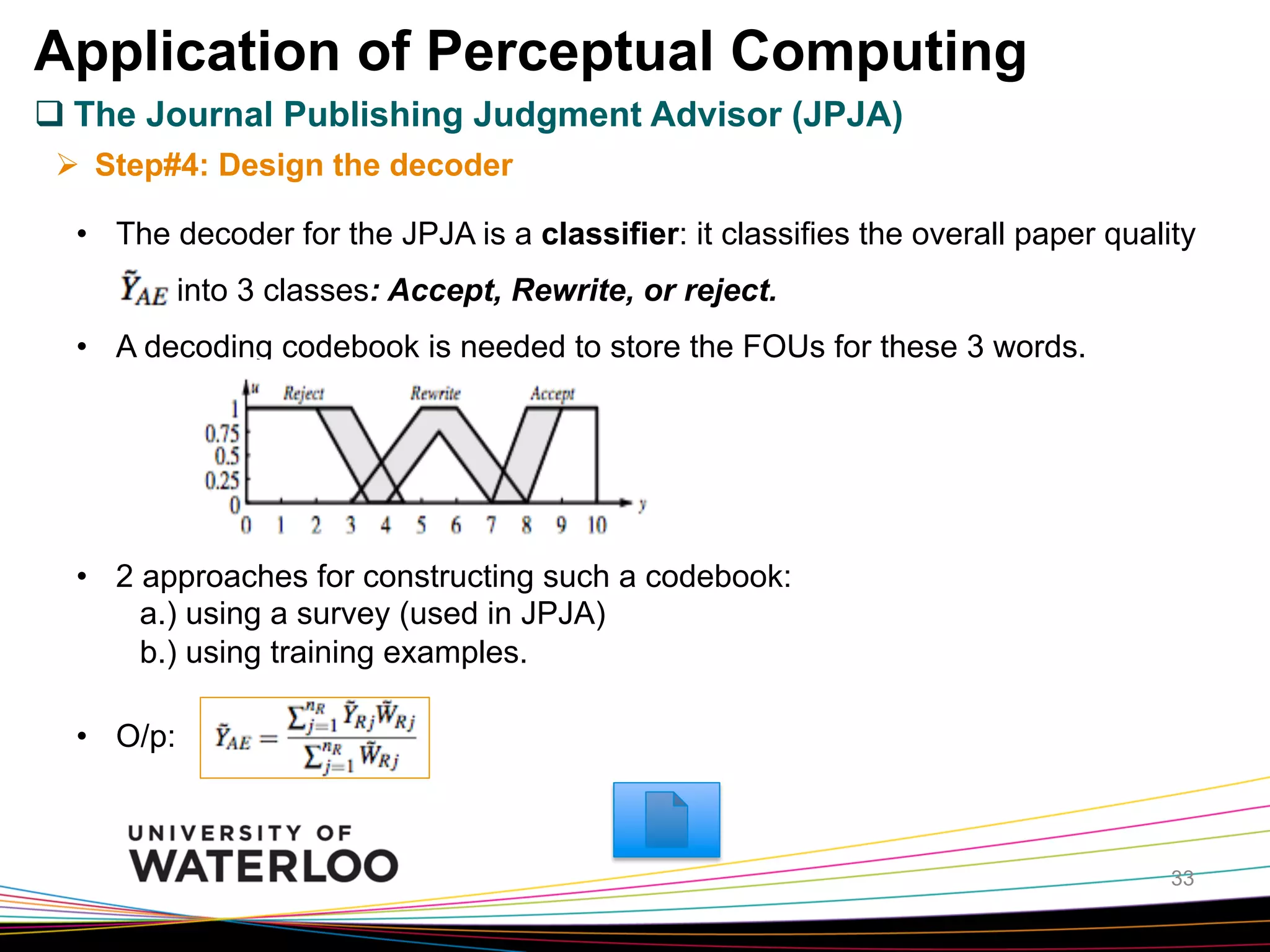
•  The decoder for the JPJA is a classifier: it classifies the overall paper quality
into 3 classes: Accept, Rewrite, or reject.
•  A decoding codebook is needed to store the FOUs for these 3 words.

•  2 approaches for constructing such a codebook:
a.) using a survey (used in JPJA)
b.) using training examples.
•  O/p:

33
Analysis of Per-C
q  Advantages
o  Very good tool for hierarchal decision making.
o  Diverse i/ps can be aggregated across different hierarchies
o  Uncertainties associated with these i/p s are preserved and
propagate into the final evaluation.

q  Limitations
o  Not data adaptive
o  Inputs (Interval end points) needs human interaction.

34
Conclusion
•  Type-2 fuzzy set enables us to model the effect of uncertainty in (FLS)
better than Type-1 fuzzy set as it combines uncertainty about the
membership function into fuzzy set theory.
•  Type-2 fuzzy set is used when there is uncertainty about the
membership grades or difficult to determine the membership
functions of fuzzy logic system.
•  Per-C is a very useful tool for hierarchal and distributed decision making
and has great potential in solving complex decision-making problems.
35
Questions ?
References
• 

[1] Oscar Castillo and Patricia Melin. Type-2 Fuzzy Logic: Theory and Applications. 223, 2008
Springer-Verlag Berlin Heidelberg. July 2007.

• 

[2] Jerry M. Mendel and Robert I. Bob John. Type-2 Fuzzy Sets Made Simple. IEEE
TRANSACTIONS ON FUZZY SYSTEMS, VOL. 10, NO. 2, APRIL 2002.

• 

[3] Jerry M Mendel. Type-2 fuzzy sets and system: an overview. IEEE computational intelligent
magazine, vol 2, no. 1, pp. 20-29. February 2007.

• 

[4] L.A. Zadeh, Fuzzy logic = computing with words, IEEE Trans. on Fuzzy Systems 4 (1996)
103-111.

• 

[5] J.M. Mendel, An architecture for making judgments using computing with words, Int. J. Appl.
Math. Comput. Sci. 12 (3) (2002) 325–335.

• 

[6] J.M.Mendel, Perceptual Computing, Willey, 2010.

37

T2 fs talk

  • 1.
    Fuzzy Set Type-2 Theory,Applications and Examples Mahmoud Alish Noha El-Prince Nouf Al Alawi
  • 2.
    Agenda •  Introduction to type-2fuzzy set. o  Interval Type-2 & General Type-2 o  Type-2 Terminologies •  Type-2 fuzzy set Theory & Systems o  Theory & operation o  Inference System o  Example (Image Edge Detection) •  Application (Computing With Words) o  o  o  o  o  Computing with Words (CWW) Perceptual Computing (Per-C) Example of Per-C: Journal Publishing Judgment Advisor (JPJA) Analysis of Per-C Conclusion
  • 3.
    Introduction •  Introduced byZadeh as theoretical concept in 1975 to handles the uncertainty that Type-1 cannot handle. •  Three sources of uncertainties –  The meanings of the words used in the antecedents & consequents •  words mean different things to different people –  The noise associated with Measurements of activating in the fuzzy system. –  The noise associated with data that are used to tune the parameters in the fuzzy system.
  • 4.
    Introduction •  Able tomodel and minimize the effects of uncertainties in the fuzzy logic systems. •  The grades of membership are fuzzy not crisp like Type-1 –  Called a “fuzzy-fuzzy set.” •  Fuzzy set of type-2 denoted by ( ) •  If all uncertainty disappears è Type-2 reduces to a Type-1
  • 5.
    Interval & General Type-2Fuzzy Set •  The membership function is three-dimensional (model uncertainty). –  –  –  –  More difficult to use and understand. Third dimension difficult to draw. Not easy to collect simple well-defined terms for the third dimension The use of type-2 is computationally more complicated. •  There are two types of fuzzy set type-2 –  General Type-2 Fuzzy Set –  Interval Type-2 Fuzzy set
  • 6.
    Interval & General Type-2Fuzzy Set General Type-2 •  Primary Membership (2D Domain) •  Secondary Membership (3D Domain) IntervalType-2 •  The third dimension value is constant everywhere è ignored
  • 7.
    The Terminologies •  FOU:Footprint of uncertainty. •  UMF & LMF: Upper and lower membership functions
  • 8.
    Agenda •  Introduction to type-2fuzzy set. o  Interval Type-2 & General Type-2 o  Type-2 Terminologies •  Type-2 fuzzy set Theory & Systems o  Theory & operation o  Inference System o  Example (Image Edge Detection) •  Application (Computing With Words) o  o  o  o  o  Computing with Words (CWW) Perceptual Computing (Per-C) Example of Per-C: Journal Publishing Judgment Advisor (JPJA) Analysis of Per-C Conclusion
  • 9.
    Type-2 Theory •  Tworepresentations: –  The vertical-slice •  The basis for most computations –  The wavy-slice •  The basis for most theoretical derivations
  • 10.
    Type-2 Theory •  Bothrepresentations called covering theorems –  Union of all vertical slices –  Union of all embedded Type-1 that cover the entire FOU. •  known as the Mendel-John Representation Theorem (RT)
  • 11.
  • 12.
  • 13.
  • 14.
    Type-2 Fuzzy System • Singleton Type-2 Fuzzy Logic Systems –  Based on Mandani –  Uncertainties in the antecedents or consequents •  Non-singleton Fuzzy Logic Systems –  Based on Mandani –  Uncertainties in both the antecedents, consequents and input measurement –  More complicated. •  Sugeno Type-2 Fuzzy Systems –  Based on Takagi and Sugeno
  • 15.
    The Use ofInterval Type-2 Fuzzy Logic as a Method for Edge Detection using Gaussian as MF •  Detecting the edges allows feature extraction & construction of input vectors for neural networks with aims of image recognition •  Traditional Methods –  The gradient methods like Roberts, Prewitt and Sobel for detect edges. •  Looking for maximum and minimum in first derived –  The Laplacian methods like Marrs-Hildreth •  Finding the zeros of second derived
  • 16.
    The Use ofInterval Type-2 Fuzzy Logic as a Method for Edge Detection using Gaussian as MF Inputs DH: Derivative Horizontal DV: Derivative Vertical HP: high-pass filter M: low-pass filter Inputs equation Rules If (DH is LOW) and (DV is LOW) then (EDGES is LOW) If (DH is MEDIUM) and (DV is MEDIUM) then (EDGES is HIGH) If (DH is HIGH) and (DV is HIGH) then (EDGES is HIGH) If (DH is MEDIUM) and (HP is LOW) then (EDGES is HIGH) If (DV is MEDIUM) and (HP is LOW) then (EDGES is HIGH) If (M is LOW) and (DV is MEDIUM) then (EDGES is LOW) If (M is LOW) and (DH is MEDIUM) then (EDGES is LOW)
  • 17.
    The Use ofInterval Type-2 Fuzzy Logic as a Method for Edge Detection using Gaussian as MF
  • 18.
    The Use ofInterval Type-2 Fuzzy Logic as a Method for Edge Detection using Gaussian as MF •  By using Type-2 fuzzy more than half of the pixels were cleared without depreciating the image –  reduce in drastic form the cost of training in a neural network.
  • 19.
    Agenda •  Introduction to type-2fuzzy set. o  Interval Type-2 & General Type-2 o  Type-2 Terminologies •  Type-2 fuzzy set Theory & Systems o  Theory & operation o  Inference System o  Example (Image Edge Detection) •  Application (Computing With Words) o  o  o  o  o  Computing with Words (CWW) Perceptual Computing (Per-C) Example of Per-C: Journal Publishing Judgment Advisor (JPJA) Analysis of Per-C Conclusion
  • 20.
    Computing with Words(CWW) CWW    is  :   “A  methodology  in  which  words  are  used      in  place  of  numbers  for  compu7ng  and        reasoning..” (Zadeh, 1996- Ref[4]) Distance  =   500   Ann  lives  near   Mary   Example:  consider  the  proposi<ons:    p1  =  Ann  lives  near  Mary    p2  =  Mary  lives  near  Clara.       Query  :  “How  far  is  Ann  from  Clara?,”        Answer:  Ann  lives  not  far  from  Clara.   Fig. Compute with numbers vs. compute with words 20
  • 21.
    Perceptual Computer (Per-C) Words (perceptions) Encoder IT2FS CWW Engine (T2 FLS) Words (word, rank, class) Decoder IT2 FS Fig. Architecture of a Per-C (Mendel Ref[5],2002) •  •  •  Words mean different things to different People = uncertainty in words = FL Uncertainty a person has about the meaning of a word (intra-personal uncertainty)=> T1 FL Uncertainties that a group of people have about the meaning of the word (inter-personal uncertainty) => T2 FL [Ref 6] 21
  • 22.
    Perceptual Computer (Per-C)cont. Encoder: Encoding Words --------------- > IT2 FSs (Code Book = Words + their FOUs) Approach q  Encoding Approaches: Ø  Person FOU Ø  Interval End-points Ø  IA Approach (mostly practically used) 22
  • 23.
    Perceptual Computer (Per-C)cont. q IA Approach: (1)  Collect interval end point data for a word from a group of persons. (2)  After removing outliers, intervals are classified as either : interior, leftshoulder, right-shoulder IT1FS. (3) Each word’s data intervals is mapped into its respective T1 interior, left shoulder or right shoulder MF (4) Interpret the MFs as an embedded T1 FS. Using Representation theorem and take their union. (5) Result is a FOU for an IT2FS model of the word. (6) The words + their FOUs constitute a codebook. 23
  • 24.
    Perceptual Computer (Per-C)cont. v  Code Book Sample: v  FOUs of 4 words 24
  • 25.
    Perceptual Computer (Per-C)cont. q  CWW Engine Words (perceptions) Encoder IT2 FS CWW Engine (T2 FLS) Words (word, rank, class) Decoder IT2 FS (a)  Linguistic Weighted Average (LWA) There are different kinds of CWW engines: = data features = The weights 25
  • 26.
    Perceptual Computer (Per-C)cont. q  CWW Engine (b) Perceptual Reasoning (PR) Given : A rule base with K rules, each of the form: Where new input and are words modeled by IT2 FSs (j = 1,...,p) are also words modeled by IT2 FSs = Output: where Firing level of Rk Jaccard similarity for IT2 FSs and are upper and lower MFs of 26
  • 27.
    Perceptual Computer (Per-C)cont. q Decoder •  Three Types of decoders according to three types of recommendations: Words (perceptions) IT2 FS CWW Engine (T2 FLS) Words (word, rank, class) Recomm. Type Encoder Decoder IT2 FS Decoder Type Word Similarity is calculated between the CWW o/p and all the words in the codebook. The o/p is the word with max. similarity. Rank A centroid-based ranking method for IT2 FSs can be used to select the best alternative. Class A decision category is the o/p made by a classifier e.g. Average subsethood 27
  • 28.
    Application of PerceptualComputing q The Journal Publishing Judgment Advisor (JPJA) 28
  • 29.
    Application of PerceptualComputing q The Journal Publishing Judgment Advisor (JPJA) Ø  Step#1: Modify Paper review form 29
  • 30.
    Application of PerceptualComputing q The Journal Publishing Judgment Advisor (JPJA) Ø  Step#2: Design the Encoder I. Codebook for the reviewer Two code books are needed : ( words (used by the reviewer), weights ) Fig. FOUs for the five-word Sub-codebook R1 Fig. FOUs for the three-word Sub-codebook R2 30
  • 31.
    Application of PerceptualComputing q The Journal Publishing Judgment Advisor (JPJA) Ø  Step#2: Design the Encoder – cont. II. Codebook for the weights Weights correspond to Importance (W Ĩ ), Content (W Co) and Depth (W D). ̃ ̃ Fig. FOUs for the three-word Sub-codebook W1 Weights correspond to Weights correspond to Style (W ̃S), Organization (W O), Clarity ̃ (W ̃Cl) and Reference (W R). ̃ Fig. FOUs for the four-word Sub-codebook W2 Weights correspond to Weights correspond to Weights correspond to Technical Merit (W ̃T ) and Presentation ( W P ) . ̃ Fig. FOUs for the two-word Sub-codebook W3 31
  • 32.
    Application of PerceptualComputing q The Journal Publishing Judgment Advisor (JPJA) Ø  Step#3: Design the CWW Engine LWAs are used : all assessments and weights are words (or FOUs) 32
  • 33.
    Application of PerceptualComputing q The Journal Publishing Judgment Advisor (JPJA) Ø  Step#4: Design the decoder •  The decoder for the JPJA is a classifier: it classifies the overall paper quality into 3 classes: Accept, Rewrite, or reject. •  A decoding codebook is needed to store the FOUs for these 3 words. •  2 approaches for constructing such a codebook: a.) using a survey (used in JPJA) b.) using training examples. •  O/p: 33
  • 34.
    Analysis of Per-C q Advantages o  Very good tool for hierarchal decision making. o  Diverse i/ps can be aggregated across different hierarchies o  Uncertainties associated with these i/p s are preserved and propagate into the final evaluation. q  Limitations o  Not data adaptive o  Inputs (Interval end points) needs human interaction. 34
  • 35.
    Conclusion •  Type-2 fuzzyset enables us to model the effect of uncertainty in (FLS) better than Type-1 fuzzy set as it combines uncertainty about the membership function into fuzzy set theory. •  Type-2 fuzzy set is used when there is uncertainty about the membership grades or difficult to determine the membership functions of fuzzy logic system. •  Per-C is a very useful tool for hierarchal and distributed decision making and has great potential in solving complex decision-making problems. 35
  • 36.
  • 37.
    References •  [1] Oscar Castilloand Patricia Melin. Type-2 Fuzzy Logic: Theory and Applications. 223, 2008 Springer-Verlag Berlin Heidelberg. July 2007. •  [2] Jerry M. Mendel and Robert I. Bob John. Type-2 Fuzzy Sets Made Simple. IEEE TRANSACTIONS ON FUZZY SYSTEMS, VOL. 10, NO. 2, APRIL 2002. •  [3] Jerry M Mendel. Type-2 fuzzy sets and system: an overview. IEEE computational intelligent magazine, vol 2, no. 1, pp. 20-29. February 2007. •  [4] L.A. Zadeh, Fuzzy logic = computing with words, IEEE Trans. on Fuzzy Systems 4 (1996) 103-111. •  [5] J.M. Mendel, An architecture for making judgments using computing with words, Int. J. Appl. Math. Comput. Sci. 12 (3) (2002) 325–335. •  [6] J.M.Mendel, Perceptual Computing, Willey, 2010. 37