Mini Lesson: Simple Past Tense Robert Van Vorst Wilkes University ESL 502
Preface This lesson is intended for a teacher-directed small group work station consisting of 2-5 students.  It targets ELLs with beginning to intermediate language proficiency levels.
Materials Chart Paper  Prepared graphic organizers Manipulatives (chips, coins, pieces of paper)
Lesson Objective: Students will improve language proficiency skills by using the simple past tense in statements.
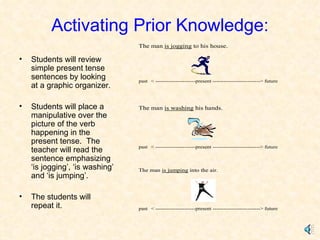
Activating Prior Knowledge: Students will review simple present tense sentences by looking at a graphic organizer. Students will place a manipulative over the picture of the verb happening in the present tense.  The teacher will read the sentence emphasizing ‘is jogging’, ‘is washing’ and ‘is jumping’. The students will repeat it.
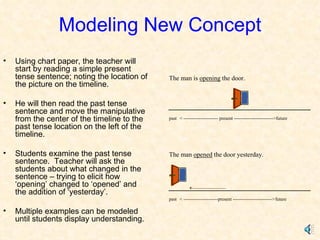
Modeling New Concept Using chart paper, the teacher will start by reading a simple present tense sentence; noting the location of the picture on the timeline.  He will then read the past tense sentence and move the manipulative from the center of the timeline to the past tense location on the left of the timeline. Students examine the past tense sentence.  Teacher will ask the students about what changed in the sentence – trying to elicit how ‘opening’ changed to ‘opened’ and the addition of ‘yesterday’.  Multiple examples can be modeled until students display understanding.
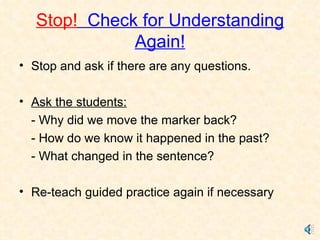
Stop!   Check for Understanding Stop and ask if there are any questions. Ask the students: - Why did we move the marker back on the timeline? - How do we know it happened in the past? - What changed in the sentence?
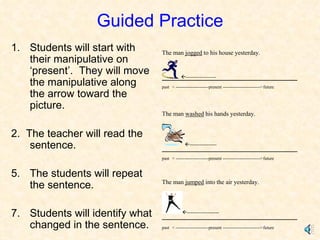
Guided Practice Students will start with their manipulative on ‘present’.  They will move the manipulative along the arrow toward the picture. 2.  The teacher will read the sentence. The students will repeat the sentence. Students will identify what changed in the sentence.
Stop!   Check for Understanding Again! Stop and ask if there are any questions. Ask the students: - Why did we move the marker back? - How do we know it happened in the past? - What changed in the sentence? Re-teach guided practice again if necessary
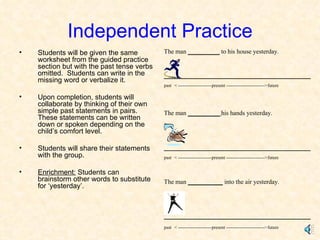
Independent Practice Students will be given the same worksheet from the guided practice section but with the past tense verbs omitted.  Students can write in the missing word or verbalize it. Upon completion, students will collaborate by thinking of their own simple past statements in pairs.  These statements can be written down or spoken depending on the child’s comfort level. Students will share their statements with the group. Enrichment:  Students can brainstorm other words to substitute for ‘yesterday’.
Closure Students will tell the teacher what it means when something happens in the past. They will indicate what spelling changes can occur in a simple past tense sentence.  They will share words indicating past tense like yesterday, last week, etc.
Assessment Ongoing assessment through class discussions, review activities, classroom observations and peer collaboration activities.

Robert Van Vorst - Mini Lesson (ESL 502)

  • 1.
    Mini Lesson: SimplePast Tense Robert Van Vorst Wilkes University ESL 502
  • 2.
    Preface This lessonis intended for a teacher-directed small group work station consisting of 2-5 students. It targets ELLs with beginning to intermediate language proficiency levels.
  • 3.
    Materials Chart Paper Prepared graphic organizers Manipulatives (chips, coins, pieces of paper)
  • 4.
    Lesson Objective: Studentswill improve language proficiency skills by using the simple past tense in statements.
  • 5.
    Activating Prior Knowledge:Students will review simple present tense sentences by looking at a graphic organizer. Students will place a manipulative over the picture of the verb happening in the present tense. The teacher will read the sentence emphasizing ‘is jogging’, ‘is washing’ and ‘is jumping’. The students will repeat it.
  • 6.
    Modeling New ConceptUsing chart paper, the teacher will start by reading a simple present tense sentence; noting the location of the picture on the timeline. He will then read the past tense sentence and move the manipulative from the center of the timeline to the past tense location on the left of the timeline. Students examine the past tense sentence. Teacher will ask the students about what changed in the sentence – trying to elicit how ‘opening’ changed to ‘opened’ and the addition of ‘yesterday’. Multiple examples can be modeled until students display understanding.
  • 7.
    Stop! Check for Understanding Stop and ask if there are any questions. Ask the students: - Why did we move the marker back on the timeline? - How do we know it happened in the past? - What changed in the sentence?
  • 8.
    Guided Practice Studentswill start with their manipulative on ‘present’. They will move the manipulative along the arrow toward the picture. 2. The teacher will read the sentence. The students will repeat the sentence. Students will identify what changed in the sentence.
  • 9.
    Stop! Check for Understanding Again! Stop and ask if there are any questions. Ask the students: - Why did we move the marker back? - How do we know it happened in the past? - What changed in the sentence? Re-teach guided practice again if necessary
  • 10.
    Independent Practice Studentswill be given the same worksheet from the guided practice section but with the past tense verbs omitted. Students can write in the missing word or verbalize it. Upon completion, students will collaborate by thinking of their own simple past statements in pairs. These statements can be written down or spoken depending on the child’s comfort level. Students will share their statements with the group. Enrichment: Students can brainstorm other words to substitute for ‘yesterday’.
  • 11.
    Closure Students willtell the teacher what it means when something happens in the past. They will indicate what spelling changes can occur in a simple past tense sentence. They will share words indicating past tense like yesterday, last week, etc.
  • 12.
    Assessment Ongoing assessmentthrough class discussions, review activities, classroom observations and peer collaboration activities.