Past Simple vs.Present
Perfect: Mastering the
Difference
A clear guide to using these tenses correctly. Presentation focuses on
interactive practice. Applies tenses to real-world applications. Target
audience: ESL/EFL learners.
by Mr. Mohamed Awad
2.
Understanding the Basics:Past Simple
Definition
Used for completed actions at a specific time in the past.
Time Frame
Finished time period. For example, last week or in 2010.
Keywords
Ago, yesterday, last [week/month/year], in [year], when.
Example
I visited Paris last summer. The trip is done.
Activity: Show images of past events. Ask prompts using past simple. (e.g. Neil Armstrong on the moon. "What did he do in 1969?")
3.
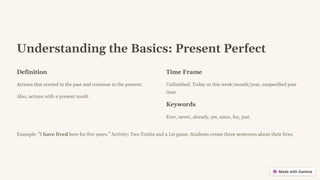
Understanding the Basics:Present Perfect
Definition
Actions that started in the past and continue to the present.
Also, actions with a present result.
Time Frame
Unfinished. Today or this week/month/year, unspecified past
time.
Keywords
Ever, never, already, yet, since, for, just.
Example: "I have lived here for five years." Activity: Two Truths and a Lie game. Students create three sentences about their lives.
4.
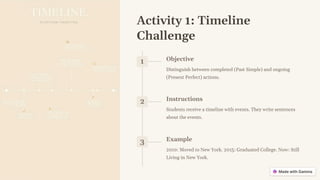
Activity 1: Timeline
Challenge
1Objective
Distinguish between completed (Past Simple) and ongoing
(Present Perfect) actions.
2 Instructions
Students receive a timeline with events. They write sentences
about the events.
3 Example
2010: Moved to New York. 2015: Graduated College. Now: Still
Living in New York.
5.
Activity 2: NewsReport Analysis
Objective
Identify the correct tense in a real-world context.
Instructions
Provide a short news article. Students highlight verbs. Students
identify whether they are in the Past Simple or Present Perfect.
Example: "The President announced a new policy yesterday." Discuss implications of using one tense over the other.
6.
Activity 3: FindSomeone
Who...
Find someone who has
traveled to Asia.
Find someone who has
never eaten sushi.
Find someone who has
met a celebrity.
Objective: Practice using Present Perfect in questions. Students mingle and
ask questions.
7.
Activity 4: PicturePrompt
Storytelling
1
Objective
Combine both tenses in a narrative.
2
Instructions
Show a series of related images that tell a story.
3
Example
A person buying a plane ticket. A person in front of the Eiffel
Tower. A person back home.
Last week, Sarah bought a plane ticket to Paris. She had always wanted to
see the Eiffel Tower.
8.
Conclusion: Putting itAll
Together
1 Recap
Key differences between Past
Simple and Present Perfect.
2 Emphasis
Understanding context for
correct tense usage.
3 Encourage
Continued practice through real-life conversations.
Final Q&A session. Emphasis on real-world speaking and writing.

![Understanding the Basics: Past Simple
Definition
Used for completed actions at a specific time in the past.
Time Frame
Finished time period. For example, last week or in 2010.
Keywords
Ago, yesterday, last [week/month/year], in [year], when.
Example
I visited Paris last summer. The trip is done.
Activity: Show images of past events. Ask prompts using past simple. (e.g. Neil Armstrong on the moon. "What did he do in 1969?")](https://image.slidesharecdn.com/past-simple-vs-present-perfect-mastering-the-difference-250318222848-fc32d062/85/Past-Simple-vs-Present-Perfect-Mastering-the-Difference-pdf-2-320.jpg)